 Chea Eliyan1,2*
 Jennifer R. McConville1
 Christian Zurbrügg3
 Thammarat Koottatep4
 Kok Sothea2
 Björn Vinnerås1
- 1Department of Energy and Technology, Swedish University of Agricultural Sciences, Uppsala, Sweden
- 2Department of Environmental Science, Royal University of Phnom Penh, Phnom Penh, Cambodia
- 3Department of Sanitation, Water and Solid Waste for Development (Sandec), Eawag: Swiss Federal Institute of Aquatic Science and Technology, Dübendorf, Switzerland
- 4School of Environment, Resources and Development, Environmental Engineering and Management, Asian Institute of Technology, Pathum Thani, Thailand
A Corrigendum on
Generation and management of faecal sludge quantities and potential for resource recovery in Phnom Penh, Cambodia
by Eliyan C, McConville JR, Zurbrügg C, Koottatep T, Sothea K and Vinnerås B (2022). Front. Environ. Sci. 10:869009. doi: 10.3389/fenvs.2022.869009
In the published article, there was an error in Table 4 as published. The amount of total nitrogen (Ntotal) in faecal sludge in the original article based on the median concentration of total nitrogen was 188 mg/L (range 51.2–657 mg/L) (Eliyan et al., 2022). According to the corrigendum of Eliyan et al. (2022) the concentration of total nitrogen in Phnom Penh ranged between 1,500–3,300 mg/L and median concentration was 2,000 mg/L. The corrected Table 4 and its caption appear below.
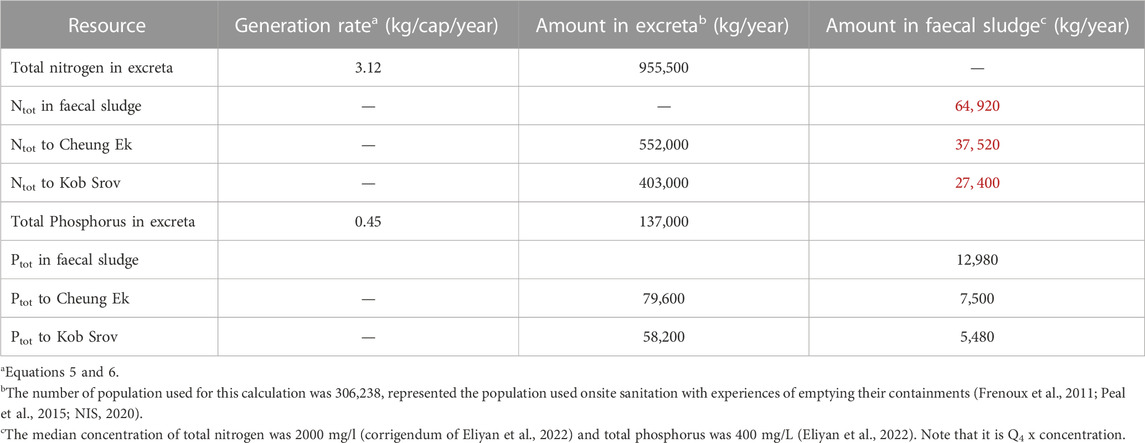
TABLE 4. Estimated amounts of resources (total nitrogen (Ntot) and total phosphorus (Ptot)) contained in excreta (urine + faeces) and in faecal sludge generated annually in Phnom Penh and discharged to Cheung Ek wetland and Kob Srov wetland.
The authors would like to apologies for this error and state that this does not change the scientific conclusions of the article in anyway. The original article has been updated.
Publisher’s note
All claims expressed in this article are solely those of the authors and do not necessarily represent those of their affiliated organizations, or those of the publisher, the editors and the reviewers. Any product that may be evaluated in this article, or claim that may be made by its manufacturer, is not guaranteed or endorsed by the publisher.
Keywords: faecal sludge management (FSM), geographic information system (GIS), nutrient recovery, onsite sanitation, sanitation service chain, spatial analysis
Citation: Eliyan C, McConville JR, Zurbrügg C, Koottatep T, Sothea K and Vinnerås B (2023) Corrigendum: Generation and management of faecal sludge quantities and potential for resource recovery in Phnom Penh, Cambodia. Front. Environ. Sci. 11:1264993. doi: 10.3389/fenvs.2023.1264993
Received: 21 July 2023; Accepted: 02 August 2023;
Published: 11 August 2023.
Edited and reviewed by:
Devendra P. Saroj, University of Surrey, United KingdomCopyright © 2023 Eliyan, McConville, Zurbrügg, Koottatep, Sothea and Vinnerås. This is an open-access article distributed under the terms of the Creative Commons Attribution License (CC BY). The use, distribution or reproduction in other forums is permitted, provided the original author(s) and the copyright owner(s) are credited and that the original publication in this journal is cited, in accordance with accepted academic practice. No use, distribution or reproduction is permitted which does not comply with these terms.
*Correspondence: Chea Eliyan, Y2hlYS5lbGl5YW5Ac2x1LnNl, Y2hlYS5lbGl5YW5AcnVwcC5lZHUua2g=