 Julia Lorke
 Heidi L. Ballard
 Lucy D. Robinson3
- 1Biology Education, Department of Biology, RWTH Aachen University, Aachen, Germany
- 2Center for Community and Citizen Science, School of Education, University of California, Davis, Davis, CA, United States
- 3Angela Marmont Centre for UK Biodiversity, Natural History Museum, London, United Kingdom
Deficit, dialogue, or participation—which of these three main models of science communications is the best fit to describe activities and experiences of citizen science? One might assume that participation is the best match, but the reality of citizen science events is more complex. The rosette model of science communication offers a more detailed set of subcategories, e.g., educate, entertain, or do, in addition to the three main models—deficit, dialogue and participation. To systematically describe citizen science activities and experiences, we apply data on what activities are offered and what young people (5–19 years old) experience when participating in a citizen science event format called BioBlitzes across the rosette model. The mapping results illustrate how the rosette model can help to make citizen science project designers and practitioners more aware of the various modes of science communications that they may encounter at BioBlitz events and inform their design decisions regarding how settings can shape participants’ experiences.
1 Introduction
In recent years, opportunities for participation in citizen science (CS) have rapidly increased. However, the definition of CS and the term itself are still a topic of debate (e.g., Cooper et al., 2021) and ongoing negotiation within the community (Haklay et al., 2021; Haklay, 2023). The most common denominator may be that its “common, shared goal is to collect and analyze information that is scientifically valuable” and that this “distinguishes citizen science from areas such as experiential learning or environmental education” (Hecker et al., 2018, p. 2). Different typologies of CS projects co-exist (e.g., Shirk et al., 2012; Haklay, 2013), commonly they use the extent of citizen scientists’ participation in the scientific process as a key indicator, for example, to determine whether a project is “contributory” or “co-created” CS. Considering the historical development of science communication models, three main models can be identified: 1) the one-way communication of the deficit model, 2) the two-way communication of the dialogue model or 3) the participation model with multiple interactions and sources of information and knowledge. Based on these three communication models deficit, dialogue, and participation, one might assume that all experiences of citizen scientists within CS projects can simply be categorized as one type of science communication, as participation. But does participation best and sufficiently reflect the intended opportunities of CS projects and the actual experience of CS participants? Zooming in on a particular science communication model, do all interactions fall in the “Participation—Do” category of the rosette model of science communication (Metcalfe, 2019; Figure 1) or is the reality more complex? In this perspective article, we explore the benefits and the limitations of using the rosette model of science communication to map activities and participation of CS. We use a specific type of CS events, so-called BioBlitzes, as examples and use data that was collected to explore youth participation and learning through CS participation in the LEARN CitSci project to assess the approach.
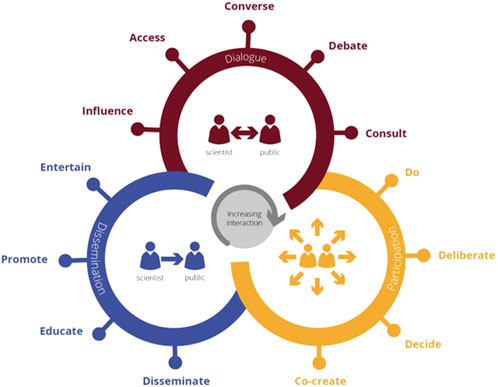
FIGURE 1. The rosette model of science communication (Metcalfe 2019), adapted according to an interview with Jenni Metcalfe on the Telling Science Stories Podcast (Fleerackers, 2023), adapted design by Lutz Kupferschläger).
2 The role of science communication and the development of the rosette model
The history of science communication can be told through the development of the three main communication models: deficit, dialogue, and participation. Starting in the 1980s with concepts such as the Public Understanding of Science (Royal Society, 1985) focusing on the deficit model, a one-way communication from science experts to the public. Then it shifted to the concept of public engagement with science in the early 2000s, stressing the need for two-way communication and a dialogue model for science communication (e.g., House of Lords, 2000). More recently, participating in science and participatory science communication have gained popularity (e.g., Hetland, 2021; Bucchi and Trench, B. 2021; Metcalfe et al., 2022). Science communication models describe “how science has been, is being or should be communicated” (Metcalfe, 2019, p. 9), however, as in many other disciplines there has been a research-practice gap. In this case, the developed models have been discussed by science communication scholars but only a few studies investigated their relevance and occurrence in science communication practice (e.g., Brossard and Lewenstein, 2010; Jensen and Holliman, 2016). Building on the models in science communication theory and considering the results of her empirical studies conducted with science communication practitioners, Metcalfe developed three science communication models (2019): the spectrum model, the rosette model, and the nexus model of science communication. The spectrum model presents deficit, dialogue, and participation as a linear progression, conveying a hierarchical structure and is less detailed than the rosette model. In comparison, the nexus model is more complex and moves beyond deficit, dialogue, and participation. It separates six different science communication actions (access, respond, persuade, consult, converse, participate), audiences (latent, activist, civil society, concerned groups, institutional, interested publics) and respective desired outcomes. To focus on activities and participants’ experiences in citizen science, the rosette model seems to be the best option, as it recognizes that “while the stated objectives of a science communication activities may align with one of the three science communication models, features of all three science communication models co-exist and complement each other in many science engagement activities” (Metcalfe, 2019, p. 180).
The science education and science communication as well as the citizen science community are still debating commonalities and borders between science communication and science education (Baram-Tsabari and Osborne, 2015; Roche et al., 2020). The rosette model offers a way forward through this discussion, potentially because its visualization works as a useful tool to illustrate the three main science communication models and subcategories to characterize different science communication formats at one glance. Since it includes “Educate” as a subcategory, education can already be considered included in the model, but the model can also be used to reflect on other formats that science educators or education researchers already use in their repertoire that go beyond the classic format of educating, e.g., entertaining or disseminating. Additionally, it enables conversations about other modes of science communication that they might try to apply in their work. Similarly, the citizen science community may feel represented through the “Participation—Do” subcategory.
3 BioBlitzes
BioBlitzes are popular CS events focused on Biodiversity monitoring. They are described as “a collaborative race against the clock to discover as many species of plants, animals and fungi as possible, within a set location, over a defined time—usually 24 h” (Robinson et al., 2013), but this definition has evolved to also include much shorter periods. BioBlitzes typically fall into the category of contributory CS (Shirk et al., 2012), as their scientific aim is to generate biological records (Isaac and Pocock, 2015) with the help of experts and non-experts that can be used for scientific or monitoring purposes.
4 Data collection
In 2018, our first year of the LEARN CitSci project, we observed 14 BioBlitzes led by the Natural History Museum in London, the California Academy of Sciences (San Francisco) and the Natural History Museum of Los Angeles County that lasted between 2 and 9 h. Following the BioBlitz typology of Meeus et al. (2023), seven of the observed BioBlitzes can be categorized as place-based, guided BioBlitzes. The seven others were place-based, guided general (monitoring any kind of biodiversity) or guided targeted (focused on a specific taxon, e.g., bats or insects) BioBlitz activities that were run within a Nature Festival setting. For this article we will call the first type “Place-based, guided BioBlitzes” and the second type “Nature Festival BioBlitzes.”
We used Cultural-historical activity theory (Engeström, 2000) to guide our observations for capturing setting characteristics and youth participation. The activities of the event, resources, rules, tools, and people involved were documented in a detailed written broad setting description. In addition, we used field observations (Emerson et al., 1995) to capture data about the participation of 91 youth. Analyzing the field notes, we identified key action/interaction episodes youth experienced during BioBlitzes. For each key action/interaction episode, we wrote a memo containing a claim about youth participation, a description of the type of participation observed and excerpts from field notes as evidence to support the claim (for more details on the LEARN CitSci data collection, analysis and results see Lorke et al., 2021; Ghadiri Khanaposhtani et al., 2022).
5 Mapping the activities
Based on the broad setting descriptions we can map the activities planned and run at the CS event and illustrate the range of different science communication formats and modes of communication offered at a BioBlitz. Since we are not interested in comparing single events, we pool the data for the two BioBlitz types that we observed in our study: “Place-based, guided BioBlitzes” and “Nature Festival BioBlitzes.”
The “Place-based, guided BioBlitzes” were run according to a “sandwich model”, wherein they started with an introduction for the whole group (See Figure 2A, octagon labelled 1), then usually smaller groups went out into nature to explore and collect data using the iNaturalist app to create records of their findings (Figure 2A, 2) and the event ended with some form of sharing results and reflecting on findings (Figure 2A, 3), (though many of the events also allowed people to join later or leave earlier). The introduction explained the goal of the day, the purpose of the BioBlitz, the use of iNaturalist and any information regarding basic needs as well as safety rules for outdoor activities. Some events entailed a short practice session, to ensure who wishes to knows how to record observations on iNaturalist. Many events required participants to sign up ahead of the day but often remained flexible to include people who opted to join on the day.
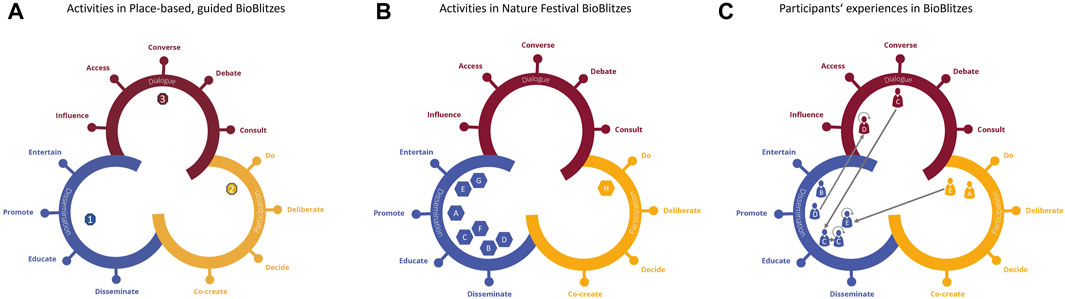
FIGURE 2. (A) Activities of “Place-based, guided BioBlitzes” mapped to the rosette model of science communication, (B) Activities of “Nature Festival BioBlitzes” mapped to the rosette model (C) Examples of youth participants’ experiences mapped to the rosette model [adapted from Metcalfe (2019), design by Lutz Kupferschläger].
The “Nature Festival BioBlitz” events offered a wide range of activities: live animal presentations, stalls showcasing the work of partnering nature-related or community-based organizations (see Figure 2B, octagon labelled A), presenting museum handling collections (pelts, fossils, insect, spider, lizard, snake, bat and snail specimens) (Figure 2B, B), offering microscope activities (Figure 2B, C), showing slideshows (about iNaturalist, the historic development of the local area) (Figure 2B, D), nature crafts activities (Figure 2B, E), iNaturalist tutorials (Figure 2B, F), a nature-themed puppet theater show (Figure 2B, G), and activities focusing on exploring and recording biodiversity such as pond dipping and nature walks (Figure 2B, H) (some themed as a bat walk, Slime, bug hunt, etc.). Some activities were scheduled, and others were available throughout the entire day. Only activities outside of the usual opening hours, namely, the bat walk, required registering; the other activities were provided as drop-in events.
6 Mapping experiences
To demonstrate the utility of the rosette model for analyzing citizen science activities, we mapped the observed youth experiences from our field notes and memos onto the rosette model of science communication. This allows us to illustrate the variety of science communication interactions that youth experience during a BioBlitz. For this demonstration purpose, we have chosen five examples (using pseudonyms) from our sample that enable us to show a broad range of different experiences (see Figure 2C):
A—Nia is on an iPhone alone, taking a picture of a tree and uploading it. She scrolls through the options for identifications and chooses one […] Nia takes a picture of the moss and uploads it to iNaturalist. (Female, elementary school-age, SF BioBlitz)
The young person is participating in the citizen science activity: Participation—Do
B—Instructor: “Let’s call them out,” Together (Instructor, Tim, and the whole group) chant, “Squirrel, Squirrel, Squirrel” Gigi moves from a tiny chair onto the floor to crawl towards the puppets. The instructor explains how squirrels communicate with their tails and stomp their feet. Tim’s eyes are locked on the puppets as he continues his migration from the back of the room to now squeezing through kids to get to the front row. (Male, elementary school-age or younger, L.A. BioBlitz)
The young person is attending the nature-themed puppet theater show: Dissemination—Entertain
C—Dean looks at the insect specimens in resin blocks that are on display (the task is to sort the specimens into groups). Educator: “Are you up for a challenge today? What do you think this is?” Dean points at specimens and identifies them as: “Arachnids,” then goes on to “Scorpion” “Spider” The educator nods in agreement: “Try the beetles—Try to work out how scientists know that a beetle is a beetle!” Educator What is it? FY: Ladybird AL: Can ladybirds fly? FY: Yes. (C1) AL: “Where are the wings? The wings are underneath. To be a beetle you need to have a line on the back. Science isn’t always easy. We have 350 scientists at the Natural History Museum.” Dean looks at them using a magnifying glass to spot the line on the back of the specimens and sorts them into piles according to whether he can see a line on their back or not. (C2) Dean then talks to his sister: “This is definitely an insect, there is a line” points out the line on the insect’s back for her to see. Educator: “Good sharing of information!” (C3) (Male, primary school-age, London BioBlitz)
The young participant can share his knowledge in a conversation with the educator, then the educator teaches him how to identify if a specimen is a beetle or not and the boy then goes on and shares his new knowledge with his little sister: C1 = Dialogue—Converse → C2 = Dissemination—Educate → C3 = Dissemination—Educate (role switch)
D—Scientists asked all participants to care for the intertidal zone by making sure that organisms went back to places where they were found and to limit harm to the organisms (D1). Lilly to her cousin, M3, “Don’t step on the little volcanoes!” Lilly seems panicked. The educator explains to Lilly’s mom that Lilly meant all the barnacles and limpets on the rocks and how their body shapes do look like little volcanos. (D2) (Female, primary school-aged, L.A. BioBlitz)
The professional scientists at the event promote responsible behavior in a natural habitat and the youth participant later insists that her cousin does not harm the barnacles and limpets: D1 = Dissemination—Promote → D2 = Dialogue—Influence (role switch)
E—A young man records his own findings using iNaturalist (E1) and then educates others, “You can ID or you can just take the picture if you’re not sure and someone can help you. […] You can still upload even if you don’t know.” (E2) (Male, high school-aged, L.A. BioBlitz)
The young person participated in citizen science and then taught another participant how to record observations on iNaturalist: E1 = Participation—Do → E2 = Dissemination—Educate (role switch)
Three of these examples (namely, C, D and E) show that the original description of communication in the rosette model as scientist to members of the public, does not match the interaction in citizen science completely. The model was not intended to cover this aspect but can be adapted easily to highlight when such role changes occur. We chose to add a switch symbol to indicate the changed role.
7 Discussion
The mapping shows that the rosette model provides a straightforward way to show which modes of science communication are covered by the offered activities. Comparing the two types of BioBlitz events, the “Nature Festival BioBlitzes” offers more varied activities, while the “Place-based, guided BioBlitzes” takes a more structured and focused approach. This seems reasonable, considering the differences in audience recruitment. Commonly, the participants of the “Place-base, guided BioBlitzes” register for the event or attend intentionally. So, it is highly likely that they already are somewhat familiar with the purpose of the citizen science event. In contrast, the “Nature Festival BioBlitzes” with their wide range of activities appear to be tailored to a broad audience. They can attract participants that not necessarily intend to take part in citizen science, entertaining, disseminating or educating activities by offering a low-risk entry point for participants. This may encourage them to engage in more activities and maybe even contribute to citizen science. In hindsight, this all may sound very logical, almost obvious, however, mapping activities across the rosette model can serve as an easy visualization technique to support citizen science event or project planning. Citizen Science often is a collaboration of multi-professional teams with varying experience in science communication. While other, more complex frameworks for science communication in citizen science exist (e.g., Hecker and Taddicken, 2022), having the activities overview available in one visualization is a huge benefit of the rosette model. This may help to quickly identify gaps in the offered programming, clarify people’s roles, leverage people’s expertise, and define objectives for each activity as well as for the overall event.
There is a current trend to “dissect” citizen science project activities to deepen our understanding of the individual participant experience, their participation, their interactions, the resources, and opportunities they use or do not use within a given citizen science setting (e.g., Phillips et al., 2019; Golumbic et al., 2020; Lorke et al., 2021; Ghadiri Khanaposhtani et al., 2022). This seems crucial to provide insights into what elements of citizen science are responsible for achieving learning outcomes ranging from interest to knowledge and skills to developing self-efficacy, agency, or engaging in identity work. Hence, mapping activities can clarify which activities are offered, but mapping participation, as shown in Figure 2C, can be one method to reveal participants’ pathways and their varied encounters within the setting. Here, we showed this only for a few examples and to illustrate the possibilities of mapping to this model for CS. A more in-depth mapping may enable researchers or evaluators to better understand the participants’ pathways throughout the event or project and maybe reveal how best to purposefully guide participants through complex settings, such as the “Nature Festival BioBlitzes”, towards the citizen science “Participation—Do” activities.
Data availability statement
The original contributions presented in the study are included in the article/supplementary material, further inquiries can be directed to the corresponding author.
Ethics statement
The studies involving humans were approved by The Open University Human Research Ethics Committee (HREC/2726/Herodotou) and UC Davis (IRB 624197-4). The studies were conducted in accordance with the local legislation and institutional requirements. Written informed consent for participation was not required from the participants or the participants’ legal guardians/next of kin in accordance with the national legislation and institutional requirements.
Author contributions
JL: Conceptualization, Writing–original draft, LR: Funding acquisition for LEARN CitSci, Writing–review and editing, HB: Funding acquisition for LEARN CitSci, Writing–review and editing.
Funding
The authors declare financial support was received for the research, authorship, and/or publication of this article. The data used as an example in this article was collected as part of the LEARN CitSci project. LEARN CitSci was supported by Wellcome Trust and ESRC under grant number 206202/Z/17/Z and the National Science Foundation under grant number 1647276.
Acknowledgments
JL especially wants to thank Dr Jenni Metcalfe for the fruitful discussion about the rosette model and the mapping approach. In addition, the authors would like to thank Lutz Kupferschläger for providing us with Figures 1, 2. Regarding the data used for this mapping exercise, we would like to thank all youth and their families, and the NHM staff and partners who helped with the LEARN CitSci study. Special thanks go to Alison Young, Dr. Rebecca Johnson and Lila Higgins who lead the museum community science programs, as well as the protocol design and data collection teams from the University of California, Davis, the Natural History Museum of Los Angeles County, the California Academy of Sciences and the Natural History Museum, London.
Conflict of interest
The authors declare that the research was conducted in the absence of any commercial or financial relationships that could be construed as a potential conflict of interest.
Publisher’s note
All claims expressed in this article are solely those of the authors and do not necessarily represent those of their affiliated organizations, or those of the publisher, the editors and the reviewers. Any product that may be evaluated in this article, or claim that may be made by its manufacturer, is not guaranteed or endorsed by the publisher.
Author disclaimer
Any opinions, findings, and conclusions or recommendations expressed in this material are those of the authors and do not necessarily reflect the views of the funders.
References
Baram-Tsabari, A., and Osborne, J. (2015). Bridging science education and science communication research. J. Res. Sci. Teach. 52 (2), 135–144. doi:10.1002/tea.21202
Brossard, D., and Lewenstein, B. V. (2010). “A critical appraisal of models of public understanding of science: using practice to inform theory,” in Communicating science. New agendas in communication. Editors L. Kahlor, and P. A Stout. 1st ed, 11–39. doi:10.4324/9780203867631
Brown, K., and Dillon, H. (2019). What is a biological record? Field Studies Council Blog. Available at: https://www.fscbiodiversity.uk/blog/what-biological-record (Accessed October 31, 2019).
Bucchi, M., and Trench, B. (2021). Rethinking science communication as the social conversation around science. JCOM 20 (03), Y01. doi:10.22323/2.20030401
Cooper, C. B., Hawn, C. L., Larson, L. R., Parrish, J. K., Bowser, G., Cavalier, D., et al. (2021). Inclusion in citizen science: the conundrum of rebranding. Science 372 (6549), 1386–1388. doi:10.1126/science.abi6487
Emerson, R. M., Fretz, R. I., and Shaw, L. L. (1995). Writing ethnographic fieldnotes. Chicago, IL, U.S.A.: University of Chicago Press. doi:10.7208/chicago/9780226206851.001.0001
Engeström, Y. (2000). Activity theory as a framework for analyzing and redesigning work. Ergonomics 43 (7), 960–974. doi:10.1080/001401300409143
Fleerackers, A. (2023). Telling science Stories episode 1: scicomm models with jennifer Metcalfe. [YouTube] https://www.youtube.com/watch?v=JPvSuhPDyag.
Ghadiri Khanaposhtani, M., Ballard, H. L., Lorke, J., Miller, A. E., Pratt-Taweh, S., Jennewein, J., et al. (2022). Examining youth participation in ongoing community and citizen science programs in 3 different out-of-school settings. Environ. Educ. Res. 28 (12), 1730–1754. doi:10.1080/13504622.2022.2078480
Golumbic, Y., Baram-Tsabari, A., and Fishbain, B. (2020). Engagement styles in an environmental citizen science project. JCOM 19 (06), A03. doi:10.22323/2.19060203
Haklay, M. (2013). “Citizen science and volunteered geographic information: overview and typology of participation,” in Crowdsourcing geographic knowledge: volunteered geographic information (VGI) in theory and practice. Editors D. Sui, S. Elwood, and M. Goodchild (Dordrecht, The Netherlands: Springer), 105–122. doi:10.1007/978-94-007-4587-2_7
Haklay, M. (2023). C*Sci 2023 and the new name of the (US) citizen science association. Po Ve Sham - Muki Haklay’s personal blog, [online, 10 June 2023] https://povesham.wordpress.com/.
Haklay, M., Fraisl, D., Greshake Tzovaras, B., Hecker, S., Gold, M., Hager, G., et al. (2021). Contours of citizen science: a vignette study. R. Soc. open Sci. 8 (8), 202108. doi:10.1098/rsos.202108
Hecker, S., Haklay, M., Bowser, A., Makuch, Z., Vogel, J., and Bonn, A. (2018). “Innovation in open science, society and policy — setting the agenda for citizen science,” in Citizen science. Innovation in open science, society and policy. Editors S. Hecker, M. Haklay, A. Bowser, Z. Makuch, J. Vogel, and A. Bonn (London, U.K.: UCL Press), 1–23. doi:10.14324/111.9781787352339
Hecker, S., and Taddicken, M. (2022). Deconstructing citizen science: a framework on communication and interaction using the concept of roles. JCOM 21 (01), A07. doi:10.22323/2.21010207
Hetland, P. (2021). “Citizen science as participatory science communication,” in Science cultures in a diverse world: knowing, sharing, caring. Editors B. Schiele, X. Liu, and M. W. Bauer (Singapore: Springer). doi:10.1007/978-981-16-5379-7_2
House of Lords (2000). House of Lords - science and technology - third report. London: Science and Technology Committee Publications.
Isaac, N. J. B., and Pocock, M. J. O. (2015). Bias and information in biological records. Biol. J. Linn. Soc. 115 (3), 522–531. doi:10.1111/bij.12532
Jensen, E., and Holliman, R. (2016). Norms and values in UK science engagement practice. Int. J. Sci. Educ. Part B 6 (1), 68–88. doi:10.1080/21548455.2014.995743
Lorke, J., Ballard, H. L., Miller, A. E., Swanson, R. D., Pratt-Taweh, S., Jennewein, J. N., et al. (2021). Step by step towards citizen science—deconstructing youth participation in BioBlitzes. JCOM, J. Sci. Commun. 20 (4), A03. doi:10.22323/2.20040203
Meeus, S., Silva-Rocha, I., Adriaens, T., Brown, P. M., Chartosia, N., Claramunt-Lopez, B., et al. (2023). More than a bit of fun: the multiple outcomes of a bioblitz (vol 73, pg 168, 2023). BIOSCIENCE 73 (5), 389. doi:10.1093/biosci/biac100
Metcalfe, J., Gascoigne, T., Medvecky, F., and Nepote, A. C. (2022). Participatory science communication for transformation. JCOM 21 (02). doi:10.22323/2.21020501
Metcalfe, J. E. (2019). Rethinking science communication models in practice, PhD thesis. Canberra: The Australian National University. doi:10.25911/5d84ab02953ae
Phillips, T., Ballard, H. L., Lewenstein, B. V., and Bonney, R. (2019). Engagement in science through citizen Science: moving beyond data collection. Sci. Educ. Wiley-Blackwell, Bd. 103, 665–690. doi:10.1002/sce.21501
Robinson, L. D., Tweddle, J. C., Postles, M. C., West, S. E., and Sewell, J. (2013). Guide to running a BioBlitz. Natural history museum, bristol natural history consortium, Stockholm environment Institute york and marine biological association. Available at: http://www.bnhc.org.uk/communicate/guide-to-running-a-bioblitz-2-0/.
Roche, J., Bell, L., Galvão, C., Golumbic, Y. N., Kloetzer, L., Knoben, N., et al. (2020). Citizen science, education, and learning: challenges and opportunities. Front. Sociol. 5, 613814. doi:10.3389/fsoc.2020.613814
Royal Society (1985). The public understanding of science: report of a royal society ad hoc group endorsed by the council of the royal society.
Keywords: science communication, citizen science, communication model, science education, community science
Citation: Lorke J, Ballard HL and Robinson LD (2024) More complex than expected—mapping activities and youths’ experiences at BioBlitz events to the rosette model of science communication. Front. Environ. Sci. 11:1270579. doi: 10.3389/fenvs.2023.1270579
Received: 01 August 2023; Accepted: 14 December 2023;
Published: 24 January 2024.
Edited by:
Alice Motion, The University of Sydney, AustraliaReviewed by:
Ana Anđelković, Institute for Plant Protection and Environment (IZBIS), SerbiaNicole Kelp, Colorado State University, United States
Copyright © 2024 Lorke, Ballard and Robinson. This is an open-access article distributed under the terms of the Creative Commons Attribution License (CC BY). The use, distribution or reproduction in other forums is permitted, provided the original author(s) and the copyright owner(s) are credited and that the original publication in this journal is cited, in accordance with accepted academic practice. No use, distribution or reproduction is permitted which does not comply with these terms.
*Correspondence: Julia Lorke, anVsaWEubG9ya2VAcnd0aC1hYWNoZW4uZGU=