 Guo Zimeng1
 Yang Wei
 Chen Qiuxia
 Huang Xiaoting
- 1School of Management, Shandong University, Jinan, China
- 2Yellow River National Strategic Research Institute, Shandong University, Jinan, China
Research background: Informatization is a new economic form arising from a new round of technological and industrial changes. Information technology has been used to promote the integrated development of the tourism industry and propel technological innovation, which will help accelerate the achievement of the strategic goals of carbon emission peaking and carbon neutrality. China’s informatization level has improved to a certain extent due to the concentration of capital and technological innovation brought about by the government-led model, and also owing to the consumer dynamics released by the industry-side reform.
Research contents and methods: This study constructs a panel vector auto-regression model to investigate the impact of tourism industry development and technological innovation on informatization based on Chinese provincial statistics from 2010 to 2019. This study adopts the entropy method, Monte Carlo simulation, variance decomposition, and pulse response to investigate the impact, characteristics, and trends of their interactions.
Results: First, tourism industry development, technological innovation, and informatization all experience inertia development and have self-reinforcing mechanisms during the research period. Second, tourism industry development and technological innovation have a significantly positive impact on the enhancement of informatization, and their influence presents a trend, from upward to downward. Third, tourism industry development has a positive impact on technological innovation, and the response trend presents a curve approximately inverted U-shape. Fourth, from the results of variance decomposition, the contribution of technological innovation to the improvement of informatization level increases rapidly and reaches 18.5% and then levels off. The contribution rate of tourism industry development to the improvement of informatization level gradually rises and reaches 5.1%, finally tending to be stable.
Contribution: This study reveals that tourism industry development and technological innovation will exert different pulling effects on informatization at different development stages in China and their advantages and provides theoretical contributions to tourism industry development and technological innovation on the advancement of informatization level. The research results provide a reference basis for the government and related industrial sectors in how to effectively facilitate the development of informatization in the context of the low-carbon economy.
1 Introduction
Since human civilization entered the industrial revolution, the man-made material wealth accumulated in 300 years has far exceeded the sum of material assets created by human beings before. The new form of human social civilization that occurred, developed, and formed with the Industrial Revolution, namely, industrial civilization, has gradually replaced the low-productivity agricultural civilization (D’Alessandro et al., 2020). Also, revolutionary changes have taken place in people’s values, production, and lifestyle, forms of social organization, and institutional systems. During the 1960s, the economic development oriented by industrial civilization created high material wealth while triggering plenty of problems such as resource depletion, environmental pollution, and ecological deterioration (Piao et al., 2010; Mercure et al., 2018), which finally forced people to consider the boundary between industrialization and sustainable development of economy and society (Raza et al., 2017). Human beings have to meditate on whether the development paradigm of industrial civilization can be sustainable? If a new paradigm is needed, what will it be? What’s worse, the pandemic had spread globally, and the contradictions of unbalance, incoherence, and unsustainability became increasingly noticeable. In order to ensure economic recovery, promote sustainable social development, and meet people’s wellbeing, countries are considering what kind of concept can be used to lead and coordinate development (Yeoman et al., 2007). Under this circumstance, China has proposed a macro plan to build an ecological civilization society. Ecological civilization in a broad sense includes not only the values of respecting nature and coexisting and co-prosperity with nature but also the mode of production, economic foundation, and superstructure, that’s to say, the institutional system formed under the guidance of these values, which constitute a form of social civilization. The essence of ecological civilization includes “harmony between human beings and nature, highly developed productive forces, comprehensive human development, and sustainable social prosperity”, which is the sum of all material and spiritual achievements (Zhang et al., 2022).
In its latest report in 2022, China’s central government states that China’s modernization is a modernization in which people live in harmony with nature, emphasizing respect for nature, adaptation to nature, and protection of nature, which are inherent requirements for the comprehensive construction of a socialist modern country (Wang et al., 2022). To start the new journey of building a comprehensive socialist modern country, government departments must firmly implement the development concept that a good ecological environment is a treasure for the benefit of future generations and adhere to the development concept of harmony between human beings and nature. The Chinese government will further resolutely abandon the traditional national modernization model of disdaining, dominating, and destroying nature, and shift to respecting, adapting to, and protecting nature. China will unswervingly take the road of ecological priority and green development and realize a modernization in which people and nature live in harmony (Zhao, 2022). Under the premise of protecting nature, it will establish an ecological economic system with industrial ecologization and ecological industrialization as the mainstay (Wang et al., 2022). China will strive to reach peak carbon dioxide emissions in 2030 and achieve carbon neutrality by 2060. Chinese path to modernization is a modernization of green development, a modernization of sustainable development, and a modernization that integrates the construction of ecological civilization into the overall development (Han and Liu, 2022).
The tourism industry has long been regarded as the “smoke-free industry” and is a pivotal part of the green economy (Zhang and Zhang, 2021; Scott et al., 2016; Yang et al., 2022a). The tourism industry is so large that almost all countries and regions in the world have begun and encouraged its development (Pan et al., 2021). Statistics showed that the annual flow of tourists around the world exceeds 10 billion. Even in 2019, before the massive outbreak of the pandemic, the total global tourism revenue reached 5.8 trillion dollars, equivalent to 6.7% of the global gross product at that time. After more than 40 years of reform and opening up as well as economic and social development, the tourism industry has become an essential sector of China’s national economy (He et al., 2022). It makes full use of modern science and technology, activates new dynamics of industrial development, and constructs a new pattern of industrial development. The development of the tourism industry has become a crucial way to improve people’s life, optimize the living environment, promote people’s welfare, and satisfy their needs for a better life. Meanwhile, the development of the tourism industry highlights harmonious unity with the economy, society, environment, and resources (Scott et al., 2010). The tourism industry covers a wide range of areas, including both urban and rural development. The development of tourism resources also depends on ecological reservation and coordinated environmental development. Promoting the sustainable development of the tourism industry is one of the vital ways to build an ecologically civilized society and move towards China’s modernization (Becken, 2017; Mao et al., 2022).
Unlike the industrial civilization, the production instruments and production methods of the informatization era which are in line with the requirements of the times features high efficiency, low pollution, and sustainability. In the process of China’s commitment to reach carbon emission peaking and carbon neutrality, informatization will undoubtedly exert indispensable impacts (Jiang and Murmann, 2022). China will promote the integrated development of informatization elements and the real economy, and use new Internet technologies to transform traditional industries in all aspects and chains (Kan et al., 2022; Song et al., 2022). We should promote the deep integration of information technology and the real economy, accelerate the digital transformation of the primary, secondary, and tertiary industries, boost total factor productivity, and give full play to the amplifying, superimposing, and multiplying effects of information technology on economic development (Hu and Cheng, 2017). At present, China’s tourism industry is entering a new stage of quality and efficiency improvement from the initial stage of brutal growth. Exploring the interactive relationship and impact effects among tourism industry development, green technological innovation, and informatization can not only find a new basis for tourism industry development and planning but also figure out the evidence for the driving and spillover effects of informatization and technological innovation on the tourism industry and national economy. Therefore, this study raises the following research questions: 1) Does tourism industry development and technological innovation affect the level of informatization? 2) How do tourism industry development, technological innovation, and informatization interact with each other?
2 Literature review
2.1 Tourism industry development and informatization
Informatization refers to the historical process of making full use of information technology, developing and utilizing information resources, promoting information exchange and knowledge sharing, enhancing the quality of economic growth, and boosting the transformation of economic and social development in a broad sense. Informatization, like industrialization, essentially indicates that human beings are entering a new historical stage after industrialization. Informatization is driving profound changes in the mode of production, lifestyle, and governance of human society, with far-reaching effects on the reconfiguration and development of tourism industry factors (Priopćenje, 2018; Abrhám, 2017). Information technology has been applied in the tourism sector, transportation sector, accommodation sector, and other sectors (Hameed et al., 2022). Therefore, the extensive use of information technology can dig and meet the changing tourism market needs (Jadhav and Mundhe, 2011; Silaban et al., 2022). Based on the literature review of informatization and the tourism industry, there are many achievements, especially in recent years. With the increased industrial informatization and the increasingly widespread use of information technology, related academic research has exhibited an upward trend. There are three main aspects: first, the research about the role, performance, and impact mechanisms of informatization in generating new tourism businesses and providing brand-new tourism experiences. For instance, the tourist experience has been significantly enriched by the empowerment of information technology for cultural heritage tourism (Yang et al., 2022d), intangible cultural heritage tourism (Đorđević and Radović, 2018), museum tourism (Huang et al., 2022), virtual tourism based on virtual reality technology (Huang X-T et al., 2020; Leung and Huang, 2023; Liu and Huang, 2023), augmented reality for tourism products empowerment (He et al., 2018; Loureiro et al., 2020), artificial intelligence and service robots for the provision of tourism services (Carvalho et al., 2022; Quiroz-Fabra et al., 2022). Second, research about the impact effect and mechanism of informatization on the improvement of economic efficiency of the tourism industry. A study from China showed that the development of the digital economy promotes the integration of the culture with the tourism industry in China during the pandemic (Li et al., 2022). The development of the digital economy in each country (region) can propel the development of the tourism industry by improving the quality of institutions, strengthening the capacity of market regulation, increasing trade freedom (Kumar and Kumar, 2020; Tang, 2023), and achieving the improvement of tourism industry performance through technological leaps in distribution channels (Berné et al., 2015; Zhang and Shang, 2022). Third, research about the feedback effect of the development of the tourism industry on the implementation of the degree of informatization and information technology innovation. For example, tourists in scenic areas The problem of tourist flow management caused by tourists visiting scenic spots will propel the adjustment and optimization of information technology (Huang X et al., 2020). Moreover, the higher requirements of hotel customers for service quality and manner give rise to the leap and application of service robot technology (Liu et al., 2020; Yang et al., 2022c).
2.2 Tourism industry development and technological innovation
China’s tourism industry is not only a sector of the service industry but also a comprehensive industry, which covers the primary, secondary, and tertiary industries (Li Keqiang, 2019). It covers the configuration of ecological agriculture and leisure, natural landscape, hot spring recreation, flora and fauna viewing, tourism local specialty cultivation, tourism souvenir supply, cultural and creative product design, tourism equipment and entertainment facility manufacturing, scenic cable cars, shuttle buses, and other transportation means. Tourism industry development provides many rich landing and application scenarios for technological innovation, involving the whole economic and social development of food, accommodation, transportation, tourism, shopping, and entertainment (Zheng et al., 2017). The penetration of informatization is empowering the tourism industry with full-scene, multi-temporal, and high-frequency characteristics. Technological innovation is increasingly playing a key role in improving the competitiveness of tourism organizations and destinations and continues to shape the tourism market (Puiu et al., 2022). Information technology is changing the structure of the tourism industry by altering barriers to entry, increasing price transparency and competition, revolutionizing distribution channels, optimizing costs, and increasing productivity (Cai et al., 2019). Technological advances can not only improve the overall efficiency of the tourism industry and enhance the overall tourism experience of tourists but also promote the transformation of the regional tourism development mode and bring new vitality and new impetus into the development of the tourism industry (Bilgihan and Nejad, 2015). In November 2020, the Ministry of Culture and Tourism, together with other ten departments, one policy related to “Internet + Tourism” was issued to underline persistence in technological empowerment and to achieve deeper transformation in the quality, efficiency, and vigor of tourism industry development. In December 2021, the “14th Five-Year Plan” was launched by the State Council, aiming at realizing the persistent and healthy development of the tourism industry. It is significant and valuable for the tourism industry to satisfy people’s needs for an ideal life. The Plan also mentioned that technological innovation should help promote the tourism industry development. Technologies and applications such as big data, cloud computing, the Internet of Things, block-chain, 5G, Beidou Navigation Satellite System, virtual reality, augmented reality, and other applications can be applied to help the tourism industry organization, supply modes, business models and consumption patterns innovate and transform. There will be a new momentum which can propel the tourism industry development and help construct the new economic development pattern of the large domestic cycle as the mainstay and domestic and international dual-cycle development patterns reinforcing each other. Furthermore, the tourism industry has a strong industrial linkage and is gradually becoming a bridge between the secondary and tertiary industrial clusters. The tourism industry pulls the production and manufacturing sectors of the secondary industry and the leisure products, shopping, and services sectors of the tertiary industry, respectively. In addition, the pulling power of industry linkage is particularly evident and catalyzes technological innovation by linking these sectors. Romão and Nijkamp, (2019) analyzed whether regional technological innovation affects the tourism industry development and how in Europe by using the spatial econometric method to study 237 European regions; Pan et al. (2021) calculated the coupling coordination degree of China’s tourism industry development and economic development with the data envelopment analysis (SBM-DEA) model based on the statistical data of 30 Provinces in China from 2007 to 2017. Gössling and Michael Hall. (2019) explored that the continuous advancement of information and communication technology laid an elementary foundation for the emergence of the new P2P business model for the shared accommodation industry. The shared accommodation industry has revitalized many idle resources in tourist destinations and promotes the consumption and sustainable development of the tourism industry. Technological innovation can drive the tourism industry development and new business models and product formats that can promote tourism consumption and thus tourism economic development. That’s to say, there is a good interactive influence relationship between tourism industry development and technological innovation (Kuo et al., 2022). For one thing, compared to traditional mode, technological innovation related to the tourism industry attaches more importance to the technological dispersion of environmentally-friendly, clean production, resource-saving, and sustainable technologies, aiming to develop toward the direction of technological empowerment and sustainability (Deng et al., 2019; Mejia, 2019). For another, technological innovation will facilitate the tourism industry development in the long term, but in reality, the impact of technological innovation on tourism industry development in different regions and periods is characterized by inconsistency and lack of synchronization due to the high cost of technological innovation, the long period, and the difficulty of transforming the results (Divisekera and Nguyen, 2018; Su and Fan, 2022). There is also a crowding-out effect of technological innovation on the development of the tourism industry in the actual development of partial regions.
2.3 Technological innovation and informatization
Informatization and technological innovation have a complex and dialectical relationship, which makes it difficult to get a glimpse of the whole picture from a specific industry perspective. As a consequence, scholars have analyzed it from the perspective of internal innovation. In the context of the booming development of information technology, the transformation of industrial informatization has become an inevitable trend (Cortes-Jimenez and Pulina, 2010; Song et al., 2020). The hallmark of enterprise informatization transformation is possessing a timely, continuous, granular, and complete information structure. The diffusion and embeddedness of informatization is an opportunity for the innovative transformation of enterprises (Ribeiro et al., 2018). Its potent penetration competence makes it widely used in production activities and business management activities in various industries to boost the informatized transformation and structural optimization of traditional enterprises (Cabras et al., 2020). Hoffman’s theorem holds that technological innovation affects industrial structure through changes in production costs, prices, and resource allocation, and therefore technological innovation is one of the crucial paths to achieve structural transformation of factor endowments and optimization and upgrading of industrial structure. Informatization can supplement other production and management technologies, reconfigure and integrate various factor resources including production and organizational methods, engender production paradigm improvements and industrial linkage effects, and promote structural optimization of production sectors (Blake et al., 2008). The application of informatization accelerates the aggregation and flow of knowledge (Nguyen et al., 2021), gradually blurs the boundaries of the innovation process, and makes a digital product and service innovation characterized by rapid iterations and upgrades. Simultaneously, informatization improves the dynamic capabilities of the innovation process, such as the dual capabilities of enterprises, reorganization capabilities, and informatization adaptation capabilities (Shi et al., 2022), drives innovation breakthroughs, and promotes sustainable industrial transformation and development (King and Levine, 1993). Informatization enables unlimited data replication, sharing, and instant interconnection, and has unique advantages in reducing data processing costs and transaction costs, and precisely allocating resources, which can reduce expenditures, improve efficiency, and increase enterprise productivity (Romer, 1986). Informatization also accelerates capital deepening by accumulating productivity progress, which ultimately increases firm productivity (Pradhan et al., 2022). Digital global trade in services is one component of the informatization of economic trade. Researchers analyzed the development trends and influencing factors of informatized global trade in services based on panel data from 33 countries during 2005–2020, and the results showed that informatization of infrastructure, labor capital, and technological innovation capabilities have a significant impact on informatized deliverable trade in each country, with the most significant impact on the level of technological innovation (Pradhan et al., 2017). The role of digital services trade is increasingly prominent in promoting sustainable economic and social development in each country. Informatization is a key condition for the transformation and innovation of financial institutions (Du et al., 2021), while financial institutions accelerate the transformation and development of digital finance through technological innovation. Digital finance improves the competitiveness of national capital markets, reduces the search and transaction costs of financial resources, and thus reduces the cost of financing, which is conducive to promoting the stable and sustainable transformation of technological innovation into productivity (Li et al., 2018; Liao et al., 2020; Erol et al., 2022; Jin et al., 2022; Xiao et al., 2022). Informatization fundamentally alters traditional business patterns (Su and Fan, 2022; Helbig et al., 2009; Kalbaska et al., 2017; Bec et al., 2021; Moon et al., 2022), social connections, and interactions, thus increasing the concentration of national markets (Rodríguez et al., 2014; Perelygina et al., 2022). Specifically, economic systems become widely shared, circular, and sustainable. In addition, technological innovation has significant spillover effects (Kim et al., 2021; Lu, 2022; Eyisi et al., 2023), significantly enhancing economic growth and thus ensuring the green economy development in the country (Chen et al., 2020; Wei et al., 2020).
2.4 Literature commentary and marginal contribution
The literature review and theoretical analysis show that the existing studies either focus on the dialectical relationship between the tourism industry and technological innovation (Uyar et al., 2022) or elaborate on the mutual promotion relationship between the tourism industry and informatization (Jayaraman and Makun, 2020). Others take technological innovation as one of the elements and qualitatively elaborate on the application of informatization in the tourism industry and the enhancement role and significance brought by informatization to the new tourism industry and the new experience. Therefore, this paper proposes to improve and extend in several ways according to the analysis: first, a new analytical framework is constructed using a panel vector auto-regression model, which places the development of tourism industry, technological innovation, and informatization in the same analytical framework and treats them as endogenous variables (Yang et al., 2022b). There are clear research questions by using this approach and it does not require explicit research hypotheses or the setting of independent and dependent variables in advance, and the interrelationships and mechanisms of action of the subjects under study can be directly explored through the model through an open exploration step. It also has many other advantages. First of all, it can control for individual and temporal effects that are not easily observed due to spatial variations, help to clearly describe the diffusion mechanism of various exogenous shocks, and observe the relative importance of the random disturbance terms that affect the variables (Wu et al., 2019; Pham et al., 2020; Leick et al., 2022). Second, this study set a number of indicators such as industrial base, industrial input, and industrial output in the tourism industry development index. Then the entropy method was used to calculate the weights, which further ensures the scientificity and accuracy of indicator selection. Furthermore, in terms of informatization variables, since informatization is a large complex system containing multi-level elements, this study takes three dimensions of informatization infrastructure, informatization industry base, and informatization terminal application in order to depict the connotation of informatization in a more comprehensive manner. Finally, this paper conducts the Granger causality test, dynamic GMM estimation, pulse response analysis, and Monte Carlo simulation on the relationship and mechanisms between the tourism industry, technological innovation, and informatization from a two-way and dynamic perspective to explore the relationship trends and the influence degree presented among the variables in this study.
3 Mechanism analysis and theoretical framework
As an information-intensive industry, the high penetration of informatization in the tourism industry has changed the operation mode and efficiency of the whole industry chain of tourism with the improvement of informatization level and the wide and various applications of informatization. Thus, the development of the tourism industry has been greatly improved (Abrhám, 2017; Kim et al., 2021). Informatization promotes the technological innovation of the tourism industry primarily in the following aspects: first, informatization promotes innovation in tourism products and multiple business models. The deep integration of digital technology and the tourism industry boosts tourism product innovation, catalyzing new scenes of tourism such as immersive experiences, virtual tourism spaces, digital twin scenic spots, digital museums, and digital exhibition halls. As a result, the types of tourism products and business models can be greatly enriched (He et al., 2018; Hameed et al., 2022) and technological innovation in the tourism industry can be progressed to enhance the development of the tourism industry (Jadhav and Mundhe, 2011). Second, informatization improves the marketing management and distribution capabilities of the tourism industry (Berné et al., 2015; Zhang and Shang, 2022). The Internet, as one of the most essential marketing tools in modern times, realizes direct contact between the supply side and tourists. It has conspicuous technological advantages in reducing marketing costs, revitalizing resources, increasing revenues, developing databases, and maintaining customer adhesion. Also, it substantially improves the technological innovation of the tourism industry by enhancing precision marketing capabilities and propping up consumer demand (Zuo and Li, 2018). Third, information technology changes the competition environment and intensifies the market competition, thus forcing the transformation and upgrading of the tourism industry (Huang X et al., 2020; Liu et al., 2020). Companies that enter the market master big data resources and possess product, technology, or management advantages so that the competition among regional tourism enterprises has intensified. On the one hand, incumbent enterprises adopt technological innovation to survive and enhance their market competitiveness. On the other hand, the increased competition has prompted the transfer of stock capital to innovative and developmental tourism enterprises and propelled the technological innovation of the regional tourism industry. In general, the tourism industry is one of the key bridges connecting the secondary and tertiary industry clusters and has a strong radiation effect on other industry sectors (Brouder, 2020; Jin et al., 2020). The tourism industry props up production and manufacturing in the secondary sector and leisure products, shopping, and services in the tertiary sector. With the increase in the frequency of modern tourism activities and the further upgrading of tourism consumption, the industry’s driving ability becomes particularly prominent, boosting technological innovation in many industry sectors (Cai et al., 2019; Bilgihan and Nejad, 2015). Based on the above analysis, this study sorts out the relationship between the tourism industry, technological innovation, and the impact of informatization. And the following theoretical framework is proposed (Figure 1).
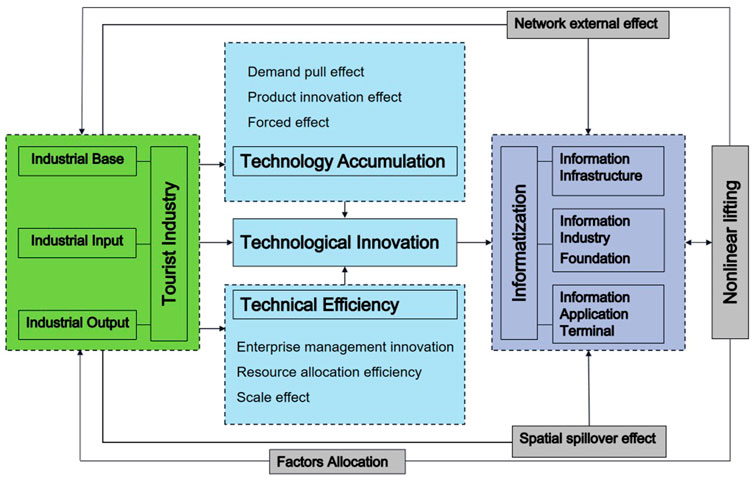
FIGURE 1. Influencing mechanism framework of tourism industry, technological innovation, and informatization.
4 Research method, sample selection, and data sources
4.1 Research method
To explore the dynamic relationship between tourism industry, technological innovation, and informatization, this paper uses the data of 30 provincial-level administrative regions (including cities, autonomous regions, and municipalities directly under the Central Government) in China (excluding Tibet, Hong Kong, Macao, and Taiwan), and the time dimension covers 2010–2019. The panel vector auto-regression model has the following advantages: it allows all variables to be endogenous, and it can accurately reflect the dynamic relationship between variables.
The research model is set up in this paper as follows.
Yit=(lntour, lntin, lninfo) is a three-dimensional column vector, lntour denotes tourism industry development, lntin denotes technological innovation, lninfo denotes informatization, and ln denotes the variables taken as logarithms; α0 is the intercept term; j is the lag order; αj is the parameter matrix with lag order j; βi is the individual fixed effect; γi is the individual time-point effect; εit is the random disturbance term.
4.2 Sample Selection
This paper selects three variables: tourism industry (Wei et al., 2020; Kim et al., 2021; Lu, 2022), technological innovation (Han, 2021; Zeng et al., 2019), and informatization. A single indicator can often only focus on one aspect of the variable, which cannot summarize the content represented by the variable as a whole. Thus, based on previous studies, this paper uses comprehensive indicators for all three variables to characterize their connotations. The entropy method is used for all the comprehensive indicators and determines the weight of each sub-index and the final comprehensive indicator score. The main calculation process of the entropy method is as follows.
Determine the sub-index attributes, give positive and negative indicators respectively, and standardize the positive and negative indicators respectively, with the following formula.
To calculate the indicator weight, the formula is as follows:
To calculate the indicator information entropy, the formula is as follows:
N represents sample size; To calculate the indicator weight, the formula is as follows:
To calculate the overall score, the formula is as follows:
4.2.1 Tourism industry (lntour)
The measurement of the tourism industry is based on current studies. An index evaluation system is established from three aspects: industrial base, industrial input, and industrial output. Industrial base indicators include the existing tourism resource base, i.e., the number of scenic spots with AAA ratings, the supply capacity of tourism enterprises including the number of travel agencies, the number of catering enterprises, and the number of accommodation enterprises. The industry input indicators are divided into labor input, i.e., the number of travel agency employees, the number of catering employees, and the number of accommodation employees. The industrial output consists of the total number of tourists of domestic tourism and inbound tourism, and the total revenue of domestic tourism and inbound tourism. The specific index decomposition and weighting are shown in Table 1.
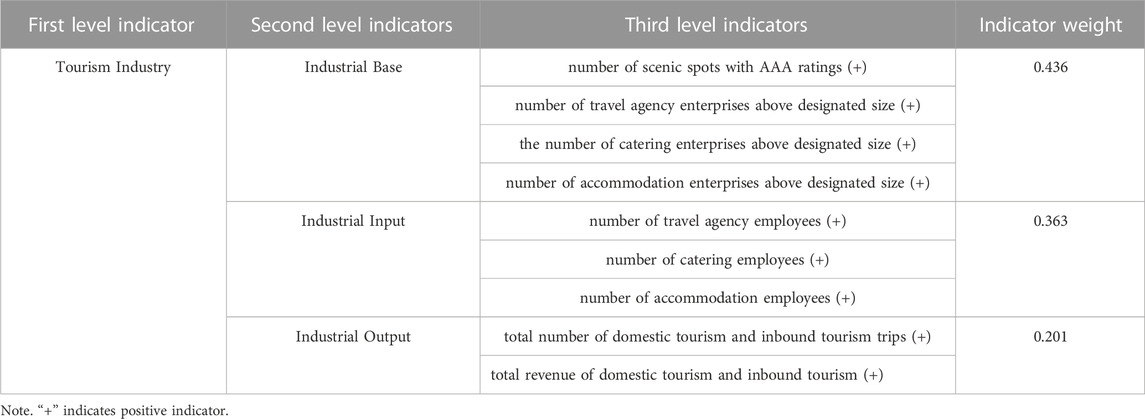
TABLE 1. Index evaluation system and weight for the tourism industry.
4.2.2 Technological innovation (lntin)
The measurement of technological innovation indicators mainly focuses on two aspects, namely, input and output of technological innovation, with the full-time equivalent of research and experimental development (R&D) personnel as input and the number of patent applications received to reflect the output situation. The breakdown of specific indicators and their weights are shown in Table 2.
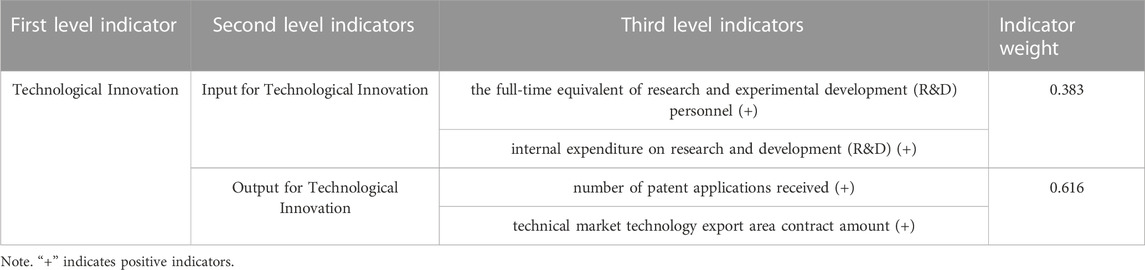
TABLE 2. Index evaluation system and weight for technological innovation.
4.2.3 Informatization (lninfo)
Existing studies have not yet reached a consensus about the measurement indicators of informatization. This paper outlines the variable of informatization from the dimension of basic guarantee, industrial support, and consumption terminal because the above three dimensions can reflect the first, middle, and last three stages of informatization. Therefore, this paper measures informatization from three dimensions: information infrastructure, informatization industry foundation, and information application terminal. As is known to all, it is inevitable for tourists to make consumption decisions without digital applications. Moreover, tourists’ behaviour will be greatly influenced by smart device. For example, tourists will use the OTA platform for ticket reservations, hotel room reservations, etc. Also, they will also use the map app to provide route navigation, which mainly relies on the smartphones carried by tourists. However, after reviewing several statistical yearbooks and materials, the researchers find that there is no exact statistical index for smartphones. Therefore, in this paper, we use the mobile phone penetration rate to measure the smartphone penetration rate as accurately as possible. And this paper uses the entropy method to assign values to each variable. The specific indicator decomposition and the weights assigned are shown in Table 3.

TABLE 3. Index evaluation system and weight for informatization.
4.3 Data Sources
Samples of this paper are from 30 provinces (cities, autonomous regions, and municipalities directly under the Central Government) in China from 2010–2019 (excluding Tibet, Hong Kong, Macao, and Taiwan). The data of indicators related to the tourism industry are obtained from China Tourism Statistical Yearbook 2011–2020, Statistical Yearbook of Tertiary Industry, the official websites of the National Bureau of Statistics, and provincial and municipal statistical bureaus. The data of indicators related to technological innovation are obtained from China Science and Technology Statistical Yearbook 2011–2020. And the data of indicators related to informatization are obtained from China Statistical Yearbook 2011–2020, China Information Statistical Yearbook 2011–2020, China Internet Industry Development Yearbook 2011–2020, China Science and Technology Statistics Yearbook 2011–2020, and the statistical bulletin of national economic and social development of each province from 2011–2020.
5 Data analysis
5.1 Stationarity test and optimal lag order selection
Although panel data alleviates the non-stationarity of the data to some extent, there may still be trend problems and intercept problems in individual variables, leading to spurious regression phenomena. In order to ensure the robustness of the research results, this paper uses three unit root tests, LLC test, ADF test and PP test, for variables such as tourism development (Intour), technological innovation (Intin) and informatization (Ininfo). All three variables passed the unit root test at the 1% significance level, which means that all three variables were relatively smooth. Before conducting panel vector auto-regression model estimation, to ensure the validity of the estimated result parameters, information criteria are needed to determine the optimal lag order of the model. In this paper, we use the PVAR2 program package of STATA15.0. To select the optimal lag order by AIC, BIC, and HQIC in three ways, and the specific results are shown in Table 4. As can be seen from the table, under the three detection criteria, the first-order lag order is optimal. Therefore, the PVAR model selection of one-phase lag is the most appropriate.
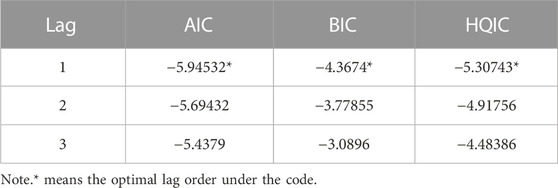
TABLE 4. Test results of optimal lag order selection.
5.2 Co-integration test
On the premise of data smoothness test, Pedroni co-integration test is used to prove whether there is a long-term equilibrium relationship between variables. Pedroni’s co-integration test results show that the original hypothesis that there is no co-integration relationship between variables at 1% significance level is denied. Therefore, there is a long-term stable equilibrium relationship among tourism development, informatization and technological innovation. Therefore, this study can conduct follow-up analysis based on the above results.
5.3 Granger causality test
To further investigate the short-term dynamic impact effect and logical relationship among tourism industry development, technological innovation, and informatization, the Granger causality test is conducted for each variable in this paper, and the results are shown in Table 5. As can be seen from the table, tourism industry development is the Granger cause of technological innovation at the significance level of 5%. The joint action of technological innovation and informatization is the Granger cause of tourism industry development at the significance level of 10%. And the joint action of technological innovation is the Granger cause of tourism industry development at the significance level of 10%. At the significance level of 1%, the combined action of technological innovation and tourism industry development is the Granger cause of informatization. At the same time, at the 1% significance level, technological innovation and tourism industry development are also respectively the Granger reasons for the development of informatization. Therefore, it can be affirmed that tourism industry development can predict technological innovation and informatization to some extent. The joint action of tourism industry development and technological innovation is crucial in predicting informatization, and the joint action of tourism industry development and informatization is also valuable in predicting technological innovation. However, the correlation among the three and the specific predictive relationship has to be further explored by tools such as GMM estimation and pulse response function.
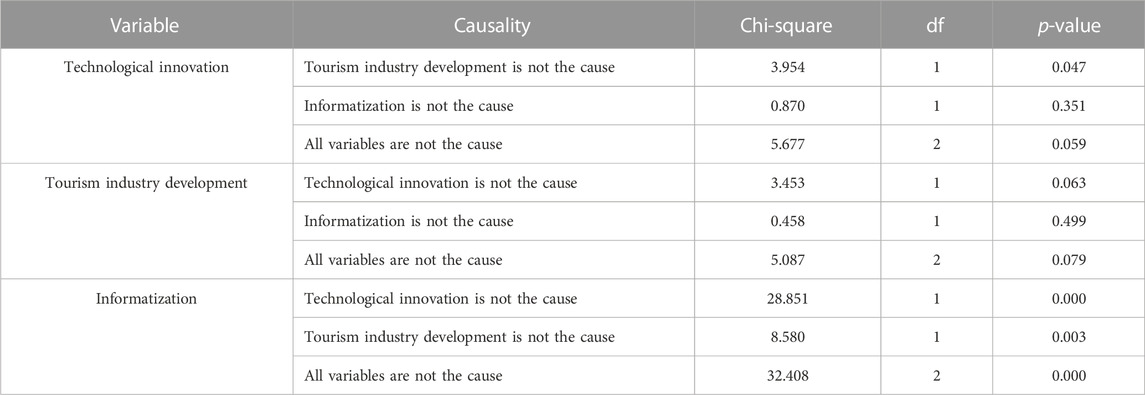
TABLE 5. Granger causality test results.
5.4 GMM estimation results analysis
After determining the optimal lag order, this paper uses STATA16 software to perform GMM estimation on the panel vector autoregressive model constructed by tourism industry development, technological innovation, and informatization, and the specific estimation results are shown in Table 6. From the table, we can conclude that: firstly, the influence coefficients of technological innovation and informatization themselves with one lag period are positive and pass the 1% significance level, indicating that two variables characterize inertial development and self-reinforcing mechanism in development. Secondly, when technological innovation is the explained variable, the influence coefficient of tourism on technological innovation lagging one cycle is positive and indeed passes the significance level, indicating that the tourism industry has a strong role in promoting technological innovation. In other words, with the application of big data, artificial intelligence, virtual reality, intelligent tourism and other technologies closely related to the development of tourism industry, the development of tourism industry has a certain “feedback effect” on technological innovation. The influence coefficient of technological innovation on the tourism industry is negative within a lag period, and the significance test indicates that technological innovation has a restraining effect on the development of the tourism industry in the short term. But from the absolute value of the influence coefficient, this inhibition effect is very weak. The reason may be that, under the requirements of the macro planning of the tourism industry development driven by the transformation of old and new driving forces and innovation, related policies, regulations and development evaluation system need to be reshaped and standardized. The factor flow and resource allocation of the tourism industry need to be adjusted and optimized, which will impact the original extensive development of the tourism industry to a certain extent, and lead to the “crowding out effect” of technological innovation on the development of the tourism industry in the short term. Third, when informatization is the explained variable, the influence coefficient of tourism development and technological innovation on a lagging informatization variable is positive and exceeds the significance level of 1%, indicating that tourism development and technological innovation can promote informatization, which is due to the pull effect and spillover effect generated by the strong correlation between tourism and the primary, secondary and tertiary industries. For example, with the improvement of information technology, it provides the tourism industry with new business forms and digital tourism products, and also brings rich tourism experience to tourists. New experiences such as those mentioned above depend to a large extent on emerging tourism technologies and equipment, which stimulate the supply of equipment manufacturing, equipment appliances and other industries related to the primary industry, thus promoting innovation, research and development and technological innovation in the industry.
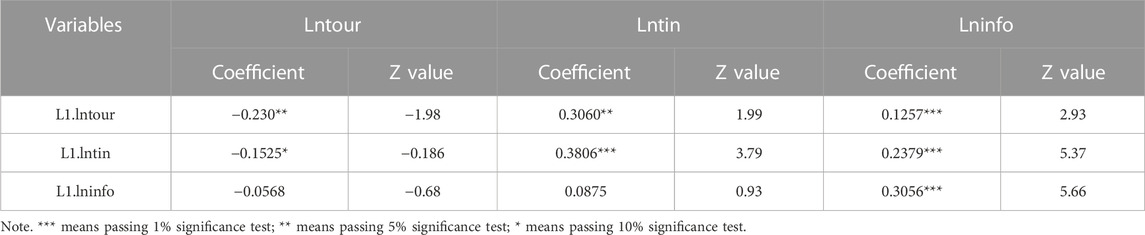
TABLE 6. GMM estimation results.
5.5 Pulse response analysis
The GMM estimation result is a static analysis of the correlation between variables. To further portray the specific dynamic interaction process and response effect between tourism industry development, technological innovation, and informatization, the pulse response within 95% confidence interval and 10-period lag is obtained based on conducting Monte-Carlo 1,000 simulations (Figure 2). The pulse response refers to the impact on itself and other variables when the random disturbance term is subjected to a standard deviation shock, which can visually reflect the dynamic time-lagged interaction relationship among the variables. From the pulse response diagram, it can be seen that: 1) each variable responds positively to the shock from itself and reaches its maximum value in the current period, and then this response gradually declines until it disappears. 2) In the face of one standard deviation impact of technological innovation and informatization, tourism industry development presents a strong response in the short term. In the long run, tourism development presents a response trend of first increasing and then decreasing, reaching the maximum value in the first phase, then gradually turning to temperature and finally tending to zero, indicating that the impact of technological innovation and informatization on the development of tourism industry has a lag and accumulation. The possible reason is that, in the context of the guideline of pursuing innovation-driven development and leading economic growth by science and technology in all regions, technological innovation and the improvement of informatization level will have a certain “crowding out effect” on the development of tourism industry to some extent. It also reminds us that we must adopt appropriate ways to adjust the development of the tourism industry, so that it can meet its own sustainable development, and accelerate the economic development of innovation and transformation, technology-led direction. 3) In the face of the standard deviation impact from informatization and tourism industry, technological innovation presents a positive response in the long run, and presents an “inverted U-shaped” response trend of first increasing and then decreasing, reaching the maximum value one period behind. Therefore, the influence of tourism industry development and informatization on technological innovation also has a positive cumulative effect. 4) In the face of the standard deviation impact from the development of tourism industry and technological innovation, informatization has a strong response in our study period, reaching a peak 1 year behind, and then gradually showing a downward trend and flattening out. It shows that the development of tourism industry and technological innovation both have a long-term and stable promoting effect on the improvement of informatization level.
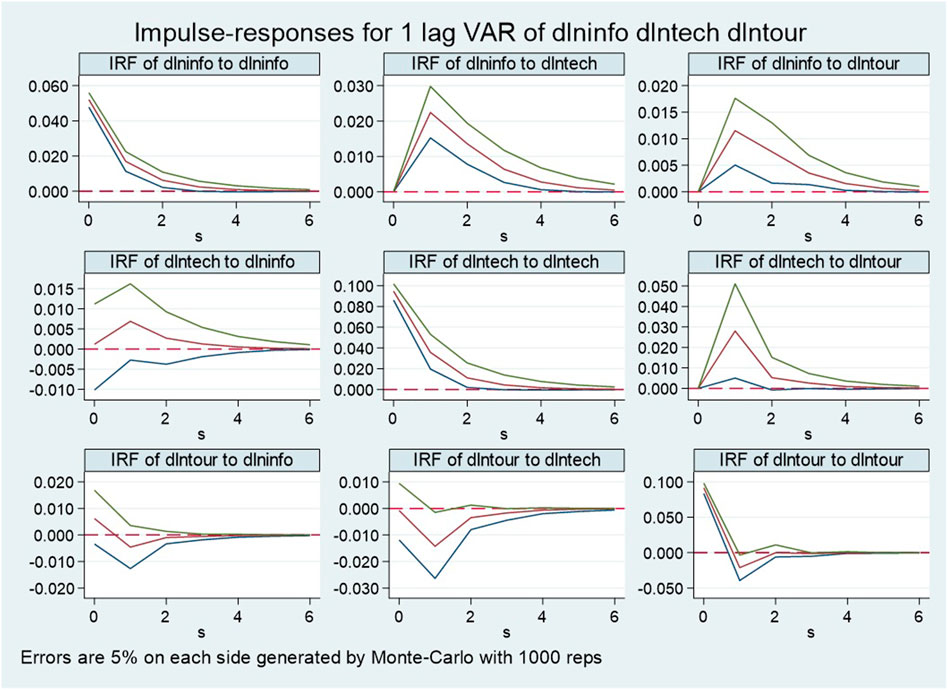
FIGURE 2. Pulse response of tourism industry, technological innovation, and informatization of China (Note: the red lines represent estimated pulse response value. The area between the green lines and blue lines is the confidence interval of 5% significance so the green lines are upper limits value and the blue lines are lower limits value).
5.6 Variance decomposition analysis
Based on pulse response analysis, the proportional contribution of each variable shock to the fluctuation of endogenous variables is measured by variance decomposition to further verify the degree of impact among variables. The results of the variance decomposition are shown in Table 7, from which it can be seen that: first, the contribution rate of the three variables of tourism industry development (lntour), technological innovation (lntin), and informatization (lninfo) to itself is much greater than the other two variables, which suggests that these three variables have a strong self-enhancement mechanism. Specifically speaking, in the first period, the contribution ratio of informatization to its own contribution was 100%, and with the passage of time, its contribution ratio gradually decreased to more than 76% during the whole research period. In the first period, the contribution ratio of technological innovation to its own is 100%, but with the passage of time, its contribution ratio gradually decreases, and the value is above 92% during the whole study period. In the first period, the contribution ratio of tourism industry to its own development is 99.5%, with the passage of time, its contribution ratio gradually decreases, but in the 10th cycle can also reach more than 96%.In order to further clarify the degree of contribution of tourism industry development and technological innovation to informatization, this study draws a graph of their contribution to informatization based on pulse response and variance decomposition. The results are shown in Figure 3. From the results of the variance decomposition of China’s informatization, in general, the degree of contribution of technological innovation and tourism industry development to informatization level shows an upward trend over time, and in the fourth period reaches the maximum and tends to be stable. According to the results, the contribution rate of technological innovation to the improvement of informatization level increases rapidly and reaches 18.5% and then tends to be stable. The contribution rate of tourism industry development to the improvement of informatization level gradually increases and reaches 5.1% and then tends to be stable. The contribution of technological innovation to the efficiency of propelling China’s informatization level is significantly higher than that of the tourism industry.
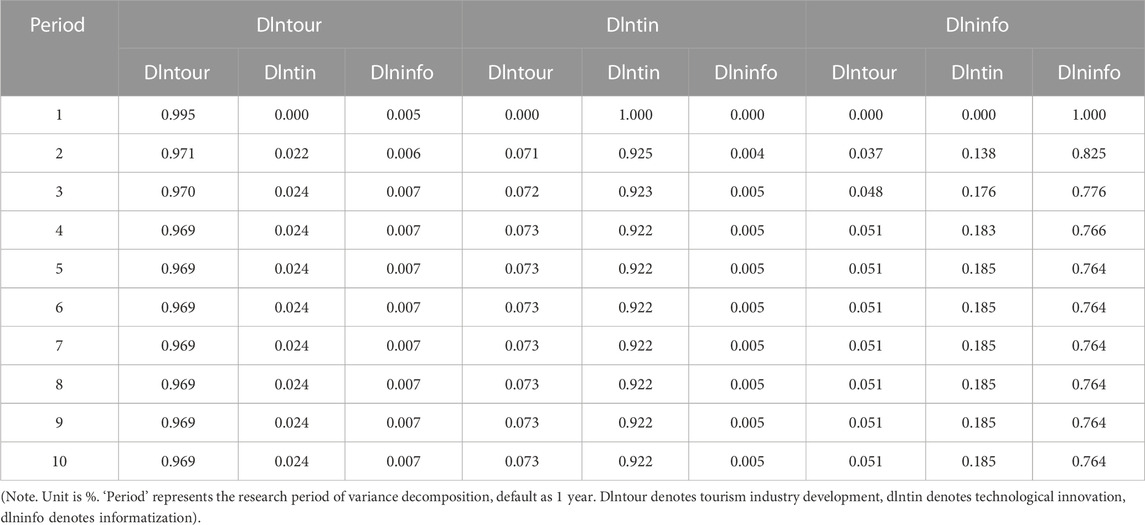
TABLE 7. Variance decomposition results.
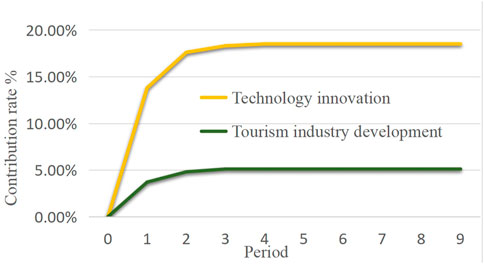
FIGURE 3. The trend of the contribution of tourism industry development and technological innovation to the promotion of informatization.
6 Conclusion and implications
6.1 Conclusion
Nowadays, the tourism industry and technological innovation represented by information and communication technology are deeply integrated and developed so it is of great value to explore the influence effects and interaction dynamics among tourism industry development, technological innovation, and informatization. This study uses panel data from 30 provinces in mainland China from 2010 to 2019, adopts the entropy method to accurately measure the tourism industry, technological innovation, and informatization, incorporates the tourism industry, technological innovation, and informatization into the analysis framework, and empirically tests whether the tourism industry and technological innovation have an impact on informatization through panel vector auto-regression model. Finally, Monte Carlo simulation, variance decomposition, and pulse response methods are used to explore the effects, characteristics, and trends of the interactions among them. Conclusions are drawn in the following part: first, tourism industry development, technological innovation, and informatization exhibit inertial development and self-reinforcing mechanisms in both the short and long term.
Second, from the perspective of technological innovation as the explained variable, tourism industry development has a positive effect on technological innovation in both the short and long term, and the short-term promotion effect is obvious, and the response curve in the study period exhibits an inverted U-shaped trend. Third, from the perspective of informatization as an explained variable, the development of the tourism industry and technological innovation have a positive contribution to the improvement of informatization both in the short and long term, and the trend of change in the research cycle is first upward and then downward. Fourth, from the perspective of tourism industry development as an explained variable, the impact of technological innovation on tourism industry development has a certain inhibitory effect in the short or long term, and the impact of informatization on tourism industry development is not significant.
6.2 Theoretical contribution
The marginal contributions of this research are mainly in three aspects. First, this paper puts tourism industry development, technological innovation, and informatization in the same research framework, and uses econometric models to investigate the effects and dynamic characteristics of the influence of the tourism industry and technological innovation on informatization. However, most previous studies have used a qualitative approach to explore the relationship and connotation of the interaction between the tourism industry and informatization (Berné et al., 2015; Buhalis, 2020), or whether the level of informatization in regional economic development facilitates the tourism industry (Kumar and Kumar, 2020; Tang, 2023). This study uses quantitative analysis to enrich the quantitative research in the areas of the tourism industry, technological innovation, and informatization. Second, this paper uses a more comprehensive set of indicators to measure the three variables.
Specifically, this paper provides a more comprehensive and overall measurement of the upstream, midstream, and downstream of the tourism industry chain in three dimensions, including industry base, industry input, and industry output. In addition, this paper also uses the entropy method to effectively measure tourism industry development, technological innovation, and informatization. The informatization is only measured by a single dimension or a simple combination of several indicators in existing research (Zhao et al., 2022; Fang and Wang, 2022), and only covers a specific type of industry, such as the degree of informatization in the fisheries and industrial sectors (Ji and Li, 2021; Zhou et al., 2021; Chen et al., 2020), lacking sufficient multiple dimensions to measure. Finally, this study uses dynamic panel auto-regression models, GMM tests, Monte Carlo simulations, pulse response analysis, and variance decomposition methods to investigate the potential connections, mutual influence effects, response characteristics, and dynamics between tourism industry development, technological innovation, and informatization. The empirical results show that the tourism industry and technological innovation can effectively promote the level of informatization in China. Existing studies have neglected the important role played by technological innovation between tourism industry development and informatization (Zhou et al., 2021). However, this study is based on the second decade of the 21st century (2010–2019), a vital period for China’s economic and social development getting into informatization, with a more focused choice of data years and more convincing results. This is a step forward in this research field due to prudent selection of data from 2010–2019 and more convincing results. Moreover, this study reveals that tourism industry development and technological innovation will exert different pulling effects on informatization at different development stages in China and their advantages and provides theoretical contributions to tourism industry development and technological innovation on the advancement of informatization level.
6.3 Practical implications
First, local governments and tourism departments should actively implement China’s informatization policies. Above all, the tourism industry, as one of the strategic pillar industries of China’s national economy, covers the primary, secondary, and tertiary industries in a comprehensive industrial sector. And the tourism industry is a vital platform that has the ability to transform the innovative application of information technology in the whole industry chain, multi-angle, multiple formats, and temporal and spatial aspects. Next, local authorities need to strengthen inter-regional synergy, establish synergistic linkage mechanisms, strengthen macro policy formulation, technological innovation, technology promotion, resource allocation, complementary advantages, and other aspects of cooperation and exchange, eliminate the chasm and barrier caused by the digital infrastructure, and promote the tourism industry, technological innovation, and informatization to develop synergistically in each region. Finally, local governments in each region should construct a macro sustainable development blueprint for informatization as soon as possible, and explore the tourism industry’s driving mechanism for informatization in terms of energy saving and emission reduction, smart cities, smart transportation, green technology utilization, and other technological advances. The level of informatization should be incorporated into the core evaluation index of tourism destinations to obtain sustainable development in the future.
Second, the tourism industry should continuously consummate the innovation system of science and technology, and accelerate the construction of informatization infrastructure. Furthermore, the tourism industry should actively usher in tourism technology enterprises to increase investment in digital technology research and development and gradually enhance the independently innovative capacity of tourism technology enterprises. The tourism industry should speed up further integration with other industries and attain a virtuous cycle in which technological innovation and tourism industry development could reciprocate each other. Digital technology is an important support for the tourism industry to accelerate integration with other industries and technological innovation. It is one of the crucial initiatives to improve the level of informatization in each region through adopting digital technology as a significant means. Government departments should apply digital technology to upgrading the regional tourism industry, innovating new consumption patterns, improving tourists’ experience, and enhancing destination management.
6.4 Limitations and future prospects
Though this study conducts plenty of statistical tests, there are two limitations. First, numerous studies have confirmed that the pandemic has had a profound impact on the development of the tourism industry and the level of informatization in many economies around the world, including China. This study only collected data for the 10 years before the pandemic. There is no doubt that it would become more meaningful and interesting to explore the impact of tourism industry development and technological innovation on informatization based on a wider range of data after the pandemic. Second, the tourism industry involves several sectors, and the data of indicators is a bit various and dispersive. Additionally, different industrial sectors comply with different statistical rules and lack the content of specific policy documents. Therefore, the construction and evaluation of relevant indicators should be further completed and improved under the circumstance of the limited availability of data. Consequently, the reasons above-mentioned bring us certain challenges and constraints in the construction of the indicator system. Next, our team will further apply information technology and use the method of big data mining to find breakthroughs in data collection, data management, and data processing. From a more diverse research perspective, we will promote the further integration of data and enhance the value and efficiency of data usage. In the future, we will also introduce suitable and accurate mediating variables and use statistical methods such as stepwise regression tests to explore the influence mechanism of how tourism industry development and technological innovation affect the development of informatization.
Data availability statement
The original contributions presented in the study are included in the article/Supplementary Material, further inquiries can be directed to the corresponding author.
Author contributions
Conceptualization: YW. Methodology and software: YW. Formal analysis: YW. Data collection: CQ and GZ. Writing-original draft preparation: YW. Writing-review and editing: YW. Supervision: HX. Visualization: CQ. Funding: HX. Research method: GZ. Data analysis: GZ. Manuscript revision: GZ. All authors have read and approved the manuscript.
Conflict of interest
The authors declare that the research was conducted in the absence of any commercial or financial relationships that could be construed as a potential conflict of interest.
Publisher’s note
All claims expressed in this article are solely those of the authors and do not necessarily represent those of their affiliated organizations, or those of the publisher, the editors and the reviewers. Any product that may be evaluated in this article, or claim that may be made by its manufacturer, is not guaranteed or endorsed by the publisher.
References
Bec, A., Moyle, B., Schaffer, V., and Timms, K. (2021). Virtual reality and mixed reality for second chance tourism. Tour. Manag. 83, 104256. doi:10.1016/j.tourman.2020.104256
Becken, S. (2017). Evidence of a low-carbon tourism paradigm? J. Sustain. Tour. 25, 832–850. doi:10.1080/09669582.2016.1251446
Berné, C., García-González, M., García-Uceda, M. E., and Múgica, J. M. (2015). The effect of ICT on relationship enhancement and performance in tourism channels. Tour. Manag. 48, 188–198. doi:10.1016/j.tourman.2014.04.012
Bilgihan, A., and Nejad, M. (2015). Innovation in hospitality and tourism industries. J. Hosp. Tour. 6 (3).
Blake, A., Arbache, J. S., Sinclair, M. T., and Teles, V. (2008). Tourism and poverty relief. Ann. Tour. Res. 35, 107–126. doi:10.1016/j.annals.2007.06.013
Brouder, P. (2020). Reset redux: Possible evolutionary pathways towards the transformation of tourism in a COVID-19 world. Tour. Geogr. 22, 484–490. doi:10.1080/14616688.2020.1760928
Buhalis, D. (2020). Technology in tourism-from information communication technologies to eTourism and smart tourism towards ambient intelligence tourism: A perspective article. Tour. Rev. 75, 267–272. doi:10.1108/TR-06-2019-0258
Cabras, I., Lorusso, M., and Waehning, N. (2020). Measuring the economic contribution of beer festivals on local economies: The case of York, United Kingdom. Int. J. Tour. Res. 22, 739–750. doi:10.1002/jtr.2369
Cai, W., Richter, S., and McKenna, B. (2019). Progress on technology use in tourism. J. Hosp. Tour. Technol. 10, 651–672. doi:10.1108/JHTT-07-2018-0068
Carvalho, I., Lopes, S., Madeira, A., Palrão, T., and Mendes, A. S. (2022). Robot coworkers: The vision of future hoteliers. Hum. Behav. Emerg. Technol. 2022, 1–13. doi:10.1155/2022/8567289
Chen, W., Si, W., and Chen, Z. M. (2020). How technological innovations affect urban eco-efficiency in China: A prefecture-level panel data analysis. J. Clean. Prod. 270, 122479. doi:10.1016/j.jclepro.2020.122479
Cortes-Jimenez, I., and Pulina, M. (2010). Inbound tourism and long-run economic growth. Curr. Issues Tour. 13, 61–74. doi:10.1080/13683500802684411
D’Alessandro, S., Cieplinski, A., Distefano, T., and Dittmer, K. (2020). Feasible alternatives to green growth. Nat. Sustain. 3, 329–335. doi:10.1038/s41893-020-0484-y
Deng, Y., You, D., and Wang, J. (2019). Optimal strategy for enterprises’ green technology innovation from the perspective of political competition. J. Clean. Prod. 235, 930–942. doi:10.1016/j.jclepro.2019.06.248
Divisekera, S., and Nguyen, V. K. (2018). Drivers of innovation in tourism: An econometric study. Tour. Econ. 24, 998–1014. doi:10.1177/1354816618794708
Đorđević, Z., and Radović, V. (2018). “Digital intangible cultural heritage as A tool for improvement of Serbian cultural tourism,” in Tourism international scientific conference vrnjačka banja-TISC, 42–60.
Du, K., Cheng, Y., and Yao, X. (2021). Environmental regulation, green technology innovation, and industrial structure upgrading: The road to the green transformation of Chinese cities. Energy Econ. 98, 105247. doi:10.1016/j.eneco.2021.105247
Erol, I., Neuhofer, I. O., Dogru (True), Dr.T., Oztel, A., Searcy, C., and Yorulmaz, A. C. (2022). Improving sustainability in the tourism industry through blockchain technology: Challenges and opportunities. Tour. Manag. 93, 104628. doi:10.1016/j.tourman.2022.104628
Eyisi, A., Lee, D., and Trees, K. (2023). Developing responsible tourism in emerging economies: The case of Nigeria. J. Tour. Cult. Change 21, 94–109. doi:10.1080/14766825.2021.2019262
Fang, Y., and Wang, W. (2022). Analysis of the influence of economic complexity on regional economic management based on computer informatization model. Sci. Program. 2022, 1–11.
Gössling, S., and Michael Hall, C. (2019). Sharing versus collaborative economy: How to align ICT developments and the SDGs in tourism? J. Sustain. Tour. 27, 74–96. doi:10.1080/09669582.2018.1560455
Hameed, I., Mubarik, M. S., Khan, K., and Waris, I. (2022). Can your smartphone make you a tourist? Mine does: Understanding the consumer’s adoption mechanism for mobile payment system. Hum. Behav. Emerg. Technol. 2022, 1–14. doi:10.1155/2022/4904686
Han, B. (2021). Research on the influence of technological innovation on carbon productivity and countermeasures in China. Environ. Sci. Pollut. Res. 28, 16880–16894. doi:10.1007/s11356-020-11890-x
Han, D., and Liu, M. (2022). How does the digital economy contribute to regional green development in China? Evidence-based on the intermediary effect of technological innovation. Sustainability 14, 11147. doi:10.3390/su141811147
He, X., Shi, J., Xu, H., Cai, C., and Hu, Q. (2022). Tourism development, carbon emission intensity and urban green economic efficiency from the perspective of spatial effects. Energies 15, 7729. doi:10.3390/en15207729
He, Z., Wu, L., Li, X., and Robert), (2018). When art meets tech: The role of augmented reality in enhancing museum experiences and purchase intentions. Tour. Manag. 68, 127–139. doi:10.1016/j.tourman.2018.03.003
Helbig, N., Gil-García, J. R., and Ferro, E. (2009). Understanding the complexity of electronic government: Implications from the digital divide literature. Gov. Inf. Q. 26, 89–97. doi:10.1016/j.giq.2008.05.004
Hu, Y., and Cheng, H. (2017). Displacement efficiency of alternative energy and trans-provincial imported electricity in China. Nat. Commun. 8, 14590. doi:10.1038/ncomms14590
Huang, X.-T., Wei, Z.-D., and Leung, X. Y. (2020). What you feel may not be what you experience: A psychophysiological study on flow in VR travel experiences. Asia Pac J. Tour. Res. 25, 736–747. doi:10.1080/10941665.2019.1711141
Huang, X., Chen, M., Wang, Y., Yi, J., Song, Z., and Ryan, C. (2022). Visitors’ spatial-temporal behaviour and their learning experience: A comparative study. Tour. Manag. Perspect. 42, 100951. doi:10.1016/j.tmp.2022.100951
Huang, X., Li, M., Zhang, J., Zhang, L., Zhang, H., and Yan, S. (2020). Tourists’ spatial-temporal behavior patterns in theme parks: A case study of ocean park Hong Kong. J. Destin. Mark. Manag. 15, 100411. doi:10.1016/j.jdmm.2020.100411
Jadhav, V. S., and Mundhe, S. D. (2011). Information technology in tourism. Int. J. Comput. Sci. Inf. Technol. 2 (6), 2822–2825.
Jayaraman, T. K., and Makun, K. K. (2020). Tourism–growth nexus in pacific island countries: A panel study on information and communication technology as a contingent factor. Tour. Econ. 26, 371–388. doi:10.1177/1354816619836332
Ji, J., and Li, Y. (2021). The development of China’s fishery informatization and its impact on fishery economic efficiency. Mar. Policy 133, 104711.
Jiang, H., and Murmann, J. P. (2022). The rise of China’s digital economy: An overview. Manag. Organ. Rev. 18, 790–802. doi:10.1017/mor.2022.32
Jin, P., Mangla, S. K., and Song, M. (2022). The power of innovation diffusion: How patent transfer affects urban innovation quality. J. Bus. Res. 145, 414–425. doi:10.1016/j.jbusres.2022.03.025
Jin, S., Yang, J., Wang, E., and Liu, J. (2020). The influence of high-speed rail on ice–snow tourism in northeastern China. Tour. Manag. 78, 104070. doi:10.1016/j.tourman.2019.104070
Kalbaska, N., Janowski, T., Estevez, E., and Cantoni, L. (2017). When digital government matters for tourism: A stakeholder analysis. Inf. Technol. Tour. 17, 315–333. doi:10.1007/s40558-017-0087-2
Kan, D., Lyu, L., Huang, W., and Yao, W. (2022). Digital economy and the upgrading of the global value chain of China’s service industry. J. Theor. Appl. Electron. Commer. Res. 17, 1279–1296. doi:10.3390/jtaer17040065
Kim, Y. R., Williams, A. M., Park, S., and Chen, J. L. (2021). Spatial spillovers of agglomeration economies and productivity in the tourism industry: The case of the UK. Tour. Manag. 82, 104201. doi:10.1016/j.tourman.2020.104201
King, R. G., and Levine, R. (1993). Finance and growth: Schumpeter might be right. Q. J. Econ. 108, 717–737. doi:10.2307/2118406
Kumar, N., and Kumar, R. R. (2020). Relationship between ict and international tourism demand: A study of major tourist destinations. Tour. Econ. 26, 908–925. doi:10.1177/1354816619858004
Kuo, F. I., Fang, W. T., and LePage, B. A. (2022). Proactive environmental strategies in the hotel industry: Eco-innovation, green competitive advantage, and green core competence. J. Sustain. Tour. 30, 1240–1261. doi:10.1080/09669582.2021.1931254
Leick, B., Kivedal, B. K., Eklund, M. A., and Vinogradov, E. (2022). Exploring the relationship between Airbnb and traditional accommodation for regional variations of tourism markets. Tour. Econ. 28, 1258–1279. doi:10.1177/1354816621990173
Leung, X. Y., and Huang, X. (2023). How virtual reality moderates daily negative mood spillover among hotel frontline employees: A within-person field experiment. Tour. Manag. 95, 104680.
Li, W., Wang, W., Wang, Y., and Ali, M. (2018). Historical growth in total factor carbon productivity of the Chinese industry – a comprehensive analysis. J. Clean. Prod. 170, 471–485. doi:10.1016/j.jclepro.2017.09.145
Li, X., Liang, X., Yu, T., Ruan, S., and Fan, R. (2022). Research on the integration of cultural tourism industry driven by digital economy in the context of COVID-19—based on the data of 31 Chinese provinces. Front. Public Health 10, 780476. doi:10.3389/fpubh.2022.780476
Liao, H., Yang, L., Ma, H., and Zheng, J. J. (2020). Technology import, secondary innovation, and industrial structure optimization: A potential innovation strategy for China. Pac. Econ. Rev. 25, 145–160. doi:10.1111/1468-0106.12326
Liu, C., and Huang, X. (2023). Does the selection of virtual reality video matter? A laboratory experimental study of the influences of arousal. J. Hosp. Tour. 54, 152–165.
Liu, C., Hung, K., Wang, D., and Wang, S. (2020). Determinants of self-service technology adoption and implementation in hotels: The case of China. J. Hosp. Mark. 29 (6), 636–661.
Loureiro, S. M. C., Guerreiro, J., and Ali, F. (2020). 20 years of research on virtual reality and augmented reality in tourism context: A text-mining approach. Tour. Manag. 77, 104028. doi:10.1016/j.tourman.2019.104028
Lu, Y. (2022). The measurement of high-quality development level of tourism: Based on the perspective of industrial integration. Sustainability 14, 3355. doi:10.3390/su14063355
Mao, S., Li, H., Cai, X., Liu, F., Zhong, H., and Song, Y. (2022). Evaluation of the development level of low-carbon tourism in Chinese cities. Front. Environ. Sci. 10, 865946. doi:10.3389/fenvs.2022.865946
Mejia, C. (2019). Influencing green technology use behavior in the hospitality industry and the role of the “green champion. J. Hosp. Mark. Manag. 28, 538–557. doi:10.1080/19368623.2019.1539935
Mercure, J.-F., Pollitt, H., Viñuales, J. E., Edwards, N. R., Holden, P. B., Chewpreecha, U., et al. (2018). Macroeconomic impact of stranded fossil fuel assets. Nat. Clim. Change 8, 588–593. doi:10.1038/s41558-018-0182-1
Moon, H., Jongsik, Y., Chua, B.-L., and Han, H. (2022). Armchair tourism: Exploring individuals’ innovative travel experience in the with-corona era. Tour. Manag. 93, 104582. doi:10.1016/j.tourman.2022.104582
Nguyen, C. P., Schinckus, C., Su, T. D., and Chong, F. H. L. (2021). The influence of tourism on income inequality. J. Travel Res. 60, 1426–1444. doi:10.1177/0047287520954538
Pan, Y., Weng, G., Li, C., and Li, J. (2021). Coupling coordination and influencing factors among tourism carbon emission, tourism economic and tourism innovation. Int. J. Environ. Res. Public. Health 18, 1601. doi:10.3390/ijerph18041601
Perelygina, M., Kucukusta, D., and Law, R. (2022). Digital business model configurations in the travel industry. Tour. Manag. 88, 104408. doi:10.1016/j.tourman.2021.104408
Pham, N. M., Huynh, T. L. D., and Nasir, M. A. (2020). Environmental consequences of population, affluence and technological progress for European countries: A malthusian view. J. Environ. Manage. 260, 110143. doi:10.1016/j.jenvman.2020.110143
Piao, S., Ciais, P., Huang, Y., Shen, Z., Peng, S., Li, J., et al. (2010). The impacts of climate change on water resources and agriculture in China. Nature 467, 43–51. doi:10.1038/nature09364
Pradhan, R. P., Maradana, R. P., Dash, S., Zaki, D. B., Gaurav, K., and Jayakumar, M. (2017). Venture capital, innovation activities, and economic growth: Are feedback effects at work? Innov. Manag. Policy Pract. 19, 189–207. doi:10.1080/14479338.2016.1276408
Pradhan, R. P., Sarangi, A. K., and Sabat, A. (2022). The effect of ICT development on innovation: Evidence from G-20 countries. Eurasian Econ. Rev. 12, 361–371. doi:10.1007/s40822-021-00189-y
Priopćenje, K. (2018). Application of communication technologies (ICT) within the tourism industry in the European union. Tour. Int. Interdiscip. J. 66 (2), 239–245.
Puiu, S., Velea, L., Udristioiu, M. T., and Gallo, A. (2022). A behavioral approach to the tourism consumer decisions of generation Z. Behav. Sci. 12, 320. doi:10.3390/bs12090320
Quiroz-Fabra, J., Valencia-Arias, A., Londoño-Celis, W., and García-Pineda, V. (2022). Technological tools for knowledge apprehension and promotion in the cultural and heritage tourism sector: Systematic literature review. Hum. Behav. Emerg. Technol. 2022, 1–12. doi:10.1155/2022/2851044
Raza, S. A., Sharif, A., Wong, W. K., and Karim, M. Z. A. (2017). Tourism development and environmental degradation in the United States: Evidence from wavelet-based analysis. Curr. Issues Tour. 20, 1768–1790. doi:10.1080/13683500.2016.1192587
Ribeiro, L. C. D. S., Lopes, T. H. C. R., Montenegro, R. L. G., and Andrade, J. R. D. L. (2018). Employment dynamics in the Brazilian tourism sector (2006–2015). Tour. Econ. 24, 418–433. doi:10.1177/1354816617736409
Rodríguez, I., Williams, A. M., and Hall, C. M. (2014). Tourism innovation policy: Implementation and outcomes. Ann. Tour. Res. 49, 76–93. doi:10.1016/j.annals.2014.08.004
Romão, J., and Nijkamp, P. (2019). Impacts of innovation, productivity and specialization on tourism competitiveness–a spatial econometric analysis on European regions. Curr. Issues Tour.
Romer, P. M. (1986). Increasing returns and long-run growth. J. Polit. Econ. 94, 1002–1037. doi:10.1086/261420
Scott, D., Gössling, S., Hall, C. M., and Peeters, P. (2016). Can tourism be part of the decarbonized global economy? The costs and risks of alternate carbon reduction policy pathways. J. Sustain. Tour. 24 (1), 52–72.
Scott, D., Peeters, P., and Gössling, S. (2010). Can tourism deliver its “aspirational” greenhouse gas emission reduction targets? J. Sustain. Tour. 18, 393–408. doi:10.1080/09669581003653542
Shi, S., Leung, W. K., and Munelli, F. (2022). Gamification in OTA platforms: A mixed-methods research involving online shopping carnival. Tour. Manag. 88, 104426. doi:10.1016/j.tourman.2021.104426
Silaban, P. H., Chen, W.-K., Nababan, T. S., Eunike, I. J., and Silalahi, A. D. K. (2022). Ow travel vlogs on YouTube influence consumer behavior: A use and gratification perspective and customer engagement. Hum. Behav. Emerg. Technol. 2022, 1–16. doi:10.1155/2022/4432977
Song, C., Shi, S., Chen, J. M., Nijkamp, P., and Li, X. (2020). The influence of emigration on tourism outward foreign direct investment: Evidence from China. J. Travel Res. 59, 631–641. doi:10.1177/0047287519846430
Song, M., Zheng, C., and Wang, J. (2022). The role of digital economy in China’s sustainable development in a post-pandemic environment. J. Enterp. Inf. Manag. 35, 58–77. doi:10.1108/JEIM-03-2021-0153
Su, Y., and Fan, Q. (2022). Renewable energy technology innovation, industrial structure upgrading and green development from the perspective of China’s provinces. Technol. Forecast. Soc. 180, 121727. doi:10.1016/j.techfore.2022.121727
Tang, R. (2023). Digital economy drives tourism development—Empirical evidence based on the UK. Econ. Res.-Ekon. Istraživanja 36, 2003–2020. doi:10.1080/1331677X.2022.2094443
Uyar, A., Kuzey, C., Koseoglu, M. A., and Karaman, A. S. (2022). Travel and tourism competitiveness index and the tourism sector development. Tour. Econ. 135481662210803, 135481662210803. doi:10.1177/13548166221080357
Wang, J., Luo, X., and Zhu, J. (2022). Does the digital economy contribute to carbon emissions reduction? A city-level spatial analysis in China. Chin. J. Popul. Resour. Environ. 20, 105–114. doi:10.1016/j.cjpre.2022.06.001
Wei, M., Peng, Q., Chen, M. H., and Su, C. H. (2020). Understanding the evolution of China’s tourism industry performance: An internal–external framework. Int. J. Tour. Res. 22, 479–492. doi:10.1002/jtr.2350
Wu, H., Hao, Y., and Weng, J. H. (2019). How does energy consumption affect China’s urbanization? New evidence from dynamic threshold panel models. Energy Policy 127, 24–38.
Xiao, Z., Peng, H., and Pan, Z. (2022). Innovation, external technological environment and the total factor productivity of enterprises. Acc. Finance 62, 3–29. doi:10.1111/acfi.12779
Yang, W., Chen, Q., Dao, Y., Huang, X., and Shao, W. (2022a). Ecological civilization and high-quality development: Do tourism industry and technological progress affect ecological economy development? Int. J. Environ. Res. Public. Health 20, 783. doi:10.3390/ijerph20010783
Yang, W., Chen, Q., Guo, Q., and Huang, X. (2022b). Towards sustainable development: How digitalization, technological innovation, and green economic development interact with each other. Int. J. Environ. Res. Public. Health 19, 12273. doi:10.3390/ijerph191912273
Yang, W., Chen, Q., Huang, X., Xie, M., and Guo, Q. (2022d). How do aesthetics and tourist involvement influence cultural identity in heritage tourism? The mediating role of mental experience. Front. Psychol., 13.
Yang, W., Chen, Q., Huang, X., Xie, J., Xie, M., and Shi, J. (2022c). Image and text presentation forms in destination marketing: An eye-tracking analysis and a laboratory experiment. Front. Psychol., 13.
Yeoman, I., Lennon, J. J., Blake, A., Galt, M., Greenwood, C., and McMahon-Beattie, U. (2007). Oil depletion: What does this mean for Scottish tourism?. Tour. Manag. 28 (5), 1354–1365.
Zeng, Y., Han, F., and Liu, J. F. (2019). Does the agglomeration of producer services promote the quality of urban economic growth. J. Quant. Tech. Econ., 36.
Zhang, J., and Shang, Y. (2022). The influence and mechanism of digital economy on the development of the tourism service trade—analysis of the mediating effect of carbon emissions under the background of COP26. Sustainability 14, 13414. doi:10.3390/su142013414
Zhang, J., and Zhang, Y. (2021). Tourism and low-carbon performance: An fsQCA approach. Asia Pac. J. Tour. Res. 26, 626–639. doi:10.1080/10941665.2021.1886133
Zhang, Z., Fu, W. K., and Ma, L. (2022). The impact of digital economy on green development in China. Front. Environ. Sci. 10, 991278. doi:10.3389/fenvs.2022.991278
Zhao, L. (2022). China’s “economic miracle” and the universal modernization model. Mod. China 48, 53–72. doi:10.1177/00977004211054845
Zhao, X., Mei, X., and Xiao, Z. (2022). Impact of the digital economy in the high-quality development of tourism—an empirical study of Xinjiang in China. Sustainability 14 (20), 12972.
Zheng, W., Huang, X., and Li, Y. (2017). Understanding the tourist mobility using GPS: Where is the next place? Tour. Manag. 59, 267–280. doi:10.1016/j.tourman.2016.08.009
Zhou, X., Cai, Z., Tan, K. H., Zhang, L., Du, J., and Song, M. (2021). Technological innovation and structural change for economic development in China as an emerging market. Technol. Forecast. Soc. Change 167, 120671. doi:10.1016/j.techfore.2021.120671
Keywords: informatization, tourism industry, technological innovation, panel vector auto-regression, pulse response, low-carbon economic development
Citation: Zimeng G, Wei Y, Qiuxia C and Xiaoting H (2023) The contribution and interactive relationship of tourism industry development and technological innovation to the informatization level: Based on the context of low-carbon development. Front. Environ. Sci. 11:999675. doi: 10.3389/fenvs.2023.999675
Received: 21 July 2022; Accepted: 23 March 2023;
Published: 17 April 2023.
Edited by:
Keng Yuen Foo, University of Science Malaysia, MalaysiaReviewed by:
Iwona Bąk, West Pomeranian University of Technology, PolandZengxian Liang, Sun Yat-sen University, China
Copyright © 2023 Zimeng, Wei, Qiuxia and Xiaoting. This is an open-access article distributed under the terms of the Creative Commons Attribution License (CC BY). The use, distribution or reproduction in other forums is permitted, provided the original author(s) and the copyright owner(s) are credited and that the original publication in this journal is cited, in accordance with accepted academic practice. No use, distribution or reproduction is permitted which does not comply with these terms.
*Correspondence: Huang Xiaoting, c2F0aW5odWFuZ0BzZHUuZWR1LmNu