 Luigi Conte1,2*
 Julia Prakofjewa1
 Tiziana Floridia1
 Alice Stocco1
 Vito Comar2
 Francesco Gonella3,4†Martina Lo Cascio5†
- 1Department of Environmental Sciences, Informatics and Statistics, Ca’ Foscari University of Venice, Venice, Italy
- 2Faculty of Biological and Environmental Sciences, Greater Dourados Federal University, Dourados, Mato Grosso do Sul, Brazil
- 3Department of Molecular Sciences and Nanosystems, Ca’ Foscari University of Venice, Venice, Italy
- 4The New Institute Centre for Environmental Humanities (NICHE), Venezia, Italy
- 5Department of Culture and Society, University of Palermo, Palermo, Italy
Like many Mediterranean areas, the Italian island of Sicily faces multiple environmental pressures such as soil loss, fire hazards, and extreme meteorological events, all of which negatively impact local food systems. In response to these threats, a re-thinking of local agriculture and natural resource management is increasingly needed. Agroecology is recognized as a robust proposal for building more resilient food systems grounded in farmers’ knowledge and practices. However, agroecological farming experiences struggle to operate and survive in Sicily due to unfavorable political-cultural, environmental, and socio-economic conditions. Learning from small-scale farmers about the ways they perceive, understand, and overcome structural limits and environmental constraints is key for a transition to agroecology in the study area. Understanding its potentials and limits is essential for planning and identifying transformative actions. We approached the problem by adopting a participatory action research methodology involving selected groups of farmers in Western Sicily. We applied a co-creative approach and developed a systemic analysis of the socio-ecological narratives to identify possible leverage points for a transition to agroecology in the study area. We identified a local potential for shifting the current system of water and fire hazards management to new systems of participatory land stewardship. To be effective, these systems should support agroecological farmers’ income by altering social practices related to food and reducing the influence of dominant agribusiness actors. Our findings indicate that implementing solutions based on the circulation of local ecological knowledge within systems of participatory guarantees can favor the development of solidarity economies and mutualistic relations between farmers, scientists, and communities. Our work suggests that scientists’ facilitation and knowledge co-creation might be of key importance in structuring local, more sustainable food systems.
1 Introduction
Transition to more sustainable food systems involves a systemic change in their physical-environmental, socio-economic and political-cultural dimensions. The systemic change needed to achieve resilient and equitable food systems acknowledges the complex interplay of various stakeholders, processes and dynamics (Wezel et al., 2009; Schipanski et al., 2016; Singh et al., 2016; Bergez et al., 2019; Lefèvre et al., 2020; García-Martín et al., 2021; Lopez-Ridaura, 2022; Röös et al., 2022; Bezner Kerr et al., 2023). In this transformative process, knowledge systems, especially farmers’ local knowledge, are crucial (Altieri, 2002; Altieri and Toledo, 2005; Cuéllar-Padilla and Calle-Collado, 2011; Guzmán et al., 2013; Calvet-Mir et al., 2018; Ingram, 2018; Conway et al., 2019; López-García et al., 2021; Luján Soto et al., 2021; Chen et al., 2022). Integrating this local knowledge with grassroots participation in scientific activity is essential for effectively evaluating and navigating the multifaceted dimensions of food system transition (Conway et al., 2019; López-García et al., 2021; Sachet et al., 2021; Jones et al., 2022). Moreover, giving voice to traditionally excluded groups by acknowledging their rich worldview and knowledge is an integral part of the decolonization process science must undergo to address global sustainability challenges effectively and equitably (Berkes et al., 1994; Bradley and Herrera, 2016; Weiner, 2017; Carlisle, 2022).
The Mediterranean region, including the island of Sicily in Southern Italy, is facing significant challenges that are worsened by ongoing climatic changes. These challenges include soil loss and water scarcity (Donta et al., 2005; Giglioli and Swyngedouw, 2008; Fantappiè et al., 2015). Sicily has been identified as a climate change ‘hotspot’ (Bordi et al., 2007; Giorgi and Lionello, 2008; Mariotti et al., 2015; Forestieri et al., 2018; Tuel and Eltahir, 2020), with one of the boundaries of Mediterranean land desertification situated in this region (Zdruli, 2012; La Mela Veca et al., 2016; Pausas and Millán, 2019; Ali et al., 2022). Studies by Abd-Elmabod et al., 2020; Antonelli et al., 2022 have highlighted these concerns at the regional level, emphasizing the potential adverse effects on food systems and society.
Sicily is a vulnerable area from both an environmental and socio-economic point of view. Its geographical location also places it at the center of human migration flows from the African continent (Pirrone and Edizioni, 2007; Pirrone, 2015; Lo Cascio, 2022). The region has undergone significant landscape changes due to urbanization and industrialization of agriculture since the 1960s, driven by national policies aimed at the economic development of Southern Italy. This shift led to the predominance of agribusiness systems, which replaced traditional farming practices and knowledge in favor of industrialized systems designed for the export of food commodities, both nationally and internationally (De Filippis and Henke, 2014). The actual agricultural labor sector is marked by the exploitation of seasonal migrant workers in rural areas, highlighting structural social inequities at the core of the food system organization (Pirrone and Edizioni, 2007; Pirrone, 2015; Lo Cascio, 2022). Such situations contribute to increasing risks of instability and formation of structural injustice within food systems. Given this context, the need for systemic rethinking and implementation of more equitable and sustainable food systems is imperative. This is crucial to address the challenges and mitigate the risks associated with the current trajectory of agricultural and food systems in the Mediterranean region, particularly in Sicily.
In this scenario, agroecology has been advanced by networks of farmers, scholars and social movements as a systemic approach that aims at understanding and transforming food systems. Agroecology concerns theoretical and applied scientific disciplines from natural and social sciences, famers knowledge, community practices, and political movements for human and land rights. It includes leveraging local and traditional ecological knowledge to produce quality food while creating stable incomes for producers and simultaneously engaging in soils and habitats regeneration, also tackling climate adaptation (Altieri, 2002; Francis et al., 2003; Altieri and Toledo, 2005; Guzmán et al., 2013; Altieri et al., 2015; Gliessman, 2016; van der Ploeg et al., 2019; Lefèvre et al., 2020; Akakpo et al., 2021; López-García et al., 2021; Luján Soto et al., 2021; Chen et al., 2022; Bezner Kerr et al., 2023; Dittmer et al., 2023). Nevertheless, the implementation of this approach faces significant challenges due to social, cultural, environmental, economic and political constraints. Despite growing scientific and policy interest in transitioning to more sustainable agriculture, there is a lack of effort in modifying top-down methodological approaches to address the vulnerability of excluded small-scale farmers and communities who already practice agroecology, being the natural backbone of the transition. This not only reflects the different positioning of scientists in defining what agroecology is (Giraldo and Rosset, 2022; Rosset et al., 2022; Borras et al., 2023), but endangers risks of maladaptation (Christian-Smith et al., 2015; Albizua et al., 2019; Asare-Nuamah et al., 2021; Bezner Kerr, 2023), where approaches to natural resource management and policy might be colonizing rather than liberating. To facilitate a food system transition that aligns with agroecological principles, new, decolonized, inclusive and effective methodologies are needed to identify systemic leverage actions that can drive transformative processes.
Since the 1990s, European Union (EU) common agricultural policy (CAP) has sought to balance food production objectives with greater consideration for rural development and sustainability concerns. However, while there is an increasing demand for sustainable, healthy food, which has created opportunities for less intensive or alternative farming systems focused on local food production (Goodman, 2003; Murdoch et al., 2017), the market-driven reforms of the CAP have further encouraged intensification and specialization of EU agriculture. This has brought about risks associated with price volatility and power imbalances in agri-food chains (Benegiamo et al., 2023). While CAP allocates funds primarily to direct payments to farmers (72%) and rural development (25%), it tends to disadvantage small farmers (Lo Cascio, 2022). The EU’s agricultural policies disproportionately affect small producers and territories with market inclusion regulated by powerful actors by means of voluntary certifications and jeopardized participation. Despite efforts to support income and rural development, CAP still prioritizes powerful actors’ interests over those of small-scale producers, undermining their autonomy and decision-making power. Specifically, CAP’s 2023-2027 direct payments are tied to technological shifts (Benegiamo et al., 2023), which generally exceeds the capacities of small farmers and creates a dependence on external technical expertise. These reliance mechanisms further exclude local knowledge systems - which are fundamental for transformative change in food systems - increasing the risk of local ecological knowledge loss, already exacerbated by climate change (Hauser et al., 2021). CAP’s environmental constraints are generally weak and insufficient to cope with the actual environmental crisis (Cuadros-Casanova et al., 2023), failing both to address environmental challenges holistically and to adequately support a more sustainable agriculture.
There exists a knowledge gap concerning the actions needed to effectively implement a transition to more sustainable, healthy and resilient food systems, particularly in vulnerable areas such as southern Mediterranean regions including Sicily. Specifically, it is poorly understood which are the full range of potentials and limits for an agroecological transition in Western Sicily and how they influence each other preventing a real change in local food systems. Filling these gaps is a pressing need motivated by the approval of the Sicilian regional government of new agricultural regulations concerning agroecology (L.R. 21/2021) dedicated to implementation of the CAP 2023-2027 policy.
This study aimed at finding systemic leverage points to drive a transition to agroecology in Western Sicily, adopting a bottom-up approach. To achieve this, 1) we built a participatory knowledge co-creation process engaging local experts and agroecological practitioners; 2) we identified the range of potentials and limits in implementing agroecology in the area according to local experts’ knowledge; 3) we examined the synergies and trade-offs relations between these drivers to identify the key processes to develop for an agroecological transition in the study area.
2 Materials and methods
2.1 Study area
Sicily is an island located in Southern Italy, at the center of the Mediterranean Sea (Figure 1A). Its climatic conditions are characterized by strong seasonality. The wet period occurs from September-October to March-April, it is characterized by a temperature climate in the whole island, except for mountain areas characterized by a cold climate. In these periods, average monthly precipitation ranges from 30 to 90 mm and average daily temperatures ranges from 8°C to 20°C. The dry period occurs from May to September characterized by an arid climate with average monthly precipitation up to 15 mm and average daily temperatures ranging from 20°C to 28°C. A reduction in precipitation intensity is observed in rain gauges consistently in the whole island with magnitudes of the order of 20 mm per decade (Drago, 2006; Viola et al., 2014). Warming trends in temperatures were observed with magnitudes of 0.3°C–0.5°C per decade (Liuzzo et al., 2016). Besides urban areas, land use is mainly devoted to agriculture and pastures with four protected parks, covering 1832.73 km2 mainly in the coastal and mountain areas of the North-Eastern part of the island, along with some local reserves. According to the last report of ISTAT (National Institute of Statistics), the number of farms in Sicily has been decreasing in the last 10 years −35.2% (−68% at the national level since 1982) with a decrease in land use −3.3% reflecting a concentration process of agricultural entrepreneurship and land ownership still underway.
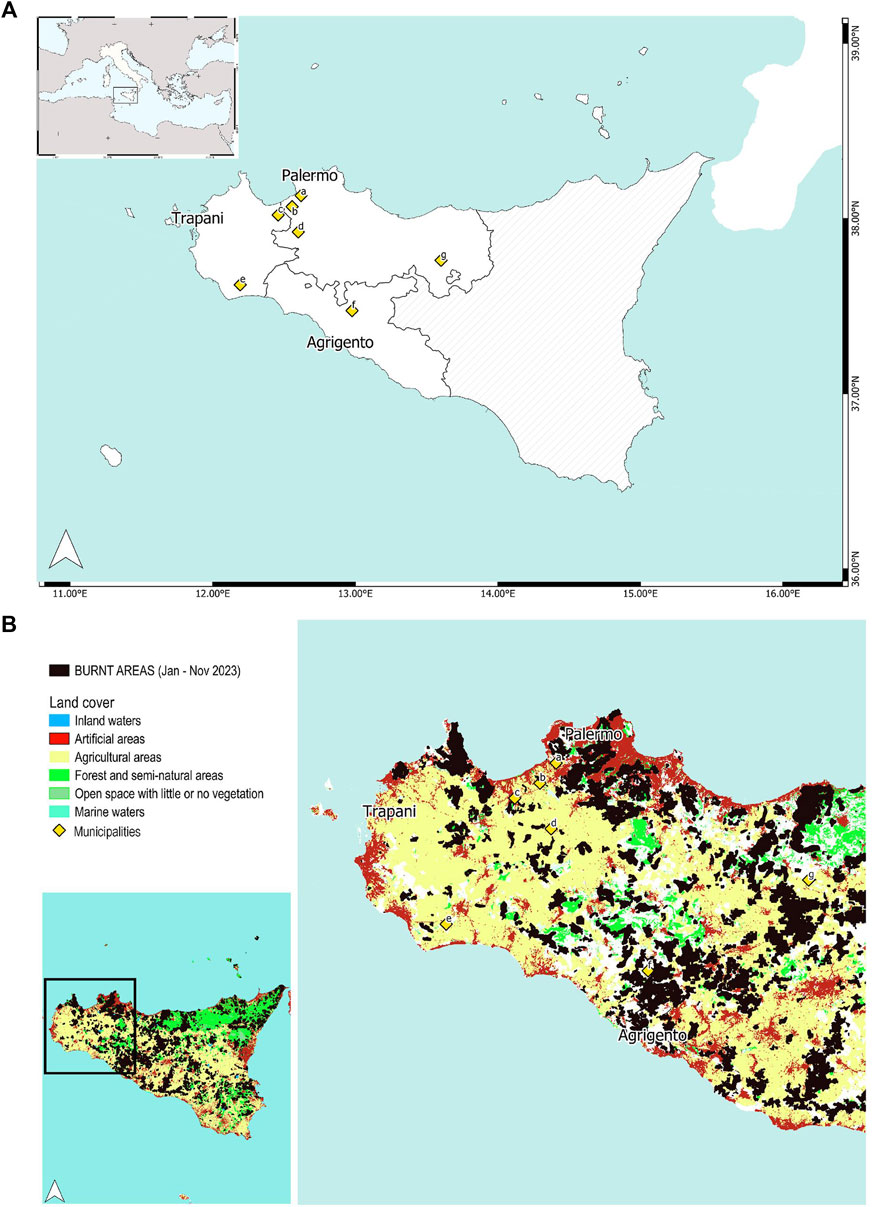
Figure 1. Study area. (A) Geographical outlook of the study area and fieldwork locations. The white areas are the Provinces included in the study. (B) Land cover patterns and burnt area distribution in Western Sicily. Yellow symbols indicate the municipalities in which the study has been conducted: (a) Borgo Parrini; (b) Partinico; (c) Alcamo; (d) Camporeale; (e) Campobello di Mazara; (f) Cianciana; (g) Polizzi Generosa.
Seasonal fire hazards in the dry seasons, generally from April to September, are common in inhabited rural areas. Fires periodically reach urban areas, too. The fire dynamics and hazards are specific to the region due to its environmental, socio-cultural and political-economical vulnerabilities. Based on data obtained from the EFFIS dataset (European Forest Fire Information System), between January and November 2023, wildfires in Sicily have consumed a total area of 73,965 ha of land, which amounts to 2.87% of the island’s total area. Fires spread in the central part of the island and severely affected central and western Sicily (Figure 1B). Among these burned surfaces, 46,049 ha affected natural land patches represented by wild grasslands, woods, and other vegetated soils, while 16,035 ha were on agricultural soils. If we consider the last 10 years period, the year 2023 marks the highest point in the steadily increasing trend of wildfires affecting agricultural lands. In 2023, the fires also affected 313 ha of artificial surfaces and 203 ha of other land cover classes, even in urban and peri-urban areas, especially threatening the cities of Palermo, Agrigento and Catania. This is noteworthy because the extent of artificial areas affected by wildfires in Sicily had never surpassed 236 ha, the maximum values of the last 10-year period, occurring in 2020.
Western Sicily is a territory characterized by historical struggles for land and water. Recent studies named the origin of grassroot movements for climate justice in Italy in the farmers movement for the construction of the Jato dam around Partinico between the 50s and the 60s (Imperatore, 2023; Cagnoni, 1976; Barbera, 1964). In Western Sicily, surface water storage and availability are limited to dams constructed between the 1960s and 1980s by small rivers and streams with seasonal water availability. In agribusiness areas, groundwater extraction is the primary source of water supply, in the coastal areas linked to a strong salinization of the aquifers (Capaccioni et al., 2005; Tiwari et al., 2019; Mastrocicco and Colombani, 2021). The estimates of the surface occupied by freshwater result between 9,381 ha, 0.36% of the island’s area (according to Corine Land Cover inventory), and 14,498 ha (0.56% of the islands’ area, based on Sentinel 2 Land Use/Land Cover). Typical agricultural landscapes in the studied area are shown in Figure 2.
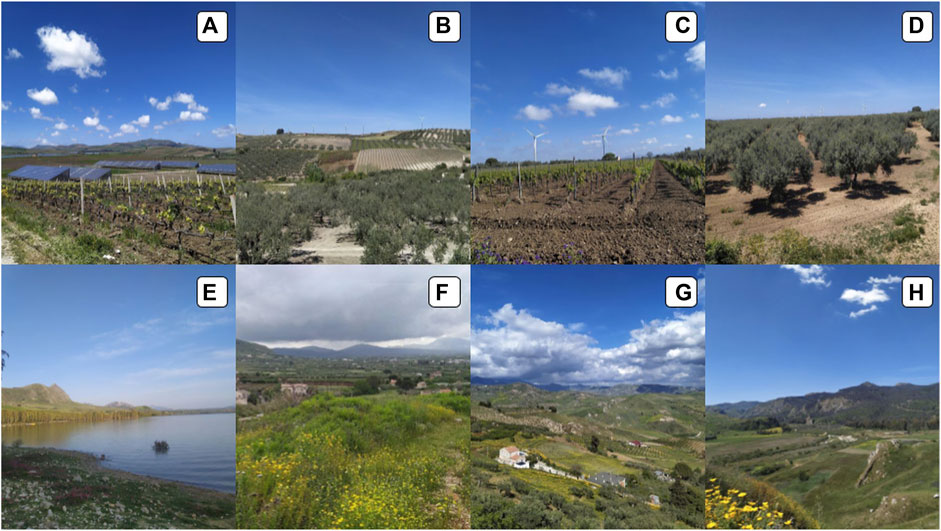
Figure 2. Landscape views of the study area. (A–D) Typical dominant cultures (olive trees, grapes) and renewable energy harvesting configurations. (E) Managed surface water reservoir. (F–H) View of rural areas with decreasing urbanization. Photo credits: Luigi Conte.
2.2 Participatory action research methodology
We applied a co-creative approach with local farmers and experts within the framework of participatory action research (Utter et al., 2021; Frank et al., 2022). We aimed at building a common platform based on active participation of local experts and collective learning to create actionable knowledge grounded in the reality of local environments and communities taking part in the study.
The action-research initiative began with an independent crowdfunding campaign aimed at integrating scientists with Fuorimercato association, an Italian grassroots organization that champions self-organized solidarity economies supporting land workers both locally and nationally. Some of the authors actively participate in Fuorimercato endeavors as scholar activists (Borras et al., 2023). The study developed in different steps taking place between February 2022 and August 2023. As shown in Figure 3, these included:
• the engagement of a first group of selected participants
• the documentation of local ecological knowledge of experts
• the translation of documented knowledge with a final group of selected participants
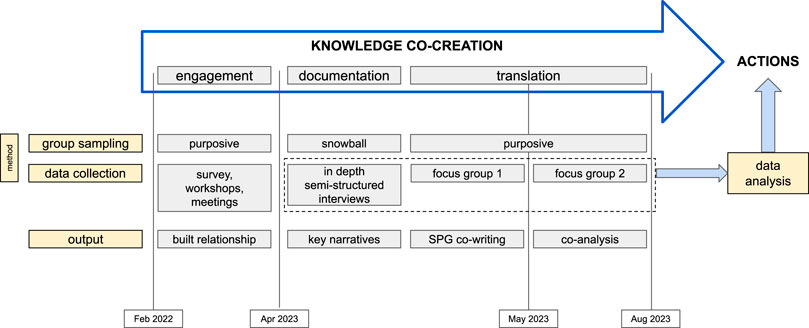
Figure 3. Process of knowledge co-creation within participatory action research. The figure describes the various steps of the study, the methods applied for the group sampling, data collection, and the output corresponding to each step. The first phase deals with the engagement of local experts and was carried out by selecting an initial group of participants to build a trusting relationship to develop the subsequent steps of the process (purposive sampling). The second step is the documentation of local knowledge that was carried out by means of in depth semi-structured interviews of local expert participants selected applying a snowball sampling strategy starting from the initial group of participants. At this stage, we identified key narratives of the interviewees which are used to introduce the first focus group discussion. The final step of translation of the documented knowledge into actionable knowledge has been carried out by means of two focus groups whose participants have been selected among the most active ones in the interviewees (purposive sampling). The reflections emerging from the first focus group discussion led to a collective writing output (https://www.fuorimercato.com/agroecologia-lavoro-migrante/420-la-garanzia-partecipata-come-strumento-di-convergenza-sintesi-dei-passaggi-chiave-della-ricerca-radicata-e-collettiva-in-sicilia.html) which was used as a basis for a deeper collective analysis of the common patterns carried out in the second focus group. The data collected during the different steps has been analyzed with qualitative methods in order to organize the findings into actionable knowledge.
In each phase of the research, we applied a specific sampling criteria and data collection method, producing outputs that were used in the later steps. The data collected during the various stages was organized to analyze socio-ecological narratives within three systemic dimensions of sustainability and agroecology: physical-environmental, socio-economic and political-cultural. We used qualitative inference methods including qualitative content analysis (Elo and Kyngäs, 2008; Schreier, 2012) and synergies and trade-offs analysis (Luukkanen et al., 2012; Schipper et al., 2022). Each participant gave oral informed consent for data collection. The Ethics and Data Management Plan Committee of the Ca Foscari University of Venice approved the research protocol. The information collected was transcribed to accurately reflect local characteristics, ensuring the distinctive nuances were preserved.
2.2.1 Data collection
The research activities began with purposive sampling to select eight agroecological farmers and practitioners, focusing on those managing less than 15 ha and employing a mix of sustainable farming methods encompassing organic, regenerative, and traditional techniques. These individuals were selected based on their deep commitment to agroecological principles and their ability to facilitate field access in Sicily and involvement of more experts. Other selection criteria included active participation in local and national food distribution networks based on solidarity economy and small farmers’ cooperative associations. In April and May 2023, extensive fieldwork was conducted in Western Sicily, following a snowball sampling method. The second phase involved documenting local experts’ knowledge through semi-structured in-depth interviews complemented by field visits to agricultural production sites. The final phase featured two focus groups with ten participants selected from the interviews, all interested in developing a participatory guarantee system (Cuellar-Padilla and Ganuza-Fernandez, 2018; Kaufmann and Vogl, 2018; Loconto and Hatanaka, 2018). The focus group discussions aimed to generate reflections and transform recorded insights into actionable knowledge (Frank et al., 2022). For a detailed description of activities, tools employed, and outputs in each step of the study we provide information in the Supplementary Material, specifically in Supplementary Tables S1, S2, S4.
Table 1 summarizes the sample distributions. Each step of the research involved a collaboration with local experts. The homogeneity by age among these groups - respectively with average age of
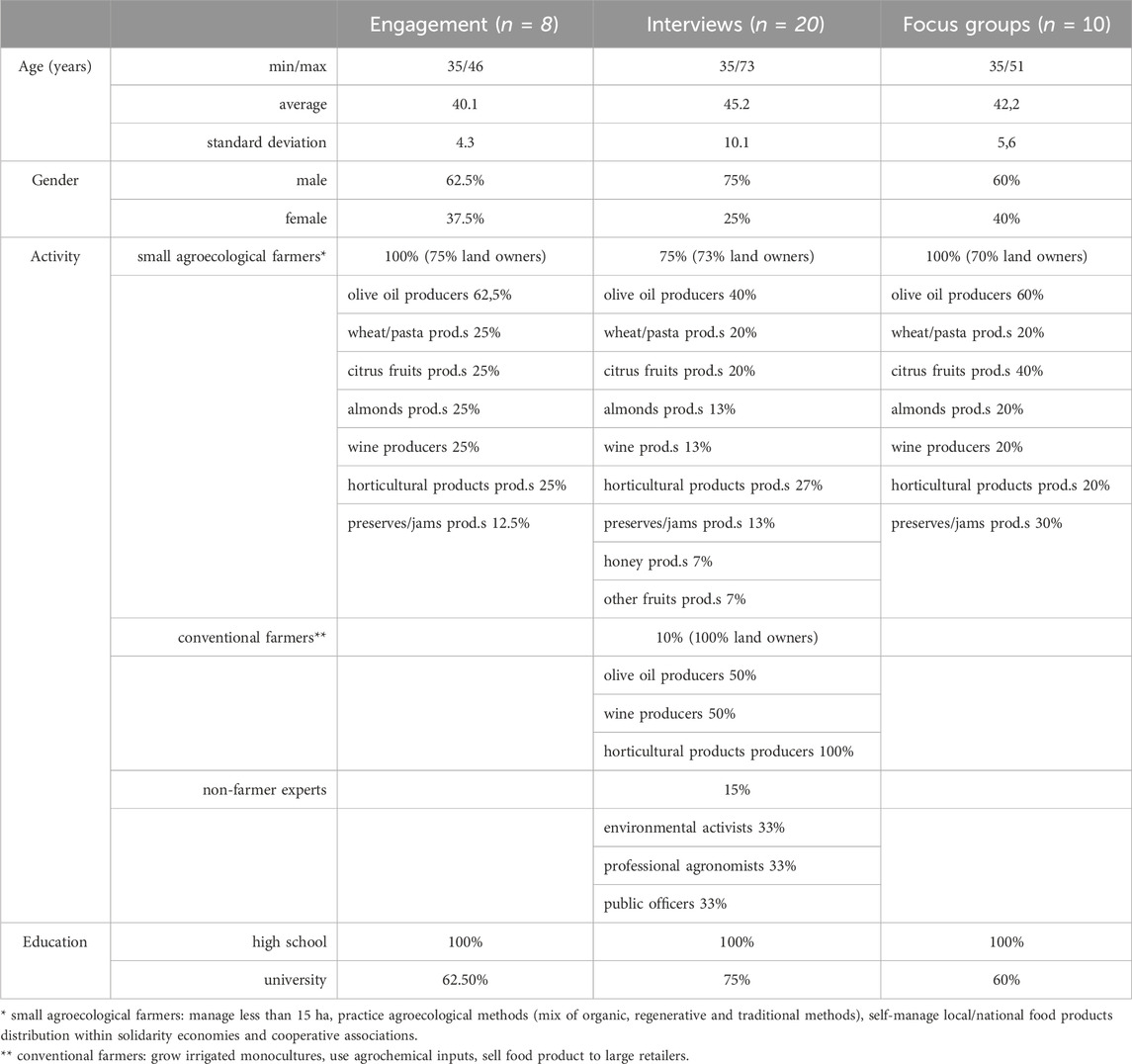
Table 1. Sample distributions by age, gender, expert activities, and education.
In the first phase we involved local small agroecological farmers with diversified productions. Among the producers, 62.5% produce olive oil, 25% wheat and pasta, 25% citrus fruits, 25% almonds, 25% wine, 25% horticultural products, and 12.5% preserves and jams. In the second phase, we interviewed local small agroecological farmers (75%), local conventional farmers (10%), and local non-farmer experts (15%). Among the agroecological farmers, 40% produce olive oil, 20% wheat and pasta, 20% citrus fruits, 13% almonds, 13% wine, 27% horticultural products, 13% preserves and jams, 7% honey, and 7% other fruit. Among the conventional farmers, 50% produce olive oil, 50% wine, and 100% horticultural products. Among the local non-farmer experts, we include environmental activists (33%), agricultural extension agents (33%), and public officers (33%). Conventional farmers and non-farmer experts were involved as local experts to increase the background information on the study area. In the focus group discussions, we involved small agroecological farmers producing olive oil (60%), wheat and pasta (20%), citrus fruits (40%), almonds (20%), wine (20%), horticultural products (20%), and preserves and jams (30%). For further details on the samples, we provide the informant table in Supplementary Material S1.
2.2.2 Data analysis
We used qualitative content analysis (QCA) to find the potentials and the limits for an agroecological transition in Western Sicily. We found and selected pivotal socio-ecological narratives from the interviews and focus groups, classifying them into emic categories that reflect the unique perspectives and culturally specific meanings of the participants. These narratives were then systematically arranged using a hierarchical clustering approach. Further, we categorized these narratives into two distinct etic groups, standing for the potentials and the limits for an agroecological transition in the study area. These narratives were organized into key topics, refined from the original questionnaire themes, and aligned with three systemic dimensions of sustainability and agroecology.
On the basis of QCA, we performed a synergies and trade-offs analysis (Luukkanen et al., 2012; Schipper et al., 2022) of the documented socio-ecological narratives to show the possible leverage points (Meadows, 2008; Fischer and Riechers, 2019; Davelaar, 2021) for a transition to agroecology in Western Sicily. To go beyond a static representation of local ecological knowledge, we explored the reinforcing and balancing interactions among the potentials and limits that were found. We constructed an interaction matrix between the potentials and limits categories defining four types of pairwise, directed interactions: synergy between potentials, synergy between limits, trade-off between potential and limit, trade-off between limit and potential. A synergy is defined between two categories if they reinforce their effect. A trade-off is defined between two categories if they balance their effect. In this matrix we defined the space of the possible pairwise interactions for each topic. The corresponding entries were labeled according to the type of interaction at stake. We defined a simple scoring system to identify the significant interactions at the topics hierarchical level. For each pair of topics, an interaction was considered significant when more than half of the possible entries corresponding to a certain class of interaction were occupied.
3 Results
We identified key topics within three pivotal dimensions: physical-environmental, socio-economic and political-cultural, essential for understanding the agroecological transition in Western Sicily. In Figure 4 we show the hierarchical clustering of the socio-ecological narratives emerging from the interviews and focus groups discussions. The classification provided the elements for a systemic analysis of a transition to agroecology in the study area. In Supplementary Material S1, we present an extensive line of sight supporting the hierarchical tree classification with data of documented socio-ecological narratives. Overall, we selected 36 socio-ecological narratives unevenly distributed within 12 topics. Among the total number of narratives, 42% were classified as potentials (n = 15) and 58% as limits (n = 21) to implement an agroecological transition in Western Sicily.

Figure 4. Hierarchical classification of socio-ecological narratives. The graph shows the categorization of recorded narratives into key topics referred to the three systemic dimensions of sustainability and agroecology. The categorization is based on qualitative content analysis (QCA). Narratives are grouped in two categories: potentials (blue) and limits (red) for an agroecological transition in Western Sicily.
The physical-environmental dimension encompassed topics such as climatic constraints, fire hazards, land use and agricultural practices. This dimension contains 42% of topics (n = 5) and 50% of narratives (n = 18). Among these narratives, 42% are classified as potentials (n = 7), while 58% as limits (n = 11). Local ecological practices, particularly those adapted to Sicily’s dry climate, such as the cultivation of rainfed native species, fire prevention strategies, soil conservation techniques that minimize agrochemical use, and the rejuvenation of abandoned agricultural lands, were identified as potential drivers for agroecological transition. According to the small farmers’ standpoint, challenges in this dimension were primarily external, including the increase in uncertainty and unpredictability of meteorological conditions, the adverse impacts of climatic extremes on agriculture, the dependency on external inputs like fertilizers and machinery, the environmental costs associated with conventional farming, the loss of local ecological knowledge due to a decline in traditional farming, and the need for new knowledge to tackle increasingly complex issues.
Within the socio-economic dimension we identified essential aspects related to the distribution of food products, the income of small-scale farmers, and the overarching dynamics of the agribusiness system. This dimension contains 25% of topics (n = 3) and 18% of narratives (n = 7). Among these narratives, 43% are classified as potentials (n = 3), while 57% as limits (n = 4). A notable potential for facilitating the transition to agroecology in the region was identified in the practices of small farmer networks and cooperative associations. These groups, characterized by their self-organization within solidarity economies, hinge on fundamental relational values that support the livelihoods and work of small-scale farmers. The inter-farmer relationships are built upon addressing tangible concerns, including enhancing the economic stability of small-scale farmers, improving working conditions, elevating the quality of agricultural outputs, and fostering environmental stewardship. However, the transition towards agroecology in Western Sicily faces significant barriers primarily due to the prevailing influence of agribusiness. The narratives collected shed light on the adverse market dynamics, where small-scale farmers find themselves in competition with large economic actors, namely, agro-industrial actors and large-scale food distribution platforms. These competition mechanisms often lead to destructive outcomes for small farmers who recognized and described the extractive nature of contemporary agribusiness models. These were identified as responsible for substantial ecological and social negative impacts - including human rights violations - as these systems prioritize the generation of profit for large corporations at the expense of local communities and ecosystems.
In the political-cultural dimension topics included agricultural policies, infrastructures, organization of agroecological networks, and local food knowledge. This dimension contains 33% of topics (n = 4) and 32% of narratives (n = 11). Among these narratives, 33% are classified as potentials (n = 4), while 67% as limits (n = 7). Small scale farmers highlighted the establishment of agroecological networks, based on relational economies as crucial for a transition towards a more sustainable food system in the study area. The socio-ecological narratives encompassed reflections on the relational values at the basis of systems of participatory guarantee, contrasting them with conventional, standardized quality certifications. Key aspects of these values included the collective recognition of small farmers material conditions; fostering mutualistic interactions within the community; collective land stewardship; and enhancing agricultural product quality and improving labour conditions. Moreover, interviewees highlighted the intergenerational exchange of knowledge related to food and agroecology as valuable tool for strengthening local food systems and building new, meaningful alliances. However, we found different limits for an agroecological transition in Western Sicily in this dimension. In particular, the exclusion of small farmers voices in societal and policy dialogues; inadequate local infrastructures; inefficient management of natural resources; and strained relations between small farmers and the agribusiness sector. Other limits encompassed the difficulties in expanding solidarity economies, the isolation of small farmers and the erosion of traditional food knowledge. Field narratives highlighted ongoing issues such as the intensification of droughts and fire hazards due to inadequate local and regional management practices; the dominance of agribusiness actors over food supply chains causing the extinction of small-scale farmers; challenges in communicating the true value of food produced by small farmers; and conflicts between agroecological and conventional farming practices.
In Figure 6 we show a description of the interaction between the topics playing a role in a transition to agroecology in the study area. In this framework, the types of interaction between topics depended on the synergies and trade-offs among documented socio-ecological narratives. The potential within a topic element resulted in reinforcing other potentials or in balancing certain limits. The limits within a topic element resulted in reinforcing other limits or balancing certain potentials. The possible leverage points for a transition to a more sustainable food system in the study area were identified with the topics which showed a clear monotonous pattern of interaction with the others. This is reflected in the color code of the matrix in Figure 6. In Supplementary Figure S2, we show the extended matrix from which Figure 6 is derived.
3.1 Interactions in key socio-ecological narratives
Practicing dryland agriculture, managing healthy soils, self-organizing food product distribution, and building agroecological networks were key elements for a transition to a more sustainable food system in the study area. We found that these topic elements consistently reinforced the potentials and balanced the limits of other system elements in all the three dimensions, as shown by the blue horizontal rows in Figure 6. This matrix provided insight on the key patterns and dynamics. Within the physical-environmental dimension, the documented traditional dryland agricultural practices were adapted to the local climate and potentially reduce the limits of conventional agriculture dependent on high external water inputs as it is typical for traditional olive, grapes and wheat cultivations in the Sicilian dryland conditions. This was reported in interviews for instance by P13 - “This is an area where we do not have groundwater or even reservoirs with a hydrographic network on our farms, therefore almost all of our farms are either dryland like mine or they have an artificial farm reservoir” (see also Figure 5E) - and P6 - “We use no irrigation for arable crops, vineyards and olive groves”. Local agroecological farmers extensively reported their experience on healthy soils in interviews and field visits, as P8 said - “The missing element [in my farm] is the use of poisons, of chemical substances”. As documented, agroecological field practices favored soil conservation by developing better conditions to reduce agrochemical inputs. This knowledge showed to be tightly connected with agricultural practice, as P13 explained - “If you manage the plants in a more balanced way, possibly allowing it to undergo a little stress, it will synthesize more defense substances and you will not need agrochemical solutions”. Many examples of the effectiveness of agroecological practices in increasing the soil quality are reported, as, for example, by P4 - “With a minimum tillage (we do it once a year): by leaving grass from autumn until late spring and then mowing, we noticed less leaching and a more intact soil”. From a political and economic perspective, the self-organization of food product distribution was a potential for an agroecological transition to create the infrastructure for a relational economy. At basis of this structures, we documented mutualistic and cooperative values based on material conditions as explained by P1 in an interview - “We think that building an autonomous, independent supply chain not only is feasible, but also a real practice against exploitation”. We found that the role of economic stability for farmers within the agribusiness mechanisms had been crucial for many of the successful initiatives represented in the study, as witnessed by P13 - “If you do not have any kind of commercial organization, you are victim of disastrous business relationships in which traders were always occasional”. In this context, building agroecological networks showed potential to create reinforcing feedback mechanisms by creating platforms for autonomous food distributions and knowledge exchange. This pattern emerged frequently during fieldwork, as for instance in the words of P13–“The solution has to take place in the producer-consumer dialogue, if agriculture can be carried out in a decent way and is recognized and actively participated by those who then consume its products and determine its strength, we have created a truly autonomous, independent, self-determined sector".
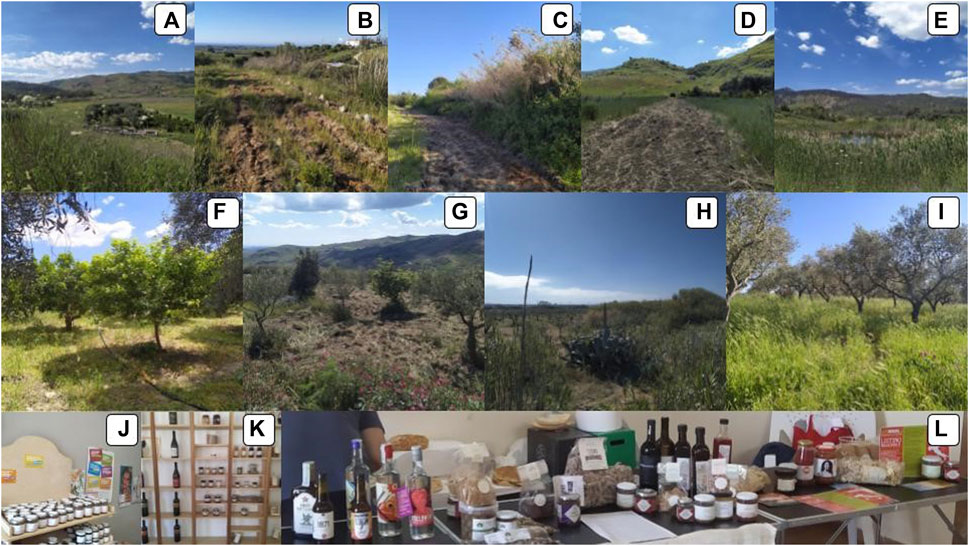
Figure 5. Documented agroecological practices. (A) Traditional farmer protection strategy with wooded area surrounding citrus grove (B–D) Traditional farmer fire defense strategy named “parafuoco” o “tagliafuoco” (firebreaks). (C) Fire defense strategy combined with maintenance of biodiversity sanctuary, “canneto” (canes, on the right). (E) Self-managed, natural water storage. (F) Irrigated traditional citrus grove (G–I) Agroecological olive groves showing healthy soils and high biodiversity (J–L) Transformed and commercialized products of the agroecological network. Photo credits: Luigi Conte.
On the other hand, we found that climatic constraints, local resources management, fire hazards, agribusiness, and public policies were obstacles for the diffusion of agroecological practices in the study area. We found that these topics consistently reinforced the limits or balanced the potentials of other system elements in all the three dimensions, as shown by the red horizontal rows in Figure 6. It was extensively reported that the climatic constraints reinforced the limits in the physical-environmental dimension by worsening water availability issues, by favoring fire spreading, by limiting the potentials of soils regeneration, and by enhancing the vulnerability of conventional agricultural systems. These patterns in narratives were recurrent and constitute a significant part of the local experiences, particularly related to water availability, as P6 explained talking about the climatic extreme conditions she faced - “In the last years we had to use water for emergency irrigation, and it has never been like this, we had to organize differently”. Extremes events influenced conventional systems as P6 witnessed - “Scary water bombs arrive, which together with wind, are the number one nightmare for greenhouse growers. They can destroy all the productive infrastructure.”, with dynamics which are less and less predictable as P9 also said - “The unpredictability has increased. (.) There are 10–11 degrees of daily temperature changes. The seasons are completely out of whack.”. The structural dependence of conventional cropping systems from high water and agrochemical inputs reduced the potentials of soil conservation and inclusion of alternative solutions. These patterns were evident in many narratives, for instance P10 said that - “Here everybody applies chemical treatments, it is insane. When there are fly attacks [on olive fruits] all farms start doing scheduled [chemical] treatments”. The same for P8 who said that–"[Here] Intensive production is characterized by the massive use of water, by the waste of water”. Other narratives focused also on the global scale, providing means to generalize the local dynamics, as P1 said - “We know, industrial agriculture is among the most polluting factors on the globe”. This dynamic is explained by P13 - “The idea of agriculture in our territory is not changing at all. Everybody keeps doing the same things as if nothing had happened.”, while P2 entered the details of the unsustainability of the agro-industrial systems - “Large olive monocultures require a lot of workforces to harvest them, in a territory where agricultural work does not have those forces, those needs attract seasonal farm laborers from Africa and therefore exploitation. Maintaining low prices causes someone within the supply chain not to be rewarded.".
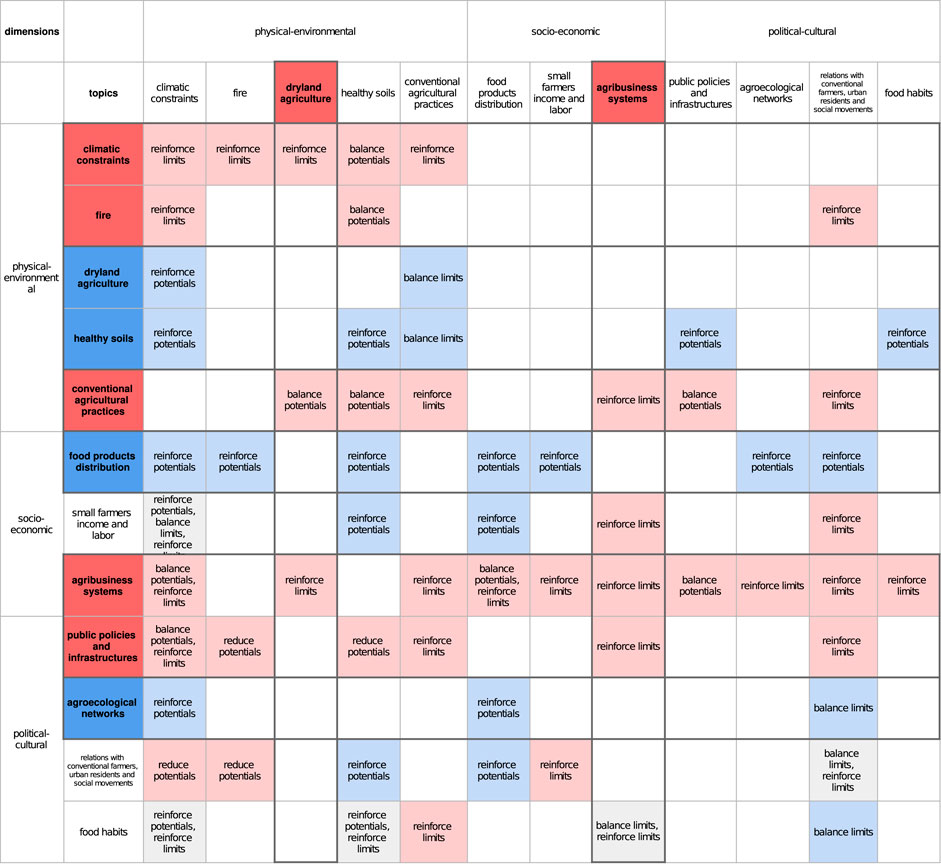
Figure 6. Synergies and trade-offs analysis of topics. The figure shows the relations between topic elements derived from the synergies and trade-offs of documented socio-ecological narratives (extended matrix in Supplementary Table S2). Light red and blue color codes are used to highlight respectively the limits and the potentials for an agroecological transition in Western Sicily emerging from this study. The dark red and blue color codes are used to highlight the topics which play a major role in limiting (red) or favoring (blue) the implementation of agroecology.
4 Discussion
4.1 Potentials and limits for an agroecological transition in Western Sicily
In this work we explored the potentials and limits of a transition to agroecology in Western Sicily by building on local ecological knowledge of local farmers and experts. Our results showed the complexity of a food system transition spanning physical-environmental, socio-economic, and political-cultural dimensions. The integration of these dimensions provided a systemic framework to analyze transition to agroecological from the grassroots level, highlighting the interconnectedness of local ecological knowledge, scientific knowledge, participative practices, social networks, economic and environmental policy frameworks.
4.1.1 Physical - environmental dimension
From a physical-environmental perspective, our findings highlighted a range of potentials for a transition to agroecology in Western Sicily. We documented local cultivation practices adapted to semi-arid climatic conditions, healthy soils management, and traditional fire spreading prevention strategies. These practices were based on the local knowledge of small farmers. They do not only potentially mitigate the reliance of producers on agrochemicals but may also contribute to the revival of abandoned agricultural lands, potentially steering the area towards agroecological practices. The effectiveness of field agroecological practices in creating better environmental conditions is a robust and general pattern found in many agroecological and environmental studies (Altieri and Toledo, 2005; Wezel et al., 2014; Altieri et al., 2015; Lujan Soto et al., 2021a; Chen et al., 2022; Dittimer et al., 2023). However, external challenges such as the increased unpredictability of climatic conditions, the mainstream dependence of local agriculture on external inputs and the erosion of traditional ecological knowledge pose significant barriers to a transition to agroecology in the study area. For instance, maladaptation of the agricultural sector, particularly in semi-arid climatic zones, have been documented in several industrial agriculture hotspots (Christian-Smith et al., 2015; Albizua et al., 2019; Asare-Nuamah et al., 2021).
Several studies highlighted the impact of climate change on agriculture in the Mediterranean region which pose significant risks to farming systems (Abd-Elmabod et al., 2020; Ali et al., 2022; Antonelli et al., 2022). However, only a few studies concentrated on community level assessments by looking at the interactions between climatic constraints and other local food system elements (Conway et al., 2019; Hauser et al., 2021). The increase in extreme climatic and environmental conditions may exacerbate existing challenges in the implementation of agroecological solutions, particularly for small farmers which are structurally under unstable economic conditions. Our emphasis on local and traditional ecological practices such as dryland farming and land stewardship aligns with the broader scientific findings that provided context-specific solutions and the valorization of local knowledge systems (Cuellar-Padilla and Calle-Collado, 2011; Loconto and Hatanaka, 2018; Lucas et al., 2019; Lujan Soto et al., 2021b; Carlisle, 2022). Nevertheless, our findings showed specific limits for the development of agroecological systems related to the unique climatic and political-cultural context of Sicily.
4.1.2 Socio - economic dimension
The potentials for a transition to agroecology is notably embedded in the collective actions of small farmers and cooperative associations (Lucas et al., 2019; Rosset et al., 2022). Within the context of Sicilian agroecological networks, solidarity economies based on self-management of farmers’ labor and sustainable food productions constitute a major emancipatory potential. This key economic role of solidarity economies and cooperative associations in the agroecological transition echoes other studies all over the world (Guzman et al., 2013; Kaufmann and Vogl, 2018; Van der Ploeg et al., 2019). However, the socio-economic challenges faced by small farmers in Western Sicily, such as competition with agribusiness and market access, are common topics found in Europe and worldwide (Van der Ploeg, 2008; Reardon et al., 2009). Studies from different regions often point out the difficulties of integrating smallholder farmers into sustainable value chains, the role of agribusiness and adverse market dynamics represent imposing obstacles (Gereffi et al., 2005; Corrado et al., 2018). The competitive pressure from large agro-industrial entities and distribution chains undermines small farming, highlighting a need for systemic changes to support local and sustainable agricultural practices (Lefèvre et al., 2020; Benegiamo et al., 2023). From this perspective, the EU’s agricultural approach has far-reaching implications for both territories and small-scale producers. While income support for agricultural producers has been a central focus since the establishment of the CAP and the introduction of rural development concepts marked a shift away from pure productivity motives, it still is true that food producers are considered secondary actors - if not negligible - within an agro-industrial system. Decision-making power is still primarily on the side of actors owning the authority and economic influence to impose food quality standards, environmental targets, food prices and labor conditions.
4.1.3 Political - cultural dimension
The Western Sicilian context added a nuanced understanding of how agroecological networks could work within the constraints of agribusiness dynamics building relational economies and mutualistic interactions. The emphasis on relational economies and collective land stewardship marked a pivotal potential to build participatory guarantee systems. Our findings reinforce and align with previous research exploring the path of participatory guarantee systems (Cuellar-Padilla and Ganuza-Fernandez, 2018; Loconto and Hatanaka, 2018; Lopez-Garcia et al., 2021). However, the exclusion of small farmers in policy dialogues, the inadequate infrastructures, and the dominance of agribusiness-centric models pose significant challenges for the implementation of agroecological principles in Western Sicily. Moreover, the loss of traditional ecological knowledge could trigger baseline shift phenomena further complicating the transition to agroecology.
The Western Sicilian case study further shed light on the specific policy and cultural barriers faced by local communities, contributing to a more holistic understanding of these issues. Beside maladaptation related to agricultural intensification, water management systems and the management of wildfires and fire hazards appears to be a real threat for people and agricultural productions, a risk which is connected to corporate interests that go beyond local communities (Giglioli and Swyngedouw, 2008).
4.2 Synergies and trade-offs
We determined a set of synergy and trade-off relations between the socio-ecological narratives, identifying the major vulnerabilities of the local food systems. From the analysis, dryland agriculture and the agribusiness system constitute overarching limitations for the development of agroecological systems in the study area. The result aligns with the current knowledge on the biophysical constraints operating on agricultural systems and on the behavior of agro-industrial food systems under external economic pressures and local limited resources (Weis, 2010; Clapp et al., 2018; Houser and Stuart, 2020). We reported that developing dryland agroecosystems had multiple constraints due to the actual conditions of climatic change in Sicily. As reported by expert participants, decrease in precipitation and rise in temperature already forced limitations in the adaptive role of traditional farming systems. Although, dryland farming practices are a potential for an agroecological transition in this area as they reduce external inputs. With this respect, agribusiness mechanisms have already pushed conventional agricultural systems beyond their carrying capacity. Moreover, the destructive competition between powerful economic actors and the small farmers participants contributed to their exclusion from the markets, from the social networks and from the political discourse.
4.3 Leverage actions for a transition to agroecology
In the context under study, imagining an agroecological transition requires actions to adapt to dryland conditions learning from small farmers’ knowledge (Altieri and Nicholls, 2017). These could happen by shifting towards native cultivations under rainfed conditions and by increasing local autonomous water storages. Native cultivations may provide concrete solutions if accompanied by a shift to more respectful management practices based on local ecological knowledge. More research and experimentation of dryland agroecosystem dynamics and the role of fire is required to provide support for an effective transition expecting more extreme climatic conditions. This could be achieved by applying participative methodologies for modeling and field experimentation of agroecological solutions in semi-arid conditions. In this process a decolonized and deconstructed contribution of scientific knowledge will be required to avoid maladaptation. Shifting from the actual management of water resources and fire hazards to new systems of participative land stewardship may provide overarching solutions that directly support agroecological farmers embedded into agribusiness power structures (McGreevy et al., 2022). This could be achieved by developing mutualistic relations within systems of participatory guarantee between farmers, researchers, and communities, but mostly by reducing the influence of global value chains on local food systems. Social practices related with food should include local ecological knowledge systems to make a transition to agroecology feasible. With this respect, designing specific educational programs that directly involve farmers providing them income support, could be an important action to implement. Policy targets must be set by including local small farmers, associations, and social movements, reducing the influence of powerful and dominant actors, such as agribusiness corporations based on conventional agro-industrial supply chains. The latter action would require upscale local communities and agroecological farmer voices in the public space. In this way, it would be possible to create the conditions for the vital interaction of diverse types of knowledge, including local and scientific knowledge.
5 Conclusion
Learning from local experts through the integration of participatory action research and systemic analysis represents a novel and critically relevant approach for agroecology and sustainability studies. Our approach can be applied as co-creative methodology within participatory action research initiatives that engages local and indigenous knowledge systems. Analyzing the local dimensions of agroecological transition through synergies and trade-off framework provides general categories for understanding the levers needed to build more sustainable food systems.
The systemic approach allowed us to shed light on the complexity of the local food system dynamics and identify the leverage points for transitioning to agroecology in the study area. We have identified three systemic leverage points: changing local resource management, moving away from agribusiness power structures, and organizing participatory guarantee systems. Transforming local water and fire hazard management into participatory stewardship systems, based on local farmers and community practices, is expected to boost agroecological productions. Shifting from the extractive agribusiness model to cooperative and participatory models is anticipated to foster the development of local, more sustainable food systems. Furthermore, organizing participatory guarantee systems might be an overarching solution to unite the local communities around concrete actions that recognize the pivotal role of people-environment relations in food systems. These levers are interdependent and should be operated simultaneously and in synergy.
The participatory action research methodology has proven effective for understanding the complexity of transitioning to agroecology. It holds transformative power as it facilitates the co-creation of knowledge through the interaction between local ecological and scientific insights within a systemic analysis framework. An equal, respectful, and clear positioning of scientists has shown great potential to foster the development of participatory guarantee systems. Farmers enhanced their awareness and capacity to share the ecological and social values of their experiences, while scientists have explored new ways to overcome the mistrust barriers traditionally associated with top-down approaches, which often hinder the development of trust, commitment and continuity. In this context, the scientist’s role as facilitator of knowledge co-creation processes is essential to drive a shift towards more sustainable food systems.
Future studies might focus on understanding the role of women and migrants in the Sicilian agroecological systems. The systematic involvement of conventional farmers might be interesting to acquire additional knowledge on their positionings, nevertheless such studies should aim at implementing concrete transition objectives by designing specific targets based on local ecological knowledge and agroecological principles. Developing a larger platform that involves scientists and experts capable of integrating agroecological farmers into evaluation, planning, experimentation, and implementation of agroecological solutions is a natural progression of this work. In this process, applying a participatory approach that merges disciplines and combines qualitative and quantitative methods might be key to developing successful initiatives.
Finding concrete agroecological solutions for transitioning to more sustainable food systems requires communities to have freedom to self-organize. This cannot be fully achieved in Sicily unless agroecological farmers are recognized as fundamental component of food systems. They already play a central role in the economies they represent and the land stewardship they practice. Without a change in the social practices related to food, the existing local agroecological knowledge will pass away in the time of a few generations. Therefore, taking concrete actions to let this knowledge circulate and be alive are essential in for sustainability and adaptation to climate change.
Data availability statement
The original contributions presented in the study are included in the article/Supplementary Material. Further inquiries can be directed to the corresponding author.
Author contributions
LC: Conceptualization, Investigation, Methodology, Data curation, Visualization, Formal Analysis, Writing–original draft, Writing–review and editing. JP: Visualization, Formal Analysis, Writing–review and editing. TF: Data curation, Writing–review and editing. AS: Visualization, Writing–review and editing. VC: Writing–review and editing. FG: Visualization, Formal analysis, Writing–review and editing, Supervision. MLC: Conceptualization, Investigation, Methodology, Data curation, Visualization, Formal analysis, Writing–review and editing, Supervision.
Funding
The author(s) declare that financial support was received for the research, authorship, and/or publication of this article. The publication costs of this work were supported by the Department of Environmental Science, Informatics and Statistics at Ca' Foscari University of Venice through funds available for open-access publications.
Acknowledgments
LC and MLC express their gratitude to all those involved in this project and study, including Scienza Radicata, Rete dell'Agricoltura Contadina e del Lavoro in Autogestione Fuorimercato-Sicilia, Contadinazioni, Azienda Agricola Bosco Falconeria, Collettivo LupoNero, Cianciana Calling, I raccolti di Tobia, Le Cuoche Combattenti, Il Gusto dei Colori, Arci Partinico Solidale, Casa Memoria Peppino e Felicia Impastato, Cooperativa Valdibella, Cooperativa Noe, and Ciauli AgriCoop for their participation and generous support. LC extends special thanks to IMAD (Instituto Meio Ambiente e Desenvolvimento). The research was supported by an independent crowdfunding.
Conflict of interest
The authors declare that the research was conducted in the absence of any commercial or financial relationships that could be construed as a potential conflict of interest.
The author(s) declared that they were an editorial board member of Frontiers, at the time of submission. This had no impact on the peer review process and the final decision.
Publisher’s note
All claims expressed in this article are solely those of the authors and do not necessarily represent those of their affiliated organizations, or those of the publisher, the editors and the reviewers. Any product that may be evaluated in this article, or claim that may be made by its manufacturer, is not guaranteed or endorsed by the publisher.
Supplementary material
The Supplementary Material for this article can be found online at: https://www.frontiersin.org/articles/10.3389/fenvs.2024.1347915/full#supplementary-material
References
Abd-Elmabod, S. K., Muñoz-Rojas, M., Jordán, A., Anaya-Romero, M., Phillips, J. D., Laurence, J., et al. (2020). Climate change impacts on agricultural suitability and yield reduction in a Mediterranean region. Geoderma 374, 114453. doi:10.1016/j.geoderma.2020.114453
Akakpo, K., Bouarfa, S., Benoît, M., and Leauthaud, C. (2021). Challenging agroecology through the characterization of farming practices’ diversity in Mediterranean irrigated areas. Eur. J. Agron. 128, 126284. doi:10.1016/j.eja.2021.126284
Albizua, A., Corbera, E., and Pascual, U. (2019). Farmers’ vulnerability to global change in Navarre, Spain: large-scale irrigation as maladaptation. Reg. Environ. Change 19 (4), 1147–1158. doi:10.1007/s10113-019-01462-2
Ali, E., Cramer, W., Carnicer, J., Georgopoulou, E., Hilmi, N. J. M., Le Cozannet, G., et al. (2022). “Cross-chapter paper 4: mediterranean region,” in Climate change 2022: impacts, adaptation, and vulnerability. Contribution of working group II to the sixth assessment report of the intergovernmental panel on climate change. Editors H.-O. Pörtner, D. C. Roberts, M. Tignor, E. S. Poloczanska, K. Mintenbeck, A. Alegríaet al. (Cambridge, UK and New York, NY, USA: Cambridge University Press), 2233–2272. doi:10.1017/9781009325844.021
Altieri, M. A. (2002). Agroecology: the science of natural resource management for poor farmers in marginal environments. Ecosyst. Environ. 93 (1-3), 1–24. doi:10.1016/s0167-8809(02)00085-3
Altieri, M. A., and Nicholls, C. I. (2017). The adaptation and mitigation potential of traditional agriculture in a changing climate. Clim. change 140, 33–45. doi:10.1007/s10584-013-0909-y
Altieri, M. A., Nicholls, C. I., Henao, A., and Lana, M. A. (2015). Agroecology and the design of climate change-resilient farming systems. Agron. Sustain. Dev. 35 (3), 869–890. doi:10.1007/s13593-015-0285-2
Altieri, M. A., and Toledo, V. M. (2005). Natural resource management among small-scale farmers in semi-arid lands: building on traditional knowledge and agroecology. Ann. Arid Zone 44 (3/4), 365.
Antonelli, M., Basile, L., Gagliardi, F., and Isernia, P. (2022). The future of the Mediterranean agri-food systems: trends and perspectives from a Delphi survey. Land Use Policy 120, 106263. doi:10.1016/j.landusepol.2022.106263
Asare-Nuamah, P., Dick-Sagoe, C., and Ayivor, R. (2021). Farmers’ maladaptation: eroding sustainable development, rebounding and shifting vulnerability in smallholder agriculture system. Environ. Dev. 40, 100680. doi:10.1016/j.envdev.2021.100680
Benegiamo, M., Corrado, A., and Fama, M. (2023). Agricultural digitalisation and just transition: a framework for the analysis. Italian Rev. Agric. Econ. 78 (2), 5–17. doi:10.36253/rea-14491
Bergez, J.-E., Audouin, E., and Therond, O. (2019) Agroecological transitions: from theory to practice in local participatory design. Springer Nature.
Berkes, F., Folke, C., and Gadgill, M. (1994). “Traditional ecological knowledge, biodiversity, resilience and sustainability,” in Biodiversity conservation: problems and policies. Papers from the biodiversity programme beijer international Institute of ecological economics royal Swedish academy of sciences (Dordrecht: Springer Netherlands), 269–287.
Bezner Kerr, R. (2023). Maladaptation in food systems and ways to avoid it. Curr. Opin. Environ. Sustain. 61, 101269. doi:10.1016/j.cosust.2023.101269
Bezner Kerr, R., Postigo, J. C., Smith, P., Cowie, A., Singh, P. K., Rivera-Ferre, M., et al. (2023). Agroecology as a transformative approach to tackle climatic, food, and ecosystemic crises. Curr. Opin. Environ. Sustain. 62, 101275. doi:10.1016/j.cosust.2023.101275
Bordi, I., Fraedrich, K., Petitta, M., and Sutera, A. (2007). Extreme value analysis of wet and dry periods in Sicily. Theor. Appl. Climatol. 87 (1–4), 61–71. doi:10.1007/s00704-005-0195-3
Borras, S. M., and, J. R., and Franco, J. C. (2023). “Scholar-activism and land struggles,” in Agrarian change and peasant studies (Rugby, UK: Practical Action Publishing).
Bradley, K., and Herrera, H. (2016). Decolonizing food justice: naming, resisting, and researching colonizing forces in the movement. Antipode 48 (1), 97–114. doi:10.1111/anti.12165
Cagnoni, F. (1976). Valle del Belice, terremoto di Stato (Vol. 1). Milano, Italia: Contemporanea edizioni.
Calvet-Mir, L., Benyei, P., Aceituno-Mata, L., Pardo-de-Santayana, M., López-García, D., Carrascosa-García, M., et al. (2018). The contribution of traditional agroecological knowledge as a digital commons to agroecological transitions: the case of the CONECT-e platform. Sustainability 10 (9), 3214. doi:10.3390/su10093214
Capaccioni, B., Didero, M., Paletta, C., and Didero, L. (2005). Saline intrusion and refreshening in a multilayer coastal aquifer in the Catania Plain (Sicily, Southern Italy): dynamics of degradation processes according to the hydrochemical characteristics of groundwaters. J. Hydrology 307 (1–4), 1–16. doi:10.1016/j.jhydrol.2004.08.037
Carlisle, L. (2022) Healing grounds: climate, justice, and the deep roots of regenerative farming. Washington, DC: Island Press.
Chen, J., Zhong, F., and Sun, D. (2022). Lessons from farmers’ adaptive practices to climate change in China: a systematic literature review. Environ. Sci. Pollut. Res. 29 (54), 81183–81197. doi:10.1007/s11356-022-23449-z
Christian-Smith, J., Levy, M. C., and Gleick, P. H. (2015). Maladaptation to drought: a case report from California, USA. Sustain. Sci. 10 (3), 491–501. doi:10.1007/s11625-014-0269-1
Clapp, J., Newell, P., and Brent, Z. W. (2018). The global political economy of climate change, agriculture and food systems. J. Peasant Stud. 45 (1), 80–88. doi:10.1080/03066150.2017.1381602
Conway, D., Nicholls, R. J., Brown, S., Tebboth, M. G. L., Adger, W. N., Ahmad, B., et al. (2019). The need for bottom-up assessments of climate risks and adaptation in climate-sensitive regions. Nat. Clim. Change 9 (7), 503–511. doi:10.1038/s41558-019-0502-0
Corrado, A., Lo Cascio, M., and Perrotta, D. (2018). “Introduzione: per un'analisi critica delle filiere e dei sistemi agroalimentari in Italia,” in Meridiana: rivista di storia e scienze sociali 93 (3), 9–26. doi:10.23744/1829
Cuadros-Casanova, I., Cristiano, A., Biancolini, D., Cimatti, M., Sessa, A. A., Mendez Angarita, V. Y., et al. (2023). Opportunities and challenges for common agricultural policy reform to support the European green deal. Conserv. Biol. 37, e14052. doi:10.1111/cobi.14052
Cuéllar-Padilla, M., and Calle-Collado, Á. (2011). Can we find solutions with people? Participatory action research with small organic producers in Andalusia. J. Rural Stud. 27 (4), 372–383. doi:10.1016/j.jrurstud.2011.08.004
Cuéllar-Padilla, M., and Ganuza-Fernandez, E. (2018). We don’t want to be officially certified! Reasons and implications of the participatory guarantee systems. Sustainability 10 (4), 1142. doi:10.3390/su10041142
Davelaar, D. (2021). Transformation for sustainability: a deep leverage points approach. Sustain. Sci. 16 (3), 727–747. doi:10.1007/s11625-020-00872-0
De Filippis, F., and Henke, R. (2014). “L’agricoltura del Mezzogiorno tra vincoli strutturali e nuove funzioni,” in L'economia reale nel Mezzogiorno (Bologna: Il Mulino), 169–205.
Dittmer, K. M., Rose, S., Snapp, S. S., Kebede, Y., Brickman, S., Shelton, S., et al. (2023). Agroecology can promote climate change adaptation outcomes without compromising yield in smallholder systems. Environ. Manag. 72 (2), 333–342. doi:10.1007/s00267-023-01816-x
Donta, A. A., Lange, M. A., and Herrmann, A. (2005) Water on Mediterranean Islands: current conditions and prospects for sustainable management. Muenster: University of Muenster: Centre for Environment Research
Drago, A. (2006) I processi di desertificazione e i possibili interventi di mitigazione Desertification processes and possible mitigation actions. Available at: http://www.sias.regione.sicilia.it/pdf/Desertificazione_mitigazione_SIAS.pdf
Elo, S., and Kyngäs, H. (2008). The qualitative content analysis process. J. Adv. Nurs. 62 (1), 107–115. doi:10.1111/j.1365-2648.2007.04569.x
Fantappiè, M., Priori, S., and Costantini, E. A. C. (2015). Soil erosion risk, Sicilian Region (1:250,000 scale). J. Maps 11 (2), 323–341. doi:10.1080/17445647.2014.956349
Fischer, J., and Riechers, M. (2019). A leverage points perspective on sustainability. People Nat. 1 (1), 115–120. doi:10.1002/pan3.13
Forestieri, A., Lo Conti, F., Blenkinsop, S., Cannarozzo, M., Fowler, H. J., and Noto, L. V. (2018). Regional frequency analysis of extreme rainfall in Sicily (Italy). Int. J. Climatol. 38, e698–e716. doi:10.1002/joc.5400
Francis, C., Lieblein, G., Gliessman, S., Breland, T. A., Creamer, N., Harwood, R., et al. (2003). Agroecology: the ecology of food systems. J. Sustain. Agric. 22 (3), 99–118. doi:10.1300/J064v22n03_10
Frank, M., Amoroso, M. M., Propedo, M., and Kaufmann, B. (2022). Co-inquiry in agroecology research with farmers: transdisciplinary co-creation of contextualized and actionable knowledge. Agroecol. Sustain. Food Syst. 46 (4), 510–539. doi:10.1080/21683565.2021.2020948
García-Martín, M., Torralba, M., Quintas-Soriano, C., Kahl, J., and Plieninger, T. (2021). Linking food systems and landscape sustainability in the Mediterranean region. Landsc. Ecol. 36 (8), 2259–2275. doi:10.1007/s10980-020-01168-5
Gereffi, G., Humphrey, J., and Sturgeon, T. (2005). The governance of global value chains. Rev. Int. political Econ. 12 (1), 78–104. doi:10.1080/09692290500049805
Gereffi, G., and Lee, J. (2012). Why the world suddenly cares about global supply chains. J. supply chain Manag. 48 (3), 24–32. doi:10.1111/j.1745-493x.2012.03271.x
Giglioli, I., and Swyngedouw, E. (2008). Let’s drink to the great thirst! Water and the politics of fractured techno-natures in sicily. Int. J. Urban Regional Res. 32 (2), 392–414. doi:10.1111/j.1468-2427.2008.00789.x
Giorgi, F., and Lionello, P. (2008). Climate change projections for the Mediterranean region. Glob. Planet. Change 63 (2–3), 90–104. doi:10.1016/j.gloplacha.2007.09.005
Giraldo, O. F., and Rosset, P. M. (2022). Emancipatory agroecologies: social and political principles. J. Peasant Stud. 50 (3), 820–850. doi:10.1080/03066150.2022.2120808
Gliessman, S. (2016). Transforming food systems with agroecology. Agroecol. Sustain. Food Syst. 40 (3), 187–189. doi:10.1080/21683565.2015.1130765
Goodman, D. (2003). The quality ‘turn’ and alternative food practices: reflections and agenda. J. rural Stud. 19 (1), 1–7. doi:10.1016/s0743-0167(02)00043-8
Guzmán, G. I., López, D., Román, L., and Alonso, A. M. (2013). Participatory action research in agroecology: building local organic food networks in Spain. Agroecol. Sustain. Food Syst. 37 (1), 120904081413002–120904081413146. doi:10.1080/10440046.2012.718997
Hauser, D. D., Whiting, A. V., Mahoney, A. R., Goodwin, J., Harris, C., Schaeffer, R. J., et al. (2021). Co-production of knowledge reveals loss of Indigenous hunting opportunities in the face of accelerating Arctic climate change. Environ. Res. Lett. 16 (9), 095003. doi:10.1088/1748-9326/ac1a36
Hennink, M., and Kaiser, B. N. (2022). Sample sizes for saturation in qualitative research: a systematic review of empirical tests. Soc. Sci. Med. 292, 114523. doi:10.1016/j.socscimed.2021.114523
Houser, M., and Stuart, D. (2020). An accelerating treadmill and an overlooked contradiction in industrial agriculture: climate change and nitrogen fertilizer. J. Agrar. Change 20 (2), 215–237. doi:10.1111/joac.12341
Ingram, J. (2018). Agricultural transition: niche and regime knowledge systems’ boundary dynamics. Environ. Innovation Soc. Transitions 26, 117–135. doi:10.1016/j.eist.2017.05.001
Jones, S. K., Bergamini, N., Beggi, F., Lesueur, D., Vinceti, B., Bailey, A., et al. (2022). Research strategies to catalyze agroecological transitions in low- and middle-income countries. Sustain. Sci. 17 (6), 2557–2577. doi:10.1007/s11625-022-01163-6
Kaufmann, S., and Vogl, C. R. (2018). Participatory Guarantee Systems (PGS) in Mexico: a theoretic ideal or everyday practice? Agric. Hum. values 35, 457–472. doi:10.1007/s10460-017-9844-2
La Mela Veca, D. S., Cullotta, S., Sferlazza, S., and Maetzke, F. G. (2016). Anthropogenic influences in land Use/Land cover changes in mediterranean forest landscapes in Sicily. Land 5 (1), 3. doi:10.3390/land5010003
Lefèvre, A., Perrin, B., Lesur-Dumoulin, C., Salembier, C., and Navarrete, M. (2020). Challenges of complying with both food value chain specifications and agroecology principles in vegetable crop protection. Agric. Syst. 185, 102953. doi:10.1016/j.agsy.2020.102953
Levis, C., Flores, B. M., Campos-Silva, J. V., Peroni, N., Staal, A., Padgurschi, M. C., et al. (2024). Contributions of human cultures to biodiversity and ecosystem conservation. Nat. Ecol. Evol. 8, 866–879. doi:10.1038/s41559-024-02356-1
Liuzzo, L., Bono, E., Sammartano, V., and Freni, G. (2016). Analysis of spatial and temporal rainfall trends in Sicily during the 1921–2012 period. Theor. Appl. Climatol. 126 (1–2), 113–129. doi:10.1007/s00704-015-1561-4
Lo Cascio, M. (2022) Agricoltura, lavoro e migrazioni in Sicilia: una ricerca etnografica sulla filiera olivicola. Varazze, Italia: PM edizioni.
Loconto, A., and Hatanaka, M. (2018). Participatory guarantee systems: alternative ways of defining, measuring, and assessing sustainability. Sociol. Rural. 58 (2), 412–432. doi:10.1111/soru.12187
López-García, D., Cuéllar-Padilla, M., de Azevedo Olival, A., Laranjeira, N. P., Méndez, V. E., Peredo y Parada, S., et al. (2021). Building agroecology with people. Challenges of participatory methods to deepen on the agroecological transition in different contexts. J. Rural Stud. 83, 257–267. doi:10.1016/j.jrurstud.2021.02.003
Lopez-Ridaura, S. (2022). Agroecology and systems analysis for sustainable agriculture. J. Rural Problems 58 (1), 31–35. doi:10.7310/arfe.58.31
Lucas, V., Gasselin, P., and Van Der Ploeg, J. D. (2019). Local inter-farm cooperation: a hidden potential for the agroecological transition in northern agricultures. Agroecol. Sustain. food Syst. 43 (2), 145–179. doi:10.1080/21683565.2018.1509168
Luján Soto, R., de Vente, J., and Cuéllar Padilla, M. (2021). Learning from farmers’ experiences with participatory monitoring and evaluation of regenerative agriculture based on visual soil assessment. J. Rural Stud. 88, 192–204. doi:10.1016/j.jrurstud.2021.10.017
Luján Soto, R., Martínez-Mena, M., Cuéllar Padilla, M., and de Vente, J. (2021). Restoring soil quality of woody agroecosystems in Mediterranean drylands through regenerative agriculture. Agric. Ecosyst. Environ. 306, 107191. doi:10.1016/j.agee.2020.107191
Luukkanen, J., Vehmas, J., Panula-Ontto, J., Allievi, F., Kaivo-oja, J., Pasanen, T., et al. (2012). Synergies or trade-offs? A new method to quantify synergy between different dimensions of sustainability. Environ. policy Gov. 22 (5), 337–349. doi:10.1002/eet.1598
Mariotti, A., Pan, Y., Zeng, N., and Alessandri, A. (2015). Long-term climate change in the Mediterranean region in the midst of decadal variability. Clim. Dyn. 44 (5–6), 1437–1456. doi:10.1007/s00382-015-2487-3
Mastrocicco, M., and Colombani, N. (2021). The issue of groundwater salinization in coastal areas of the mediterranean region: a review. Water 13 (1), 90. doi:10.3390/w13010090
McGreevy, S. R., Rupprecht, C. D., Niles, D., Wiek, A., Carolan, M., Kallis, G., et al. (2022). Sustainable agrifood systems for a post-growth world. Nat. Sustain. 5 (12), 1011–1017. doi:10.1038/s41893-022-00933-5
Meadows, D. H. (2008) Thinking in systems: a primer. White River Junction, VT: Chelsea Green Publishing.
Murdoch, J., Marsden, T., and Banks, J. (2017). “Quality, nature, and embeddedness: some theoretical considerations in the context of the food sector,” in The rural (London, UK: Routledge), 107–126.
Paola Imperatore (2023) “Territori in lotta,” in Capitalismo globale e giustizia ambientale nell’era della crisi climatica. Milano, Italia: Meltemi.
Pausas, J. G., and Millán, M. M. (2019). Greening and browning in a climate change hotspot: the mediterranean basin. BioScience 69 (2), 143–151. doi:10.1093/biosci/biy157
Pirrone, M. (2015). Mitologia dell’integrazione in Sicilia. Quest. Teor. casi empirici. Milano, Italia: Mimesis.
Pirrone, M. A. (2007) Crocevia e trincea: la Sicilia come frontiera mediterranea. Roma, Italia: XL Edizioni.
Reardon, T., Barrett, C. B., Berdegué, J. A., and Swinnen, J. F. (2009). Agrifood industry transformation and small farmers in developing countries. World Dev. 37 (11), 1717–1727. doi:10.1016/j.worlddev.2008.08.023
Röös, E., Mayer, A., Muller, A., Kalt, G., Ferguson, S., Erb, K. H., et al. (2022). Agroecological practices in combination with healthy diets can help meet EU food system policy targets. Sci. Total Environ. 847, 157612. doi:10.1016/j.scitotenv.2022.157612
Rosset, P. (2013). Re-thinking agrarian reform, land and territory in La via Campesina. J. Peasant Stud. 40 (4), 721–775. doi:10.1080/03066150.2013.826654
Rosset, P. M., Barbosa, L. P., Val, V., and McCune, N. (2022). Critical Latin American agroecology as a regionalism from below. Globalizations 19 (4), 635–652. doi:10.1080/14747731.2021.1923353
Sachet, E., Mertz, O., Le Coq, J. F., Cruz-Garcia, G. S., Francesconi, W., Bonin, M., et al. (2021). Agroecological transitions: a systematic review of research approaches and prospects for participatory action methods. Front. Sustain. Food Syst. 5, 709401. doi:10.3389/fsufs.2021.709401
Schipanski, M. E., MacDonald, G. K., Rosenzweig, S., Chappell, M. J., Bennett, E. M., Kerr, R. B., et al. (2016). Realizing resilient food systems. BioScience 66 (7), 600–610. doi:10.1093/biosci/biw052
Schipper, E. L. F., Revi, A., Preston, B. L., Carr, E. R., Eriksen, S. H., Fernandez-Carril, L. R., et al. (2022). “Climate resilient development pathways,” in Climate change 2022: impacts, adaptation, and vulnerability. Contribution of working group II to the sixth assessment report of the intergovernmental panel on climate change. Editors H.-O. Pörtner, D. C. Roberts, M. Tignor, E. S. Poloczanska, K. Mintenbeck, A. Alegríaet al. (Cambridge, UK and New York, NY, USA: Cambridge University Press), 2655–2807. doi:10.1017/9781009325844.027
Singh, C., Dorward, P., and Osbahr, H. (2016). Developing a holistic approach to the analysis of farmer decision-making: implications for adaptation policy and practice in developing countries. Land Use Policy 59, 329–343. doi:10.1016/j.landusepol.2016.06.041
Singh, C., Ford, J., Ley, D., Bazaz, A., and Revi, A. (2020). Assessing the feasibility of adaptation options: methodological advancements and directions for climate adaptation research and practice. Clim. Change 162, 255–277. doi:10.1007/s10584-020-02762-x
Spirito, F., Blanco, V., and Navarro, R. M. (2024). “Agroecology as a transformative approach to sustainable food systems,” in Critical sustainability sciences (London, UK: Routledge), 200–218.
Tiwari, A. K., Pisciotta, A., and De Maio, M. (2019). Evaluation of groundwater salinization and pollution level on Favignana Island, Italy. Environ. Pollut. 249, 969–981. doi:10.1016/j.envpol.2019.03.016
Tongco, M. D. C. (2007). Purposive sampling as a tool for informant selection. Ethnobot. Res. Appl. 5, 147–158. doi:10.17348/era.5.0.147-158
Tuel, A., and Eltahir, E. A. B. (2020). Why is the mediterranean a climate change hot spot? J. Clim. 33 (14), 5829–5843. doi:10.1175/jcli-d-19-0910.1
Utter, A., White, A., Méndez, V. E., and Morris, K. (2021). Co-creation of knowledge in agroecology. Elem. Sci. Anth 9 (1), 00026. doi:10.1525/elementa.2021.00026
Van Der Ploeg, J. D. (2008). “The new peasantries,” in Struggles for autonomy and sustainability in an Era of empire and globalization (London and Sterling, VA: Earthscan).
Van der Ploeg, J. D., Barjolle, D., Bruil, J., Brunori, G., Costa Madureira, L. M., Dessein, J., et al. (2019). The economic potential of agroecology: empirical evidence from Europe. J. Rural Stud. 71, 46–61. doi:10.1016/j.jrurstud.2019.09.003
Viola, F., Liuzzo, L., Noto, L. V., Lo Conti, F., and La Loggia, G. (2014). Spatial distribution of temperature trends in Sicily. Int. J. Climatol. 34 (1), 1–17. doi:10.1002/joc.3657
Weiner, J. (2017). Applying plant ecological knowledge to increase agricultural sustainability. J. Ecol. 105 (4), 865–870. doi:10.1111/1365-2745.12792
Weis, T. (2010). The accelerating biophysical contradictions of industrial capitalist agriculture. J. Agrar. change 10 (3), 315–341. doi:10.1111/j.1471-0366.2010.00273.x
Wezel, A., Bellon, S., Doré, T., Francis, C., Vallod, D., and David, C. (2009). Agroecology as a science, a movement and a practice. A review. A Rev. Agron. Sustain. Dev. 29 (4), 503–515. doi:10.1051/agro/2009004
Wezel, A., Casagrande, M., Celette, F., Vian, J. F., Ferrer, A., and Peigné, J. (2014). Agroecological practices for sustainable agriculture. A review. Agron. Sustain. Dev. 34 (1), 1–20. doi:10.1007/s13593-013-0180-7
Keywords: agroecology, local knowledge, participatory action research, systems thinking, agroecological transition, small farmers, complexity, socio-ecological systems
Citation: Conte L, Prakofjewa J, Floridia T, Stocco A, Comar V, Gonella F and Lo Cascio M (2024) Learning from farmers on potentials and limits for an agroecological transition: a participatory action research in Western Sicily. Front. Environ. Sci. 12:1347915. doi: 10.3389/fenvs.2024.1347915
Received: 01 December 2023; Accepted: 27 May 2024;
Published: 16 August 2024.
Edited by:
Maureen G. Reed, University of Saskatchewan, CanadaReviewed by:
Muhammad Ziaul Hoque, Bangabandhu Sheikh Mujibur Rahman Agricultural University, BangladeshCristina Amaro Costa, Instituto Politecnico de Viseu, Portugal
Copyright © 2024 Conte, Prakofjewa, Floridia, Stocco, Comar, Gonella and Lo Cascio. This is an open-access article distributed under the terms of the Creative Commons Attribution License (CC BY). The use, distribution or reproduction in other forums is permitted, provided the original author(s) and the copyright owner(s) are credited and that the original publication in this journal is cited, in accordance with accepted academic practice. No use, distribution or reproduction is permitted which does not comply with these terms.
*Correspondence: Luigi Conte, bHVpZ2kuY29udGVAdW5pdmUuaXQ=
†These authors share last authorship