 Rachel R. Y. Oh1,2*
 Richard A. Fuller3
 Birte Peters1,2
 Angela J. Dean3,4
 Nancy A. Pachana5Corey T. Callaghan6Nicola J. Sockhill3
 Aletta Bonn1,2,7
 Andres F. Suarez-Castro8
- 1Department of Biodiversity and People, Helmholtz Centre for Environmental Research (UFZ), Leipzig, Germany
- 2German Centre for Integrative Biodiversity Research (iDiv) Halle-Jena-Leipzig, Leipzig, Germany
- 3School of the Environment, The University of Queensland, Brisbane, QLD, Australia
- 4School of Agriculture and Food Sustainability, The University of Queensland, Gatton, QLD, Australia
- 5School of Psychology, The University of Queensland, St Lucia, QLD, Australia
- 6Department of Wildlife Ecology and Conservation, Fort Lauderdale Research and Education Center, University of Florida, Davie, FL, United States
- 7Institute of Biodiversity, Friedrich Schiller University Jena, Jena, Germany
- 8Australian Rivers Institute, School of Environment and Science, Griffith University, Nathan, QLD, Australia
Engagement in biodiversity citizen science initiatives can confer health and wellbeing benefits to individuals and communities. Yet, few biodiversity citizen science initiatives are explicitly planned to optimize health and wellbeing as a potential co-benefit, leading to missed opportunities for biodiversity conservation and human health. In this perspective, we use a dose-response approach to discuss the components that determine how engagement in biodiversity citizen science initiatives map onto opportunities to foster health and wellbeing benefits. We considered aspects related to the duration and frequency of contact with nature, and the intensity of interactions with nature and between individuals to highlight the different health benefits across the variety of citizen science initiatives. To illustrate these aspects, we use a sample of 95 citizen science initiatives from seven English and non-English-speaking countries and show how careful project design can increase the potential to confer health and wellbeing benefits to participants. We conclude with considerations on how to enhance the health and wellbeing benefits from citizen science initiatives, and propose potential research avenues to assess synergies and trade-offs between benefits to biodiversity and human health from these initiatives.
Introduction
Citizen (or community) science initiatives focused on crowd-sourcing biodiversity data are increasing rapidly in number and scale. These broadly refer to initiatives that engage volunteers (members of the public, who may or may not be scientifically trained) to work with professional scientists to collectively gather and/or process data (Miller-Rushing et al., 2012; Bonney et al., 2016). Consequently, citizen science data now form one of the predominant sources of biodiversity data (Fritz et al., 2019), is widely used to track biodiversity change (Forister et al., 2021), inform on-the-ground conservation approaches (Sullivan et al., 2017), and quantify ecological processes and species interactions (Groom et al., 2021) in many regions of the world. However, the potential benefits of citizen science initiatives extend far beyond the contribution of biodiversity data (Peter et al., 2021; Williams et al., 2021). Understanding the aspects that influence how people benefit from these initiatives can have important implications for policies that improve human health and wellbeing.
Citizen science projects can enhance human health through interactions with nature (Nigg et al., 2022), and the social contexts within which these projects operate. As most biodiversity citizen science projects require participants to be outdoors to collect data on biodiversity and the environment, these initiatives facilitate health-promoting behaviors such as physical exercise through walking and hiking (Warburton and Bredin, 2017; Biddle et al., 2019). A physical immersion in nature activates psychological and physiological mechanisms that can directly and indirectly reduce stress, improve mood (Alcock et al., 2014), and enhance cognitive function (Stobbe et al., 2022). Citizen science initiatives often require active engagement from participants in biodiversity data collection, and this could offer greater psychological benefits than the passive experience of visiting greenspaces. Furthermore, the inherently social and collaborative nature of citizen science initiatives often necessitates interactions among participants, fostering social connections and reducing social isolation―key factors for strengthened mental resilience and wellbeing (Evans et al., 2005; Jordan et al., 2011). Citizen science initiatives may also create opportunities to empower marginalized groups, such as older adults, to effect meaningful changes in their environment, as seen in projects documenting urban features for healthy aging (Wood et al., 2022). Participation in citizen science initiatives can promote personal growth, learning, and a sense of purpose (Day et al., 2022), contributing to overall wellbeing and life satisfaction, and potentially benefiting physical and mental health (Pocock et al., 2023).
From a health perspective, biodiversity citizen science projects encompass numerous elements that foster health-promoting behaviors, positioning them as potential “nature-based interventions” for healthcare practitioners. Nature-based interventions are intentional programs, activities or strategies designed to engage individuals in nature-based experiences with the specific objective of enhancing health and wellbeing (Shanahan et al., 2019; Gritzka et al., 2020). The growing interest in nature-based interventions is fueled by the global mental health crisis and a need to reduce the production and consumption of pharmaceutical products to minimize their adverse impacts on the climate, environment and biodiversity (Van Den Bosch and Ode Sang, 2017; Belkhir and Elmeligi, 2019; Gworek et al., 2021; Helwig et al., 2024). Research has shown that increased engagement with nature can buffer the negative mental and behavioral impacts of intense stressful events, such as the COVID-19 pandemic (Berdejo-Espinola et al., 2021). Nature-based interventions are centered around green (e.g., urban parks, forests and wilderness), blue (rivers, lakes, coastal areas) and other natural elements (e.g., geological formations). They encompass a wide range of activities, from the development of community gardens, to sea swimming initiatives and wilderness programs (Hunter et al., 2019). These interventions can be conducted in individual or group settings. Nature-based interventions not only support health promotion and prevention, but may also be recommended as treatments within a broader suite of therapeutic tools (De Bell et al., 2024). Biodiversity citizen science projects thus represent a crucial opportunity for healthcare systems to innovate their services (Britton et al., 2020). Urban and public health administrations are beginning to acknowledge the importance of proximity to, and interaction with natural environments as proactive health interventions for populations (Maller et al., 2006).
Here, we illustrate how engagement in biodiversity citizen science projects create opportunities to foster health and wellbeing benefits. We present a dose-response perspective to discuss the main components that determine the potential health benefits of biodiversity citizen science initiatives, and how it supports a rapid and comprehensive assessment of nature exposure in relation to social determinants of health. We demonstrate its application with two case studies that represent the primary ways we interact with nature daily: direct and indirect engagement. We then discuss considerations for extending biodiversity citizen science initiatives as nature-based health interventions, and explore potential synergies and trade-offs between biodiversity and human health goals. To fully recognize the suite of conservation and health benefits associated with engagement in biodiversity citizen science projects, we argue for an explicit consideration of the pathways that amplify human health and wellbeing benefits. This holistic understanding is essential to maximize the positive impacts of these projects on both biodiversity conservation and human health.
Evaluating nature exposure in biodiversity citizen science initiatives
Our approach encompasses two major components: (i) the interactions that individuals have with nature; and (ii) the social determinants of health, such as forming quality relationships with others. This approach integrates perspectives from ecology and health. The dose-response perspective was originally developed to model the effect of a dose of a substance or activity on health outcome(s) of an individual, community or population (Altshuler, 1981). It has been used to determine the duration and intensity of physical activity associated with premature mortality and the prevention of chronic medical conditions such as cardiovascular disease (Warburton and Bredin, 2017). It has also been adapted to assess the components of nature exposure that impact human health, such as (i) the frequency of exposure (how often), (ii) the duration of exposure (how long), and (iii) the intensity of exposure (the quality or quantity of nature itself; Shanahan et al., 2015; 2016).
This perspective can be applied to understand the spatial and temporal dynamics (quantity) of opportunities for human-nature interactions within a citizen science initiative, and across groups of initiatives. Of key relevance are measures of how frequently a citizen science event occurs and the duration of each event. These metrics are crucial as they also define the sampling effort in biodiversity data collection, and commonly take the form of how much time, distance or area covered by the data collector and typically reflected in the metadata of the biodiversity data generated through citizen science initiatives. For example, sampling effort using eBird data (a citizen science platform used to record bird species) can be quantified using the total number of checklists submitted for a given location and time period, providing an indication of observer activity (Box 1; Sullivan et al., 2017).
The intensity of exposure is less well-defined as it is highly dependent on the scientific discipline of the citizen science project. For environmental projects, this could be tied to measures of biodiversity, such as the number of taxonomic groups (e.g., plants, vertebrates) and taxonomic diversity (e.g., encountering 50 versus 10 bird species). It could also be the structural complexity of the natural environment where these citizen science initiatives take place; for instance, a patch with more vertical layers of vegetation is more complex and thus may deliver a more intense interaction with nature than a simple grass lawn. From a social health perspective, intensity of exposure can involve measures that recognize the balance between costs and benefits, such as the degree of urbanization intensity. A person’s overall health status is therefore a function of exposure to nature (benefits) and human stressors (costs; White et al., 2023). This approach also considers social determinants of health, including whether the initiatives are conducted in individual or group settings, the extent of contact between participants and project staff or researchers, participants’ gain in knowledge and skills, and the degree to which citizen scientists experience a sense of contribution and recognition.
Box 1: eBird (direct nature contact)
eBird is a popular field-based data collection app, wherein individuals submit checklists of bird species, and their abundances, they encounter as the primary data. Each checklist also captures secondary data relating to the sampling effort (i.e., the duration and route taken during the birdwatching activity) and the number of birders present (i.e., if the birding event was done alone or as a group, as each checklist could be “shared” with other birders). From a conservation perspective, checklists aggregated at a specific location across time are analyzed to assess changes in bird population trends and composition. From a health perspective, the “sampling effort” secondary data provides a measure of the quantity of nature contact. Aggregated across time and space, checklists submitted by one individual could provide objective measures on how frequently they engage with nature, and the average duration per nature visit. The geolocated data could then be associated with other environmental data such as digital elevation maps and landcover maps to generate a measure of the intensity (e.g., whether the birdwatching took place within a highly dense and polluted city or within wildlands) of the nature-based physical activity, with possible links to health-centric measures such as energy expenditure. Further inquiry could include investigating whether nature contact varies by socio-demographic factors such as group size, age and gender. This may be particularly useful for public health researchers and practitioners to explore the use of biodiversity citizen science initiatives on potentially at-risk communities such as those who are socially isolated, groups such as older adults or those living with mobility or sensory limitations who are in search of meaningful engagement and use of their skills, and persons with chronic illness who often struggle to re-engage in physical activities and communities of shared interest.
Box 2: FrogFind (Indirect nature contact)
FrogFind is an online citizen science initiative where each participant is presented with a 30 s audio clip collected from an Australian habitat. Each clip may contain calling frogs, and participants are asked to identify the species of frog(s) calling. There is also a forum for online social interaction between participants and between participants and project staff and researchers. From a conservation perspective, analyzed calls support herpetologists in understanding the spatial and temporal distribution of target frog species. From a public health perspective, exposure to natural soundscapes (typically characterized by sounds from animals, wind or water; Buxton et al., 2021) can have a range of positive effects related to wellbeing, including improved mood and cognitive function (Buxton et al., 2021; Stobbe et al., 2022). Some research suggests that greater species richness may contribute to more mental health benefits (Fisher et al., 2021) but findings are mixed (Rozario et al., 2023). Indirect nature contact could also be useful for persons with functional limitations, such as impaired mobility. While they may be unable to directly interact with nature, they can help in the categorization or analysis of nature-based data, which could contribute to their wellbeing through engagement in a meaningful activity and/or with a like-minded community; the astronomy community provides an excellent model here (Christian et al., 2012). The burgeoning “passive citizen science” literature using social media to document aspects of nature is also notable; for example, observational data of diurnal birds by photographers on Flickr aligns closely with data compiled through the National Biodiversity Network Atlas (Edwards et al., 2021), and could be a way to engage an even wider community in terms of awareness and engagement with nature.
Evaluating health and wellbeing outcomes from biodiversity citizen science initiatives
Quantifying health and wellbeing outcomes in biodiversity citizen science initiatives requires approaches that can be tailored to the specifics of each initiative. Methods range from administrating surveys before and after program engagement, to implementing more holistic frameworks involving healthcare practitioners. Regardless of the chosen approach, it is essential to distinguish between short-term and long-term outcomes. Short-term outcomes, such as stress levels, can be measured immediately before and after participation, and are more likely to improve after a short-term, one-off citizen science event (Oh et al., 2024). Long-term outcomes, such as depressive symptoms, are less responsive to short-term interventions (Oh et al., 2024), and more likely to be influenced by repeated engagement with citizen science initiatives. Frameworks developed to evaluate complex health interventions may also be applied to evaluate benefits and impacts of biodiversity citizen science initiatives. These frameworks emphasize flexibility, and extend evaluation beyond whether a single target outcome was achieved, to encompass diverse impacts, potential mechanisms of effect, the influence of contextual factors and resources required to deliver benefits (Skivington et al., 2021).
We recognize that a targeted evaluation of the specific health and wellbeing benefits of citizen science initiatives extends beyond the scope of many citizen science coordinators, who already balance diverse goals such as enhancing scientific literacy and contributing to scientific research. Collaborating with health and social science experts can facilitate effective evaluation and adaptation, rather than placing additional burdens on coordinators. For example, if increasing nature-based physical activity is a goal, then initiatives could be designed with features that encourage participants to gradually increase the frequency, duration and intensity of their engagement. Recognizing the curvilinear relationship between physical activity and health benefits, where notable health benefits are observed with relatively minor volumes of physical activity (Barton and Pretty, 2010; Warburton and Bredin, 2017), initiatives such as eBird (see Box 1; Figure 1) exemplify inclusivity and flexibility. By allowing participants to engage with nature on their own terms, without minimum engagement requirements that may create barriers to participation, this feature accommodates diverse preferences. It also enables participation in various settings, from birding in a forest (direct) to observing birds in gardens from a living room window (indirect).
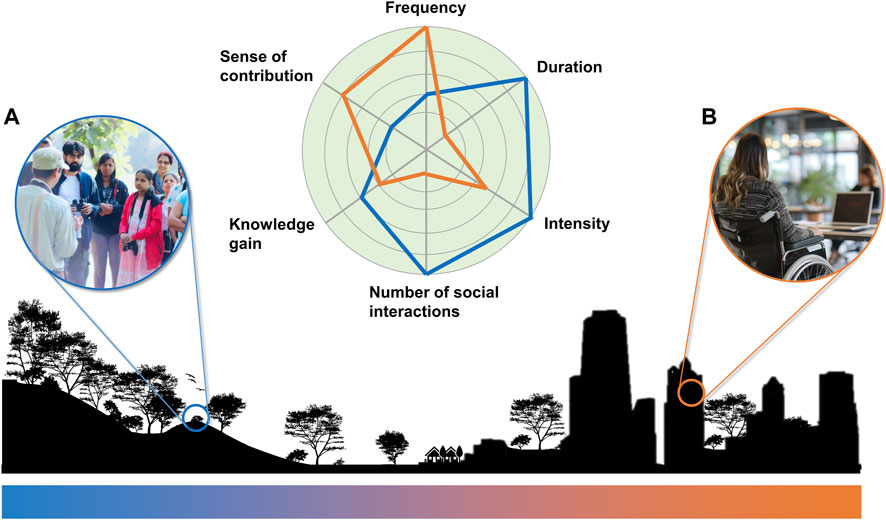
Figure 1. Biodiversity citizen science initiatives are conducted along a spectrum of natural and urban environments that could range from unmanaged, more remote wilderness (left; blue) to cities (right; orange). The radar chart in the center compares potential metrics of citizen science initiatives as nature-based interventions, comprising possible components such as the frequency and duration of nature interactions, intensity, number of social interactions (with other participants and/or project staff and researchers), knowledge gain, and sense of contribution. The radar chart will vary across individuals and initiatives, which we illustrate with two examples: (A) a field-based citizen science initiative that engages in birdwatching in forests as a group (see also Box 1); and (B) a citizen science initiative that uses digital platforms to engage individuals with disabilities (see also Box 2). Accordingly, the blue line in the radar chart represents metrics associated with the first example, while the orange line in the radar chart represents that from the second example. This illustrates how different contexts could influence the nature and social determinants of health within biodiversity citizen science initiatives. Photos are by: Ravi N Jha from Unsplash, and Freepik.
By reimagining biodiversity citizen science initiatives as integral components of broader health and wellbeing interventions, we can enable a more comprehensive evaluation of their impacts and the processes driving these changes. While it may be challenging to achieve all biodiversity and health goals to a high standard, embedding health and wellbeing considerations into the core goals and design of projects, rather than treating them as separate additions, can unlock new synergies that amplify their utility and impact on conservation and human health. Particularly since the process of assessing nature exposure is relatively straightforward (as demonstrated in Figure 1; Boxes 1, 2) ―metrics related to sampling effort not only contributes biodiversity data collection but also naturally serve as measures of health-promoting behaviors.
Considerations to maximize citizen science initiatives’ potential as NBIs
Citizen science initiatives hold significant potential as nature-based health interventions due to the diversity in combinations of quantity and quality of nature exposure offered, methods of delivery and target groups (Box 3). The wide variety of citizen science initiatives could engage a broad segment of the population as it allows individuals to choose initiatives that best suit their needs and capabilities. Such a transition towards health-promotion where people are empowered with the skills and confidence to manage their own health could reduce societal burden on healthcare resources.
As with most societal change initiatives, motivation and capability are necessary for widespread uptake of biodiversity citizen science initiatives (Soga and Gaston, 2021), and constraints on motivation or capability may limit participation and health goals. Motivation, a process which energizes and directs behavior, is often higher in individuals who already have a strong connection to nature. This connection significantly shapes people’s experiences of and motivations to engage with nature, and it is those who exhibit a higher-than-population-average connection who engage in citizen science initiatives (Oh et al., 2024). Consequently, the application of citizen science initiatives as nature-based interventions may inadvertently perpetuate health inequalities as health and wellbeing benefits derived from engagement in biodiversity citizen science initiatives are limited to those who participate, and do not necessarily translate to broader societal or population levels. Indeed, access to nature and nature-based recreation is limited for many social groups (Suárez et al., 2020; Dean et al., 2022). For example, field-based initiatives are unlikely to engage individuals with health or mobility challenges, even though these individuals could make meaningful contributions (e.g., retired teachers), and derive significant benefits from their participation.
To ensure that citizen science initiatives gain traction at societal and population levels, and become recognized as public health (not just health) interventions, a multi-faceted approach is needed. This should combine bottom-up promotion of the desired behavior and its benefits to normalize participation, while securing appropriate funding support from top-down sources, with a focus on social groups rather than individuals (Hébert-Dufresne et al., 2022). Through this, citizen science initiatives can exhibit the three characteristics of a public health intervention: (i) scope: the intervention improves the health of entire populations, often through community-wide or population-level efforts (e.g., vaccination programs); (ii) focus: prioritizes the prevention of health problems and promotes healthy behaviors and environments, through programs and policies that affect entire communities (rather than diagnosing and treating individual diseases); and (iii) delivery approach: involves various stakeholders including government and non-governmental organizations, rather than confined to healthcare systems and medical staff (Escoffery et al., 2019).
Capability refers to an individual’s capacity to engage in interactions with nature (Soga and Gaston, 2021). While discussions have primarily focused on physical capability (e.g., the physical ability to climb mountains) and cognitive capability (e.g., skills to identify species), it is important to understand the socio-economic factors that constrain capability. Challenges related to diversity, equity and inclusion in citizen science initiatives mirror those in nature-based interventions (Cooper et al., 2021). Many biodiversity citizen science initiatives, especially those involving field-based data collection and direct contact with nature, exclude historically underrepresented populations such as women and people of color, due to negative experiences related to racism or general feelings of unsafety (Bailey et al., 2020). A cross-sectional study on demographics of citizen science participants demonstrated an underrepresentation of women from ethnic minorities, and socio-economically disadvantaged individuals (Pateman et al., 2021). Incidents such as that experienced by African-American bird enthusiast Christian Cooper highlight safety concerns for participants from minority groups (Bailey et al., 2020). Addressing these barriers is crucial to actively promoting participation in underrepresented or vulnerable groups in citizen science initiatives. For example, co-production principles which focus on creating safe and inclusive environments while providing resources and support for diverse participants can have meaningful impacts on breaking down some of these barriers (Hidalgo et al., 2021).
Box 3: Nature exposure varies considerably across biodiversity citizen science initiatives
To demonstrate the diversity of citizen science initiatives and the extent to which they facilitate nature exposure, we performed a general search for citizen science initiatives using Google.com, covering a total of 95 citizen science initiatives across seven English and non-English speaking countries (English: Australia, Singapore, India and the United States of America; non-English: Colombia, Argentina and Germany; see Supplementary Material for details on search method). This was not intended to be a comprehensive analysis, rather we use it for illustration. For each citizen science initiative, we extracted data on quantity of nature exposure, specifically the duration of each data collection event (minutes) and the frequency it occurs within a year (e.g. daily, weekly, monthly etc.). We also extracted possible biodiversity and social measures of intensity, such as (i) number of biodiversity taxonomic groups; (ii) type of contact (direct or online); (v) whether engagement occurred in an individual- or group-setting.
We found that citizen science initiatives varied in their duration and frequency of nature exposure, and biodiversity and social measures of intensity. In general, the duration ranged from 1 to 855 minutes (average 141.4 ± 40.8 SE), while the frequency ranged from 1 to 370 monitoring sessions per year (average 153.7 ± 33.7 SE). There was a general trade-off between duration and frequency of nature contact monitoring sessions of longer durations tend to be conducted less frequently (Figure 2). The intensity of nature exposure—in this case the type of ecosystems and taxonomic groups participants encountered—varied across terrestrial, intertidal and marine settings but favored more easily detectable taxonomic groups such as birds (29.0%) and mammals (16.1%; Figure 2).
Inter-cultural differences similarly existed—initiatives in Asia had more frequent nature contact at an individual level, while initiatives in Latin America were of a lower frequency for individuals but occurred at higher frequencies in group settings (Figure 2).
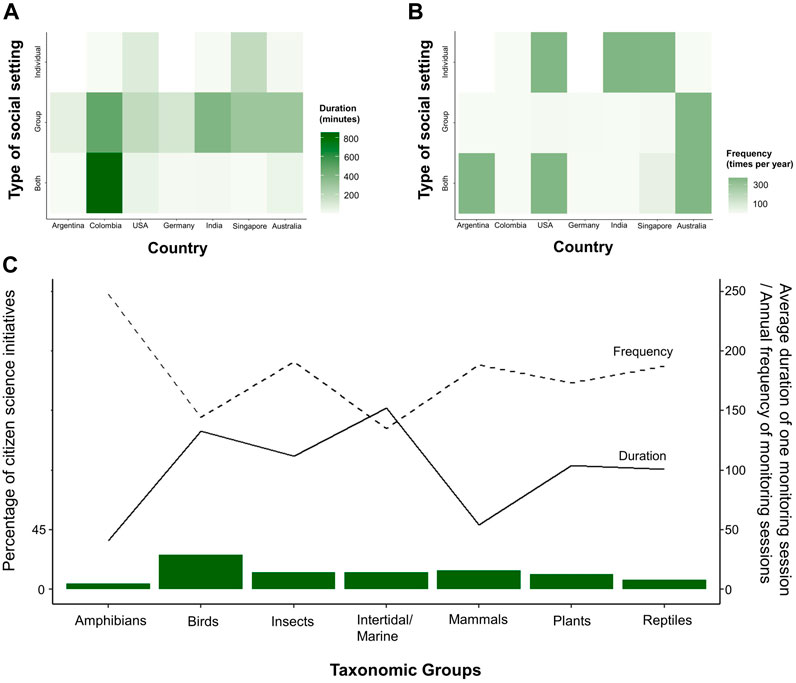
Figure 2. Summarizes the variability in citizen science efforts by country, social setting, and taxonomic focus from 95 citizen science initiatives. The heatmaps illustrate the (A) average duration (in minutes) of citizen science monitoring events and (B) the annual frequency (number of times a year) of citizen science monitoring events in various social settings (group, individual, or both individual and groups) across seven countries. Darker shades indicate longer durations or higher frequencies. (C) The bar chart depicts the percentage of citizen science initiatives investigating each taxonomic group, with some initiatives focusing on two or more groups (green columns; x-axis). The solid line represents the average duration (in minutes) of one monitoring session, while the dashed line indicates the annual frequency (number of times a year) of monitoring sessions for each taxonomic group (y-axis).
It is essential to consider variations in how people perceive and respond to nature-based activities, and the types of nature and climate that they face. Geographic, cultural and socio-economic factors significantly shape health behaviors and perceptions of wellbeing. Some populations live with greater risks of ill health from nature exposure due to climate differences (e.g., greater heat risk; Kjellstrom et al., 2009), safety concerns (e.g., armed conflicts in biodiversity hotspots; Ladan, 2014; Ordway, 2015) and existing biodiversity (e.g., encounters with dangerous wildlife such as bears; Abrahms, 2021). To maximize participation, initiatives must be culturally sensitive and align with the values and contextual constraints of the target population.
The plurality of citizen science initiatives challenges their appraisal as a safe, effective and affordable nature-based health interventions. For stakeholders to conduct such an appraisal, a logical first step involves a transition from isolated assessments to a collaborative, multi-project approach. Computer science methods offer great potential to innovate how health and wellbeing changes are monitored in citizen science participants, regardless of which initiatives they engage in. For example, using federated databases and learning systems to access multiple health and wellbeing datasets can streamline the analysis of high-resolution data, promoting standardization across initiatives. In this model, citizen scientists store their health and wellbeing data on personal devices or within existing citizen science apps. Through a central “management node,” researchers can pose specific questions such as analyzing bird observations in particular regions or among specific user groups (e.g., individuals with disabilities). This federated learning approach can be extended to wearables (e.g., FitBit), fitness and wellbeing apps (e.g., meditation, yoga apps), empowering individuals as valued data sources who maintain control over their information while contributing to a larger collective. It further reinforces a positive feedback loop wherein individuals are empowered to use their data to improve their own health. A compelling example is the Estonian Biobank where 210,000 Estonians (20% of the adult population) contributed genetic samples and received their genetic results. These participants were provided with valuable information about their genetic traits, including disease risk, ancestry markers and variation of other health-related markers (e.g., genes influencing caffeine metabolism) (Callaway, 2024). Empowered by this knowledge, individuals can take appropriate actions based on their results (e.g., reducing caffeine intake if they possess a gene variant that slows caffeine breakdown).
Benefits to biodiversity and human health: synergies and tradeoffs
Understanding the co-benefits of biodiversity citizen science initiatives for both conservation and human health is essential to ensure that projects align with practical applications in conservation management and policymaking. The intertwined relationship between biodiversity and human wellbeing underscores the importance of investigating the synergies and potential trade-offs inherent in these initiatives. Achieving benefits for both biodiversity and health is complex, as these outcomes are not independent of each other (Walker et al., 2021; Pienkowski et al., 2024), and relationships might be highly non-linear (Howe et al., 2014). As such, unintentional trade-offs might result when initiatives overlook the interactions between them. For example, facilitating community access to urban greenspaces typically incurs a lower ecological impact than accessing threatened ecosystems or protected areas; urban greenspace use is less likely to undermine conservation goals through habitat degradation, species disturbance, or the introduction and spread of invasive species. However, this approach could reduce health benefits if urban greenspaces are subjected to intense air and noise pollution, or lack necessary infrastructure that encourages physical activity and sustained social interactions. Conversely, providing carefully-managed access to natural ecosystems could strengthen conservation goals through acquiring data to overcome knowledge gaps. Through these efforts, citizen science initiatives can exemplify the practical application of integrating conservation and human health objectives to inform future conservation management and policymaking to embrace a more holistic view of environmental stewardship and community wellbeing.
Incorporating health and wellbeing as a recruitment strategy in citizen science initiatives can serve to attract a broader subset of society, enriching the dataset available for conservation efforts. Specifically, health and wellbeing benefits may appeal to those subsets of society where citizen science recruitment is currently lower, resulting in biases in sampling. This expanded participant base not only diversifies the scope of collected data but also enhances the applicability of findings in informing policy making and conservation strategies. Leveraging the universal value of health as a catalyst for broader engagement and more comprehensive research outcomes can significantly enhance the impact of citizen science initiatives.
Conclusion
The synergistic integration of health and wellbeing goals into biodiversity citizen science initiatives holds great promise for amplifying their impact also as a nature-based health intervention. By aligning biodiversity project goals with health outcomes and utilizing straightforward metrics to assess nature- and social-determinants of human health and wellbeing, we can create a powerful model that recognizes the interconnectedness of environmental and human health. This approach paves the way for innovative and impactful citizen science initiatives that serve the dual purposes of advancing nature conservation and promoting healthier communities.
Open Research Statement
Data is accessible via https://doi.org/10.5281/zenodo.13284070.
Data availability statement
The datasets presented in this study can be found at https://doi.org/10.5281/zenodo.13284070.
Author contributions
RO: Conceptualization, Data curation, Formal Analysis, Funding acquisition, Investigation, Methodology, Project administration, Supervision, Visualization, Writing–original draft, Writing–review and editing. RF: Conceptualization, Funding acquisition, Project administration, Writing–review and editing. BP: Investigation, Writing–review and editing. AD: Writing–review and editing. NP: Writing–review and editing. CC: Conceptualization, Writing–review and editing. NS: Writing–review and editing. AB: Funding acquisition, Writing–review and editing. AS: Funding acquisition, Investigation, Project administration, Supervision, Writing–review and editing.
Funding
The author(s) declare that financial support was received for the research, authorship, and/or publication of this article. RO, BP, and AB acknowledge funding from the German Research Foundation (DFG-FZT 118, 202548816) that supports the German Centre for Integrative Biodiversity Research (iDiv) Halle-Jena-Leipzig. We also acknowledge funding from the Universities Australia and Deutscher Akademischer Austauschdienst (German Academic Exchange Service, DAAD) under the Australia-Germany Joint Research Co-operation Scheme (57600873).
Acknowledgments
We express our sincere gratitude to all participants in the citizen science initiatives, and to the passionate and dedicated teams leading these initiatives. We extend our thanks to both reviewers whose feedback have strengthened our manuscript considerably.
Conflict of interest
The authors declare that the research was conducted in the absence of any commercial or financial relationships that could be construed as a potential conflict of interest.
Publisher’s note
All claims expressed in this article are solely those of the authors and do not necessarily represent those of their affiliated organizations, or those of the publisher, the editors and the reviewers. Any product that may be evaluated in this article, or claim that may be made by its manufacturer, is not guaranteed or endorsed by the publisher.
Supplementary material
The Supplementary Material for this article can be found online at: https://www.frontiersin.org/articles/10.3389/fenvs.2024.1444161/full#supplementary-material
References
Abrahms, B. (2021). Human-wildlife conflict under climate change. Science 373 (6554), 484–485. doi:10.1126/science.abj4216
Alcock, I., White, M. P., Wheeler, B. W., Fleming, L. E., and Depledge, M. H. (2014). Longitudinal effects on mental health of moving to greener and less green urban areas. Environ. Sci. and Technol. 48 (2), 1247–1255. doi:10.1021/es403688w
Altshuler, B. (1981). Modeling of dose-response relationships. Environ. Health Perspect. 42, 23–27. doi:10.2307/3429186
Bailey, K., Morales, N., and Newberry, M. (2020). Inclusive conservation requires amplifying experiences of diverse scientists. Nat. Ecol. Evol. 4 (10), 1294–1295. doi:10.1038/s41559-020-01313-y
Barton, J., and Pretty, J. (2010). What is the best dose of nature and green exercise for improving mental health? A multi-study analysis. Environ. Sci. and Technol. 44 (10), 3947–3955. doi:10.1021/es903183r
Belkhir, L., and Elmeligi, A. (2019). Carbon footprint of the global pharmaceutical industry and relative impact of its major players. J. Clean. Prod. 214, 185–194. doi:10.1016/j.jclepro.2018.11.204
Berdejo-Espinola, V., Suárez-Castro, A. F., Amano, T., Fielding, K. S., Oh, R. R. Y., and Fuller, R. A. (2021). Urban green space use during a time of stress: a case study during the COVID-19 pandemic in Brisbane, Australia. People Nat. 3 (3), 597–609. doi:10.1002/pan3.10218
Biddle, S. J. H., Ciaccioni, S., Thomas, G., and Vergeer, I. (2019). Physical activity and mental health in children and adolescents: an updated review of reviews and an analysis of causality. Psychol. Sport Exerc. 42, 146–155. doi:10.1016/j.psychsport.2018.08.011
Bonney, R., Phillips, T. B., Ballard, H. L., and Enck, J. W. (2016). Can citizen science enhance public understanding of science? Public Underst. Sci. 25 (1), 2–16. doi:10.1177/0963662515607406
Britton, E., Kindermann, G., Domegan, C., and Carlin, C. (2020). Blue care: a systematic review of blue space interventions for health and wellbeing. Health Promot. Int. 35 (1), 50–69. doi:10.1093/heapro/day103
Buxton, R. T., Pearson, A. L., Allou, C., Fristrup, K., and Wittemyer, G. (2021). A synthesis of health benefits of natural sounds and their distribution in national parks. Proc. Natl. Acad. Sci. U. S. A. 118 (14), e2013097118. doi:10.1073/pnas.2013097118
Callaway, E. (2024). Estonians gave their DNA to science—now they’re learning their genetic secrets. Nature 631 (8019), 17. doi:10.1038/d41586-024-02108-y
Christian, C., Lintott, C., Smith, A., Fortson, L., and Bamford, S. (2012). Citizen science: contributions to astronomy research. arXiv preprint arXiv:1202.2577.
Cooper, C. B., Hawn, C. L., Larson, L. R., Parrish, J. K., Bowser, G., Cavalier, D., et al. (2021). Inclusion in citizen science: the conundrum of rebranding. Science 372 (6549), 1386–1388. doi:10.1126/science.abi6487
Day, G., Fuller, R. A., Nichols, C., and Dean, A. J. (2022). Characteristics of immersive citizen science experiences that drive conservation engagement. People Nat. 4 (4), 983–995. doi:10.1002/pan3.10332
Dean, A. J., Ross, H., Roiko, A., Fielding, K. S., Saeck, E., Johnston, K., et al. (2022). Beyond proximity: how subjective perceptions of enablers and constraints influence patterns of blue space recreation. Landsc. Urban Plan. 228, 104557. doi:10.1016/j.landurbplan.2022.104557
De Bell, S., Alejandre, J. C., Menzel, C., Sousa-Silva, R., Straka, T. M., Berzborn, S., et al. (2024). Nature-based social prescribing programmes: opportunities, challenges, and facilitators for implementation. Environ. Int. 190, 108801. doi:10.1016/j.envint.2024.108801
Edwards, T., Jones, C. B., Perkins, S. E., and Corcoran, P. (2021). Passive citizen science: the role of social media in wildlife observations. PLOS ONE 16 (8), e0255416. doi:10.1371/journal.pone.0255416
Escoffery, C., Lebow-Skelley, E., Udelson, H., Böing, E. A., Wood, R., Fernandez, M. E., et al. (2019). A scoping study of frameworks for adapting public health evidence-based interventions. Transl. Behav. Med. 9 (1), 1–10. doi:10.1093/tbm/ibx067
Evans, C., Abrams, E., Reitsma, R., Roux, K., Salmonsen, L., and Marra, P. P. (2005). The neighborhood nestwatch program: participant outcomes of a citizen-science ecological research project. Conserv. Biol. 19 (3), 589–594. doi:10.1111/j.1523-1739.2005.00s01.x
Fisher, J. C., Irvine, K. N., Bicknell, J. E., Hayes, W. M., Fernandes, D., Mistry, J., et al. (2021). Perceived biodiversity, sound, naturalness and safety enhance the restorative quality and wellbeing benefits of green and blue space in a neotropical city. Sci. Total Environ. 755, 143095. doi:10.1016/j.scitotenv.2020.143095
Forister, M. L., Halsch, C. A., Nice, C. C., Fordyce, J. A., Dilts, T. E., Oliver, J. C., et al. (2021). Fewer butterflies seen by community scientists across the warming and drying landscapes of the American West. Science 371 (6533), 1042–1045. doi:10.1126/science.abe5585
Fritz, S., See, L., Carlson, T., Haklay, M. (M.), Oliver, J. L., Fraisl, D., et al. (2019). Citizen science and the united nations sustainable development goals. Nat. Sustain. 2 (10), 922–930. doi:10.1038/s41893-019-0390-3
Gritzka, S., MacIntyre, T. E., Dörfel, D., Baker-Blanc, J. L., and Calogiuri, G. (2020). The effects of workplace nature-based interventions on the mental health and well-being of employees: a systematic review. Front. Psychiatry 11, 323. doi:10.3389/fpsyt.2020.00323
Groom, Q., Pernat, N., Adriaens, T., de Groot, M., Jelaska, S. D., Marčiulynienė, D., et al. (2021). Species interactions: next-level citizen science. Ecography 44 (12), 1781–1789. doi:10.1111/ecog.05790
Gworek, B., Kijeńska, M., Wrzosek, J., and Graniewska, M. (2021). Pharmaceuticals in the soil and plant environment: a review. Water, Air, and Soil Pollut. 232 (4), 145. doi:10.1007/s11270-020-04954-8
Hébert-Dufresne, L., Waring, T. M., St-Onge, G., Niles, M. T., Kati Corlew, L., Dube, M. P., et al. (2022). Source-sink behavioural dynamics limit institutional evolution in a group-structured society. R. Soc. Open Sci. 9 (3), 211743. doi:10.1098/rsos.211743
Helwig, K., Niemi, L., Stenuick, J.-Y., Alejandre, J. C., Pfleger, S., Roberts, J., et al. (2024). Broadening the perspective on reducing pharmaceutical residues in the environment. Environ. Toxicol. Chem. 43 (3), 653–663. doi:10.1002/etc.5563
Hidalgo, S. E., Perelló, J., Becker, F., Bonhoure, I., Legris, M., Cigarini, A., et al. (2021). “Participation and co-creation in citizen science,” in The science of citizen science. Editor K. Vohland, 199–218. doi:10.1007/978-3-030-58278-4_11Chapter 11
Howe, C., Suich, H., Vira, B., and Mace, G. M. (2014). Creating win-wins from trade-offs? Ecosystem services for human well-being: a meta-analysis of ecosystem service trade-offs and synergies in the real world. Glob. Environ. Change 28, 263–275. doi:10.1016/j.gloenvcha.2014.07.005
Hunter, R. F., Clelanda, C., Cleary, A., Droomers, M., Wheeler, B. W., Sinnette, D., et al. (2019). Environmental, health, wellbeing, social and equity effects of urban green space interventions - a meta-narrative evidence synthesis. Environ. Int. 130, 104923. doi:10.1016/j.envint.2019.104923
Jordan, R. C., Gray, S. A., Howe, D. V., Brooks, W. R., and Ehrenfeld, J. G. (2011). Knowledge gain and behavioral change in citizen-science programs. Conserv. Biol. 25 (6), 1148–1154. doi:10.1111/j.1523-1739.2011.01745.x
Kjellstrom, T., Holmer, I., and Lemke, B. (2009). Workplace heat stress, health and productivity – an increasing challenge for low and middle-income countries during climate change. Glob. Health Action 2 (1), 2047. doi:10.3402/gha.v2i0.2047
Ladan, S. I. (2014). Forests and forest reserves as security threats in northern Nigeria. Eur. Sci. J. 10 (35), 120–142.
Maller, C., Townsend, M., Pryor, A., Brown, P., and St Leger, L. (2006). Healthy nature healthy people: ‘Contact with nature’ as an upstream health promotion intervention for populations. Health Promot. Int. 21 (1), 45–54. doi:10.1093/heapro/dai032
Miller-Rushing, A., Primack, R., and Bonney, R. (2012). The history of public participation in ecological research. Front. Ecol. Environ. 10 (6), 285–290. doi:10.1890/110278
Nigg, C., Schipperijn, J., Hennig, O., Petzold, M. B., Rulf, E., Meyer-Lindenberg, A., et al. (2022). Time to go green? Sports Psychiatry 1 (3), 116–118. doi:10.1024/2674-0052/a000018
Oh, R. R. Y., Suarez-Castro, A. F., Fuller, R. A., Tervo, M., Rozario, K., Peters, B., et al. (2024). Using nature-based citizen science initiatives to enhance nature connection and mental health. doi:10.1101/2024.07.14.603425
Ordway, E. M. (2015). Political shifts and changing forests: effects of armed conflict on forest conservation in Rwanda. Glob. Ecol. Conservation 3, 448–460. doi:10.1016/j.gecco.2015.01.013
Pateman, R., Dyke, A., and West, S. (2021). The diversity of participants in environmental citizen science. Citiz. Sci. Theory Pract. 6 (1), 9. doi:10.5334/cstp.369
Peter, M., Diekötter, T., Höffler, T., and Kremer, K. (2021). Biodiversity citizen science: outcomes for the participating citizens. People Nat. 3 (2), 294–311. doi:10.1002/pan3.10193
Pienkowski, T., Keane, A., Booth, H., Kinyanda, E., Fisher, J. C., Lawrance, E., et al. (2024). Nature’s contributions to social determinants of mental health and the role of conservation. One Earth 7 (7), 1213–1227. doi:10.1016/j.oneear.2024.05.004
Pocock, M. J. O., Hamlin, I., Christelow, J., Passmore, H., and Richardson, M. (2023). The benefits of citizen science and nature-noticing activities for well being, nature connectedness and pro-nature conservation behaviours. People Nat. 5 (2), 591–606. doi:10.1002/pan3.10432
Rozario, K., Oh, R. R. Y., Marselle, M., Schröger, E., Gillerot, L., Ponette, Q., et al. (2023). The more the merrier? Perceived forest biodiversity promotes short-term mental health and well-being—a multicentre study. People Nat. 6, 180–201. doi:10.1002/pan3.10564
Shanahan, D., Astell–Burt, T., Barber, E., Brymer, E., Cox, D., Dean, J., et al. (2019). Nature–based interventions for improving health and wellbeing: the purpose, the people and the outcomes. Sports 7 (6), 141. doi:10.3390/sports7060141
Shanahan, D. F., Bush, R., Gaston, K. J., Lin, B. B., Dean, J., Barber, E., et al. (2016). Health benefits from nature experiences depend on dose. Sci. Rep. 6 (2855), 28551–28615. doi:10.1038/srep28551
Shanahan, D. F., Fuller, R. A., Bush, R., Lin, B. B., and Gaston, K. J. (2015). The health benefits of urban nature: how much do we need? BioScience 65 (5), 476–485. doi:10.1093/biosci/biv032
Skivington, K., Matthews, L., Simpson, S. A., Craig, P., Baird, J., Blazeby, J. M., et al. (2021). A new framework for developing and evaluating complex interventions: update of Medical Research Council guidance. BMJ n2061, n2061. doi:10.1136/bmj.n2061
Soga, M., and Gaston, K. J. (2021). Towards a unified understanding of human–nature interactions. Nat. Sustain. 5 (5), 374–383. doi:10.1038/s41893-021-00818-z
Stobbe, E., Sundermann, J., Ascone, L., and Kühn, S. (2022). Birdsongs alleviate anxiety and paranoia in healthy participants. Sci. Rep. 12 (1), 16414. doi:10.1038/s41598-022-20841-0
Suárez, M., Barton, D. N., Cimburova, Z., Rusch, G. M., Gómez-Baggethun, E., and Onaindia, M. (2020). Environmental justice and outdoor recreation opportunities: a spatially explicit assessment in Oslo metropolitan area, Norway. Environ. Sci. and Policy 108, 133–143. doi:10.1016/j.envsci.2020.03.014
Sullivan, B. L., Phillips, T., Dayer, A. A., Wood, C. L., Farnsworth, A., Iliff, M. J., et al. (2017). Using open access observational data for conservation action: a case study for birds. Biol. Conserv. 208, 5–14. doi:10.1016/j.biocon.2016.04.031
Van Den Bosch, M., and Ode Sang, Å. (2017). Urban natural environments as nature-based solutions for improved public health – a systematic review of reviews. Environ. Res. 158, S79–S384. doi:10.1016/j.jth.2017.05.230
Walker, D. W., Smigaj, M., and Tani, M. (2021). The benefits and negative impacts of citizen science applications to water as experienced by participants and communities. WIREs Water 8 (1), e1488. doi:10.1002/wat2.1488
Warburton, D. E. R., and Bredin, S. S. D. (2017b). Health benefits of physical activity. Curr. Opin. Cardiol. 32 (5), 541–556. doi:10.1097/hco.0000000000000437
White, M. P., Hartig, T., Martin, L., Pahl, S., Van Den Berg, A. E., Wells, N. M., et al. (2023). Nature-based biopsychosocial resilience: an integrative theoretical framework for research on nature and health. Environ. Int. 18, 108234. doi:10.1016/j.envint.2023.108234
Williams, C. R., Burnell, S. M., Rogers, M., Flies, E. J., and Baldock, K. L. (2021). Nature-based citizen science as a mechanism to improve human health in urban areas. Int. J. Environ. Res. Public Health 19 (1), 68. doi:10.3390/ijerph19010068
Keywords: community-led, cobenefits, health intervention, nature-based solutions, conservation, human-nature interaction, community engagement
Citation: Oh RRY, Fuller RA, Peters B, Dean AJ, Pachana NA, Callaghan CT, Sockhill NJ, Bonn A and Suarez-Castro AF (2024) Enhancing the health and wellbeing benefits of biodiversity citizen science. Front. Environ. Sci. 12:1444161. doi: 10.3389/fenvs.2024.1444161
Received: 06 June 2024; Accepted: 05 August 2024;
Published: 21 August 2024.
Edited by:
James Kevin Summers, U.S. Environmental Protection Agency (EPA), United StatesReviewed by:
Susan Harrell Yee, United States Environmental Protection Agency, United StatesMasashi Soga, The University of Tokyo, Japan
Copyright © 2024 Oh, Fuller, Peters, Dean, Pachana, Callaghan, Sockhill, Bonn and Suarez-Castro. This is an open-access article distributed under the terms of the Creative Commons Attribution License (CC BY). The use, distribution or reproduction in other forums is permitted, provided the original author(s) and the copyright owner(s) are credited and that the original publication in this journal is cited, in accordance with accepted academic practice. No use, distribution or reproduction is permitted which does not comply with these terms.
*Correspondence: Rachel R. Y. Oh, ci5vaEB1cS5lZHUuYXU=