 Luca Gallitelli
 Maciej Liro
- 1Department of Sciences, University of Roma Tre, Rome, Italy
- 2Institute of Nature Conservation, Polish Academy of Sciences, Kraków, Poland
Main
Ocean garbage patches (OGPs) are the most evident example of artificial litter accumulation hotspots on the ocean’s surface (e.g., Lebreton et al., 2018), presenting a unique opportunity for the effective removal of floating litter from the marine environment (Galgani et al., 2022). Recent evidence suggests that litter accumulation hotspots can also form on the water, in the sediments and in the vegetation of riverine ecosystems (Gallitelli and Scalici, 2023, 2024; Liro et al., 2022; Van Emmerik et al., 2022; Tasseron et al., 2024). These hotspots can form because rivers act both as carriers of land-produced litter to the sea and as long-term sinks for it (Liro et al., 2020; Gallitelli and Scalici, 2022; Van Emmerik et al., 2022). This trapped litter poses numerous risks to ecosystem functioning and human health (Galgani et al., 2022; Gallitelli and Scalici, 2023).
To stimulate future discussion on river garbage patches (RGPs), defined here as a concentrated accumulation of floating or surface-stored artificial litter in rivers, we outlined their key characteristics in comparison to OGPs (Figure 1). The key difference between these two types of garbage patches is that individual RGPs cover areas that are several orders of magnitude smaller than OGPs, yet they provide plastic abundances several orders higher.
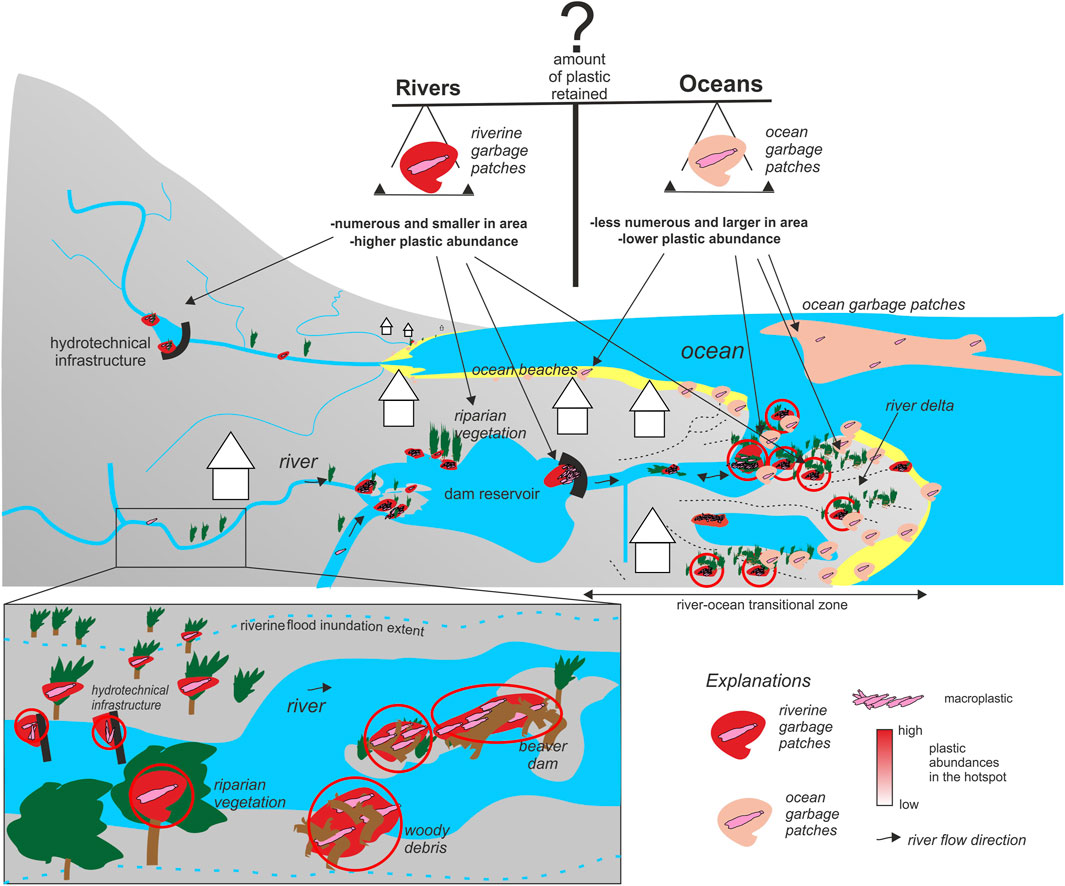
Figure 1. Plastic garbage patches in rivers and oceans. In the larger panel, from left to right, rivers flow through dam reservoirs and river deltas to the oceans. Most plastics remain within rivers, a situation further explained in the smaller panel on the left. In this panel, groynes, riparian vegetation, woody debris, and beaver dams are illustrated as potential local-scale sinks for macroplastics in rivers. During floods, rising water levels transport macroplastics out of the river channel, depositing them along the riverbanks and interacting with these elements.
For example, the plastic concentration in the Great Pacific Garbage Patch (GPGP), which is considered the oceanic garbage patch with the highest concentration of plastics, reaches ∼70 kg/km2 (0.07 g/m2) and ∼700,000 items/km (0.7 items/m2) (Table 2 in Lebreton et al., (2018)). In contrast, hotspots of plastic accumulation in rivers (RGPs), especially in river channels and on riverbanks, exhibit values at least two orders of magnitude higher (e.g., Liro et al., 2022; Tasseron et al., 2024). For instance, the amount of macroplastic stored in wood jams in moderately polluted mountain rivers averages 9.5 items and 113 g per m2 (Liro et al., 2022). Although this is a rough estimation, we should consider that it is likely an underestimation of macrolitter in rivers as very few studies currently address this issue (Liro et al., 2020; Van Emmerik et al., 2022). Most existing field and modeling works focus on plastic transport from rivers to oceans (Meijer et al., 2021; UNEP, 2020; González-Fernández et al., 2023; Morales-Caselles et al., 2021). Future research should focus on gathering more data on plastic abundance in river accumulation areas (RGPs) and estimating their global extent, ultimately enabling comparisons between the amount of plastic stored in RGPs and OGPs.
River ecosystems are recently hypothesized to function as litter sinks most of the time when large floods are not occurring (Liro et al., 2020; Van Emmerik et al., 2022; Gallitelli and Scalici, 2024); such events can lead to massive erosion of RGPs, resulting in plastic mobilization (Liro et al., 2020), fragmentation, and downstream transport (Van Emmerik et al., 2022). This ultimately contributes to the downstream dispersal of macroplastic (Liro et al., 2020; Van Emmerik et al., 2022) and production of secondary microplastic (Liro et al., 2023), increasing the related risks to biota and human health. It is important to notice that OGPs may not be fueled by riverine inputs to the ocean and only receive a small portion of land-based plastics (Lebreton et al., 2018; Morales-Caselles et al., 2021), given that most land-based litter is trapped nearshore areas and only small fragments might reach the open ocean, apart from the sea-based sources (Morales-Caselles et al., 2021) (Figure 1).
Recent studies indicated that RGPs can vary considerably depending on the river characteristics (Tasseron et al., 2024). Due to complex hydromorphological and land cover patterns in riverine ecosystems, even at the local scale of an individual landscape or geomorphological unit, river garbage patches tend to be more localized and concentrated in specific areas within rivers (see e.g., Liro et al., 2022). This contrasts with ocean garbage patches, which are often large and widespread (Lebreton et al., 2018; Galgani et al., 2022). OGPs are typically surrounded by large areas of open water, while rivers in populated areas are enclosed by land with easier access for transportation. This increases the potential for removing litter hotspots through cleanup efforts or the implementation of engineering infrastructure. OGPs have a significantly larger surface area compared to individual river garbage patches (RGPs), and their size and location can shift over time, making their removal more challenging and costly. In contrast, RGPs generally remain stable throughout most of their existence, except during rare periods of mobilization caused by major floods (Liro et al., 2020; Van Emmerik et al., 2022; Gallitelli and Scalici, 2024).
Future outlook
Comparing the total amount of plastic in oceanic garbage patches to that in riverine patches is challenging due to the limited and often heterogeneous data available. Here, we highlight the specific features of these two types of plastic accumulation hotspots, suggesting potentially different opportunities and challenges for their removal from the environment. Since RGPs are more abundant in plastic, more widespread, accessible, scattered, and substantially smaller than OGPs, clean-up efforts through citizen science initiatives may be more effective for RGPs. Evaluating the cost-effectiveness of clean-up activities in both oceanic and riverine hotspots could be a crucial step in mitigating and addressing plastic pollution.
Author contributions
LG: conceptualization, investigation, project administration, software, supervision, validation, visualization, writing–original draft, and writing–review and editing. ML: conceptualization, funding acquisition, investigation, project administration, supervision, validation, visualization, writing–original draft, and writing–review and editing.
Funding
The author(s) declare that financial support was received for the research, authorship, and/or publication of this article. The work of ML was completed within the Research Project 2020/39/D/ST10/01935 financed by the National Science Centre of Poland.
Acknowledgments
The authors deeply thank the editor Daniel Gonzalez-Fernández and the reviewer for their helpful comments on this work.
Conflict of interest
The authors declare that the research was conducted in the absence of any commercial or financial relationships that could be construed as a potential conflict of interest.
Publisher’s note
All claims expressed in this article are solely those of the authors and do not necessarily represent those of their affiliated organizations, or those of the publisher, the editors, and the reviewers. Any product that may be evaluated in this article, or claim that may be made by its manufacturer, is not guaranteed or endorsed by the publisher.
References
Galgani, F., Michela, A., Gérigny, O., Maes, T., Tambutté, E., and Harris, P. T. (2022). Marine litter, plastic, and microplastics on the seafloor in plastics and the ocean: origin, characterization, fate, and impacts (Hoboken, NJ, USA: Wiley), 151–197.
Gallitelli, L., and Scalici, M. (2022). Riverine macroplastic gradient along watercourses: a global overview. Front. Environ. Sci. 10, 937944. doi:10.3389/fenvs.2022.937944
Gallitelli, L., and Scalici, M. (2023). Can macroplastics affect riparian vegetation blooming and pollination? First observations from a temperate South-European river. Ecol. Indic. 154, 110531. doi:10.1016/j.ecolind.2023.110531
Gallitelli, L., and Scalici, M. (2024). Conceptual model of global plants entrapping plastics. Environ. Rev. 00, 1–15. doi:10.1139/er-2023-0141
González-Fernández, D., Roebroek, C. T. J., Laufkötter, C., Cózar, A., and van Emmerik, T. H. M. (2023). Diverging estimates of river plastic input to the ocean. Nat. Rev. Earth Environ. 4, 424–426. doi:10.1038/s43017-023-00448-3
Lebreton, L. C. M., Slat, B., Ferrari, F., Sainte-Rose, B., Aitken, J., Marthouse, R., et al. (2018). Evidence that the Great pacific garbage patch is rapidly accumulating plastic. Sci. Rep. 8 (1), 1–15. doi:10.1038/s41598-018-22939-w
Liro, M., Emmerik, T. V., Wyżga, B., Liro, J., and Mikuś, P. (2020). Macroplastic storage and remobilization in rivers. Water 12 (7), 2055. doi:10.3390/w12072055
Liro, M., Mikuś, P., and Wyżga, B. (2022). First insight into the macroplastic storage in a mountain river: the role of in-river vegetation cover, wood jams and channel morphology. Sci. Total Environ. 838, 156354. doi:10.1016/j.scitotenv.2022.156354
Liro, M., Zielonka, A., and van Emmerik, T. H. M. (2023). Macroplastic fragmentation in rivers. Environ. Int. 180, 108186. doi:10.1016/j.envint.2023.108186
Meijer, L. J., Van Emmerik, T., Van Der Ent, R., Schmidt, C., and Lebreton, L. (2021). More than 1000 rivers account for 80% of global riverine plastic emissions into the ocean. Sci. Adv. 7 (18), eaaz5803. doi:10.1126/sciadv.aaz5803
Morales-Caselles, C., Viejo, J., Martí, E., González-Fernández, D., Pragnell-Raasch, H., González-Gordillo, J. I., et al. (2021). An inshore–offshore sorting system revealed from global classification of ocean litter. Nat. Sustain 4, 484–493. doi:10.1038/s41893-021-00720-8
Tasseron, P., van Emmerik, T., Vriend, P., Hauk, R., Alberti, F., Mellink, Y., et al. (2024). Defining plastic pollution hotspots. Sci. Total Environ. 934, 173294. doi:10.1016/j.scitotenv.2024.173294
UNEP (2020). Monitoring plastics in rivers and lakes: guidelines for the harmonization of methodologies. U. N. Environ. Programme.
Keywords: plastic pollution, river garbage patches, litter management, plastic hotspot areas, plastic accumulation
Citation: Gallitelli L and Liro M (2024) Do river garbage patches exist?. Front. Environ. Sci. 12:1480391. doi: 10.3389/fenvs.2024.1480391
Received: 13 August 2024; Accepted: 01 October 2024;
Published: 22 October 2024.
Edited by:
Daniel González-Fernández, University of Cádiz, SpainReviewed by:
Zbigniew Kowalewski, AGH University of Science and Technology, PolandCopyright © 2024 Gallitelli and Liro. This is an open-access article distributed under the terms of the Creative Commons Attribution License (CC BY). The use, distribution or reproduction in other forums is permitted, provided the original author(s) and the copyright owner(s) are credited and that the original publication in this journal is cited, in accordance with accepted academic practice. No use, distribution or reproduction is permitted which does not comply with these terms.
*Correspondence: Luca Gallitelli, bHVjYS5nYWxsaXRlbGxpQHVuaXJvbWEzLml0; Maciej Liro, bGlyb0Bpb3Aua3Jha293LnBs
†These authors have contributed equally to this work