 Stephanie Mansourian1,2,3*
 Ida N. S. Djenontin4
 Marlène Elias5
 Johan A. Oldekop6
 Mercy Afua Adutwumwaa Derkyi7
 Christian A. Kull2
 Pablo Pacheco8
- 1Mansourian.org, Crassier, Vaud, Switzerland
- 2Institute of Geography and Sustainability, University of Lausanne, Lausanne, Vaud, Switzerland
- 3Department of Social Sciences, University of Geneva, Geneva, Geneva, Switzerland
- 4Department of Geography, College of Earth and Mineral Sciences, Penn State University, University Park, PA, United States
- 5Bioversity International, Rome, Italy
- 6Global Development Institute, University of Manchester, Manchester, United Kingdom
- 7School of Natural Sciences, University of Energy and Natural Resources, Sunyani, Ghana
- 8WWF, Washington, DC, United States
Globally, forest landscape restoration (FLR) is gaining ground, alongside other forms of restoration under the UN Decade on Ecosystem Restoration. In most cases, projects and initiatives fail to consider human dimensions that influence the processes and outcomes of the restoration effort. These dimensions refer to how and why humans value natural resources; how humans want resources to be managed; and how humans affect or are affected by natural resource management decisions. Using the model of the forest transition curve that shows the trajectory from loss of forests to restored forests, we discuss how FLR intersects in different ways with this transition curve. We conclude that: 1) definitions and their implications are a fundamental challenge for FLR; 2) there is an intrinsic interdependence between people and forests that varies across spatial and temporal scales and that is mediated by institutions; 3) power differentials among stakeholders create imbalances in restoration; 4) conflicts around restoration result from differing interests, power and values. Equitable and durable restoration requires a much greater inclusion of human dimensions along all steps of the process.
1 Introduction
Consideration of human dimensions in forest landscape restoration (FLR) or other restoration undertakings is critical as people are an intricate part of restoration processes (Höhl et al., 2020; Fleischman et al., 2020; Löfqvist et al., 2023). This is particularly relevant in large scale restoration, such as FLR, that involves multiple stakeholders with multiple interests, and has broader socio-economic and environmental repercussions than site-based restoration.
There are many definitions of FLR (Mansourian, 2018) and it can include diverse activities. For example Sabogal et al. (2015), identify the following FLR intervention options: planted forests and woodlots; natural regeneration; silviculture enhancement of existing forests and woodlands and stocking; agroforestry; improved fallow; mangrove restoration; and watershed protection and erosion control. Essentially, FLR aims to balance both human wellbeing and ecological integrity of forested landscapes (Mansourian et al., 2021). These aims are echoed in multiple international agendas, including the UN Decade on Ecosystem Restoration which emphasizes that restoration “needs to be carried out in ways that balance social, economic and environmental objectives and with the engagement of relevant stakeholders, including indigenous peoples and local communities” (UNGA, Res/73/284: 4). The UN Decade further acknowledges that ecosystem restoration is a process to halt and reverse degradation, improving ecosystem services for people and supporting biodiversity recovery (Nelson et al., 2024). Yet, in practice, restoration has given limited attention to human dimensions emphasizing instead climate mitigation or ecological priorities (Elias et al., 2022).
Human dimensions in relation to natural resources refer to: 1) how and why humans value natural resources; 2) how humans want resources to be managed; and 3) how humans affect or are affected by natural resource management decisions (Decker et al., 2012). Firstly, humans may value natural resources for their intrinsic, relational, or instrumental values (Himes et al., 2024). Such values are shaped by diverse cosmovisions or worldviews, perspectives, and knowledge systems not limited to Western knowledge (Pascual et al., 2023). For example, both Traditional (the Kitcisakik Algonquin community) and Western knowledge were applied in the restoration of mixed eastern white pine (Pinus strobus L.) forests in western Quebec (Lake et al., 2018). Understanding the different values held and assigned over the resources to restore in each context is crucial.
Secondly, humans can also have different objectives and needs that, together with their values, shape how they want the resources deemed degraded to be restored (Djenontin et al., 2020; Mansourian, 2021). This calls for understanding restoration motivations, prioritizing the needs of local communities living in the landscapes to be restored. Reaching an acceptable and shared vision for the future landscape may require negotiations among stakeholders to seek consensus. For example, in the context of Habitat 141° - a diverse alliance seeking to protect and restore a highly fragmented landscape in Australia - negotiations led to a common 50-year vision: “To work with communities to conserve, restore and connect habitats for plants and wildlife on a landscape-scale from the outback to the ocean” (Bixler et al., 2018). In contrast, in India Rai et al. (2018), highlight the top-down approach taken to restoration through the 2016 Compensatory Afforestation Fund Act, which has led in many instances to restrictions imposed on rural communities for grazing, cultivation and collection of non-timber forest products in areas slated for restoration. Negotiation, reconciliation of interests situated at multiple scales, management of trade-offs among ecological and social dimensions, and minimization of power imbalances are, therefore critical challenges for large scale forest restoration (Guariguata and Brancalion, 2014).
Thirdly, humans shape natural resource management and use by setting rules, building mechanisms to frame these rules, and incentivizing or penalizing compliance. Sabogal et al. (2015) identified “key areas of intervention” in FLR that include understanding the institutional setting and governance context, echoing other studies that pointed to various governance and institutional issues to consider in restoration implementation, such as local participation in decision making (Elias et al., 2022), incentives and broader equitable distribution of costs and benefits (de Groot et al., 2013), cross-scale and cross-sectoral institutional arrangements (Wiegant et al., 2022; Djenontin and Zulu, 2021) and tenure security (McLain et al., 2021). These governance and institutional factors and conditions mediate the management outcomes, including the benefits people can draw from the resources.
We use the model of a forest transition (Mather, 1992), which sets out a country or region’s temporal trajectory from net forest loss to net forest gain, to map and better understand the extent of human dimensions in forest landscape restoration and determine potential leverage points for policy and practice. Human dimensions associated with FLR intersect in different ways with this transition curve (Figure 1).
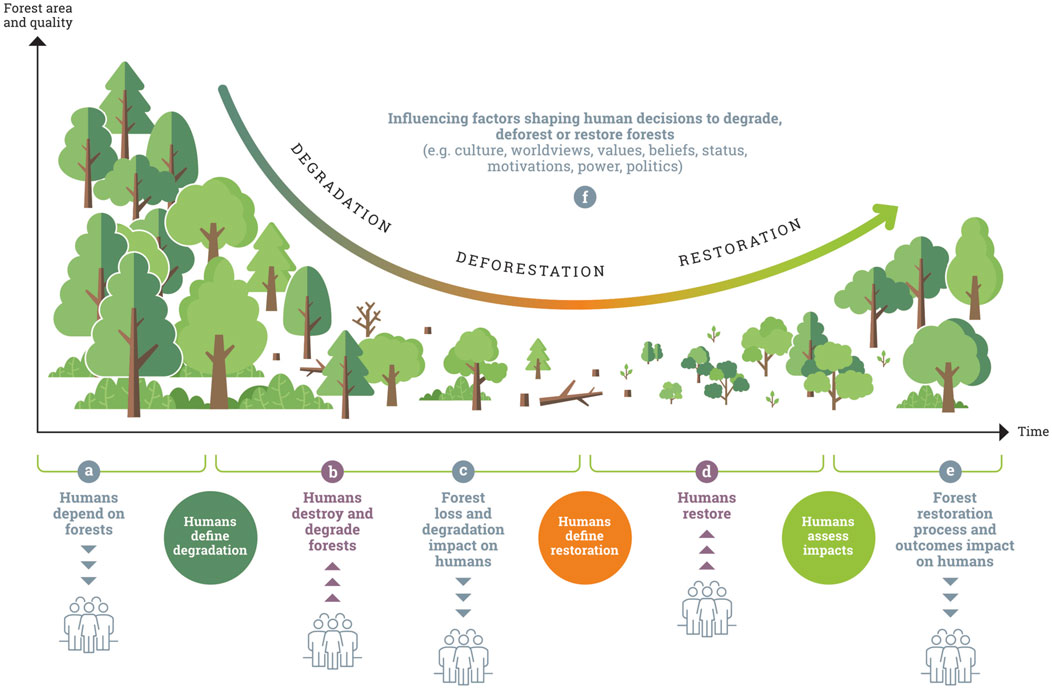
Figure 1. Framing the human dimensions of FLR. A simplified forest transition curve from deforestation to reforestation showing the intersection between humans and forests along this curve, starting with (a) the dependence of humans on healthy forests; (b) anthropogenic degradation of forests; and (c) the loss and degradation of forests impacting on people; followed by (d) restoration actions and (e) impacts thereof. It also demonstrates that all these actions are mediated by (f) influencing factors.
2 Human dimensions in a forest transition
Extensions to forest transition theory have mapped multiple potential pathways from forest loss to gain (Meyfroidt and Lambin, 2011). As restoration researchers, we recognize that although FLR represents one pathway along the forest transition curve, it is by no means the only one. Furthermore, the lack of agreed definitions (e.g., on forest degradation and restoration) generates challenges to identify broadly acceptable restoration objectives (e.g., Hobbs, 2016; Chazdon et al., 2016). Nonetheless, it is also widely acknowledged that land degradation and its cascade of impacts, are jeopardizing the lives of millions of people around the globe (IPBES, 2018). As such, while Figure 1 is clearly a simplification (realities in different times and places are more complex: Cochard et al., 2023), we believe it presents a useful framework to better understand the intersections between human dimensions and forest restoration.
Human dimensions operate at the intersection of the social and the ecological systems. Many people depend directly on forests for their livelihoods (point a in Figure 1), and even more depend indirectly on forests for the multiple contributions that they provide (Diaz et al., 2018). Yet, people also degrade forests, as shown in Figure 1 (point b). Critically, the people who most depend on forests directly, are often not the ones degrading them, although this will depend on specific locations. For example, in Brazil’s Xingu Indigenous reserve, Indigenous communities that depend on the Amazon forest have been conserving and restoring it, while non-Indigenous migrants moving to the area have been responsible for exploiting the forest around the Indigenous reserve (Sanches et al., 2021). In other examples, multinational mining companies with poor management practices have been directly responsible for degrading and deforesting forest areas (Sonter et al., 2017). Other compounded socio-economic and institutional factors, such as poverty and insecure tenure, condition environmental degradation behaviors. For instance, in southern Burkina Faso, relatively wealthy migrants who lack secure land tenure engage less with assisted natural regeneration practices than local farmers with more secure land rights (Etongo et al., 2016).
Moving along the forest transition curve (to point c), the loss and degradation of forests have a direct impact on humans. These impacts may be local (e.g., the loss of material and non-material benefits previously provided by forests, such as provisioning and cultural services), national (e.g., loss of revenue from economic streams linked to such natural capital) or global (e.g., loss of biodiversity such as unique species) and will affect different people. Then, moving along the forest transition curve, it is also humans who are responsible for restoration (point d, Figure 1). Even when natural regeneration is favored as an approach to restoration, human activities may be required to protect new growth by, for example, excluding herbivores or securing rights to the land and forests. Restoration processes and outcomes impact people in many ways (point e), with again differences depending on the actor and stakeholder. For example, local people may benefit (through job opportunities or secure rights) from restoration, but they may also be excluded from certain forest areas, and thereby bear the costs of the restoration process.
Several factors (point f in Figure 1) influence and mediate these interactions between people and the forest restoration process. They include worldviews, power dynamics and culture that influence people’s relationships with each other and with the land, trees, and forests. Along the transition curve, humans also shape discourses and understandings of forests and restoration. The concept of degradation is a subjective one and humans are responsible for defining and interpreting it in diverse ways (Hobbs, 2016; Ghazoul and Chazdon, 2017). Likewise, the concept of restoration is defined by humans, and there are a multitude of terms, framings (see, e.g., Mansourian, 2018; Gerwing et al., 2023), and different interpretations associated with the term (Reinecke and Blum, 2018).
3 Discussion
Four key points stand out from our assessment of the linkages between the forest transition and human dimensions in FLR. Firstly, the power of definitions and their implications emerges as a fundamental challenge in restoration (Reinecke and Blum, 2018). Current large scale restoration efforts have been criticized for their limited attention to biodiversity (e.g., Parr et al., 2024), reflecting divergent understandings of what restoration entails (Zerbe, 2023). The concepts of degradation and restoration are central to the model of the transition curve, and defining these concepts is a socio-political process that carries with it significant implications (Hobbs, 2016; Chazdon et al., 2016). If a national government considers an area degraded but not the local community, government-imposed restoration measures are likely to go against the community’s interests (e.g., from Viet Nam, McElwee, 2009). Respect for diverse values and knowledge systems as they relate to forests and landscapes provides space for negotiating restoration objectives that are acceptable to all.
Secondly, there is an intrinsic interdependence between people and forests that varies across spatial and temporal scales–with those most proximate typically relying more heavily on forests than those more distant, and being more impacted by degradation as well as restoration. Responsibilities for degrading or restoring also differ, with people who depend most on forests not necessarily being most directly responsible for forest degradation. Institutions, such as tenure rights, mediate the ways in which people relate to forests along the whole transition curve (Hecht et al., 2019; McLain et al., 2021).
At the same time, and this is our third point, power differentials among stakeholders create significant imbalances in the restoration processes being implemented around the globe (Elias et al., 2021). These power differentials occur at different scales. They may relate to knowledge and data, access to resources, or may be situated in historical processes. For example, many large scale carbon sequestration projects funded by powerful multinational companies skew benefits stemming from land use in favour of actors based in faraway cities (Mansourian and Vallauri, 2023; Schubert et al., 2024). Also, the knowledge used to implement restoration can reflect power imbalances when local knowledge systems and practices are disregarded (Robinson et al., 2021). In addition, the forest transition itself creates power imbalances as different stakeholders benefit more or less at different stages of the transition (Kull et al., 2024).
Fourthly, and as a result of the previous point, conflicts stemming from both degradation and restoration are the result of differing interests, power and values. For example, the creation of value through restoration may lead to conflict (Barr and Sayer, 2012). Various conflict resolution mechanisms can help to address such conflicts in restoration, including, for example, strategy games (Garcia et al., 2022), emphasizing negotiation and mediation (Mansourian et al., 2024).
Despite its limitations in portraying the often uneven evolution of the transition (Kull, 2017; Kull et al., 2024), the forest transition model can help conceptualize the intersections between forests (and tree-based systems more generally) and people along a trajectory from loss to recovery. It provides an opportunity to identify leverage points at different stages in the restoration process.
Improving forest landscape restoration outcomes for people and nature requires more than passive stakeholder engagement, as proposed by some principles on restoration (e.g., Besseau et al., 2018; FAO et al., 2021; Bartholomew et al., 2024), or tokenism (Robinson et al., 2021). Instead, equitable and durable restoration needs to fully engage with human dimensions throughout the entire process, acknowledging that there can be no restoration without people.
Data availability statement
The original contributions presented in the study are included in the article/supplementary material, further inquiries can be directed to the corresponding author.
Author contributions
SM: Conceptualization, Project administration, Writing–original draft, Writing–review and editing. ID: Conceptualization, Writing–review and editing. ME: Conceptualization, Writing–review and editing. JAO: Conceptualization, Writing–review and editing. MD: Conceptualization, Writing–review and editing. CK: Writing–review and editing. PP: Conceptualization, Writing–review and editing.
Funding
The author(s) declare that financial support was received for the research, authorship, and/or publication of this article.
Acknowledgments
The authors thank Janice Burns and Michael Kleine (IUFRO), Anita Diederichsen and Daniel Vallauri (WWF), Bethanie Walder (SER), Emily Gonzales (Parks Canada), Luiz Moraes (Embrapa) and Gretchen Walters (UNIL) for their feedback at various stages of work on a report on human dimensions of FLR, which contributed some of the background for this article. We wish to thank Karen Holl and John Parrotta for their feedback on an earlier version of this manuscript as well as two reviewers. We are also grateful to Bertrand Dubois for his assistance with the diagram. SM and CK gratefully acknowledge the financial contribution of Velux Stiftung for this article. SM also thanks WWF, IUFRO and SER for supporting the report which contributed some of the background for this article. JO acknowledges funding from UKRI through a Frontier Research Grant (EP/X023222/1) selected by the European Research Council and from the ESRC (ES/Y002660/1).
Conflict of interest
The authors declare that the research was conducted in the absence of any commercial or financial relationships that could be construed as a potential conflict of interest.
Generative AI statement
The author(s) declare that no Generative AI was used in the creation of this manuscript.
Publisher’s note
All claims expressed in this article are solely those of the authors and do not necessarily represent those of their affiliated organizations, or those of the publisher, the editors and the reviewers. Any product that may be evaluated in this article, or claim that may be made by its manufacturer, is not guaranteed or endorsed by the publisher.
References
Barr, C. M., and Sayer, J. A. (2012). The political economy of reforestation and forest restoration in Asia–Pacific: critical issues for REDD+. Biol. Conserv. 154, 9–19. doi:10.1016/j.biocon.2012.03.020
Bartholomew, D. C., Mosyaftiani, A., Morgan, B., Shah, T., Shaw, K., Stillman, C., et al. (2024). The global biodiversity standard: manual for assessment and best practices. Washington, D.C: BGCI, Richmond, UK and SER.
Besseau, P., Graham, S., and Christophersen, T. (2018). “Restoring forests and landscapes: the key to a sustainable future,” in Global partnership on forest and landscape restoration. Vienna: IUFRO.
Bixler, R. P., Jedd, T., and Wyborn, C. (2018). “Polycentric governance and forest landscape restoration: considering local needs, knowledge types and democratic principles,” in Forest landscape restoration. Editors S. Mansourian, and J. Parrotta (London and New York: Routledge), 176–197.
Chazdon, R. L., Brancalion, P. H., Laestadius, L., Bennett-Curry, A., Buckingham, K., Kumar, C., et al. (2016). When is a forest a forest? Forest concepts and definitions in the era of forest and landscape restoration. Ambio 45 (5), 538–550. doi:10.1007/s13280-016-0772-y
Cochard, R., Gravey, M., Rasera, L. G., Mariethoz, G., and Kull, C. A. (2023). The nature of a “forest transition” in Thừa Thiên Huế Province, Central Vietnam–A study of land cover changes over five decades. Land Use Policy 134, 106887. doi:10.1016/j.landusepol.2023.106887
D. J. Decker, S. J. Riley, and W. F. Siemer (2012). Human dimensions of wildlife management (Baltimore, MD: JHU Press).
De Groot, R. S., Blignaut, J., Van Der Ploeg, S., Aronson, J., Elmqvist, T., and Farley, J. (2013). Benefits of investing in ecosystem restoration. Conserv. Biol. 27 (6), 1286–1293. doi:10.1111/cobi.12158
Díaz, S., Pascual, U., Stenseke, M., Martín-López, B., Watson, R. T., Molnár, Z., et al. (2018). Assessing nature's contributions to people. Science 359 (6373), 270–272. doi:10.1126/science.aap8826
Djenontin, I. N., and Zulu, L. C. (2021). The quest for context-relevant governance of agro-forest landscape restoration in Central Malawi: insights from local processes. For. Policy Econ. 131, 102555. doi:10.1016/j.forpol.2021.102555
Djenontin, I. N. S., Zulu, L. C., and Etongo, D. (2020). Ultimately, what is forest landscape restoration in practice? Embodiments in sub-saharan africa and implications for future design. Environ. Manag. 68, 619–641. doi:10.1007/s00267-020-01360-y
Elias, M., Joshi, D., and Meinzen-Dick, R. (2021). Restoration for whom, by whom? A feminist political ecology of restoration. Ecol. Restor. 39 (1-2), 3–15. doi:10.3368/er.39.1-2.3
Elias, M., Kandel, M., Mansourian, S., Meinzen-Dick, R., Crossland, M., Joshi, D., et al. (2022). Ten people-centered rules for socially sustainable ecosystem restoration. Restor. Ecol. 30 (4), e13574. doi:10.1111/rec.13574
Etongo, D., Djenontin, I. N. S., and Kanninen, M. (2016). Poverty and environmental degradation in southern Burkina Faso: an assessment based on participatory methods. Land 5 (3), 20. doi:10.3390/land5030020
FAO, IUCN CEM and SER (2021). Principles for ecosystem restoration to guide the united nations decade 2021–2030. Rome: FAO.
Fleischman, F., Basant, S., Chhatre, A., Coleman, E. A., Fischer, H. W., Gupta, D., et al. (2020). Pitfalls of tree planting show why we need people-centered natural climate solutions. BioScience 70 (11), 947–950. doi:10.1093/biosci/biaa094
Garcia, C. A., Savilaakso, S., Verburg, R. W., Stoudmann, N., Fernbach, P., Sloman, S. A., et al. (2022). Strategy games to improve environmental policymaking. Nat. Sustain. 5 (6), 464–471. doi:10.1038/s41893-022-00881-0
Gerwing, T. G., Hawkes, V. C., and Murphy, S. D. (2023). Speaking the same language: aligning project designations to clarify communication in restoration ecology. Environ. Rev. 31 (3), 498–508. doi:10.1139/er-2022-0091
Ghazoul, J., and Chazdon, R. (2017). Degradation and recovery in changing forest landscapes: a multiscale conceptual framework. Annu. Rev. Environ. Resour. 42, 161–188. doi:10.1146/annurev-environ-102016-060736
Guariguata, M. R., and Brancalion, P. H. (2014). Current challenges and perspectives for governing forest restoration. Forests 5 (12), 3022–3030. doi:10.3390/f5123022
Hecht, S. B., Morrison, K. D., and Padoch, C. (2019). “The social lives of forests: past, present, and future of woodland resurgence.” University of Chicago Press.
Himes, A., Muraca, B., Anderson, C. B., Athayde, S., Beery, T., Cantú-Fernández, M., et al. (2024). Why nature matters: a systematic review of intrinsic, instrumental, and relational values. BioScience 74 (1), 25–43. doi:10.1093/biosci/biad109
Hobbs, R. J. (2016). Degraded or just different? Perceptions and value judgements in restoration decisions. Restor. Ecol. 24 (2), 153–158. doi:10.1111/rec.12336
Höhl, M., Ahimbisibwe, V., Stanturf, J. A., Elsasser, P., Kleine, M., and Bolte, A. (2020). Forest landscape restoration—what generates failure and success? Forests 11 (9), 938. doi:10.3390/f11090938
IPBES (2018). “Summary for policymakers of the assessment report on land degradation and restoration of the intergovernmental science-policy platform on biodiversity and ecosystem services,” in IPBES report. Editors R. J. Scholes, L. Montanarella, E. Brainich, N. Barger, B. ten Brink, M. Canteleet al. (Bonn: IPBES Secretariat).
Kull, C. A. (2017). Forest transitions: a new conceptual scheme. Geogr. Helvetica 72 (4), 465–474. doi:10.5194/gh-72-465-2017
Kull, C. A., Bartmess, J., Dressler, W., Gingrich, S., Grodzicki, M., Jasikowska, K., et al. (2024). Pitfalls for the sustainability of forest transitions: evidence from Southeast Asia. Environ. Conserv. 51, 152–162. doi:10.1017/s0376892924000079
Lake, F. K., Parrotta, J., Giardina, C. P., Davidson-Hunt, I., and Uprety, Y. (2018). “Integration of Traditional and Western knowledge in forest landscape restoration,” in Forest landscape restoration: integrated approaches to support effective implementation. Editors S. Mansourian, and J. Parrotta (London: Routledge), 198–226.
Löfqvist, S., Kleinschroth, F., Bey, A., de Bremond, A., DeFries, R., Dong, J., et al. (2023). How social considerations improve the equity and effectiveness of ecosystem restoration. BioScience 73 (2), 134–148. doi:10.1093/biosci/biac099
Mansourian, S. (2018). In the eye of the beholder: reconciling interpretations of forest landscape restoration. Land Degrad. and Dev. 29 (9), 2888–2898. doi:10.1002/ldr.3014
Mansourian, S. (2021). Disciplines, sectors, motivations and power relations in forest landscape restoration. Ecol. Restor. 39 (1-2), 16–26. doi:10.3368/er.39.1-2.16
Mansourian, S., Berrahmouni, N., Blaser, J., Dudley, N., Maginnis, S., Mumba, M., et al. (2021). Reflecting on twenty years of forest landscape restoration. Restor. Ecol. 29 (7), e13441. doi:10.1111/rec.13441
Mansourian, S., Derkyi, M., Djenontin, I., Elias, M., Oldekop, J., Pacheco, P., et al. (2024). Human dimensions of forest landscape restoration. Vienna: IUFRO, 76.
Mansourian, S., and Vallauri, D. (2023). Categories of actors involved in tree planting by multinational corporations based in France, Switzerland and the UK. Sustain. Dev. 31 (4), 2929–2937. doi:10.1002/sd.2559
McElwee, P. (2009). Reforesting “bare hills” in Vietnam: social and environmental consequences of the 5 million hectare reforestation program. Ambio A J. Hum. Environ. 38 (6), 325–333. doi:10.1579/08-r-520.1
McLain, R., Lawry, S., Guariguata, M. R., and Reed, J. (2021). Toward a tenure-responsive approach to forest landscape restoration: a proposed tenure diagnostic for assessing restoration opportunities. Land Use Policy 104, 103748. doi:10.1016/j.landusepol.2018.11.053
Meyfroidt, P., and Lambin, E. F. (2011). Global forest transition: prospects for an end to deforestation. Annu. Rev. Environ. Resour. 36 (1), 343–371. doi:10.1146/annurev-environ-090710-143732
Nelson, C. R., Hallett, J. G., Romero Montoya, A. E., Andrade, A., Besacier, C., Boerger, V., et al. (2024). “Standards of practice to guide ecosystem restoration – a contribution to the united nations decade on ecosystem restoration 2021–2030.” Washington, DC.
Parr, C. L., Te Beest, M., and Stevens, N. (2024). Conflation of reforestation with restoration is widespread. Science 383 (6684), 698–701. doi:10.1126/science.adj0899
Pascual, U., Balvanera, P., Anderson, C. B., Chaplin-Kramer, R., Christie, M., González-Jiménez, D., et al. (2023). Diverse values of nature for sustainability. Nature 620 (7975), 813–823. doi:10.1038/s41586-023-06406-9
Rai, N. D., Bhasme, S., and Balaji, P. (2018). “Power, inequality and rights: a political ecology of forest restoration,” in Forest landscape restoration: integrated approaches to support effective implementation. Editors S. Mansourian, and J. Parrotta (London: Routledge), 63–78.
Reinecke, S., and Blum, M. (2018). Discourses across scales on forest landscape restoration. Sustainability 10 (3), 613. doi:10.3390/su10030613
Robinson, J. M., Gellie, N., MacCarthy, D., Mills, J. G., O'Donnell, K., and Redvers, N. (2021). Traditional ecological knowledge in restoration ecology: a call to listen deeply, to engage with, and respect Indigenous voices. Restor. Ecol. 29 (4), e13381. doi:10.1111/rec.13381
Sabogal, C., Besacier, C., and McGuire, D. (2015). Forest and landscape restoration: concepts, approaches and challenges for implementation. Unasylva 66 (245), 3. doi:10.1505/146554824839071652
Sanches, R. A., Futemma, C. R. T., and Alves, H. Q. (2021). Indigenous territories and governance of forest restoration in the Xingu River (Brazil). Land Use Policy 104, 104755. doi:10.1016/j.landusepol.2020.104755
Schubert, S. C., Battaglia, K. E., Blebea, C. N., Seither, C. J., Wehr, H. L., and Holl, K. D. (2024). Advances and shortfalls in applying best practices to global tree-growing efforts. Conserv. Lett. 17 (2), e13002. doi:10.1111/conl.13002
Sonter, L. J., Herrera, D., Barrett, D. J., Galford, G. L., Moran, C. J., and Soares-Filho, B. S. (2017). Mining drives extensive deforestation in the Brazilian Amazon. Nat. Commun. 8 (1), 1013. doi:10.1038/s41467-017-00557-w
Wiegant, D., van Oel, P., and Dewulf, A. (2022). Scale-sensitive governance in forest and landscape restoration: a systematic review. Reg. Environ. Change 22 (1), 25. doi:10.1007/s10113-022-01889-0
Keywords: social-ecological system, human dimensions, restoration, governance, forest transition
Citation: Mansourian S, Djenontin INS, Elias M, Oldekop JA, Derkyi MAA, Kull CA and Pacheco P (2025) Situating the “human” in forest landscape restoration. Front. Environ. Sci. 12:1522979. doi: 10.3389/fenvs.2024.1522979
Received: 05 November 2024; Accepted: 26 December 2024;
Published: 24 February 2025.
Edited by:
Vinicius Londe, University of Georgia, United StatesReviewed by:
Verina Jane Ingram, Wageningen University and Research, NetherlandsKatharina Löhr, Leibniz Centre for Agricultural Landscape Research (ZALF) e.V., Germany
Copyright © 2025 Mansourian, Djenontin, Elias, Oldekop, Derkyi, Kull and Pacheco. This is an open-access article distributed under the terms of the Creative Commons Attribution License (CC BY). The use, distribution or reproduction in other forums is permitted, provided the original author(s) and the copyright owner(s) are credited and that the original publication in this journal is cited, in accordance with accepted academic practice. No use, distribution or reproduction is permitted which does not comply with these terms.
*Correspondence: Stephanie Mansourian, c3RlcGhhbmllQG1hbnNvdXJpYW4ub3Jn