 Pavlos Tziourrou
 Evangelia E. Golia
- Laboratory of Soil Science, School of Agriculture, Aristotle University of Thessaloniki, Thessaloniki, Greece
Introduction
Microplastics (MPs) in the atmosphere represent an emerging environmental concern with implications that extend beyond air pollution (Biswas et al., 2025). Their interactions with soils, mediated by plant processes, remain poorly understood, highlighting a critical knowledge gap (Li et al., 2025). Addressing these interactions is essential for soil health (Golia et al., 2024) and exploring the potential of phytoremediation as a strategy for mitigating environmental pollution (Sharma et al., 2025).
Microplastics in the atmosphere
Air pollutants arise from both natural and human-made sources and have the capacity to bio-magnify and bio-accumulate across trophic levels, thereby enhancing toxicity within the food chain (Lee et al., 2020). A range of air pollutants, including particulate matter (PM), volatile organic compounds (VOCs), inorganic air pollutants (IAP), persistent organic pollutants (POPs), heavy metals, and black carbon, have been shown to have detrimental effects on both environmental and human health following extended exposure (Lee et al., 2020). MPs are currently recognized as pollutants and particulates in the atmosphere. Recent research has shown the presence of MPs in urban, rural, and remote atmospheric environments, as well as in atmospheric deposition. As a pollutant in the atmosphere, MPs have considerable potential for long-distance transport [as occurs in the oceans (Tziourrou, 2021)], which can consequently affect areas that are distant from the sources of MPs pollution (Zhang et al., 2020). According to recent study conducted by Tatsii et al. (2024), it has been demonstrated that MPs can be carried through the atmosphere to nearly any location on Earth. They are found throughout the troposphere and potentially in the stratosphere, taking into account both low and high efficiencies of in-cloud scavenging.
According to Zhang et al. (2020), MPs have been identified in the atmosphere of urban, suburban, and even distant regions far removed from the source areas of MPs, indicating the possibility of long-distance atmospheric transport of these particles. MPs are present in the atmosphere from urban to remote locations, with their abundance and deposition varying by 1–3 orders of magnitude across different sites. Fibers and fragments are the most commonly reported forms and types of plastic, which generally correspond with global plastic demand (Zhang et al., 2020).
Ιnteraction with the sea surface
Microplastics in the atmosphere can originate from various sources, including the sea surface. According to Gaylarde et al. (2025), the intricate interplay between MPs present in the atmosphere and on the surface of the Earth is influenced by both natural and human-induced factors. MPs are carried from the ocean to the atmosphere through processes such as bubble scavenging and the formation of sea spray, while land-based sources contribute to their release through air currents and human activities (Harb et al., 2023). It has been estimated that as much as 8.6 megatons of MPs are suspended in the air above the oceans each year (Gaylarde et al., 2025). These particles are disseminated by wind, water, and fomites, eventually returning to the Earth’s surface through rainfall and passive deposition; however, they can also escape into the stratosphere, where they may persist for several months (Gaylarde et al., 2025).
Microplastics in indoor and outdoor air
Despite these secondary aspects, this is connected to human-made aerosols, including paints, agrochemicals, personal care and cosmetic products, as well as domestic and industrial activities (such as air conditioning, vacuuming, washing, waste disposal, and the production of plastic-containing items), contribute directly to the airborne load of MPs, which is found to be greater in indoor environments compared to outdoor air (Gaylarde et al., 2025).
The deposition of MPs in isolated areas has been documented to vary between 50 and 700 MPs per square meter daily (Gaylarde et al., 2025). The concentrations of MPs in outdoor air fluctuated between less than 1 and over 1,000 MPs per cubic meter, while deposition rates ranged from 0.5 to 1,357 MPs per square meter per day (O’Brien et al., 2023). Dust concentrations exhibited a variation from 2 to 477 MPs per gram in road dust, and from 18 to 225 MPs per gram in outdoor dust. In indoor environments, air concentrations varied from less than 1 MP per cubic meter to a mean of 1,583 ± 1,181 MPs per cubic meter (O’Brien et al., 2023). The dustfall indoors contained between 475 and 19,600 MPs per square meter per day, and indoor dust ranged from 10 to 67,000 MPs per gram (O’Brien et al., 2023). The composition of these MPs was as follows: Air: PET, PE, PP; Deposition: PET, PE, PP; Road dust: PE, PVC, PP; Outdoor dust: PET, PP, PA; Indoor dust: PET, PE, PP (O’Brien et al., 2023). Particles of various types, ranging from 100 to 1,000 nm in size, are recognized to be transported over considerable distances in the atmosphere, occasionally spanning an entire hemisphere (Damoah et al., 2004). As referred to by Tatsii et al. (2024), numerous studies have demonstrated that even particles exceeding 75 μm in diameter can remain suspended in the air for prolonged durations and be deposited thousands of kilometers from their origin. This phenomenon is also relevant to MPs, which are frequently discovered in isolated areas of the globe (Tatsii et al., 2024).
Atmospheric microplastics and climate change: an overlooked interaction
These aspects indirectly link phytoremediation and soil processes to broader environmental phenomena, such as climate change. Atmospheric aerosols, including mineral dust and various forms of airborne particulate matter, affect the climate of Earth by absorbing and scattering radiation, which is referred to as direct radiative effects. These effects are typically measured using the effective radiative forcing (ERF) metric (Myhre et al., 2013). Nevertheless, the radiative impacts of airborne MPs and their potential consequences for global climate remain largely unexamined. The ERF for airborne MPs has been calculated to be 0.044 ± 0.399 mw per square metre in the current atmosphere, based on an assumed uniform surface concentration of 1 MP particle per cubic metre and a vertical distribution extending up to 10 km in altitude. However, significant uncertainties exist regarding the geographical and vertical distribution of MPs. If it is assumed that they are limited to the boundary layer, shortwave effects prevail, resulting in a MP ERF of approximately −0.746 ± 0.553 mw per square metre (Revell et al., 2021). In comparison to the total ERF attributed to aerosol–radiation interactions, which ranges from −0.71 to −0.14 W per square metre, the MP ERF is relatively minor (Bellouin et al., 2020). Nonetheless, plastic production has surged dramatically over the last 70 years (Geyer et al., 2017); without significant efforts to reform plastic production and waste management practices, the prevalence and ERF of airborne MPs are likely to rise.
Human health and microplastics
Although our main focus is on the soil, the impacts on human health indirectly highlight the importance of managing microplastics in soil. Individuals may be exposed to MPs via oral consumption, inhalation, and dermal contact (Li et al., 2023). The consequences include oxidative stress, DNA damage, organ dysfunction, metabolic disorders, immune responses, neurotoxicity, as well as reproductive and developmental toxicity (Li et al., 2023). These particles can infiltrate the human body through inhalation, ingestion, or skin contact, leading to various health risks such as cellular injury, hormonal disruption, and cardiovascular diseases (Lalrinfela et al., 2024). MPs and nanoplastics (NPs) enter the human system through the consumption of seafood and sea salt, drinking water (Lalrinfela et al., 2024), and the inhalation of airborne MPs released from urban dust, synthetic clothing, and the erosion of rubber tires, among other sources (Prata, 2018). Although airborne MPs represent a relatively new area of research, numerous observational studies have documented the inhalation of plastic fibers and particles, particularly among exposed workers, frequently accompanied by dyspnea resulting from airway and interstitial inflammatory responses (Prata, 2018). Inhalable plastic particles are associated with an increased incidence of cancer, and exposure in rats leads to granulomatous lesions with slow clearance after 12 weeks (Prata, 2018). Secondary sources of MPs include synthetic fabric fibers, dust from synthetic rubber tires, paint particles, and the degradation of larger plastics that become brittle due to UV radiation exposure (Evangeliou et al., 2020; Rochman, 2018); When inhaled from ambient air, MPs and NPs may pose significant threats to human health (Goodman et al., 2021).
The significant role of phytoremediation
Understanding the impacts of microplastics on human health also highlights the significant role of phytoremediation in mitigating these pollutants. Phytoremediation plays a significant role in controlling air pollution as a cost-effective, energy-efficient, and environmentally friendly method for addressing air pollutants (Lee et al., 2020). In the process of phytoremediation, plant organs and the associated microbes in both the phyllosphere and rhizosphere interact to mitigate air pollutants (Figure 1). The phytoremediation of air pollutants utilizes the rhizosphere of plants, as pollutants can accumulate in the soil during leaf drop and rainfall (Lee et al., 2020). The deposition of MPs/NPs on the above-ground parts of plants may be a potential mechanism for the phytostabilization of airborne MPs/NPs. Plant leaves are essential in combating air pollution, as they can absorb pollutants from the air, acting as a sink for these contaminants due to their extensive and irregular surfaces (Gong et al., 2023).
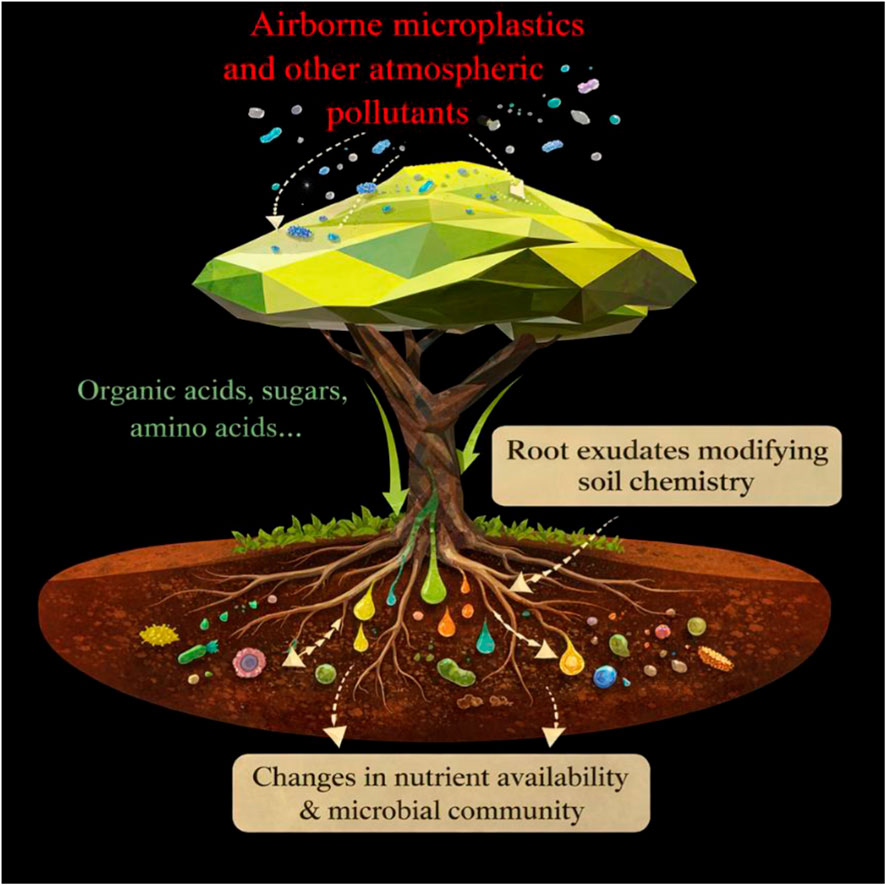
Figure 1. A conceptual illustration depicting the possible effects of atmospheric plastics (MPs/NPs) on terrestrial ecosystems and soil health, alongside the wider implications of air pollution. The diagram emphasizes significant knowledge gaps and research inquiries related to environmental impacts, such as potential disturbances to soil processes, plant functionality, and food chain interactions, highlighting the necessity for additional interdisciplinary research. Furthermore, it stresses the vital function of plants in atmospheric remediation, serving as natural filters capable of reducing MPs and other airborne pollutants. The diagram was created using a combination of PowerPoint and artificial intelligence (AI).
Certain submerged aquatic vegetation has the capacity to uptake and accumulate MPs through electrostatic interactions, leading to the formation of biofilms on their leaves (Kalčíková et al., 2017) and within their cell walls (Zhang et al., 2022). The leaf uptake of MPs by terrestrial plants is increasingly alarming, as atmospheric deposition introduces over 280 particles per square meter of MPs into the environment each day (Dris et al., 2015). Under sunlight exposure, the stomata of terrestrial plant leaves open to approximately 25 μm in length and 3–10 μm in width, facilitating the entry of small MPs into the leaves (Lv et al., 2019).
Different plant types may vary in their efficiency to capture airborne MPs. For instance, the chemical landscape of leaf surfaces (Ossola and Farmer, 2024) and leaf surface area—such as differences between broadleaf trees and conifers—as well as surface roughness, may influence capture effectiveness. Broadleaf trees may be more effective due to their larger leaf surface area and rougher leaf surfaces, whereas shrubs and herbs likely have lower capture potential. However, systematic comparative studies across plant types are still limited. Therefore, this represents an important avenue for future research to better understand the role of vegetation in mitigating airborne MP pollution.
Another important point is that roots do not simply absorb nutrients from the soil; they also exudate organic compounds that shape soil chemistry and microbial communities (Upadhyay et al., 2022; Canarini et al., 2019; Badri and Vivanco, 2009; Bais et al., 2006; Walker et al., 2003; Dakora and Phillips, 2022). This ‘dual action’ of roots underscores that plants are not passive recipients, but active modulators of their soil environment. This raises a critical question: can airborne pollutants influence the soil through these root exudates?
Nonetheless, the effectiveness of phytoremediation in removing pollutants requires validation and verification (Lee et al., 2020). The use of plants for the remediation of air contaminants is influenced by several key factors: (a) the tolerance levels of plants to various pollutants, (b) environmental conditions such as wind, precipitation, temperature, pH, solar intensity, and water availability, (c) specific characteristics of the plants including surface roughness, thickness, ultrastructure, pubescence, wax content, leaf size, and structure, (d) the composition of the air pollutants, (e) uncertainties surrounding plant-microbe interactions, and (f) the selection of both plants and microbes, which impacts the overall uptake of air pollutants (Lee et al., 2020). Finally, it is important to note that the various processes within the global system (including the terrestrial, atmospheric, and aquatic, compartments of the Earth planet) are interconnected (Tziourrou and Golia, 2024). As a result, environmental pollution (e.g., plastics) can affect different components of the system in multiple and sometimes opposing ways (Tziourrou et al., 2025). Moreover, Brahney et al. (2021) highlighted that plastics exhibit distinct residence times across different environmental compartments. Despite the shift toward biodegradable polymers, non-biodegradable plastics will continue to recirculate within the Earth’s systems, while substantial uncertainties persist regarding their sources, transport pathways, and deposition processes (Brahney et al., 2021).
Discussion
Phytoremediation of atmospheric MPs/NPs has the potential to influence soil health through multiple, plant-mediated pathways. Plants can intercept airborne MPs/NPs on leaf surfaces and subsequently affect soil properties via leaf litter deposition, root exudation, and interactions within the rhizosphere. These processes may alter soil structure, nutrient cycling, microbial communities, and organic matter dynamics. Although the overall likelihood and magnitude of these effects remain uncertain, available evidence suggests that plant-mediated pathways may play a significant role in transferring atmospheric pollutants to soils.
Despite the rapidly growing interest in atmospheric MPs/NPs, studies directly assessing their impacts on soil via phytoremediation remain limited. The current lack of empirical evidence limits quantitative evaluation of these effects; however, it simultaneously highlights a critical and underexplored knowledge gap. Drawing on existing research on MPs in soils and on the phytoremediation of other environmental pollutants, we propose that the interception of atmospheric MPs/NPs by plants and their subsequent transfer to soils—through leaf litter deposition, root-mediated processes, or rhizosphere interactions—may influence soil structure, microbial communities, and key biogeochemical processes.
Despite these insights, several critical knowledge gaps remain unresolved. The relative contributions of different plant functional types, the influence of MP/NP characteristics (e.g., size, shape, polymer type), and the long-term impacts on soil physicochemical and biological properties are still poorly understood.
To address these gaps, we propose a focused research agenda including testable hypotheses. For example, some tree species may intercept higher loads of airborne MPs compared to other species (e.g., broadleaf vs. coniferous), or the deposition of MPs via leaf litter may significantly alter microbial community composition and enzyme activities in soils. Such studies are essential for evaluating the environmental and ecological consequences of atmospheric plastic phytoremediation and for optimizing plant-based mitigation strategies.
Conclusion
Based on the above, it is important to propose the development of research on the restoration of the atmosphere from MPs and NPs using phytoremediation methods. Deforestation of trees or forest fires should be seriously considered with regard to the restoration of the atmosphere from the different types of MPs and NPs. The case of air pollution from plastics is related, among other things, to negative impacts on human health as mentioned above in this opinion article. Ultimately, what are the impacts on the physicochemical and biological characteristics of soil following the exposure of plants and trees to a polluted environment mainly caused by MPs and NPs?
Author contributions
PT: Conceptualization, Formal Analysis, Investigation, Software, Supervision, Visualization, Writing – original draft. EG: Writing – review and editing.
Funding
The author(s) declared that financial support was not received for this work and/or its publication.
Conflict of interest
The author(s) declared that this work was conducted in the absence of any commercial or financial relationships that could be construed as a potential conflict of interest.
Generative AI statement
The author(s) declared that generative AI was not used in the creation of this manuscript.
Any alternative text (alt text) provided alongside figures in this article has been generated by Frontiers with the support of artificial intelligence and reasonable efforts have been made to ensure accuracy, including review by the authors wherever possible. If you identify any issues, please contact us.
Publisher’s note
All claims expressed in this article are solely those of the authors and do not necessarily represent those of their affiliated organizations, or those of the publisher, the editors and the reviewers. Any product that may be evaluated in this article, or claim that may be made by its manufacturer, is not guaranteed or endorsed by the publisher.
References
Badri, D. V., and Vivanco, J. M. (2009). Regulation and function of root exudates. Plant, Cell Environ. 32 (6), 666–681. doi:10.1111/j.1365-3040.2009.01926.x
Bais, H. P., Weir, T. L., Perry, L. G., Gilroy, S., and Vivanco, J. M. (2006). The role of root exudates in rhizosphere interactions with plants and other organisms. Annu. Rev. Plant Biol. 57, 233–266. doi:10.1146/annurev.arplant.57.032905.105159
Bellouin, N., Quaas, J., Gryspeerdt, E., Kinne, S., Stier, P., Watson-Parris, D., et al. (2020). Bounding global aerosol radiative forcing of climate change. Rev. Geophys. 58 (1), e2019RG000660. doi:10.1029/2019RG000660
Biswas, A., Saini, N., Chivukula, N., Samal, A., Jansari, M. R., Bhadury, P., et al. (2025). The dawn of a new air pollutant: inhalable microplastics as emerging vectors of hazardous contaminants and their implications for human health. Environ. Int. 205, 109897. doi:10.1016/j.envint.2025.109897
Brahney, J., Mahowald, N., Prank, M., Cornwell, G., Klimont, Z., Matsui, H., et al. (2021). Constraining the atmospheric limb of the plastic cycle. Earth, Atmos. Planet. Sci. 118 (16), e2020719118. doi:10.1073/pnas.2020719118
Canarini, A., Kaiser, C., Merchant, A., Richter, A., and Wanek, W. (2019). Root exudation of primary metabolites: mechanisms and their roles in plant responses to environmental stimuli. Front. Plant Sci. 10, 157. doi:10.3389/fpls.2019.00157
Dakora, F. D., and Phillips, D. A. (2022). Root exudates as mediators of mineral acquisition in low-nutrient environments. Plant Soil 245, 35–47. doi:10.1023/A:1020809400075
Damoah, R., Spichtinger, N., Forster, C., James, P., Mattis, I., Wandinger, U., et al. (2004). Around the world in 17 days-hemispheric-scale transport of forest fire smoke from Russia in May 2003. Atmos. Chem. Phys. 4, 1311–1321. doi:10.5194/acp-4-1311-2004
Dris, R., Gasperi, J., Rocher, V., Saad, M., Renault, N., and Tassin, B. (2015). Microplastic contamination in an urban area: a case study in greater paris. Environ. Chem. 2, 592–599. doi:10.1071/EN14167
Evangeliou, N., Grythe, H., Klimont, Z., Heyes, C., Eckhardt, S., Lopez-Aparicio, S., et al. (2020). Atmospheric transport is a major pathway of microplastics to remote regions. Nat. Commun. 11, 3381. doi:10.1038/s41467-020-17201-9
Gaylarde, C. C., Neto, J. A. B., and da Fonseca, E. M. (2025). Atmospheric microplastics: inputs and outputs. Micro 5, 27. doi:10.3390/micro5020027
Geyer, R., Jambeck, J. R., and Law, K. L. (2017). Law, production, use, and fate of all plastics ever made. Sci. Adv. 3, e1700782. doi:10.1126/sciadv.1700782
Golia, E. E., Liava, V., Achilias, D. S., Navarro-Pedreño, J., Zorpas, A. A., Bethanis, J., et al. (2024). Microplastics’ impact on soil health and quality: effect of incubation time and soil properties in soil fertility and pollution extent under the circular economy concept. Waste Manag. Res. 43 (7), 1146–1155. doi:10.1177/0734242X241299110
Gong, X., Shi, G., Zou, D., Wu, Z., Qin, P., Yang, Y., et al. (2023). Micro- and nano-plastics pollution and its potential remediation pathway by phytoremediation. Planta 257, 35. doi:10.1007/s00425-023-04069-4
Goodman, K. E., Hare, J. T., Khamis, Z. I., Hua, T., and Sang, Q.-X. A. (2021). Exposure of human lung cells to polystyrene microplastics significantly retards cell proliferation and triggers morphological changes. Chem. Res. Toxicol. 34 (4), 1069–1081. doi:10.1021/acs.chemrestox.0c00486
Harb, C., Pokhrel, N., and Foroutan, H. (2023). Quantification of the emission of atmospheric microplastics and nanoplastics via sea spray. Environ. Sci. Technol. Lett. 10, 513–519. doi:10.1021/acs.estlett.3c00164
Kalčíková, G., Gotvajn, A. Ž., Kladnik, A., and Jemec, A. (2017). Impact of polyethylene microbeads on the floating freshwater plant duckweed lemna minor. Environ. Pollut. 230, 1108–1115. doi:10.1016/j.envpol.2017.07.050
Lalrinfela, P., Vanlalsangi, R., Lalrinzuali, K., and Babu, P. J. (2024). Microplastics: their effects on the environment, human health, and plant ecosystems. Environ. Pollut. Manag. 1, 248–259. doi:10.1016/j.epm.2024.11.004
Lee, B. X. Y., Hadibarata, T., and Yuniarto, A. (2020). Phytoremediation mechanisms in air pollution control: a review. Water Air Soil Pollut. 231, 437. doi:10.1007/s11270-020-04813-6
Li, Y., Tao, L., Wang, Q., Wang, F., Li, G., and Song, M. (2023). Potential health impact of microplastics: a review of environmental distribution, human exposure, and toxic effects. Environ. and Health 1 (4), 249–257. doi:10.1021/envhealth.3c00052
Li, Y., Zhang, J., Xu, L., Li, R., Zhang, R., Li, M., et al. (2025). Leaf absorption contributes to accumulation of microplastics in plants. Nature 641, 666–673. doi:10.1038/s41586-025-08831-4
Lv, J., Christie, P., and Zhang, S. (2019). Uptake, translocation, and transformation of metal-based nanoparticles in plants: recent advances and methodological challenges. Environ. Sci. Nano 6, 41–59. doi:10.1039/C8EN00645H
Myhre, G., Shindell, D., Bréon, F.-M., Collins, W., Fuglestvedt, J., Huang, J., et al. (2013). “Anthropogenic and natural radiative forcing,” in Climate change 2013: the physical science basis. Contribution of working group I to the fifth assessment report of the intergovernmental panel on climate change. Editors T. F. Stocker, D. Qin, G.-K. Plattner, M. Tignor, S. K. Allen, J. Boschunget al. (Cambridge, United Kingdom and New York, NY, USA: Cambridge University Press). Available online at: https://www.ipcc.ch/report/ar5/wg1/.
Ossola, R., and Farmer, D. (2024). The chemical landscape of leaf surfaces and its interaction with the atmosphere. Chem. Rev. 124 (9), 5764–5794. doi:10.1021/acs.chemrev.3c00763
O’Brien, S., Rauert, C., Ribeiro, F., Okoffo, E. D., Burrows, S. D., O’Brien, J. W., et al. (2023). There’s something in the air: a review of sources, prevalence and behaviour of microplastics in the atmosphere. Sci. Total Environ. 874, 162193. doi:10.1016/j.scitotenv.2023.162193
Prata, J. C. (2018). Airborne microplastics: consequences to human health? Environ. Pollut. 234, 115e–126e. doi:10.1016/j.envpol.2017.11.043
Revell, L. E., Kuma, P., Ru, E. C. L., Somerville, W. R. C., and Gaw, S. (2021). Direct radiative effects of airborne microplastics. Nature 598, 462–467. doi:10.1038/s41586-021-03864-x
Rochman, C. M. (2018). Microplastics research—from sink to source. Science 360, 28–29. doi:10.1126/science.aar7734
Sharma, U., Sharma, S., Sankhyan, N., and Das, J. (2025). Phytoremediation as a nature-based solution for air pollution mitigation: a review. Int. J. Phytoremediation, 1–22. doi:10.1080/15226514.2025.2596172
Tatsii, D., Bucci, S., Bhowmick, T., Guettler, J., Bakels, L., Bagheri, G., et al. (2024). Shape matters: long-range transport of microplastic fibers in the atmosphere. Environ. Sci. Technol. 58, 671–682. doi:10.1021/acs.est.3c08209
Tziourrou, P. (2021). Study of the formation of microplastics, the development and the characteristics of biofilm on plastic debris and the interaction of micro and macroplastics with an organic pollutant in the absence and presence of biofilm in the coastal environment. Doctoral Dissertation (Department of Chemistry, University of Patras: Patras, Greece). Available online at: https://www.didaktorika.gr/eadd/handle/10442/50555?Locale=en.
Tziourrou, P., and Golia, E. E. (2024). Plastics in agricultural and urban soils: interactions with plants, micro-organisms, inorganic and organic pollutants: an overview of polyethylene (PE) litter. Soil Syst. 8 (1), 23. doi:10.3390/soilsystems8010023
Tziourrou, P., Bethanis, J., Alexiadis, D., Triantafyllidou, E., Papadimou, S. G., Barbieri, E., et al. (2025). Impact of biodegradable plastics on soil health: influence of global warming and vice versa. Microplastics 4 (3), 43. doi:10.3390/microplastics4030043
Upadhyay, S. K., Srivastava, A. K., Rajput, V. D., Chauhan, P. K., Bhojiya, A. A., Jain, D., et al. (2022). Root exudates: mechanistic insight of plant growth promoting rhizobacteria for sustainable crop production. Front. Microbiol. 13, 916488. doi:10.3389/fmicb.2022.916488
Walker, T. S., Bais, H. P., Grotewold, E., and Vivanco, J. M. (2003). Root exudation and rhizosphere biology. Plant Physiol. 132, 44–51. doi:10.1104/pp.102.019661
Zhang, Y., Kang, S., Allen, S., Allen, D., Gao, T., and Sillanpää, M. (2020). Atmospheric microplastics: a review on current status and perspectives. Earth-Science Rev. 203, 103118. doi:10.1016/j.earscirev.2020.103118
Keywords: bioremediation, degraded air quality, nanoplastics, plant uptake, terrestrial environment
Citation: Tziourrou P and Golia EE (2026) A discussion on the removal of microplastics from the atmosphere through phytoremediation. Are there any effects on soil from airborne pollutants?. Front. Environ. Sci. 14:1762425. doi: 10.3389/fenvs.2026.1762425
Received: 07 December 2025; Accepted: 20 January 2026;
Published: 28 January 2026.
Edited by:
Fayuan Wang, Qingdao University of Science and Technology, ChinaReviewed by:
Mahendra Aryal, Tribhuvan University, NepalCopyright © 2026 Tziourrou and Golia. This is an open-access article distributed under the terms of the Creative Commons Attribution License (CC BY). The use, distribution or reproduction in other forums is permitted, provided the original author(s) and the copyright owner(s) are credited and that the original publication in this journal is cited, in accordance with accepted academic practice. No use, distribution or reproduction is permitted which does not comply with these terms.
*Correspondence: Pavlos Tziourrou, cHR6aW91cmFAYWdyby5hdXRoLmdy; Evangelia E. Golia, ZWdvbGlhQGF1dGguZ3I=