 Matthew Hamilton1,2*
 Jonathan Salerno3
- 1School of Environment and Natural Resources, The Ohio State University, Columbus, OH, United States
- 2Sustainability Institute, The Ohio State University, Columbus, OH, United States
- 3Department of Human Dimensions of Natural Resources, Colorado State University, Fort Collins, CO, United States
The potential for prescribed fire to address fuel management and forest restoration goals has received considerable attention. However, many wildfire risk mitigation practitioners and researchers consider prescribed fire to be an underutilized tool for forest and fire management. Prescribed fire can affect a broad range of values (e.g., air quality, wildlife habitat, timber, protection of homes) and these effects, which we term valued outcomes, may result from complex dynamics operating within fire-prone social-ecological systems. Increasing the effective use of prescribed fire requires a better understanding of how these dynamics are perceived by stakeholders, whose support is crucial for forest and fire management initiatives that affect diverse groups of people. We evaluated perceptions of the effects of prescribed fire on valued outcomes using data from 111 cognitive maps elicited from stakeholders in the wildfire-prone Eastern Cascades Ecoregion of central Oregon. As representations of relationships among biological, physical, social, political, and other factors that structure individuals' understanding of a system, cognitive maps are ideal for analyzing perceptions of dynamics in complex social-ecological systems. We found that prescribed fire was perceived to positively affect valued outcomes in individuals' cognitive maps. However, when we aggregated individuals' cognitive maps to evaluate perceptions of prescribed fire at varying stakeholder group sizes, we found that perception of desirable effects declined with group size. Additionally, representatives of fire response and non-governmental organizations tended to perceive prescribed fire more favorably, while private citizens and representatives of private businesses emphasized adverse effects. Finally, we measured how the perceptions of the effects of prescribed fire varied across 15 distinct valued outcomes and found that air quality, aesthetic values, and wildlife habitat were perceived to be most negatively affected by prescribed fire, while cultural and historical values, protection of flora, water quality, and firefighter safety were perceived to be most positively affected. Taken together, our results help to explain the challenge of scaling up the use of prescribed fire and highlight the need for policy processes that account for stakeholders' views of the multiple—and potentially opposing—effects of prescribed fire on different valued outcomes.
Introduction
Throughout dry temperate forest ecosystems in the western U.S., decades of fire exclusion and suppression have disrupted ecological processes and resulted in denser and more flammable understory vegetation (Spies et al., 2014; North et al., 2015; Fischer et al., 2016). Ample research indicates that the reintroduction of fire as an ecological process can address restoration goals while reducing fuel density. In fire-adapted forests, the use of prescribed fire can restore forest structure and understory conditions (Taylor, 2010; North et al., 2012), and can increase biodiversity while reducing non-native species (Webster and Halpern, 2010). Prescribed fire can also moderate the likelihood of uncharacteristically severe fires (Cochrane et al., 2012), which can reduce threats to firefighter safety as well as to other values at risk.
However, the use of prescribed fire has been relatively limited (Stephens et al., 2007). Despite calls to scale up the use of prescribed fire in fire-adapted forests (North et al., 2015), forest managers often cite a gap between the area treated with prescribed fire per year and the level of low-intensity fire they judge necessary to maintain or establish low-density forests (North et al., 2012; Quinn-Davidson and Varner, 2012). Practitioners and researchers alike recognize a range of proximate explanations for this gap, such as the logistical challenges of timing prescribed fire and marshaling the funding needed to implement a costly management practice (Quinn-Davidson and Varner, 2012). In some cases, addressing such barriers hinges upon overcoming legal, institutional, and social barriers. For example, efforts to reform forest and fire management are constrained by institutional inertia and norms that prioritize short-term risk reduction over long-term planning (North et al., 2015). Likewise, the current biophysical state of forests can hamper restoration and fuel management efforts; reintroduction of fire may be too risky in forests with dense flammable understory vegetation or in close proximity to human settlements with extensive values at risk.
Recent research has highlighted the value of adopting a systems perspective to analyze the dynamics that interact to perpetuate undesirable forest conditions and amplify wildfire risk to communities (Calkin et al., 2015; Fischer et al., 2016; Hamilton et al., 2019). Decisions about forest and fire management play out in complex settings shaped by interactions among physical, biological, social, economic, and institutional processes. It is crucial to account for how these dynamics interact to influence management decisions as well as their outcomes. Understanding stakeholders' perceptions of factors that shape management outcomes is particularly important, given their capacity to influence decisions and the implementation of forest and fire management actions (Abrams et al., 2005). For example, among stakeholders with distinct values and sets of knowledge, disagreement about how to reduce wildfire risk may limit their capacity to reach decisions. Likewise, the effectiveness of some management actions require compliance or the support of community members and other local stakeholders.
Among tools for forest restoration and wildfire risk mitigation, prescribed fire has implications for a particularly wide range of values, including wildlife habitat, protection of property, air quality, timber assets, heritage, and cultural resources. In many cases, prescribed fire's impacts on distinct assets and ecosystem services—which we refer to as valued outcomes—occur by way of intermediary effects on other social and ecological conditions, which contributes to the complexity of decision-making. Likewise, forest and fire decision-making plays out across landscapes managed by diverse stakeholders operating at different spatial scales (e.g., private properties, tribal lands, U.S. National Forests) and it is important to understand how individuals as well as groups of stakeholders conceptualize wildfire risk and the potential outcomes of management approaches such as prescribed fire.
This study evaluates how stakeholders—individually and collectively—perceive complex sets of interactions by which prescribed fire affects valued outcomes in a fire-prone forested landscape in Oregon, U.S.A. In particular, we evaluated how the perceived effects of prescribed fire vary (1) depending on the size of stakeholder groups, (2) among different stakeholder groups, and (3) among different types of valued outcomes.
We addressed these questions through analysis of 111 cognitive maps of a diverse set of stakeholders. As representations of stakeholders' perceptions of dynamics spanning ecological and social factors, these cognitive maps enabled us to evaluate the rich sets of direct and indirect pathways by which stakeholders perceived prescribed fire to affect outcomes. Likewise, aggregation of individual cognitive maps allowed us to assess how perceptions varied depending on the number of individuals whose sets of knowledge were combined, which has important implications for reaching decisions about prescribed fire in collaborative governance settings that bring together numerous and diverse stakeholders. Following the presentation of our methodology and results, we discuss how our findings advance understanding of the challenge of scaling up the use of prescribed fire as a tool to address linked risk mitigation and restoration goals in settings characterized by large and diverse groups of stakeholders, and how collaborative decision-making processes can potentially encourage more effective approaches for using prescribed fire.
Materials and Methods
Study Area
We evaluated perceptions of the effects of prescribed fire in the Eastern Cascades Ecoregion (ECE) of Oregon (Figure 1). The ECE is a patchwork of tribal, federal, private and state lands. Private industrial timber companies, land trusts, woodlot owners, and ranchers own and manage significant portions of the study area. Other stakeholders such as non-governmental organizations do not manage land but exert considerable influence over forest and fire management decisions.
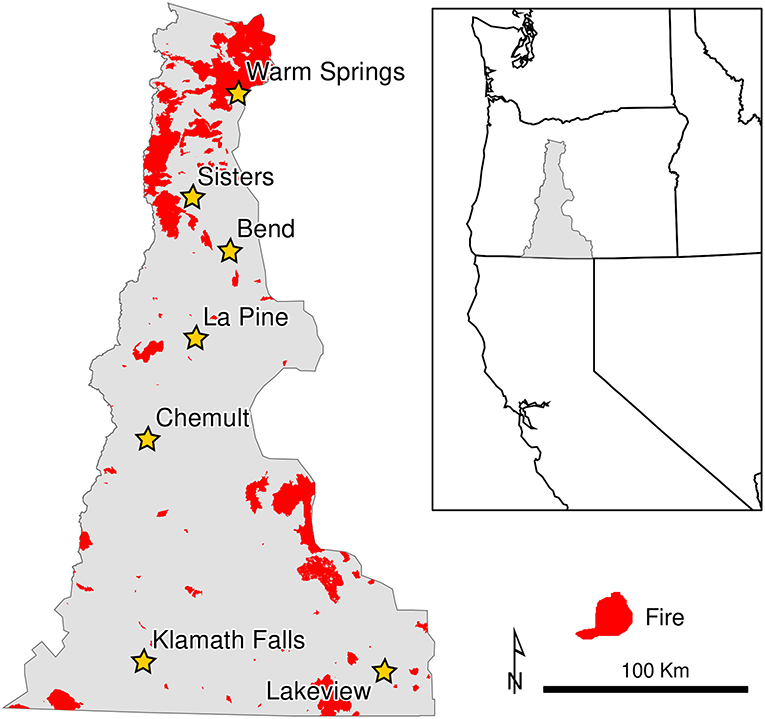
Figure 1. The Eastern Cascades Ecoregion in Oregon. Shading indicates wildfires that occurred between 2000 and 2018 (Geospatial Multi-Agency Coordination Group, 2018).
The ECE is characterized by shrub steppe ecosystems toward its eastern boundary. Elevation increases moving westward. Dry forests dominated by ponderosa pine characterize mid-elevation ecosystems, which transition to cooler and wetter subalpine forests toward the western boundary, marked by the crest of the Cascades mountain range.
Historically, fire was an important ecological process that shaped forest structure in the ECE. For example, forests dominated by ponderosa pine burned approximately every 10-25 years (Agee, 1993). Settlement by Europeans reduced the frequency and extent of fires, especially toward the end of the 19th century (Hessburg and Agee, 2003), and 20th-century fire suppression and exclusion practices and policies contributed to denser understory vegetation that characterizes ponderosa pine and mixed conifer forests (Hessburg et al., 2005; Merschel et al., 2014). Such vegetation can provide the fuel for large and intense fires (Miller et al., 2009). These ecological changes have been accompanied by demographic change, most notably the growth of human settlements in forested areas. In particular, Deschutes County has experienced rapid population growth over the past several decades in part due to amenity development and recreational opportunities (Olson, 2016). This trend has compounded wildfire risk by increasing valued assets (e.g., homes) in fire-prone forests.
The dominant strategy for reducing wildfire risk throughout the ECE involves the removal of flammable material to reduce the likelihood of high severity fires and to enable firefighters to more effectively manage fires that directly threaten values at risk (Spies et al., 2014; Charnley et al., 2017). Management activities include mechanical thinning, mowing/mastication, prescribed fire, and managed fire, i.e., the supervision and potential intervention in naturally ignited fires, potentially aided by tools such as the Wildland Fire Decision Support System (Noonan-Wright et al., 2011). Commonly, a fuels treatment may involve a combination of these activities, for example thinning to prepare a tract of forest for prescribed fire. The use of prescribed fire is limited because of logistical challenges (e.g., the difficulty of timing activities to accommodate the availability of personnel while weather conditions are favorable). However, a range of initiatives aim to address these challenges. For example, the Oregon Prescribed Fire Council was established in 2013 to facilitate dialog, learning, and policy changes that increase land managers' capacity to use prescribed fire. Prescribed Fire Training Exchanges provide hands-on training for practitioners (Kelly et al., 2019). Such initiatives engage diverse stakeholders, including representatives from federal and state agencies, tribal governments, conservation organizations, and private landowners.
Participant Recruitment and Data Collection
We collected data on perceived effects of prescribed fire using cognitive mapping exercises, which were conducted in-person with respondents during November 2017-March 2018. All activities were approved by the University of Michigan Institutional Review Board (ID: HUM00133263). As part of each cognitive mapping exercise, respondents were prompted to identify factors they considered to be related to wildfire risk as well as the causal relationships among those factors. These exercises were conducted using Mental Modeler software (Gray et al., 2013), which provided a graphical interface that allowed respondents to visualize the network of factors and relationships they had identified. Respondents were encouraged to iterate between adding factors and relationships until they considered the resulting cognitive map to adequately capture their understanding of the dynamics that characterize wildfire risk.
We collected 111 such cognitive maps from a diverse set of respondents. Respondents were identified from a pool of 787 individuals who had been identified as collaborators and/or sources of information and advice about wildfire management in a study on wildfire risk in the ECE conducted during 2011-2013. This pool of individuals was stratified by geographic region and by stakeholder affiliation (e.g., government agency, private business, non-governmental organization), and we randomly selected individuals across both strata. While research participants were broadly representative of the groups of stakeholders involved in wildfire management, we did not recruit participants from outside the ECE who nevertheless influence forest and fire management within the study system (e.g., state agency representatives based in Salem, OR); consequently, our analysis does not capture the perspectives and values of stakeholders external to the study region. Participants were recruited by phone and email. Cognitive mapping exercises were conducted at respondents' places of work, public places, or other convenient locations. We did not ask respondents to explicitly report their values. Our objective was not to compare respondents' reported values with their cognitive maps, but to evaluate stakeholders' understanding of the relationships among factors that contribute to wildfire risk and associated outcomes on values.
Measurement of Perceived Effects of Prescribed Fire on Valued Outcomes
Cognitive maps ranged in size from 9 to 48 factors. Collectively, the 111 cognitive maps featured 1310 unique factors, which were assigned to parent classes (e.g., outcomes), child classes (e.g., valued outcomes), and sub-child classes (e.g., aesthetic value) as described in greater detail in Hamilton et al. (2019). We analyzed cognitive maps as networks (Figures 2A,B), which allowed us to apply graph theoretic approaches to measure perception of the impact of prescribed fire on valued outcomes. Specifically, we measured perception of the effects of prescribed fire as network configurations in which prescribed fire affected a valued outcome (Figure 2C). Typically, these effects occurred by way of multiple intermediary factors, and a key advantage of studying the wildland fire social-ecological system as a network was that it allowed us to account for these intermediary factors using the network concept of paths. To identify paths from prescribed fire to different valued outcomes, we used the “All_Simple_Paths” algorithm in the Python language package NetworkX (Hagberg et al., 2008). Given a network, subsets of “source” and “target” nodes (in our case, nodes corresponding to prescribed fire and all valued outcomes, respectively), and a cutoff parameter for path length, the algorithm generates a list of all paths from source nodes to target nodes that do not exceed the cutoff path length.1 We measured whether the path represented a positive or negative effect of prescribed fire on the valued outcome by drawing upon insight from graph theory that the sign of a path is equal to the product of the signs of the linkages that comprise it (Harary, 1953). Specifically, we calculated the product of all causal linkages between nodes that comprised each path (e.g., in the path depicted on the right-hand side of Figure 2C, A (–) B (–) C (+) D (+) E, −1*−1*1*1 = 1, a cumulatively positive effect). For example, if increased use of prescribed fire was perceived to reduce the density of bitterbrush, which was perceived to provide habitat for mule deer, the resulting path (−1*1 = −1) would indicate a negative effect of prescribed fire on one type of valued outcome (wildlife habitat).
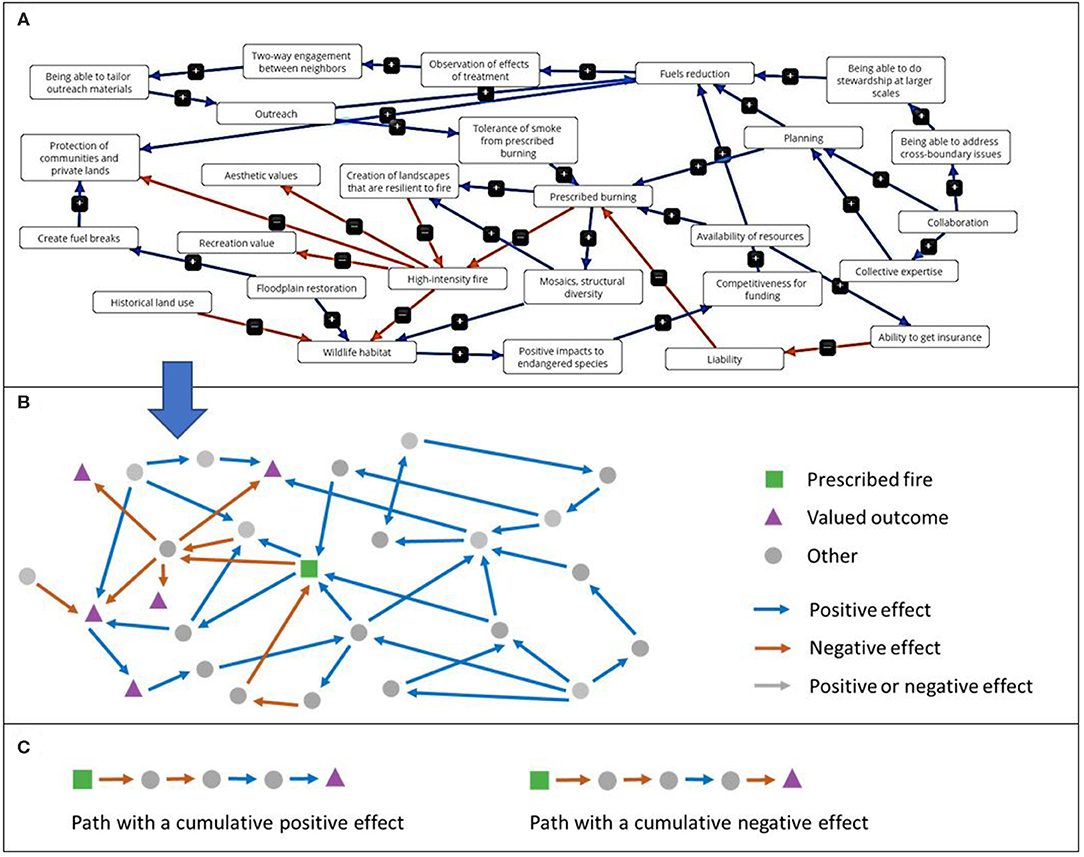
Figure 2. Cognitive map network, with substructures used to measure perception of the effects of prescribed fire on valued outcomes. (A) An individual's cognitive map of wildfire risk, as depicted in Mental Modeler software (Gray et al., 2013). (B) The same cognitive map, represented as a network with nodes colored by class (e.g., prescribed fire, valued outcome) and linkages colored to indicate perceived causal effects. (C) Graphical depiction of examples of paths representing positive (left) and negative (right) effects of prescribed fire on a valued outcome.
Aggregation of Individual Cognitive Maps
Given our goal of evaluating how perceptions of the effects of prescribed fire on valued outcomes vary with the size of stakeholder groups, we needed to aggregate individual cognitive maps (Özesmi and Özesmi, 2004; Gray et al., 2012). Maps were aggregated on the basis of common factors. In many cases, multiple respondents included the same factors (with identical names) in their cognitive maps. More commonly, respondents used different names for the same factor (e.g., “prescribed fire” and “prescribed burning”), which were renamed to enable comparison of common factors across cognitive maps. Common factors were subsequently used to link and aggregate cognitive maps (Figure 3).
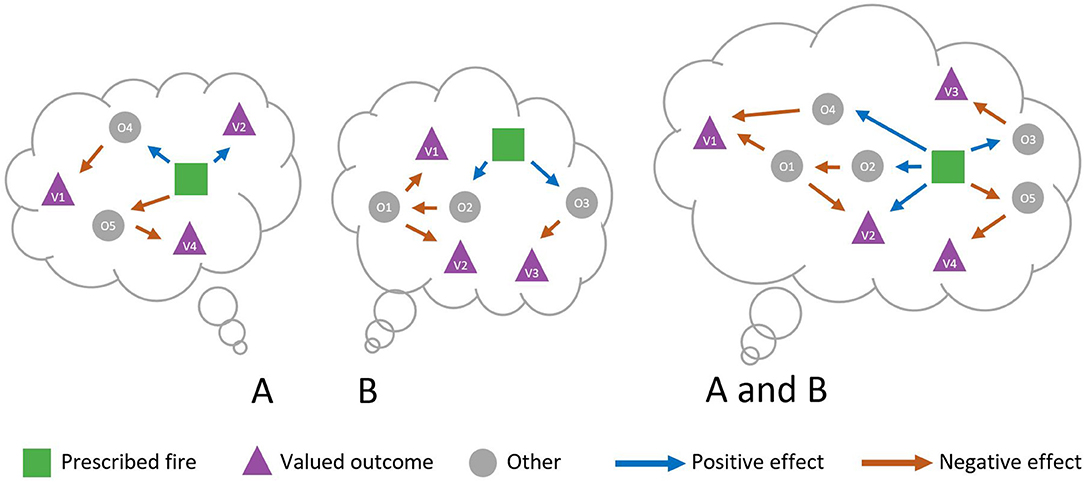
Figure 3. Aggregation of cognitive maps on the basis of common factors. In the example shown, individuals (A,B) independently include prescribed fire (green square) as well as valued outcomes V1 and V2 (purple triangles) in their cognitive maps. The aggregation of their cognitive maps results in a collective cognitive map that accounts for their shared perception that prescribed fire positively affects V2, as well as their conflicting perceptions of effects on V1 (individual A perceives a negative effect while B perceives a positive effect).
Evaluation of Perceptions of Prescribed Fire for Different Sizes of Stakeholder Groups
We measured perception of the effects of prescribed fire on each valued outcome for all 111 individual cognitive maps, as well as for aggregations of 2, 4, 8, 16, and 32 individual cognitive maps. For each level of aggregation n, we randomly drew and aggregated n individual maps and measured all instances of perceived effects of prescribed fire on valued outcomes. We repeated this sampling process 300 times for each level of aggregation. We modified this approach to evaluate how members of different stakeholder groups perceived the effects of prescribed fire. Rather than randomly sampling from the entire pool of 111 cognitive maps, for each level of aggregation n and for each stakeholder group, we randomly drew n maps from the subset of maps produced by members of that group. Because the size of these subsets varied and some were not large enough to draw 300 random samples without replacement, we instead drew samples in proportion to the size of each stakeholder group. Specifically, we drew 5*(size of stakeholder group) samples for each level of aggregation n (e.g., with 50 cognitive maps of government agency representatives, we drew 250 random samples at each level of aggregation of this stakeholder group).
Statistical Modeling
We evaluated how perceptions of the effects of prescribed fire varied among different valued outcomes using a Bayesian multilevel binomial logistic regression model predicting the binary value outcome of a positive impact of prescribed fire. The unit of observation was pathways of perceived causal relationships from prescribed fire to valued outcomes (e.g., Figure 2C). The dataset was hierarchically structured (i.e., nested), which informed our choice of a multilevel approach (Goldstein, 1987; Gelman et al., 2013). Because of the computational challenge of modeling the entire dataset of paths, we conducted our analysis on a random sample of 15000 paths2. We included the length of paths (i.e., number of intermediary factors) as a fixed effect, and included varying intercepts for each valued outcome (e.g., “air quality”), the number of cognitive maps aggregated (1, 2, 4, 8, 16, or 32), and an identifier of the individual or aggregated map from which paths were measured.
The model was estimated with Bayesian methods and a Hamiltonian Monte Carlo procedure in Stan, called through the R Statistical Environment (Carpenter et al., 2017; R Core Team, 2018; Stan Development Team, 2018). Priors on fixed effects were Gaussian, with mean of zero and standard deviation of one. Priors on all varying intercept effects were Gaussian with mean of zero and variance hyperparameters; priors on hyperparameters were half-Cauchy with location of zero and scale of one (McElreath, 2015). The model was computed with a 5000-iteration burn-in, and the joint posterior distribution was drawn from 5000 samples. Traceplots and kernel densities were examined to confirm adequate mixing. Additional diagnostics indicated that chains were efficient (n_eff values were not substantially different than the number of samples in the posterior distribution) and converged (Gelman-Rubin convergence diagnostic values were 1).
Results
To evaluate how the perceived effects of prescribed fire vary depending on the sizes and identities of stakeholder groups, we interpret results of descriptive analysis that were not subject to significance tests. We subsequently present results from our statistical model, which reveals variation in perceived effects of prescribed fire on different types of valued outcomes.
Group Size
While prescribed fire was perceived to positively affect valued outcomes, this effect weakened with the number of cognitive maps aggregated (Figure 4). In individual cognitive maps, the pathways by which prescribed fire affects valued outcomes tended to be positive, as indicated by the large number of dark green points plotted toward the right-hand side of each panel in the figure. However, as individuals' cognitive maps were aggregated, pathways were less likely to represent positive effects.
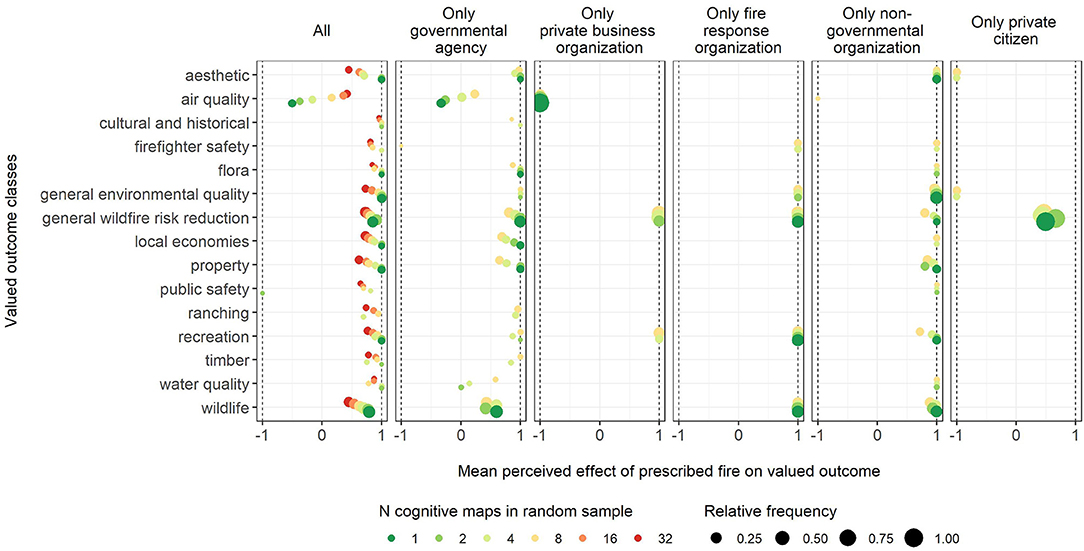
Figure 4. Mean perceived effect of prescribed fire on different classes of valued outcomes, among different stakeholder groups, and by aggregating an increasing number of cognitive maps (e.g., 1 = individual stakeholders, 2 = pairs of stakeholders, and so on). Points indicate the mean perceived effect on each valued outcome, ranging from −1 (all paths represent a negative effect) to 1 (all paths represent a positive effect). Points are sized according to the number of effects relative to the number of effects on all classes for each level of aggregation.
Exceptions to this tendency included effects on air quality. Higher levels of aggregation resulted in greater likelihood that perceived effects of prescribed fire on air quality were positive. This effect was primarily driven by cognitive maps of representatives of government organizations and private businesses.
Stakeholder Group Affiliation
We found considerable variation in how different stakeholder groups perceive the effects of prescribed fire on different valued outcomes (Figure 4). Private citizens and representatives of private businesses tended to perceive negative effects, while representatives of non-governmental organizations and fire response organizations tended to perceive positive effects.
Stakeholder groups also varied in terms of the breadth and types of valued outcomes they emphasized in their cognitive maps (Figure 4). Representatives of government agencies, non-governmental organizations, and fire response organizations perceived effects of prescribed fire on a wide range of valued outcomes. In addition to effects on general wildfire risk reduction, representatives of private businesses emphasized effects of recreation and air quality, while private citizens emphasized effects on general environmental quality and aesthetic values.
Differences Among Valued Outcomes
In our regression model (Figure 5), the grand mean intercept estimate indicates that prescribed fire is perceived to positively affect valued outcomes. Controlling for other variables in the model, we found that positive perceptions of the effects of prescribed fire are ~17 times more likely than negative (log-odds: 2.83). Prescribed fire was more likely to be perceived to positively affect cultural and historical values, flora, water quality, and firefighter safety, relative to other valued outcomes. Meanwhile, air quality, wildlife, and aesthetic values were more likely to be perceived to be negatively affected by prescribed fire.
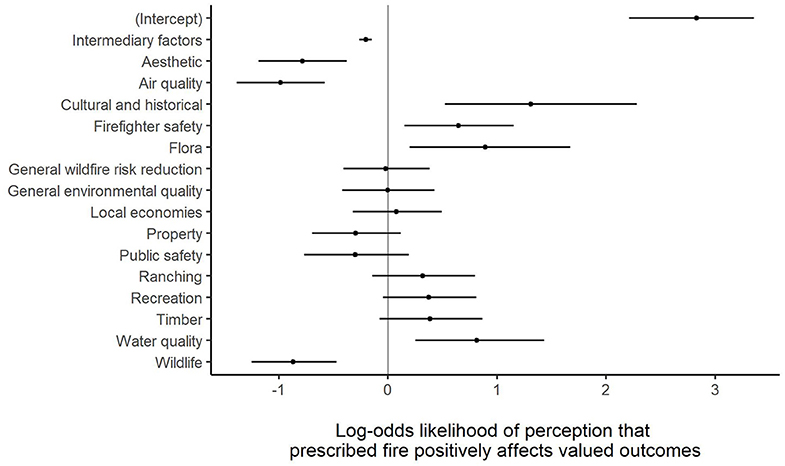
Figure 5. Model results of how perception of the effects of prescribed fire varies across different types of valued outcomes. The analysis was conducted on a random sample of 15,000 paths representing perceived effects of prescribed fire on valued outcomes. Points indicate mean estimates of the log-odds likelihood that a path represents a positive effect of prescribed fire on a valued outcome. Bars show 95% credibility intervals, drawn from joint posteriors.
Discussion
Aggregation of Knowledge Reduces Consensus About the Effects of Prescribed Fire
Despite ample evidence of its utility and safety, prescribed fire has been underutilized at levels needed to achieve forest and fire management goals at large spatial scales (North et al., 2012; Kolden, 2019). Motivated by this puzzle, our study exposes a contradiction: while forest and fire managers encounter societal resistance to prescribed fire (Carroll et al., 2007; Quinn-Davidson and Varner, 2012), our results reveal considerable consensus among diverse stakeholders about its desirability, as measured through pathways of perceived causal linkages from prescribed fire to valued outcomes.
However, our results also point to an explanation for this apparent contradiction: the aggregation of stakeholders' perceptions about the effects of prescribed fire reduces their collective consensus about the desirability of those effects. For forest and fire management decision-makers in socially complex landscapes, this finding may seem obvious and broadly reflective of observations that the greater the number of stakeholders involved, the more difficult the task of reaching consensus about any given management approach, especially one that affects such diverse values as prescribed fire. However, one of this study's key insights is that declining consensus is not simply the result of accounting for cognitive maps of stakeholders opposed to prescribed fire. Instead, this trend reflects the tendency for multiple sets of knowledge to “complete” adverse action-outcome pathways when aggregated. Stated another way, while individual stakeholders may be only aware of subsets of the dynamics that comprise complex social-ecological systems, such subsystems of knowledge and beliefs may aggregate to represent a more holistic “wisdom of the crowd” that encompasses more than the sum of its parts (Galton, 1907; Krause et al., 2010). For example, one stakeholder may perceive that prescribed fire affects a particular ecological process while another stakeholder may perceive a relationship between that process and a valued outcome. While neither individual perceives the entire pathway by which prescribed fire affects the outcome, it is nevertheless embedded in the aggregation of their cognitive maps, and our analysis indicates that such pathways resulting from aggregation tend to emphasize the adverse effects of prescribed fire.
Consequently, this finding points to the importance of collaborative interaction among stakeholders, and specifically of processes that enable the “confrontation and integration of knowledge” (Galafassi et al., 2017, p. 8), thereby revealing the numerous ways in which prescribed fire can affect diverse valued outcomes. For groups that seek to increase the scale of prescribed fire, such discussions can expose barriers that would otherwise remain overlooked, thereby revealing strategies for more effectively addressing forest and fire management challenges.
Furthermore, this result suggests that certain strategies for outreach may not be effective for addressing resistance to prescribed fire. In particular, the high level of consensus in individual cognitive maps about the desirability of prescribed fire indicates that simply communicating knowledge about prescribed fire to stakeholders may not significantly increase support for prescribed fire as a forest and fire management tool. Rather, targeting specific values held by specific stakeholder groups may prove more effective.
Balancing the Benefits of Prescribed Fire With Adverse Effects on Certain Outcomes for Particular Stakeholder Groups
While our results highlight the importance of collaborative models of forest and fire decision-making generally, variation in how different types of stakeholders perceive prescribed fire to affect distinct valued outcomes cases highlights opportunities for improving decision-making processes through targeted engagement.
For example, our finding that private citizens and representatives of private businesses are more attuned to the adverse effects of prescribed fire highlights the importance of meaningful engagement of these stakeholders in decision-making processes. While findings regarding these two groups align with prior research that documents their relatively low levels of acceptability of prescribed fire (Costanza and Moody, 2011; Toman et al., 2011), our analysis of how perceptions varied across different valued outcomes suggests more nuanced dynamics. Private citizens and business representatives identified effects of prescribed fire on only three valued outcomes each (private businesses: recreation, air quality, and general wildfire risk reduction; private citizens: general environmental quality, aesthetic value, and general wildfire risk reduction). Consequently, our analysis reveals an opportunity to conduct engagement in ways that increase awareness of how prescribed fire affects other outcomes that may be of value to members of these groups, including protection of property, public safety, enhancing local economies, and improving opportunities for recreation. In particular, we found that representatives of private businesses were particularly prone to focus on the adverse effects of prescribed fire on recreation, which is likely due to the direct or indirect reliance of some private businesses on tourism. Our study region is representative of many landscapes throughout the western U.S. that were defined historically by resource extraction but increasingly emphasize recreational amenities (Olson, 2016). For prescribed fire to gain the social license necessary for more widespread application, decisions about its use as a tool for restoration of ecosystem services and fuels management must account for how smoke and trail closures may affect the value of forests for recreation in the short term, which may in many cases require the participation of local business owners in decision-making processes in order to gain widespread support.
Such an increase in level of awareness may lead stakeholders to conceptualize prescribed fire in ways that more resemble the cognitive maps of representatives of government agencies and non-governmental organizations, who perceived a wide range of outcomes resulting from prescribed fire. In particular, although representatives of non-governmental organizations did not perceive prescribed fire as a panacea (e.g., perceived effects on air quality are negative), a subset of these organizations have emerged as leaders in promoting and implementing innovative approaches for forest and fire management, including Prescribed Fire Training Exchanges (Kelly et al., 2019).
The Value of Systems Thinking in Forest and Fire Management
Fire-prone forests are complex social-ecological systems. In such settings, the diversity of stakeholder groups and management objectives can complicate decision-making processes. Similarly, system dynamics are shaped by complex interactions spanning biological, physical, social, political, and other processes, which can challenge individuals' abilities to perceive the outcomes of management actions, such as prescribed fire. Taken together, our findings highlight the value of cognitive mapping for evaluating how stakeholders perceive complex sets of interactions by which prescribed fire affects valued outcomes. Cognitive mapping has been productively utilized to evaluate how stakeholders grapple with complexity in fire-prone social-ecological systems (Zaksek and Árvai, 2004; Zhang and Jetter, 2016; Walpole et al., 2017; Hamilton et al., 2019), and we advance this literature by demonstrating how the prospects of scaling up a particular management approach hinge upon perceptions of how it directly and indirectly affects a multitude of processes within the broader social-ecological system.
Additionally, we recognize opportunities to build upon insights from the present study by coupling cognitive mapping with complementary research methods. For example, simulation-based approaches such as agent-based modeling (Spies et al., 2017; Ager et al., 2018) provide the flexibility to evaluate how forest and fuel management practices affect a range of social and ecological characteristics at multiple spatial and temporal scales. Likewise, research that combines simulations and engagement with stakeholders themselves (White et al., 2019) can enrich modeling efforts with the diverse perspectives of practitioners. Additionally, cognitive mapping can complement participatory GIS exercises, which have been productively utilized to map values in wildfire risk management settings (e.g., Carver et al., 2009; McBride et al., 2017). In particular, the integration of cognitive maps with spatial features of the physical landscapes can facilitate the production of systems models that may be especially well suited for research that aims to disentangle complex relationships among cognitive, social, and ecological processes.
Conclusions
We evaluated perceptions of the effects of prescribed fire on valued outcomes, using data from 111 cognitive maps elicited from diverse stakeholders in the wildfire-prone Eastern Cascades Ecoregion of central Oregon. While prescribed fire was perceived to have a positive effect on valued outcomes generally, we found that adverse perceived effects of prescribed fire were more likely as we aggregated cognitive maps. Representatives of fire response and non-governmental organizations tended to perceive prescribed fire more favorably, while private citizens and representatives of private businesses emphasized adverse effects. We found that air quality, aesthetic values, and wildlife habitat were perceived to be most negatively affected by prescribed fire, while cultural and historical values, flora, water quality, and firefighter safety were perceived to be most positively affected, relative to other valued outcomes. Taken together, our results help to explain the challenge of scaling up the use of prescribed fire and highlight the need for decision-making processes that account for stakeholders' views of the multiple—and potentially opposing—effects of prescribed fire on different valued outcomes.
Data Availability Statement
The datasets generated for this study are available on request to the corresponding author.
Ethics Statement
The studies involving human participants were reviewed and approved by University of Michigan Institutional Review Board. Written informed consent for participation was not required for this study in accordance with the national legislation and the institutional requirements.
Author Contributions
MH conceived and designed the study. MH and JS performed the data analysis and wrote the manuscript. All authors contributed to manuscript revision, read, and approved the submitted version.
Funding
This work was supported by US National Science Foundation, Directorate for Social, Behavioral, and Economic Sciences Postdoctoral Fellowship Grant #1715053.
Conflict of Interest
The authors declare that the research was conducted in the absence of any commercial or financial relationships that could be construed as a potential conflict of interest.
Acknowledgments
We thank the stakeholders who participated in this study. A. P. Fischer, E. J. Davis, and J. Creighton provided valuable recommendations preceding and during fieldwork. We also thank the reviewers for their helpful comments and edits.
Footnotes
1. ^We set the cutoff parameter to identify paths with up to five linkages This threshold served to prevent measuring an excessively large number of paths. The number of paths of length l increases sharply with each unit increase in l, before declining at high values of l.
2. ^Results from analyses of smaller (e.g., 5,000) and larger (e.g., 20,000) datasets were nearly identical to results from our model. The full dataset included ~15,0000 observations.
References
Abrams, J., Kelly, E., Shindler, B., and Wilton, J. (2005). Value orientation and forest management: the forest health debate. Environ. Manage. 36, 495–505. doi: 10.1007/s00267-004-7256-8
Ager, A. A., Barros, A. M. G., Day, M. A., Preisler, H. K., Spies, T. A., and Bolte, J. (2018). Analyzing fine-scale spatiotemporal drivers of wildfire in a forest landscape model. Ecol. Modell 384, 87–102. doi: 10.1016/j.ecolmodel.2018.06.018
Calkin, D. E., Thompson, M. P., and Finney, M. A. (2015). Negative consequences of positive feedbacks in US wildfire management. For. Ecosyst. 2, 1–10. doi: 10.1186/s40663-015-0033-8
Carpenter, B., Gelman, A., Hoffman, M. D., Lee, D., Goodrich, B., Betancourt, M., et al. (2017). Stan: a probabilistic programming language. J. Stat. Softw. 76, 1–32. doi: 10.18637/jss.v076.i01
Carroll, M. S., Blatner, K. A., Cohn, P. J., and Morgan, T. (2007). Managing fire danger in the forests of the US inland northwest: a classic “wicked problem” in public land policy. J. For. 105, 239–244. doi: 10.1093/jof/105.5.239
Carver, S., Watson, A., Waters, T., Matt, R., Gunderson, K., and Davis, B. (2009). “Developing computer-based participatory approaches to mapping landscape values for landscape and resource management,” in Planning Support Systems Best Practice and New Methods, eds S. Geertman and J. Stillwell (Dordrecht: Springer), 431–448. doi: 10.1007/978-1-4020-8952-7_21
Charnley, S., Spies, T., Barros, A., White, E., and Olsen, K. (2017). Diversity in forest management to reduce wildfire losses: implications for resilience. Ecol. Soc. 22:22. doi: 10.5751/ES-08753-220122
Cochrane, M. A., Moran, C. J., Wimberly, M. C., Baer, A. D., Finney, M. A., Beckendorf, K. L., et al. (2012). Estimation of wildfire size and risk changes due to fuels treatments. Int. J. Wildland Fire 21, 357–367. doi: 10.1071/WF11079
Costanza, J., and Moody, A. (2011). Deciding Where to burn: stakeholder priorities for prescribed burning of a fire-dependent ecosystem. Ecol. Soc. 16:14. doi: 10.5751/ES-03897-160114
Fischer, A. P., Spies, T. A., Steelman, T. A., Moseley, C., Johnson, B. R., Bailey, J. D., et al. (2016). Wildfire risk as a socioecological pathology. Front. Ecol. Environ. 14:1283. doi: 10.1002/fee.1283
Galafassi, D., Daw, T. M., Munyi, L., Brown, K., Barnaud, C., and Fazey, I. (2017). Learning about social-ecological trade-offs. Ecol. Soc. 22:2. doi: 10.5751/ES-08920-220102
Gelman, A., Carlin, J. B., Stern, H. S., and Rubin, D. B. (2013). Bayesian Data Analysis. 3rd Edn. New York, NY: Chapman and Hall/CRC. doi: 10.1201/b16018
Geospatial Multi-Agency Coordination Group (2018). Historic Fire Data. Available online at: http://rmgsc.cr.usgs.gov/outgoing/GeoMAC. (accessed July 7, 2017).
Goldstein, H. (1987). Multilevel Models in Education and Social Research. New York, NY: Oxford University Press.
Gray, S., Chan, A., Clark, D., and Jordan, R. (2012). Modeling the integration of stakeholder knowledge in social–ecological decision-making: benefits and limitations to knowledge diversity. Ecol. Modell 229, 88–96. doi: 10.1016/j.ecolmodel.2011.09.011
Gray, S. A., Gray, S., Cox, L. J., and Henly-Shepard, S. (2013). Mental modeler: a fuzzy-logic cognitive mapping modeling tool for adaptive environmental management. 2013 46th Hawaii International Conference on System Sciences, Wailea, Maui, HI, 2013, 965–973. doi: 10.1109/HICSS.2013.399
Hagberg, A., Schult, D., and Swart, P. (2008). “Exploring network structure, dynamics, and function using NetworkX,” in Proceedings of the 7th Python in Science Conference; 19–24 August, 2008 (Pasadena, CA, United States) eds G. Varoquaux, T. Vaught, and J. Millman, 11–15.
Hamilton, M., Salerno, J., and Fischer, A. P. (2019). Cognition of complexity and trade-offs in a wildfire-prone social-ecological system. Environ. Res. Lett. 14:125017. doi: 10.1088/1748-9326/ab59c1
Harary, F. (1953). On the notion of balance of a signed graph. Michigan Math. J. 2, 143–146. doi: 10.1307/mmj/1028989917
Hessburg, P. F., and Agee, J. K. (2003). An environmental narrative of inland northwest United States forests, 1800–2000. For. Ecol. Manage 178, 23–59. doi: 10.1016/S0378-1127(03)00052-5
Hessburg, P. F., Agee, J. K., and Franklin, J. F. (2005). Dry forests and wildland fires of the inland northwest USA: contrasting the landscape ecology of the pre-settlement and modern eras. For. Ecol. Manage 211, 117–139. doi: 10.1016/j.foreco.2005.02.016
Kelly, E. C., Charnley, S., and Pixley, J. T. (2019). Polycentric systems for wildfire governance in the Western United States. Land Use Policy 89:104214. doi: 10.1016/j.landusepol.2019.104214
Kolden, C. A. (2019). We're not doing enough prescribed fire in the western united states to mitigate wildfire risk. Fire 2:30. doi: 10.3390/fire2020030
Krause, J., Ruxton, G. D., and Krause, S. (2010). Swarm intelligence in animals and humans. Trends Ecol. Evol. 25, 28–34. doi: 10.1016/j.tree.2009.06.016
McBride, B. B., Sanchez-Trigueros, F., Carver, S. J., Watson, A. E., Stumpff, L. M., Matt, R., et al. (2017). Participatory geographic information systems as an organizational platform for the integration of traditional and scientific knowledge in contemporary fire and fuels management. J. For. 115, 43–50. doi: 10.5849/jof.14-147
McElreath, R. (2015). Statistical Rethinking: A Bayesian Course with Examples in R and Stan. 1 Edn. Boca Raton: Chapman and Hall/CRC.
Merschel, A. G., Spies, T. A., and Heyerdahl, E. K. (2014). Mixed-conifer forests of central Oregon: effects of logging and fire exclusion vary with environment. Ecol. Appl. 24, 1670–1688. doi: 10.1890/13-1585.1
Miller, J. D., Safford, H. D., Crimmins, M., and Thode, A. E. (2009). Quantitative evidence for increasing forest fire severity in the sierra nevada and southern cascade mountains, california and nevada, USA. Ecosystems 12, 16–32. doi: 10.1007/s10021-008-9201-9
Noonan-Wright, E. K., Opperman, T. S., Finney, M. A., Zimmerman, G. T., Seli, R. C., Elenz, L. M., et al. (2011). Developing the US wildland fire decision support system. J. Combus. 2011:168473. doi: 10.1155/2011/168473
North, M., Collins, B. M., and Stephens, S. (2012). Using fire to increase the scale, benefits, and future maintenance of fuels treatments. J. For. 110, 392–401. doi: 10.5849/jof.12-021
North, M., Stephens, S. L., Collins, B. M., Agee, J. K., Aplet, G., Franklin, J. F., et al. (2015). Reform forest fire management. Science 349, 1280–1281. doi: 10.1126/science.aab2356
Olson, B. (2016). “‘In the real estate business whether we admit it or not': timber and exurban development in central oregon,” in A Comparative Political Ecology of Exurbia: Planning, Environmental Management, and Landscape Change, eds L. E. Taylor and P. T. Hurley (Cham: Springer International Publishing), 131–145. doi: 10.1007/978-3-319-29462-9_6
Özesmi, U., and Özesmi, S. L. (2004). Ecological models based on people's knowledge: a multi-step fuzzy cognitive mapping approach. Ecol. Modell. 176, 43–64. doi: 10.1016/j.ecolmodel.2003.10.027
Quinn-Davidson, L. N., and Varner, J. M. (2012). Impediments to prescribed fire across agency, landscape and manager: an example from northern California. Int. J. Wildland Fire 21, 210–218. doi: 10.1071/WF11017
R Core Team (2018). R: A Language and Environment for Statistical Computing. Vienna, Austria: R Foundation for Statistical Computing. Available online at: https://www.R-project.org/
Spies, T., White, E., Ager, A., Kline, J., Bolte, J., Platt, E., et al. (2017). Using an agent-based model to examine forest management outcomes in a fire-prone landscape in Oregon, USA. Ecol. Soc. 22:25. doi: 10.5751/ES-08841-220125
Spies, T. A., White, E. M., Kline, J. D., Fischer, A. P., Ager, A., Bailey, J., et al. (2014). Examining fire-prone forest landscapes as coupled human and natural systems. Ecol. Soc. 19:9. doi: 10.5751/ES-06584-190309
Stan Development Team (2018). RStan: the R interface to Stan. R package Version 2.16.2. Available online at: http://mc-stan.org/
Stephens, S. L., Martin, R. E., and Clinton, N. E. (2007). Prehistoric fire area and emissions from California's forests, woodlands, shrublands, and grasslands. For. Ecol. Manage 251, 205–216. doi: 10.1016/j.foreco.2007.06.005
Taylor, A. H. (2010). Fire disturbance and forest structure in an old-growth Pinus ponderosa forest, southern Cascades, USA. J. Veget. Sci. 21, 561–572. doi: 10.1111/j.1654-1103.2009.01164.x
Toman, E., Stidham, M., Shindler, B., and McCaffrey, S. (2011). Reducing fuels in the wildland - urban interface: community perceptions of agency fuels treatments. Int. J. Wildland Fire 20:340. doi: 10.1071/WF10042
Walpole, E., Toman, E., Wilson, R., and Stidham, M. (2017). Shared visions, future challenges: a case study of three collaborative forest landscape restoration program locations. Ecol. Soc. 22:35. doi: 10.5751/ES-09248-220235
Webster, K. M., and Halpern, C. B. (2010). Long-term vegetation responses to reintroduction and repeated use of fire in mixed-conifer forests of the Sierra Nevada. Ecosphere 1:art9. doi: 10.1890/ES10-00018.1
White, E. M., Lindberg, K., Davis, E. J., and Spies, T. A. (2019). Use of science and modeling by practitioners in landscape-scale management decisions. J. For. 117, 267–279. doi: 10.1093/jofore/fvz007
Zaksek, M., and Árvai, J. L. (2004). Toward improved communication about wildland fire: mental models research to identify information needs for natural resource management. Risk Anal. 24, 1503–1514. doi: 10.1111/j.0272-4332.2004.00545.x
Zhang, P., and Jetter, A. (2016). Understanding risk perception using fuzzy cognitive maps. in Management of Engineering and Technology (PICMET), 2016 Portland International Conference on (IEEE), 606–622. Available at: http://ieeexplore.ieee.org/abstract/document/7806749/ (accessed September 11, 2017).
Keywords: prescribed fire, fuel management, cognitive maps, risk governance, oregon
Citation: Hamilton M and Salerno J (2020) Cognitive Maps Reveal Diverse Perceptions of How Prescribed Fire Affects Forests and Communities. Front. For. Glob. Change 3:75. doi: 10.3389/ffgc.2020.00075
Received: 24 December 2019; Accepted: 22 May 2020;
Published: 01 July 2020.
Edited by:
Karin Lynn Riley, United States Forest Service (USDA), United StatesReviewed by:
Célia Marina P. Gouveia, Portuguese Institute of Ocean and Atmosphere (IPMA), PortugalFrank K. Lake, USDA Forest Service, United States
Isaac C. Grenfell, United States Department of Agriculture (USDA), United States
Copyright © 2020 Hamilton and Salerno. This is an open-access article distributed under the terms of the Creative Commons Attribution License (CC BY). The use, distribution or reproduction in other forums is permitted, provided the original author(s) and the copyright owner(s) are credited and that the original publication in this journal is cited, in accordance with accepted academic practice. No use, distribution or reproduction is permitted which does not comply with these terms.
*Correspondence: Matthew Hamilton, aGFtaWx0b24uMTMyM0Bvc3UuZWR1