Abstract
The importance of Reducing Emissions from Deforestation and Forest Degradation (REDD+) has been elevated within the new climate framework outlined by the Paris Agreement, placing a significant emphasis on encouraging nations to adopt and promote REDD+ strategies. The success of REDD+ is highly dependent on financial resources that aid in addressing and mitigating the primary causes of deforestation and forest degradation. Furthermore, REDD+ projects utilize technology to counter challenges such as land-use changes for agriculture, infrastructure development, illegal logging, fuelwood collection, and forest fires. This study investigates the status of REDD+ projects, which are aimed at combating global deforestation and climate change, supported by the Climate Technology Center Network (CTCN) and the Green Climate Fund (GCF), both of which are critical mechanisms under the United Nations Framework Convention on Climate Change (UNFCCC). We examined these projects through the lenses of technology convergence and finance blending. The analysis revealed that the CTCN and GCF predominantly support projects leveraging technology for forest disaster management. In addition, the agricultural sector demonstrated the highest degree of technology convergence. The findings indicate that a strategic approach for securing private funding involves integrating mitigation and adaptation efforts in projects. Furthermore, partnerships can facilitate the blending of financial strategies to mitigate risks. The study highlights the potential of technology convergence in enhancing the feasibility of scaling up REDD+ projects by promoting stakeholder engagement and catalyzing the private capital influx.
1. Introduction
Carbon dioxide emissions from deforestation and forest degradation have rapidly increased and are one of the primary causes of global climate change (Begum et al., 2020). Anthropogenic land-use changes, including deforestation and forest degradation, accounts for approximately one-fifth of global annual carbon dioxide emissions, resulting in approximately 0.9 gigatons per year (IPCC, 2013). Reducing Emissions from Deforestation and Forest Degradation (REDD+) is a result-based payment mechanism that emerged to address this problem.
The important of REDD+ has been elevated in the new climate framework outlined by the Paris Agreement. Article 5 specifically incorporates REDD+ and actively encourages countries to adopt and promote REDD+ strategies. This particular article is remarkable because it exclusively focuses on the forestry sector, emphasizing the political significance of forests and other ecosystems in addressing climate change. It also underscores the crucial role of “adequate and predictable financial resources, including payments based on achieved results (.)” for facilitating the implementation of policy approaches and incentives aimed at reducing deforestation and forest degradation in regions where they are most needed (UNFCCC, Decision -/CP.21).
According to Climate Focus (2015), REDD+ implementation has the potential to be integrated into Nationally Determined Contributions (NDCs) as a viable source of emission reduction. The criteria and regulations established to achieve NDCs are relevant and can stimulate activities associated with forests and land use. As highlighted by the United Nations Framework Convention on Climate Change (2008), “removals by sinks of greenhouse gases” is frequently cited as a mitigation option in the detailed specifications of NDCs.
Alongside the sustained international focus on REDD+, academic interest in REDD+ implementation persists. Policy changes and governance (various institutions, organizations, principles, norms, mechanisms, and decision-making procedures), reform (Kanninen et al., 2007; Angelsen et al., 2009; Corbera and Schroeder, 2011; Luttrell et al., 2011), and governance-related issues are being investigated within the context of good governance. These include the adequacy of fiscal mechanisms; the allocation and accessibility of REDD+ benefits; and the efficiency, transparency, accountability, and legitimacy of monitoring systems (Karsenty, 2008; Biermann et al., 2009; Corbera and Schroeder, 2011; Kanowski et al., 2011; Angelsen et al., 2012; Karsenty and Ongolo, 2012; Vatn and Vedeld, 2012). Studies on REDD+ implementation (Corbera and Broderick, 2009; Luttrell et al., 2013; Pokorny et al., 2013; Maraseni et al., 2014) and its barriers (Sills et al., 2009; Mattsson et al., 2012; Mustalahti et al., 2012; Lin et al., 2014) have been conducted to improve REDD+ implementation outcomes.
Reducing Emissions from Deforestation and Forest Degradation presents itself as a multifaceted concept that encompasses a combination of interconnected issues. It involves a series of interventions for which there is no universal approach. REDD+ is an effective and economical mechanism for addressing the root causes of deforestation through the adoption of appropriate measures and technologies; however, its successful implementation necessitates the fulfillment of stringent requirements and adherence to established methodologies. Numerous countries continue to encounter challenges and barriers in establishing the necessary enabling environment and mobilizing efforts to prepare for REDD+ readiness. Recognizing the critical importance of this acknowledgment and willingness, international organizations and other relevant institutions are strongly urged to develop comprehensive packages of REDD+ assistance for developing countries, thereby strengthening their participation in REDD+ activities.
From this point of view, research has been conducted on how to improve the effectiveness of REDD+. GCF (2013) and Sills et al. (2014) emphasized the need to comprehensively link other fields, such as energy, water, food, and urban development, related to the cause of deforestation and to seek private financing measures to improve the effectiveness of REDD+. In other words, it was emphasized that “converging technology” and “blended finance” are required to eliminate factors contributing to deforestation in the target area and to increase the effectiveness of REDD+ implementation (Sills et al., 2014; Bushley, 2015).
In this context, this study aims to examine REDD+ projects through the lenses of “converging technology” and “blended finance” by analyzing actual case studies. In addition, it endeavors to provide practical recommendations on how these two distinct concepts can be effectively combined to enhance the sustainability of REDD+ initiatives.
2. Theoretical framework
2.1. Discourse on REDD+
Reducing Emissions from Deforestation and Forest Degradation was first proposed at the 11th United Nations Framework Convention on Climate Change (UNFCCC COP 11), led by Papua New Guinea and Costa Rica. The UNFCCC negotiations (UNFCCC; Decision 2/COP 13; Decision 4/COP 15; Decision 1/COP16) formalized REDD+ as a cost-effective mechanism for protecting forests in developing countries. REDD+ mitigates 20–30% of all carbon dioxide (CO2) emissions annually and as well as supports the livelihoods of local residents and stakeholders engaged in forest economic activities, the major cause of deforestation and forest degradation (UN-REDD, 2010). The primary objective of REDD+ is to provide countries with positive economic incentives to countries to reduce carbon emissions from deforestation and forest degradation, as well as through sustainable management of forests and the conservation and enhancement of forest carbon stocks.
The conceptual meaning of REDD has evolved over the years into REDD, REDD+, and REDD++ stages, which are based on rewarding countries according to their performance (Angelsen and McNeill, 2012). Under the UNFCCC, the international society agreed on the Warsaw REDD+ Framework, comprising four readiness criteria (national strategy, forest reference level, monitoring system, and safeguard) for REDD+ implementation that are aligned with carbon market mechanisms. Based on these criteria, capacity building and pilot projects for REDD+ implementation in developing countries have been further promoted (Voigt and Ferreira, 2015). The sustainable implementation of REDD+ in developing countries has progressed. To date, 54 developing nations have provided data and information regarding their implementation of REDD+. This includes the submission of forest reference level, resulting in the verification of more than over 8 gigatons of emission reductions1.
Despite the potential significance of the forest sector in mitigating global greenhouse gas (GHG) emissions, projects in this sector have had a comparatively minor presence on the international market for trading credits associated with emission reductions (Gaast et al., 2018). At the 26th UNFCCC Conference of the Parties held in Glasgow, the Paris Rulebook for Article 6 was finalized. This is critical to the implementation of REDD+, and Article 6 serves to recognize the eligibility of REDD+ activities. In other words, the carbon credits acquired through a REDD+ project can be used to achieve Nationally Determined Contribution (NDC) targets. With the completion of the Paris Rulebook for Article 6 of the Paris Agreement, REDD+ has become even more important. Reducing greenhouse gas emissions through the forest sector is not only cost-effective compared to other methods but also has considerable carbon reduction capabilities and is widely recognized as a key factor in responding to climate change. The recent voluntary market is a prime example of the high price tag for carbon credits derived from forestry activities (Ecosystem Marketplace, 2022).
2.2. Converging technology for REDD+
“Converging technology” entails the merging or blending of various technological sectors, leading to the emergence of numerous novel technologies (Nguyen and Moehrle, 2023). This concept started to gain momentum during the 1980s, and its influence grew substantially in the 1990s as robotics, computing, and information and communications technologies (ICTs) increasingly overlapped. It greatly impacted product development and corporate strategies in a wide range of industries, from ICTs to consumer electronics and mechatronics (Sun et al., 2020). In other words, “converging technology” is the harmonious amalgamation of two or more generic technologies with the purpose of accomplishing shared goals, and resulting in the mutual enhancement of these technologies as they become capable of collaborating with one another.
Recent global issues, such as climate change response and sustainable development, require a convergent and complex approach to technology owing to the complexity and diversity of the problem. For example, the invention of the electric vehicle (EV) greatly contributes to the transition to a low-carbon city through the convergence of several technologies. EV technology encompasses multiple fields, and research on technology convergence in various fields can explain the interdisciplinary development in this field (Feng et al., 2020).
From another point of view, climate technology for responding to climate change can be classified as both mitigation and adaptation technology, as well as a convergence of the two. According to Green Technology Center (2020), climate technology comprises 14 sectors and 45 technologies in the domains of mitigation, adaptation, and convergence of adaptation and mitigation.
Among climate technologies, forest technology is defined as “a technology to maintain and promote forest health and diversity in the long term by conserving the biodiversity, promoting the absorption and storage of carbon dioxide in the atmosphere, and reducing the damage caused by disasters and pests, in a complicated system where carbon is absorbed and stored, but the system could be a source of emission due to human impacts such as damages or disasters or maladjustment to climate change” (Green Technology Center, 2020). Forest technologies have three categories: (1) promotion of forest production; (2) reduction of forest damages; (3) ecology, monitoring, and restoration (Table 1).
TABLE 1
| Forest technology category | Sub forest technology category |
| F.1. Promotion of forest production | a. Reforestation using suitable species with good traits |
| b. Multilayered forest development by selective cutting | |
| c. Extension of new carbon sinks | |
| d. Increased use of wood products | |
| F.2. Reduction of forest damages | e. Forecasting, prevention, and reduction of forest fires |
| f. Vulnerability assessment, prevention, and reduction of landslides | |
| g. Monitoring, change prediction, and control of diseases and pests | |
| h. Monitoring of forest decline and improving resilience | |
| F.3. Ecology, monitoring, and restoration | i. Monitoring of the ecosystem changes caused by climate change |
| j. Ecological restoration for climate change adaptation |
Types of forest technologies.
Revised from Green Technology Center (2020).
TABLE 2
| Field | Non-forest technology |
| I. Mitigation | A. Bioenergy |
| B. Waste energy | |
| C. Building efficiency | |
| D. Carbon storage | |
| II. Adaptation | E. Crop cultivation and production |
| F. Processing, storage, and distribution | |
| G. Securing and supplying water resources | |
| H. Water disaster management | |
| I. Climate prediction and modeling | |
| J. Climate information warning systems |
Non-forest technologies applied to the forest sector.
Revised from Green Technology Center (2020).
The promotion of forest production includes technologies for reforestation using high-quality tree species, multilayered forest development through selective cutting, securing carbon sinks through urban forests, and increased use of wood-based products. Wood processing technologies, such as cross-laminated timber (CLT), are developed and distributed to continuously increase the number of wooden buildings and expand the use of wood-based products. Many countries contemplate pushing ahead with their plans to manage the forest ecosystem, increase the carbon storage capacity of wood-based products’, and develop afforestation and reforestation projects abroad. Some governments are considering the establishment of a plan to promote active forest management activities, such as the expansion of tree thinning, the development of multilayered forests, the adoption of the long-term reduction of deforestation, the securing of forest roads, the development of high-quality tree species, reforestation after deforestation, and the promotion of a nationwide afforestation campaign (Green Technology Center, 2020).
The technology for reducing forest damage requires consideration of forest fires, heavy rain, pests and diseases, and forest degradation. In particular, forest fires, heavy rain, and pests and diseases have caused long-lasting damage to forests. Integrating technologies such as big data, the Internet of Things (loT), and remote sensing (satellite images, aerial photos, and drone photos) has increased the efficiency of technology, thereby elevating the level of technology in this sector. Various technologies have been developed to prevent and reduce forest fire damage. These include models for estimating the forest fuel load using data from on-site investigations, such as forest resource surveys and remote sensing; models for forest fire risk assessment considering factors, such as forest fuel load, climate, and human activities; and models for predicting the forest fire spread by correlating the microclimate of forests, changes in microclimate during a fire, and the conditions of forests. Geospatial information systems provide data on the locations and areas affected by past landslides (Green Technology Center, 2020).
The forests and terrestrial ecosystems store large amounts of carbon in living organisms and soils, and their rate of exchange with the atmosphere via photosynthesis and respiration is considerably higher than that of other ecosystems. The climate change adaptation technology in forests and terrestrial ecosystems refers to the technology that can be used to monitor the impacts of climate change on the biodiversity and function of forests and terrestrial ecosystems and their functions, analyze vulnerabilities to reduce the negative impacts and damage and take advantage of the positive effects as an opportunity. The climate change adaptation technologies for forest and terrestrial ecosystems are categorized as technologies for ecosystem monitoring, impact forecast model development, vulnerability assessment, forest disaster reduction, biodiversity conservation, and restoration. Among these technologies, those for forest disaster reduction, ecosystem monitoring, biodiversity conservation, and restoration can be categorized as ecology monitoring and restoration technologies (Green Technology Center, 2020).
As explained above, the forest carbon project represented by REDD+ can be more effective when comprehensively linking other fields, such as energy, water, food, and urban development, that are related to the cause of deforestation.
A more effective strategy to combine these technologies is to first identify the technologies that can tackle the root causes of deforestation. For example, deforestation is closely linked to illegal logging, energy sources and slash-and-burn agriculture for food security (Ngwira and Watanabe, 2019). Therefore, by targeting the source of forest degradation and converging technologies that can improve it with reforestation technology, it is possible to increase the cost-effectiveness and enhanced carbon sequestration capacity of forests.
2.3. Blended finance for REDD+
Finance plays a pivotal role in addressing climate change, with a particular emphasis on the recognition that public sector funding alone is insufficient to adequately address this challenge. Consequently, the convergence of private investments becomes crucial. In certain instances, the combination of public and private financing can yield synergistic effects, fostering a more comprehensive approach to climate change mitigation and adaptation (GCF, 2022). The central idea of blended finance is to combine public-sector financing with private-sector financial inputs in order to maximize the overall efficiency of financing for achieving a specific goal. Public and charitable funding can encourage the private sector to invest more aggressively by mitigating early-stage risks while serving as primers for practical solutions to problems. In the context of REDD+, blended finance can contribute a paradigm shift by increasing the total amount of financing allocated to REDD+ (Guarnaschelli et al., 2018).
In terms of securing private investment, forest carbon projects face a greater degree of risk than carbon projects in other sectors. For example, the risk of business failure because of deforestation and conversion of farmland, man-made and natural factors such as wildfires, and the economic risk of long-term payback periods all serve as risk premiums for forest carbon projects.
Blended finance is generally classified into four types: (see Table 3) (1) concessionary finance; (2) guarantees and risk insurance included in structured finance; (3) design and preparation funds; and (4) technical assistance funds deployed outside structured finance mobilization (Earth Security, 2021).
TABLE 3
| Category | Description | Likely providers |
| Concessional finance | Concessional finance is granted by public entities on more favorable terms in order to mobilize commercial capital. Debt or equity at below-market interest rates reduces the overall cost of capital and mobilizes finance from risk-averse investors. This includes accepting subordinate or junior terms (first-loss or junior equity) compared to other co-investors. Concessional loans can also effectively reduce the overall interest rate of financing in other lenders that offer market-rate loans, thereby improving the affordability of finance to the investee. Concessional capital can also be provided contingent on a pre-agreed set of results (“impact-linked loans” or “results-based financing”), which provide investors with the assurance that financing will be effectively tied to the anticipated ecological and social impact. | Philanthropic foundations, donors and multi-donor funds, and development finance institutions |
| Guarantees and risk insurance | As part of a capital structures, risk guarantees protect investors against potential future losses. This de-risks projects that are initially perceived to be too risky by private investors. The guarantor agrees to cover the loss, in full or in part, of a third-party financing transaction in the event of non-payment or value loss. Risk guarantees allow transactions to attract capital at more competitive interest rates. Other risk mitigation instruments, such as political risk insurance, play a similar role. | Donors and multi-donor funds, and development finance institutions |
| Design and preparation funds | Grant funding for designing stage grants is used to support the rationale of the concept, establish a baseline and a monitoring system, and further develop a pipeline, and provide the pre-commercial funding necessary in the initial stages of an investment thesis or vehicle. Instruments may include grants or convertible grants. | Philanthropic foundations |
| Technical assistance funds | Technical assistance grants are used to develop the technical capacity of investees and key stakeholders, such as local communities, who may be crucial to the successful implementation and the commercial viability of a project. They can also be used to build capacity in other areas such as financial management, contracting, business model development, or impact monitoring and evaluation. Donors often provide technical assistance grants through a dedicated fund running in parallel to an investment vehicle. | Donors and multi-donor funds |
Category of blended finance.
The importance of strategic public finance arrangements for mitigating risks and leveraging private investment is critical. It aids in identifying business opportunities at an early stage, especially when developing REDD+ projects that should be based on rigorous baselines, monitoring systems and other crediting and issuance mechanisms. With the system in place, it can attract private capital capable of creating market and business opportunities. The first two phases of REDD+ lay the groundwork and create an enabling environment conducive to public financing (i.e., grants to support technical assistance or concessional loans at low interest rates). These opportunities, many of which are featured here, are the early-stage prototypes of REDD+ implementation.
2.4. “Converging technology” and “Blended finance” for REDD+
”Converging technology” has the potential to unlock private financing, thereby facilitating the realization of sustainable projects. Stakeholder engagement can be enhanced by strategic measures aimed at reducing GHG emissions and enhancing the quality of project market offerings. Additionally, pursuing social and environmental benefits can amplify the effectiveness of projects. This approach has been validated through a tangible initiative funded by the Green Climate Fund (GCF). Businesses can augment their effectiveness, improve their performance in reducing GHG emissions, and enhance their long-term sustainability by employing a convergence strategy (GCF, 2019).
In the context of climate technologies, the following types of convergence/complex green/climate technology are recognized: (1) “combination of green/climate technology,” (2) “combination of green/climate technology and technologies in other fields,” (3) “green/climate technology and other technologies” presented as “integration between disciplines in the field,” and (4) “integration between green climate technology and industries in other fields,” and the scope of convergence is continuously expanding (Shin et al., 2020).
The phases of REDD+ are not necessarily sequential, and numerous financial modalities could be deployed over a range of time horizons. REDD+ project development follows the rigorous standards established by the Warsaw Framework. Prior to the full implementation of REDD+, a specific set of preliminary conditions must be met, including a result-based payment phase to specifically incentivize activities that reduce deforestation. Monitoring, reporting, and evaluation are integral components of REDD+, and establishing a baseline and providing essential support are prioritized. Creating an enabling environment to appropriately incentivize, as well as providing support for institutionalization and governance transformation, constitutes an integral part of REDD+. This means that an array of interventions should be developed in various phases of REDD+ by analyzing the technology, institutional, and financial preparedness of countries. Consequently, it could serve as a benchmark for establishing a baseline for measuring progress and arranging appropriate funding modalities for future projects based on its achievements. REDD+ projects are quite exclusive and distinct from other sectoral projects because of the expected returns from verifiable emission reductions and the potential demand for tradable credits in compliance and voluntary carbon markets. All investments supported by technical assistance mechanisms or private investment must ensure compliance with UNFCCC requirements for REDD+ and vice versa to reduce the uncertainties associated with future demand.
Ensuring the identification of technology relevant to specific contexts and its potential impact on forest loss alterations is crucial during the proposal design phase. This consideration is essential because the anticipated outcomes and effects at each stage of project implementation should seamlessly integrate into subsequent intervention phases. By incorporating promising technologies into this framework, we pave the way for sustained support, fostering the evolution of innovative project interventions to bolster REDD+ investments. From this perspective, the concept of “converging technology” and “blended finance” holds substantial significance for the advancement of REDD+. In addition to the convergence of technologies, policy and finance are actively promoted (Shin et al., 2020).
Insofar as conceptually feasible, convergence can manifest itself in several ways, as shown in Figure 1. Converging technology and blended finance can occur in various categories such as technology, system, and sector, as shown in Figure 1: (1) Technology convergence: forest technology + technology in other fields; (2) Convergence in the field: mitigation technology + adaptation technology; (3) Technology and sector convergence: forest mitigation and adaptation technology + other sector technologies; (4) Policy and industrial convergence: technology means + policy means; (5) Financial convergence: public and private finance. According to the dictionary definition of technology convergence, the technology and financial convergence of the forest carbon project are intended to generate additional value. Therefore, forest carbon project development utilizing technology convergence can be defined as the creation of added value by combining forest technology and other fields of climate technology.
FIGURE 1

Convergence types of forest carbon projects.
3. Materials and methods
3.1. Case study: CTCN and GCF
A contextual understanding of REDD+ implementation based on convergence strategies improve applicability of benchmarking to facilitate REDD+ implementation. Therefore, this study analyzed the convergence cases of forest carbon projects supported by The CTCN, a technology mechanism, and the GCF, a financial mechanism. These results can provide practical policy information to secure private financial resources for the scale-up and sustainable implementation of REDD+ implementation.
3.1.1. CTCN
The CTCN, along with the Technology Executive Committee (TEC), constitutes the technology mechanism that was established at the 16th Conference of the Parties (COP) of the UNFCCC in 2010 (Green Technology Center, 2021). The CTCN plays a more functional role as an implementation body for the diffusion of climate change response technologies. Procedurally, for CTCN to diffuse technology, the National Designated Entity (NDE) in each developing country to request prior technical support for their country. Consequently, the CTCN provides technical assistance by establishing a response plan that utilizes its network of climate technology experts to design and deliver contextual interventions tailored to local needs.
The CTCN is the organization that submits the most funding proposals to the GCF and continues to develop and implement the GCF Readiness and Preparatory Support Program. A CTCN support project is divided into five categories: (1) technical assessment; (2) policy establishment; (3) capacity building; (4) demand analysis on methodology; and (5) implementation plans. The CTCN technical support has focus items for each sector in climate change mitigation and adaptation measures, and for the forest sector, it spans both climate change mitigation and adaptation (Table 4).
TABLE 4
| Mitigation | Adaptation | Cross-cutting |
| – Agriculture | – Agriculture and forestry | – Ecosystem and biodiversity |
| – Carbon fixation and removal | – Marine area | – Endogenous technology |
| – Energy efficiency | – Early warning and environmental assessment | – Gender equality |
| – Forest | – Human health | – Capacity building and education training |
| – Industry | – Infrastructure and urban planning | – Promotion and awareness improvement |
| – Renewable energy | – Marine and fishing | |
| – Transportation | – Water resources | – Economic, financial decision |
| – Waste disposal | – Governance and planning design |
CTCN’s technical assistance category.
To date, there are only a few technical assistance projects (four of which are) in the forestry sector, whereas the number of projects that have a mixed component of agriculture and forestry is approximately 3–4 times larger.
Projects that distinctively focuses on the forest sector have requested assistance in the following areas: “tree monitoring,” “development of a methodological framework for ecosystem-based adaptation planning,” “designing nature-based solutions to increase the resilience of rural communities in protected areas,” and “developing a framework to increase carbon sinks using earth observation.” It appears countries in need of technical assistance are interested in tree monitoring and carbon estimation technology based on remote sensing technology; these are essential elements in laying the groundwork for sustainable forest management. The process entails capacity building through knowledge and technology transfer, and it is possible to provide the necessary infrastructure for technical carbon emission monitoring setup while training professionals and implementers in a practical and efficient manner through these transactions.
For other technical requests in agriculture and forestry, the focus has shifted to “the use of sustainable wood fuel,” “developing national agroforestry strategy and policy,” “technology adaptation support for coconut lands,” and “conversion of biomass waste to energy.” As indicated in these requests, countries in need of technical assistance have expressed a strong interest in prioritizing the use of wood products and the application of climate-resilient farming practices to increase productivity. This elucidates several cross-cutting areas of interest in the forestry and energy sectors. This observation indicates the strong interconnection between agriculture and forestry, and their impact on economic activities in these contexts. There are 24 projects supported by CTCN related to forest sector. The following is a list of CTCN project titles (Table 5).
TABLE 5
| No. | Project title |
| CTCN 1 | Tree monitoring for climate adaptation in the City of Mbombela |
| CTCN 2 | Building up integrated monitoring and early warning forest fire detection system in the Borjomi-Kharagauli National Park by innovative remote sensing tools |
| CTCN 3 | Workshop on Sand and Dust Storms (SDS) technologies to control dust storms sources with focus on degraded lands, dried up riverbeds and lakes, and plains and agricultural fields |
| CTCN 4 | Scaling-up sustainable wood fuel (charcoal and firewood) systems in the Pwani, Lindi, and Mtwara regions of Tanzania |
| CTCN 5 | Enhancing climate resilience and economic sustainability of livestock farming in a rural community of Mongolia |
| CTCN 6 | Identification of technical practices for climate-smart agriculture (CSA) in Indonesia |
| CTCN 7 | Technology adaptation program for farmers to minimize the impacts of climate change on coconut lands in Puttalam district |
| CTCN 8 | Formulation of Kenya’s ten-year national agroforestry strategy (2020 – 2030) |
| CTCN 9 | Development of an integrated and comprehensive agroforestry policy |
| CTCN 10 | Design of an ecological response and restoration platform against fires for the Chilean silvo-farming sector |
| CTCN 11 | Community based livelihood improvement program |
| CTCN 12 | Technical support to formulate a National Agroforestry Policy for Nepal |
| CTCN 13 | Development of a methodological framework for incorporating ecosystem-based adaptation in the process of planning and management of protected areas in Peru |
| CTCN 14 | Technology development for climate resilience and efficient use of resources in the agricultural sector in Thailand |
| CTCN 15 | Developing a Climate-Smart Agriculture Manual for Agriculture Education in Zimbabwe |
| CTCN 16 | Design and scale-up of climate resilient waste management and energy capture technologies in small and medium livestock farms |
| CTCN 17 | Design and financing for crop drying and storage technologies to strengthen food security in the face of climate change |
| CTCN 18 | Identification of climate adaptation technologies with rural communities |
| CTCN 19 | Developing a framework and methodology to carbon sinks from the forestry sector using earth observation in Samoa |
| CTCN 20 | Development of agrometeorological information tools and processes for decision-making in the agricultural sector |
| CTCN 21 | Study on the valorization of forest biomass waste into energy |
| CTCN 22 | Developing policy framework and business model to promote sustainable use of biomass briquettes in Nepal |
| CTCN 23 | Designing nature-based solutions with an ethnic and gender-equity approach, to increase the resilience of rural mountain communities in protected natural areas affected by extreme weather events in Honduras |
| CTCN 24 | Technology needs assessment (TNA) and technology action plan (TAP) for Chile’s NDC implementation |
List of CTCN projects titles related to forest sector.
3.1.2. GCF
The GCF establishes several support mechanisms for forests that recognize the forest beyond its role in climate change mitigation by incorporating a broader range of development considerations. This allows for the incorporation of local communities as well as the concept of enhansing the resilience and the livelihoods of the most vulnerable. The inclusiveness in understanding the role of forests in human aspects also encompasses improving the health and wellbeing of people, expanding access to food and water security, and augmenting the function of the ecosystem and its services.
There were 25 projects that were supported by GCF facilities that have cross-cutting components that span the forestry, agricultural, and energy sectors. The GCF projects covered a wide range of topics, ranging from “improving adaptive capacity and risk management of the rural community,” “promoting zero-deforestation production on non-timber forest product,” “carbon sequestration through climate investment”, “REDD+ Results-based Payments,” “community-based natural resource management,” and “Creating venture fund.” It could be inferred from the list of projects that requests made to the GCF facility attempted to address and tackle legislative framework barriers and challenges that could prevent successful REDD+ implementation.
The facility for results-based payment can strengthen blended transactions and is a vital GCF facility of GCF for REDD+ implementation. It can, in a sense, leverage the confidence of public investors that their support for blended transactions can amplify meaningful effects on a larger scale. In addition, part of the GCF support framework includes the establishment of “funds” for REDD+, which can be beneficially layered to distribute risks and yield various returns for commercial and concessional investors.
The support provided by the GCF facility emphasizes the “inclusiveness” of the indigenous communities. Through the assistance mechanism, it attempts to embrace the minority and its representativeness while also incorporating them into the broader social landscape in terms of development. The communication platform for knowledge sharing and communication of the local community in order to establish a feedback loop to facilitate consolidation at the local level is also crucial for the successful implementation and the commercial viability of projects. This is aligned with education-based local community capacity building. Educating representatives of landowners and stakeholders is essential for maintaining the sustainability of the projects. Training could occur concurrently with project planning and implementation. Creating a sense of strong coalition among partners requires a systemic perspective. This assists in identifying opportunities to catalyze, replicate, and leverage changes across different sectors, thereby augmenting its effectiveness on a larger scale.
In addition, the GCF facility also provides resources to strengthen the institutional capacities of REDD+ implementers in the requesting country. A country may request readiness funding from the GCF to address legislative framework barriers or deficiencies that would otherwise prevent successful REDD+ implementation. Readiness funding can also be used to implement the Warsaw Framework elements: a safeguard information system, a national forest monitoring system, a REDD+ strategy or action plan, and a FREL/FRL.
A substantial amount of GCF support for the forest sector is geared toward mitigating the impact of climate change and, in part, contributing to the adaptation thereof by increasing resilience and enhancing the provision of ecosystem services. This underpins the commitments of the GCF to support transformative action in the forest sector that focuses on both mitigation and adaptation. It is one of crucial mechanisms that can serve as a springboard for delivering programs that catalyze and mobilize financing from both public and private sectors while attempting to promote paradigm shift on a large scale.
3.2. Analytical framework
Based on Andoh et al. (2022), this study established an analytical framework to understand the “converging technology” and “blended finance” cases. The primary objective of the analysis was to identify registered forestry projects supported by the CTCN and GCF, which are technology-financial mechanisms under the UNFCCC through lenses of “converging technology” and blended finance.”
Data were collected from the CTCN (Table 5) and GCF (Table 6) project introduction webpages information and project documents to verify the detailed project specifics. The CTCN Technical Assistance Request and CTCN Response Plan documents submitted by developing countries and project termination reports (in the case of completed projects) were chosen as the scope of analysis and approved funding for the GCF project. Using Approved Funding Proposal, we verified whether private funds were blended with public funds. As described in Chapter 2.3, the types of finance blending were identified and classified into the following four categories: (1) concessionary finance; (2) guarantees and risk insurance included in structured finance; (3) design and preparation funds; and (4) technical support funds.
TABLE 6
| Projects no. | Project title |
| GCF 1 | Aimags and Soums green regional development investment program (ASDIP) |
| GCF 2 | Improving adaptive capacity and risk management of rural communities in Mongolia |
| GCF 3 | Promoting zero-deforestation cocoa production for reducing emissions in Côte d’Ivoire (PROMIRE) |
| GCF 4 | Carbon sequestration through Climate Investment in Forests and Rangelands in Kyrgyz Republic (CS-FOR) |
| GCF 5 | Enabling implementation of forest sector reform in Georgia to reduce GHG emissions from forest degradation |
| GCF 6 | Costa Rica REDD-plus results-based payments for 2014 and 2015 |
| GCF 7 | Colombia REDD+ results-based payments for results period 2015-2016 |
| GCF 8 | Renewable energy program #1 - solar |
| GCF 9 | Ulaanbaatar green affordable housing and resilient urban renewal project (AHURP) |
| GCF 10 | MSME business loan program for GHG emission reduction |
| GCF 11 | Energy efficient consumption loan programme |
| GCF 12 | Green cities facility |
| GCF 13 | GCF-EBRD SEFF co-financing programme |
| GCF 14 | Climate investor one |
| GCF 15 | High impact programme for the corporate sector |
| GCF 16 | Green growth equity fund |
| GCF 17 | Water banking and adaptation of agriculture to climate change in northern Gaza |
| GCF 18 | Scaling-up investment in low-carbon public buildings |
| GCF 19 | Accelerating the transformational shift to a low-carbon economy in the Republic of Mauritius |
| GCF 20 | Mali solar rural electrification project |
| GCF 21 | GCF-EBRD Kazakhstan renewables framework |
| GCF 22 | Cooling facility |
| GCF 23 | Tonga renewable energy project under the pacific islands renewable energy investment programme |
| GCF 24 | Empower to adapt: creating climate-change resilient livelihoods through community-based natural resource management (CBNRM) in Namibia |
| GCF 25 | KawiSafi ventures fund |
List of GCF projects related to forest sector.
From the perspective of REDD+ technology convergence (refer to Chapter 2.2), non-forest technologies (as detailed in Table 2) can converge with the forest technologies (Table 1). Combining three forest technologies with ten non-forest technologies can result in thirty distinct convergence technology types. Out of these, twenty-four convergence technology groups can be derived after excluding six forest technologies, taking into account their practical applicability. Additionally, eighty-two sub-convergence technology types for REDD+ can be formulated by pairing with sub-forest technology categories (Table 1). We categorized the convergence technologies utilized in 49 forest projects supported by CTCN and GCF. Specifically, the data were analyzed based on the classification criteria outlined in Table 7, and the type of private finance convergence was analyzed using the classification criteria for financial convergence described in Chapter 2.3.
TABLE 7
| Field | Non-forest technology | Forest technology category | Technology convergence type code |
| I. Mitigation | A. Bioenergy | F.1. Promotion of forest production | I-A-F.1 |
| B. Waste energy | F.1. Promotion of forest production | I-B-F.1 | |
| C. Building efficiency | F.1. Promotion of forest production | I-C-F.1 | |
| D. Greenhouse gas fixation | F.1. Promotion of forest production | I-D-F.1 | |
| F.2. Reduction of forest damages | I-D-F.2 | ||
| F.3 Ecology, monitoring, restoration | I-D-F.3 | ||
| II. Adaptation | E. Crop cultivation and production | F.1. Promotion of forest production | I-E-F.1 |
| F.2. Reduction of forest damages | I-E-F.2 | ||
| F.3 Ecology, monitoring, restoration | I-E-F.3 | ||
| F. (Agriculture and livestock) processing, storage, and distribution |
F.1. Promotion of forest production | I-F-F.1 | |
| F.2. Reduction of forest damages | I-F-F.2 | ||
| F.3 Ecology, monitoring, restoration | I-F-F.3 | ||
| G. Securing and supplying water resources | F.1. Promotion of forest production | I-G-F.1 | |
| F.2. Reduction of forest damages | I-G-F.2 | ||
| F.3 Ecology, monitoring, restoration | I-G-F.3 | ||
| H. Water disaster management | F.1. Promotion of forest production | I-H-F.1 | |
| F.2. Reduction of forest damages | I-H-F.2 | ||
| F.3 Ecology, monitoring, restoration | I-H-F.3 | ||
| I. Climate prediction and modeling | F.1. Promotion of forest production | I-I-F.1 | |
| F.2. Reduction of forest damages | I-I-F.2 | ||
| F.3 Ecology, monitoring, restoration | I-I-F.3 | ||
| J. Climate information warning systems | F.1. Promotion of forest production | I-J-F.1 | |
| F.2. Reduction of forest damages | I-J-F.2 | ||
| F.3 Ecology, monitoring, restoration | I-J-F.3 |
Analytic framework of converging technology in the forest sector.
4. Results
4.1. Status of technology application in forest projects
Based on Tables 5, 6, the Table 8 illustrates the application of converging technology to forest sector projects supported by the CTCN and GCF.
TABLE 8
| Technology sector | CTCN (project ID no.) | GCF (project ID no.) | ||
| Forest only | 3, 7, 8, 9, 12, 14, 15, 16, 17, 20, 24 | 8, 9, 10, 11, 12, 13, 14, 15, 16, 17, 19, 20, 21, 23, 25 | ||
| Sub total | 11 | Sub total | 15 | |
| Forest + other fields | 1, 2, 4, 5, 6, 10, 11, 13, 18, 19, 21, 22, 23 | 1, 2, 3, 4, 5, 6, 7, 18, 22, 24 | ||
| Sub total | 13 | Sub total | 10 | |
| Total | 24 | 25 | ||
Status of applying converging technology in forest projects supported by the CTCN and GCF.
Regarding forest technologies, the most widely implemented were mitigation field technologies (expansion of new carbon storage and promotion of wood product use) were the most widely implemented. Climate adaptation technology (resilience improvement, forest decline monitoring technology, and forest restoration technology using climate-endogenous seeds) was the second most frequently applied (Figure 2).
FIGURE 2
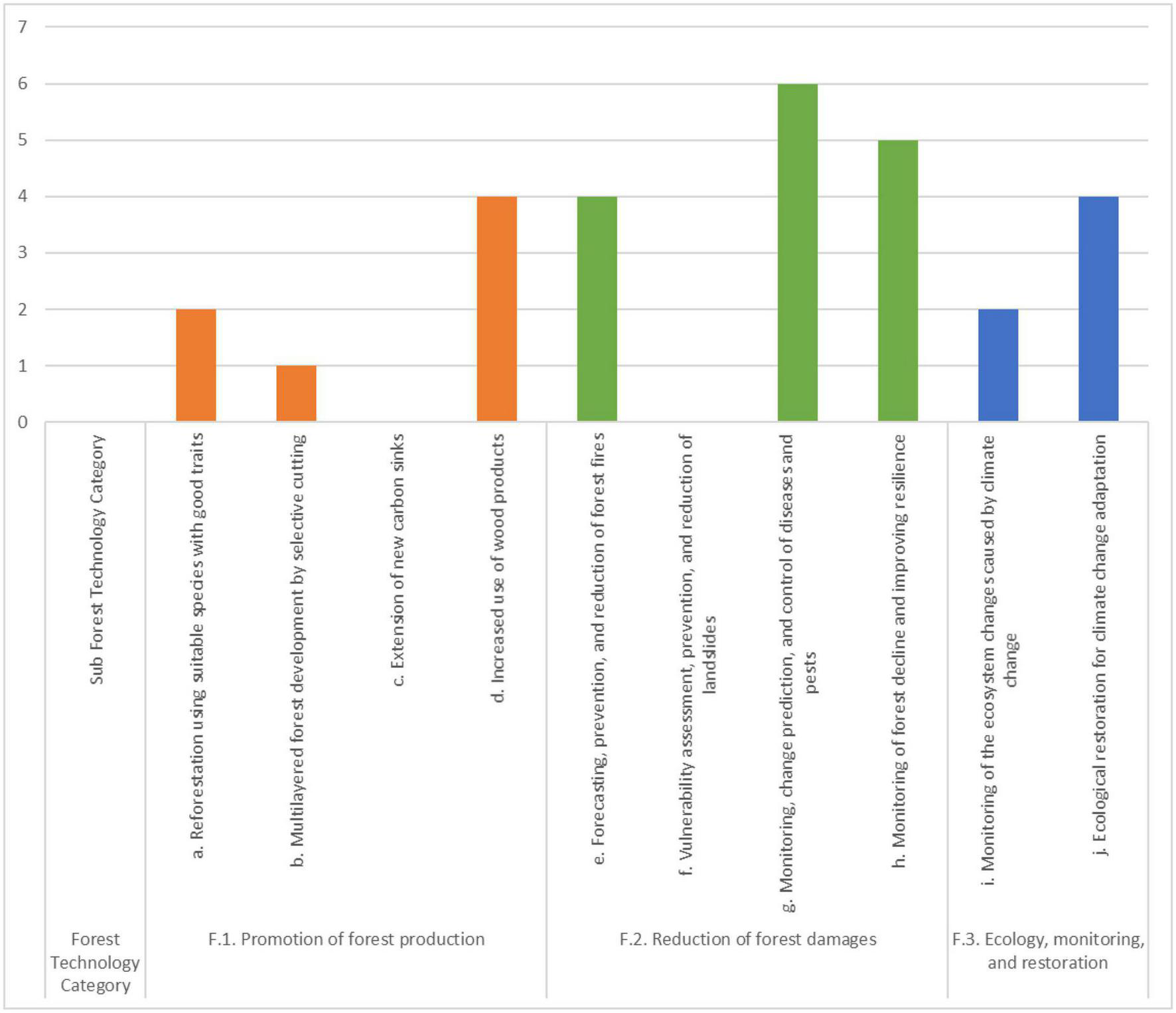
Number of projects by forest technology (y-axis: number of projects).
4.2. Status of converging technology in forest sector projects supported by the CTCN and GCF
The converging technologies that can eliminate deforestation factors by converging three technologies in the forest sector in the fields of energy, agriculture, and water resources, as well as the distribution of financial resources supported, are outlined in Table 9.
TABLE 9
| Technology convergence type code* | Project no. | Project title | Techniques applied |
| I-A-F.1-d | CTCN 4 | Scaling-up sustainable wood fuel (charcoal and firewood) systems in the Pwani, Lindi and Mtwara regions of Tanzania | Resource-efficient wood charcoal production technologies, improved cook stoves |
| CTCN 22 | Developing policy framework and business model to promote sustainable use of biomass briquettes in Nepal | Biomass briquettes, power and for heating | |
| GCF 5 | Enabling implementation of forest sector reform in Georgia to reduce GHG emissions from forest degradation | Sustainable forest management, biomass utilization, forest restoration, forest biomass, alternate resource as fuelwood and timber marketing enhancement | |
| I-B-F.1-c | CTCN 21 | Study on the valorization of forest biomass waste into energy | Forest biomass energy conversion |
| I-C-F.1-c | GCF 22 | Cooling facility | On-grid/off-grid cooling facilities incl. fans, green roof/wall; refrigeration facilities |
| I-C-F.1-d | GCF 18 | Scaling-up investment in low-carbon public buildings | Low carbon energy consumption in public buildings, forest biomass |
| I-D-F.1-c | GCF 6 | Costa Rica REDD-plus results-based payments for 2014 and 2015 | REDD+, PES, forest conservation, fire prevention, and restoration, natural regeneration, agroforestry |
| GCF 7 | Colombia REDD+ results-based payments for results period 2015-2016 | REDD+, SFM incl. Forest product utilization and marketing, forest restoration and enrichment, forest monitoring, controlling and surveillance | |
| I-D-F.2-h | CTCN 1 | Tree monitoring for climate adaptation in the city of Mbombela | GIS-based tree monitoring system/tool |
| II-E-F.1-a | Agroforestry for people, peace and prosperity - innovative solutions for a Sustainable coffee industry | Solar-powered water purification systems, agroforestry, sustainable farming practice | |
| Prosperous forests - Reimagining coffee to empower farmers and regenerate forests | Shortening the value chain, allowances, regenerative agroforestry | ||
| II-E-F.1-c | GCF 3 | Promoting zero-deforestation cocoa production for reducing emissions in Côte d’Ivoire (PROMIRE) | Capacity building, agricultural model development, forest restoration, agroforestry |
| II-E-F.1-d | CTCN 11 | Community based livelihood improvement program | Sustainable forest management, forest user groups, community-based agricultural extension |
| II-E-F.2-e | CTCN 10 | Design of an ecological response and restoration platform against fires for the Chilean silvo-farming sector | Design of an ecological post-fire restoration platform exchanging the relevant knowledge |
| GCF 6 | Costa Rica REDD-plus results-based payments for 2014 and 2015 | REDD+, PES, forest conservation, fire prevention, and restoration, natural regeneration, agroforestry | |
| II-E-F.2-h | CTCN 19 | Developing a framework and methodology to carbon sinks from the forestry sector using earth observation in Samoa | Forest mapping framework and defining methodology for carbon sink estimation |
| II-E-F.3-i | CTCN 6 | Identification of technical practices for climate-smart agriculture (CSA) in Indonesia | Sensing soil water content and soil chemistry, watering and fertilizing tool automation |
| II-E-F.3-j | CTCN 10 | Design of an ecological response and restoration platform against fires for the Chilean silvo-farming sector | Design of an ecological post-fire restoration platform exchanging the relevant knowledge |
| CTCN 18 | Design and financing for crop drying and storage technologies to strengthen food security in the face of climate change | Community adaptation planning | |
| II-F-F.1-c | GCF 4 | Carbon sequestration through climate investment in forests and rangelands in Kyrgyz republic (CS-FOR) | Capacity building, improving governance, financing, integrated rangeland and forest management, forest restoration |
| II-F-F.3-i | CTCN 5 | Enhancing climate resilience and economic sustainability of livestock farming in a rural community of Mongolia | Climate-resilient livestock farming, community-scale sustainable meat processing system for livelihood improvement |
| II-F-F.3-j | GCF 1 | Aimags and Soums green regional development investment program (ASDIP) | Rangeland management, efficient animal husbandry, financing, forest restoration, agroforestry |
| II-G-F.1-a | GCF 2 | Improving adaptive capacity and risk management of rural communities in Mongolia | Watershed and catchment protection, natural resources management, (catchment) reforestation |
| GCF 24 | Empower to adapt: creating climate-change resilient livelihoods through community-based natural resource management (CBNRM) in Namibia | Local-level climate monitoring, conservation agriculture, water demand management, forest restoration, tree savanna management | |
| II-G-F.2-h | CTCN 1 | Tree monitoring for climate adaptation in the city of Mbombela | GIS-based tree monitoring system/tool |
| II-H-F.2-f | CTCN 23 | Designing nature-based solutions with an ethnic and gender-equity approach, to increase the resilience of rural mountain communities in protected natural areas affected by extreme weather events in Honduras | Nature-based solutions for disaster risk reduction, water disaster management, water treatment |
| II-I-F.3-j | CTCN 13 | Development of a methodological framework for incorporating ecosystem-based adaptation in the process of planning and management of protected areas in Peru | Ecosystem-based adaptation (EbA) |
| II-J-F.2-e | CTCN 2 | Building up integrated monitoring and early warning forest fires detection system in the Borjomi-Kharagauli National Park by innovative remote sensing tools | Suitable integrated monitoring and early warning forest fire detection system |
List of forest sector projects funded by the CTCN and GCF.
*The “technology convergence type code” is composed of technology classification combinations. The first digit represents the technology categories of the climate mitigation and adaptation from same table. The second digit denotes the non-forest technology category from Table 2. The third and fourth digits signify the forest technology categories and sub forest technology categories from Table 1, respectively.
In the forest carbon project, technologies in other fields where most technologies converged were listed in the following order: agriculture, energy, and water resources (Figure 3). From the perspective of forest technology classification, forest disaster reduction has the most cases (Figure 3).
FIGURE 3
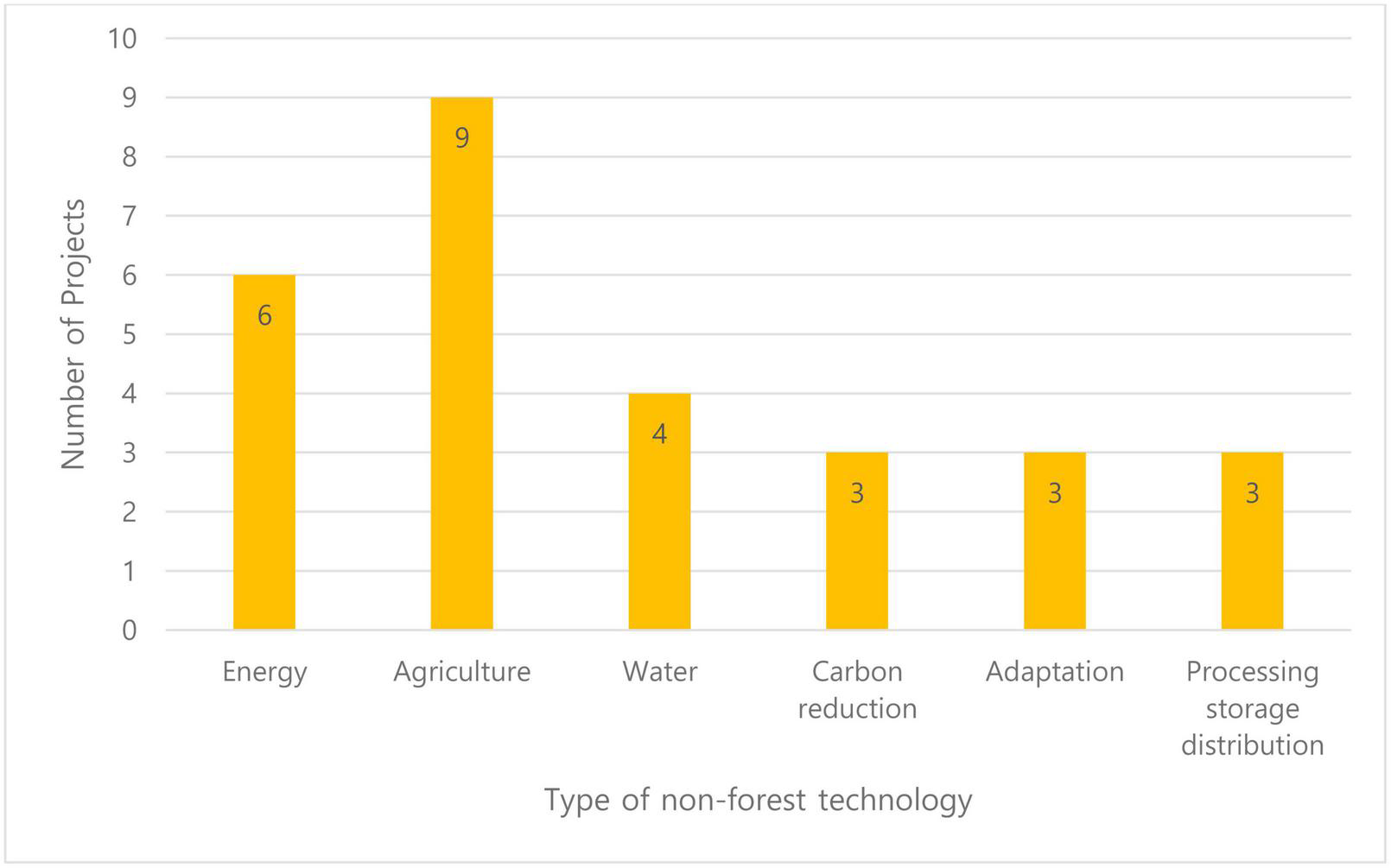
Number of forest projects combined with the non-forestry sector.
There are 10 technical fields in the convergence of forest technology and other technologies, which are as follows: bioenergy, waste energy, construction efficiency, carbon storage, crop cultivation/production, processing/storage/distribution, water resource acquisition and supply, water resource disaster management, climate forecasting and modeling, climate information warning systems.
Regarding climate change mitigation and adaptation technology, there were nine mitigation projects and one adaptation project across the 10 sectors. When applying the detailed technology classification, the technology combination most closely related to the forest carbon-related technology sector was found to be crop cultivation/production technology and ecological restoration technology to expand new carbon sinks and adapt to climate change.
These projects are closely associated with agroforestry practices, which involve the simultaneous planting crops and afforestation to secure carbon sinks and facilitate ecological restoration. Additionally, the bioenergy technology sector and the expansion of wood product utilization emerge as important components. This is because energy production utilizing woody biomass, such as by-products generated during the wood production process, holds potential. The carbon storage technology sector exhibits strong interconnectedness with the advancement of new carbon sink expansion technology within forest carbon-related technologies. This relationship stems from the inherent nature of the sector. Moreover, the processing/storage/distribution technology sector persists to be an integral part of the value chain that includes forest and pastoral land management as well as the livestock industry.
4.3. Status of blended finance
From the perspective of two categories of climate change response, mitigation, and adaptation, in terms of projects supported by the CTCN, there were four cases of mitigation projects, seven cases of adaptation projects, and two cases of combined mitigation and adaptation projects (Figure 4). These results indicate that the CTCN projects favors adaptation projects. In the case of GCF projects, there were five and three projects for climate change mitigation and adaptation, respectively, and two projects that combined mitigation and adaptation, showing that more mitigation projects are being conducted than CTCN projects (Figure 4). GCF support focused on financial support because activities such as afforestation and infrastructure construction, which were carried out as mitigation projects in the forestry sector, required large-scale investment. However, because adaptation projects require more technical assistance than mitigation projects, the support of the CTCN, which included project activities to identify necessary technologies in developing countries, tended to be more.
FIGURE 4
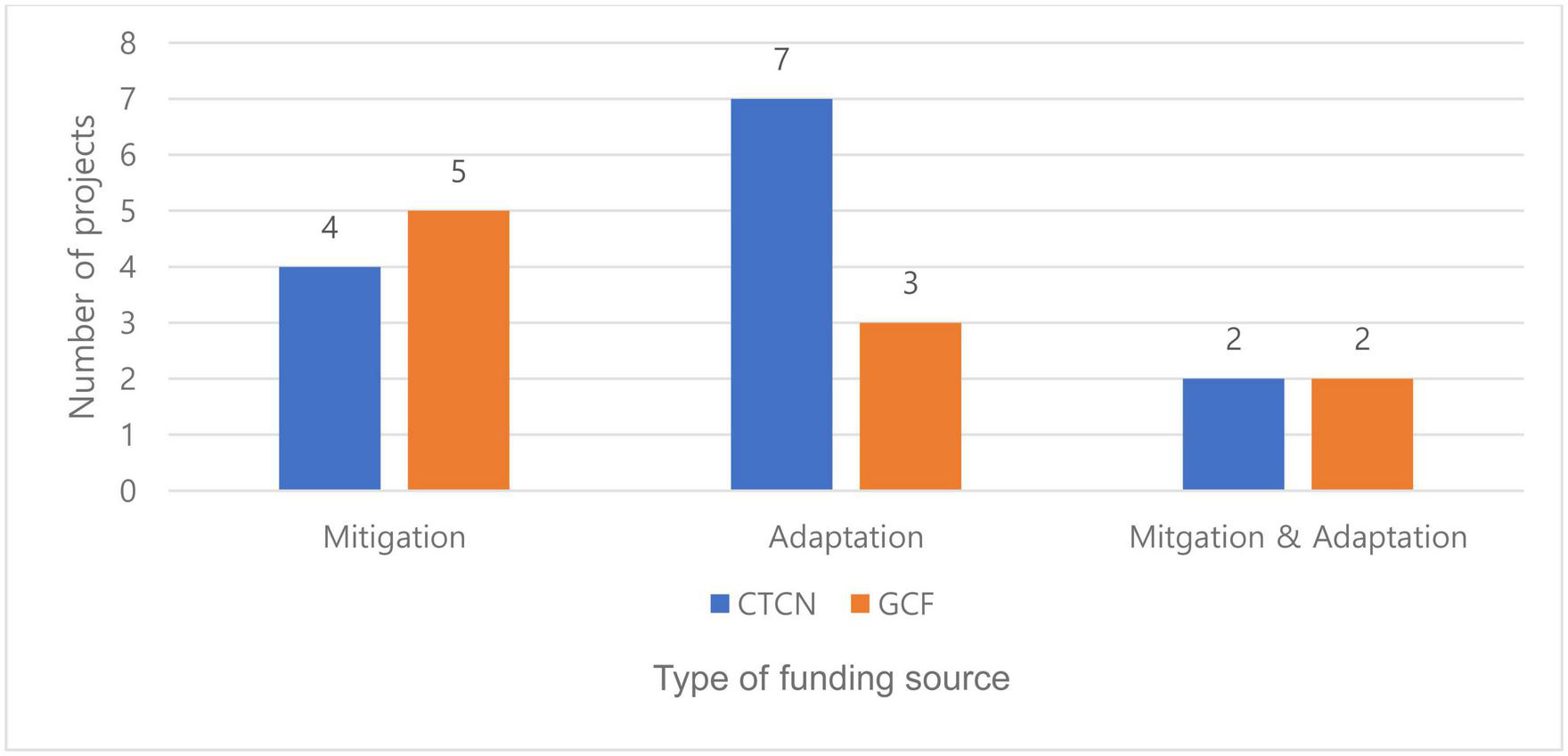
Climate change mitigation and adaptation projects by funding source.
The application of converging technology plays a positive role in attracting private finance, as nine out of ten GCF projects that utilize convergence technologies showed blended financing with public and private resources (Table 10). Furthermore, eight of the nine projects in which private finance blended with public funds had the form of technical support funds and were composed of concessional finance, guaranteed finance, and reserve funds in that order.
TABLE 10
| Project no. | Technical assistance funds | Concessional finance | Guarantees and risk insurance included in structured finance | Design and preparation funds |
| GCF 1 | √ | √ | √ | √ |
| GCF 2 | √ | |||
| GCF 3 | √ | |||
| GCF 4 | √ | √ | √ | |
| GCF 5 | √ | √ | √ | |
| GCF 7 | √ | √ | ||
| GCF 18 | √ | √ | ||
| GCF 22 | √ | √ | √ | |
| GCF 24 | √ | √ | ||
| Total | 8 | 6 | 5 | 2 |
Convergence categories for GCF project funding.
The forest carbon projects supported by the CTCN are mainly funds for technical support, whereas the forest carbon projects supported by the GCF contain a diverse mix of private finance. Private finance is blended in various ways in the forest carbon project supported by the GCF. The blending method of private finance was analyzed for four types (concessional finance, guarantee and risk insurance, design and preparation funds, and technical assistance funds). The largest types of blended private funds invested in forest carbon projects were technical assistance funds (eight cases), concessional finance (six cases), guarantee and risk insurance (five cases), and design and preparation (two cases). The GCF 6 project is a result-based payment project, which represents the last stage of REDD+ implementation, and is not applicable to any of the four types presented. This shows that the means of supporting feasibility assessment and assuring creditworthiness were utilized to reduce the risk of private financial investment while commercializing and scaling up the GCF project to support the implementation of the forest carbon project (Table 10).
Considering the current state of public-private joint funding types for climate change mitigation, adaptation, and mitigation and adaptation convergence projects, public-private joint financial projects accounted for many mitigation projects, with six projects funded by the public sector and 16 funded by public-private partnerships. However, for adaptation projects, the public sector accounted for the majority, with 11 cases in the public sector and three cases in the public-private joint sector. For mitigation and adaptation projects, nine public finance projects and seven public-private joint finance projects did not show a significant difference (Figure 5).
FIGURE 5
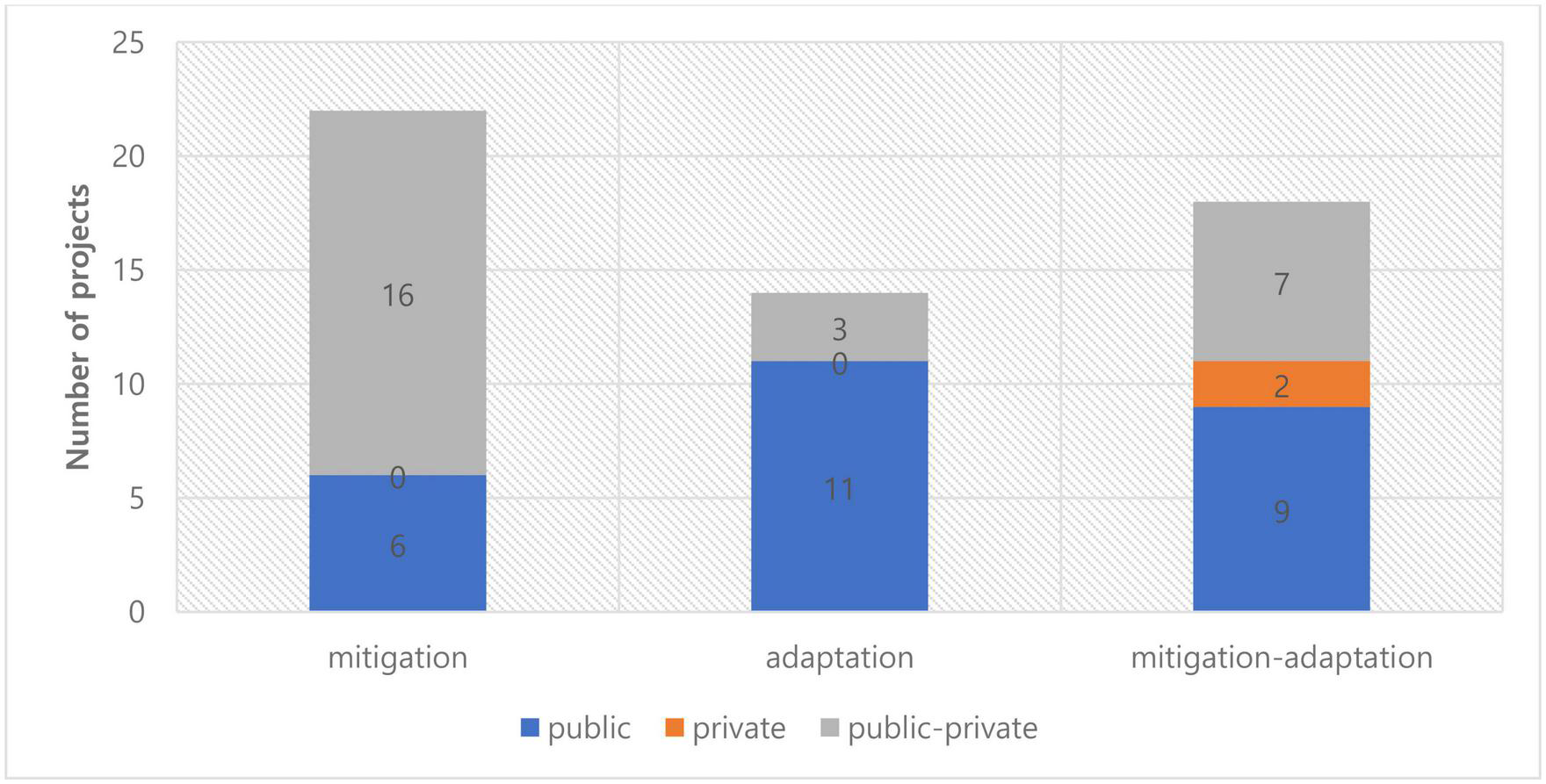
Climate change mitigation and adaptation projects by funding type.
Notably, there are only two privately funded projects in the mitigation and adaptation sectors. As there were 16 public-private partnerships in the mitigation sector and three public-private partnerships in the adaptation sector (Figure 5), conditions for sufficient capital investment are created when the private sector financially supports the public sector. It can be inferred that financial support from the sector alone is insufficient to create conditions for investment. In contrast, the mitigation and adaptation sector is an example of its potential to attract pure private investment. de Nevers (2011) emphasizes that insufficient scarce resource public funds should be used to guide and facilitate private sector investments potential. Thus, it is necessary to establish a financial system that maximizes the effect of private investment.
5. Discussion
5.1. Creation of private financial convergence opportunities through technology convergence
In REDD+ projects, alternative measures are introduced to address the root causes of deforestation and forest degradation, including agriculture, energy consumption, illegal logging, infrastructure development, and forest fires, among others (Agrawal et al., 2011). The introduction of innovative ideas and technologies to address these causes has the potential to either reduce the negative impacts of human activities on forest ecosystems or replace the benefits previously derived from deforestation (Strassburg et al., 2010). By converging technologies across these sectors, strategies can be devised to both conserve forests and deliver the aforementioned benefits. This research confirms that such an approach is being actively implemented in projects supported by CTCN and GCF.
It is necessary to graft non-forest technologies that are highly connected to forest technologies in order to increase the likelihood of project success of the project, maximize its effectiveness, and achieve the desired results of gradually expanding the scope and scale of the project. Therefore, the convergence status between forestry and non-forestry technology sectors was examined through content analysis. According to the project case studies, convergence projects in forest technology, bioenergy, and wood carbon storage are expected to increase the possibility of business success in the climate change mitigation sector. Additionally, a project converging forest technology with crop cultivation/production/processing/storage/distribution-related technologies is expected to be a lucrative business model in the climate change adaptation sector.
However, at the actual project stage, it is necessary to review the technology convergence in the forest sector from various perspectives. For example, in some countries, the provision of incentives by designating wood as a carbon-neutral fuels remains one of the main issues (Cornwall, 2017; Pierce, 2017). From the perspective of convergence between forest technology and energy technology, it is necessary to design well so that the use of wood energy to ensure it emits no more carbon than the use of existing fuels or other alternative energies.
The combination of public impact-driven funding and private capital can leverage investment opportunities and create multilayered funding structures. The potential for these sources to provide substantial funding for REDD+ should not be underestimated, and all possible means of overcoming any challenges in engaging with these private sector actors should be explored. Concessional capital is one of the most commonly used types of blended financing in nature-based solutions, and it can improve the returns on investment for investors, while risk guarantees assist in making nature-based projects bankable.
In the context of REDD+, private engagement could fall into two broad classes: those involved in the carbon market trading mechanism and those directly linked to commodity supply chains associated with deforestation and forest degradation. The first group consists of players who are mainly involved with trading (both production and sales of carbon credits) and may include project developers, technical service providers, financial institutions, and buyers. The second group consists of private sector players mainly associated with forest loss activities related to agricultural commodity supplies. The range of suppliers remains constant throughout the supply chain, including raw material producers, manufacturers, traders, retailers, consumers, and service providers. Identifying these two groups is very important to the success of REDD+.
5.2. Opportunities to develop a REDD+ project model based on the integration of converging technology and blended finance
Depending on the project development stage, the country needs to understand the role of blended finance to access the most appropriate source of financing. For example, the country can focus on pipeline development by utilizing project preparation funding, which, depending on the project stage, can consist of a combination of grants and concessional loans. Bowman and Minas (2019) noted that the interconnection between finance and technology mechanisms under the UNFCCC can strengthen the GCF’s role in facilitating the implementation of the Paris Agreement. As the project is scaled up for the subsequent phase, relevant stakeholders can consider catalyzing funds that enable more innovative support and may endure for extended project periods. In the final phase of REDD+ implementation, there are opportunities for impact investors to participate while searching for potential and innovative business models that could be introduced into the market. Therefore, greater coordination is required to mobilize public and private sector capital to establish an enabling environment and unlock market opportunities.
As described above, if active investment from the private sector is recruited at the design stage of a forest carbon convergence project based on a business model that can achieve results in climate change mitigation and adaptation, a business plan with a greater ripple effect can be developed. According to previous research finding, so-called blended finance, in which the public sector can support and promote private sector investment, can be an innovative and powerful private investment incentive. Therefore, it is necessary to apply the four mixed finance types (i.e., concession finance guarantee and risk guarantee, design and reserve funds, and technical support funds) according to the convergence characteristics of each project. As shown in the example of the forest carbon convergence project with mixed finance application in Table 10, it is necessary to apply all or part of the four types of mixed finance to increase the size of the project and diversify the project contents according to the business expertise of the participating private entities.
It is necessary to strategically allocate the budget, considering the motives and obstacles for the private sector to participate in forest carbon projects. The motivation of the private sector to participate can be divided into three categories: (1) pure donations; (2) links to the company’s business projects; and (3) securing carbon credits. As the environmental, social, and governance (ESG) concept has recently become a major issue in corporate management, environmental issues have emerged as an important area in corporate evaluation. As the demand for environmental soundness increases, many companies are investing in forest carbon projects to achieve goals 1 and 3. This demand is also prominent in voluntary carbon markets. The increase in forest carbon projects and issuance in the voluntary market shows that the business execution risk has been reduced, the price is still trading at a premium to the regulated market, and non-AFOLU emission rights indicate that it is still preferred as an ESG management tool. In addition, it can be used to link the voluntary market with Article 6.2 of the Paris Agreement. Therefore, there is an opportunity to secure large-scale reduction results. Furthermore, expanding business participants to companies linked to the supply chain value chain is possible. To this end, when designing a project, it is necessary to specifically identify the output produced through the forest carbon REDD+ project and connect it to the private sector.
The convergence approach is an effective strategy in practice. For example, the AFR100 is a large-scale regional initiative that combines public and private funding with converged forest restoration technologies to combat deforestation and degradation while advancing forest restoration in Africa via agroforestry (NEPAD, 2022). A convergence approach to technology and finance can be a strategy for resolving deforestation and degradation, which are closely related to livelihood issues such as food and energy (Figure 6).
FIGURE 6
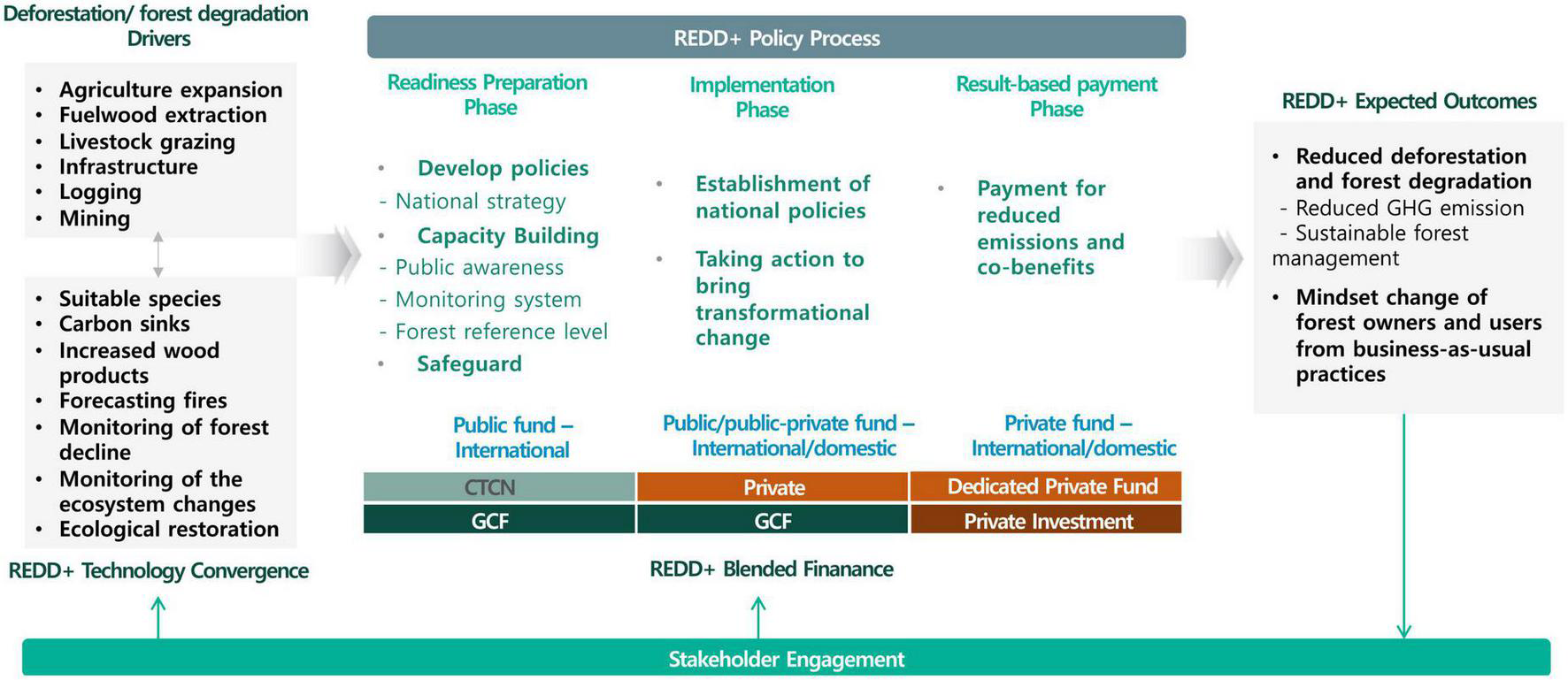
Technology convergence and finance blending for REDD+.
5.3. Challenges to promote the integration of converging technology and blended finance in REDD+
The convergence of technology and blended finance involves a combination of stakeholders who possess different technologies, occupy diverse business sectors, and expect various effects on forest carbon projects. These forest carbon convergence projects require stakeholder engagement, and it is essential to lay the foundation for building a partnership that can support this. Implementing a project in the forestry sector requires the active participation of local stakeholders, including small-scale farmers, local communities, and businesses, who often require training in technical, business, or financial skills (Angelsen, 2008). Improving the long-term feasibility of REDD+ investment may be contingent on enhancing the capacity of these major stakeholders. In addition to improving capacity, strategic use of CTCN TA also improves impact measurement and reporting, which can enable the participation of a broad range of investors (i.e., government agencies, multilateral banks, and other funds) that do not have the fiduciary mandate to engage in commercial transactions during the early stage of project pipeline development or implementation (Luttrell et al., 2013). Therefore, it is important to note that the use of TA could build local capacities with clear development objectives and encourage investors to participate in regenerative projects for REDD+.
The scale-up of REDD+ projects through a convergence strategy can be achieved through the participation of stakeholders engaged in activities geared toward implementing REDD+ (Nukpezah and Alemagi, 2020). Technological mechanisms have an important role in matching proper members with climate technologies. As a financial mechanism, the GCF supports implementing REDD+ projects and financing them with public and private funds. In the development process of the GCF project, various types of stakeholders, from the global to the regional level, are involved. Implementing REDD+, governance with a range of actors (public organizations, enterprises, non-governmental organizations, local communities, and research institutes) creates project-specific networks (Corbera and Schroeder, 2011). Partnerships contribute funding, knowledge, and technology transfer to scale up REDD+ projects (Shin et al., 2022). Therefore, policy measures are needed to provide information and support mutual networking for private and public stakeholders with forest carbon convergence technologies to participate in the convergence REDD+ project. Fundamentally, R&D support for appropriate technology development and step-by-step financial support for the commercialization of these technologies in the market are needed. In particular, preparing a policy program that can be promoted in connection with the CTCN and GCF projects as a national-level policy is necessary in order to be applied and demonstrated to the REDD+ project in the commercialization stage (Figure 4). Establishing and identifying a national database of technical and financial partners will create the creation of an enabling environment that can lead to participation in REDD+ activities that can respond to climate change and prevent deforestation (Phelps et al., 2010).
This step-by-step approach can also contribute to solving the problem of the distribution of the GCF. As Cui et al. (2014) mentioned, GCF is not going smoothly, and there is currently no satisfactory way to raise and allocate funds. However, REDD+ can show how efficiently GCF can be allocated. This is because forest projects can be a model that combines abatement efficiency (carbon sequestration) and adaptation fairness (improving the local environment and revitalizing the economy), which GCF considers important in allocating funds (Abbott and Gartner, 2011). Therefore, if the feasibility of the project is demonstrated through linkage with the technology mechanism and the scale of the project is expanded through the GCF, it will be a good example of the GCF’s financing and distribution.
6. Conclusion
This study provides practical and valuable insights by analyzing the cases of CTCN and GCF initiatives in terms of technology convergence and financial blending. It elucidates which technology convergences are actually being applied, the feasibility of financial blending, and highlights the types of projects preferred by CTCN and GCF for utilization as seed money for REDD+ implementation.
From a technical perspective, examining REDD+ projects allows for the exploration of ways to enhance greenhouse gas mitigation and adaptive effects by tackling factors of deforestation and forest degradation through a technology. Sustainable REDD+ initiatives take place especially pertinent when aiming to expand REDD+ projects from site-level to regional and national scales. Employing strategies that blend technology convergence with private financing with public funds will encourage the participation of diverse stakeholders and offer a variety of implementation options. From this viewpoint, our research holds practical significance as it presents feasible structures for technology convergence and financial blending that could serve as viable strategies. This pragmatic approach can potentially aid in efficiently allocating public funds for REDD+ projects, which aim to combat the global issue of deforestation, by leveraging private resources.
The results of this study indicate that among the various factors that are forestry-specific, convergence technologies were mainly applied to address factors related to agriculture, fuelwood usage, and disasters such as forest fires. This suggests that there is a need for the development of projects that apply a broader range of convergence technologies targeting other factors, such as infrastructure development and unsustainable forest management. Additionally, to encourage private sector participation in REDD+ projects, there is a need to expand programs that can guarantee or mitigate risks when investing private funds, as well as those that enable private sector involvement in public initiatives.
However, this study has a limited number of cases for analysis and highlights the data constraints. Furthermore, as our analysis is based on project plan documents rather than completed projects. Such limitations could potentially be addressed with a more extensive dataset and quantitative analysis, providing empirical evidence for future studies. Nonetheless, this study holds significant merit as it offers a fresh perspective on the technological means to address the environmental issue of REDD+ and furnishes practical insights for its sustainable implementation.
Statements
Author contributions
E-KJ: conceptualization, methodology, formal analysis, validation, resources, and writing—original draft preparation. E-KJ, DK, and GC: software, investigation, and visualization. DK, E-KJ, and JM: data curation. E-KJ, GC, and JM: writing—review and editing. GC: project administration and funding acquisition. All authors have read and agreed to the published version of the manuscript.
Funding
This research was funded by the National Institute of Forest Science, grant project number FP0900-2021-01-2023. This research was supported by the National Institute of Green Technology, grant project number C2320301 and the Asian Forest Cooperation Organization (AFoCO), grant number O220001.
Conflict of interest
The authors declare that the research was conducted in the absence of any commercial or financial relationships that could be construed as a potential conflict of interest.
Publisher’s note
All claims expressed in this article are solely those of the authors and do not necessarily represent those of their affiliated organizations, or those of the publisher, the editors and the reviewers. Any product that may be evaluated in this article, or claim that may be made by its manufacturer, is not guaranteed or endorsed by the publisher.
Footnotes
1.^UNFCCC REDD+ Web Platform, https://redd.unfccc.int/info-hub.html?_gl=1*wgzh1i*_ga*MTk3ODcwMTc1LjE2ODA1MDUxMDA.*_ga_7ZZWT14N79*MTY4NzkxNzEyOC4zLjAuMTY4NzkxNzE1Mi4wLjAuMA.
References
1
Abbott K. W. Gartner D. (2011). The green climate fund and the future of environmental governance. Earth System Governance Working Paper 16.Lund: Earth System Governance Project. 10.2139/ssrn.1931066
2
Agrawal A. Nepstad D. Chhatre A. (2011). Reducing emissions from deforestation and forest degradation.Annu. Rev. Environ. Resour.36373–396. 10.1146/annurev-environ-042009-094508
3
Andoh J. Oduro K. A. Park J. Lee Y. (2022). Towards REDD+ implementation: Deforestation and forest degradation drivers, REDD+ financing, and readiness activities in participant countries.Front. For. Glob. Change5:957550. 10.3389/ffgc.2022.957550
4
Angelsen A. (2008). Moving ahead with REDD: Issues, options and implications.Bogor: CIFOR.
5
Angelsen A. McNeill D. (2012). “The evolution of REDD +,” in Analyzing REDD +: Challenges and choices, edsAngelsenA.BrockhausM.SunderlinW. D.VerchotL. V. (Bogor: CIFOR), 31–48.
6
Angelsen A. Brockhaus M. Kanninen M. Sills E. Sunderlin W. D. Wertz- Kanounnikoff S. (2009). Realizing REDD +: National strategy and policy options.Bogor: CIFOR.
7
Angelsen A. Brockhaus M. Sunderlin W. D. Verchot LV (eds.) (2012). Analyzing REDD+: Challenges and choices.Bogor: CIFOR, 15–30.
8
Begum R. A. Raihan A. Said M. N. M. (2020). Dynamic impacts of economic growth and forested area on carbon dioxide emissions in Malaysia.Sustainability12:9375. 10.3390/su12229375
9
Biermann F. Pattberg P. van Asselt H. Zelli F. (2009). The fragmentation of global governance architectures: A framework for analysis.Glob. Environ. Polit.914–40. 10.1162/glep.2009.9.4.14
10
Bowman M. Minas S. (2019). Resilience through interlinkage: The green climate fund and climate finance governance.Clim. Policy19342–353. 10.1080/14693062.2018.1513358
11
Bushley B. R. (2015). Coordination and cross-sectoral integration in REDD+: Experiences from seven countries.Clim. Dev.8458–471. 10.1080/17565529.2015.1050979
12
Climate Focus (2015). Results-based finance for REDD+: Emerging approaches. KfW REDD+ Expert Dialogue 7.
13
Corbera E. Broderick J. (2009). The expanding carbon markets: Issues, perspectives, and the role of science. Norwich: Tyndall Centre.
14
Corbera E. Schroeder H. (2011). Governing and implementing REDD +.Environ. Sci. Policy1289–100. 10.1016/j.envsci.2010.11.002
15
Cornwall W. (2017). Is wood a green source of energy? Scientists are divided.Science35518–21. 10.1126/science.355.6320.18
16
Cui L. B. Zhu L. Springmann M. Fan Y. (2014). Design and analysis of the green climate fund.J. Syst. Sci. Syst. Eng.23266–299. 10.1007/s11518-014-5250-0
17
de Nevers M. (2011). Climate finance: Mobilizing private investment to transform development, Global Economic Governance Program (GEG) Working Paper, No. 2011/60.Oxford: University College.
18
Earth Security (2021). The blended finance playbook for nature-based solutions.London: Earth Security.
19
Ecosystem Marketplace (2022). Ecosystem Marketplace’s state of the voluntary carbon markets 2022 Q3.Washington, DC: Ecosystem Marketplace.
20
Feng S. An H. Li H. Qi Y. Wang Z. Guan Q. et al (2020). The technology convergence of electric vehicles: Exploring promising and potential technology convergence relationships and topics.J. Clean. Product.260:120992. 10.1016/j.jclepro.2020.120992
21
Gaast W. Sikkema R. Vohrer M. (2018). The contribution of forest carbon credit projects to addressing the climate change challenge.Clim. Policy1842–48. 10.1080/14693062.2016.1242056
22
GCF (2013). The why and how of subnational REDD+.Seoul: Green Technology Center.
23
GCF (2019). Accelerating REDD+ implementation. Green Climate Fund Working Paper No.2. June 2019.Seoul: Green Technology Center.
24
GCF (2022). Ecosystems and ecosystem services. Sectoral Guide Consultation Version 1.Seoul: Green Technology Center.
25
Green Technology Center (2020). Korea green climate technology outlook 2020.Seoul: Green Technology Center.
26
Green Technology Center (2021). GTC BRIEF 2-3.Seoul: Green Technology Center.
27
Guarnaschelli S. Limketkai B. Vandeputte P. (2018). Financing sustainable land use. Unlocking business opportunities in sustainable land use with blended finance. Mumbai: KOIS Invest.
28
IPCC (2013). “Contribution to the intergovernmental panel on climate change,” in Proceedings of the Fifth assessment report climate change WG I, 2013: The physical science basis summary for policymakers; IPCC working group I, Stockholm. 10.1017/CBO9781107415324
29
Kanninen M. Murdiyarso D. Seymour F. Angelsen A. Wunder S. German L. (2007). Do trees grow on money?: The implications of deforestation research for policies to promote REDD, Vol. 4. Bogor: CIFOR.
30
Kanowski P. J. McDermott C. L. Cashore B. W. (2011). Implementing REDD +: Lessons from analysis of forest governance.Environ. Sci. Policy14111–117. 10.1016/j.envsci.2010.11.007
31
Karsenty A. (2008). The architecture of proposed REDD schemes after Bali: Facing critical choices.Int. For. Rev.10443–457. 10.1505/ifor.10.3.443
32
Karsenty A. Ongolo S. (2012). Can ‘fragile states’ decide to reduce their deforestation? The inappropriate use of the theory of incentives with respect to the REDD mechanism.For. Policy Econ.1838–45. 10.1016/j.forpol.2011.05.006
33
Lin L. Sills E. Cheshire H. (2014). Targeting areas for reducing emissions from deforestation and forest degradation (REDD+) projects in Tanzania. Glob. Environ. Change24, 277–286. 10.1016/j.gloenvcha.2013.12.003
34
Luttrell C. Loft L. Gebara M. F. Kweka D. L. Brockhaus M. Angelsen A. et al (2013). Who should benefit from REDD+? Rationales and realities.Ecol. Soc.181–18. 10.5751/ES-05834-180452
35
Luttrell C. Obidzinski K. Brockhaus M. Muharrom E. Petkova E. Wardell A. et al (2011). Lessons for REDD+ from measures to control illegal logging in Indonesia, Vol. 74. Bogor: CIFOR.
36
Maraseni T. N. Neupane P. R. Lopez-Casero F. Cadman T. (2014). An assessment of the impacts of the REDD+ pilot project on community forests user groups (CFUGs) and their community forests in Nepal. J. Environ. Manage. 136, 37–46. 10.1016/j.jenvman.2014.01.011
37
Mattsson E. Persson U. M. Ostwald M. Nissanka S. P. (2012). REDD+ readiness implications for Sri Lanka in terms of reducing deforestation. J. Environ. Manage. 100, 29–40. 10.1016/j.jenvman.2012.01.018
38
Mustalahti I. Bolin A. Boyd E. Paavola J. (2012). Can REDD+ reconcile local priorities and needs with global mitigation benefits? Lessons from Angai Forest, Tanzania. Ecol. Soc. 17:16. 10.5751/ES-04498-170116
39
NEPAD (2022). The State of AFR100: The progress of forest landscape restoration by implementing partners.Midrand: AUDA-NEPAD.
40
Nguyen N. U. P. Moehrle M. G. (2023). Combining the analysis of vertical and horizontal technology convergence: Insights from the case of urban innovation.IEEE Trans. Eng. Manag.701402–1415. 10.1109/TEM.2021.3086320
41
Ngwira S. Watanabe T. (2019). An analysis of the causes of deforestation in Malawi: A case of Mwazisi.Land8:48. 10.3390/land8030048
42
Nukpezah D. Alemagi D. (2020). An examination of REDD plus readiness and implementation in Ghana.Int. For. Rev.22504–517. 10.1505/146554820831255560
43
Phelps J. Guerrero M. C. Dalabajan D. A. Young B. Webb E. L. (2010). What makes a ‘REDD’ country?Glob. Environ. Change20322–332. 10.1016/j.gloenvcha.2010.01.002
44
Pierce F. (2017). Carbon loophole: Why is wood burning counted as green energy.Yale Environ.360.
45
Pokorny B. Scholz I. De Jong W. (2013). REDD+ for the poor or the poor for REDD+? About the limitations of environmental policies in the Amazon and the potential of achieving environmental goals through pro-poor policies. Ecol. Soc. 18:3. 10.5751/ES-05458-180203
46
Shin J. Shin H. Jeon E. Jeong H. (2020). A review of the concept and types of convergence, green and climate technology: A literature review and case analysis of technology convergence and convergence. GTC FOCUS 1-4.Seoul: Green Technology Center.
47
Shin S. Park M. S. Lee H. Baral H. (2022). The structure and pattern of global partnerships in the REDD+ mechanism.For. Policy Econ.141:102780. 10.1016/j.forpol.2021.102640
48
Sills E. O. Atmadja S. S. de Sassi C. Duchelle A. E. Kweka D. L. Resosudarmo I. A. P. et al (2014). REDD+ on the ground: A case book of subnational initiatives across the globe.Bogor: CIFOR. 10.17528/cifor/005202
49
Sills E. Madeira E. M. Sunderlin W. D. Wertz-Kanounnikoff S. (2009). “The evolving landscape of REDD+ projects,” in Realising REDD+: National strategy and policy options, edsAngelsenA.BrockhausM.KanninenM.SillsE.SunderlinW. D.Wertz-KanounnikoffS. (Bogor: CIFOR), 265–280
50
Strassburg B. B. Kelly A. Balmford A. Davies R. G. Gibbs H. K. Lovett A. et al (2010). Global congruence of carbon storage and biodiversity in terrestrial ecosystems.Conserv. Lett.398–105. 10.1111/j.1755-263X.2009.00092.x
51
Sun G. Q. Wang S. F. Li M. T. Li L. Zhang J. Zhang W. et al (2020). Transmission dynamics of COVID-19 in Wuhan, China: Effects of lockdown and medical resources.Nonlinear Dyn.1011981–1993. 10.1007/s11071-020-05770-9
52
United Nations Framework Convention on Climate Change (2008). Conference of the Parties 14, Poznan, December 2008.Rio de Janeiro: United Nations Framework Convention on Climate Change.
53
Vatn A. Vedeld P. O. (2012). National governance structures for REDD+.Glob. Environ. Change23422–432. 10.1016/j.gloenvcha.2012.11.005
54
Voigt C. Ferreira F. (2015). The warsaw framework for REDD+: Implications for national implementation and access to results-based finance.Carbon Clim. Law Rev.9113–129. 10.4337/9781783478316.00014
Summary
Keywords
convergence technology, forest and wood carbon, public-private financing, REDD+, CTCN, GCF
Citation
Jang E-K, Kwak D, Choi G and Moon J (2023) Opportunities and challenges of converging technology and blended finance for REDD+ implementation. Front. For. Glob. Change 6:1154917. doi: 10.3389/ffgc.2023.1154917
Received
08 February 2023
Accepted
21 August 2023
Published
07 September 2023
Volume
6 - 2023
Edited by
Yashwant Singh Rawat, Federal Technical and Vocational Education and Training Institute (FTVETI), Ethiopia
Reviewed by
Bhupendra Singh, VCSG Uttarakhand University, Ranichauri, Tehri Garhwal, India; Edward Morgan, Griffith University, Australia
Updates
Copyright
© 2023 Jang, Kwak, Choi and Moon.
This is an open-access article distributed under the terms of the Creative Commons Attribution License (CC BY). The use, distribution or reproduction in other forums is permitted, provided the original author(s) and the copyright owner(s) are credited and that the original publication in this journal is cited, in accordance with accepted academic practice. No use, distribution or reproduction is permitted which does not comply with these terms.
*Correspondence: Eun-Kyung Jang, ekjang85@korea.krGayoung Choi, choigayoung@nigt.re.kr
†These authors have contributed equally to this work and share corresponding authorship
Disclaimer
All claims expressed in this article are solely those of the authors and do not necessarily represent those of their affiliated organizations, or those of the publisher, the editors and the reviewers. Any product that may be evaluated in this article or claim that may be made by its manufacturer is not guaranteed or endorsed by the publisher.