Abstract
Background: As experts studying occupational health psychology know, low level of work engagement leads to higher turnover intentions. Some researchers have put a focus on the association between organizational support and work engagement. However, little has been done concerning the mediating effect of psychological capital (PsyCap) on the association between perceived organizational support (POS) and work engagement (vigor, dedication, absorption) among Chinese doctors.
Methods: A cross-sectional study has been carried out from November to December in 2017, in Liaoning Province, China. The questionnaire consists of Survey of Perceived Organizational Support, the Utrecht Work Engagement Scale, Psychological Capital Questionnaire, and demographic and working variables. The self-administered questionnaires were distributed to 1,009 doctors. Effective responses were collected from 836 participants (82.85%). Hierarchical multiple regression and the asymptotic and resampling strategies were used to examine the association between POS and work engagement mediated by PsyCap.
Results: After controlling the demographic and working variables, POS was positively related to vigor (β = 0.402, P < 0.01), dedication (β = 0.413, P < 0.01), and absorption (β = 0.373, P < 0.01). Psychological capital was positively associated with vigor (β = 0.442, P < 0.001), dedication (β = 0.413, P < 0.001), and absorption (β = 0.395, P < 0.001). Thus, PsyCap [a × b = 0.1895, bias-corrected and accelerated 95% confidence interval (BCa 95% CI) = 0.1524, 0.2290]; a × b = 0.1517, BCa 95% CI = 0.1180, 0.1875; a × b = 0.1693, BCa 95% CI = 0.1299, 0.2099] significantly mediated the association between POS and vigor, dedication, and absorption, respectively.
Conclusion: There was a low level of work engagement among Chinese doctors. Perceived organizational support could indirectly improve vigor, dedication, and absorption, partially through mediator PsyCap. Perceived organizational support intervention, education, and training in PsyCap should be carried out to cope with work engagement.
Introduction
Work engagement is defined as an active, substantial, and job-relevant status of spirit (1). It consists of three subscales: vigor (i.e., always keep energetic work), dedication (i.e., actively and enthusiastically involved in the work), and absorption (i.e., totally focus on one's work) (2). Low work engagement among a large proportion of practitioners could generate a negative attitude toward their work (3). Around the world, low work engagement is a serious problem among all types of occupational groups, especially to the doctors (4–6). In China, shortage of doctors is a common phenomenon in the hospitals, which probably leads to overfatigue (7) and even low level of work engagement. The number of doctors was 2.83 million in 2017 in China, indicating the doctor–patient ratio is 2.44 doctors for 1,000 patients (8). This ratio is immensely lower than the ratio of 9.8 in high-income or the ratio of 4.45 in middle-income countries (9). More seriously, doctors in China complain about being in highly intensive work and in enormously stressful environment. Approximately 94% doctors work more than 8 h per day in China. One-quarter of doctors work more than 12 h per day without corresponding recompense. Most doctors must work on national holidays, who have not received contractually required income (10). In addition, doctors are often overworked. They have frequent night shifts, lots of daily consultations, and even hundreds of patients 1 day. This undoubtedly increases their occupational prevalence and undermines their work engagement compared with nurses and other occupations (4, 5, 11–13). Even worse, low work engagement may damage the job motivation and job enthusiasm of doctors and then exacerbate job burnout and turnover intentions (6, 14–16). Ultimately, a low level of work engagement has a negative impact on doctors' mental health and medical service quality (2). On the contrary, a high level of work engagement could promote doctors' working performance, contentment, and psychological health (17–19). Loerbroks et al. (2) research demonstrates that improving doctors' work engagement, particularly vigor and dedication, are related to better patient care. Therefore, work engagement of doctors in China needs further research.
A low level of work engagement dramatically impacts physical and psychological health, the quality of life, and the health service of the doctors. It is essential to find positive psychological resources to manage this adverse effect. Doctors are usually rewarded for providing excellent medical services. In the work, perceived organizational support (POS) could be maintaining an employee's feelings. Perceived organizational support relates to the degree that the organization treasures his/her contribution and concerns with his/her well-being (20). It appears through encountering benefits to employees taken by the organization. Perceived organizational support is also a vital element of the social interaction. It means employees trust that the organization will provide encouragements and value their achievements, and the organization trusts that employees will perform excellently at work (21). Empirical studies have shown that low POS leads to negative work attitude and performance. Low POS also negatively influences mental health and employee engagement (20, 22–24). Especially in hospitals, low POS results to bad consequences in doctors, such as frequent absenteeism, reduced productivity, and separation (20, 25, 26). Furthermore, it may have a negative impact on the quality of medical services. Perceived organizational support was found to be a positive factor relating with work engagement in professional managers and nurses before (11, 27, 28). Hence, improving POS may be a kind of means for promoting the doctors' professional performance (20).
Psychological science is becoming increasingly important at all aspects of society. Because POS has been explored at the organizational aspect, it is also an interesting topic to enhance the doctors' work engagement at the personal aspect. The psychological factors at the personal perspective can enrich interventions in the future. Based on the results of many previous studies, a vital notion derived from organizational psychological behavior is psychological capital (PsyCap). It is a positive resource and psychological force against “doctor pressure and resignation” (29–33). As an exploitable human resource, PsyCap can be suitably developed through training and intervention programs (34). As people become increasingly aware of the significance of positive psychological resources, organizations seek to promote physical and mental health of doctors via reinforcing psychological resources (35). In recent years, some studies have shown that PsyCap relates to POS and work engagement in nurse and staff (11, 29), while PsyCap is connected with professional identity among Chinese doctors (33). For instance, raising PsyCap has positively to do with POS and work engagement (11, 36). Additionally, a previous review presents that POS could influence work engagement through PsyCap but lacks empirical research (34). Nevertheless, to the best of our knowledge, PsyCap has not been entirely certified as a mediator between POS and working engagement, particularly among doctors in the Asian countries. Therefore, we want to add psychological resources to the model of doctors' work engagement and to explore the mediating role of PsyCap in “organization” and “individual.”
Purpose of the Study
Based on the research presented above, this study explored the potential mediating role of PsyCap on the association between organizational care and employee mentality. We try to explore the role of PsyCap on the relationships between POS and work engagement (vigor, dedication, and absorption) among Chinese doctors (Figure 1). Four hypotheses were proposed:
Figure 1
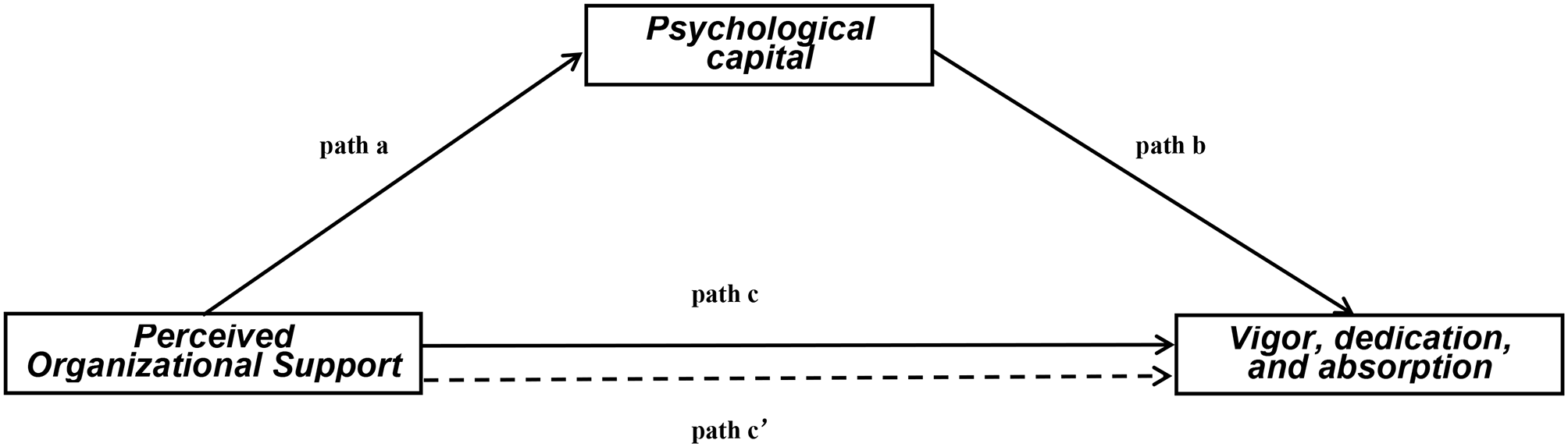
Theoretical model of the mediating role of PsyCap on the association between POS and work engagement. c: association of POS with vigor, dedication and absorption; a: association of POS with PsyCap; b: association between PsyCap and vigor, dedication, and absorption after controlling for the covariates; c′: association of POS with vigor, dedication, and absorption after adding PsyCap as a mediator; c = c′ + ab. POS, perceived organizational support; PsyCap, psychological capital.
Hypothesis 1: Perceived organizational support is positively associated with work engagement (vigor, dedication, absorption) (path c).
Hypotheses 2 and 3: Psychological capital is positively related to POS (path a) and work engagement (vigor, dedication, absorption) (path b).
Hypothesis 4: The effects of POS on work engagement (vigor, dedication, absorption) are partially mediated by PsyCap (path c′).
Materials and Methods
Ethics Statement
All participants filled in the informed written consent voluntary and anonymous. The study was performed in accordance with the Declaration of Helsinki, and the protocol was approved by the Committee on Human Experimentation of China Medical University.
Study Design and Sample
This cross-sectional study was conducted from November to December in 2017, in Liaoning Province, China. Liaoning province has 14 cities, 57 tertiary hospitals, and 98,985 doctors in 2017 (8). Tertiary hospitals need more than 500 beds in China (37). Based on geographic division, we selected doctors from five cities and randomly chose one tertiary hospital in each city. Then, we randomly selected ~200 doctors from each hospital. With acquiring informed consent written by participants, the self-administered questionnaires were distributed to 1,009 doctors. Eight hundred thirty-six doctors provided effective answers (effective response rate, 82.85%).
Demographic Characteristics and Working Characteristics
Demographic characteristics included gender, age (years), marital status, and educational level. “Age (years)” was classified as ≤30, 31–40, and ≥41; “Marital status” was classified as single/widow/divorced/separated and marriage/cohabitation; “Educational level” was classified as junior college or lower, college, and postgraduate or higher. Working characteristics included professional title and monthly income (RMB, yuan); “Professional title” was classified as junior, intermediate, and senior; “Monthly income (RMB, yuan)” was classified as <4,000 yuan, 4,000 to 8,000 yuan, and >8,000 yuan.
Measurement of Work Engagement
The Utrecht Work Engagement Scale (UWES) was used to assess work engagement. It has three subscales and 17 items, which are vigor (6 items), dedication (5 items), and absorption (6 items) (11). All items range from 0 (never) to 6 (always), and the total score of each dimension was valued by summing scores of each dimension (38). Higher scores indicate high-level work engagement. The Chinese version of UWES is practiced in many Chinese occupational groups. It has satisfactory reliability and validity (39, 40). In this study, Cronbach α coefficients for vigor, dedication, absorption, and the UWES scales were 0.848, 0.867, 0.835, and 0.943, respectively. The confirmatory factor analyses for the UWES were RMSEA (root mean square error of approximation) = 0.052, CFI (comparative fit index) = 0.979, GFI (goodness-of-fit index) = 0.962, AGFI (adjusted goodness-of-fit index) = 0.931, TLI (Tucker–Lewis index) = 0.966, and NFI (normed fit index) = 0.970.
Measurement of POS
A 9-item scale of the Survey of Perceived Organizational Support (SPOS) was used to evaluate POS (20). All items were scored from 1 (strongly disagree) to 7 (strongly agree). Higher POS needs higher scores. The short-version SPOS is practiced in many Chinese occupational groups. It has satisfactory reliability and validity (23, 24). In this study, Cronbach α coefficient for the SPOS scale was 0.883. The confirmatory factor analysis for SPOS were RMSEA = 0.045, CFI = 0.991, GFI = 0.982, AGFI = 0.968, TLI = 0.987, and NFI = 0.985.
Measurement of PsyCap
Psychological Capital Questionnaire (PCQ) was used to examine PsyCap, which has 24 items (41). All items were scored from 1 (strongly disagree) to 6 (strongly agree). Higher PsyCap needs higher scores. Numerous Chinese researches have used the Chinese version of the PCQ and have excellent reliability and validity (42–44). In this study, Cronbach α coefficient for PsyCap scale was 0.934. The confirmatory factor analyses for PCQ were RMSEA = 0.049, CFI = 0.962, GFI = 0.940, AGFI = 0.917, TLI = 0.951, and NFI = 0.945.
Statistical Analyses
The demographic and working variables were described with mean ± SD. Differences of the mean value of work engagement in different groups were tested by t test or one-way analysis of variance. Pearson correlation analysis was used to assess correlations among continuous variables. The validity of the scales was tested by confirmatory factor analysis. In this study, multicollinearity was not an issue in the estimate because of variance inflation factor values <10. Hierarchical multiple regression was applied to explore the mediating effect of PsyCap in the association between POS and work engagement. All variables in univariate analysis (P < 0.05) were entered: Step 1, adding covariates demographic and working variables (gender, age, and professional title); Step 2, adding independent variable POS; Step 3, adding mediation PsyCap. As shown in Figure 1, in Steps 1 and 2 after adjusting for covariates, the purpose was to test whether POS has an effect on work engagement (the c path). In Step 3, the purpose was to explore the mediation of PsyCap. If the effect of POS on work engagement (c′ path coefficient) in Step 3 was smaller than the c path coefficient in Step 2, PsyCap was likely to be considered to have a partial mediating role (45, 46). Asymptotic and resampling strategies were used to examine PsyCap as potential mediator in the association between POS and work engagement (vigor, dedication, and absorption) based on 5,000 bootstrap samples. The bias-corrected and accelerated 95% confidence interval (BCa 95% CI) was estimated for mediation, and a BCa 95% CI excluding 0 indicated a significant mediating role (37). All the above analyses were conducted using IBM SPSS Statistics 21.0 (IBM, Asia Analytics Shanghai, China) and IBM AMOS 21.0 (IBM, Asia Analytics Shanghai, China) statistical software for Windows. Two-tailed P < 0.05 was viewed as statistically significant in this study.
Results
Demographic and Working Characteristics of Subjects of Work Engagement
Demographic and wok characteristics of participants and comparisons on vigor, dedication, and absorption are shown in Table 1. The score of absorption in women's group was significantly higher than that in men's group (P < 0.01). The scores of vigor, dedication, and absorption in the senior professional title group were significantly higher than those in junior and intermediate groups, respectively (P < 0.001).
Table 1
| Variables | n (%) | Vigor Mean ± SD | F/t | P | Dedication Mean ± SD | F/t | P | Absorption Mean ± SD | F/t | P |
|---|---|---|---|---|---|---|---|---|---|---|
| Gender | 0.472 | 0.637 | 1.856 | 0.064 | 2.752 | 0.006 | ||||
| Men | 285 (34.1) | 23.64 ± 8.32 | 21.13 ± 7.12 | 23.74 ± 8.79 | ||||||
| Women | 551 (65.9) | 23.92 ± 7.84 | 22.06 ± 6.70 | 25.42 ± 7.50 | ||||||
| Age (years) | 1.637 | 0.195 | 1.175 | 0.309 | 1.948 | 0.143 | ||||
| ≤30 | 162 (19.4) | 24.01 ± 7.44 | 21.72 ± 5.99 | 24.30 ± 7.48 | ||||||
| 31–40 | 467 (55.9) | 23.41 ± 8.09 | 21.48 ± 7.09 | 24.63 ± 7.92 | ||||||
| ≥41 | 207 (24.8) | 24.60 ± 8.19 | 22.35 ± 6.94 | 25.77 ± 8.52 | ||||||
| Marital status | 0.507 | 0.613 | 0.021 | 0.983 | 0.224 | 0.823 | ||||
| Single/widow/divorced/separated | 148 (17.7) | 24.13 ± 8.16 | 21.75 ± 6.78 | 24.98 ± 7.58 | ||||||
| Marriage/cohabitation | 688 (82.3) | 23.76 ± 7.97 | 21.74 ± 6.88 | 24.82 ± 8.09 | ||||||
| Educational level | 1.715 | 0.181 | 2.743 | 0.065 | 1.980 | 0.139 | ||||
| Junior college or lower | 60 (7.2) | 25.26 ± 8.59 | 23.03 ± 7.30 | 25.56 ± 9.19 | ||||||
| College | 138 (16.5) | 22.99 ± 7.34 | 20.70 ± 7.12 | 23.65 ± 8.11 | ||||||
| Postgraduate or higher | 638 (76.3) | 23.87 ± 7.99 | 21.84 ± 6.74 | 25.04 ± 7.84 | ||||||
| Professional title | 9.755 | 0.000 | 9.120 | 0.000 | 7.688 | 0.000 | ||||
| Junior | 300 (35.9) | 24.27 ± 7.56b | 22.21 ± 6.40b | 24.68 ± 7.46b | ||||||
| Intermediate | 401 (48.0) | 22.73 ± 8.12 | 20.80 ± 7.11 | 24.17 ± 8.30 | ||||||
| Senior | 135 (16.1) | 26.08 ± 8.10a | 23.50 ± 6.68a | 27.24 ± 7.83a | ||||||
| Monthly income (RMB, yuan) | 0.393 | 0.675 | 0.578 | 0.556 | 0.857 | 0.425 | ||||
| <4,000 | 80 (9.6) | 24.17 ± 7.82 | 21.75 ± 6.21 | 24.94 ± 7.65 | ||||||
| 4,000–8,000 | 286 (34.2) | 23.49 ±± 8.02 | 21.39 ± 7.04 | 24.35 ± 7.68 | ||||||
| >8,000 | 470 (56.2) | 23.97 ± 8.03 | 21.95 ± 6.83 | 25.13 ± 8.25 |
Demographic and working characteristics of subjects and comparisons on vigor, dedication, and absorption.
Significantly higher compared with intermediate group, P < 0.001.
SD, standard deviation.
Correlations Among Study Variables
Correlations among study variables are shown in Table 2. The mean age of our sample was 36.55 (SD = 7.31) years, and the mean scores of vigor, dedication, and absorption were 23.82 (SD = 8.00), 21.74 (SD = 6.86), 24.85 (SD = 8.00), respectively. Age was positively correlated with PsyCap. Perceived organizational support was positively connected with PsyCap. Perceived organizational support and PsyCap were positively connected with vigor, dedication, and absorption among Chinese doctors.
Table 2
| Variable | Mean ± SD | 1 | 2 | 3 | 4 | 5 | 6 |
|---|---|---|---|---|---|---|---|
| 1. Age | 36.55 ± 7.31 | 1 | |||||
| 2. POS | 44.18 ± 7.96 | 0.000 | 1 | ||||
| 3. PsyCap | 104.83 ± 13.5 | 0.803* | 0.424*** | 1 | |||
| 4. Vigor | 23.82 ± 8.00 | 0.705* | 0.403*** | 0.535*** | 1 | ||
| 5. Dedication | 21.74 ± 6.86 | 0.602 | 0.416*** | 0.514*** | 0.862*** | 1 | |
| 6. Absorption | 24.85 ± 8.00 | 0.105** | 0.376*** | 0.485*** | 0.846*** | 0.820*** | 1 |
Correlations among study variables.
P < 0.05,
P < 0.01,
P < 0.001 (two-tailed).
SD, standard deviation; POS, perceived organizational support; PsyCap, psychological capital.
Associations of POS and PsyCap With Work Engagement
In Table 3, the hierarchical regression analysis was performed to investigate the contribution and mediation associated with work engagement (vigor, dedication, and absorption). In Step 1, we found that gender and professional title were associated with work engagement. In Step 2, after controlling for gender, age, and professional title, POS was positively related to work engagement [vigor (β = 0.402; P < 0.001), dedication (β = 0.413; P < 0.001), and absorption (β = 0.373; P < 0.001)], explaining 16.1, 17.0, and 13.8% of the variance of vigor, dedication, and absorption, respectively. In Step 3, PsyCap was positively associated with work engagement [vigor (β = 0.442, P < 0.001), dedication (β = 0.413, P < 0.001), and absorption (β = 0.395, P < 0.001)], explaining 15.9, 13.8, and 12.7% of the variance of vigor, dedication, and absorption, respectively. Moreover, the positive effect of POS on work engagement (0.214, 0.237, 0.204) in Step 3 was smaller than that (0.402, 0.413, 0.373) in Step 2, indicating the probable mediation of PsyCap in the relationship between POS and work engagement (vigor, dedication, and absorption).
Table 3
| Variables | Vigor | Dedication | Absorption | ||||||
|---|---|---|---|---|---|---|---|---|---|
| Block 1 (β) | Block 2 (β) | Block 3 (β) | Block 1 (β) | Block 2 (β) | Block 3 (β) | Block 1 (β) | Block 2 (β) | Block 3 (β) | |
| Gender | 0.021 | 0.002 | 0.021 | 0.068 | 0.048 | 0.066* | 0.108** | 0.090** | 0.108*** |
| Age (years) | 0.102* | 0.091* | 0.068 | 0.095 | 0.083 | 0.062 | 0.100* | 0.089 | 0.068 |
| Professional title | −0.035 | −0.022 | −0.038 | −0.039 | −0.025 | −0.041 | 0.017 | 0.030 | 0.015 |
| POS | 0.402*** | 0.214*** | 0.413*** | 0.237*** | 0.373*** | 0.204*** | |||
| PsyCap | 0.442*** | 0.413*** | 0.395*** | ||||||
| F | 1.886 | 41.959*** | 80.525*** | 2.593 | 45.464*** | 77.344*** | 6.388*** | 39.862*** | 67.016*** |
| Adjusted R2 | 0.003 | 0.164 | 0.323 | 0.006 | 0.176 | 0.314 | 0.019 | 0.157 | 0.283 |
| ΔR2 | 0.007 | 0.161*** | 0.159*** | 0.009 | 0.170*** | 0.138*** | 0.023*** | 0.138*** | 0.127*** |
Associations of POS and PsyCap with vigor, dedication, and absorption.
P < 0.05;
P < 0.01;
P < 0.001 (two-tailed). Gender, men vs. women. Age was controlled in the model as a continuous variable.
POS, perceived organizational support; PsyCap, psychological capital.
Mediating Role of PsyCap
Based on the results of hierarchical linear regression analysis in Table 3, asymptotic and resampling strategies were used to examine the mediating role of PsyCap. In Table 4, POS was positively associated with PsyCap (a = 0.7231, P < 0.001). Thus, PsyCap (a × b = 0.1895, BCa 95% CI = 0.1524, 0.2290) significantly mediated the association between POS and vigor; PsyCap (a × b = 0.1517, BCa 95% CI = 0.1180, 0.1875) significantly mediated the association between POS and dedication; PsyCap (a × b = 0.1693, BCa 95% CI = 0.1299, 0.2099) significantly mediated the association between POS and absorption.
Table 4
| Dependent variables | Mediators | a | b | a × b (BCa 95% CI) |
|---|---|---|---|---|
| Vigor | PsyCap | 0.7231*** | 0.2621*** | 0.1895 (0.1524, 0.2290) |
| Dedication | PsyCap | 0.7231*** | 0.2097*** | 0.1517 (0.1180, 0.1875) |
| Absorption | PsyCap | 0.7231*** | 0.2341*** | 0.1693 (0.1299, 0.2099) |
Mediating role of PsyCap.
P < 0.001 (two-tailed). Gender, age and professional title were adjusted. a: the association of POS with PsyCap; b: the association of PsyCap with vigor, dedication, and absorption after controlling for the covariates; a × b: the product of a and b; BCa 95% CI: the bias-corrected and accelerated 95% confidence interval.
PsyCap, psychological capital.
Discussion
In this research, we probed the relationships of POS and PsyCap with work engagement (vigor, dedication, absorption). Likewise, we examined the partially mediating role of PsyCap in the association between POS and work engagement (vigor, dedication, absorption) among Chinese doctors.
The present research results have theoretical and practical significance for work engagement. Perceived organizational support was discovered to be positively connected with work engagement (vigor, dedication, absorption). It is consistent with previous studies (11, 24). One of the proper explanations is: POS not only improves work attitude, but also promotes many positive organizational behaviors (11). The doctors who have been recognized by the organizations generally hold an organized identity themselves, which increases emotional bond with the organization (47). Positive and satisfactory work experience of doctors can promote their work actively. It can also improve their emotional response and attitude toward treatment (48), such as high work engagement. In this study, POS was positively connected with work engagement (vigor, dedication, absorption), which support our hypothesis. Therefore, hospital administrators should take some targeted interventions immediately to improve the organizational support of doctors, for example, creating a better working environment for doctors (49).
In particular, previous studies viewed PsyCap as a positive resource for countering negative health outcomes, such as “workplace pressure, lassitude, and work–family conflict” (35, 42–44, 50, 51). Luthans et al. (32) reported that high-level PsyCap can strengthen self-confidence, so that employees make their efforts to succeed. Bonner et al. (31) thought PsyCap as an antecedent to work engagement. Psychological capital can maintain one's ambition to accomplish goals and boost the positive psychological ability to deal with difficult problems (52, 53). Other researchers are also concerned about the potential role of PsyCap among doctors (33, 54, 55). Qiu et al. (33) showed workplace violence will reduce doctors' PsyCap level, as well as result in low-level professional identity. Another study showed that workplace bullying can lead to emotional exhaustion. It is exacerbated when psychological distress is too high (56). Once you have a psychological breakdown, you are failing to resist workplace bullying, and your work engagement is worse. Psychological capital, as a positive psychological resource, may play a positive role in resisting workplace violence and bullying and improving work engagement. Therefore, it is particularly important to strengthen PsyCap in Chinese doctors. In our study, the result explains the positive relationship between PsyCap and vigor, dedication, absorption among Chinese doctors. So, we have reason to think that PsyCap is a positive resource for improving work engagement (vigor, dedication, absorption).
Our research also found that PsyCap partially mediated the relationship between POS and work engagement (vigor, dedication, absorption) among Chinese doctors. This proposed that POS might be good for PsyCap (11) and increase doctors' PsyCap, in order to improve doctors' work engagement (vigor, dedication, absorption). The conceivable explanation is that with high level of PsyCap doctors could resist heavier psychological burden. Therefore, they can improve their POS and balance work–family schedule (34). This suggests hospital administrators improve the access to organizational support to improve the doctors' POS. As work demands increase and work resources decrease, the medical environment is increasingly deteriorating. At this point, it is critical to provide an active work environment for employees (57). Establishing a supportive work environment can effectively improve the psychological health and work attitude of doctors, as well as improve organizational performance.
Our findings provide empirical support for positive psychology about work engagement in Chinese doctors. Above all, our results have implications for intervening low level of work engagement in Chinese doctors. It is essential to enhance work engagement by proposing targeted measures in Chinese doctors. First, the impact of organizational encouragement on personal PsyCap is important. Hospital administrators should create a supportive organizational climate to improve the POS and increase the professional happiness of doctors (58). Our findings can also help hospital managers to comprehend doctors' dedication (58). Second, doctors need positive psychological intervention to improve their work engagement, especially boost their PsyCap by valid methods (59). For instance, we can develop a PsyCap intervention (PCI) training model (60). Measures from both working environment and personal resources can improve the doctor's performance, efficiency, and physical and mental quality (5, 50, 59).
In addition, our previous researches focus on the positive psychological resources to improve the mental health of doctors. By strengthening PsyCap, it reduces the physical and mental fatigue of doctors. The emphasis of this study lies in organizational benefits; it further studies the positive psychological resources to promote the organizational behavioral health of doctors. On the basis of insufficient organizational support, strengthening PsyCap can accelerate the improvement of physical and mental health of doctors; promote healthy workplace behaviors, such as high levels of work engagement; and ultimately increase organizational benefits and improve medical care. This article integrates positive psychology and organizational behavior and uses positive psychological resources to mediate the relationship between organizational support and doctors' organizational behavior. It could be beneficial to the intervention for low-level work engagement and the promotion for workplace health in Chinese doctors.
Nevertheless, this article has several limitations that need to be explained. First, the cross-sectional study design is unable to prove temporal relationship, which requires a longitudinal study to improve. Second, the study was limited to hospitals and not others such as general practice. Later, we would like to extend the study areas in the research. Third, the sample appears to be skewed toward younger doctors; we will pay more attention to the work engagement of older doctors in future research. Fourth, self-reporting is commonly assumed to cause inaccuracy; it should be minimized by using some effective measures.
Conclusion
The findings of this study demonstrate that work engagement (vigor, dedication, absorption) of doctors in China was comparatively low, particularly in the dedication subscale. First, this study links POS with work engagement in the doctor field in the context of Chinese hospitals. Second, on the organizational psychology perspective, our findings help to identify that PsyCap really fosters work engagement as well as mediates the relationship between POS and work engagement among Chinese doctors. Our findings also pave the way for interventions that aim to increase doctors' well-being and performance. Third, our results can be used to study further on how to make the interventions more targeted in Asian countries, such as China, by providing practice guidelines for hospital leaders. We consider boosting the doctors' work engagement by improving salary rewards, providing a safe and comfortable working environment, carrying out PCI activities, and increasing the PsyCap levels of doctors.
Statements
Data availability statement
The datasets generated for this study are available on request to the corresponding author.
Ethics statement
All participants filled in the informed written consent voluntary and anonymous. The study was performed in accordance with the Declaration of Helsinki, and the protocol was approved by the Committee on Human Experimentation of China Medical University.
Author contributions
HW and SY designed the research and organized the investigation. SY and HH carried out data analysis. SY wrote the paper. TQ, FT, ZG, and XG provided assistance in interpreting and paper writing. All authors read and approved the final manuscript.
Funding
The study was supported by the National Natural Science Foundation of China (No. 71673300).
Acknowledgments
We would like to thank all the teachers and teammates who assisted in obtaining written informed consent for the survey and in distributing questionnaires to the subjects.
Conflict of interest
The authors declare that the research was conducted in the absence of any commercial or financial relationships that could be construed as a potential conflict of interest.
References
1.
Schaufeli WB Salanova M González-Romá V Bakker AB . The measurement of engagement and burnout: a two sample confirmatory factor analytic approach. J Happiness Studies. (2002) 3:71–92. 10.1023/A:1015630930326
2.
Loerbroks A Glaser J Vu-Eickmann P Angerer P . Physician burnout, work engagement and the quality of patient care. Occup Med. (2017) 67:356–62. 10.1093/occmed/kqx051
3.
Denton DA Newton JT Bower EJ . Occupational burnout and work engagement: a national survey of dentists in the United Kingdom. Br Dent J. (2008) 205:382–3. 10.1038/sj.bdj.2008.654
4.
Inoue A Kawakami N Ishizaki M et al . Organisational justice, psychological distress, and work engagement in Japanese workers. Int Arch Occup Environ Health. (2010) 83:29–38. 10.1007/s00420-009-0485-7
5.
Viseu J Neves de Jesus S Rus C Canavarro JM . Teacher motivation, work satisfaction, and positive psychological capital: a literature review. Electr J Res Educ Psychol. (2016) 14:439–61. 10.14204/ejrep.39.15102
6.
Calvo JM Kwatra J Yansane A Tokede O Gorter RC Kalenderian E . Burnout and Work Engagement Among US Dentists. J Patient Saf. (2017). 10.1097/PTS.0000000000000355. [Epub ahead of print].
7.
Demerouti E Bakker AB Nachreiner F Schaufeli WB . The job demands-resources model of burnout. J Appl Psychol. (2001) 86:499–512. 10.1037/0021-9010.86.3.499
8.
National Bureau of Statistics of China . China Statistical Yearbook 2017. Beijing: China Statistics Press (2017). Available online at: http://www.stats.gov.cn/tjsj/ndsj/2017/indexeh.htm
9.
Wan Q Zhou W Li Z Shang S Yu F . Work engagement and its predictors in registered nurses: a cross-sectional design. Nurs Health Sci. (2018) 20:415–21. 10.1111/nhs.12424
10.
Ma ZS Wang L Du GS Wang L Chen XJ . What is the work environment of orthopedic surgeons in China?Clin Orthop Relat Res. (2014) 472:3576–80. 10.1007/s11999-014-3859-4
11.
Wang X Liu L Zou F Hao J Wu H . Associations of Occupational Stressors, Perceived organizational support, and Psychological Capital with Work Engagement among Chinese Female Nurses. Biomed Res Int. (2017) 72:2–11. 10.1155/2017/5284628
12.
Keyko K Cummings GG Yonge O Wong CA . Work engagement in professional nursing practice: a systematic review. Int J Nurs Stud. (2016) 61:142–64. 10.1016/j.ijnurstu.2016.06.003
13.
Vander Elst T Cavents C Daneels K Johannik K Baillien E Van den Broeck A et al . Job demands-resources predicting burnout and work engagement among Belgian home health care nurses: a cross-sectional study. Nurs Outlook. (2016) 64:542–56. 10.1016/j.outlook.2016.06.004
14.
Halbesleben JR Wheeler AR . The relative roles of engagement and embeddedness in predicting job performance and intention to leave. Work Stress. (2008) 22:242–56. 10.1080/02678370802383962
15.
Filho POV Souza MR Elias PEM Viana ALD . Physicians' job satisfaction and motivation in a public academic hospital. Hum Resour Health. (2016) 14:1–11. 10.1186/s12960-016-0169-9
16.
Li F Wang G Li Y Zhou R . Job demands and driving anger: the roles of emotional exhaustion and work engagement. Accid Anal Prev. (2017) 98:198–205. 10.1016/j.aap.2016.10.013
17.
Mache S Vitzthum K Klapp BF Danzer G . Surgeons' work engagement: influencing factors and relations to job and life satisfaction. Surgeon. (2014) 12:181–90. 10.1016/j.surge.2013.11.015
18.
Imamura K Kawakami N Inoue A Shimazu A Tsutsumi A Takahash M et al . Correction: work engagement as a predictor of onset of major depressive episode (MDE) among workers, independent of psychological distress: a 3-year prospective cohort study. PLoS ONE. (2016) 11:e0167862. 10.1371/journal.pone.0167862
19.
Laguna M Mielniczuk E Zalinski A Walachowska K . Organizational commitment and work engagement-theoretical conceptions and terminological problems. Med Pr. (2015) 66:277–84. 10.13075/mp.5893.00169
20.
Rhoades L Eisenberger R . Perceived organizational support: a review of the literature. J Appl Psychol. (2002) 87:698–714. 10.1037/0021-9010.87.4.698
21.
Battistelli A Galletta M Vandenberghe C Odoardi C . Perceived organizational support, organizational commitment and self-competence among nurses: a study in two Italian hospitals. J Nurs Manage. (2016) 24:E44–53. 10.1111/jonm.12287
22.
Puah LN Ong LD Chong WY . The effects of perceived organizational support, perceived supervisor support and perceived co-worker support on safety and health compliance. Int J Occup Saf Ergon. (2016) 22:333–9. 10.1080/10803548.2016.1159390
23.
Hao J Wang J Liu L Wu W Wu H . Perceived organizational support impacts on the associations of work-family conflict or family-work conflict with depressive symptoms among chinese doctors. Int J Environ Res Public Health. (2016) 13:326. 10.3390/ijerph13030326
24.
Mahon EG Taylor SN Boyatzis RE . Antecedents of organizational engagement: exploring vision, mood and perceived organizational support with emotional intelligence as a moderator. Front Psychol. (2014) 5:1322. 10.3389/fpsyg.2014.01322
25.
Lachish S Goldacre MJ Lambert T . Associations between perceived institutional support, job enjoyment, and intentions to work in the United Kingdom: national questionnaire survey of first year doctors. BMC Med Educ. (2016) 16:151. 10.1186/s12909-016-0673-6
26.
Liu J Liu YH . Perceived organizational support and intention to remain: The mediating roles of career success and self-esteem. Int J Nurs Pract. (2016) 22:205–14. 10.1111/ijn.12416
27.
Li X Gao J . An empirical study based on middle professional manager: the relations among work-family conflict, perceived supervisory support and job satisfaction. Sci Sci Manag.(in Chinese). Available online at: http://en.cnki.com.cn/Article_en/CJFDTOTAL-KXXG201102023.htm. (accessed February, 2011).
28.
Spence Laschinger HK Nosko A Wilk P Finegan J . Effects of unit empowerment and perceived support for professional nursing practice on unit effectiveness and individual nurse well-being: a time-lagged study. Int J Nurs Stud. (2014) 51:1615–23. 10.1016/j.ijnurstu.2014.04.010
29.
Avey JB Luthans F Jensen SM . Psychological capital: a positive resource for combating employee stress and turnover. Hum Resour Manage. (2009) 48:677–93. 10.1002/hrm.20294
30.
Luthans F Youssef CM . Human, social, and now positive psychological capital management: Investing in people for competitive advantage. Organiz Dyn. (2004) 33:143–60. 10.1016/j.orgdyn.2004.01.003
31.
Bonner L . A survey of work engagement and psychological capital levels. Br J Nurs. (2016) 25:865–71. 10.12968/bjon.2016.25.15.865
32.
Luthans F. Youssef C. M. Avolio B. J. Psychological capital: Developing the human competitive edge. Oxford University Press. (2007). 10.1037/t06483-000
33.
Qiu T Liu C Huang H Yang S Gu Z Tian F et al . The mediating role of psychological capital on the association between workplace violence and professional identity among Chinese doctors: a cross-sectional study. Psychol Res Behav Manage. (2019) 12:209–17. 10.2147/PRBM.S198443
34.
Nikhil Seena Arthi J . Perceived Organisational Support and Work Engagement: Mediation of Psychological Capital - A Research Agenda (February 1, 2018). J Strat Hum Res Manage (JSHRM). Vol. 7. Available online at: https://ssrn.com/abstract=3174118
35.
Wang Y Chang Y Fu J Wang L . Work-family conflict and burnout among Chinese female nurses: the mediating effect of psychological capital. BMC Public Health. (2012) 12:915. 10.1186/1471-2458-12-915
36.
Sweetman D Luthans F . The power of positive psychology: Psychological capital and work engagement. Work Engag. (2010) 54–68. 10.4324/9780203853047
37.
Liu L Xu P Zhou K Xue J Wu H . Mediating role of emotional labor in the association between emotional intelligence and fatigue among Chinese doctors: a cross-sectional study. BMC Public Health. (2018) 18:881. 10.1186/s12889-018-5817-7
38.
Roelen CA van Hoffen MF Groothoff JW de Bruin J Schaufeli WB van Rhenen W . Can the Maslach Burnout Inventory and Utrecht Work Engagement Scale be used to screen for risk of long-term sickness absence?Int Arch Occup Environ Health. (2015) 88:467–75. 10.1007/s00420-014-0981-2
39.
Zhu Y Liu C Guo B Zhao L Lou F . The impact of emotional intelligence on work engagement of registered nurses: the mediating role of organisational justice. J Clin Nurs. (2015) 24:2115–24. 10.1111/jocn.12807
40.
Fong TC Ng SM . Measuring engagement at work: validation of the Chinese version of the Utrecht Work Engagement Scale. Int J Behav Med. (2012) 19:391–7. 10.1007/s12529-011-9173-6
41.
Luthans F Avolio BJ Avey JB Norman SM . Positive psychological capital: measurement and relationship with performance and satisfaction. Pers Psychol. (2007) 60:541–72. 10.1111/j.1744-6570.2007.00083.x
42.
Ding Y Yang Y Yang X Zhang T Qiu X He X et al . The mediating role of coping style in the relationship between psychological capital and burnout among Chinese nurses. PLoS ONE. (2015) 10:e0122128. 10.1371/journal.pone.0122128
43.
Peng J Jiang X Zhang J Xiao R Song Y Zhanag Z et al . The impact of psychological capital on job burnout of Chinese nurses: the mediator role of organizational commitment. PLoS ONE. (2013) 8:e84193. 10.1371/journal.pone.0084193
44.
Kan D Yu X . Occupational stress, work-family conflict and depressive symptoms among chinese bank employees: the role of psychological capital. Int J Environ Res Public Health. (2016) 13:134. 10.3390/ijerph13010134
45.
Yang L Li P Mao H Wang H Shu C Bliksted V . Theory of mind deficits partly mediate impaired social decision-making in schizophrenia. BMC Psychiatry. (2017) 17:168. 10.1186/s12888-017-1313-3
46.
Preacher KJ Hayes AF . SPSS and SAS procedures for estimating indirect effects in simple mediation models. Behav Res Methods Instru Comp. (2004)36:717–31. 10.3758/BF03206553
47.
Fuller JB Marler LE Hester K . Promoting felt responsibility for constructive change and proactive behavior: exploring aspects of an elaborated model of work design. J Organiz Behav. (2006) 27:1089–120. 10.1002/job.408
48.
Zhao H Wayne SJ Glibkowski BC Bravo J . The impact of psychological contract breach on work-related outcomes: a meta-analysis. Personnel Psychol. (2007) 60:647–80. 10.1111/j.1744-6570.2007.00087.x
49.
Kinnunen U Feldt T Makikangas A . Testing the effort-reward imbalance model among Finnish managers: the role of perceived organizational support. J Occup Health Psychol. (2008) 13:114–27. 10.1037/1076-8998.13.2.114
50.
Zhong X Li X Liu T Chen Y . The mediator role of psychological capital: A study among authentic leadership, work engagement, and psychological capital. In: Paper presented at: 2016 IEEE International Conference on Industrial Engineering and Engineering Management (IEEM). (2016). Avaialble online at: https://ieeexplore.ieee.org/abstract/document/7798200)
51.
Hao J Wu D Liu L Li X Wu H . Association between work-family conflict and depressive symptoms among chinese female nurses: the mediating and moderating role of psychological capital. Int J Environ Res Public Health. (2015) 12:6682–99. 10.3390/ijerph120606682
52.
Luthans KW Luthans BC Chaffin TD . Refining grit in academic performance: the mediational role of psychological capital. J Manage Educ. (2019) 43:35–61. 10.1177/1052562918804282
53.
Fu J Sun W Wang Y Yang X Wang L . Improving job satisfaction of Chinese doctors: the positive effects of perceived organizational support and psychological capital. Public Health. (2013) 127:946–51. 10.1016/j.puhe.2012.12.017
54.
Guan J . Origin and prevention of workplace violence in health care in China: legal and ethical considerations. Chin Med J. (2017) 130:1731–6. 10.4103/0366-6999.209888
55.
Wang Y Yao L Liu L et al . The mediating role of self-efficacy in the relationship between Big five personality and depressive symptoms among Chinese unemployed population: a cross-sectional study. BMC Psychiatry. (2014) 14:61. 10.1186/1471-244X-14-61
56.
Anasori E Bayighomog SW Tanova C . Workplace bullying, psychological distress, resilience, mindfulness, and emotional exhaustion. Serv Industries J. (2020) 40:65–89. 10.1080/02642069.2019.1589456
57.
Abdelhadi N Drach-Zahavy A . Promoting patient care: work engagement as a mediator between ward service climate and patient-centred care. J Adv Nurs. (2012) 68:1276–87. 10.1111/j.1365-2648.2011.05834.x
58.
Bobbio A Bellan M Manganelli AM . Empowering leadership, perceived organizational support, trust, and job burnout for nurses: a study in an Italian general hospital. Health Care Manage Rev. (2012) 37:77–87. 10.1097/HMR.0b013e31822242b2
59.
Mache S Vitzthum K Wanke E David A Klapp BF Danzer G . Exploring the impact of resilience, self-efficacy, optimism and organizational resources on work engagement. Work. (2014) 47:491–500. 10.3233/WOR-131617
60.
Dello Russo S Stoykova P . Psychological capital intervention (PCI): A replication and extension. Hum Resour Dev Q. (2015) 26:329–47. 10.1002/hrdq.21212
Summary
Keywords
Chinese doctors, work engagement, perceived organizational support, psychological capital, mediating effect
Citation
Yang S, Huang H, Qiu T, Tian F, Gu Z, Gao X and Wu H (2020) Psychological Capital Mediates the Association Between Perceived Organizational Support and Work Engagement Among Chinese Doctors. Front. Public Health 8:149. doi: 10.3389/fpubh.2020.00149
Received
30 October 2019
Accepted
09 April 2020
Published
22 May 2020
Volume
8 - 2020
Edited by
Leah Okenwa Emegwa, Swedish Red Cross University College, Sweden
Reviewed by
Siti Munira Yasin, MARA University of Technology, Malaysia; Sok King Ong, Ministry of Health, Brunei
Updates
Copyright
© 2020 Yang, Huang, Qiu, Tian, Gu, Gao and Wu.
This is an open-access article distributed under the terms of the Creative Commons Attribution License (CC BY). The use, distribution or reproduction in other forums is permitted, provided the original author(s) and the copyright owner(s) are credited and that the original publication in this journal is cited, in accordance with accepted academic practice. No use, distribution or reproduction is permitted which does not comply with these terms.
*Correspondence: Hui Wu hwu@cmu.edu.cn
This article was submitted to Occupational Health and Safety, a section of the journal Frontiers in Public Health
Disclaimer
All claims expressed in this article are solely those of the authors and do not necessarily represent those of their affiliated organizations, or those of the publisher, the editors and the reviewers. Any product that may be evaluated in this article or claim that may be made by its manufacturer is not guaranteed or endorsed by the publisher.