FF
fausto ferreira
Faculty of Electrical Engineering and Computing, University of Zagreb
Zagreb, Croatia
8,109
Total downloads
45k
Total views and downloads
Over the past few decades, ships have been granted with increasing levels of automation. The degree of automation has substantially increased since it was introduced in the 1960s and Dynamic Positioning or Autopilot are now widely used in many ships. More recently, autonomy has been introduced initially in the so-called Autonomous (or Unmanned) Surface Vehicles (or Vessels) – USVs/ASVs domain. These vessels, typically small to medium size, have been used for scientific research or military purposes with high levels of autonomy.
More recently, autonomy has been introduced to larger vessels, such as large ships or ferries, giving birth to the area of Maritime Autonomous Surface Ships (MASS). This Research Topic shall address recent advances in the perception and navigation of both small-medium ASVs and larger MASS.
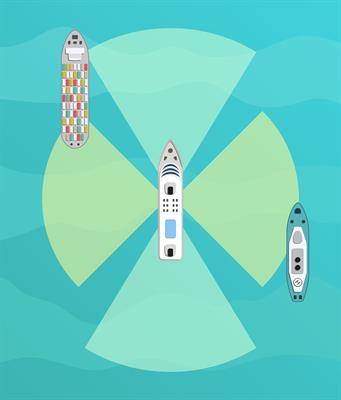
The goal of this Research Topic is to shed light on the state of the art of ASVs and MASS bringing together the two research communities. While some of the issues facing the operation of small research ASVs and large commercial MASS are different, most of the current research tackles the same perception and navigation issues. For instance, remote control from a shore-based center for a large MASS engaged on an intercontinental voyage requires higher communication capabilities and may be more complex than a small-scale deployment for a short-term scientific mission. However, according to the Convention on the International Regulations to Prevent Collisions at Sea (COLREGs), the same intrinsic issues remain such as multi-modal sensing, sensor fusion, situational awareness, obstacle detection and avoidance or navigation.
Recent advances in situational awareness and autonomous decision-making based on sensor fusion and the use of machine learning will be in focus in this Research Topic. Similarly, validation and verification methods to assess COLREGs-compliant navigation by using digital twins and simulation tools are within the topics that need more research attention. These issues (and related ones as below) will be addressed in this Research Topic.
This Research Topic explores themes including, but not limited to:
• Navigation, Guidance and Control for ASVs/MASS
• Obstacle detection and collision avoidance
• Autonomous navigation systems
• Situational awareness for ASVs/MASS
• Multi-modal sensing techniques and sensor fusion
• COLREGs-compliant navigation
• Collision avoidance decision-making
• Perception-based autonomous decision-making
• Modelling and simulation of ASVs/MASS navigation
• Digital twin simulation-based for testing of navigation algorithms
• Validation and verification of AI technologies in safety-critical functions (navigation and perception)
• Techniques and methods to enable safe interactions between conventional and automated ships
• Multi-vehicle systems
Details of the requirements and article types accepted to this Research Topic can be found here: https://www.frontiersin.org/journals/robotics-and-ai#article-types
Keywords: Autonomous surface vehicles, maritime autonomous surface ships, situational awareness, navigation, autonomous decision-making
Important note: All contributions to this Research Topic must be within the scope of the section and journal to which they are submitted, as defined in their mission statements. Frontiers reserves the right to guide an out-of-scope manuscript to a more suitable section or journal at any stage of peer review.