XL
xiaohu li
Xinjiang Astronomical Observatory, Chinese Academy of Sciences
Urumqi, China
2,685
Total downloads
17k
Total views and downloads
Submit your idea
Select the journal/section where you want your idea to be submitted:
Manuscript Submission Deadline 15 April 2026
This Research Topic is currently accepting articles.
Most of the stars in our and other galaxies are low- and intermediate-mass stars (1-8 M☉). Near the end of their active lives, they pass through the asymptotic giant branch (AGB) phase of stellar evolution, during which they lose a significant amount of their initial mass. Mass loss in AGB stars is an important process for the final fates of stars, as well as for the chemical enrichment of the interstellar medium (ISM). Therefore, studying the molecular and solid state species in the circumstellar envelopes of AGB stars is crucial for understanding the enrichment and chemical composition of the ISM. Standard stellar evolutionary models of single AGB stars predict a transition from O-rich to C-rich stars with intermediate stage known as S-type stars. These stars are characterized by the presence of slow neutron capture elements, often referred to as s-process elements, and a ratio of C/O~1. However, in reality, the situation is more complex due to evolution in binary systems. While the presence of binarity is not easy detectable when one of the stars is an AGB giant, it becomes evident in their descendants, such as post-AGB objects, or white dwarfs. Thus, the potential influence of evolution in binary system should be considered.
The study of chemistry in the circumstellar envelopes (CSEs) of evolved stars is made possible mainly by molecular observations in the radio domain using single-dish radio telescopes and interferometers. The advent of high angular resolution mm/sub-mm interferometers, such as the Atacama Large Millimeter/submillimeter Array (ALMA), has made it possible to study the chemical complexity of AGB CSEs, including molecules important in the formation of dust particles, with unparalleled detail. On the other hand, significant advances in understanding the circumstellar chemistry of evolved stars have also been achieved through space-based infrared (Infrared Space Observatory - ISO, Spitzer Space Telescope - SST) and sub-mm (Herschel Space Observatory - HSO) spectroscopic observations. All these efforts have led to the detection of about 100 molecules in the CSEs of evolved stars, including those around massive stars. With the launch of the James Webb Space Telescope (JWST), space-based mid-infrared spectroscopy is again possible with much higher sensitivity and spatial resolution than provided by the previous missions such as ISO or SST.
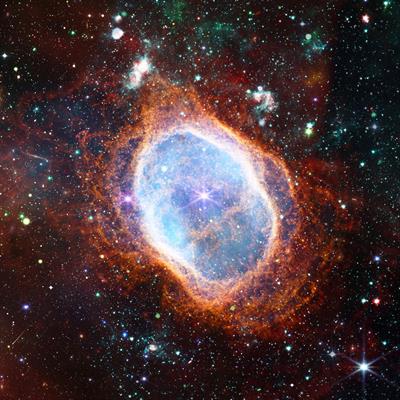
The purpose of this Research Topic is to provide a forum for the presentation of recent advances in the field of chemistry of circumstellar envelopes around low- and intermediate-mass evolved stars (AGB and post-AGB objects), as well as around massive evolved stars (red supergiants, yellow hypergiants), or even in the supernovae remnants that can inspire the planning of CSEs observations with ALMA, JWST, and future instruments and facilities. The Topic welcomes observational and theoretical articles, as well as laboratory results on the chemistry of circumstellar mater.
This Research Topic accepts the following article types, unless otherwise specified in the Research Topic description:
Articles that are accepted for publication by our external editors following rigorous peer review incur a publishing fee charged to Authors, institutions, or funders.
Keywords: evolved stars: asymptotic giant branch (AGB), post-AGB stars, massive evolved stars, circumstellar envelopes (CSEs), dust formation, chemistry of CSEs, molecular spectroscopy
Important note: All contributions to this Research Topic must be within the scope of the section and journal to which they are submitted, as defined in their mission statements. Frontiers reserves the right to guide an out-of-scope manuscript to a more suitable section or journal at any stage of peer review.

Manuscripts can be submitted to this Research Topic via the main journal or any other participating journal.
Submit your idea
Select the journal/section where you want your idea to be submitted: