AF
amirreza fahim golestaneh
Purdue University Fort Wayne
Fort Wayne, United States
183
Total views and downloads
Submit your idea
You will be redirected to our submission process.
Manuscript Summary Submission Deadline 30 June 2026 | Manuscript Submission Deadline 30 September 2026
This Research Topic is currently accepting articles.
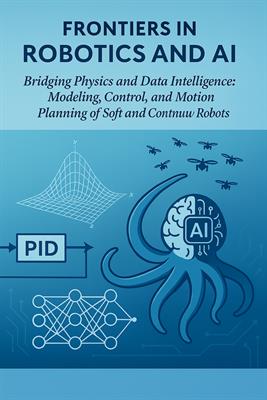
Soft and continuum robots have emerged as transformative systems capable of achieving complex, adaptive, and dexterous behaviors inspired by biological organisms. Their potential for safe human interaction, adaptability to unstructured environments, and multifunctional actuation has fueled rapid developments across diverse fields including medicine, underwater exploration, and autonomous manipulation. However, despite considerable progress in materials and actuation mechanisms, fundamental challenges remain in the modeling, control, and motion planning of these systems.
This Research Topic aims to gather innovative contributions that advance the understanding and capabilities of soft and continuum robotic systems through both analytical and data-driven approaches. We welcome studies that introduce new frameworks for dynamic modeling, simulation, and control—ranging from physics-based formulations grounded in continuum mechanics to learning-based or hybrid methods that integrate artificial intelligence with physical insight. Submissions addressing advanced dynamic modeling, experimental model validation, integration of environment interaction—such as fluid–structure interaction (FSI)—and approaches that improve robustness and adaptability of continuum robot models are encouraged.
Areas of particular interest include:
• Bridging physics-based and data-driven approaches for dynamic modeling and control of continuum robots, including hybrid and physics-informed frameworks.
• Strain-based and Cosserat-inspired dynamic parametrizations combined with learning methods for identification and control.
• Data-driven calibration, identification, and model reduction of continuum robot models, including PCC kinematic models and Cosserat-rod dynamic models.
• Kinematics and control of artificial muscles and soft actuators using model-based control enhanced by learning or adaptation.
• Actuator-integrated dynamic models and digital twins that fuse physics-based simulation with real-time data streams.
• Path and motion planning of continuum robots that exploit both physical models and learned environment representations.
• Passivity-based, Lyapunov-based, and energy-shaping control schemes augmented with adaptive or learning components.
• Hybrid rigid–soft robotic systems where rigid-body and soft-body models are connected through shared data-driven layers.
• Embedded sensing and state estimation that combine physics-based observers with AI or machine-learning techniques.
• Safe or constraint-aware control of compliant systems using model-based guarantees together with online learning under uncertainty.
By providing a platform for diverse theoretical, numerical, and experimental advances, this Research Topic seeks to promote the rapid exchange of emerging ideas in modeling, control, and motion planning of soft and continuum robots. Cross-listing with related journals such as Frontiers in Mechanical Engineering and Frontiers in Bioengineering and Biotechnology is proposed to enhance its multidisciplinary reach.
This Research Topic accepts the following article types, unless otherwise specified in the Research Topic description:
Articles that are accepted for publication by our external editors following rigorous peer review incur a publishing fee charged to Authors, institutions, or funders.
Keywords: Soft robotics, continuum mechanics, dynamic modeling, control, motion planning, artificial intelligence, hybrid modeling, actuation, fluid–structure interaction (FSI), autonomy
Important note: All contributions to this Research Topic must be within the scope of the section and journal to which they are submitted, as defined in their mission statements. Frontiers reserves the right to guide an out-of-scope manuscript to a more suitable section or journal at any stage of peer review.
Purdue University Fort Wayne
Fort Wayne, United States
Interdisciplinary Centre for Security, Reliability and Trust, University of Luxembourg
Luxembourg, Luxembourg
IIHR-Hydroscience and Engineering, University of Iowa
Iowa City, United States
Manuscripts can be submitted to this Research Topic via the main journal or any other participating journal.
Submit your idea
You will be redirected to our submission process.