 Pramil N. Singh1,2*
 Karen Jaceldo-Siegl1
 Wendy Shih2
 Nancy Collado2
 Lap T. Le2Krystal Silguero2Dennys Estevez2
 Michael Jordan3Hector Flores4David E. Hayes-Bautista5
 William J. McCarthy6
- 1Center for Nutrition, Healthy Lifestyles and Disease Prevention, School of Public Health, Loma Linda University, Loma Linda, CA, United States
- 2Center for Health Research, School of Public Health, Loma Linda University, Loma Linda, CA, United States
- 3Center for Hispanic Health, White Memorial Medical Center, Los Angeles, CA, United States
- 4Department of Family Medicine, White Memorial Medical Center, Los Angeles, CA, United States
- 5Center for Study of Latino Health and Culture, David Geffen School of Medicine, University of California at Los Angeles, Los Angeles, CA, United States
- 6Health Policy and Management, School of Public Health, UCLA Jonsson Comprehensive Cancer Center, Los Angeles, CA, United States
A Corrigendum on
Plant-Based Diets Are Associated With Lower Adiposity Levels Among Hispanic/Latino Adults in the Adventist Multi-Ethnic Nutrition (AMEN) Study
by Singh, P. N., Jaceldo-Siegl, K., Shih, W., Collado, N., Le, L. T., Silguero, K., et al. (2019). Front. Nutr. 6:34. doi: 10.3389/fnut.2019.00034
In the original article, there was a mistake in Table 2 as published. The waist circumference results were provided in cm and should in fact be in inches. The corrected Table 2 appears below.
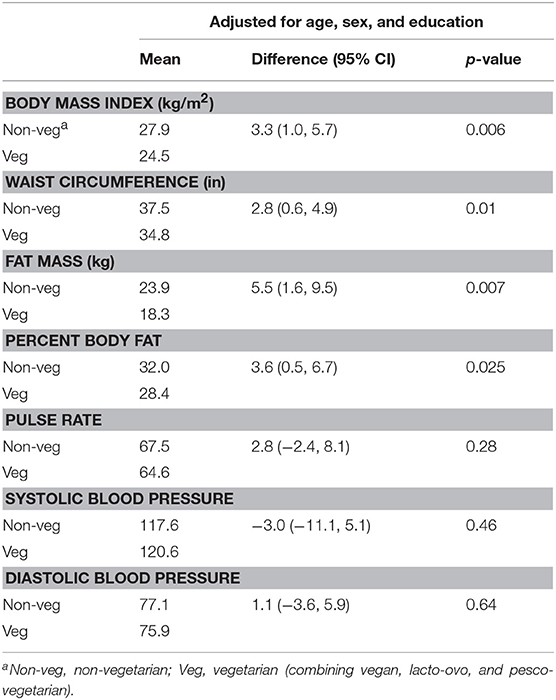
Table 2. Comparison of obesity measures, body composition, pulse, and blood pressure in vegetarians and non-vegetarians in the AMEN Study.
Additionally, throughout the article the waist circumference was listed in centimeters and should in fact be in inches.
Corrections have therefore been made to the following section:
The Abstract, paragraph four:
“Results: Vegetarian diet patterns (Vegan, Lacto-ovo vegetarian, Pesco-vegetarian) were associated with significantly lower BMI (24.5 kg/m2 vs. 27.9 kg/m2, p = 0.006), waist circumference (34.8 in vs. 37.5 in, p = 0.01), and fat mass (18.3 kg vs. 23.9 kg, p = 0.007), as compared to non-vegetarians. Adiposity was positively associated with pro-inflammatory cytokines (Interleukin-6) in this sample, but adjusting for this effect did not alter the associations with vegetarian diet.”
The Results, subsection Vegetarian Diet and Adiposity:
“In linear regression models (Table 2), we tested the association between measures of adiposity (BMI, waist circumference (WC), fat mass, and percent body fat) as outcomes and vegetarian diet status as a main exposure. We found that BMI was lower among the vegetarians than the non-vegetarians (24.5 kg/m2 vs. 27.9 kg/m2, p = 0.006) after adjusting for age, sex, and education. Vegetarians also had significantly lower waist circumference (34.8 in vs. 37.5 in), fat mass (18.3 kg vs. 23.9 kg), and percent body fat (28.4% vs. 32%) as compared to non-vegetarians. Pulse rate, systolic and diastolic blood pressure values among vegetarians were not significantly different from those of non-vegetarians.”
The Discussion, paragraph one:
“In the AMEN study, we found that in a sample of Seventh-day Adventist Hispanic/Latino adults, those following a vegetarian dietary pattern had a BMI that was lower (24.5 kg/m2 vs. 27.9 kg/m2, p = 0.006) and within federally-recommended limits as compared to non-vegetarians. These findings were confirmed by similar decreases in other measures of adiposity [fat mass (18.3 kg vs. 23.9 kg), and percent body fat (28.4% vs. 32%)] and abdominal adiposity [waist circumference (34.8 in vs. 37.5 in)].”
The authors apologize for these errors and state that they do not change the scientific conclusions of the article in any way. The original article has been updated.
Keywords: Hispanic/Latino, plant-based diet, vegetarian, obesity, Seventh-day Adventist
Citation: Singh PN, Jaceldo-Siegl K, Shih W, Collado N, Le LT, Silguero K, Estevez D, Jordan M, Flores H, Hayes-Bautista DE and McCarthy WJ (2019) Corrigendum: Plant-Based Diets Are Associated With Lower Adiposity Levels Among Hispanic/Latino Adults in the Adventist Multi-Ethnic Nutrition (AMEN) Study. Front. Nutr. 6:88. doi: 10.3389/fnut.2019.00088
Received: 15 April 2019; Accepted: 24 May 2019;
Published: 12 June 2019.
Approved by:
Frontiers Editorial Office, Frontiers Media SA, SwitzerlandCopyright © 2019 Singh, Jaceldo-Siegl, Shih, Collado, Le, Silguero, Estevez, Jordan, Flores, Hayes-Bautista and McCarthy. This is an open-access article distributed under the terms of the Creative Commons Attribution License (CC BY). The use, distribution or reproduction in other forums is permitted, provided the original author(s) and the copyright owner(s) are credited and that the original publication in this journal is cited, in accordance with accepted academic practice. No use, distribution or reproduction is permitted which does not comply with these terms.
*Correspondence: Pramil N. Singh, cHNpbmdoQGxsdS5lZHU=