 Ty Beal1,2*
 Flaminia Ortenzi3
- 1Knowledge Leadership, Global Alliance for Improved Nutrition, Washington, DC, United States
- 2Department of Environmental Science and Policy, University of California, Davis, Davis, CA, United States
- 3Knowledge Leadership, Global Alliance for Improved Nutrition, Geneva, Switzerland
A corrigendum on
Priority micronutrient density in foods
by Beal, T., and Ortenzi, F. (2022). Front. Nutr. 9:806566. doi: 10.3389/fnut.2022.806566
In the original article, there was an error in Table 1 as published. The values for iron for adults 25+ and vitamin A for children 2–4, adolescents 10–19, women 15–49, and adults 25+ were incorrect. The corrected Table 1 appears below.
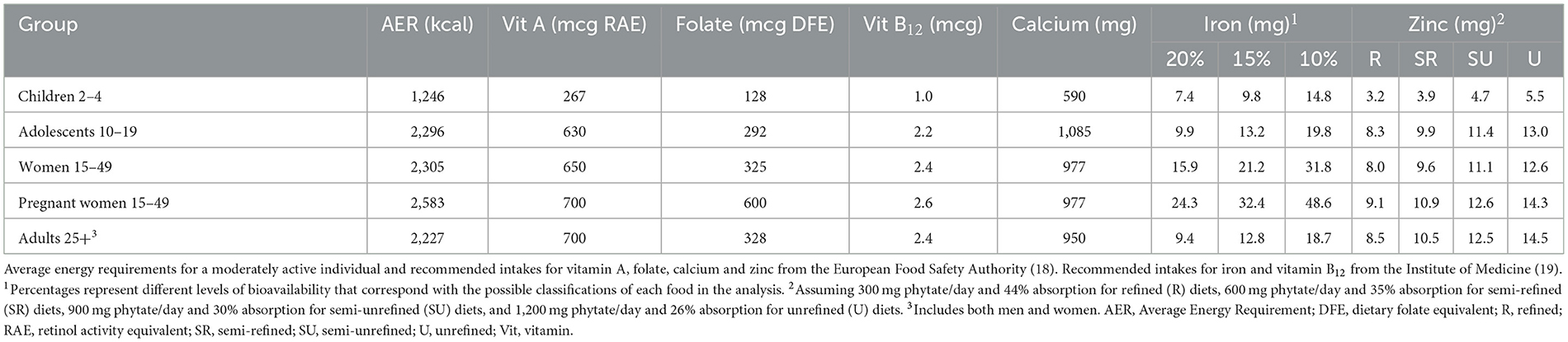
Table 1. Recommended nutrient intakes for select groups.
The authors apologize for this error and state that this does not change the scientific conclusions of the article in any way. The original article has been updated.
Publisher's note
All claims expressed in this article are solely those of the authors and do not necessarily represent those of their affiliated organizations, or those of the publisher, the editors and the reviewers. Any product that may be evaluated in this article, or claim that may be made by its manufacturer, is not guaranteed or endorsed by the publisher.
Keywords: nutrient density, micronutrient deficiencies, animal-source foods, organs, shellfish, fish, dark green leafy vegetables, ruminant meat
Citation: Beal T and Ortenzi F (2023) Corrigendum: Priority micronutrient density in foods. Front. Nutr. 10:1195752. doi: 10.3389/fnut.2023.1195752
Received: 28 March 2023; Accepted: 29 March 2023;
Published: 11 April 2023.
Approved by:
Frontiers Editorial Office, Frontiers Media SA, SwitzerlandCopyright © 2023 Beal and Ortenzi. This is an open-access article distributed under the terms of the Creative Commons Attribution License (CC BY). The use, distribution or reproduction in other forums is permitted, provided the original author(s) and the copyright owner(s) are credited and that the original publication in this journal is cited, in accordance with accepted academic practice. No use, distribution or reproduction is permitted which does not comply with these terms.
*Correspondence: Ty Beal, dGJlYWxAZ2FpbmhlYWx0aC5vcmc=