
Non-biomedical Perspectives on Pain and its Prevention and Management - Volume I

Cover image for Research Topic "Non-biomedical Perspectives on Pain and its Prevention and Management - Volume I"
124kviews
Editorial: Non-biomedical perspectives on pain and its prevention and management
Editorial30 May 2024
Editorial: Non-biomedical perspectives on pain and its prevention and management

Overreliance on the biomedical paradigm has contributed, in part, to overuse of surgery and longterm drug medication with harmful physical, psychological, social, and economic consequences.Research is dominated by a tissue-centric biomedical view of pain at the expense of a holistic firstperson experience of living with pain in communities of people habiting modern-world settings. Pain practice seems overly consumed with the burden of pain at an individual level (patient-centred pain management) and has neglected exploration of societal level (community-centred) or environmental level (ecologically-centred) solutions.This Research Topic acknowledges that the biomedical paradigm does not provide a complete understanding of pain by focussing attention upstream towards the role of the environment in fashioning the experience and impact of pain on health. Research methodologies from nonbiomedical disciplines can explore social, cultural, economic, political, and environmental conditions that influence the living experience of pain in the modern era. Investigating the phenomenon of pain using socio-ecological frameworks provide opportunities to shift perspectives and open-up new avenues for exploration, including innovative strategies to reduce the burden of pain on society.The purpose of this Research Topic is to broaden and deepen the conceptual understanding of pain in the modern era by showcasing contributions from non-biomedical disciplines. This includes exploration of the concept of painogenic lifestyles and environments, and non-medical strategies targeting living well with, and recovery from, pain at individual, community, or population levels.Our desire is to catalyse scholarly conversation about the interplay between individuals, society, and ecosystems to gain a better understanding of the phenomenon of pain and to inform future healthcare research, practice, and policy.The Research Topic is deliberately broad in scope to encourage cross-fertilisation of scholarly disciplines from the humanities and the sciences, e.g., social, natural, formal, and applied. We encouraged articles that offered novel perspectives and invited contributions from Anthropology, Behavioural sciences, Ecology, Evolution, Health promotion, History, Politics, Philosophy, Sociology, Socio-economics, Spirituality, the Arts, and Theology. We accepted seventeen articles, both theoretical and empirical, that cover topics not normally visible in conventional pain science literature including the ecology, language, salutogenesis, art, emotional memory, and temporality.Contributions offer viewpoints that curiously and critically explore biomedical dogma to provide a 1404074_Manuscript_REVISED_CLEAN-29-04-2024 broader and deeper understanding of pain and its persistence within the complex socio-ecological milieu of modern life.

A socio-ecological model for pain Many of the perspectives offered by the contributions are encapsulated in a socio-ecological model of pain presented in the article by Johnson and Woodall and reproduced here in Figure 1. the dominant biomedical narrative of modern living may be preventing people from connecting with a sense of self and their social world.

The contribution by van Rysewyk offers perspective on the role of language about pain, motivated by the 20th century Austrian philosopher Wittgenstein (3). Van Rysewyk reveals how the use of the word 'pain' is "…linked to participation in a social milieu where specific rules are learnt for the regulation of concepts" and that "pain is not merely a 'raw feel'…" ut rather a social construct which is learnt and refined throughout life. Consequently, disagreements between health care professionals about the nature (diagnosis) of a person's pain should be recognized as the 'indefiniteness' of pain.

Various contributions explore pain through a salutogenic lens. Salutogenesis is a whole-person approach to grow health, grounded in a person's unique life story and current situation, encompassing physical, mental, social, and spiritual aspects that are meaningful to the individual (7-9). Johnson and Woodall suggest that healthy settings approaches based on the principles of salutogenesis are likely to alleviate painogenicity and the stickiness of pain. Paley and Johnson offer perspective on salutogenic approaches and how mindfulness interventions can be integrated into daily living to improve a person's comprehension, meaningfulness, and managea ility of living well in the modern world, i.e., a sense of coherence. Georgiadis and Johnson position positive psychology within a whole-person salutogenic approach to care, and they discuss how incorporation of personal narration could foster an agentic form of positive psychology, conferring synergistic benefits. This was the purpose of Unmasking Pain, an artist-led project that explored creative approaches to telling stories of life with pain, discussed in the contribution by Johnson et al. People living with persistent pain descri ed nmasking Pain as "a new set of rules", providing opportunities for "explorative oy despite pain". This contrasts with clinical encounters and reveals the potential of art to facilitate expression of complex inner experiences and personal stories to help people make-sense of themselves, shifting them from "I can't do, I am not willing to do it", to "Perhaps I can, I'll give it a go, I en oyed". Engagement with Unmasking Pain also freed-up thinking for pain specialists allowing conceptual thought beyond the biopsychosocial model of pain.

A critical aspect of Johnson and Woodall's model of pain is that socio-ecological events affect the structure and function of cells, tissue, organs, and systems, i.e., bioplasticity -the ability of bodily structures and processes to adapt (10), including neuroplasticity that reshapes connectivity associated with learning and memory. Several contributions from Hudson and Johnson explore pain and its stickiness from the perspective of non-conscious emotional memory images (EMIs). Hudson and Johnson introduce the notion of EMIs as "Trauma induced, non-conscious, contiguously formed 1404074_Manuscript_REVISED_CLEAN-29-04-2024 multimodal mental imagery, which triggers an amnesic, anachronistic, stress response within a splitsecond." (4) p.1. They contend that encounters in daily living re-trigger EMIs which in turn activate the hypothalamic-pituitary-adrenal (HPA) axis amplifying neural input that may contribute to a debilitating state of psychophysiological dis-ease associated with threat, fear, anxiety, and intractable pain (q.v. (11,12)). Hudson and Johnson suggest that activities of daily living trigger EMIs and 'outdated' stress responses, placing the person in a perpetual state of 'alarm', and they offer some case vignettes to demonstrate how a therapeutic approach, which they call Split-Second nlearning, may 'clear' EMIs to 'un lock' the 'stickiness' of pain. Hudson and Johnson extend their exploration of EMIs in a contribution that draws upon clinical cases and existing literature to explore how a dysfunctional paternalistic family system, often characterised by authoritarian dynamics, emotional neglect, and abuse, is a fertile ground for the creation of emotional memory images, potentially making pain sticky. The findings provide evidence that more consideration should be given to spatiotemporality as an organizing principle in the management and conceptualisation of persistent pain.

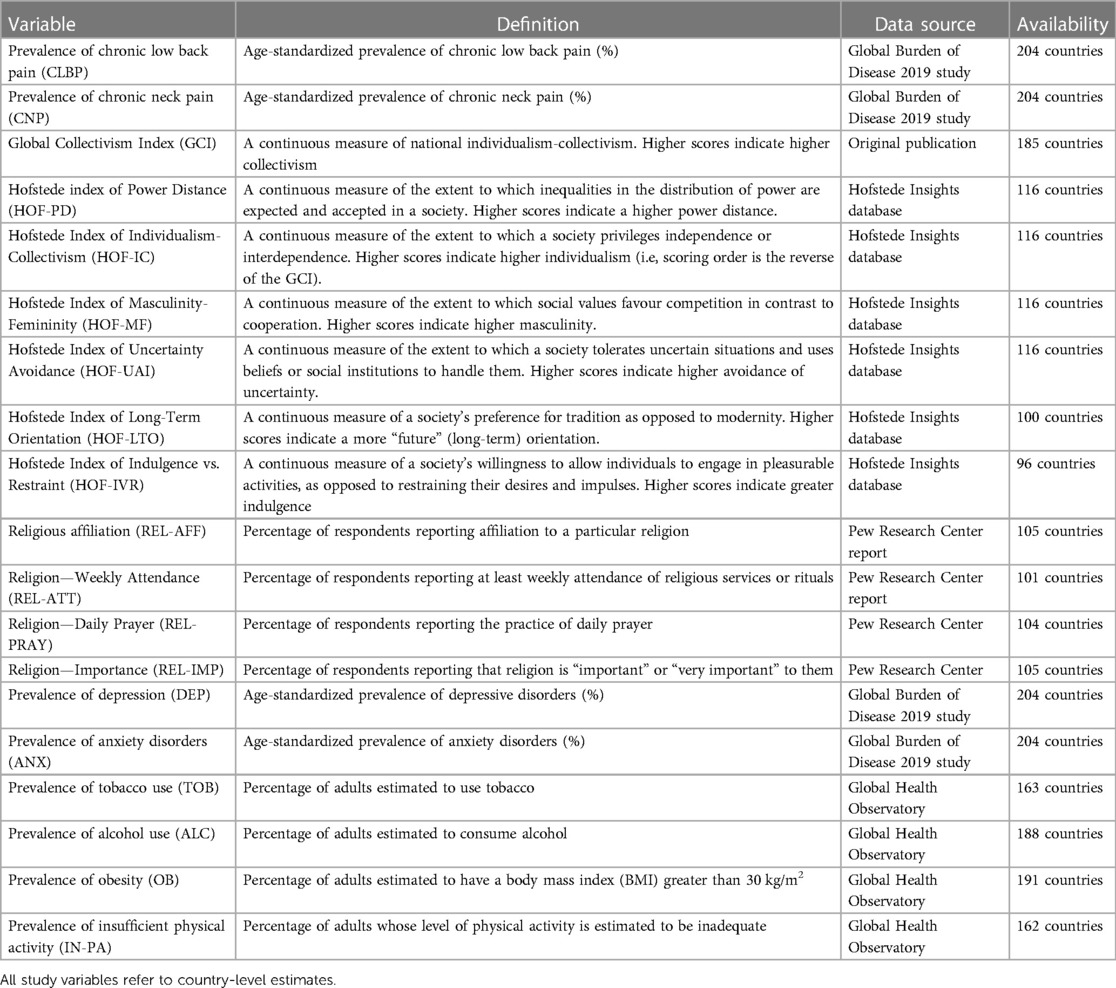
Various contributions advocate the need for greater focus on psychosocial perspectives to support people living with pain. An analysis of data from the 2019 Global Burden of Disease study (13) by Rajkumar provides evidence of the importance of cross-cultural variations in the occurrence of common forms of chronic musculoskeletal pain. Rajkumar reports that the prevalence of chronic neck pain was inversely correlated with Uncertainty Avoidance and the prevalence of chronic low back pain was inversely correlated with the cultural dimensions of Power Distance and Collectivism.Moretti et al. provide evidence that medical curricula of highly ranked universities worldwide are 1404074_Manuscript_REVISED_CLEAN-29-04-2024 biophysically-focused at the expense of the needs and expectations of patients. Moretti et al.contend that the role of men in biomedical science has been negatively impacting the delivery of high-quality and personalized medical care to women and they offer an innovative education intervention to limit the effects of gender bias on future medical practitioners.Li and Hapidou report a multidimensional analysis of variables affecting outcome to psychosocial treatments that revealed two groupings (i) anxiety, depression, catastrophizing, somatic symptoms, pain intensity and pre-contemplation, and (ii) contemplation, action, maintenance, activity engagement and pain willingness; these groupings resonate with

Contributions in this Research Topic confirm the value of broadening the lens through which the persistence (stickiness) of pain is studied. The contributions weave together a variety of perspectives that situate pain at the intersect of tissue and environment to reveal avenues of exploration aligned with pain experience. In doing so, the contributions transcend the orthodox tissue-centric biopsychosocial way of thinking to reveal opportunities for scholarship, research, clinical practice, and society that go beyond mainstream pain science. Contributions in this Research Topic demonstrate the power of non-biomedical perspectives to inform whole-person centred approaches, such as contemplative practices and the performing arts, to enable people to curiously explore the relationship between their pain and their living experience. Shifting the focus from pain perception to pain perspective opens a vista of interconnectedness between body, mind, 'spirit', community, and environment; and the realisation of greater need for community-based pain support services. We hope that this eBook inspires pain scholars, researchers, and health care practitioners to investigate more thoroughly the complex milieu in which individuals, communities, and populations experience pain, to develop an ecology of pain grounded in a more constructive and meaningful societal narrative.1404074_Manuscript_REVISED_CLEAN-29-04-2024

2,437 views

2 citations

Metaphorical language is used to convey one thing as representative or symbolic of something else. Metaphor is used in figurative language but is much more than a means of delivering ‘poetic imagination’. A metaphor is a conceptual tool for categorising, organizing, thinking about, and ultimately shaping reality. Thus, metaphor underpins the way humans think. Our viewpoint is that metaphorical thought and communication contribute to ‘painogenicity’, the tendency of socio-ecological environments (settings) to promote the persistence of pain. In this perspectives article, we explore the insidious nature of metaphor used in pain language and conceptual models of pain. We explain how metaphor shapes mental organisation to govern the way humans perceive, navigate and gain insight into the nature of the world, i.e., creating experience. We explain how people use metaphors to ‘project’ their private sensations, feelings, and thoughts onto objects and events in the external world. This helps people to understand their pain and promotes sharing of pain experience with others, including health care professionals. We explore the insidious nature of ‘warmongering’ and damage-based metaphors in daily parlance and demonstrate how this is detrimental to health and wellbeing. We explore how metaphors shape the development and communication of complex, abstract ideas, theories, and models and how scientific understanding of pain is metaphorical in nature. We argue that overly simplistic neuro-mechanistic metaphors of pain contribute to fallacies and misnomers and an unhealthy focus on biomedical research, in the hope of developing medical interventions that ‘prevent pain transmission [sic]’. We advocate reconfiguring pain language towards constructive metaphors that foster a salutogenic view of pain, focusing on health and well-being. We advocate reconfiguring metaphors to align with contemporary pain science, to encourage acceptance of non-medicalised strategies to aid health and well-being. We explore the role of enactive metaphors to facilitate reconfiguration. We conclude that being cognisant of the pervasive nature of metaphors will assist progress toward a more coherent conceptual understanding of pain and the use of healthier pain language. We hope our article catalyses debate and reflection.

12,712 views

33 citations

This article contributes a perspective on pain motivated by the philosopher Ludwig Wittgenstein.According to Wittgenstein, the child learns from others that the occasions on which it manifests certain reactions-the reactions that we manifest when injured-make it appropriate to self-ascribe 'pain'. When the child can signal correctly that she is in the requisite bodily state, then she has a conception of pain. Using the concept pain to symbolise an experience makes it possible to tell other people what is going on and to solicit their help in managing the pain. In pain discourse, we can say "Sam can tell that Jason is with pain", or "She could tell you that Jason is with pain if she wanted to". These uses are linked to social milieu where rules are learnt for the application of concepts, such as the concept stoicism. In rural communities, adults tell other adults about pain when it interrupts work or social activities. The rural stoic who tells another about pain only if he wants to can complicate clinical pain management, which can undermine the patient's special authority. In contrast, convergence in pain definitions and judgements between the patient and health professional can protect the authority of the patient and improve the clinical interaction. Pain is not simply a quale that is privately perceived; it must be capable of being expressed. Thus, pain has a social role, which is learnt. The study of linguistic rules in pain discourse could help explain the learning and application of the concept pain.

3,293 views

1 citations

Gender and sex bias in prevention and clinical treatment of women’s chronic pain: hypotheses of a curriculum development
This manuscript focuses on the role that undergraduate medical education may play in tackling gender bias in medical practice with reference to preventing and managing chronic pain in women in a non-biomedical perspective. The paper proposes an innovative curriculum development approach to be implemented throughout all years of study in medical programs. This novel strategy could be used to cross-contaminate all other healthcare practitioners’ university programs and to stimulate an interprofessional debate aiming at fostering inclusiveness and equality of opportunities in medicine and allied health sciences.

33,146 views

28 citations

Multiple influences prevent recovery from pain. Our viewpoint is that non-conscious emotional mental imagery (EMI) triggers outdated stress responses contributing to the intractability of pain. In this perspectives article we explore the concept that EMIs contribute to the persistence of pain. We contend that psychophysiological ‘stress’ responses resulting from first-time, novel and unprecedented pernicious or adverse events form EMIs within very short time frames (split-second learning). Subsequently, these EMIs are re-triggered in daily living ‘re-playing’ stress responses. We postulate that EMIs continually ‘raise the alarm’ to socio-ecological stimuli by re-triggering the HPA-axis and amplifying neural input associated with threat, fear, anxiety, and pain, creating a debilitating state of psychophysiological dis-ease. We position the EMI within a philosophical debate on the nature and locus of memory and explain how the EMI, irrespective of whether it is a ‘thing’ or a metaphor, can create a basis for understanding for the client to grasp. We describe a therapeutic approach (Split-Second Unlearning) to ‘clear’ EMIs and the ‘stickiness’ of pain and help people embark on a healing journey. This involves surveillance of clients for micro-expression(s) signifying in-the-moment stress response, representative of the presence of an EMI, and encouraging the client to become a curious observer within/of their own experience. This helps the client detach their EMI from its stress response. We contend that this occurs rapidly without the need to get bogged down in a whole-life narrative. We advocate further exploration of our EMI model of dis-ease in the context of intractable pain.

4,298 views

7 citations

Low back pain and neck pain are among the most commonly reported forms of chronic pain worldwide, and are associated with significant distress, disability and impairment in quality of life. Though these categories of pain can be analyzed and treated from a biomedical perspective, there is evidence that they are both related to psychological variables such as depression and anxiety. The experience of pain can be significantly influenced by cultural values. For example, cultural beliefs and attitudes can influence the meaning attached to the experience of pain, the responses of others to a sufferer’s pain, and the likelihood of seeking medical care for particular symptoms. Likewise, religious beliefs and practices can influence the both experience of pain and the responses to it. These factors have also been associated with variations in the severity of depression and anxiety. In the current study, data on the estimated national prevalence of both low back pain and neck pain, obtained from the 2019 Global Burden of Disease Study (GBD 2019), is analyzed in relation to cross-national variations in cultural values, as measured using Hofstede’s model (n = 115 countries) and in religious belief and practice, based on the most recent Pew Research Center survey (n = 105 countries). To address possible confounding factors, these analyses were adjusted for variables known to be associated with chronic low back or neck pain, namely smoking, alcohol use, obesity, anxiety, depression and insufficient physical activity. It was found that the cultural dimensions of Power Distance and Collectivism were inversely correlated with the prevalence of chronic low back pain, and Uncertainty Avoidance was inversely correlated with the prevalence of chronic neck pain, even after adjustment for potential confounders. Measures of religious affiliation and practice were negatively correlated with the prevalence of both conditions, but these associations were not significant after adjusting for cultural values and confounders. These results highlight the existence of meaningful cross-cultural variations in the occurrence of common forms of chronic musculoskeletal pain. Psychosocial factors that could account for these variations are reviewed, along with their implications for the holistic management of patients with these disorders.

8,772 views

25 citations

PERSPECTIVE
30 May 2023
Pain through the perspective of art and creativity: insights from the Unmasking Pain project
Mark I. Johnson, 10 more and James Woodall
People struggle to tell their story of living with pain and when they do it is articulated in a way that may not be understood, heard or taken seriously. Unmasking Pain is an artist-led project that explored creative approaches to tell stories of life with pain. The project was led by a dance theatre company that specialises in storytelling and emotional experiences for players and audiences. The project involved artists and people living with ongoing pain co-creating activities and environments to curiously explore ‘oneself’, through imagination and creative expression. This article discusses insights and perspectives emerging from the project. The project revealed the power of art to make-sense of oneself with or without pain, and how art facilitates expression of complex inner experience and personal stories. People described Unmasking Pain as ‘explorative joy despite pain’, and ‘a new set of rules’ that contrasts with those experienced during clinical encounters. We discuss how art has the potential to improve clinical encounters and promote health and well-being, and whether artist-led activities are an intervention, therapy, or something else. Pain rehabilitation specialists from the project described Unmasking Pain as ‘freeing-up thinking’, allowing conceptual thought beyond the biopsychosocial model of pain. We conclude that art has the potential to shift people living with pain from ‘I can’t do, I am not willing to do it’ to ‘Perhaps I can, I’ll give it a go, I enjoyed’.

9,461 views

18 citations

PERSPECTIVE
21 October 2022
The Analgesic Museum
Ian J. Koebner, 2 more and Manon Parry
This manuscript uses the perspectives and insights that emerged from the Analgesic Museum conference held virtually on March 11, 2022 as a mechanism for considering the role museums and artists can play in the public health effort to reduce the burden of persistent pain. One hundred and fifty-seven individuals from 22 countries registered for the Analgesic Museum conference. The event explored the intersection of art and pain management practices with presentations centered on three domains of interest: exhibition development, arts experiences and practices, and research and creative scholarship.

3,046 views