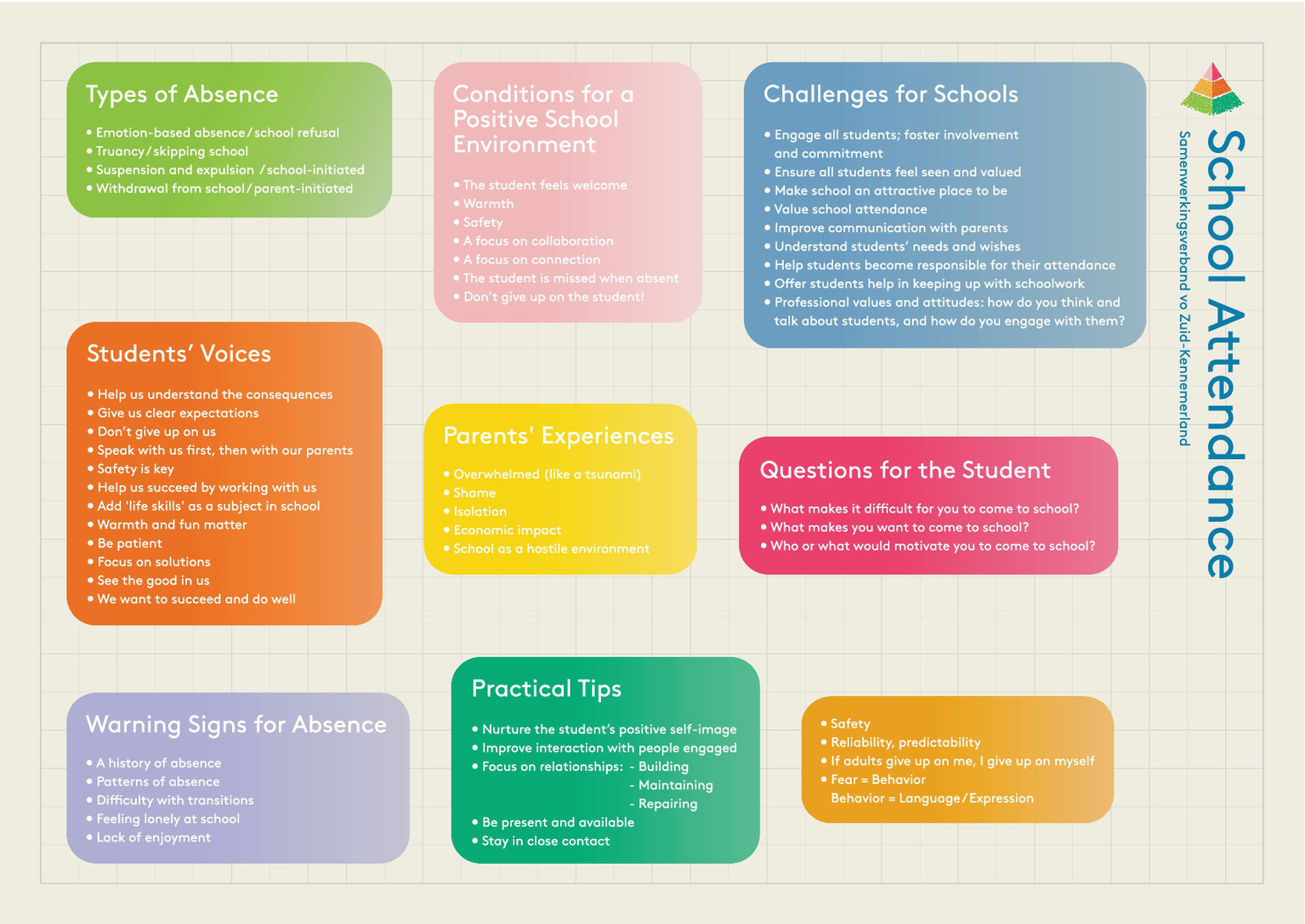
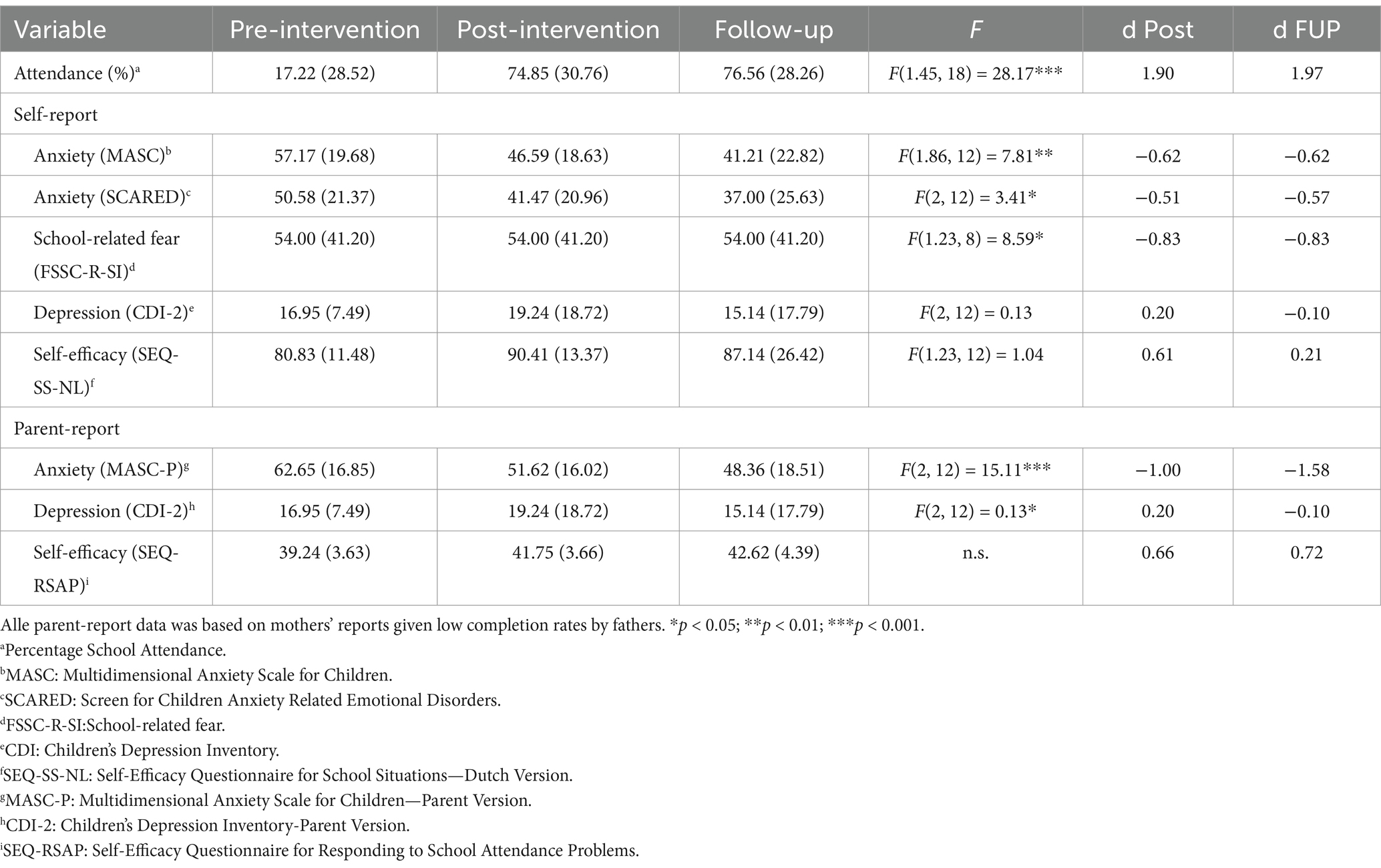
This Research Topic aims to disseminate novel research and emerging theoretical frameworks that advance our understanding of the complex drivers of EBSA and inform practical, evidence-based responses and interventions. In addition, it explores how EBSA relates to other forms of SAPs, identifying overlaps and distinctions, and their implications for prevention and intervention efforts.Across contributions, a consistent message emerges: EBSA and SAPs are driven by multiple interacting factors rather than a single, distinct cause. They are shaped by multi-level, dynamic processes in which attendance emerges from interacting influences across individual, relational, institutional, societal, and temporal levels. Therefore, bioecological frameworks are particularly relevant, as they conceptualise development as the product of ongoing interactions between individuals and the systems in which they are embedded (Gubbels et al., 2019).While the papers in this special issue address influences across multiple system levels, the largest number focus on individual-level factors, particularly emotional distress and cognitivemotivational processes. Multiple studies identify internalising symptoms, particularly anxiety and depression, as primary drivers. Using network analysis, Alanko et al. (2025) demonstrate that depression and social anxiety occupy central positions within symptom and function networks of SAPs. Krause et al. (2025) present longitudinal evidence from Canada showing a bidirectional relationship between mental health difficulties and poor attendance, while trajectory modelling by Brittain and Vaillancourt (2026) indicates that mental health and attendance are "co-developing intertwined trajectories." Several studies highlight the role of internal psychological mechanisms. Perez-Marco et al. (2025) show that learned helplessness -a pattern in which students believe they cannot succeed academically -has strong predictive and discriminative value in identifying students at high risk of SAPs. Similarly, Sorrenti et al. (2025) show an association between students' lower awareness and acceptance of present thoughts, feelings, and social experiences (mindfulness) and increased peer and emotional difficulties, which contribute to school refusal. Sasso (2025) reports that for autistic students, absenteeism often functions as their coping response to sensory overload, exhaustion and social interaction.Research focusing on microsystem-level factors emphasises the role of relationships. Trusting relationships are identified as key factors supporting regular attendance. Ekornes et al. (2025) highlight that teachers identify students of concern by assessing deviations from the individual child's 'typical' functioning rather than relying solely on general age norms, emphasizing the value of close teacher-student knowledge. Hamadi et al. (2025) highlight how difficulties in the student-teacher relationship and delayed or mismatched professional responses can drive feelings of alienation and SAPs. Parent-focused studies by Hansen et al. (2025) and Knollmann and Reissner (2025) underscore the importance of respectful relationships between parents and professionals; interventions succeed when parents feel empowered and are included in decision-making.Furthermore, a systematic review by Alaimo and Kelly (2025) underscores that school staff's conceptualisation of non-attendance varies widely, distinguishing among 'within-child', 'home', and 'school-related' factors that directly shape the support strategies they employ. Enderle et al. (2025) demonstrate that while professionals often focus on procedures, students prioritise emotional safety and being understood. Practice-focused studies demonstrate how relational approaches support attendance. Alaimo and Kelly (2025) demonstrate how participatory, school-owned relational models support attendance, while Karel et al. (2025) reports that outcomes of the @School intervention, a modular, developmentally sensitive Cognitive Behavioral Therapy (CBT) program designed to support neurodiverse adolescents with emotion-related school attendance challenges, improve when families and schools collaborate around shared attendance goals. Bania et al.'s (2025) evaluation of the pilot of Back2School intervention, also a modular CBT that draws on core components from the @School program, developed to address a broader range of problematic school absenteeism, indicates that indicates that teachers are vital partners, and their involvement needs to be clearly defined.At the exosystem level, research highlights the role of school-level structures. Heyne et al. (2025) draw attention to the often-overlooked category of authorised absence. Their action research in the Netherlands reveals that schools exert significant influence over authorised leave, suggesting that addressing school-initiated absences is critical.School belonging emerges as a key protective factor in multiple studies, including Whitley et al. (2026), and trajectory research by Brittain and Vaillancourt (2026), while transition points are consistently identified as risk accelerators. Whitley and colleagues (2026) further identified unmet support needs and school-initiated exclusion as systemic factors that undermine inclusive education. Transition points, particularly entry into secondary school, are consistently identified as risk accelerators in longitudinal modelling. Systematic review evidence from Middleton et al. (2026) shows mixed but promising effects of school-based interventions, including mentoring, counselling, family-linked approaches, and school-health integrated approaches. Neumann et al. (2025) address the critical gap between clinical care and education by presenting the protocol for 'SchuTIng-stAR', a seamless stepwise rehabilitation program designed to support sustainable reintegration following psychiatric inpatient treatment.At the macrosystem level, the special issue underscores that SAPs are fundamentally equity issues. Whitley et al. (2026) document disproportionately high levels of absence among students with disabilities and those from lower-income households. Complementing this, Chen (2026) uses computational text analysis to demonstrate how national and societal expectations regarding academic performance in China shape attitudes, pressures, and institutional practices that influence EBSA. Comparative contributions across Europe, North America and Asia further illustrate how policy frameworks shape attendance responses. A key conceptual contribution by Kearney (2025) reframes chronic absenteeism as a public health issue, calling for cross-sector responses.Studies framed within the chronosystem highlight that SAPs are developmental outcomes that are progressive and cumulative. Hamadi et al. describe a gradual onset of SAPs rather than a sudden withdrawal. Developmental trajectory work by Brittain and Vaillancourt (2026) further shows co-evolving patterns of attendance and academic achievement, with school transitions as periods of elevated risk. In addition, Krause et al.'s (2025) analyses of longitudinal data during the COVID-19 pandemic highlight shifting patterns of absence.The articles in this special issue demonstrate that SAPs and EBSR are complex, developmentally embedded phenomena. Effective responses cannot be achieved through isolated or child-focused interventions alone. The findings point to the need for integrated, multi-tiered approaches that align supports across education, mental health, and social care systems (Graczyk & Kearney, 2024;Kearney & Graczyk, 2022). Schools play a pivotal dual role as sites of both risk and protection and therefore require sustained support to implement equitable, preventative, and data-informed attendance practices. Collectively, the contributions in this Research Topic call for a paradigm shift in understanding emotionally based school avoidance. Future progress depends on cross-sector collaboration, early and developmentally informed prevention, and policies that enable flexible and inclusive school responses.


5 Authors
- EV
Elisabeth Valmyr Bania
The Regional Centre for Child and Youth Mental Health and Child Welfare – Central Norway, RKBU Midt-Norge, Norwegian University of Science and Technology (NTNU), Norway
- TS
Toril Sørheim Nilsen
Institute of Psychology, The Arctic University of Norway, Norway
- MT
Mikael Thastum
Department of Psychology and Behavioral Sciences, Aarhus University, Denmark
- JM
Jo Magne Ingul
The Regional Centre for Child and Youth Mental Health and Child Welfare – Central Norway, RKBU Midt-Norge, Norwegian University of Science and Technology (NTNU), Norway
- TH
Trude Havik
Norwegian Centre for Learning Environment and Behavioural Research, University of Stavanger, Norway
4,508 views
2 citations
6 Authors
- SE
Stine Ekornes
Regional Centre for Child and Youth Mental Health and Child Welfare, Norwegian University of Science and Technology, Norway
- SH
Solveig Holen
Center for Child and Adolescent Mental Health, Eastern and Southern Norway, Norway
- JM
Jo Magne Ingul
Regional Centre for Child and Youth Mental Health and Child Welfare, Norwegian University of Science and Technology, Norway
- SN
Simon-Peter Neumer
Center for Child and Adolescent Mental Health, Eastern and Southern Norway, Norway
- FA
Frode Adolfsen
Regional Centre for Child and Youth Mental Health and Child Welfare North, Faculty of Health Sciences, UiT The Arctic University of Norway, Norway
- EV
Elisabeth Valmyr Bania
Regional Centre for Child and Youth Mental Health and Child Welfare, Norwegian University of Science and Technology, Norway
2,877 views
1,451 views

5,078 views
4 citations