Abstract
Here, we have developed a novel, simple, efficient, and green protocol for one-pot synthesis of pyrano[2,3-c]pyrazole using arylidene malononitrile and pyrazolone in Water Extract of Banana Peels (WEB) as a reaction medium at room temperature (r.t.). This is a green and general synthetic protocol without utilization of any toxic organic solvent, ligand, base that could be applicable for the wide substrate scope in good to excellent yields. This protocol has various advantages such as fast reactions, eco-friendly reaction conditions, easy isolation of the product without using column chromatography. The green chemistry matrices calculation like atom economy reaction, environmental factor, as well as process mass intensity indicates the eco-friendly nature of the protocol.
Introduction
The development of a reaction under green and mild condition by employing naturally available waste material is highly advantageous in organic synthesis (Marvaniya et al., 2011; Parmar et al., 2013; Maleki and Ashrafi, 2014). From the green chemistry point of view, the designing of a novel, efficient and clean reaction protocol is done by using a catalyst which is easy to separate, reusable and inexpensive. The synthesis of pharmaceutical product and fine chemicals via green chemistry approach has recently gained significant interest from academia and industry (Bazgir et al., 2013; Naeimi et al., 2014; Dalal et al., 2016; Dwivedi et al., 2018a,b, 2019). However, most of the organic synthesis uses catalysts which are expensive and toxic in nature. Therefore, choice of catalyst for green reaction is limited and has become a matter of concern for researchers nowadays (Kumarswamyreddy and Kesavan, 2016; Maddila et al., 2016b; Sebenzile et al., 2016; Zhang et al., 2017; Reddy et al., 2018). On the other hand, the use of renewable feedstock in organic transformations provides not only environmentally benign protocol but is also easily available in bulk (Saikia and Borah, 2015). The use of nature-derived reaction medium in organic synthesis successfully replaced toxic solvents, reagents, and expensive catalysts. Importantly, these methods are very efficient, suitable and generates negligible hazardous by-products (Saikia and Borah, 2015; Reddy et al., 2018). There are several naturally available plant based waste materials such as banana plants (trunk, rhizome, and peel) which have no use after collecting the banana fruits (Deka and Talukdar, 2007; Neog and Deka, 2013; Leitemberger et al., 2019). Finding a new method to use these type of waste material in organic transformation is worthful. Several organic transformations have been reported using WEB as reaction medium and catalyst such as synthesis of 3-carboxycoumarins (Bagul et al., 2017), Suzuki–Miyaura cross-coupling reactions (Boruah et al., 2015), The Henry reaction (Surneni et al., 2016) using WEB etc.
The pyranopyrazoles (Figure 1) is an important heterocyclic compound containing five-membered pyrazole ring fused with a six-membered pyran ring that occupies an important and wide area in medicinal chemistry (Maddila et al., 2017). Among other isomer the pyrano[2,3-c]pyrazole shows various biological activity including anti-bacterial (Das et al., 2014), anti-HIV (Fadda et al., 2013; Sirous et al., 2019), insecticidal, anti-tumors (Mariappan et al., 2010), antifungal, anti-cancer (Lalit et al., 2012) anti-inflammatory (Hamama et al., 2012), and analgesic (Mandour et al., 2012; Kasiotis et al., 2014). Owing to the biological importance, several methods for the synthesis of pyrano[2,3-c]pyrazole have been reported using different reaction condition like in EtOH (Junek and Aigner, 1973), piperidine (Vasuki and Kumaravel, 2008), morpholine (Sharanina et al., 1982), Et3N (Tacconi et al., 1980), L-Proline (Guo et al., 2007), neat (solvent free) (Nagarajan and Reddy, 2009), glycine (Reddy et al., 2010), nano-sized magnesium oxide (Babaie and Sheibani, 2011; Gangu et al., 2017), cupreine (Gogoi and Zhao, 2009), per-6-amino-β-cyclodextrin (per-6-ABCD catalyst) (Kanagaraj and Pitchumani, 2010). However, these methods have certain limitations viz. use of harsh reaction conditions, low yields, longer reaction time, tedious workup procedures, use of volatile and toxic organic solvent that negatively impact human health and the environment. Therefore, development of simple, clean, efficient, and high yielding protocol using natural waste materials and their extracts for the synthesis of pyrano[2,3-c]pyrazoles is highly desirable (Maddila et al., 2016a; Mamaghani and Hossein Nia, 2019; Shi et al., 2019). Therefore, here we describe an efficient ligand-free one-pot green methodology for the synthesis of pyranopyrazoles by the reaction of arylidene malononitrile and pyrazolone in WEB.
Figure 1
Experimental Section
General Experimental Detail
All commercially available chemicals were used without further purification. 1H NMR spectra were obtained on Bruker 500 MHz FT-NMR spectrometer. 13C NMR spectra were recorded at 125 MHz Chemical shifts are reported relative to the TMS signal. Multiplicity is indicated as follows: s (singlet); bs (broad singlet); d (doublet); t (triplet); q (quartet); m (multiplet); dd (doublet of doublets), etc. TOF and quadrupole mass analyzer types are used for the HRMS. FT-IR spectrometer (Shimadzu) in the range of 400–4,000 cm−1.
General Procedure for the Synthesis of pyrano[2,3-c]pyrazole, 3(a-r)
To a solution of arylidene malononitrile (1 mmol) and WEB (3 ml/mmol), 3-methyl-5-pyrazolone (1 mmol) was added and the mixture was stirred for the indicated time (Table 1) at room temperature. The progresses of reaction was monitored by TLC (thin layer chromatography); however, the same can be inferred by disappearance of color and white precipitate formation. After completion of the reaction, as indicated by the TLC, the reaction mixture was filtered by using Whatman filter paper No 1 and washed with cold water. The obtained crude solid was then dissolved in ethyl acetate and passed through celite bed to remove any particulate impurities. The solvent was evaporated under reduced pressure and the obtained solid product was recrystallized by using methanol to give analytically pure 6-amino-3-methyl-4-phenyl-2,4-dihydro-pyrano[2,3-c]pyrazole-5-carbonitrile products (3a-3q) (Data shown in Supplementary Material).
Table 1
| Entry | Solvent | T°C | Time (min)b | Yield (%)c |
|---|---|---|---|---|
| 1 | MeOH | r.t. | 300 | 5% |
| 2 | EtOH | r.t. | 300 | 5% |
| 3 | MeOH+ WEB(1:1) | r.t. | 240 | 20 |
| 4 | EtOH + WEB (1:1) | r.t. | 120 | 25 |
| 5 | MeOH +WEB(2:8) | r.t. | 120 | 55 |
| 6 | EtOH + WEB (2:8) | r.t. | 120 | 60 |
| 7 | DCM + WEB (1:1) | r.t. | 240 | 25 |
| 8 | DCM + WEB (2:8) | r.t. | 120 | 40 |
| 9 | WEB | r.t. | 30 | 96 |
Optimization of reaction condition for the synthesis of pyrano[2,3-c]pyrazolea.
Reaction condition: All reactions were carried out on 1 mmol scale using equimolar amount of starting materials in WEB.
Time for overall reaction.
Isolated yield.
Spectral Data for Selected Compounds of pyrano[2,3-c]pyrazole (3a, 3d, 3l, 3o)
6-amino-3-methyl-4-phenyl-2,4-dihydropyrano[2,3-c]pyrazole-5-carbonitrile, 3a: 89% yield, white solid. Rf = 0.45 (80% EtOAc/Hexane). M.P. 195–197°C IR (KBr) υmax (cm−1) 3363, 3083, 2912, 1627, 1599, 1481, 1354, 1300, 1220, 1182, 1066, 867, 833, 761, 612; 1H NMR (500 MHz, CDCl3+DMSO-d6) δ 8.16 (s, 1H), 7.30 (t, J = 7.3 Hz, 2H), 7.21 (t, J = 6.3 Hz, 1H), 7.18 (t, J = 6.9 Hz, 2H), 6.71 (s, 2H), 4.55 (s, 1H), 1.80 (s, 3H). 13C NMR (125 MHz, CDCl3+DMSO-d6) δ 158.96, 152.91, 142.47, 133.59, 126.42, 125.56, 124.73, 118.88, 95.63, 55.40, 34.50, 7.87. HRMS (ESI+): m/z calculated for [C14H12N4O+H+]: 253.1089; found 253.1115.
6-amino-4-(2-chlorophenyl)-3-methyl-2,4-dihydropyrano[2,3-c]pyrazole-5-carbonitrile, 3d: 92% yield, white solid. Rf = 0.40 (80% EtOAc/Hexane). M.P 214–215°C. IR (KBr) υmax (cm−1) 3351, 3098, 2924, 1637, 1582, 1479, 1341, 1317, 1230, 1194, 1079, 878, 842, 751, 601; 1H NMR (500 MHz, CDCl3+DMSO-d6) δ 8.15 (s, 1H), 7.36 (d, J = 7.7 Hz, 1H), 7.28 (t, J = 7.2 Hz, 1H), 7.22 (t, J = 7.1 Hz, 1H), 7.17 (d, J = 7.1 Hz, 1H), 6.79 (s, 2H), 5.10 (s, 1H), 1.80 (s, 3H). 13C NMR (125 MHz, CDCl3+DMSO-d6) δ 158.93, 153.11, 145.59, 143.50, 133.84, 133.50, 119.20, 118.10, 113.51, 109.56, 95.97, 56.30, 53.85, 34.38, 8.18. HRMS (ESI+): m/z calculated for [C14H11ClN4O+H+]: 287.0700; found 287.0736.
6-amino-4-(furan-2-yl)-3-methyl-2,4-dihydropyrano[2,3-c]pyrazole-5-carbonitrile, 3l: 91% yield, pale yellow color. Rf = 0.42 (80% EtOAc). M.P 215-217°C. IR (KBr) υmax (cm−1) 3344, 3068, 2912, 1646, 1513, 1498, 1347, 1327, 1243, 1198, 1087, 875, 833, 751, 586; 1H NMR (500 MHz, CDCl3+DMSO-d6) δ 7.93 (s, 1H), 7.37 (s, 1H), 6.50 (s, 2H), 6.31 (s, 1H), 6.13 (s, 12H), 4.72 (s, 1H), 2.05 (s, 3H). 13C NMR (125 MHz, CDCl3+DMSO-d6) δ 160.10, 154.25, 140.16, 134.33, 119.15, 108.55, 103.95, 93.50, 52.89, 28.59, 8.23. HRMS (ESI+): m/z calculated for [C12H10N4O2+H+]: 243.0882; found 243.0921.
6'-amino-1benzyl-3'-methyl-2-oxo-2'H-spiro[indoline-3,4'-pyrano[2,3-c]pyrazole]-5-carbonitrile, 3o: 87% yield, white solid. Rf = 0.49 (80% EtOAc/Hexane). M.P 236°C. IR (KBr) υmax (cm−1) 3368, 3098, 2923, 1622, 1716, 1584, 1482, 1343, 1302, 1242, 1161, 1046, 852, 821, 752, 623; 1H NMR (500 MHz, CDCl3+DMSO-d6) δ 7.70 (s, J = 6.4 Hz, 1H), 7.39 (d, J = 7.2 Hz, 2H), 7.34–7.30 (m, 2H), 7.27 (d, J = 7.3 Hz, 1H), 7.22 (t, J = 7.5 Hz, 1H), 7.11 (d, J = 7.2 Hz, 1H), 7.07–7.03 (m, 1H), 6.84 (d, J = 7.7 Hz, 1H), 6.50 (s, 2H), 5.04 (d, J = 15.5 Hz, 1H), 4.88 (d, J = 15.5 Hz, 1H), 1.46 (s, J = 6.3 Hz, 3H). 13C NMR (125 MHz, CDCl3+DMSO-d6) δ 175.93, 161.88, 154.56, 140.97, 134.55, 134.25, 130.95, 127.90, 127.64, 126.60, 126.38, 123.64, 122.37, 117.82, 108.12, 94.21, 55.37, 46.20, 42.88, 8.36. HRMS (ESI+): m/z calculated for [C22H17N5O2+H+]: 384.1460; found 384.1506.
Results and Discussion
Preparation and Characterization of “Water Extract of Banana Peels” (WEB)
Banana peels are naturally available waste material. The banana peels (Figure 2) was dried under sunlight and were burned to get the ash at 500°C for 2 h. This ash was transferred into a glass beaker containing distilled water (3 gm of ash to 100 ml of distilled water) and the mixture was stirred for 10 min at room temperature. The slurry was filtered using a sintered glass funnel and the filtrate was termed as WEB (Boruah et al., 2015; Bagul et al., 2017). As mentioned earlier the WEB consists of different hydroxides and carbonated of metals such as Na and K etc. (Deka and Talukdar, 2007). These metal hydroxides and carbonates contributes the basicity of the extract. The pH of the extract was found to be 9.3, which confirms the basic nature of the WEB and catalyzes the reaction.
Figure 2
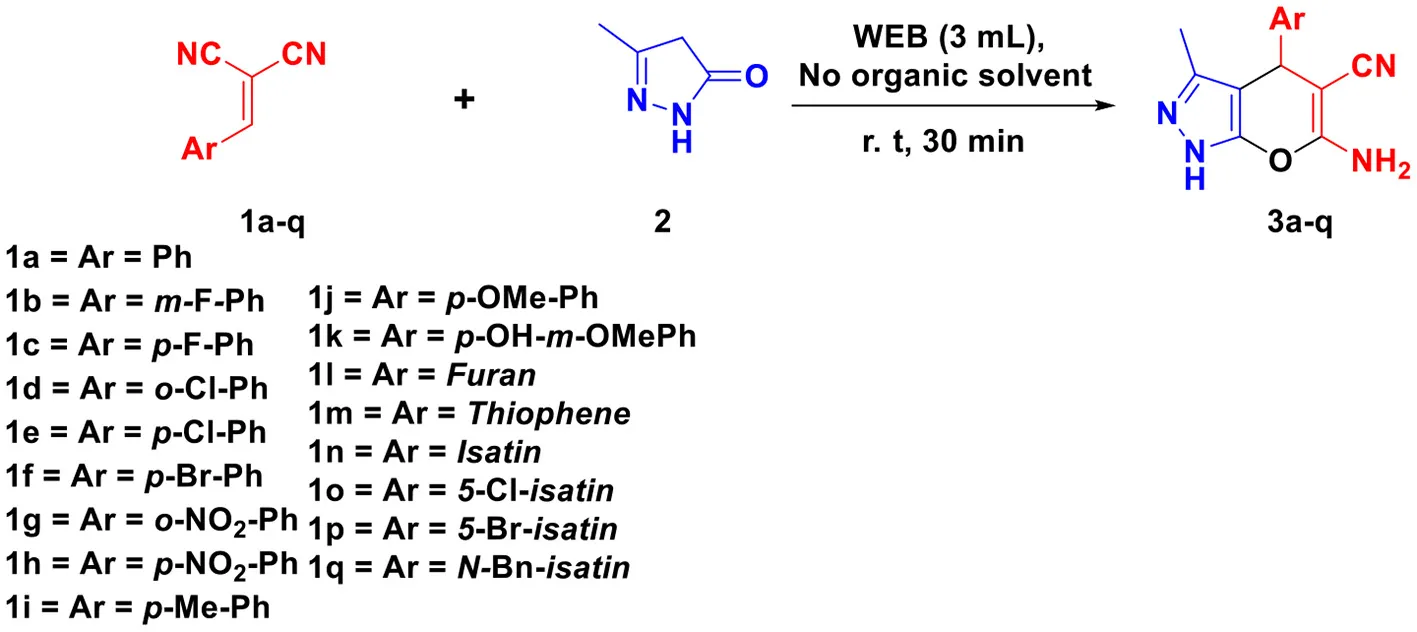
For optimizing the reaction condition, the model reaction was planned with an equimolar amount of arylidene malononitrile 1a (1 mmol) and 3-methyl-5-pyrazolone 2 (1 mmol) in WEB under different solvents at room temperature (Scheme 1; Table 1). Initially, the reaction in simple methanol and ethanol as a solvent yielded trace amount of product even after 300 min (Table 1, entry 1,2). The reaction in a ratio of MeOH/EtOH to WEB in (1:1) afforded the desired product in 25% yield in 240 min (Table 1, entry 3,4). An increase in the ratio of MeOH:WEB (2:8) yielded the product in 55% (Table 1, entry 5,6). However, the yield was decreased when the reaction was performed in combination of DCM and WEB (Table 1, entry 7, 8). Thereafter, the reaction was examined in neat WEB which afforded the desired product in 96% (Table 1, Entries 9). Thus, by using WEB the yield of product was excellent and found to be the best optimized condition for the synthesis of pyrano[2,3-c]pyrazole as reaction medium without using other organic solvents.
Scheme 1
To optimize the amount of WEB required for the reaction, the reaction was performed in different amount of WEB and equimolar amount of arylidene malononitrile 1a (1 mmol), 3-methyl-5-pyrazolone 2 (1 mmol) at room temperature. It was found that 3 ml of WEB is sufficient enough to complete the reaction in 30 min to give quantitative amount of product (Scheme 2).
Scheme 2
By employing the optimized condition, the reaction was performed with various substituted arylidene malononitrile 1a-q and 3-methyl-5-pyrazolone 2 in WEB at r.t. The methodology was found to have wide substrate scope. All halogenated substrates afforded the pyrano[2,3-c]pyrazoles 3 with excellent yield without any side reaction. It is interesting to note that different arylidene malononitrile with various electron-withdrawing group and electron-donating groups at C-2, C-3, C-4, position successfully give the desired product in quantitative yield (Table 2).
Table 2
 |
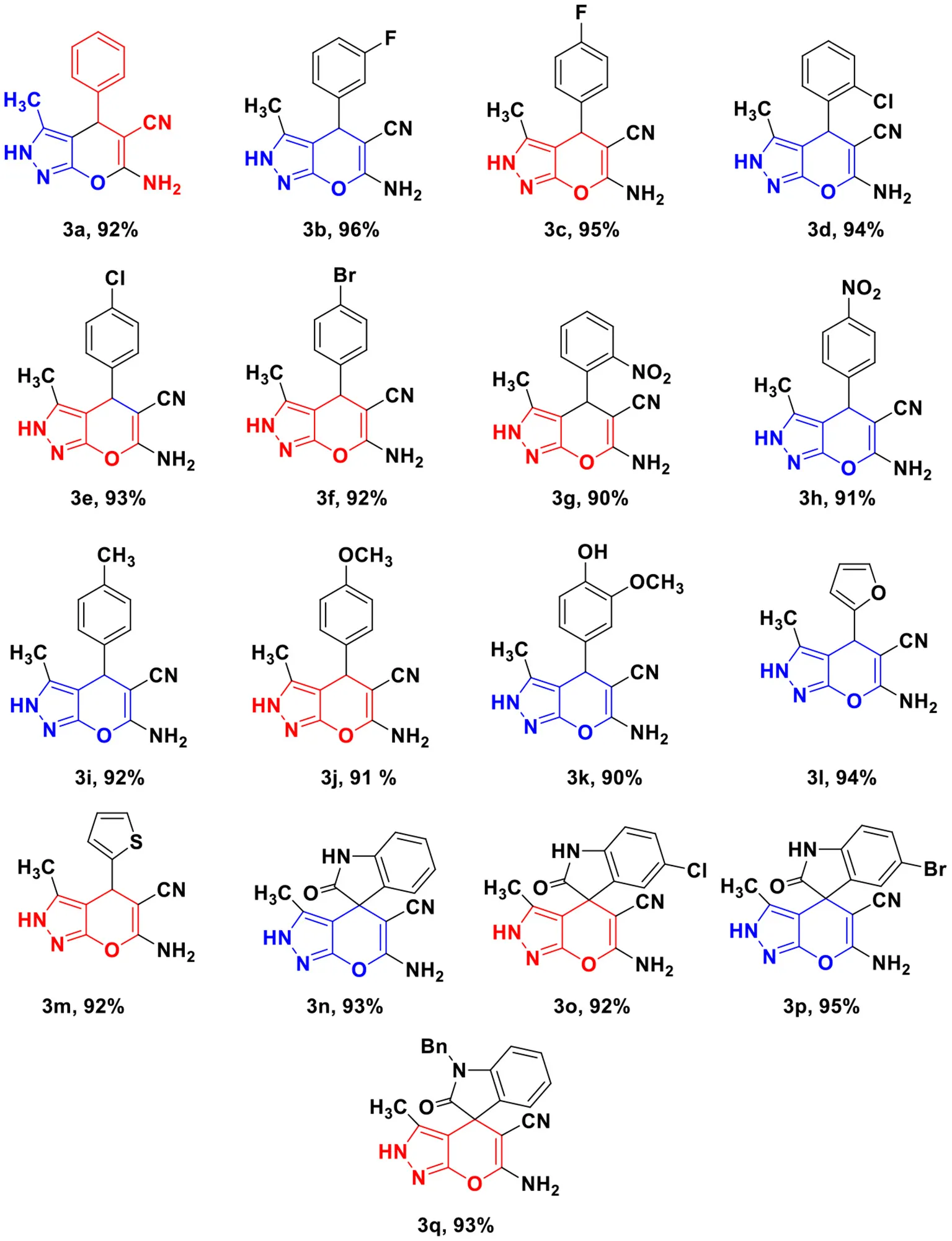 |
Substrate scope for the synthesis of pyrano[2,3-c]pyrazoles.
To further explore the scale-up performance of this protocol for one-pot preparation of pyrano[2,3-c]pyrazole derivative 3a which is important for possible large-scale application. Therefore, we performed a gram-scale reaction for the preparation of 3a (10 mmol) and the yield obtained was quantitative in nature (Scheme 3).
Scheme 3
Green chemistry matrices (Bahuguna et al., 2017; Chowhan et al., 2017) like atom economy (A.E.) reaction mass efficiency (R. M. E) should be high, and environmental factor (E), as well as process mass intensity (P. M. I) should be low (Constable et al., 2002). Green chemistry matrixes were calculated for the reaction, and we found low E-factor (0.086), P. M. I (1.164), high R. M. E (91.99%), high atom economy (A.E. = 100%), and process mass intensity (P.M.I. factor = 1.164). These values clearly indicate the efficacy of the present protocol.
The mechanism involved is as follows. Initially, in the presence of WEB, 3-methyl-5-pyrazolone 2 can form its enolic form 4, which undergoes Michael addition with arylidene malononitrile 1 to give intermediate 5 (Figure 3). Abstraction of the proton from B-H by intermediate 5 generates the intermediate 6 which could undergo intramolecular cyclization and give the intermediate 7 which could isomerizes and gives the desired product 3 (Ahadi et al., 2010; Zou et al., 2011).
Figure 3
Conclusions
A simple, efficient and green protocol has been developed for the synthesis of pyrano[2,3-c]pyrazole at room temperature using WEB as reaction medium without using other organic solvents, base, additives. The method has a broad range of substrate scope. The waste material was successfully used as a reaction medium for the organic transformation. The main advantage of this method is mild reaction condition, faster reaction, high yield, ecofriendly, and sustainable from the economic point of view. Calculated green chemistry matrices calculated prove the efficacy of the protocol. The method is very efficient for practical synthesis. Therefore, waste derived reaction medium can be efficient and ecofriendly alternative for the organic synthesis.
Statements
Data availability statement
All datasets generated for this study are included in the article/Supplementary Material.
Author contributions
KD, BB, and LC contributed in designing the work, execution, and analysis of the results.
Acknowledgments
KD gratefully acknowledges the financial support from the UGC for Non-NET fellowship. Authors thank the Central University of Gujarat for the infrastructure to carry out the work.
Conflict of interest
The authors declare that the research was conducted in the absence of any commercial or financial relationships that could be construed as a potential conflict of interest.
Supplementary material
The Supplementary Material for this article can be found online at: https://www.frontiersin.org/articles/10.3389/fchem.2019.00944/full#supplementary-material
References
1
AhadiS.YasaeiZ.BazgirA. (2010). A clean and one-pot synthesis of spiroindoline-pyranopyrazoles. Indian J. Heterocycl. Chem.47, 1090–1094. 10.1002/jhet.437
2
BabaieM.SheibaniH. (2011). Nanosized magnesium oxide as a highly effective heterogeneous base catalyst for the rapid synthesis of pyranopyrazoles via a tandem four-component reaction. Arab. J. Chem.4, 159–162. 10.1016/j.arabjc.2010.06.032
3
BagulS. D.RajputJ. D.BendreR. S. (2017). Synthesis of 3-carboxycoumarins at room temperature in water extract of banana peels. Environ. Chem. Lett.15, 725–731. 10.1007/s10311-017-0645-z
4
BahugunaA.KumarS.SharmaV.ReddyK. L.BhattacharyyaK.RavikumarP. C.et al. (2017). Nanocomposite of MoS2-RGO as facile, heterogeneous, recyclable, and highly efficient green catalyst for one-pot synthesis of indole alkaloids. ACS Sustain. Chem. Eng.5, 8551–8567. 10.1021/acssuschemeng.7b00648
5
BazgirA.HosseiniG.GhahremanzadehR. (2013). Copper ferrite nanoparticles: an efficient and reusable nanocatalyst for a green one-pot, three-component synthesis of spirooxindoles in water. ACS Comb. Sci.15, 530–534. 10.1021/co400057h
6
BoruahP. R.AliA. A.SaikiaB.SarmaD. (2015). A novel green protocol for ligand free Suzuki–Miyaura cross-coupling reactions in WEB at room temperature. Green Chem.17, 1442–1445. 10.1039/C4GC02522A
7
ChowhanL. R.ReddyM. S.KumarN. S. (2017). An efficient and rapid synthesis of 3-hydroxy-3-alkyl-2-oxindoles via Zn-mediated barbier-type reaction under aqueous conditions. J. Chem. Sci.129, 1205–1209. 10.1007/s12039-017-1329-8
8
ConstableD. J.CurzonsA. D.CunninghamV. L. (2002). Metrics to ‘green'chemistry—which are the best?Green Chem.4, 521–527. 10.1039/B206169B
9
DalalK. S.TayadeY. A.WaghY. B.TrivediD. R.DalalD. S.ChaudhariB. L. (2016). Bovine serum albumin catalyzed one-pot, three-component synthesis of dihydropyrano [2, 3-c] pyrazole derivatives in aqueous ethanol. RSC Adv.6, 14868–14879. 10.1039/C5RA13014J
10
DasD.BanerjeeR.MitraA. (2014). Bioactive and pharmacologically important pyrano [2, 3-c] pyrazoles. J. Chem. Pharm. Res. 6, 108–116. Available online at: https://pdfs.semanticscholar.org/9596/0127b67558aa10424329911dd11e7d338dc0.pdf
11
DekaD. C.TalukdarN. N. (2007). Chemical and spectroscopic investigation of Kolakhar and its commercial importance. Indian J. Trad. Knowl.6, 72–78. Available online at: http://nopr.niscair.res.in/handle/123456789/834
12
DwivediK. D.MarriS. R.NandigamaS. K.ChowhanL. R. (2018a). Exploring TiO2 NPs as efficient catalyst for 1, 6 Michael addition of 3-methyl-5-pyrazolone on 3-methyl-4-nitro-5-alkenyl isoxazoles and rapid synthesis of 3, 3-bis (indolyl) oxindoles in water. Synth. Commun.48, 2695–2707. 10.1080/00397911.2018.1518456
13
DwivediK. D.MarriS. R.NandigamaS. K.ChowhanR. L. (2018b). An efficient solvent-free synthesis of 3-methyl-4-nitro-5-styrylisoxazoles using solid nano-titania. J. Chem. Sci.130:129. 10.1007/s12039-018-1534-0
14
DwivediK. D.ReddyM. S.KumarN. S.ChowhanL. R. (2019). Facile synthesis of 3-hydroxy oxindole by a decarboxylative aldol reaction of β-ketoacid and isatin in WERSA. Chem. Sel.4, 8602–8605. 10.1002/slct.201900150
15
FaddaA. A.El-MekabatyA.ElattarK. M. (2013). Chemistry of enaminonitriles of pyrano[2, 3-c]pyrazole and related compounds. Synth. Commun.43, 2685–2719. 10.1080/00397911.2012.744842
16
GanguK. K.MaddilaS.MukkamalaS. B.JonnalagaddaS. B. (2017). Synthesis, structure, and properties of new Mg (II)-metal–organic framework and its prowess as catalyst in the production of 4 H-Pyrans. Indus. Eng. Chem. Res.11, 2917–2924. 10.1021/acs.iecr.6b04795
17
GogoiS.ZhaoC. G. (2009). Organocatalyzed enantioselective synthesis of 6-amino-5-cyanodihydropyrano[2,3-c]pyrazoles. Tetrahedron Lett.50, 2252–2255. 10.1016/j.tetlet.2009.02.210
18
GuoS. B.WangS. X.LiJ. T. (2007). D, L-proline-catalyzed one-pot synthesis of pyrans and pyrano [2,3-c]pyrazole derivatives by a grinding method under solvent-free conditions. Synth. Commun. 37, 2111–2120. 10.1080/00397910701396906
19
HamamaW. S.El-GoharyH. G.KuhnertN.ZoorobH. (2012). Chemistry of pyrazolinones and their applications. Curr. Org. Chem.16, 373–399. 10.2174/138527212799499921
20
JunekH.AignerH. (1973). Synthesen mit Nitrilen, XXXV. Reaktionen von tetracyanäthylen mit heterocyclen. Chem. Ber.106, 914–921. 10.1002/cber.19731060323
21
KanagarajK.PitchumaniK. (2010). Solvent-free multicomponent synthesis of pyranopyrazoles: per-6-amino-β-cyclodextrin as a remarkable catalyst and host. Tetrahedron Lett.51, 3312–3316. 10.1016/j.tetlet.2010.04.087
22
KasiotisK. M.TzanetouE. N.HaroutounianS. A. (2014). Pyrazoles as potential anti-angiogenesis agents: a contemporary overview. Front. Chem.2:78. 10.3389/fchem.2014.00078
23
KumarswamyreddyN.KesavanV. (2016). Enantioselective synthesis of dihydrospiro [indoline-3, 4′-pyrano [2, 3-c] pyrazole] derivatives via michael/hemiketalization reaction. Org. Lett.18, 1354–1357. 10.1021/acs.orglett.6b00287
24
LalitK.ChandreshT.VivekS. (2012). Biological significance of pyrazolone: a review. Int. J. Res. Pharm. Sci. 2, 13–22. Available online at: http://www.ijrpsonline.com/voi2,issue2,april-june2012.php
25
LeitembergerA.BöhsL. M. C.RosaC. H.SilvaC. D.GalettoF. Z.GodoiM. (2019). 273 Synthesis of symmetrical diorganyl disulfides employing WEB as an eco-friendly oxidative 274 system. Chem. Sel. 4, 7686–7690. 10.1002/slct.20190138s
26
MaddilaS. N.MaddilaS.ZylW. E.JonnalagaddaS. B. (2016a). Ru-hydroxyapatite: an efficient and reusable catalyst for the multicomponent synthesis of pyranopyrazoles under facile green conditions. Curr. Org. Synth. 13:893. 10.2174/1570179413666151218202439
27
MaddilaS. N.MaddilaS.ZylW. E.JonnalagaddaS. B. (2016b). Ceria-vanadia/silica-catalyzed cascade for C-C and C-O bond activation: green one-pot synthesis of 2-amino-3-cyano-4H-pyrans. ChemistryOpen5, 38–42. 10.1002/open.201500159
28
MaddilaS. N.MaddilaS.ZylW. E.JonnalagaddaS. B. (2017). CeO2/ZrO2 as green catalyst for one-pot synthesis of new pyrano[2,3-c]-pyrazoles. Res. Chem. Intermed. 43, 4313–4325. 10.1007/s11164-017-2878-7
29
MalekiB.AshrafiS. S. (2014). Nano α-Al2O3 supported ammonium dihydrogen phosphate (NH4H2 PO4/Al2O3): preparation, characterization and its application as a novel and heterogeneous catalyst for the one-pot synthesis of tetrahydrobenzo [b] pyran and pyrano [2, 3-c] pyrazole derivatives. RSC Adv.4, 42873–42891. 10.1039/C4RA07813F
30
MamaghaniM.Hossein NiaR. (2019). A review on the recent multicomponent synthesis of pyranopyrazoles. 10.1080/10406638.2019.1584576
31
MandourA.El-SawyE.EbaidM.HassanS. (2012). Synthesis and potential biological activity of some novel 3-[(N-substituted indol-3-yl) methyleneamino]-6-amino-4-aryl-pyrano (2, 3-c) pyrazole-5-carbonitriles and 3, 6-diamino-4-(N-substituted indol-3-yl) pyrano (2, 3-c) pyrazole-5-carbonitriles. Acta Pharm.62, 15–30. 10.2478/v10007-012-0007-0
32
MariappanG.SahaB. P.SutharsonL.AnkitsG.PandeyL.KumarD. (2010). The diverse pharmacological importance of pyrazolone derivatives: a review. J. Pharm. Res. 3, 2856–2859. Available online at: https://pdfs.semanticscholar.org/b16b/6e8577e220ff96f635601edd22b7b8231de9.pdf?_ga=2.17991291.332792044.1578919756-1634417742.1566909052
33
MarvaniyaH. M.ModiK. N.SenD. J. (2011). Greener reactions under solvent free conditions. Int. J. Drug Dev. Res. 3, 42–51. Available online at: https://www.researchgate.net/profile/Prof_Dr_Dhrubo_Jyoti_Sen/publication/286462167_Greener_reactions_under_solvent_free_conditions/links/5bc955e592851cae21b1d503/Greener-reactions-under-solvent-free-conditions.pdf
34
NaeimiH.RashidZ.ZarnaniA. H.GhahremanzadehR. (2014). Efficient synthesis of novel spiro-furo-pyrido-pyrimidine-indolines by manganese ferrite nanoparticles as a highly active magnetically reusable nanocatalyst in water. New J. Chem.38, 348–357. 10.1039/C3NJ00940H
35
NagarajanA. S.ReddyB. S. (2009). Synthesis of substituted pyranopyrazoles under neat conditions via a multicomponent reaction. Synlett12, 2002–2004. 10.1055/s-0029-1217526
36
NeogS. R.DekaC. D. (2013). Salt substitute from banana plant (Musa Balbiciana Colla). J. Chem. Pharm. Res. 5, 155–159. Available online at: https://pdfs.semanticscholar.org/5d58/1a53568e0477d8196ffb48285f1a3ec7c998.pdf
37
ParmarN. J.BaradH. A.PansuriyaB. R.TalpadaN. P. (2013). A highly efficient, rapid one-pot synthesis of some new heteroaryl pyrano [2, 3-c] pyrazoles in ionic liquid under microwave-irradiation. RSC Adv.3, 8064–8070. 10.1039/c3ra00068k
38
ReddyM. M.JayashankaraV. P.PashaM. A. (2010). Glycine-catalyzed efficient synthesis of pyrano -pyrazoles via one-pot multicomponent reaction. Synth. Commun.40, 2930–2934. 10.1080/00397910903340686
39
ReddyM. S.KumarN. S.ChowhanL. R. (2018). Heterogeneous graphene oxide as recyclable catalyst for azomethine ylide mediated 1, 3 dipolar cycloaddition reaction in aqueous medium. RSC Adv.8, 35587–35593. 10.1039/C8RA06714G
40
SaikiaB.BorahP. (2015). A new avenue to the Dakin reaction in H2O2-WERSA. RSC Adv.5, 105583–105586. 10.1039/C5RA20133K
41
SebenzileS.MaddilaS.ZylW. E.JonnalagaddaS. B. (2016). A facile, efficacious and reusable Sm2O3/ZrO2 catalyst for the novel synthesis of functionalized 1,4-dihydropyridine derivatives. Catal. Comm.79, 21–25. 10.1016/j.catcom.2016.02.017
42
SharaninaL. G.PromonenkovV. K.MarshtupaV. P.PashchenkoA. V.PuzanovaV. V.SharaninY. A.et al. (1982). 6-Amino-5-cyano-1H, 4H-pyrazolo [3, 4-b] pyrans. Chem. Heterocycl. Compd. 18, 607–611. 10.1007/BF00506154
43
ShiX.LiX.ShiD. (2019). Ligand-and additive-free 2-position-selective trifluoromethylation of heteroarenes under ambient conditions. Front. Chem.7:613. 10.3389/fchem.2019.00613
44
SirousH.ChemiG.GemmaS.ButiniS.DebyserZ.ChristF.et al. (2019). Identification of novel 3-hydroxy-pyran-4-one derivatives as potent HIV-1 integrase inhibitors using in silico structure-based combinatorial library design approach. Front. Chem.7:574. 10.3389/fchem.2019.00574
45
SurneniN.BaruaN. C.SaikiaB. (2016). Application of natural feedstock extract: the Henry reaction. Tetrahedron Lett.57, 2814–2817. 10.1016/j.tetlet.2016.05.048
46
TacconiG.GattiG.DesimoniG.MessoriV. (1980). A new route to 4H-pyrano [2,3-c] pyrazoles. J. Prakt. Chem.322, 831–834. 10.1002/prac.19803220519
47
VasukiG.KumaravelK. (2008). Rapid four-component reactions in water: synthesis of pyranopyrazoles. Tetrahedron Lett.49, 5636–5638. 10.1016/j.tetlet.2008.07.055
48
ZhangM.LiuY. H.ShangZ. R.HuH. C.ZhangZ. H. (2017). Supported molybdenum on graphene oxide/Fe3O4: an efficient, magnetically separable catalyst for one-pot construction of spiro-oxindole dihydropyridines in deep eutectic solvent under microwave irradiation. Catal. Commun.88, 39–44. 10.1016/j.catcom.2016.09.028
49
ZouY.HuY.LiuH.ShiD. (2011). Rapid and efficient ultrasound-assisted method for the combinatorial synthesis of spiro [indoline-3, 4′-pyrano [2, 3-c] pyrazole] derivatives. ACS Comb. Sci.14, 38–43. 10.1021/co200128k
Summary
Keywords
pyrano[2,3-c]pyrazoles, web, arylidene malononitrile, 3-methyl-5-pyrazolone, green chemistry
Citation
Dwivedi KD, Borah B and Chowhan LR (2020) Ligand Free One-Pot Synthesis of Pyrano[2,3-c]pyrazoles in Water Extract of Banana Peel (WEB): A Green Chemistry Approach. Front. Chem. 7:944. doi: 10.3389/fchem.2019.00944
Received
17 September 2019
Accepted
31 December 2019
Published
22 January 2020
Volume
7 - 2019
Edited by
Pu-Xian Gao, University of Connecticut, United States
Reviewed by
Werner Ewald Van Zyl, University of KwaZulu-Natal, South Africa; Josefina Pons, Autonomous University of Barcelona, Spain
Updates
Copyright
© 2020 Dwivedi, Borah and Chowhan.
This is an open-access article distributed under the terms of the Creative Commons Attribution License (CC BY). The use, distribution or reproduction in other forums is permitted, provided the original author(s) and the copyright owner(s) are credited and that the original publication in this journal is cited, in accordance with accepted academic practice. No use, distribution or reproduction is permitted which does not comply with these terms.
*Correspondence: L. Raju Chowhan rchowhan@cug.ac.in
This article was submitted to Green and Sustainable Chemistry, a section of the journal Frontiers in Chemistry
Disclaimer
All claims expressed in this article are solely those of the authors and do not necessarily represent those of their affiliated organizations, or those of the publisher, the editors and the reviewers. Any product that may be evaluated in this article or claim that may be made by its manufacturer is not guaranteed or endorsed by the publisher.