Abstract
A short and efficient multicomponent sequence for synthesizing fused novel polyheterocyclic chromeno spiro-pyrrolidine oxindoles via 1,3-dipolar cycloaddition reaction mediated by reactive azomethine ylides catalyzed by the Graphene Oxide (GO) is reported herein. This approach was utilized for synthesizing fused polyheterocyclic spiro-pyrrolothiazole and spiro-pyrrole oxindoles with yields ranging from good to excellent. A heterogeneous GO catalyst with an ultra-low catalytic loading of 0.05 wt% could proficiently catalyze the reaction without the formation of any side products and can also be visualized by the formation of solid mass in the reaction flask. The methodology is green in nature and the products were isolated by simple filtration without the use of any chromatographic techniques.
Introduction
Spiro-heterocycles form a major class of natural products and have good biological activities. The chiral spiro carbon leads to sterically constrained spiro structures, which probably explains the wide scope of pharmacological activities. The spirooxindoles nucleus is found in numerous natural products and often dictates biological activities like anti-cancer, anti-viral, anti-inflammatory, anti-leukemic, and anti-tubercular effects, to name a few.
Cycloaddition reactions are one of the most frequented classes of reactions in organic chemistry. In synthetic chemistry, isatin has a highly reactive C-3 carbonyl group and complex multi-spiro-heterocycles can be constructed by implying 1,3-dipolar cycloaddition reactions (Borad et al., 2014; Zhu et al., 2017; Dwivedi et al., 2021), Morita–Baylis–Hillman reaction (Deng et al., 2011; Liao et al., 2021), electrocyclization (Viswambharan et al., 2010), and photo-induced reactions (Wang et al., 2005). The 1,3-dipolar cycloaddition reactions (1,3-DCR) are a fascinating set of protocols that are often regarded as the most competent process and opens new vistas in the field of furnishing efficient and high-yield products in a regio- and stereo-controlled fashion (Coldham and Hufton, 2005; Ramesh et al., 2018; Reddy et al., 2018a; Reddy et al., 2018b; Kumar et al., 2019; ).
An important aspect that further establishes the importance of 1,3-DCR is the placement of the ylide dipole and alkene or alkyne dipolarophile within the same molecule, which can provide direct access to polycyclic compounds with extensive complexity and interesting architecture (Padwa and Pearson, 2003; Borah et al., 2021a; Borah et al., 2021b; Borah et al., 2021b). Various methods for cycloaddition reactions involve the formation of highly reactive azomethine ylides and the addition of suitable dipolarophiles; the success of this setup is often described in the synthesis of pyrrolidine and pyrrole containing natural products and medicinally important synthetic targets (Namboothiri and Hassner, 2001) Figure 1. The conformational constraints and juxtaposition of reactants frequently lead to readily cycloaddition with complete or very high selectivity. For the reasons mentioned above, 1,3-DCR has been described as “the single most important method for the construction of heterocyclic five-membered rings” (Jørgensen, 2002; Gupta and Khurana., 2019; Thadem et al., 2021).
FIGURE 1

Some important naturally occurring and synthetic spirooxindoles containing molecules.
Major hurdles that regularly occur in organic synthesis are atom economy and novel and efficient reactions, which can answer both the ecological aspect and target-oriented synthesis (de Graaff et al., 2012; Lledó et al., 2019). Often traditional synthesis routes include multiple steps and long, tedious purification processes like column chromatography; these stages often add a significant amount of side products and also generate a huge amount of waste. One probable answer to the ever-growing challenge of environment pollution is multicomponent reactions (MCRs) that are widely regarded as a dynamic tool in organic chemistry as they have a wide scope of tolerance for various functional groups. MCRs often fascinate chemists by their ability to create a library of molecules with considerable complexity and geometry, which is otherwise rarely encountered in synthesis. Another aspect that points to the environmental conscience is the usage of commercially available reactants in one-pot conversion to a complex/target molecule (Xu et al., 2016; Kumar et al., 2021). This conversion often includes the formation of multiple bonds in a single step, thereby including high atom economy, operational simplicity, and considerably less requirement of energy, which further proves MCRs as the perfect candidate for the synthesis of natural products, structurally diverse, and pharmaceutically active compounds (Sunderhaus and Martin, 2009).
Results and Discussion
MCRs being operationally simple, if coupled with heterogeneous catalysts like graphene oxide (GO), can result in sequences that are easy to carry out with high yields (Sachdeva., 2020; Naeim-Fallahiyeh et al., 2020). Currently, the synthesis of complex molecules having appealing stereochemistry being synthesized by relatively simple protocol and environmental conscience is of utmost importance and can be largely correlated by frequent reports occurring in literature (Sharma et al., 2021; Singh et al., 2021). As a part of our group’s research interest in sustainable and operationally simple, efficient sequences, we wish to report a simple and effective method mediated by azomethine ylide for the construction of a library of complex spiro-pyrrolizineindoline and spiro-pyrroleindoline molecules via 1,3-dipolar cycloaddition reaction in a one-pot, multicomponent approach using a heterogeneous catalyst (Chowhan et al., 2019; Lakshmi et al., 2020).
Our synthetic approach started with 1,3-dipolar cycloaddition of α,β-unsaturated carbonyl compounds in equimolar concentrations, i.e., coumarin 3 and non-stabilized azomethine ylide, in situ generated via the condensation of isatin 1 and L-proline 2 in protic solvents (Scheme 1; Table 1). The mixture was stirred vigorously at room temperature and the progress of the reaction was monitored continuously by thin-layer chromatography (TLC). After 24 h, we observed that the yields of 4 (18%) were appreciable but not satisfactory (Entry 1, Table 1). MeOH used as solvent gave somewhat better yields of 22% (Entry 2, Table 1). Owing to the large surface area and acidic nature of GO, GO 0.5% by wt. was then used as a catalyst and to our delight, the reaction proceeded swiftly to afford a single product 4 in 97% yields (Entry 3, Table 1). To assess even better yields, catalytic loading was then increased to 1 and 2% by wt.; however, significant improvements in yields, 94% and 95%, respectively, were not observed (Entry 4–5, Table 1). Intrigued by the results, we then applied this protocol to a series of isatins 1, L-proline 2, and coumarin 3 to create a series of spirocyclo adducts (Scheme 2; Table 2). It is worth mentioning that further reduction in catalytic loading led to a slight decrease in the yields with increased reaction times (Entry 3, Table 1). Another aspect is that all the products were obtained in analytically pure form and did not require filtration by column chromatography and the formation of the product can be visualized by the formation of solid mass in the reaction flask. Solid products were collected on filter paper, dissolved in ethyl acetate, and passed through a pad of celite to filter out the heterogeneous catalyst followed by removing the solvent under reduced pressure and washing it with cold methanol.
SCHEME 1

Optimization of reaction conditions.
TABLE 1
| Entrya | Solvent | Graphene Oxide (GO) wt% | Time | Yield % |
|---|---|---|---|---|
| 1 | EtOH | — | 24 h | 18% |
| 2 | MeOH | — | 24 h | 22% |
| 3 | MeOH | 0.5 | 10 min | 97% |
| 4 | MeOH | 1 | 10 min | 94% |
| 5 | MeOH | 2 | 10 min | 95% |
| 6 | MeOH | 0.25 | 1 h | 87% |
Optimization of reaction conditions.
All reactions were carried out at 0.5 mmol scale, with 1 eq. of isatin, 1 eq. of proline, 0.5 wt% GO, and 1 eq. coumarin at rt.
SCHEME 2

Reaction conditions for the synthesis of spiro pyrrolizineindoline.
TABLE 2
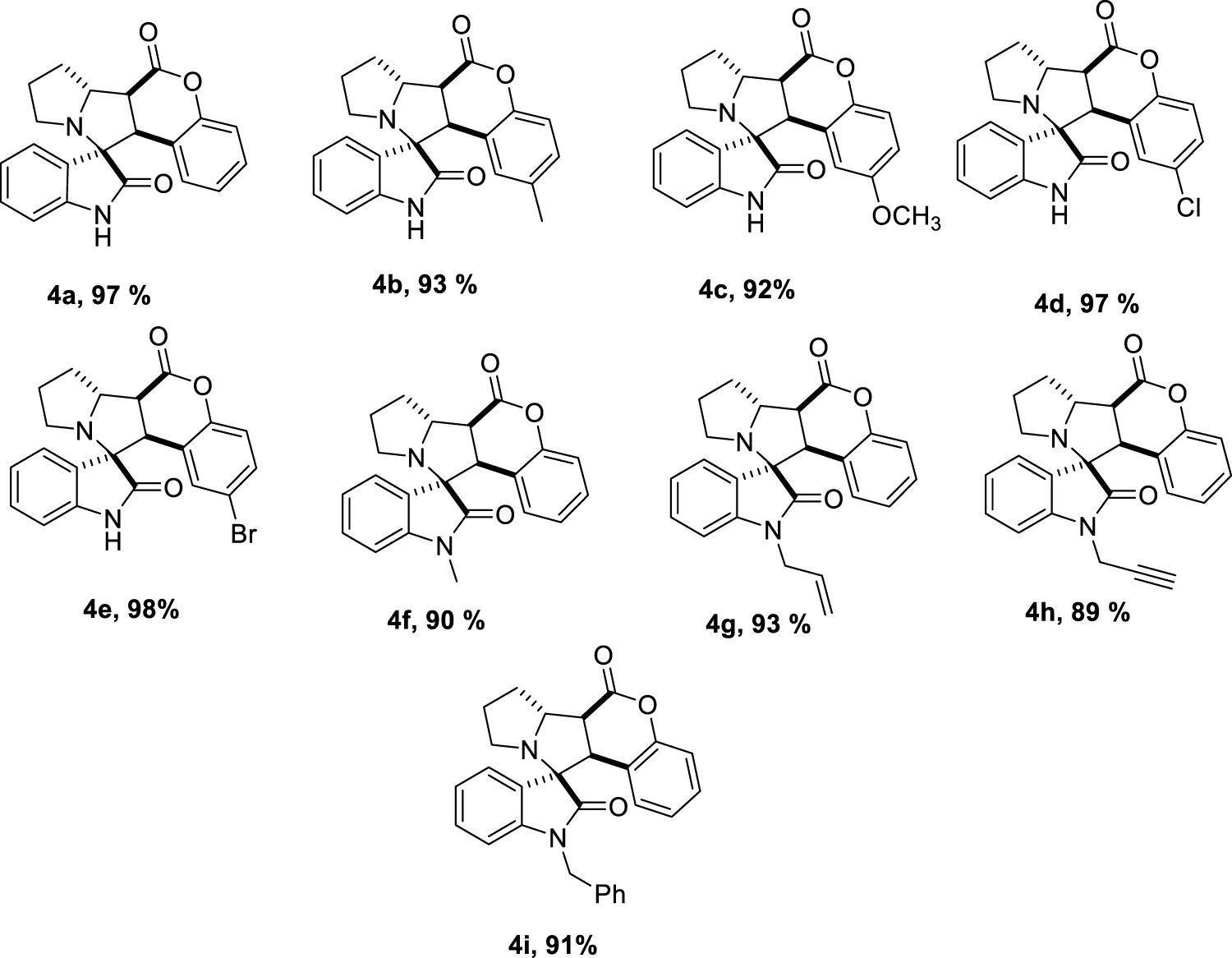 |
Substrate scope for spiro pyrrolizineindoline synthesis.
Optimized reaction conditions could efficiently utilize a wide range of substrates (Scheme 2). Coumarins, when substituted with an electron donating group, the yield decreased slightly (Table 2, 4avs.4b, 4c), 95% to 93 and 92%, respectively. Upon the substitution of an electron withdrawing group on coumarin, the yield increased from 95% in (4a) to 97% in (4d) and 98% (4e). N- substituted isatins generally gave good to excellent yields.
To further establish the scope of the methodology, proline was replaced with thio-proline 5; again, the expected product 4j-n was obtained in good to excellent yields, as shown in Scheme 3; Table 3.
SCHEME 3

Reaction conditions for the synthesis of spiro pyrrolothiazoleindoline.
TABLE 3
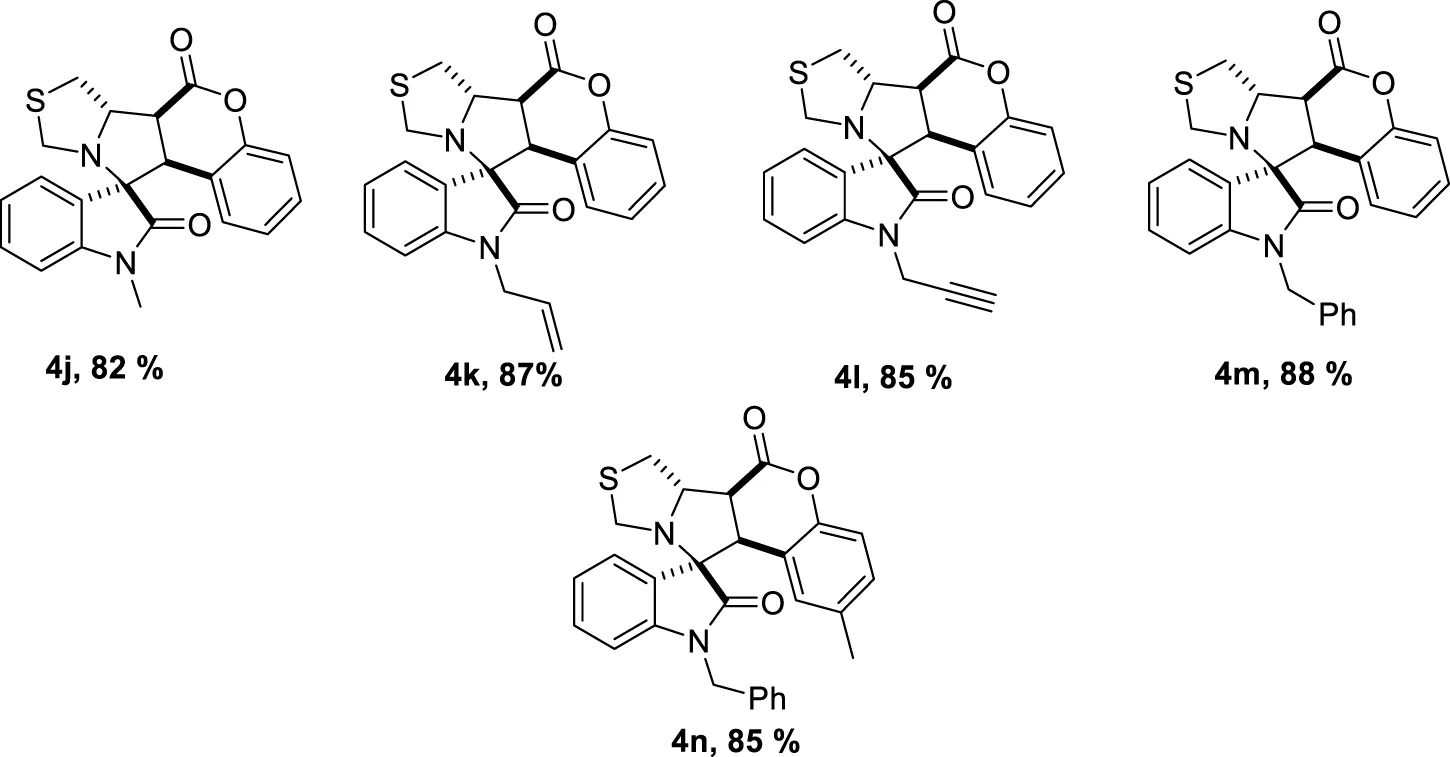 |
Substrate scope for spiro pyrrolothiazoleindoline synthesis.
With these optimized conditions, we were intrigued to explore the substrate scope of the methodology further; to our delight, we found that the reaction conditions could further accommodate a wide range of various substituted benzyl amines 6 (Scheme 4). It is worth mentioning that benzylamines are less reactive and according to a previous report, benzylamine fails to give the desired product (Liu et al., 2016). However, under optimized conditions, a series of compounds were synthesized with yields ranging from good to excellent. In this case, also the products could be obtained analytically pure without involving column chromatography (Table 4).
SCHEME 4

Reaction conditions for the synthesis of spiro pyrroleindoline.
TABLE 4
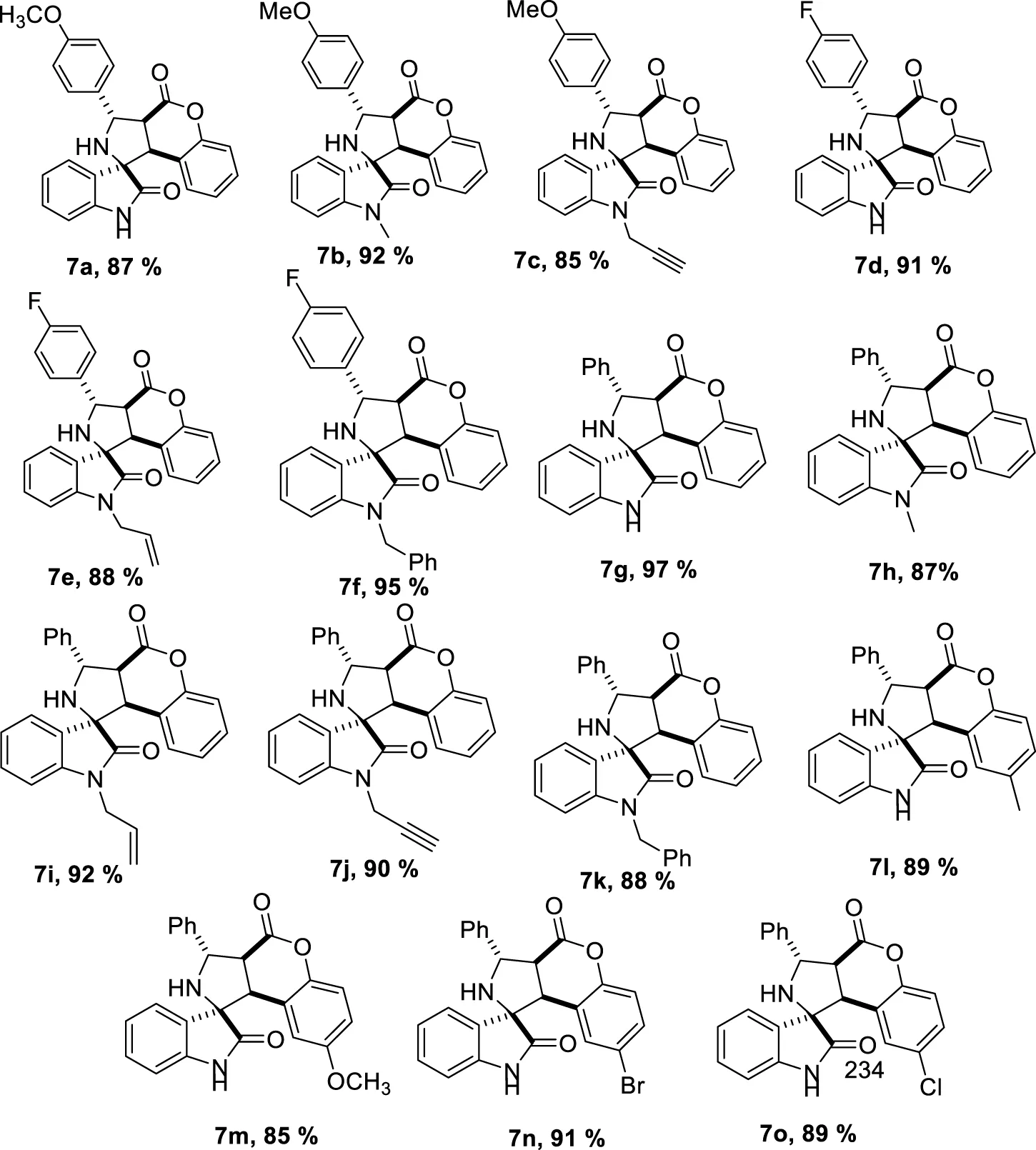 |
Substrate scope for the synthesis of spiro pyrroleindoline.
To strengthen the efficacy of the established reaction conditions, a series of reactions were planned using the optimized reaction conditions with various substituted isatins, benzyl amines, and coumarins. Methyl substituted isatin 7b gave a slightly better 92% yield, as compared to unsubstituted (7b, 87%), allyl (7e, 88%), and propargyl (7c, 85%) substituted isatins. Benzyl amine substituted with the electron withdrawing group (fluorine) 7d, 91%, gave somewhat better results than amines substituted with the electron donating group (methoxy) 7a, 87%. Methoxy substituted coumarin underperformed with 85% yield, 7m, and bromo substituted coumarin gave better results (7n, 91%). It can be inferred that with the substitution of the electron donating groups, the yield generally decreased, whereas with the substitution of the electron withdrawing groups, the reaction performed slightly better.
Plausible Mechanism
We assume the following plausible mechanism for the reaction (Figure 2). Reactants are initially localized onto the surface of the catalyst owing to π-stacking and the capability of the catalyst to form hydrogen bonding I and II (Reddy et al., 2018a; Reddy et al., 2018b). Due to the acidic nature of GO, it enables the imine formation to generate very reactive azomethine ylide 8 (intermediate II). Due to the sheet form of GO, the dipolarophile can approach the reactive azomethine ylide from one side exclusively, which yields a single diastereomer as the product III. The interaction between heteroatoms in the oxindole motif with the azomethine ylide dipole (zwitterion) generated during reaction directs the orientation of incoming dipolarophile (coumarin) onto the dipole III.
FIGURE 2

Plausible mechanism for GO catalyzed synthesis of spiro pyrroleindoline.
Conclusion
In conclusion, we have explored one-pot multicomponent 1,3-dipolar cycloaddition reaction mediated by azomethine ylide catalyzed by heterogeneous catalyst sequence for the diastereoselective and regioselective synthesis of spirochromeno pyrrolizine/pyrrolothiazole/pyrrole -indolinedione. Single-step, facile synthesis and ultra-low catalytic loading with direct access to pure products in good to excellent yields simply by filtration establishes the importance and hence usability of this practical approach. The protocol as an extension of frequently used MCRs with simple sequence and sort reaction times deserves some consideration and attention in synthetic chemistry.
Statements
Data availability statement
The original contributions presented in the study are included in the article/Supplementary Material; further inquiries can be directed to the corresponding author.
Author contributions
VS and SL performed the experimental part and RC is the supervisor.
Acknowledgments
VS and SRL acknwoledge UGC-India for the non-NET fellowship. The authors thank CIF-CUG for all the analytical data and CUG for providing the infrastructure and other resources to carry out this work.
Conflict of interest
The authors declare that the research was conducted in the absence of any commercial or financial relationships that could be construed as a potential conflict of interest.
Publisher’s note
All claims expressed in this article are solely those of the authors and do not necessarily represent those of their affiliated organizations, or those of the publisher, the editors and the reviewers. Any product that may be evaluated in this article, or claim that may be made by its manufacturer, is not guaranteed or endorsed by the publisher.
Supplementary material
The Supplementary Material for this article can be found online at: https://www.frontiersin.org/articles/10.3389/fchem.2021.759436/full#supplementary-material
References
1
BoradM. A.BhoiM. N.PrajapatiN. P.PatelH. D. (2014). Review of Synthesis of Multispiro Heterocyclic Compounds from Isatin. Synth. Commun.44, 1043–1057. 10.1080/00397911.2013.858361
2
BorahB.DwivediK. D.ChowhanL. R. (2021a). 4‐Hydroxycoumarin: A Versatile Substrate for Transition‐metal‐free Multicomponent Synthesis of Bioactive Heterocycles. Asian J. Org. Chem10, 3101–3126. 10.1002/ajoc.202100550
3
BorahB.DwivediK. D.ChowhanL. R. (2021b). Recent Approaches in the Organocatalytic Synthesis of Pyrroles. RSC Adv.11, 13585–13601. 10.1039/D1RA01690C
4
ChowhanL. R.SinghV.Raj LakshmiS. (2019). Stereoselective Synthesis of Hagen's Gland Lactones by Employing Vinylogous Mukaiyama Type Reaction. ChemistrySelect4, 13601–13603. 10.1002/slct.201902744
5
ColdhamI.HuftonR. (2005). Intramolecular Dipolar Cycloaddition Reactions of Azomethine Ylides. Chem. Rev.105, 2765–2810. 10.1021/cr040004c
6
de GraaffC.RuijterE.OrruR. V. A. (2012). Recent Developments in Asymmetric Multicomponent Reactions. Chem. Soc. Rev.41, 3969–4009. 10.1039/c2cs15361k
7
DengH.-P.WeiY.ShiM. (2011). Highly Regio- and Diastereoselective Construction of Spirocyclopenteneoxindoles through Phosphine-Catalyzed [3 + 2] Annulation of Morita-Baylis-Hillman Carbonates with Isatylidene Malononitriles. Org. Lett.13, 3348–3351. 10.1021/ol201094f
8
DwivediK. D.KumarB.ReddyM. S.BorahB.Nagendra BabuJ.ChowhanL. R. (2021). Acetyl Oxime/azirine 1, 3-dipole and Strategy for the Regioselective Synthesis of Polysubstituted Pyrroles via [3 + 2] Cycloaddition with Alkyne Utilizing Fe2O3@cellulose Catalyst. Results Chem.3, 100201. 10.1016/j.rechem.2021.100201
9
GuptaS.KhuranaJ. M. (2019). Catalyst‐Free One‐Pot Regioselective Synthesis of Spiropyrrolizines Using 1,3‐Dipolar Cycloaddition Reaction. ChemistrySelect4, 7200–7203. 10.1002/slct.201901531
10
JørgensenK. A. (2002). Cycloaddition Reactions in Organic Synthesis. Hoboken, US: John Wiley & Sons.
11
KumarB.ReddyM. S.DwivediK. D.DahiyaA.BabuJ. N.ChowhanL. R. (2021). Synthesis of In Situ Immobilized Iron Oxide Nanoparticles (Fe 3 O 4 ) on Microcrystalline Cellulose: Ecofriendly and Recyclable Catalyst for Michael Addition. Appl. Organomet. Chem., e6455. 10.1002/aoc.6455
12
KumarN. S.ReddyM. S.BheeramV. R.MukkamalaS. B.Raju ChowhanL.Chandrasekhara RaoL. (2019). Zinc Oxide Nanoparticles as Efficient Catalyst for the Synthesis of Novel Di-spiroindolizidine Bisoxindoles in Aqueous Medium. Environ. Chem. Lett.17, 455–464. 10.1007/s10311-018-0772-1
13
LakshmiS. R.SinghV.ChowhanL. R. (2020). Highly Efficient Catalyst-free Domino Conjugate Addition, Decarboxylation and Esterification/amidation of Coumarin Carboxylic Acid/esters with Pyrazolones: a green Chemistry Approach. RSC Adv.10, 13866–13871. 10.1039/d0ra01906b
14
LiaoJ.DongJ.XuJ.WangW.WuY.HouY.et al (2021). Phosphine-Catalyzed [3 + 2] Annulation of Morita-Baylis-Hillman Carbonates with Isoxazole-Based Alkenes. J. Org. Chem.86, 2090–2099. 10.1021/acs.joc.0c01948
15
LiuX.-W.YaoZ.YangJ.ChenZ.-Y.LiuX.-L.ZhaoZ.et al (2016). 1,3-Dipolar Cycloaddition Enabled Isoxazole-Fused Spiropyrrolidine Oxindoles Syntheses from 3-methyl-4-nitro-5-alkenyl-isoxazoles and Azomethine Ylides. Tetrahedron72, 1364–1374. 10.1016/j.tet.2016.01.029
16
LledóD.GrindlayG.SansanoJ. M. (2019). 1,3-Dipolar Cycloadditions of Stabilized Azomethine Ylides and Electrophilic Alkenes Mediated by a Recyclable TSIL·AgOAc Catalyst. Eur. J. Org. Chem.2019, 4095–4100. 10.1002/ejoc.201900724
17
Naeim-FallahiyehS.RostamiE.GolchamanH.Kaman-TorkiS. (2020). Graphene Oxide Anchored with Sulfonic Acid-Functionalized Glycerin: Production, Characterization and Catalytic Performance for the Synthesis of N,N′-alkylidene Bisamides. Res. Chem. Intermed46, 4141–4153. 10.1007/s11164-020-04197-6
18
NamboothiriI. N. N.HassnerA. (2001). Stereoselective Intramolecular 1,3-Dipolar Cycloadditions. Stereoselective Heterocycl. Synth.III, 1–49. 10.1007/3-540-44726-1_1
19
PadwaA.PearsonW. H. (2003). Synthetic Applications of 1, 3-dipolar Cycloaddition Chemistry toward Heterocycles and Natural Products. Hoboken, US: John Wiley & Sons.
20
RameshP.ReddyM. S.KumarN. S.RathodB.PrakashamR. S.ChowanL. R. (2018). TiO2 Nanoparticle Catalyzed Rapid Synthesis of Spiroxindole-Pyrrolidine in Aqueous Medium and Evaluation of Their Antimicrobial Properties. ChemistrySelect3, 9096–9101. 10.1002/slct.201801639
21
ReddyM. S.ChowhanL. R.Satish KumarN.RameshP.MukkamalaS. B. (2018a). An Expedient Regio and Diastereoselective Synthesis of Novel Spiropyrrolidinylindenoquinoxalines via 1,3-dipolar Cycloaddition Reaction. Tetrahedron Lett.59, 1366–1371. 10.1016/j.tetlet.2018.02.044
22
ReddyM. S.KumarN. S.ChowhanL. R. (2018b). Heterogeneous Graphene Oxide as Recyclable Catalyst for Azomethine Ylide Mediated 1,3 Dipolar Cycloaddition Reaction in Aqueous Medium. RSC Adv.8, 35587–35593. 10.1039/C8RA06714G
23
SachdevaH. (2020). Recent Advances in the Catalytic Applications of GO/rGO for green Organic Synthesis. Green. Process. Synth.9, 515–537. 10.1515/gps-2020-0055
24
SharmaN.SwamiS.ShrivastavaV.NairR.ShrivastavaR. (2021). Graphene Oxide and Functionalized Graphene Oxide: Robust, 2D Material as Heterogeneous green Catalyst for Heterocyclic Synthesis. Mater. Today Proc.43, 3309–3317. 10.1016/j.matpr.2021.01.968
25
SinghR.BhardwajD.SainiM. R. (2021). Recent Advancement in the Synthesis of Diverse spiro-indeno[1,2-b]quinoxalines: a Review. RSC Adv.11, 4760–4804. 10.1039/D0RA09130H
26
SunderhausJ. D.MartinS. F. (2009). Applications of Multicomponent Reactions to the Synthesis of Diverse Heterocyclic Scaffolds. Chem. Eur. J.15, 1300–1308. 10.1002/chem.200802140
27
ThademN.RajeshM.DasS. (2021). Activator Free Diastereoselective 1,3-dipolar Cycloaddition: a Quick Access to Coumarin Based spiro Multi Heterocyclic Adducts. RSC Adv.11, 29934–29938. 10.1039/D1RA05070B
28
ViswambharanB.SelvakumarK.MadhavanS.ShanmugamP. (2010). Pyridine Core Activation via 1,5-Electrocyclization of Vinyl Pyridinium Ylides Generated from Bromo Isomerized Morita−Baylis−Hillman Adduct of Isatin and Pyridine: Synthesis of 3-Spirodihydroindolizine Oxindoles. Org. Lett.12, 2108–2111. 10.1021/ol100591r
29
WangL.ZhangY.HuH.-Y.FunH. K.XuJ.-H. (2005). Photoreactions of 1-Acetylisatin with Alkynes: Regioselectivity in Oxetene Formation and Easy Access to 3-Alkylideneoxindoles and Dispiro[oxindole[3,2']furan[3',3' ']oxindole]s. J. Org. Chem.70, 3850–3858. 10.1021/jo047870+
30
XuH.ZhouB.ZhouP.ZhouJ.ShenY.YuF.-C.et al (2016). Insights into the Unexpected Chemoselectivity in Brønsted Acid Catalyzed Cyclization of Isatins with Enaminones: Convenient Synthesis of Pyrrolo[3,4-C]quinolin-1-Ones and Spirooxindoles. Chem. Commun.52, 8002–8005. 10.1039/c6cc02659a
31
ZhuG.WeiQ.ChenH.ZhangY.ShenW.QuJ.et al (2017). Asymmetric [3 + 2] Cycloaddition of 3-Amino Oxindole-Based Azomethine Ylides and α,β-Enones with Divergent Diastereocontrol on the Spiro[pyrrolidine-oxindoles]. Org. Lett.19, 1862–1865. 10.1021/acs.orglett.7b00625
Summary
Keywords
chromeno spirooxindoles, azomethine ylides, heterogeneous catalysis, multi component reactions, 1,3 dipolar cycloaddition, coumarin
Citation
Singh V, Lakshmi SR and Chowhan LR (2022) Graphene Oxide Catalyzed Synthesis of Fused Chromeno Spiro Pyrrolidine Oxindoles via Tandem Decarboxylation and 1,3-Dipolar Cycloaddition. Front. Chem. 9:759436. doi: 10.3389/fchem.2021.759436
Received
16 August 2021
Accepted
22 November 2021
Published
11 January 2022
Volume
9 - 2021
Edited by
Angela Stefanachi, Angela Stefanachi, Italy
Reviewed by
William Brittain, Durham University, United Kingdom
Kathiravan Suppan, Linnaeus University, Sweden
Updates
Copyright
© 2022 Singh, Lakshmi and Chowhan.
This is an open-access article distributed under the terms of the Creative Commons Attribution License (CC BY). The use, distribution or reproduction in other forums is permitted, provided the original author(s) and the copyright owner(s) are credited and that the original publication in this journal is cited, in accordance with accepted academic practice. No use, distribution or reproduction is permitted which does not comply with these terms.
*Correspondence: L. Raju Chowhan, rchowhan@cug.ac.in
This article was submitted to Organic Chemistry, a section of the journal Frontiers in Chemistry
Disclaimer
All claims expressed in this article are solely those of the authors and do not necessarily represent those of their affiliated organizations, or those of the publisher, the editors and the reviewers. Any product that may be evaluated in this article or claim that may be made by its manufacturer is not guaranteed or endorsed by the publisher.