Abstract
We employed the dynamically constrained phase space coalescence model to study the , where the parton and hadron cascade model (PACIAE) was used to simulate Pb-Pb collisions at TeV in centralities of and . In this work, we examined the correlation between the yield of the and the parameters and . Additionally, We predicted the yields of the for its three plausible configurations, namely, the hadronic molecular state, tetraquark state and nuclear-like state, in Pb-Pb collisions at TeV. We also analyzed the transverse momenta for three different structures of the . Sizable differences were observed in the transverse momentum distributions among the three different structures.
1 Introduction
Hadron spectroscopy is a field replete with frequent discoveries and surprises, and the theoretical complexities associated with understanding the strong interaction in the color confinement regime make the field even more fascinating. A very successful classification scheme for hadrons in terms of their valence quarks and antiquarks was independently proposed by Murray Gell-Mann [1] and George Zweig [2] in 1964. This classification, known as the quark model, essentially divides hadrons into two major families: mesons (quark-antiquark) and baryons (three-quarks). Theoretically, the basic theory of the strong interaction, quantum chromodynamics (QCD), allows for the existence of exotic hadrons beyond the conventional picture.
The first quarkonium-like state, the , was discovered by the Belle collaboration in the decay in 2003 [3]. It was subsequently confirmed by other experiments [4–6]. With the development of experimental techniques and the accumulation of data, a number of hadronic states beyond the conventional two-quark meson and three-quark baryon picture have been observed in the last 2 decades which are popular candidates for exotic hadrons [7]. By now, many approaches have been used to disentangle the nature of the numerous exotic hadrons discovered, but some difficulties remain [8, 9]. The study of exotic hadrons is also one of the most important topics in hadron physics.
The production yields of exotic states in high-energy collisions, which are expected to be strongly influenced by their internal structure, have received increasing attention [10–18]. The internal structure of exotic hadrons is still under debate. They are assumed to be loosely bound hadronic molecule, a compact tetraquark, or just a kinematic effect such as the triangle singularity, etc [8, 9]. The internal structure and interactions of compact multiquark states and hadronic molecular states have been extensively studied. The former are bound by the strong interaction directly, while the latter are bound by residual strong interaction [8, 9, 19].
The abundant number of quarks and antiquarks for both light and heavy flavors suggests that heavy-ion collisions provide an ideal environment for exotic hadron production, compared to electron-positron and proton-proton (or antiproton) collisions. The first evidence for the production in relativistic heavy ion collisions was reported by the CMS Collaboration [16]. In this work, we think that the may be a tetraquark, nuclear-like, or molecular state, and study their production using the dynamically constrained phase-space coalescence model (DCPC). We employ the parton and hadron cascade (PACIAE) model to simulate Pb-Pb collisions at TeV in centralities of and . Using the DCPC, we then predict the yield and transverse momentum of the .
2 Model
The PACIAE model [20–22] is a parton and hadron cascade model based on PYTHIA [23]. It has been successfully used to describe particle multiplicity, transverse momentum, rapidity distributions, and other observables in high-energy collisions [17, 24–27]. The PACIAE Monte-Carlo (MC) simulation provides a complete description of one collision, which includes the partonic initialization stage, partonic rescattering stage, hadronization stage, and the hadronic rescattering stage. For nucleon-nucleon (NN) collisions, compared to PYTHIA, the partonic and hadronic rescattering are introduced before and after the hadronization, respectively. The initial-state free parton is produced by breaking the strings of quarks, antiquarks, and gluons formed in the Pb-Pb collision with the PACIAE model. The parton rescattering is further considered using the leading-order (LO) perturbative QCD parton-parton cross sections [28]. The total and differential cross section in the evolution of the deconfined quark matter state are calculated using MC method. After the partonic freeze-out, the hadronization of the partonic matter is executed by the LUND string fragmentation [23] or the MC coalescence model [20]. Hadron rescattering is performed based on the two-body collision until the hadronic freeze-out.
The DCPC model was proposed to study production of the light nuclei in collisions [29]. In the DCPC model, based on the quantum statistical mechanics [30, 31], we can estimate the yield of a single particle in the six-dimension phase space by an integralHere, , and denote the energy threshold and the energy function of the particle, respectively. The variables and correspond to the coordinates and momenta of the particle in the center-of-mass frame of the collision at the moment after hadronization. Furthermore, the yield of a cluster consisting of particles is defined as following:
Therefore, the yield of an consisting of cluster in the DCPC model can be calculated by.
where,
The denote the relative distance between and . The represents the radius of the cluster (a free parameter). Obviously, the relative distance between and in the compact picture is shorter than that in the nuclear or molecular picture. Consequently, the radius of the compact state is also smaller. We assumed to that the might exist in three different state: tetraquark, nuclear-like, or molecular state, each with a distinct radius. In our simulation, we distinguish these three structures of the based on the value of . According to the radius of deuteron and the result in Refs. [15, 19], the is assumed to be a tetraquark state when fm; a nuclear-like state when fm; a molecular state, when fm. The denotes the rest mass of , and refers to its mass uncertainty. The , denote the energies of the two particles ( and ), while , represent their respective momenta.
The DCPC model has been successfully applied to different collision systems at RHIC and LHC, including [13, 17, 32–35], Cu-Cu [36, 37], Au-Au [24, 38–40], and Pb-Pb [41, 42] collisions. Especially, it has been successfully used to calculate the yields of the exotic states following transport model simulations [13, 17, 34, 35].
3 Result
In this work, we produce the and investigate its nature in Pb-Pb collisions at TeV within the and centrality ranges using PACIAE + DCPC. The production involves a two-step process: first, simulating Pb-Pb collisions at TeV to generate the multi-particle final states; then, combining the final states , , and to generate the tetraquark, nuclear-like and molecular states of the using DCPC model.
In the production of final states particles with PACIAE, the impact parameter is set to , and , according to Ref. [45], to simulate Pb-Pb collisions in the centrality ranges of and , respectively. The other model parameters are fixed at their default values given in the PYTHIA model, expect for the factor and the parameters parj (1), parj (2), and parj (3). Here, the factor is introduced to include the higher order and the nonperturbative corrections, parj (1) represents the suppression of diquark–antidiquark pair production relative to the quark–antiquark pair production, parj (2) denotes the suppression of strange quark pair production relative to up (down) quark pair production, parj (3) indicates the extra suppression for strange diquark production compared to the normal suppression of a strange quark. These parameters are determined by fitting to the ALICE data [43, 44] for , , , and in Pb-Pb collisions at TeV. The comparison of the yields for each final states between the simulation from the PACIAE model with determined parameters and the experimental measurements by ALICE collaboration is shown in Table 1, which are consistent with each other within uncertainties.
TABLE 1
| Particle | ||||
|---|---|---|---|---|
| PACIAE | ALICE | PACIAE | ALICE | |
| 1501.74 | 368.87 | |||
| 228.53 | 58.89 | |||
| 68.64 | 16.7 | |||
| 6.60 | 1.02 | |||
In this work, the states are generated by combining the final state particles and (or and ) using the DCPC model, following the simulation of Pb-Pb collisions by the PACIAE model. First, we calculate the yield of the in Pb-Pb collisions at TeV, with parameter varying from 1.0 fm to 10.0 fm, at a given mass uncertainty MeV/ (obtained from [18]). Depending on the value of , the exotic state can be classified into three structures: the tetraquark state for fm, the nuclear-like state for fm, and the molecular state for fm. They are denoted as , and , respectively [15, 19]. Figure 1 present the distribution of the yield of these three different structures of the as a function of the parameter . From Figure 1, we can conclude that the yield of each structure of the increase with parameter at a given mass uncertainty MeV/.
FIGURE 1
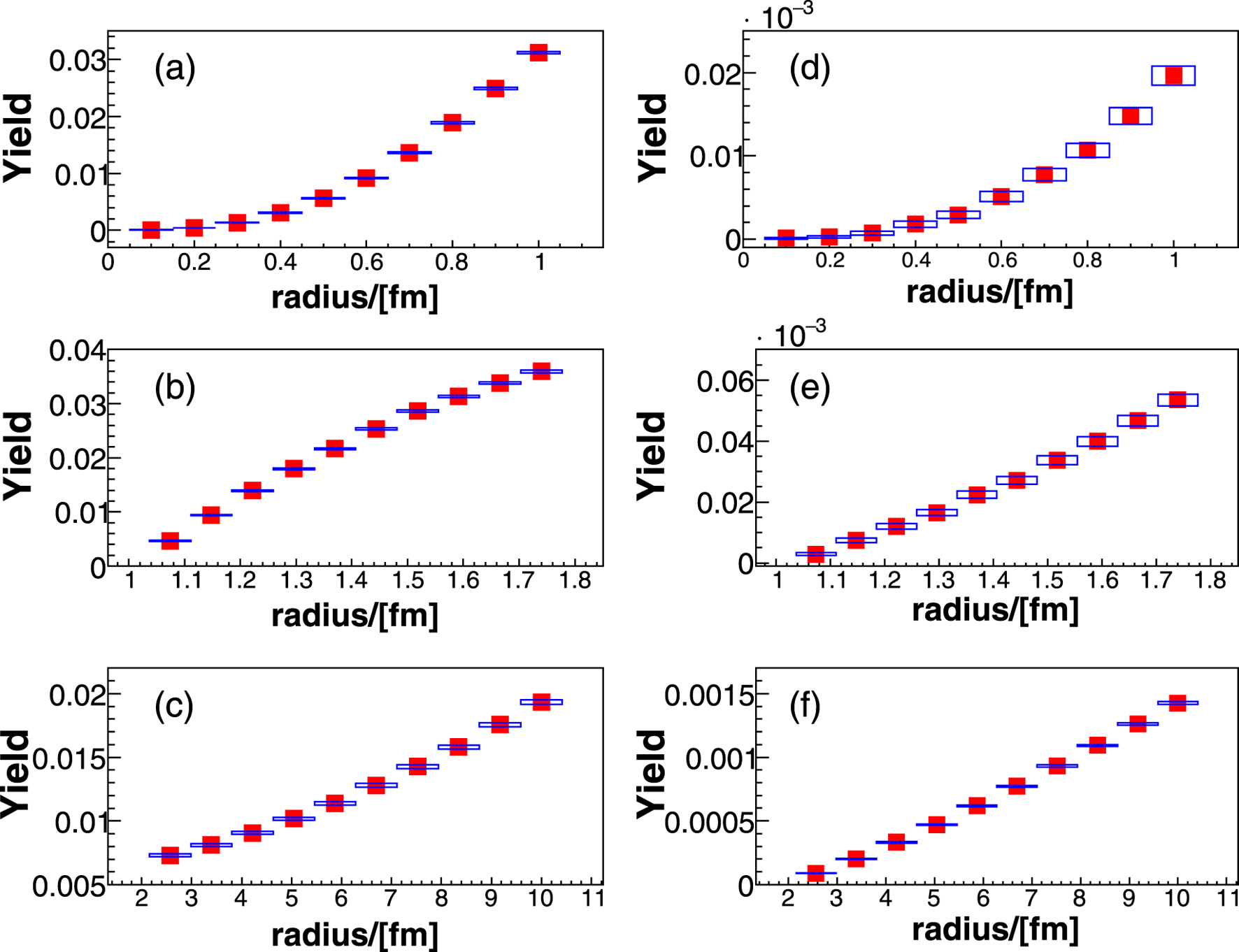
Radius distributions of Pb-Pb collisions at TeV. As a function of radius parameter R. The left and right hand plot is performed in centralities of and , respectively. The distribution in top, middle and bottom is for tetraquark, nuclear-like, molecular state. The blue empty markers indicates statistical uncertainties, red filled markers indicates data point by PACIAE + DCPC model.
Then, we calculate the yields of three structures of the in Pb-Pb collisions as parameter increases from 0.595 MeV (the half of the width of ) to MeV. The distribution of the yield of the as a function of is shown in Figure 2. From Figure 2, we observe that the yields of increase exponentially with increasing .
FIGURE 2
![Six graphs labeled (a) to (f) compare yield against mass difference (\(\Delta m/[MeV/c^2]\)) on logarithmic scales. Red squares with blue error bars depict data, showing increasing trends from \(10^{-3}\) to \(10^{-1}\) on the horizontal axis and varying scales on the vertical axis. Each subplot exhibits a positive correlation between yield and mass difference.](https://www.frontiersin.org/files/Articles/1604033/xml-images/fphy-13-1604033-g002.webp)
Mass distributions of the in Pb-Pb collisions at TeV as a function of mass uncertainty . The left and right hand plots correspond to centralities of and , respectively. The distribution in top, middle and bottom is for tetraquark, nuclear-like, molecular state. The blue empty markers indicate statistical uncertainties, while red filled markers indicate data points obtained by PACIAE + DCPC model.
As a reasonable prediction, we can predict the yields of the by assuming a mass uncertainty of MeV/ (obtained from [18]). The predicted yields of the in Pb-Pb collision at TeV within and centrality ranges are shown in Table 2. From these results, We observe that the yield is larger in central collisions. When comparing the yield in central Pb-Pb collision with pp collisions, we find that the yield in pp collision is lower.
TABLE 2
| Centrality | Tetraquark | Nuclear-like | Molecular |
|---|---|---|---|
The yield of with three states in 0%–10% and 30%–50% Pb-Pb collisions at TeV.
Moreover, we calculate the transverse momentum distribution of the tetraquark, nuclear-like and molecular states the . Figure 3 shows the transverse momentum distributions of these three different structures of the in Pb-Pb collision at TeV, for centralities of and . Obviously, the distributions of the for the three different structures are similar to each other. From the distributions, we can find the yield of increases with increasing in small range, and decreases with increasing in larger range. However, the molecular state exhibits a narrower distribution than the tetraquark state and nuclear-like state in the centrality range. In the centrality range, the differential yields of the compact and nuclear-like state of the are smaller than that of the molecular state of the , and their uncertainties are larger. The features of distributions may be used to distinguish of different structure.
FIGURE 3
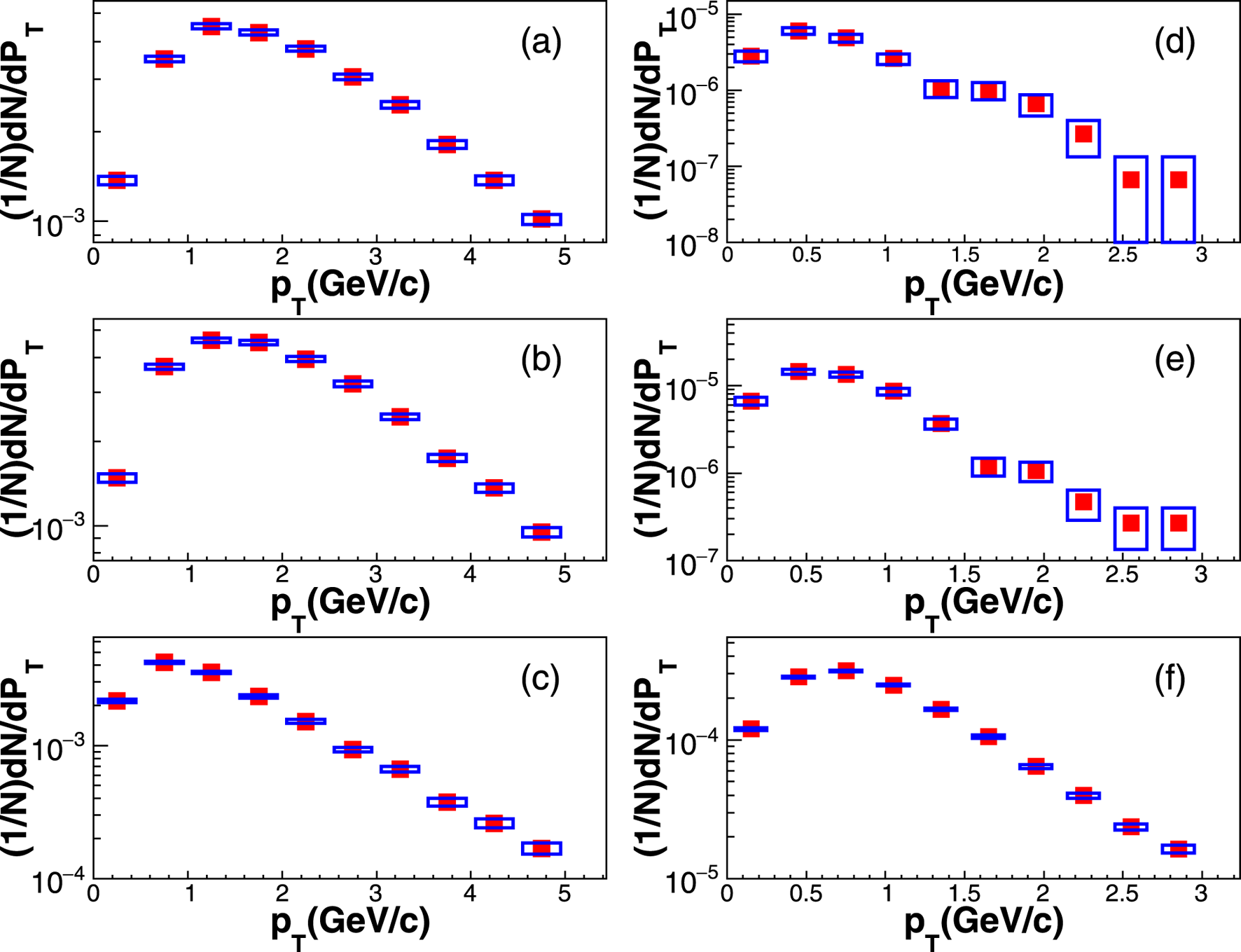
The transverse momentum distributions of the as a tetraquark state, nuclear-like state and molecular state. The left and right hand plot correspond to centralities of and , respectively. The distribution in top, middle and bottom represent the tetraquark, nuclear-like, molecular state, respectively. The blue empty markers indicate statistical uncertainties, while the red filled markers indicate data point by PACIAE + DCPC model.
In Figure 3, we show the predicted pT-differential yields of the tetraquark, nuclear-like and molecular states of the . We also analyze the pT-differential yield ratios for the and , with the result shown in Figure 4.
FIGURE 4
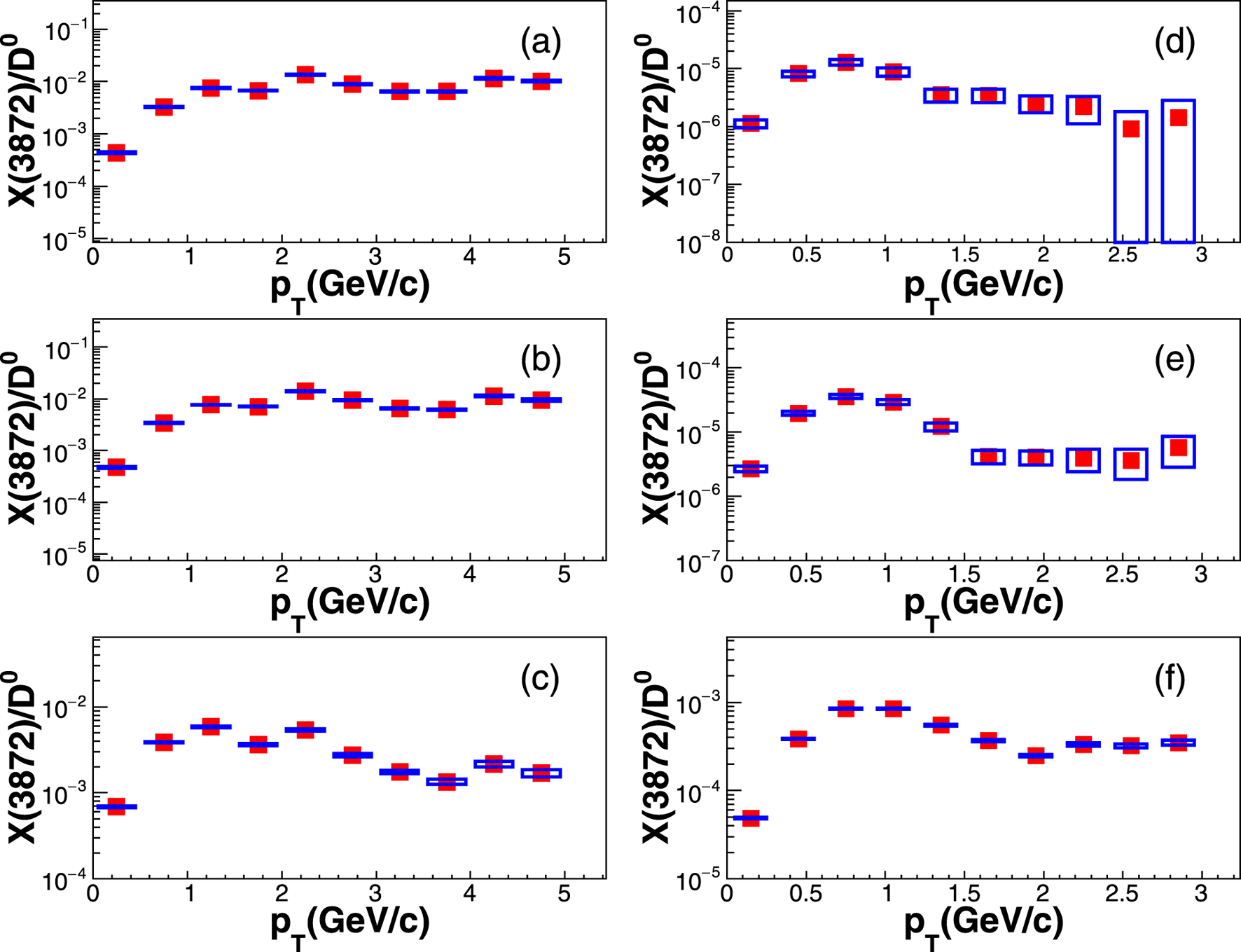
The yield ratio for and as a function of in centralities of (left panel) and (right panel) in collisions. The distribution in top, middle and bottom is the ratio for tetraquark, nuclear-like, molecular state of and , respectively. The blue empty markers indicates statistical uncertainties, red filled markers indicates data point by PACIAE + DCPC model.
From Figure 4, we observe that the yield ratio for the and in the centrality ranges of is larger than that in the centrality ranges of . In centrality, the yield ratio for the molecular state of the and is lower than that for the tetraquark and nuclear-like states of the . However, in centrality, the yield ratio for the molecular state of the and is higher than that for the tetraquark and nuclear-like states of the .
4 Conclusion
In this paper, we study the production of the in Pb-Pb collision at TeV within the centrality ranges of and using the PACIAE + DCPC model. First, we investigate the dependence of the production on the mass uncertainty and radius . The results indicate that the yields of increase with the increasing and . We also predict the yield of the tetraquark, nuclear-like and molecular states of the in Pb-Pb collision at TeV for centralities of and , respectively. Subsequently, we examine the transverse momentum of these three different states of the . We find that the distributions of the for the three different structures are generally similar to each other. However, in the centrality range, the molecular state exhibits a narrower distribution than tetraquark state and nuclear-like state .
Statements
Data availability statement
The original contributions presented in the study are included in the article/supplementary material, further inquiries can be directed to the corresponding author.
Author contributions
HX: Conceptualization, Data curation, Formal Analysis, Investigation, Methodology, Software, Validation, Writing – original draft, Writing – review and editing. ZS: Data curation, Resources, Software, Writing – review and editing. NY: Conceptualization, Funding acquisition, Project administration, Writing – review and editing. ZZ: Investigation, Methodology, Validation, Writing – review and editing.
Funding
The author(s) declare that financial support was received for the research and/or publication of this article. This work is supported by the Scientific Research Foundation of Hubei University of Education for Talent Introduction (No. ESRC20230002 and No. ESRC20230007) and Research Project of Hubei Provincial Department of Education (No. D20233003 and No. B2023191).
Conflict of interest
The authors declare that the research was conducted in the absence of any commercial or financial relationships that could be construed as a potential conflict of interest.
Generative AI statement
The author(s) declare that no Generative AI was used in the creation of this manuscript.
Publisher’s note
All claims expressed in this article are solely those of the authors and do not necessarily represent those of their affiliated organizations, or those of the publisher, the editors and the reviewers. Any product that may be evaluated in this article, or claim that may be made by its manufacturer, is not guaranteed or endorsed by the publisher.
References
1.
Gell-MannM. A schematic model of baryons and mesons. Phys. Lett. (1964) 8:214–5. 10.1016/s0031-9163(64)92001-3
2.
ZweigG, An SU3 model for strong interaction symmetry and its breaking. Version 1 10.17181/CERN-TH-401 (1964).
3.
ChoiSKOlsenSLAbeTAbeIAdachiIAiharaKet alObservation of a narrow charmonium-like state in exclusive B± → K±π+π−J/ψ decays. Phys. Rev. Lett. (2003) 91:262001. 10.1103/PhysRevLett.91.262001
4.
AubertBBarateRBoutignyDCoudercFGaillardJMHicheurAet alStudy of the B → J/ψK−π+π− decay and measurement of the B → X(3872)K− branching fraction. Phys. Rev. D (2005) 71:071103. 10.1103/PhysRevD.71.071103
5.
AcostaDAffolderTAhnMHAkimotoTAlbrowMGAmbroseDet al(CDF), Observation of the narrow state X(3872) → J/ψπ+π− in collisions at TeV. Phys. Rev. Lett. (2004) 93:072001. 10.1103/PhysRevLett.93.072001
6.
AbazovVMAbbottBAbolinsMAcharyaBSAdamsDLAdamsMet alObservation and Properties of the X(3872) Decaying to J/ψπ+π− in Collisions at TeV. Phys. Rev. Lett. (2004) 93:162002. 10.1103/PhysRevLett.93.162002
7.
NavasSAmslerCGutscheTHanhartCHernández-ReyJJLourençoCet alReview of particle physics*. Phys. Rev. D (2024) 110:030001. 10.1103/PhysRevD.110.030001
8.
LiuMZPanYWLiuZWWuTWLuJXGengLS. Three ways to decipher the nature of exotic hadrons: multiplets, three-body hadronic molecules, and correlation functions. Phys. Rept. (2025) 1108:1–108. 10.1016/j.physrep.2024.12.001
9.
ChenH-XChenWLiuXLiuY-RZhuS-L. An updated review of the new hadron states. Rept. Prog. Phys. (2023) 86:026201. 10.1088/1361-6633/aca3b6
10.
ChoSFurumotoTHyodoTJidoDKoCMLeeSHet alIdentifying multiquark hadrons from heavy ion collisions. Phys. Rev. Lett. (2011) 106:212001. 10.1103/physrevlett.106.212001
11.
ChoSHyodoTJidoDKoCMLeeSHMaedaSet alExotic hadrons from heavy ion collisions. Prog. Part. Nucl. Phys. (2017) 95:279–322. 10.1016/j.ppnp.2017.02.002
12.
HuYLiaoJWangEWangQXingHZhangH. Production of doubly charmed exotic hadrons in heavy ion collisions. Phys. Rev. D (2021) 104:L111502. 10.1103/physrevd.104.l111502
13.
ChenCHXieYLXuHGZhangZZhouDMSheZLet alExotic states Pc(4312), Pc(4440), and Pc(4457) in pp collisions at , 13 TeV. Phys. Rev. D (2022) 105:054013. 10.1103/PhysRevD.105.054013
14.
EspositoAFerreiroEGPilloniAPolosaADSalgadoCA. The nature of X(3872) from high-multiplicity pp collisions. Eur. Phys. J. C (2021) 81:669. 10.1140/epjc/s10052-021-09425-w
15.
ChenBYJiangLLiuXHLiuYPZhaoJX. X(3872) production in relativistic heavy-ion collisions. Phys. Rev. C (2022) 105:054901. 10.1103/physrevc.105.054901
16.
SirunyanAMTumasyanAAdamWAmbrogiFBergauerTDragicevicMet alEvidence for X(3872) in Pb-Pb collisions and studies of its prompt production at =5.02 TeV. Phys. Rev. Lett. (2022) 128:032001. 10.1103/PhysRevLett.128.032001
17.
XuHGSheZLZhouDMZhengLKangXLChenGet alInvestigation of exotic state X(3872) in pp collisions at , 13 TeV. Eur. Phys. J. C (2021) 81:784. 10.1140/epjc/s10052-021-09573-z
18.
ZhangHLiaoJFWangEKWangQXingHX. Deciphering the nature of X(3872) in heavy ion collisions. Phys. Rev. Lett. (2021) 126:012301. 10.1103/physrevlett.126.012301
19.
GrinsteinBMaianiLPolosaAD. Radiative decays of X(3872) discriminate between the molecular and compact interpretations. Phys. Rev. D (2024) 109:074009. 10.1103/physrevd.109.074009
20.
SaBHZhouDMYanYLLiXMFengSQDongBGet alPACIAE 2.0: an Updated parton and hadron cascade model (program) for the relativistic nuclear collisions. Comput. Phys. Commun. (2012) 183:333–46. 10.1016/j.cpc.2011.08.021
21.
SaBHZhouDMYanYLDongBGCaiX. PACIAE 2.1: an updated issue of the parton and hadron cascade model PACIAE 2.0. Comput. Phys. Commun. (2013) 184:1476–9. 10.1016/j.cpc.2012.12.026
22.
ZhouDMYanYLLiXLLiXMDongBGCaiXet alAn upgraded issue of the parton and hadron cascade model, PACIAE 2.2. Comput. Phys. Commun. (2015) 193:89–94. 10.1016/j.cpc.2015.01.022
23.
SjöstrandTMrennaSSkandsP. Pythia 6.4 physics and manual. J High Energ Phys (2006) 2006:026. 10.1088/1126-6708/2006/05/026
24.
ChenGYanYLLiDSZhouDMWangMJDongBGet alAntimatter production in central Au+Au collisions at =200 GeV. Phys. Rev. C (2012) 86:054910. 10.1103/physrevc.86.054910
25.
YanYLDongBGZhouDMLiXMSaBH. Theoretical analysis for the apparent discrepancy between and pp data in charged particle forward-backward multiplicity correlations. Phys. Lett. B (2008) 660:478–82. 10.1016/j.physletb.2008.01.048
26.
ZhouDMZhengLYanYLSongZHChenGLiXMet alImpact of single string structure and multiple string interaction on strangeness production in Pb + Pb collisions at TeV. Phys. Rev. C (2020) 102:044903. 10.1103/physrevc.102.044903
27.
ZhengLZhouDMYinZBYanYLChenGCaiXet alEffect of single string structure and multiple string interaction on strange particle production in pp collisions at TeV. Phys Rev C (2018) 98:034917. 10.1103/physrevc.98.034917
28.
CombridgeBLKripfganzJRanftJ. Hadron production at large transverse momentum and QCD. Phys Lett B (1977) 70:234–8. 10.1016/0370-2693(77)90528-7
29.
YanYLChenGLiXMZhouDMWangMJHuSYet alPredictions for the production of light nuclei in pp collisions at and 14 TeV. Phys Rev C (2012) 85:024907. 10.1103/physrevc.85.024907
30.
StoweK. An introduction to thermodynamics and statistical mechanics. 2nd ed.Cambridge University Press (2007).
31.
KuboRIchimuraHUsuiTHashizumeN. Statistical mechanics: an advanced course with problems and solutions. North-Holland Pub. Co (1965).
32.
RagabNASheZLChenG. The production of light (anti-)nuclei and (anti-)hypertriton in pp collisions at = 0.9, 2.76, and 7 TeV. Eur Phys J Plus (2020) 135:736. 10.1140/epjp/s13360-020-00735-8
33.
XuHGChenGYanYLZhouDMZhengLXieYLet alStudy on the States Decaying to in pp collisions at , 13 TeV. Phys Rev C (2020) 102:054319. 10.1103/PhysRevC.102.054319
34.
WuCTSheZLPengXYKangXLXuHGZhouDMet alStudy on the structure of exotic states χc1(3872) via beauty-hadron decays in pp collisions at TeV. Phys Rev D (2023) 107:114022. 10.1103/physrevd.107.114022
35.
ZhangZZhengLChenGXuHGZhouDMYanYLet alThe study of exotic state decaying to J/ψπ± in the pp collisions at = 1.96, 7, and 13 TeV. Eur Phys J C (2021) 81:198. 10.1140/epjc/s10052-021-08983-3
36.
LiuFXChenGSheZLZhengLXieYLDongZJet al production and characterization in Cu+Cu collisions at GeV. Phys Rev C (2019) 99:034904. 10.1103/PhysRevC.99.034904
37.
LiuFXChenGZheZLZhouDMXieYL. Light (anti)nuclei production in Cu+Cu collisions at GeV. Eur Phys J A (2019) 55:160. 10.1140/epja/i2019-12851-x
38.
ChenGChenHWuJLiDSWangMJ. Centrality dependence of light (anti)nuclei and (anti)hypertriton production in Au+Au collisions at =200 GeV. Phys Rev C (2013) 88:034908. 10.1103/physrevc.88.034908
39.
ChenGChenHWangJLChenZY. Scaling Properties of light (anti)nuclei and (anti)hypertriton production in Au+Au collisions at GeV. J Phys G (2014) 41:115102. 10.1088/0954-3899/41/11/115102
40.
DongZJChenGWangQYSheZLYanYLLiuFXet alEnergy dependence of light (anti)nuclei and (anti)hypertriton production in the Au-Au collision from to 5020 GeV. Eur Phys J A (2018) 54:144. 10.1140/epja/i2018-12580-8
41.
SheZLChenGLiuFXZhengLXieYL. Study of nuclear modification factors of (anti-)hadrons and light (anti-)nuclei in Pb-Pb collisions at = 2.76 TeV (2019).
42.
SheZLGangCXuHGZengTTLiDK. Centrality dependence of light (anti)nuclei and (anti)hypertriton production in Pb-Pb collisions at TeV. Eur Phys J A (2016) 52:93. 10.1140/epja/i2016-16093-2
43.
AcharyaSAdamováDAdhyaSPAdlerAAdolfssonJAggarwalMMet alProduction of charged pions, kaons, and (anti-)protons in Pb-Pb and inelastic pp collisions at TeV. Phys Rev C (2020) 101:044907. 10.1103/PhysRevC.101.044907
44.
AcharyaSAdamováDAdlerAAdolfssonJAgnelloMAgrawalNet alPrompt D0, D+, and D*+ production in Pb–Pb collisions at = 5.02 TeV. J High Energ Phys (2022) 174. 10.1007/JHEP01(2022)174
45.
YanYLZhouDMLeiAKLiXMZhangXMZhengLet alRevisiting the centrality definition and observable centrality dependence of relativistic heavy-ion collisions in paciae model. Comput Phys Commun (2023) 284:108615. 10.1016/j.cpc.2022.108615
Summary
Keywords
heavy ion collision, exotic hadron, hadronic molecular state, tetraquark state, nuclear-like state
Citation
Xu H, She Z, Yu N and Zhang Z (2025) Production of the in Pb-Pb collisions at TeV from PACIAE model. Front. Phys. 13:1604033. doi: 10.3389/fphy.2025.1604033
Received
01 April 2025
Accepted
20 June 2025
Published
09 July 2025
Volume
13 - 2025
Edited by
Shahin Agaev, Baku State University, Azerbaijan
Reviewed by
Atif Arif, COMSATS University, Pakistan
Fabrizio Grosa, European Organization for Nuclear Research (CERN), Switzerland
Updates
Copyright
© 2025 Xu, She, Yu and Zhang.
This is an open-access article distributed under the terms of the Creative Commons Attribution License (CC BY). The use, distribution or reproduction in other forums is permitted, provided the original author(s) and the copyright owner(s) are credited and that the original publication in this journal is cited, in accordance with accepted academic practice. No use, distribution or reproduction is permitted which does not comply with these terms.
*Correspondence: Ning Yu, ning.yuchina@gmail.com
Disclaimer
All claims expressed in this article are solely those of the authors and do not necessarily represent those of their affiliated organizations, or those of the publisher, the editors and the reviewers. Any product that may be evaluated in this article or claim that may be made by its manufacturer is not guaranteed or endorsed by the publisher.