 Yifei Lyu
 Xiangyu Wang
- 1School of Music, Baotou Teachers’ College, Inner Mongolia University of Science and Technology, Baotou, China
- 2School of Architecture and Art Design, Inner Mongolia University of Science and Technology, Baotou, China
Introduction: Music therapy has gained increasing recognition for its benefits in educational settings, particularly in supporting students with diverse learning needs and promoting overall well-being. However, existing reviews reveal several limitations, including fragmented research efforts, limited interdisciplinary and international collaboration, and practical constraints such as insufficient funding and a shortage of trained music therapists. These gaps highlight the need for a more comprehensive understanding of the field’s development.
Methods: This research systematically examined publication trends, key contributors, and thematic clusters in the field of music therapy in education. Both quantitative indicators (e.g., publication and citation patterns) and qualitative thematic analysis were employed to generate an integrated overview of current research dynamics.
Results: The analysis revealed a strong increase in publications and citations, largely driven by Western institutions. Despite this growth, several persistent challenges were identified: research fragmentation, limited international collaboration, and a notable underrepresentation of studies focusing on media-related aspects of music therapy.
Discussion: The study recommends strengthening interdisciplinary and international research networks, expanding investigations into media-related practices, developing standardized assessment tools, and increasing support in terms of funding and professional development. These recommendations provide a strategic roadmap for advancing music therapy in educational contexts and offer actionable guidance for researchers, educators, and policymakers aiming to enhance its integration and effectiveness.
1 Introduction
Music therapy has become vital in educational settings, particularly for children with special needs. Music therapy improves learning outcomes and emotional well-being and has a long history and is backed by a number of theoretical models. From its early promotion by organizations like the National Society of Musical Therapeutics in the early 20th century to its integration into modern educational frameworks, music therapy has proven effective in addressing language, behavioral, and social challenges among students with neurological conditions such as autism spectrum disorder (Riley et al., 2019). Music therapy is a vital tool for both educators and therapists because it not only supports social interaction and inclusivity but also cognitive and emotional development.
Despite its significant benefits, existing literature reviews on music therapy in education reveal critical gaps and limitations. Current studies often present fragmented research efforts, with isolated thematic clusters and limited interdisciplinary collaboration, which hinder the development of cohesive theoretical frameworks. Furthermore, bibliometric analyses are crucial for charting research trends, evaluating contributions from around the world, and identifying influential studies, yet they have been conspicuously lacking in this field. The lack of comprehensive bibliometric reviews limits our understanding of the research landscape, collaboration networks, and the overall impact of music therapy in education. Addressing these gaps through a bibliometric approach is crucial, as it provides a structured and quantitative assessment of the existing literature, facilitating informed decision-making and strategic planning for future research.
This study aims to conduct a bibliometric and content analysis of international research on music therapy in education in the past decade. It uses the bibliometrix package in R to map research trends, assess the productivity and impact of important sources and affiliations, and investigate international collaboration networks using data from the Web of Science and Scopus databases. This study also provides a detailed roadmap of the research output, identifies emerging trends, and highlights influential studies that can guide future investigations in the field.
The main contributions of this study are as follows:
(1) Identifying and visualizing the evolution of key themes and methodologies in music therapy within educational settings over the past two decades.
(2) Evaluating the extent and impact of international collaborations, highlighting key contributing countries and institutions.
(3) Determining the most impactful journals and publications offers insights into disseminating and recognizing research findings.
(4) Providing actionable recommendations to address identified challenges, promote interdisciplinary and international collaborations, and enhance the overall effectiveness of music therapy practices in education.
2 Methodology
Assessing and analyzing the current state of Music Therapy in Education research motivates this bibliometric and content analysis study. These analyses are able to identify research questions, limitations, methodologies, and knowledge boundaries, providing a comprehensive roadmap for future investigations (Altarturi et al., 2020). The bibliometric approach employed in this study involves four key phases: designing search keywords, collecting and creating the dataset, outlining findings, and analyzing the results, as shown in Figure 1. These phases help define relevant research areas, uncover current trends, and highlight influential studies that guide further research in the field.
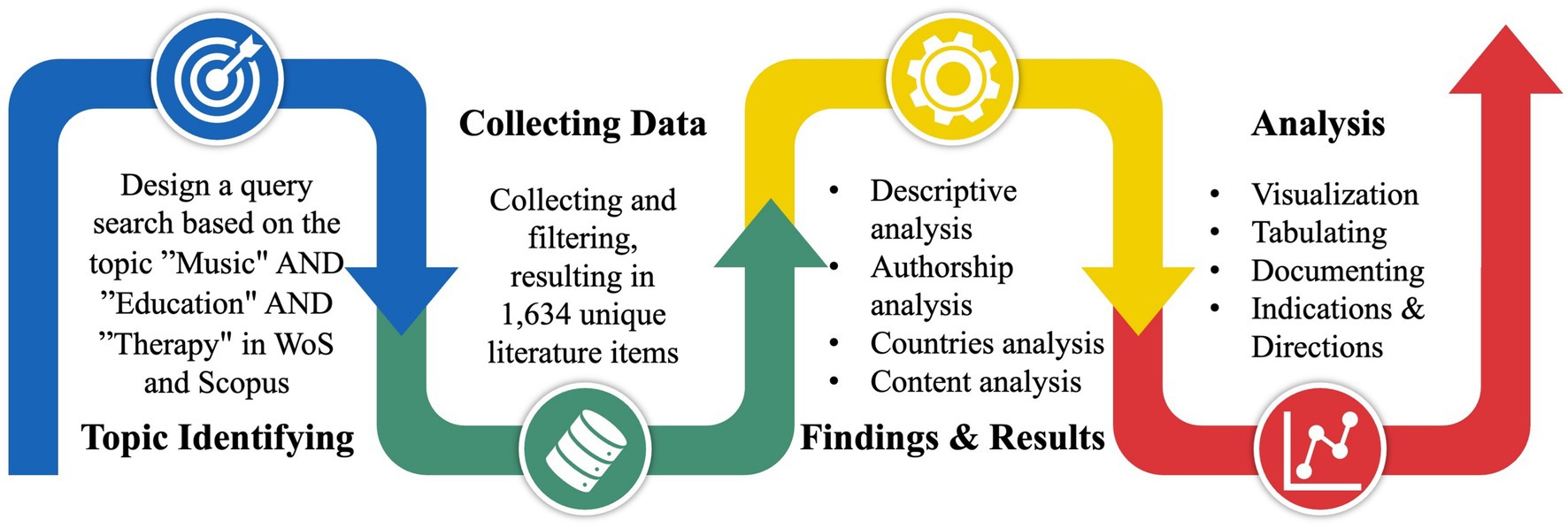
Figure 1. Methodology of the study.
The literature collection was conducted in January 2025 using the Web of Science (WoS) and Scopus databases. These were chosen because they cover a lot of ground and can produce bibliometric data. WoS is known for having a lot of high-impact publications, while Scopus has the biggest database of peer-reviewed research in many fields (Altarturi et al., 2023a). Using a structured query with Boolean operators, the study incorporated keywords related to music therapy and education, including synonyms, to ensure a broad and inclusive search. The search query combined keyword groups related to music therapy and education. By using Boolean operators (“AND,” “OR”), it captures all relevant variants such as “music therapy,” “music-based intervention,” “music education,” “school,” and “learning.” The query collected publications from 2004 to 2024 and retrieved 1,463 records from Scopus and 794 from Web of Science (WoS). Using the mergeDbSources() function of the bibliometrix R library (as described in its official documentation) to automatically remove duplicates, followed by a manual screening of titles and abstracts for accuracy, the final dataset comprised 1,634 unique documents.
For the bibliometric analysis, the study utilised the bibliometrix package in R accessed through the Biblioshiny web interface. Biblioshiny facilitates comprehensive data processing. This software supports various analytical tasks such as content analysis, corpus pre-processing, and visualization of findings. We used the package’s standard functions [e.g., biblioAnalysis(), conceptualStructure(), thematicMap()] to do all the analysis, including keyword co-occurrence, thematic evolution, and conceptual structure mapping. We followed the package’s official documentation where theme extraction and clustering were done automatically, making sure that the results were consistent and could be repeated without the need for manual coding or inter-coder validation. Furthermore, country-level analysis was predicated on the institutional affiliation of the corresponding author, as cataloged in Scopus and Web of Science, instead of the researcher’s individual nationality.
Alongside the bibliometric analysis, a narrative synthesis was performed to qualitatively assess theoretical frameworks, therapeutic mechanisms, and educational applications of music therapy. The narrative synthesis was directly extracted from the identical bibliometric corpus, guaranteeing methodological coherence between quantitative and qualitative analyses. From the 1,634 documents, a subset of 212 publications was manually screened based on inclusion criteria emphasizing (a) educational or school-based contexts, (b) music therapy models such as CoMT, NMT, or Dalcroze, and (c) empirical or theoretical contributions relevant to learning or psychological outcomes. Papers without explicit educational components or insufficient methodological detail were excluded. While no formal quality appraisal was conducted, consistent with bibliometric standards, only peer-reviewed and conceptually relevant works were included to ensure rigor. The two analyses complemented each other: the bibliometric mapping quantified global patterns and trends, while the narrative synthesis contextualized these results by interpreting theoretical foundations, intervention mechanisms, and pedagogical applications within education.
3 Findings
3.1 Descriptive analysis
The Summary Information section provides essential statistics on the examined dataset. Table 1 highlights 1,634 items published between 2004 and 2024 across 937 sources, involving 5,064 authors. A co-author ratio of 3.61 and an international collaboration rate of 6.18% were recorded. Keywords Plus (6,565) and author’s keywords (3,763) show diverse research focus, with 14.17 average citations per document. A 9.43% annual growth rate indicates rising interest and development in music therapy in education. Additionally,

Table 1. Summary information of the dataset.
Table 2 reveals a predominant reliance on journal articles, constituting over two-thirds of the dataset.

Table 2. Types of literature items in the dataset.
3.1.1 Annual growth of publications
The annual growth in Music Therapy in Education research publications (shown in Figure 2) demonstrates a consistent upward trajectory, increasing from 30 articles in 2004 to 182 in 2024. The significant acceleration in publication volume post-2015 likely reflects enhanced institutional support and a growing acknowledgment of music therapy’s impact on student outcomes.

Figure 2. Yearly publication growth for the ethnic media domain.
3.1.2 Top 15 impacting sources
The impact and productivity of scientific sources in Music Therapy in Education research are assessed through key bibliometric indicators such as the number of publications (NP), total citations (TC), and h-index.
Table 3 highlights the most influential journals contributing to the field, providing a comprehensive overview of the primary platforms shaping current discourse. These metrics collectively offer insights into the journals’ ability to disseminate impactful research and sustain academic relevance over time.

Table 3. Analysis of the top 15 most impacting sources in the dataset.
Among the top sources, the Journal of Autism and Developmental Disorders stands out with the highest total citations. Music Therapy Perspectives and the Journal of Music Therapy also demonstrate substantial influence. Additionally, interdisciplinary journals like Plos One and Frontiers in Psychology indicate the field’s expanding reach and integration with broader psychological and community music research.
Despite the presence of highly cited journals, the data reveals a concentration of impactful work within a limited number of sources. A large portion of the 937 sources contributing only a single publication and a notable number receiving no citations. The emergence of 105 new sources in 2023 onwards suggests growing diversification.
3.1.3 Top contributing affiliations
The number of publications from affiliation is a crucial metric to gauge its academic influence and contribution to Music Therapy in Education research. Figure 3 highlights the leading institutions, with the top 10 affiliations collectively accounting for a significant portion of the research output. Institutional names were standardized to merge duplicates (e.g., ‘University of Melbourne’ and ‘The University of Melbourne’) and aggregated by system when applicable (e.g., University of Minnesota System) Notably, universities from diverse geographical regions, including North America, Asia, and Africa, demonstrate substantial involvement, reflecting the global interest and varied perspectives contributing to the field’s advancement.

Figure 3. Top contributing affiliations based on the number of articles.
Despite the prominent contributions from these key institutions, the data reveals that most affiliations have limited engagement, with nearly half contributing only to a single publication. Enhancing collaboration and supporting a wider range of institutions could foster a more inclusive and comprehensive development of music therapy practices in educational settings (Figure 4).

Figure 4. Countries’ collaboration on the ethnic media field.
3.2 Countries analysis
The landscape of ethnic media research is shaped by contributions from various countries. In the dataset under analysis, 75 countries have made their mark. Evaluating the contributions of each country offers a panoramic view of the global research dynamics, highlighting the influence and commitment of different nations to this domain. This section delves into two distinct metrics: countries’ productivity and collaborations.
3.2.1 Countries’ impact and productivity
In this section, each document is attributed to the country of its primary author, ensuring that every document is associated with just one country. This method facilitates the calculation of Single Country Publications (SCP) and Multiple Country Publications (MCP) metrics, along with the Total Citation (TC), number of publications, and frequency appearance in all literature. The MCP ratio further refines our understanding of collaboration levels among countries. Additionally, this section delves into the total citation counts for each nation, as detailed in Table 5.
The United States remains the foremost contributor, demonstrating both high productivity and substantial citation impact. Other significant contributors include China, the United Kingdom, Australia, and Canada. Notably, countries like Italy and the United Kingdom show higher MCP percentages.
Despite the strong contributions from these leading nations, the data reveals that the majority of countries engage primarily in single-country publications, with limited international collaboration. Furthermore, while most countries have made multiple contributions, a significant number still have minimal participation, highlighting disparities in research resources and collaborative networks.
3.2.2 Collaboration between countries
This section examines the international collaboration dynamics within Music Therapy in Education research, highlighting the patterns of co-authorship between countries, as shown in Table 4. The collaboration network is predominantly centered around a few key partnerships, with the USA and the United Kingdom leading the way through extensive joint publications. Strong ties also exist between the USA and Australia, as well as the USA and Canada, reflecting a significant concentration of collaborative efforts among these nations. Additionally, European countries such as Germany, Italy, and Spain demonstrate notable collaborative relationships, often interconnected with the United Kingdom and Australia, suggesting regional clusters of cooperative research.

Table 4. Analysis of countries’ impact and productivity.
Despite these active partnerships, the overall level of international collaboration remains relatively limited, with most country pairs engaging in only a handful of joint publications. Furthermore, the emergence of collaborations involving countries like China, India, and Brazil indicates gradual expansion, yet these remain sparse compared to established partnerships.
3.3 Authorship analysis
Various metrics, including the h-index, total citation count (TC), and number of publications, are utilised to evaluate authors’ scientific output and influence in Music Therapy in Education research, as shown in Table 5.

Table 5. Authorship analysis based on publication metrics.
Prominent contributors such as Michael J. Silverman and Felicity Baker exhibit substantial publication records and citation impacts. However, the analysis reveals that most authors engage only once, highlighting a highly fragmented authorship landscape.
The predominance of single-publication authors and the many works with minimal citations indicate challenges in achieving widespread recognition and impact. Additionally, the recent influx of new contributors points to growing interest, yet the field continues to rely heavily on a small group of prolific authors. Enhancing support for emerging scholars and promoting sustained contributions can help ensure that Music Therapy in Education benefits from both breadth and depth of scholarly input.
3.4 Content analysis
3.4.1 Author keywords
This section uses author keywords to reveal significant trends in Music Therapy in Education research. The Timeline Bubble Plot, illustrated in Figure 5, highlights shifts in focus, with early studies focusing on foundational themes like music therapy and education. Over time, specialised topics such as mental health, anxiety, and dementia emerged, reflecting the field’s growth in addressing psychological and developmental challenges.

Figure 5. Trend Topics over time in the field of music therapy education.
From 2015 onwards, core themes like “music therapy” and “music” remained prominent, while emerging topics like “virtual reality,” “creativity,” and “randomised controlled trial” signal the integration of innovative methodologies. The rise of “covid-19” highlights responsiveness to global health crises, alongside increasing focus on holistic and evidence-based mental health and education approaches.
3.4.2 Keywords plus
This section uses Keywords Plus with Multiple Correspondence Analysis (MCA) to identify thematic clusters in Music Therapy in Education research, illustrated in Figure 6. Six clusters emerge, with Cluster 1 focusing on foundational concepts like “music therapy” and “psychology,” Cluster 2 addressing demographic and methodological aspects such as “female,” “male,” and “controlled study,” and Cluster 3 highlighting the intersection of “music” and “education.”

Figure 6. Dendrogram of the Keywords Plus in the field of music therapy education.
Clusters 5 and 6 focus on health-related themes, including conditions like “anxiety,” “dementia,” and “pain,” as well as broader topics like “quality of life” and therapeutic interventions such as “psychotherapy.” Cluster 4, represented by “therapy,” is a central link between various therapeutic approaches.
3.4.3 Abstract and title analysis
This section analyses abstracts and titles using Natural Language Processing (NLP) techniques (Altarturi et al., 2023b), focusing on bigrams and co-occurrence patterns to uncover key research themes in Music Therapy in Education. The Walktrap clustering algorithm identifies six thematic clusters, highlighting interconnected concepts and revealing research strengths and gaps, as shown in Figure 7.

Figure 7. Network co-occurrence illustration for title and abstract contents in the field of music therapy education.
Cluster 1 focuses on foundational elements like “music therapy” and “psychology,” while Cluster 2 addresses demographics and methodologies such as “controlled study.” Cluster 3 emphasises the role of “music” in “education,” and Clusters 5 and 6 explore health themes like “anxiety” and “pain management,” showcasing music therapy’s application in diverse health contexts.
4 Music therapy in education
Music therapy has become a vital component in educational settings, particularly for children with special needs. Its application is grounded in a rich historical context and supported by various theoretical models that underscore its effectiveness in enhancing learning outcomes and emotional well-being. This section explores the theoretical frameworks, benefits, methodologies, and challenges of music therapy in education.
To avoid conceptual overlap, this study distinguishes music therapy from music education. Music therapy is a clinical and evidence-based practice conducted by certified therapists to achieve therapeutic, emotional, or cognitive goals, as American Music Therapy Association clarified. In comparison, music education focuses on developing musical skills, creativity, and literacy through structured pedagogy. While both share musical processes and learning contexts, their objectives, methods, and outcomes differ, with therapy targeting personal well-being and education emphasizing artistic and academic development.
4.1 Theoretical framework
Music therapy has a long history, beginning with early mentions in 1789 and evolving through formal academic programs in the mid-20th century under pioneers like E. Thayer Gaston. It has become particularly beneficial in educational settings, enhancing language, behavioral, and social skills for students with neurological challenges and autism (Riley et al., 2019).
4.1.1 Developmental models
One of the important models focuses on students’ growth and development in skills through music. Music education fosters cognitive development by enhancing perception, learning, and memory skills. It also supports emotional growth by allowing students to express and manage emotions through music (Hargreaves and Lamont, 2017). For example, the Sequential Development model outlines several steps, such as personal connections and growth. The student who engages with music while learning a particular skill will develop that skill more effectively (Dvorak et al., 2017).
4.1.2 Ecological models
Environmental influences on the students are considered in the Ecological model, using theories like Bronfenbrenner’s Ecological systems theory. This is the immediate environment where students interact directly, such as family, school, and peers. Teachers and parents play a crucial role in this system by providing direct support and creating a nurturing environment (Khairul Amali et al., 2023). The relationship between home and school enables collaboration and communication between teachers and parents for the benefit of the children. Moreover, a comprehensive framework between home, school, community, and virtual support can optimise students’ learning experiences (Olson et al., 2023).
4.1.3 Community music therapy
Another model is Community Music Therapy (CoMT), which emphasises social interaction and community involvement. These models are encouraged to be used in communities like schools, as CoMT can help students with social challenges by involving them in group music activities, fostering social skills, and building relationships. Some studies show that CoMT children with autism spectrum disorder (ASD) particularly benefit from social interaction in comparison with traditional music education (Wang and Zhang, 2023). Other studies indicated that CoMT is linked to critical theory and conflict transformation, which is beneficial in school settings to promote harmony among students (Hassanein, 2023).
4.1.4 Neurological models
Neurological models demonstrate that music therapy stimulates brain areas linked to language, memory, and emotion, improving cognitive functions and brain connectivity in students with disabilities or ADHD. This approach allows for tailored interventions that enhance learning outcomes (Lai et al., 2023).
4.1.5 Integrative models
Integrative models combine elements from various theories, such as the Biopsychosocial Model, addressing biological, psychological, and social factors. In education, these models enhance learning outcomes by connecting language skills, content, culture, and technology (Qizi, 2024).
4.2 Benefits of music therapy in education
In the following section, the study will discuss the emotional and psychological benefits, cognitive benefits, and socio-emotional benefits of musical therapy in education and the strategies for implementing it in educational settings.
4.2.1 Emotional and psychological benefits
Music therapy offers a safe and creative outlet for emotional expression, enhancing emotional intelligence and reducing behavioral issues in the classroom (Wang et al., 2022). It effectively manages anxiety, depression, and trauma, thereby improving overall well-being and quality of life, as evidenced by significant reductions in psychological distress and improved mood regulation in structured programs (Chen et al., 2024).
4.2.2 Cognitive benefits
Music therapy enhances attention, concentration, and executive functions, particularly benefiting students with ADHD by reducing hyperactivity and improving focus (Lee et al., 2024). Additionally, it improves memory retention and recall by engaging both hemispheres of the brain, supporting learning in subjects like mathematics and language arts, and fostering creativity and critical thinking skills (Kousloglou et al., 2023; Nabila et al., 2024).
4.2.3 Socio-emotional benefits
Music therapy cultivates social skills and empathy through group activities such as composition and improvisation, promoting pro-social behaviors and emotional expression (Silke et al., 2024). It also boosts self-esteem and confidence, particularly in children with ADHD and other disabilities, fostering a growth mindset and motivation to face challenges (Sholeh and Supena, 2021).
4.2.4 Implementation of strategies in educational settings
Integrating music therapy into school curricula requires close collaboration between educators and certified music therapists, along with tailored interventions and professional development for teachers (Marcos Treceño and Arias Gago, 2024). Technological integration enhances accessibility and engagement, while supportive school environments and dedicated spaces for music activities significantly improve students’ academic performance and emotional health (Ahmed and Mohammed, 2024).
4.3 Methodologies in music therapy
Various music therapy methodologies address the needs of students with special educational requirements, enhancing emotional, cognitive, social, and behavioral functioning. Integrating these approaches into the curriculum creates inclusive learning environments.
4.3.1 Individualised music interventions
Personalised music interventions aligned with students’ Individualised Education Program (IEP) goals improve communication, social skills, and emotional expression in conditions like ASD and ADHD. Music therapy enhances emotional management and social development (Marcos Treceño and Arias Gago, 2024).
4.3.2 Group music therapy sessions
Group music therapy significantly enhances social Group settings foster social interaction, emotional health, and empathy. These sessions enhance social skills for children with ASD and adolescents with depression (Choi and Kirby, 2023). Improve interpersonal relationships and self-expression, and facilitate group music-making that leads to notable social development gains.
4.3.3 Music as a tool for behavioral management
Integrating music into daily routines supports emotional regulation, encourages positive behaviors, and refines classroom dynamics. Techniques like Musical Contour Regulation Facilitation (MCRF) aid emotion regulation in early childhood (Sena Moore and Hanson-Abromeit, 2015). Coordinated rhythmic movements improve focus, self-regulation, and overall classroom behavior (Williams, 2018).
4.3.4 Integration with educational curriculum
Embedding music therapy within academic subjects like language arts, math, and science creates holistic learning experiences and enhances student engagement. This interdisciplinary approach promotes critical and creative thinking skills necessary for 21st-century learners (Kuwar and Acharya, 2024). In math, music integration improves cognitive and motor skills (Souto, 2024). Educational music therapy advances inclusion, emotional management, and social development, ultimately improving learning outcomes (Marcos Treceño and Arias Gago, 2024).
4.3.5 Professional development for educators
Training in music therapy techniques empowers educators to create inclusive and supportive classrooms, ensuring effective application of music-based interventions (Li, 2024). Comprehensive professional development, including hands-on training and innovative tools like virtual reality, enhances teachers’ technical and pedagogical competence, addressing challenges such as limited resources (Elhambakhsh et al., 2024).
5 Challenges and limitations
The study highlights significant challenges in the field of Music Therapy in Education. Research is fragmented, with thematic clusters operating in isolation, limiting the development of cohesive theoretical frameworks. Interdisciplinary integration remains inadequate, as methodological approaches are not consistently linked to health or educational outcomes. Underrepresentation of media practices and cultural perspectives further constrains the field, while Western-centric viewpoints restrict global applicability. Oversaturation in core areas like anxiety and music therapy may stifle innovation.
Practical implementation in schools also faces substantial barriers. A shortage of qualified music therapists (Springer and Gooding, 2023) and misconceptions among educators and administrators hinder effective integration. Limited resources, budget constraints (Xinyue, 2024), and time restrictions (Clements-Cortes, 2023). impede consistent music therapy sessions. Individual variability in student responses, a lack of standardised assessments, and insufficient training opportunities (Raposo et al., 2023). make evaluation and advocacy more challenging. Addressing these issues through enhanced support, interdisciplinary collaboration, and broader cultural perspectives is essential for realizing the full potential of music therapy in education.
6 Discussion and future directions
The bibliometric and content analyses collectively highlight both the advancement and structural challenges within Music Therapy in Education. The field has experienced substantial growth, marked by a steady increase in publications and diverse thematic contributions since 2004. However, much of this expansion remains concentrated within Western institutions and journals, reflecting an uneven global landscape. Limited international collaboration and a dominance of single-country studies suggest barriers to broader knowledge exchange and inclusivity. Similarly, while the research output demonstrates strong academic grounding, the lack of interdisciplinary integration indicates that theoretical and methodological cohesion remains underdeveloped.
From a thematic standpoint, the keyword and clustering analyses indicate fragmentation within significant domains, including mental health, special education, and technological applications. Although the emergence of new areas, such as virtual reality, creativity, and systematic review approaches, signals methodological innovation, these remain loosely connected to core educational or therapeutic frameworks. The limited representation of media and technology in the literature further constrains understanding of how digital tools can enhance therapeutic engagement and educational accessibility. Strengthening links across these fragmented research clusters will be essential for building a coherent, evidence-based framework for music therapy in education.
Institutional and authorship analyses indicate that research productivity is heavily skewed toward a few universities and scholars, while most affiliations contribute only once. This suggests a significant degree of fragmentation and a low retention rate of active contributors in the domain. To address this problem, building capacity, creating mentorship networks, and making it easier for established and new researchers to work together are essential. The persistent shortage of qualified music therapists, coupled with funding and policy limitations, underscores the need for structural and institutional support to facilitate consistent implementation of music therapy programs in schools.
6.1 Key messages and practical implications
6.1.1 For teachers
For Teachers: Findings highlight strong evidence linking music therapy to improved focus, emotional regulation, and inclusion, especially for learners with ADHD, autism, and anxiety. To improve engagement and classroom well-being, teachers should use structured musical interventions and work with certified therapists.
6.1.2 For school administrators
The dominance of single-publication institutions indicates limited long-term engagement. Schools should establish sustained collaborations with universities and allocate dedicated spaces, time, and resources to embed music therapy consistently within curricula.
6.1.3 For policymakers
Low international collaboration (6.18%) and Western research dominance suggest inequities in access and perspective. Policymakers should fund cross-cultural programs, enforce therapist certification standards, and include music therapy in national education and mental-health frameworks.
6.1.4 For researchers
Subsequent research should amalgamate models such as CoMT, NMT, and Dalcroze, utilize longitudinal methodologies, and investigate virtual and data-driven therapeutic instruments to enhance theoretical and practical coherence.
Data availability statement
The original contributions presented in the study are included in the article/supplementary material, further inquiries can be directed to the corresponding author.
Author contributions
YL: Writing – original draft. XW: Writing – review & editing.
Funding
The author(s) declare that no financial support was received for the research and/or publication of this article.
Acknowledgments
The authors would like to express their sincere gratitude to all the researchers and institutions whose work contributed to the comprehensive dataset used in this study. We extend our appreciation to the Web of Science and Scopus databases for providing access to a vast array of scholarly publications.
Conflict of interest
The authors declare that the research was conducted in the absence of any commercial or financial relationships that could be construed as a potential conflict of interest.
Generative AI statement
The author(s) declare that Gen AI was used in the creation of this manuscript. Clarification of AI use: during manuscript preparation, we used the large-language-model service “ChatGPT” (OpenAI, May 2024 model) strictly as a writing-assistant tool. Functions performed: grammar and style polishing of drafts developed by the authors; help in restructuring paragraphs for concision or coherence; generating provisional keyword lists and outline templates. Functions not delegated to the AI: The AI produced no portion of the statistical/bibliometric analyses or underlying data; The AI generated no original results, interpretations, or conclusions; the authors performed all literature searching, screening, extraction and citation management manually. Verification: the authors, who accept full responsibility for the content, reviewed, edited where necessary, and fact-checked every AI-edited sentence against the cited sources. Authorship: the AI tool is not listed as an author and has no authorship claims. Thus, the AI acted only as a language-editing aid comparable to conventional grammar-checking software, with all intellectual contribution and accountability retained by the human authors.
Any alternative text (alt text) provided alongside figures in this article has been generated by Frontiers with the support of artificial intelligence and reasonable efforts have been made to ensure accuracy, including review by the authors wherever possible. If you identify any issues, please contact us.
Publisher’s note
All claims expressed in this article are solely those of the authors and do not necessarily represent those of their affiliated organizations, or those of the publisher, the editors and the reviewers. Any product that may be evaluated in this article, or claim that may be made by its manufacturer, is not guaranteed or endorsed by the publisher.
References
Ahmed, M. M., and Mohammed, O. (2024). The design of a creative environment to promote mental health and develop fine arts student’s skills. Int. Des. J. 14, 485–489. doi: 10.21608/idj.2024.282487.1135
Altarturi, H. H. M., Nor, A. R. M., Jaafar, N. I., and Anuar, N. B. (2023a). A bibliometric and content analysis of technological advancement applications in agricultural e-commerce. Electron. Commer. Res. 25, 805–848. doi: 10.1007/s10660-023-09670-z
Altarturi, H. H. M., Saadoon, M., and Anuar, N. B. (2020). Cyber parental control: a bibliometric study. Child Youth Serv. Rev. 116:105134. doi: 10.1016/j.childyouth.2020.105134
Altarturi, H. H. M., Saadoon, M., and Anuar, N. B. (2023b). Web content topic modeling using LDA and HTML tags. PeerJ Comput. Sci. 9:e1459. doi: 10.7717/peerj-cs.1459
Chen, Q., Mao, C., Qi, L., Luo, Y., Yang, G., Wang, L., et al. (2024). Music-based therapeutic interventions for medical school students with emotional regulation and mental health: a pre-post cohort study. Front. Psychol. 15:1401129. doi: 10.3389/fpsyg.2024.1401129
Choi, K., and Kirby, W. (2023). The effectiveness of group music therapy as a treatment for youths with depression. J. Stud. Res. 12:4100. doi: 10.47611/jsrhs.v12i1.4100
Clements-Cortes, A. (2023). A personal reflection on challenges facing music therapy education, training and clinical practice. Music Med. 15:942. doi: 10.47513/mmd.v15i4.942
Dvorak, A. L., Hernandez-Ruiz, E., Jang, S., Kim, B., Joseph, M., and Wells, K. E. (2017). An emerging theoretical model of music therapy student development. J. Music. Ther. 54, 196–227. doi: 10.1093/jmt/thx0005
Elhambakhsh, S. E., Neysani, M., and Nikbakht, A. (2024). Exploring L2 educators’ training and professional development needs in VR English language learning. Heliyon 10:e36700. doi: 10.1016/j.heliyon.2024.e36700
Hargreaves, D., and Lamont, A. (2017). The psychology of musical development. Cambridge, UK: Cambridge University Press.
Hassanein, Z. (2023). Peace camp: reflections on community music therapy and conflict transformation. Voices World Forum Music Ther. 23:3335. doi: 10.15845/voices.v23i1.3335
Khairul Amali, N. A., Mohd Ridzuan, M. U., Rahmat, N. H., Seng, H. Z., and Mustafa, N. C. (2023). Exploring learning environment through Bronfenbrenner’s ecological systems theory. Int. J. Acad. Res. Prog. Educ. Dev. 12, 144–162. doi: 10.6007/IJARPED/v12-i2/16516
Kousloglou, M., Petridou, E., Molohidis, A., and Hatzikraniotis, E. (2023). Promoting students’ critical thinking & problem solving skills via mobile-supported labs. Lisbon, Portugal: International Association for the Development of the Information Society (IADIS).
Kuwar, R., and Acharya, N. H. (2024). Integrated curriculum: concept, characteristics and consideration for planning and designing. ILAM 20, 176–196. doi: 10.3126/ilam.v20i1.67318
Lai, N., Philiastides, M., Kawsar, F., and Deligianni, F. (2023). Towards personalised music-therapy; a neurocomputational modelling perspective. Lisbon, Portugal: International Association for the Development of the Information Society (IADIS).
Lee, M.-W., Yang, N.-J., Mok, H.-K., Yang, R.-C., Chiu, Y.-H., and Lin, L.-C. (2024). Music and movement therapy improves quality of life and attention and associated electroencephalogram changes in patients with attention-deficit/hyperactivity disorder. Pediatr. Neonatol. 65, 581–587. doi: 10.1016/j.pedneo.2023.11.007
Li, Y. (2024). The impact of music education on the quality of talent cultivation. Trans. Comput. Educ. 6:60110. doi: 10.23977/trance.2024.060110
Marcos Treceño, G., and Arias Gago, A. R. (2024). The use of music therapy techniques as an educational tool: a systematic review. Res. Stud. Music Educ. 46, 230–256. doi: 10.1177/1321103X231192370
Nabila, N. P., Rahayu, F. A., and Elfina, E. M. R. (2024). Encourage students to think critical and innovative with the problem based learning model. Satmata J. Hist. Educ. Stud. 2, 17–22. doi: 10.61677/satmata.v2i1.176
Olson, A. B., Ozaki, C. C., and Johnston-Guerrero, M. P. (2023). Recentering the individual in context using the phenomenological variant of ecological systems theory: applications for higher education. N. Dir. High. Educ. 2023, 83–92. doi: 10.1002/he.20486
Qizi, A. D. X. (2024). An integrative approach to teaching English: enhancing language learning through multidimensional instruction. Int. J. Adv. Sci. Res. 4, 87–89. doi: 10.37547/ijasr-04-05-18
Raposo, M. M., Abreu, A. M., Dionizio, L. L., Leite, T., and Castro-Caldas, A. (2023). Music therapy assessment with the IMCAP-ND: a pilot study. Voices World Forum Music Ther. 23:3423. doi: 10.15845/voices.v23i1.3423
Riley, M., Colson, T., and Smothers, M. (2019). Music therapy’s role in the education system. Ky. Teach. Educ. J. J. Teach. Educ. Div. Ky. Counc. Except. Child. 6:1017. doi: 10.61611/2995-5904.1017
Sena Moore, K., and Hanson-Abromeit, D. (2015). Theory-guided therapeutic function of music to facilitate emotion regulation development in preschool-aged children. Front. Hum. Neurosci. 9:572. doi: 10.3389/fnhum.2015.00572
Sholeh, A., and Supena, A. (2021). A children’s music therapy to enhance the self-esteem of children with attention deficit hyperactivity disorder (ADHD) in elementary school. Al Ibtida: Jurnal Pendidikan Guru MI 8:93. doi: 10.24235/al.ibtida.snj.v8i1.7459
Silke, C., Davitt, E., Flynn, N., Shaw, A., Brady, B., Murray, C., et al. (2024). Activating social empathy: an evaluation of a school-based social and emotional learning programme. Soc. Emot. Learn. Res. Pract. Policy 3:100021. doi: 10.1016/j.sel.2023.100021
Souto, O. R. D. R. R. (2024). “The interrelated learning of mathematics and music” in Challenges and innovations in education: Scientific perspectives. I. de Souza Carvalho, (editor) (Logroño, Spain: Seven Editora).
Springer, D. G., and Gooding, L. F. (2023). Music therapy knowledge, interest, and career recommendations: a survey of music educators. Music. Ther. Perspect. 41, 159–168. doi: 10.1093/mtp/miad014
Wang, F., Huang, X., Zeb, S., Liu, D., and Wang, Y. (2022). Impact of music education on mental health of higher education students: moderating role of emotional intelligence. Front. Psychol. 13:938090. doi: 10.3389/fpsyg.2022.938090
Wang, Y., and Zhang, T., (2023). The effect of music therapy on social interaction function in interventions with children with autism spectrum disorder.
Williams, K. E. (2018). Moving to the beat: using music, rhythm, and movement to enhance self-regulation in early childhood classrooms. Int. J. Early Child. 50, 85–100. doi: 10.1007/s13158-018-0215-y
Keywords: music therapy, music education, emotional well-being, content analysis, bibliometric analysis
Citation: Lyu Y and Wang X (2025) A horizon scan of music therapy in education. Front. Psychol. 16:1635258. doi: 10.3389/fpsyg.2025.1635258
Edited by:
Daniel H. Robinson, The University of Texas at Arlington College of Education, United StatesReviewed by:
Moushumi Sharmin, Western Washington University, United StatesMathieu Pater, Stichting Papageno Muziektherapie, Netherlands
Copyright © 2025 Lyu and Wang. This is an open-access article distributed under the terms of the Creative Commons Attribution License (CC BY). The use, distribution or reproduction in other forums is permitted, provided the original author(s) and the copyright owner(s) are credited and that the original publication in this journal is cited, in accordance with accepted academic practice. No use, distribution or reproduction is permitted which does not comply with these terms.
*Correspondence: Xiangyu Wang, d2FuZ3h5MjI2QGltdXN0LmVkdS5jbg==