 Vincenzo Mirabello
 Fernando Cortezon-Tamarit
 Sofia I. Pascu*†
A Corrigendum on
Oxygen Sensing, Hypoxia Tracing and in Vivo Imaging with Functional Metalloprobes for the Early Detection of Non-communicable Diseases
by Mirabello, V., Cortezon-Tamarit, F., and Pascu, S. I. (2018). Front. Chem. 6:27. doi: 10.3389/fchem.2018.00027
In the original article, there was a mistake in the legend for Figure 1 as published. The figure was not reprinted from (Hauge et al., 2017) but from (Horsman et al., 2012). The corrected legend appears below.
Figure 1. Schematic representation of tumor cells distribution under chronic (A) and acute (B) hypoxia. In a diffusion-limited chronic hypoxia condition (A) the oxygen molecules diffusing from the vessels are used by normoxic cells which result in a decrease of pO2 (C). The reduced level of molecular oxygen triggers the proliferation of hypoxic cells at the periphery of the blood vessels. When the vessels are functionally compromised, all the cells around the capillary become acutely hypoxic. Representative flows of pO2 over time in the occluded region are shown for comparison (D). Adapted with permission from Horsman et al. (2012).
Additionally, there was a small mistake in Figure 6 as there is a missing a methylene group. The corrected Figure 6 appears below.
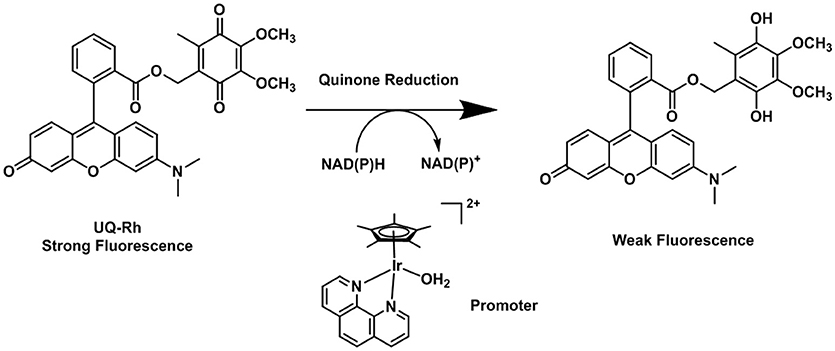
Figure 6. Reduction process of the fluorescent quinone derivative UQ-Rh by NAD(P)H (Komatsu et al., 2014).
In the original manuscript there was one error in Horsman et al. (2012) reference. The title read “Imaging hypoxia to improve radiotherapy outcome” and has now been corrected. Also page number range should be 674–687. The corrected wording for these references appear in the Reference List.
The authors apologize for these errors and state that this does not change the scientific conclusions of the article in any way.
The original article has been updated.
Conflict of Interest Statement
The authors declare that the research was conducted in the absence of any commercial or financial relationships that could be construed as a potential conflict of interest.
References
Hauge, A., Wegner, C. S., Gaustad, J.-V., Simonsen, T. G., Andersen, L. M. K., and Rofstad, E. K. (2017). DCE-MRI of patient-derived xenograft models of uterine cervix carcinoma: associations with parameters of the tumor microenvironment. J. Trans. Med. 15:225. doi: 10.1186/s12967-017-1331-4
Horsman, M. R., Mortensen, L. S., Petersen, J. B., Busk, M., and Overgaard, J. (2012). Imaging hypoxia to improve radiotherapy outcome. Nat. Rev. Clin. Oncol. 9, 674–687. doi: 10.1038/nrclinonc.2012.171
Keywords: oxygen sensing, molecular imaging, hypoxia, metals in medicine, FRET
Citation: Mirabello V, Cortezon-Tamarit F and Pascu SI (2018) Corrigendum: Oxygen Sensing, Hypoxia Tracing and in Vivo Imaging with Functional Metalloprobes for the Early Detection of Non-communicable Diseases. Front. Chem. 6:512. doi: 10.3389/fchem.2018.00512
Received: 01 October 2018; Accepted: 04 October 2018;
Published: 23 October 2018.
Edited and reviewed by: Simone Brogi, Università degli Studi di Siena, Italy
Copyright © 2018 Mirabello, Cortezon-Tamarit and Pascu. This is an open-access article distributed under the terms of the Creative Commons Attribution License (CC BY). The use, distribution or reproduction in other forums is permitted, provided the original author(s) and the copyright owner(s) are credited and that the original publication in this journal is cited, in accordance with accepted academic practice. No use, distribution or reproduction is permitted which does not comply with these terms.
*Correspondence: Vincenzo Mirabello, di5taXJhYmVsbG9AYmF0aC5hYy51aw==
Fernando Cortezon-Tamarit, Zi5jLmNvcnRlem9uLnRhbWFyaXRAYmF0aC5hYy51aw==
Sofia I. Pascu, cy5wYXNjdUBiYXRoLmFjLnVr
†These authors have contributed equally to this work