 Zhemi Xu
 Peiyuan Guan
 Tianhao Ji
 Yihong Hu3
 Zhiwei Li
 Nuo Xu
- 1College of Chemistry and Material Engineering, Beijing Technology and Business University, Beijing, China
- 2School of Materials Science and Engineering, University of New South Wales, Sydney, NSW, Australia
- 3College of Computer, National University of Defense Technology, Changsha, China
- 4College of Electronic Science and Technology, National University of Defense Technology, Changsha, China
Metal oxide-based memristors are promising candidates for breaking through the limitations in data storage density and transmission efficiency in traditional von Neumann systems, owing to their great potential in multi-state data storage and achievement of the in-memory neuromorphic computing paradigm. Currently, the resistive switching behavior of those is mainly ascribed to the formation and rupture of conductive filaments or paths formed by the migration of cations from electrodes or oxygen vacancies in oxides. However, due to the relatively low stability and endurance of the cations from electrodes, and the high mobility and weak immunity of oxygen vacancies, intermediate resistance states can be hardly retained for multilevel or synaptic resistive switching. Herein, we reviewed the memristors based on cationic interstitials which have been overlooked in achieving digital or analog resistive switching processes. Both theoretical calculations and experimental works have been surveyed, which may provide reference and inspiration for the rational design of multifunctional memristors, and will promote the increments in the memristor fabrications.
Introduction
As the memories and CPUs are separated in the current von Neumann computer system, the data have to be transferred between them through the limited bandwidth buses, which limits the time and energy efficiencies in the data processing. Such issue could be addressed by achieving an in-memory computing paradigm, for which the memristor is a suitable device because of its higher data storage density (Cheng et al., 2017; Chen et al., 2019) and excellent physical characteristics of conditional switching and physical MAC operation (Yang et al., 2017; Zhou et al., 2019; Xu et al., 2021; Li et al., 2022). Meanwhile, they can also bridge various electrical devices and be applied in energy storage, remote sensing, low-power applications, etc. (Chen, 2017; Han et al., 2020; Wang et al., 2020; Zhang and Sun, 2021) Thus, memristors are crucial for non-volatile memory, logic operations, Internet of Things, and neuromorphic computing in the big data era (Qin et al., 2020; Xu et al., 2020; Yao et al., 2020; Huang et al., 2021).
The memristor is a two-terminal electrical device that regulates the flow of electrical current in a circuit and remembers the amount of charge that has previously flowed through it even after removing the bias voltage (Fu et al., 2020). The original concept for memristors was proposed by Leon Chua in 1971, which was described as a nonlinear, passive two-terminal electrical component that linked electric charge and magnetic flux (Chua, 1971). This conceptual device has been firstly linked to a kind of physical resistive switching device (ReRAM) by HP labs in 2008 (Strukov et al., 2008). Nowadays, the definition of memristor has been broadened to the arbitrary form of non-volatile memory with the foundation principle of resistance switching.
So far, the state transition phenomenon in different material systems is employed to trigger the resistive switching (RS) behavior and further construct the different types of memristors. Except for the well-studied RS behavior in metal-oxide materials (Illarionov et al., 2020; Liu et al., 2021; Wang et al., 2021), phase change materials (Hazra et al., 2021), organic materials (Chen, 2017; Cheng et al., 2017), ferroelectric materials (Guan et al., 2017), and magnetic materials (Park et al., 2018) are also reported to exhibit the macroscopic RS behavior because of the transition of crystalline phase, ferroelectric polarization, and spin polarization respectively. Among these numerous material systems, the metal-oxide-based memristors are promising owing to their low cost, simple process, and high compatibility with complementary metal-oxide-semiconductor (CMOS) technology (Mohammad et al., 2016; Illarionov et al., 2020; Nili et al., 2020).
However, compared to the basic metal-oxide-semiconductor (MOS) transistor which is the foundation device of constructing the current computing system, the memristor is still suffering from the relatively low reliability caused by device fluctuation, limited stability, and durability to maintain the resistance value or to improve repeated erasable times. Therefore, rational design and optimization of the memristor active layer through material engineering for enhancing the performance of memristors are expected. The works on metal-oxide-based RS have been mainly focused on the migration or ionization of oxygen vacancies (VO) or cations from active electrodes (Waser et al., 2009; Chen et al., 2013; Kamiya et al., 2014; Tang et al., 2015). However, due to the high mobility of VO and relative low endurance of cation-based resistive random-access memories (RRAM), it is a challenge to maintain stable intermediate states, which greatly limited the applications of memristors in multi-level RS and artificial synapses.
Compared to Vo and cations from electrodes, another common ionic defect in metal oxides, cationic interstitial (Cint) can also contribute to the successful RS, which has been less focused on previously. In the limited reports, Cints have shown great potential in enhancing the performance of memristors with better stability and endurance, higher ON/OFF ratio, lower operation voltage, etc. Multi-level RS and synaptic RS have also been realized via modulating Cints in memristors. Hence, in this mini-review, we focused on studying the Cint-induced RS behaviors from the previous reports. Both theoretical and experimental works have been investigated, which may provide reference and inspiration for the rational design of multifunctional memristors from a new perspective and may shed some light on the increments in memristors.
Review of the Works Related to the First-Principle Studies
First-principles calculations have been always employed to investigate the mechanism of the RS behavior through some calculations in terms of formation energy, the density of states, partial charge densities, etc. For Cints-induced RS, there are two main contributions from Cints to realize or enhance the RS: forming a conductive path and promoting charge transfer in the metal oxides. Related works have been summarized in Table 1.

TABLE 1. Theoretical works on the Cint-induced RS behavior.
Gu et al. have compared the formation possibility of conductive paths with Cu interstitials (Cuint) and Vo in the Ta2O5 atomic switch through first-principles studies (Gu et al., 2010): Figure 1A shows that Cuint can form an effective conduction channel in the Ta2O5, as the formation of Cuint, may connect the two adjacent Ta-O planes through the simulation process, while Vo failed to form such a conductive channel. But it should be noted that the conductive path formed by Cints is sensitive to the concentrations of interstitials, which need to be tuned carefully in the experiments.
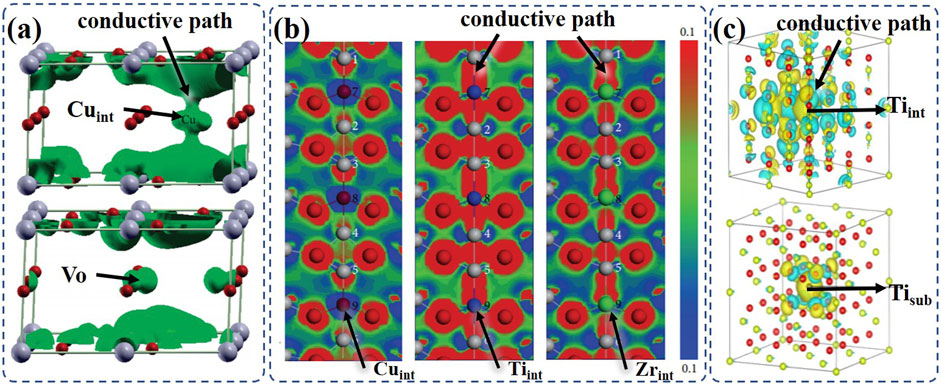
FIGURE 1. (A) Isosurface plot of the partial charge density corresponding to the defect state induced by the interstitial Cuint and Vo in Ta2O5 (reproduced with permission (Gu et al., 2010). Copyright 2010, American Chemical Society); (B) deformation electron density in [110] for the defected TiO2 with the Cuint, Tiint, and Zrint (reproduced with permission (Li et al., 2015). Copyright 2015, Lei Li et al.); (C) isosurface plots of Tiint and Tisub (reproduced with permission (Hussain et al., 2018). Copyright 2018, Springer-Verlag GmbH Germany).
The formation of the conductive path with Cints is sensitive to the valences of the doped cations as well. Li et al. have systematically calculated the TiO2 and ZrO2 with different Cints and investigated how Cints with different valence states may affect the transport coefficients (Li et al., 2015). Figure 1B illustrates the deformation electron densities for the TiO2 with Cuint, Tiint, and Zrint, respectively. The blue region around Cuint indicates that the loss of e− from Cu could form ionic bonds with nearby O atoms, while such a phenomenon has not been observed in the situation of Tiint and Zrint. The calculation results indicate that the transport coefficients of the materials with Tiint and Zrint are higher than that with Cuint. To optimize the RS behavior, the doping of metals with +4 or higher valences could be employed as it may enhance the transport properties.
Similarly, Zrint and Tiint in CeO2 and Taint in Ta2O5 have also been confirmed to contribute to the formation of conductive paths in memristor. As it is shown in Figure 1C, Tiint can form a more obvious conductive path in CeO2 compared to the Ti substitution (Tisub). And then, Tiint and Zrint have been introduced in experiments and successfully improved the RS performance of CeO2 RRAMs (Hussain et al., 2018). Zhu et al. compared the VO and Taint in the Ta2O5-based RRAM and confirmed the contribution of Taint in realizing RS under oxygen-poor conditions (Zhu et al., 2016). Thus, it is concluded that the Cints can introduce more defect states to above metal oxides than that of Vo, and the Cint-induced RS can be enhanced under an electric field.
The synergistic effects of Vo and Cints for achieving RS have also been identified in memristors. In the Au-doped HfO2, it has been confirmed that both Vo and Auint are involved in the formation of conductive filaments (Tan et al., 2018). Similarly, Abdelouahed et al. compared the TiO2 with Vo and Tiint and revealed the co-formation of both defects, which induced a net dipole moment, and enhanced RS behavior under an electric field (Abdelouahed and Mckenna, 2015).
Review of Experimental Works
Cint-induced or enhanced RS behavior in memristors has also been confirmed in experimental works (as summarized in Table 2).
·The formation of Cints and Cint-induced RS behavior
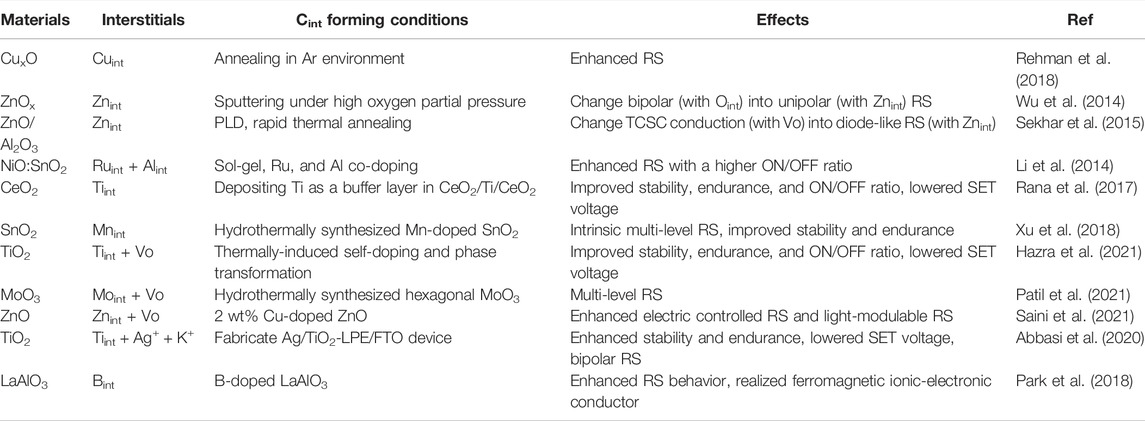
TABLE 2. Experimental works on the Cint-induced RS behavior.
The Cints can be introduced to metal oxides by modifying the synthesis parameters, such as the annealing conditions, oxygen partial pressure, doping concentration, etc. For example, by changing the annealing temperature and improving the oxygen concentration during the annealing process, Cuints have been successfully formed in the CuxO, and the RS can be enhanced by tuning the Cuints in the memristors (Rehman et al., 2018). In the sputtering process, by adjusting the oxygen partial pressure, the formation of Oint or Znint could be controlled, and interestingly, it is found that the bipolar and unipolar RS behavior can be tuned by forming Oint and Znint in the Al/ZnOx/Al memory device, respectively (Wu et al., 2014). In the pulsed laser deposition (PLD), rapid thermal annealing may also change the defects in ZnO/Al2O3 memristor: the trap-controlled-space-charge (TCSC) limited conduction mechanism has been observed when Vo dominates, while, diode-like RS behavior has been identified in the case of Znint dominating. In the latter, the stability, endurance, and ON/OFF ratio of the memristor have been significantly improved as it is shown in Figure 2A (Sekhar et al., 2015). Such transition is ascribed to the formation of ZnAL2O4 as an interlayer, which acts as the e− trapping/detrapping area and achieved successful RS.
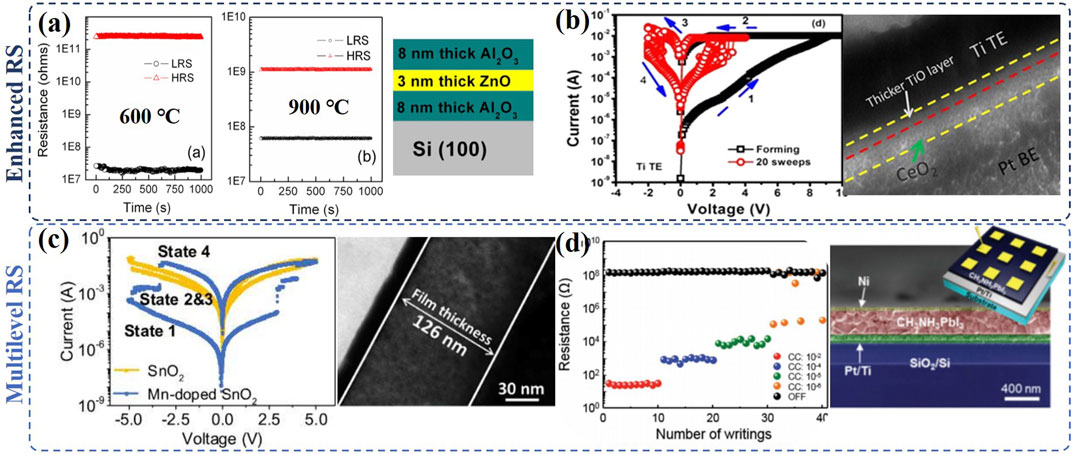
FIGURE 2. Enhanced RS performance and the cross-section images of the device based on (A) Al2O3/ZnO/Al2O3 memristors (reproduced with permission (Sekhar et al., 2015). Copyright 2015, Elsevier B.V.) and (B) CeO2/Ti/CeO2 (reproduced with permission (Rana et al., 2017). Copyright 2017, Anwar Manzoor Rana et al.); the multilevel RS and the cross-section images of the device based on (C) Mn-doped SnO2 (reproduced with permission (Xu et al., 2018). Copyright 2018, Elsevier Ltd.) and (D) CH3NH3PbI3 thin films (reproduced with permission (Choi et al., 2016). Copyright 2016, John Wiley & Sons, Inc.).
In the memristors fabricated from solution-processed, Cints are usually introduced via doping. In the NiO:SnO2 memristor, Ruint, and Alint can be achieved through Ru and Al co-doping in the sol-gel process (Li et al., 2014). Compared to the Vo induced RS, the RS behavior conducted by Ruint and Alint could be greatly improved and show a larger ON/OFF ratio. The enhanced RS is ascribed to the increased trapped states between the equilibrium Fermi level and conduction band by Ruint and Alint (Li et al., 2014). Mnints have been achieved in SnO2 by increasing the Mn-doping level to 12.5 mol% in the liquid-liquid interface hydrothermal process and compared to the pure SnO2 with Vo, Mn-doped SnO2 memristor shows more effective and stable RS with significantly larger ON/OFF ratio and better intermediate state retention (Xu et al., 2018).
Adding a buffer layer is another method to introduce the Cints. As it is illustrated in Figure 2B, Tiints have been introduced by a Ti buffer layer in the TaN/CeO2/Ti/CeO2/Pt memory device, in which Tiints assisted the formation of conductive filaments in CeO2. Compared to the device without the Ti buffer layer, the device’s stability and endurance could be significantly improved alongside the lower SET voltage and larger memory window (Rana et al., 2017). Similarly, by alternately depositing the SnO2 layer with Vo and Mn-doped SnO2 layer with Mnint, Mnints have been introduced to the SnO2-based RRAMs, which significantly enhance the RS behavior with a higher ON/OFF ratio and better stability and endurance (Xu et al., 2017).
·Cint-induced Multi-level RS
Multilevel RS has also been investigated in Cint-induced memristors. Intrinsic multi-state RS behavior with good endurance and stability has been observed in Mn-doped SnO2-based memristor by increasing the Mn-doping concentration, as it is illustrated in Figure 2C (Xu et al., 2018). By comparing the RS behavior of Mn-doping, Al-doping, and In-doping in SnO2 together with the XPS results and the calculated defect formation energies, the multi-level RS has been ascribed to Mnint instead of Vo. Iodine interstitials induced multi-level RS has also been achieved in the Ag/CH3NH3PbI3/Pt cells as shown in Figure 2D (Choi et al., 2016). Owing to the relatively low activation energies, the migration of Iint enables filament formation and annihilation at a relative operation voltage.
·Synergistic RS induced by Cint and other defects
Furthermore, the synergistic effect of Cints with other ionic defects in memristor has been confirmed in experiments more than the theoretical results above (Lee et al., 2021). The synergistic effect of Tiint with Vo has been confirmed in the Au/TiO2 nanotube/Ti memory (Hazra et al., 2021). In the Ti/MoO3/FTO memory cell, it is identified that Moint, surface defects, and Vo have contributed together to the multilevel RS behavior (Patil et al., 2021). Znint together with Vo enables the formation and rupture of conducting filaments in the Cu-doped ZnO, and both electric controlled and white light modulated RS has been achieved (Saini et al., 2021). Similarly, Vo and Iint assisted RS via a Schottky barrier tuning has also been verified in the Au/CH3NH3PbI3/TiO2/FTO memory device (Lee et al., 2021).
In addition, Cint can act as assistance or a game-changer in metal oxides. Figure 3A illustrates the defect-abundant memory device of Ag/TiO2-LPE (known as lime peel extract)/FTO, in which Tiint from TiO2, Ag+ oxidized from the Ag electrode, and K+ from the LPE synergistically contribute to the RS behavior. Tiints provide active paths for cation migrations, which enhanced the stability and endurance of bipolar RS of the memory cell with low operation voltage and high ON/OFF ratio (Abbasi et al., 2020). In the B-doped LaAlO3, Bints realized charge injection into the neighboring cations, which enables remarkable electrical RS and transformed the oxide into a ferromagnetic ionic-electronic conductor at the same time, as it is shown in Figure 3B. This extends applications of Cints to contribute to energy-efficient and spin-based devices (Park et al., 2018).
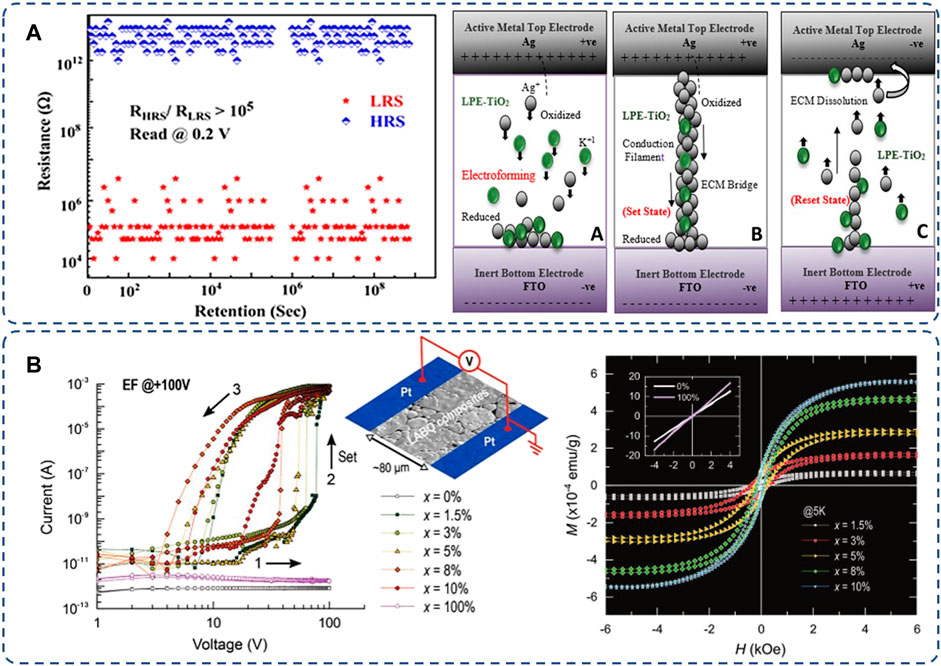
FIGURE 3. (A) Enhanced retention and the schematic of Tiint assisted the conductive filament with Ag+ and K+ (reproduced with permission (Abbasi et al., 2020). Copyright 2020, American Chemical Society); (B) the remarkably enhanced RS and ferromagnetic behavior by Bint in LaAlO3(1-x):LaBO3(x) (reproduced with permission (Park et al., 2018). Copyright 2018, John Wiley & Sons, Inc.).
Summary and Outlook
In summary, the cationic interstitials induced RS behavior in metal-oxide-based memories has been summarized. For a defect that has been less focused, there are very few reports on the formation, contribution, and mechanism of Cint-induced RS behavior compared to those on Vo or active electrodes. However, from both theoretical and experimental aspects, the Cint-induced or enhanced RS behavior has been confirmed in recent years. As discussed above, diversified Cints provide more opportunities to tailor the metal oxides for different electronic devices. The rational fabrication of memristors with Cints may give rise to remarkable enhancement in RS performance with better stability and endurance, lower operation voltage, higher ON/OFF ratio, faster device speed, etc. However, Cint-based memristors are sensitive to the concentration and valence state of Cint, which makes the formation of Cint in metal oxide synthesis need to be carefully modulated. By adjusting the Cints, suitable electric structures would be established in the metal oxides, which helps improve the performance of the electronic devices.
Author Contributions
All authors listed have made a substantial, direct, and intellectual contribution to the work, and approved it for publication.
Funding
ZX acknowledges financial support from the Beijing Technology and Business University (Grant No. 19005902140). YH, WW, and NX acknowledge financial support from the National Natural Science Foundation of China (Grant No. 61832007) and the Research Foundation from the National University of Defense Technology (Grant No. ZK20-02).
Conflict of Interest
The authors declare that the research was conducted in the absence of any commercial or financial relationships that could be construed as a potential conflict of interest.
Publisher’s Note
All claims expressed in this article are solely those of the authors and do not necessarily represent those of their affiliated organizations, or those of the publisher, the editors, and the reviewers. Any product that may be evaluated in this article, or claim that may be made by its manufacturer, is not guaranteed or endorsed by the publisher.
References
Abbasi, M. S., Irshad, M. S., Arshad, N., Ahmed, I., Idrees, M., Ahmad, S., et al. (2020). Biomaterial-Induced Stable Resistive Switching Mechanism in TiO2 Thin Films: The Role of Active Interstitial Sites/Ions in Minimum Current Leakage and Superior Bioactivity. ACS Omega 5, 19050–19060. doi:10.1021/acsomega.0c02410
Abdelouahed, S., and Mckenna, K. P. (2015). Relevance of Non-equilibrium Defect Generation Processes to Resistive Switching in TiO2. J. Appl. Phys. 118, 134103. doi:10.1063/1.4932225
Chen, E. T. (2017). Nanostructured Biomimetic Sensing and Energy Storage: Organic Memristor/Memcapacitors. Dekker Encyclopedia of Nanoscience and Nanotechnology. 3rd Edition. Boca Raton: CRC Press.
Chen, J.-Y., Hsin, C.-L., Huang, C.-W., Chiu, C.-H., Huang, Y.-T., Lin, S.-J., et al. (2013). Dynamic Evolution of Conducting Nanofilament in Resistive Switching Memories. Nano Lett. 13, 3671–3677. doi:10.1021/nl4015638
Chen, Z., Huang, W., Zhao, W., Hou, C., Ma, C., Liu, C., et al. (2019). Ultrafast Multilevel Switching in Au/YIG/n-Si RRAM. Adv. Electron. Mat. 5, 1800418. doi:10.1002/aelm.201800418
Cheng, X.-F., Xia, S.-G., Hou, X., Xiao, X., He, J.-H., Ren, Z.-G., et al. (2017). Racemic Effect on the Performance of Organic Multilevel Memory: beyond Molecular Design. Adv. Mat. Technol. 2, 1700202. doi:10.1002/admt.201700202
Choi, J., Park, S., Lee, J., Hong, K., Kim, D.-H., Moon, C. W., et al. (2016). Organolead Halide Perovskites for Low Operating Voltage Multilevel Resistive Switching. Adv. Mat. 28, 6562–6567. doi:10.1002/adma.201600859
Chua, L. (1971). Memristor-The Missing Circuit Element. IEEE Trans. Circuit Theory 18, 507–519. doi:10.1109/tct.1971.1083337
Fu, Y., Dong, B., Su, W.-C., Lin, C.-Y., Zhou, K.-J., Chang, T.-C., et al. (2020). Enhancing LiAlOX Synaptic Performance by Reducing the Schottky Barrier Height for Deep Neural Network Applications. Nanoscale 12, 22970–22977. doi:10.1039/d0nr04782a
Gu, T., Tada, T., Watanabe, S., Watanabe, S., Watanabe, S., and Watanabe, S. (2010). Conductive Path Formation in the Ta2O5 Atomic Switch: First-Principles Analyses. ACS Nano 4, 6477–6482. doi:10.1021/nn101410s
Guan, P., Sun, Y., Wan, T., Lin, X., Xu, Z., and Chu, D. (2017). Development of Ferroelectric Oxides Based Resistive Switching Materials. Mater. Sci. Technol. 33, 2010–2023. doi:10.1080/02670836.2017.1366712
Han, X., Xu, Z., Wu, W., Liu, X., Yan, P., and Pan, C. (2020). Recent Progress in Optoelectronic Synapses for Artificial Visual‐Perception System. Small Struct. 1, 2000029. doi:10.1002/sstr.202000029
Hazra, A., Tripathi, A., Jan, A., Kundu, S., and Boppidi, P. K. R. (2021). Multiple Nano-Filaments Based Efficient Resistive Switching in TiO2 Nanotubes Array Influenced by Thermally Induced Self-Doping and Anatase to Rutile Phase Transformation. Nanotechnology 32, 115201. doi:10.1088/1361-6528/abd05c
Huang, C., Xu, N., Qiu, K., Zhu, Y., Ma, D., and Fang, L. (2021). Efficient and Optimized Methods for Alleviating the Impacts of IR-Drop and Fault in RRAM Based Neural Computing Systems. IEEE J. Electron Devices Soc. 9, 645–652. doi:10.1109/jeds.2021.3093478
Hussain, F., Imran, M., Rana, A. M., Khalil, R. M. A., Khera, E. A., Kiran, S., et al. (2018). An Insight into the Dopant Selection for CeO2-Based Resistive-Switching Memory System: a DFT and Experimental Study. Appl. Nanosci. 8, 839–851. doi:10.1007/s13204-018-0751-7
Illarionov, G. A., Morozova, S. M., Chrishtop, V. V., Einarsrud, M. A., and Morozov, M. I. (2020). Memristive TiO2: Synthesis, Technologies, and Applications. Front. Chem. 8, 724. doi:10.3389/fchem.2020.00724
Kamiya, K., Yang, M. Y., Magyari-Kpe, B., Nishi, Y., Shiraishi, K., and Shiraishi, K. (2014). Modeling of Resistive Random Access Memory (RRAM) Switching Mechanisms and Memory Structures. Woodhead Publ. 8, 262. doi:10.1533/9780857098092.2.262
Lee, S., Wolfe, S., Torres, J., Yun, M., and Lee, J.-K. (2021). Asymmetric Bipolar Resistive Switching of Halide Perovskite Film in Contact with TiO2 Layer. ACS Appl. Mat. Interfaces 13, 27209–27216. doi:10.1021/acsami.1c06278
Li, J.-C., Cao, Q., and Hou, X.-Y. (2014). Ru-Al Codoping to Mediate Resistive Switching of NiO:SnO2 Nanocomposite Films. Appl. Phys. Lett. 104, 113511. doi:10.1063/1.4869231
Li, L., Xia, C., Li, W., Ji, A., Zhu, C., Zhang, L., et al. (2015). Nature of the Interstitials in Titanium Dioxide and Their Impact on Transmission Coefficient: Ab Initio Calculations. J. Nanomater. 2015, 574752.doi:10.1155/2015/574752
Li, Z., Long, H., Zhu, X., Wang, Y., Liu, H., Li, Q., et al. (2022). Error Detection and Correction Method toward Fully Memristive Stateful Logic Design. Adv. Intell. Syst. 1, 2100234.doi:10.1002/aisy.202100234
Liu, Z., Cheng, P., Li, Y., Kang, R., Zhang, Z., Zuo, Z., et al. (2021). High Temperature CsPbBrxI3-X Memristors Based on Hybrid Electrical and Optical Resistive Switching Effects. ACS Appl. Mat. Interfaces 13, 58885–58897. doi:10.1021/acsami.1c13561
Mohammad, B., Jaoude, M. A., Kumar, V., Al Homouz, D. M., Nahla, H. A., Al-Qutayri, M., et al. (2016). State of the Art of Metal Oxide Memristor Devices. Nanotechnol. Rev. 5, 311–329. doi:10.1515/ntrev-2015-0029
Nili, H., Vincent, A., Prezioso, M., Mahmoodi, M. R., Kataeva, I., and Strukov, D. (2020). Comprehensive Compact Phenomenological Modelling of Integrated Metal-Oxide Memristors. IEEE Trans. Nanotechnol. 19, 344–349. doi:10.1109/TNANO.2020.2982128
Park, D.-S., Rees, G. J., Wang, H., Rata, D., Morris, A. J., Maznichenko, I. V., et al. (2018). Electromagnetic Functionalization of Wide-Bandgap Dielectric Oxides by Boron Interstitial Doping. Adv. Mat. 30, 1802025. doi:10.1002/adma.201802025
Patil, S. R., Mullani, N. B., Kamble, B. B., Tayade, S. N., Kamat, R. K., Park, T. J., et al. (2021). Forming-free and Multilevel Resistive Switching Properties of Hydrothermally Synthesized Hexagonal Molybdenum Oxide Microrods. J. Mater Sci. Mater Electron 32, 12490–12502. doi:10.1007/s10854-021-05883-w
Qin, Y.-F., Bao, H., Wang, F., Chen, J., Li, Y., and Miao, X.-S. (2020). Recent Progress on Memristive Convolutional Neural Networks for Edge Intelligence. Adv. Intell. Syst. 2, 2000114. doi:10.1002/aisy.202000114
Rana, A. M., Akbar, T., Ismail, M., Ahmad, E., Hussain, F., Talib, I., et al. (2017). Endurance and Cycle-To-Cycle Uniformity Improvement in Tri-layered CeO2/Ti/CeO2 Resistive Switching Devices by Changing Top Electrode Material. Sci. Rep. 7, 39539. doi:10.1038/srep39539
Rehman, S., Hur, J.-H., and Kim, D.-K. (2018). Resistive Switching in Solution-Processed Copper Oxide (CuxO) by Stoichiometry Tuning. J. Phys. Chem. C 122, 11076–11085. doi:10.1021/acs.jpcc.8b00432
Saini, M., Kumar, M., Mandal, R., Mitra, A., and Som, T. (2021). White Light Modulated Forming-free Multilevel Resistive Switching in ZnO:Cu Films. Appl. Surf. Sci. 563, 150271. doi:10.1016/j.apsusc.2021.150271
Sekhar, K. C., Kamakshi, K., Bernstorff, S., and Gomes, M. J. M. (2015). Effect of Annealing Temperature on Photoluminescence and Resistive Switching Characteristics of ZnO/Al2O3 Multilayer Nanostructures. J. Alloys Compd. 619, 248–252. doi:10.1016/j.jallcom.2014.09.067
Strukov, D. B., Snider, G. S., Stewart, D. R., and Williams, R. S. (2008). The Missing Memristor Found. Nature 453, 80–83. doi:10.1038/nature06932
Tan, T., Cao, A., and Zha, G. (2018). A First-Principles Study of the Effects of Au Dopants in HfO2-Based RRAM. Superlattices Microstruct. 121, 38–44. doi:10.1016/j.spmi.2018.07.022
Tang, Z., Fang, L., Xu, N., and Liu, R. (2015). Forming Compliance Dominated Memristive Switching through Interfacial Reaction in Ti/TiO2/Au Structure. J. Appl. Phys. 118, 185309. doi:10.1063/1.4935622
Wang, S., Wang, C.-Y., Wang, P., Wang, C., Li, Z.-A., Pan, C., et al. (2020). Networking Retinomorphic Sensor with Memristive Crossbar for Brain-Inspired Visual Perception. Natl. Sci. Rev. 8, nwaa172. doi:10.1093/nsr/nwaa172
Wang, Y., Gong, Y., Yang, L., Xiong, Z., Lv, Z., Xing, X., et al. (2021). MXene‐ZnO Memristor for Multimodal In‐Sensor Computing. Adv. Funct. Mat. 31, 2100144. doi:10.1002/adfm.202100144
Waser, R., Dittmann, R., Staikov, G., Szot, K., Szot, K., and Szot, K. (2009). Redox-Based Resistive Switching Memories - Nanoionic Mechanisms, Prospects, and Challenges. Adv. Mat. 21, 2632–2663. doi:10.1002/adma.200900375
Wu, X., Xu, Z., Liu, B., Sun, T., Zhao, W., Liu, S., et al. (2014). Effect of Cation and Anion Defects on the Resistive Switching Polarity of ZnO X Thin Films. Appl. Phys. A 114, 847–852. doi:10.1007/s00339-013-7704-5
Xu, Z., Guan, P., Younis, A., Chu, D., Li, S., and Li, S. (2017). Manipulating Resistive States in Oxide Based Resistive Memories through Defective Layers Design. RSC Adv. 7, 56390–56394. doi:10.1039/c7ra11681k
Xu, Z., Younis, A., Cazorla, C., Yi, J., Chu, D., and Li, S. (2018). Engineering Cationic Defects in Transparent Tin Oxide Superlattices. Mater. Des. 155, 71–76. doi:10.1016/j.matdes.2018.05.061
Xu, N., Park, T. G., Kim, H. J., Shao, X., Yoon, K. J., Park, T. H., et al. (2020). A Stateful Logic Family Based on a New Logic Primitive Circuit Composed of Two Antiparallel Bipolar Memristors. Adv. Intell. Syst. 2, 1900082. doi:10.1002/aisy.201900082
Xu, N., Park, T., Yoon, K. J., and Hwang, C. S. (2021). In‐Memory Stateful Logic Computing Using Memristors: Gate, Calculation, and Application. Phys. Rapid Res. Ltrs 15, 2100208. doi:10.1002/pssr.202100208
Yang, C.-S., Shang, D.-S., Chai, Y.-S., Yan, L.-Q., Shen, B.-G., and Sun, Y. (2017). Electrochemical-reaction-induced Synaptic Plasticity in MoOx-Based Solid State Electrochemical Cells. Phys. Chem. Chem. Phys. 19, 4190–4198. doi:10.1039/c6cp06004h
Yao, P., Wu, H., Gao, B., Tang, J., Zhang, Q., Zhang, W., et al. (2020). Fully Hardware-Implemented Memristor Convolutional Neural Network. Nature 577, 641–646. doi:10.1038/s41586-020-1942-4
Zhang, H., and Sun, C. (2021). Cost-effective Iron-Based Aqueous Redox Flow Batteries for Large-Scale Energy Storage Application: A Review. J. Power Sources 493, 229445. doi:10.1016/j.jpowsour.2020.229445
Zhou, L., Yang, S., Ding, G., Yang, J.-Q., Ren, Y., Zhang, S.-R., et al. (2019). Tunable Synaptic Behavior Realized in C3N Composite Based Memristor. Nano Energy 58, 293–303. doi:10.1016/j.nanoen.2019.01.045
Keywords: resistive switching (RS), cationic interstitials, metal oxides, memristor, conductive filament
Citation: Xu Z, Guan P, Ji T, Hu Y, Li Z, Wang W and Xu N (2022) Cationic Interstitials: An Overlooked Ionic Defect in Memristors. Front. Chem. 10:944029. doi: 10.3389/fchem.2022.944029
Received: 14 May 2022; Accepted: 08 June 2022;
Published: 08 July 2022.
Edited by:
Meng Zheng, Qingdao Haiwan Science and Technology Industry Research Institute Co., Ltd, ChinaCopyright © 2022 Xu, Guan, Ji, Hu, Li, Wang and Xu. This is an open-access article distributed under the terms of the Creative Commons Attribution License (CC BY). The use, distribution or reproduction in other forums is permitted, provided the original author(s) and the copyright owner(s) are credited and that the original publication in this journal is cited, in accordance with accepted academic practice. No use, distribution or reproduction is permitted which does not comply with these terms.
*Correspondence: Nuo Xu, eHVudW9AbnVkdC5lZHUuY24=