 Ruxian Chen1,2
 Salma Kanwal
 Saima Noor
- 1School of Public and General Education, Guangzhou Civil Aviation College, Guangzhou, Gaudong, China
- 2Institute of Computing Science and Technology, Guangzhou University, Guangzhou, China
- 3Department of Basic Science, Preparatory Year, King Faisal University, Al-Ahsa, Saudi Arabia
- 4Department of Mathematics, College of Science, King Faisal University, Al-Ahsa, Saudi Arabia
- 5Department of Mathematics, Lahore College for Women University, Lahore, Pakistan
In this paper, we investigate square-hexagonal chains, a class of systems where the inner dual of a structure with a square-hexagon shape forms a path graph. The specific configuration of square and hexagonal polygons, and how they are concatenated, leads to different types of square-hexagonal chains. A square containing a vertex of degree 2 is classified as having a kink, and the resulting kink is referred to as a type
1 Preliminaries
Graph theory is a mathematical discipline that studies graphs, which are abstract structures used to model and analyze relationships between objects. A Graph
In chemical graph theory, the numerical values assigned to a molecular graph, known as topological indices or molecular descriptors, are often used to correlate with chemical structures and their properties. In other words, topological indices refer to graph invariants or descriptors that have significant chemical relevance. These indices are based on the graphical representation of a molecule and can encode chemical information such as atom types and bond multiplicities. Topological indices are valuable for predicting specific chemical and physical properties of the underlying molecular structure, combining logical and mathematical principles to translate a molecule’s symbolic representation into a useable numerical form. Chemical graph theory, which merges the fields of chemistry and graph theory, uses graphs to represent chemical structures, providing insights into the physical and chemical characteristics of molecules.
The first degree based topological descriptor was introduced by Milan Randic in 1975 in his paper (Randic, 1975) “On characterization of molecular branching.” This index is referred to as Randic index and is defined as
The Randic index has been recognized as a valuable tool in drug design and has been widely used for this purpose in various studies (Randic, 1975).
The first and second Zagreb indices are the oldest degree based graph invariants introduced by Gutman and Trinajstic (Gutman and Trinajstic, 1972b) in 1972. They were later included among topological descriptors and are defined as
The first and second Zagreb indices were initially applied to branching problem (Gutman et al., 1975b). Later, they found applications in QSPR and QSAR studies (Balaban, 1979; Bonchev and Trinajsti, 2001; Devillers and Balaban, 1999).
The applicability of Zagreb indices motivated the researchers to define different variants of Zagreb indices. The Hyper Zagreb index was put forwarded by Shirdel et al. (Shirdel et al., 2013) in 2013 and is defined as
Another variant of Zagreb indices namely, first and second redefined Zagreb indices were introduced by Ranjini et al. (Ranjini et al., 2013)
Motivated by the definitions of first and second Zagreb indices and their chemical applicability, V. Kulli (Kulli, 2017a) introduces the first and second Gourava indices. These topological indices are defined as
The first and second Revan descriptors were introduced by V. Kulli (Kulli, 2017b) and are defined as
where
For more details on the importance of topological indices and their applications see (Noreen and Mahmood, 2018; Wei and Shiu, 2019; Raza, 2020; Wei et al., 2020; Fang et al., 2021; Alraqad et al., 2022; Zhang X. et al., 2023; Zhang Guoping et al., 2023; Hui et al., 2023a; Hui et al., 2023b; Huang et al., 2023). For results related to mathematical properties of the topological indices, we refere (Zhou, 2004; Zhao et al., 2016; Gao et al., 2017; Kulli, 2017c; Kulli, 2017e; Zhang et al., 2024; Govardhan et al., 2024; Prabhu et al., 2024a; Prabhu et al., 2024b).
2 Square-hexagonal system and kink chains
A square-hexagonal system, also known as a rectangular hexagonal system, is a connected geometric structure created by joining equal-sized squares and hexagons. This arrangement blends elements of square and hexagonal lattices, forming a distinctive repeating pattern that combines the characteristics of both shapes. The lattice points in this system create a regular and continuous design, where each polygon is linked to its neighbors. Two polygons are considered neighboring if they share a common edge, emphasizing the interconnected nature of this hybrid structure. This system is widely used in crystallography and materials science, particularly for analyzing the structures of materials with hexagonal crystal systems that exhibit square symmetry along specific crystallographic directions. It provides a geometric framework for understanding the arrangement of atoms, ions, or other structural components within such materials.
A square-hexagonal system is a two-dimensional lattice structure that combines square and hexagonal elements in a unified arrangement. In contrast, a square-hexagonal chain is a one-dimensional sequence where square and hexagonal configurations alternate along its length. While both concepts incorporate square and hexagonal features, they differ in their structure and intended applications. The structure of a square-hexagonal chain varies depending on the types of polygons used and how they are concatenated. A square-hexagonal chain composed of
To derive key results, it is important to introduce certain terminologies related to square-hexagonal chains. In graph theory, a kink refers to a point in the graph where there is a sudden change in direction or slope. More precisely, a kink is a vertex whose degree is greater than the degrees of its neighboring vertices, resulting in a bend or angular deviation in the graph’s structure.
Kinks play a significant role in graph analysis, as they often highlight structural changes or key points within the graph. They can influence various graph properties and algorithms, including traversal methods, connectivity analysis, and the identification of critical nodes or hubs in networks. In network analysis, for instance, identifying kinks or high-degree vertices can reveal essential nodes that contribute significantly to the network’s connectivity or exert considerable influence. Moreover, the presence of kinks can affect processes like random walks, as high-degree vertices are more likely to attract repeated visits, thereby altering the overall dynamics of the system.
A polygon at one end of a chain, typically lacking a neighboring polygon on one of its sides, is referred to as a terminal polygon. In contrast, a polygon located within the chain, with neighboring polygons on both sides and not positioned at the chain’s ends, is termed a non-terminal polygon.
If the centers of two adjacent non-terminal polygons are not collinear, the polygon is described as kinked in the chain. There are two types of square-hexagonal kinks, denoted as
(1)
(2)
(3)
(4)
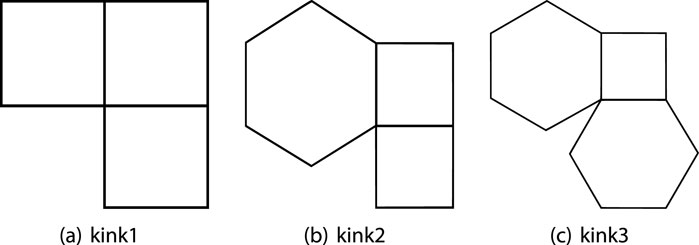
Figure 1. Kinks of Type
In graph theory, the expected values of topological indices serve as statistical measures of a graph’s structural properties, capturing key characteristics such as connectivity, distances, and vertex degrees. These values are particularly valuable for analyzing and comparing random graphs, optimizing network designs, and predicting behaviors in fields like chemistry, biology, and social networks. Additionally, they enable the development of efficient algorithms for large-scale graph analysis by reducing the computational complexity of calculating indices across various graph models. Our work is motivated from our previous work on the kink chains introduced in (Chunsong et al., 2024). We considered three types of kink chains,
(a)
(b)
(c)
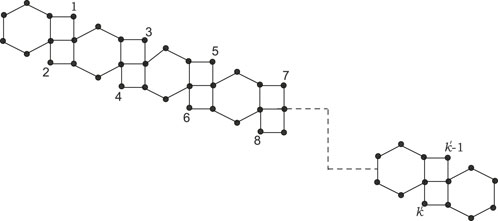
Figure 2.
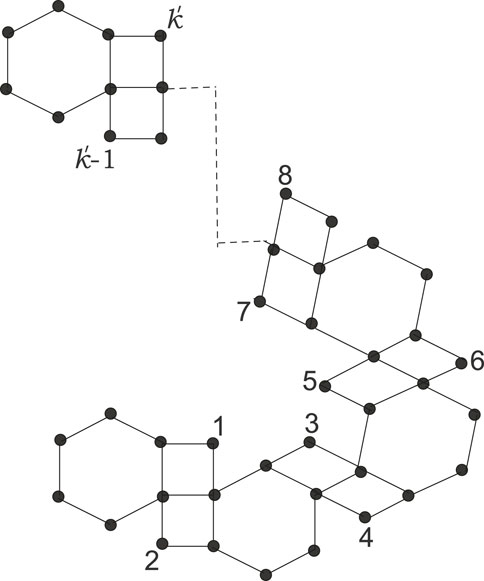
Figure 3.
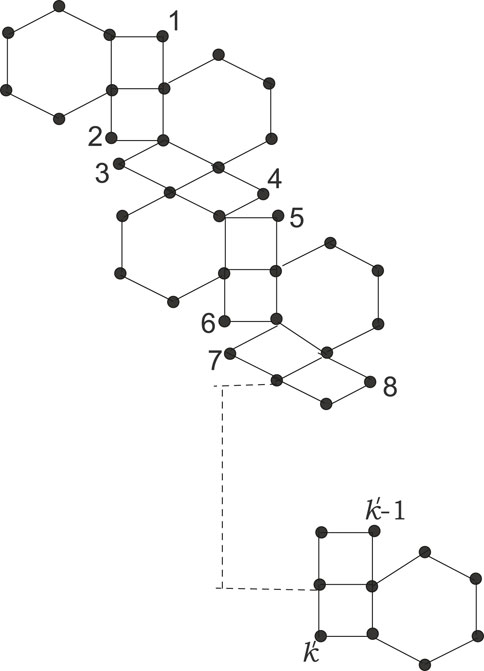
Figure 4.
Observe that there is no edge between two adjacent vertices of degree 2, only one edge between two adjacent vertices of degree 2, and two edges between two adjacent vertices of degree two in kink chains
2.1 Vertex and corresponding edge partitions of
Let
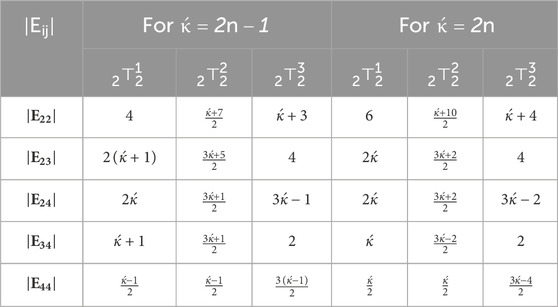
Table 1. Edge partitions of
Let
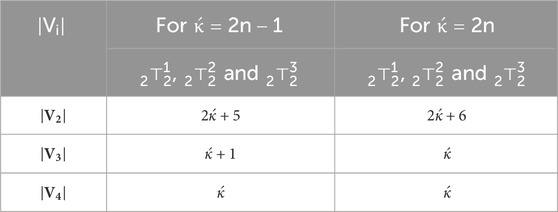
Table 2. Vertex partitions of
3 Topological descriptors of
In this section, we will calculate some topological descriptors of
Lemma 1. For
Proof. For
For
Lemma 2. For
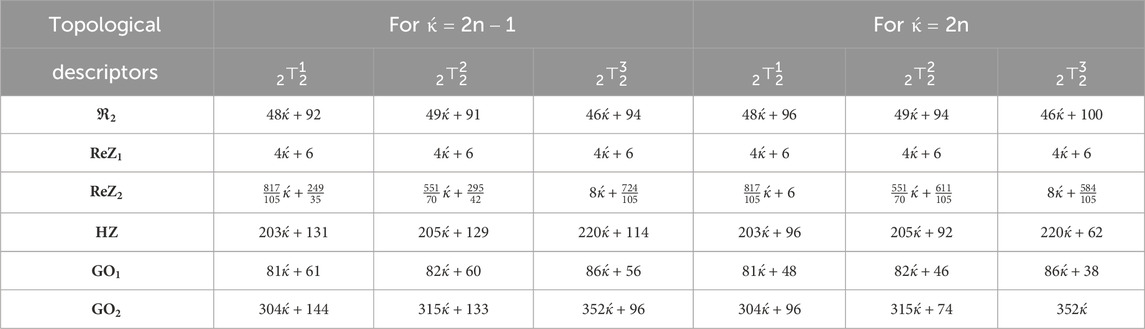
Table 3. Topological descriptors of
4 Graphical representation of numerical values of topological descriptors of
In this section, we compared the above calculated topological descriptors using graphical representation of
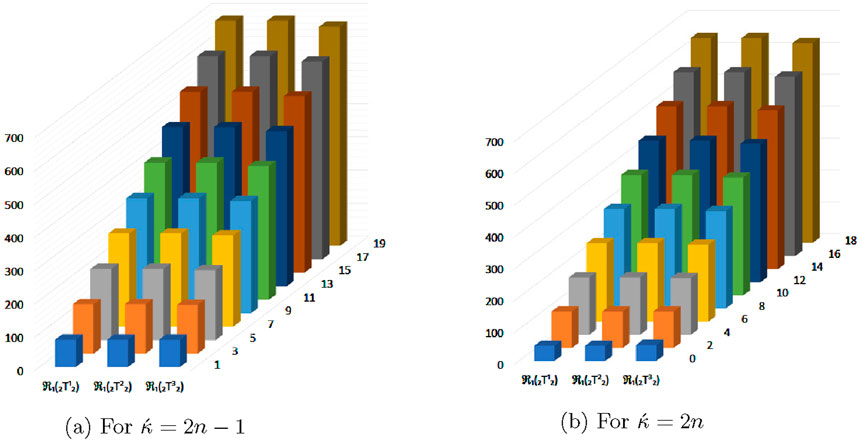
Figure 5. Graphical representation of
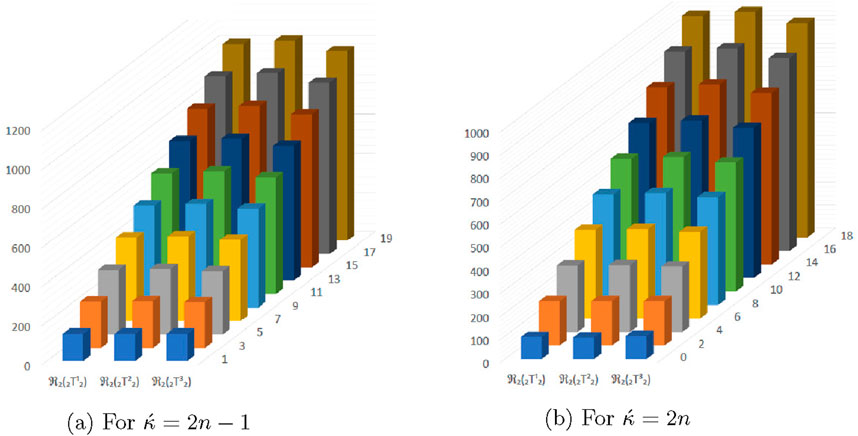
Figure 6. Graphical representation of
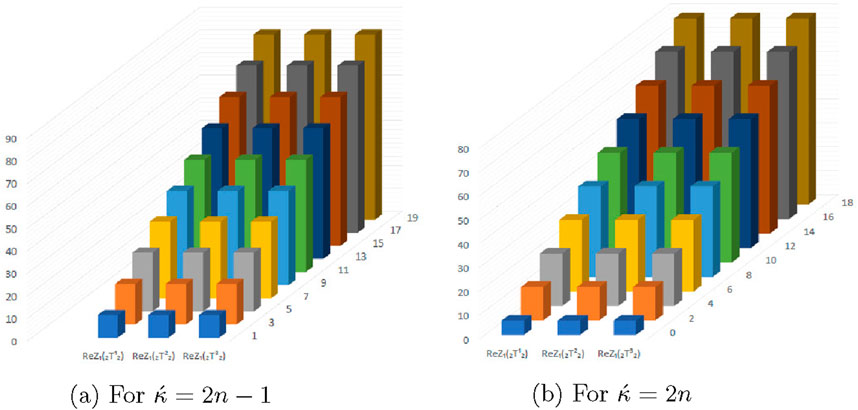
Figure 7. Graphical representation of
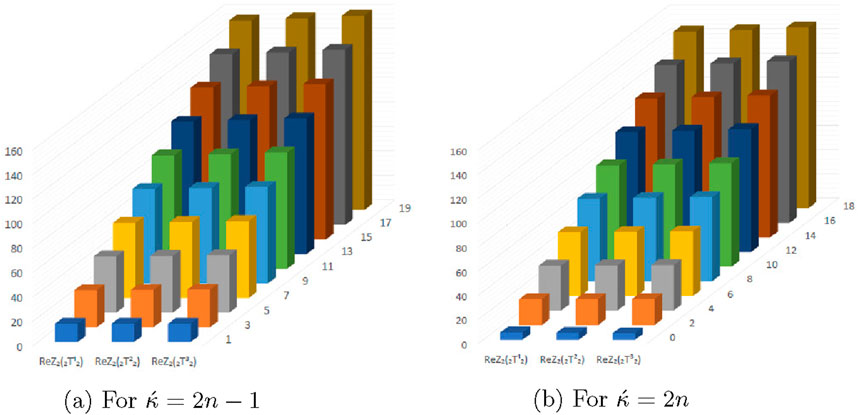
Figure 8. Graphical representation of
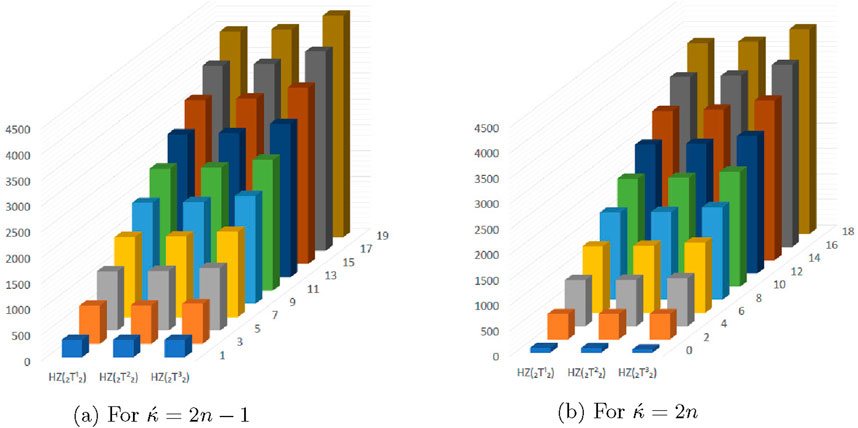
Figure 9. Graphical representation of
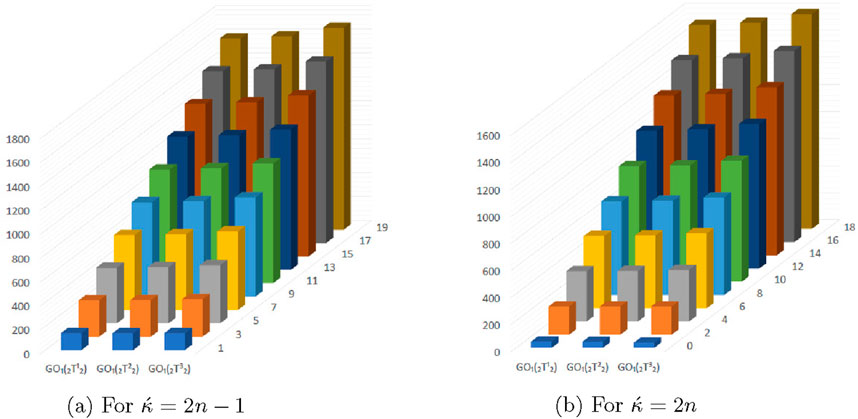
Figure 10. Graphical representation of
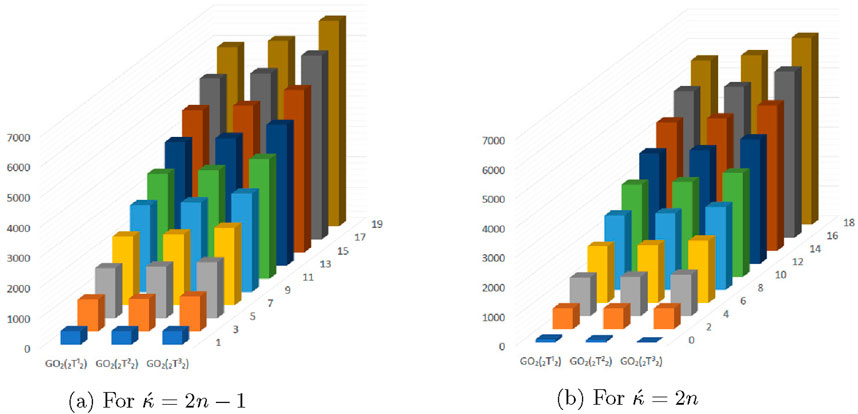
Figure 11. Graphical representation of
5 Expected values of topological descriptors of kink chains of type
As we know that there are only three possible kink chains (
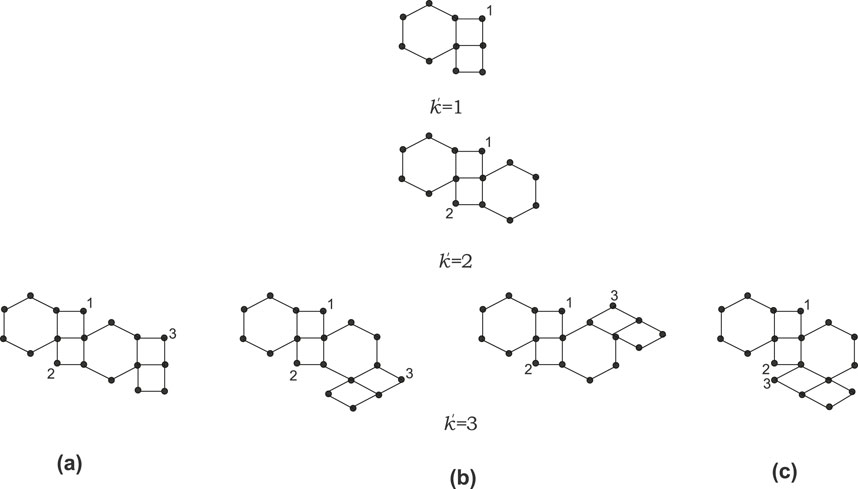
Figure 12. Possible arrangements of kink chains of type
Let the
As
Note that if
(1) At
5.1 Results at
The three possible constructions at
For

Table 4. Change in edge partitions of

Table 5. Change in edge partitions of
Theorem 5.1. Let
(a) For
(b) For
Proof.
For
Thus, we have
Using (6.1), (6.2) and (6.3), we get the following relation
Applying operator E on both sides, we get
Using recursive relation upto
For
Thus, we have
Using (6.4), (6.5) and (6.6), we get the following relation
Applying operator E on both sides, we get
Using recursive relation upto
which completes the proof.
Theorem 5.2. Let
(a) For
(b) For
Proof.
Thus, we have
Using (6.7), (6.8) and (6.9), we get the following relation
Using recursive relation upto
Thus, we have
Using (6.10), (6.11) and (6.12), we get the following relation
Using recursive relation upto
which completes the proof.
Theorem 5.3. Let
Proof.
Thus, we have
Using (6.13), (6.14) and (6.15), we get the following relation
Applying operator E on both sides and
Using recursive relation upto
Thus, we have
Using (6.16), (6.17) and (6.18), we get the following relation
Using recursive relation upto
which completes the proof.
Theorem 5.4. Let
(a) For
(b) For
Proof.
Thus, we have
Using (6.19), (6.20) and (6.21), we get the following relation
Using recursive relation upto
Thus, we have
Using (6.22), (6.23) and (6.24), we get the following relation
Applying operator E on both sides and
Using recursive relation upto
which completes the proof.
Theorem 5.5. Let
(a) For
(b) For
Proof.
Thus, we have
Using (6.25), (6.26) and (6.27), we get the following relation
Applying operator E on both sides and
Using recursive relation upto
Thus, we have
Using (6.28), (6.29) and (6.30), we get the following relation
Using recursive relation upto
which completes the proof.
Theorem 5.6. Let
(a) For
(b) For
Proof.
Thus, we have
Using (6.31), (6.32) and (6.33), we get the following relation
Applying operator E on both sides and
Using recursive relation upto
Thus, we have
Using (6.34), (6.35) and (6.36), we get the following relation
Using recursive relation upto
which completes the proof.
Theorem 5.7. Let
(a) For
(b) For
Proof.
Thus, we have
Using (6.37), (6.38) and (6.39), we get the following relation
Applying operator E on both sides and
Using recursive relation upto
Thus, we have
Using (6.40), (6.41) and (6.42), we get the following relation
Using recursive relation upto
which completes the proof.
The expected values
Corollary 1. Let
Remark 1. The value of
It is observed that the expected values
Remark 2. Let
5.2 Analytical expressions at
Now we analytically prove that at
Corollary 2. For
Proof.
which holds for
which holds for all
Corollary 3. For
Proof.
which holds for
which holds for all
Corollary 4. For
Proof.
which holds for
which holds for all
Corollary 5. For
Proof.
which holds for
which holds for all
Corollary 6. For
Proof.
which holds for
which holds for all
Corollary 7. For
Proof.
which holds for
which holds for all
From the above analytical expressions we get;
Corollary 8.
5.3 A comparison of expected values of topological descriptors at
Table 6, 7 depict the expected values of Revan descriptors, Zagreb descriptors, Hyper-Zagreb descriptor and Gourava descriptors for
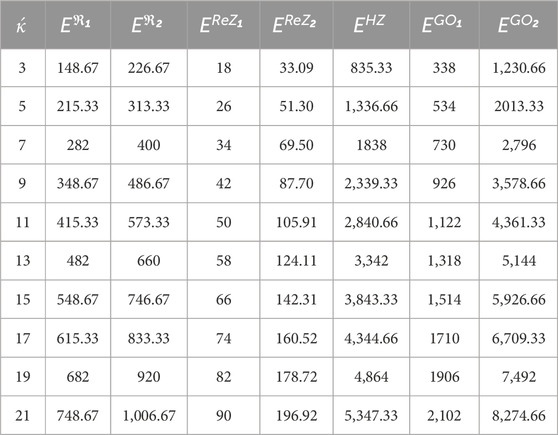
Table 6. Expected values for topological descriptors at
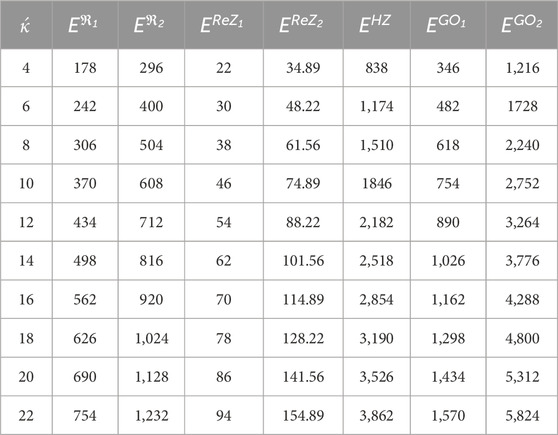
Table 7. Expected values for topological descriptors at
5.4 Graphical representation of expected values of topological descriptors at
The Figures 13–16 shows that expectation of
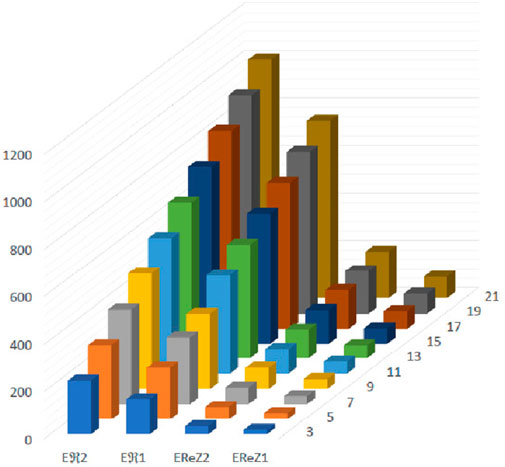
Figure 13. Graphical representation of expectations of
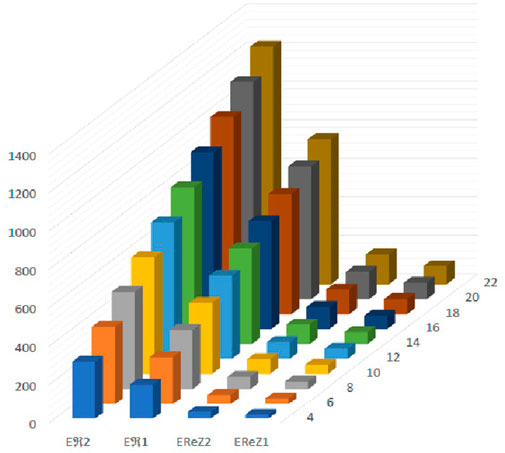
Figure 14. Graphical representation of expectations of
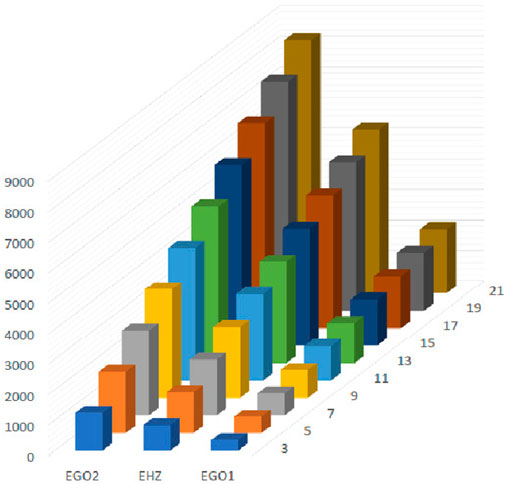
Figure 15. Graphical representation of expectations of
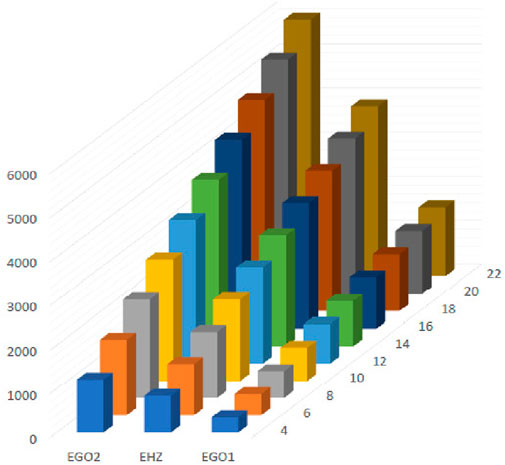
Figure 16. Graphical representation of expectations of
6 Applications
Kinks, which denote abrupt changes in the direction of edges within a graph, hold notable applications across diverse fields. In circuit design, minimizing kinks optimizes wire lengths and enhances efficiency. Network routing benefits from understanding kinks, as they affect data flow and network performance. Transportation planners use kink analysis to streamline traffic, plan intersections, and design efficient road networks. Graph drawing algorithms consider kinks for aesthetically pleasing and comprehensible visual representations. Lastly, in various applications where visual appeal matters, reducing kinks enhances the attractiveness and clarity of graph representations.
Studying the interforce interactions and scattering of (Lima and Almeida, 2023) kink-antikink-like solutions in a two-dimensional dilaton gravity model has practical implications in fields like material science, nonlinear optics, and cosmology. It aids in understanding energy distribution, stability dynamics, and defect interactions, which are crucial for developing advanced technologies and predicting behaviors in complex physical systems. The in situ (Zhu et al., 2023) investigations have revealed the important role for the kinks. During the growth, the creation of kinks determines the growth rate. Besides, when two domains coalesce, the shape of the final flake is affected by kinks.
In computer graphics, square and hexagonal grids are frequently used to create images or simulations. Kinks in these grids can represent corners or junctions in a digital image. Hexagonal kinks are essential in the study of tessellation and pattern generation. The expected value of random graphs plays a crucial role in graph theory as well. It helps analyze and predict various graph properties in probabilistic settings. By studying expected values in graph theory, we gain a balanced understanding of how certain structures behave under randomness, which informs both theory and practical applications. Expected values are used to calculate the probability that a random graph is connected. It can be employed to estimate the likelihood that two randomly generated graphs are isomorphic. This is valuable in assessing the structural similarity between graphs.
7 Conclusion
In this research work, we determined
Data availability statement
The original contributions presented in the study are included in the article/supplementary material, further inquiries can be directed to the corresponding authors.
Author contributions
RC: Conceptualization, Investigation, Methodology, Validation, Writing–review and editing. AR: Conceptualization, Investigation, Methodology, Validation, Writing–review and editing. MK: Formal Analysis, Investigation, Validation, Writing–original draft. SK: Conceptualization, Methodology, Validation, Writing–original draft. SN: Conceptualization, Formal Analysis, Investigation, Validation, Writing–review and editing. RN: Conceptualization, Formal Analysis, Investigation, Validation, Writing–review and editing.
Funding
The author(s) declare that financial support was received for the research, authorship, and/or publication of this article. This work was supported by National Natural Science Foundation of China (No. 62407011, 62172116) and the Guangzhou Academician and Expert Workstation (No. 2024-D003) and Deanship of the Science Research, Vice Presidency for Graduate Studies and Scientific Research, King Faisal University, Saudi Arabia (KFU242800).
Conflict of interest
The authors declare that the research was conducted in the absence of any commercial or financial relationships that could be construed as a potential conflict of interest.
Generative AI statement
The author(s) declare that no Generative AI was used in the creation of this manuscript.
Publisher’s note
All claims expressed in this article are solely those of the authors and do not necessarily represent those of their affiliated organizations, or those of the publisher, the editors and the reviewers. Any product that may be evaluated in this article, or claim that may be made by its manufacturer, is not guaranteed or endorsed by the publisher.
References
Alraqad, T. A., Saber, H., Ali, A., and Mazorodze, J. P. (2022). On-bond incident degree indices of square-hexagonal chains. J. Math. 2022. doi:10.1155/2022/1864828
Bonchev, D., and Trinajsti, N. (2001). Sar. QSAR Environ. Res. 12, 213236. doi:10.1080/10629360108035379
Chunsong, B., Khalil, M., Razzaque, A., Kanwal, S., Nazir, R., and Noor, S. (2024). Exploring structural variations and topological descriptors of square-hexagonal kink chains of type T2, 2 in engineering applications. Adv. Mech. Eng. 16 (10), 16878132241290418. doi:10.1177/16878132241290418
J. Devillers, and A. T. Balaban (1999). Topological indices and related descriptors in QSAR and QSPR (Amsterdam: Gordon & Breach).
Fang, X., You, L., and Liu, H. (2021). The expected values of Sombor indices in random hexagonal chains, phenylene chains and Sombor indices of some chemical graphs. Int. J. Quantum Chem. 121 (17), e26740. doi:10.1002/qua.26740
Gao, W., Jamil, M. K., and Farahani, M. R. (2017). The hyper-Zagreb index and some graph operations. J. Appl. Math. Comput. 54, 263–275. doi:10.1007/s12190-016-1008-9
Govardhan, S., Roy, S., Prabhu, S., and Arulperumjothi, M. (2024). Topological characterization of cove-edged graphene nanoribbons with applications to NMR spectroscopies. J. Mol. Struct. 1303, 137492. doi:10.1016/j.molstruc.2024.137492
Gutman, I., Rucic, B., Trinajstic, N., and Wilcox, C. F. (1975b). J. Chem. Phys. 62 (9), 3399–3405. doi:10.1063/1.430994
Gutman, I., and Trinajstic, N. (1972b). Graph theory and molecular orbitals. Total φ-electron energy of alternant hydrocarbons. Chem. Phys. Lett. 17, 535–538. doi:10.1016/0009-2614(72)85099-1
Huang, R.-R., Aftab, S., Noureen, S., and Aslam, A. (2023). Analysis of porphyrin, PETIM and zinc porphyrin dendrimers by atom-bond sum-connectivity index for drug delivery. Mol. Phys. 121, 15. doi:10.1080/00268976.2023.2214073
Hui, Z., Rauf, A., Naeem, M., Aslam, A., and Vania Saleem, A. (2023b). Quality testing analysis of Ve-degree based entropies by using benzene derivatives, 121, 17. e27146.
Hui, Z.-H, Yousaf, S., Aslam, A., Ahsan Binyamin, M., and Kanwal, S. (2023a). On expected values of some degree based topological descriptors of random Phenylene chains. Molecular 121. doi:10.1080/00268976.2023.2225648
Kulli, V. R. (2017a). On Hyper-Gourava indices and coindices. Int. J. Math. Archive 8 (12), 116–120.
Kulli, V. R. (2017b). Revan indices of oxide and honeycomb networks. Int. J. Math. its Appl. 5 (4-E), 663–667.
Kulli, V. R. (2017c). The Gourava indices and coindices of graphs. Ann. Pure Appl. Math. 14 (1), 33–38. doi:10.22457/apam.v14n1a4
Li, M., Asif, M., Ali, H., Mahmood, F., and Ali, P. (2023). Kirchhoff index and additive Kirchhoff index based on multiplicative degree for a random polyomino chain. Symmetry 15 (3), 718. doi:10.3390/sym15030718
Lima, F. C. E., and Almeida, C. A. S. (2023). Aspects of kink-like structures in 2D dilaton gravity. Fortschritte Phys. 71 (12), 2300051. doi:10.1002/prop.202300051
Noreen, S., and Mahmood, A. (2018). Zagreb polynomials and redefined Zagreb indices for the line graph of carbon nanocones. Open J. Math. analysis 2 (1), 66–73. doi:10.30538/psrp-oma2018.0012
Prabhu, S., Arulperumjothi, M., Manimozhi, V., and Balasubramanian, K. (2024b). Topological characterizations on hexagonal and rectangular tessellations of antikekulenes and its computed spectral, nuclear magnetic resonance and electron spin resonance characterizations. Int. J. Quantum Chem. 124 (7), e27365. doi:10.1002/qua.27365
Prabhu, S., Murugan, G., Imran, M., Arockiaraj, M., Alam, M. M., and Ghani, M. U. (2024a). Several distance and degree-based molecular structural attributes of cove-edged graphene nanoribbons. Heliyon 10 (15), e34944. doi:10.1016/j.heliyon.2024.e34944
Randic, M. (1975). Characterization of molecular branching. J. Am. Chem. Soc. 97, 6609–6615. doi:10.1021/ja00856a001
Ranjini, P. S., Lokesha, V., and Usha, A. (2013). Relation between phenylene and hexagonal squeeze using harmonic index. Int. J. Graph Theory 1, 116–121.
Raza, Z. (2020). The expected values of arithmetic bond connectivity and geometric indices in random phenylene chains. Heliyon 6 (7), e04479. doi:10.1016/j.heliyon.2020.e04479
Raza, Z. (2021). The expected values of some indices in random phenylene chains. Eur. Phys. J. Plus 136 (1), 91–15. doi:10.1140/epjp/s13360-021-01082-y
Shirdel, G. H., Rezapour, H., and Sayadi, A. M. (2013). The hyper-Zagreb index of graph operations, Iran. J. Math. Chem. 4, 213–220.
Shooshtari, H., Sheikholeslami, S. M., and Amjadi, J. (2022). The expected values of hyper Zagreb and forgotten topological indices in random phenylene chains. Polycycl. Aromat. Compd. 1-9. doi:10.1080/10406638.2022.2131851
Wei, L., Bian, H., Yu, H., and Ding, J. (2020). The expected values of Merrifield-Simmons index in random phenylene chains. Iran. J. Math. 11 (4), 271–281. doi:10.22052/IJMC.2020.237192.1508
Wei, S., and Shiu, W. C. (2019). Enumeration of Wiener indices in random polygonal chains. J. Math. Analysis Appl. 469 (2), 537–548. doi:10.1016/j.jmaa.2018.09.027
Zhang, G., Mushtaq, A., Aslam, A., Parveen, S., and Kanwal, S. (2023b). Studying some networks using topological descriptors and multi-criterion decision making. Mol. Phys. 121, 16. doi:10.1080/00268976.2023.2222345
Zhang, X., Aslam, A., Saeed, S., Razzaque, A., and Kanwal, S. (2023a). Investigation for metallic crystals through chemical invariants, QSPR and fuzzy-TOPSIS. J. Biomol. Struct. Dyn. 42, 2316–2327. doi:10.1080/07391102.2023.2209656
Zhang, X., Prabhu, S., Arulperumjothi, M., Prabhu, S. M., Arockiaraj, M., and Manimozhi, V. (2024). Distance based topological characterization, graph energy prediction, and NMR patterns of benzene ring embedded in P-type surface in 2D network. Sci. Rep. 14 (1), 23766. doi:10.1038/s41598-024-75193-8
Zhao, B., Gan, J., and Wu, H. (2016). Redefined Zagreb indices of some nano structures. Appl. Math. Nonlinear Sci. 1 (1), 291–300. doi:10.21042/amns.2016.1.00024
Keywords: random square-hexagonal kink chains, topological descriptors, expected values, Randic index, Zagreb indices
Citation: Chen R, Razzaque A, Khalil M, Kanwal S, Noor S and Nazir R (2025) Expected values of topological descriptors for possible kink chains of type 2
Received: 27 October 2024; Accepted: 16 December 2024;
Published: 18 February 2025.
Edited by:
Jose Luis Cabellos, Polytechnic University of Tapachula, MexicoReviewed by:
María Guadalupe Hernández-Linares, Benemérita Universidad Autónoma de Puebla, MexicoXianya Geng, Anhui University of Science and Technology, China
Copyright © 2025 Chen, Razzaque, Khalil, Kanwal, Noor and Nazir. This is an open-access article distributed under the terms of the Creative Commons Attribution License (CC BY). The use, distribution or reproduction in other forums is permitted, provided the original author(s) and the copyright owner(s) are credited and that the original publication in this journal is cited, in accordance with accepted academic practice. No use, distribution or reproduction is permitted which does not comply with these terms.
*Correspondence: Asima Razzaque, YXJhenphcXVlQGtmdS5lZHUuc2E=; Salma Kanwal, c2FsbWEua2Fud2FsQGxjd3UuZWR1LnBr