 Eric Rosa
 Marie Larocque
 Christine E. Hatch
 Abraham E. Springer
- 1Groundwater Research Group, Institut de Recherche en Mines et en Environnement, Université du Québec en Abitibi-Témiscamingue, Amos, QC, Canada
- 2Geotop Research Center, Université du Québec à Montréal, Montréal, QC, Canada
- 3Chaire de Recherche Eau et Conservation du Territoire, Département des Sciences de la Terre et de l’atmosphère, Université du Québec à Montréal, Montréal, QC, United States
- 4Department of Earth, Geographic, and Climate Sciences, University of Massachusetts, Amherst, MA, United States
- 5School of Earth and Sustainability, Northern Arizona University, Flagstaff, AZ, United States
Editorial on the Research Topic
“Novel approaches for understanding groundwater dependent ecosystems in a changing environment”
Groundwater represents one of the largest reservoirs of freshwater on the planet (Oki and Kanae, 2006) and is the source of drinking water for 2.5 billion people (Grönwall and Danert, 2020). From the earliest evidence of groundwater-related knowledge dating back to antiquity, with the construction of qanats in the Middle East, to the contemporary use of artificial intelligence in support of aquifer studies, hydrogeological science has expanded rapidly (Fetter, 2004a; Fetter, 2004b; Niu et al., 2014). Other related disciplines such as hydrology, ecology, land use planning, and climatology, have experienced comparable booms. Yet, one of the downfalls of the rapid growth and specialization of different scientific disciplines is that the scientific community sometimes becomes split into groups with complementary expertise.
As a result, some challenges that should implicitly be addressed with holistic or multidisciplinary approaches have been neglected by the scientific community. This justifies pursuing the study of groundwater dependent ecosystems (GDEs). GDEs are ecosystems for which vegetation composition, structure, and functions are reliant on a given supply of groundwater (Kløve et al., 2011). GDE types are extremely varied and include springs, wetlands, and groundwater-fed terrestrial and aquatic environments (Bertrand et al., 2012). The study of GDEs is thus clearly positioned at the intersection of many disciplines (Figure 1).
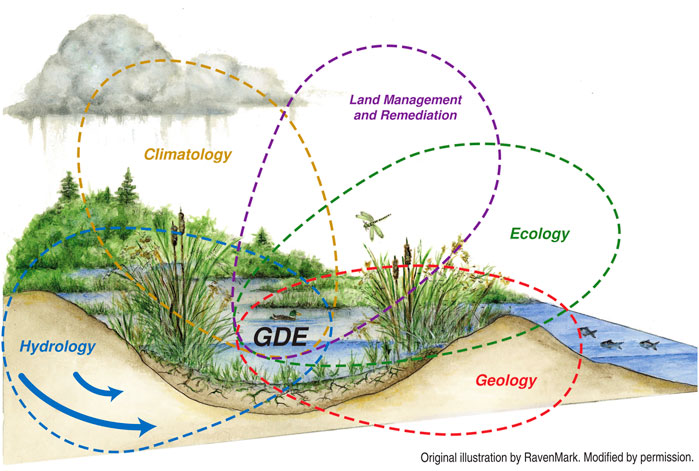
FIGURE 1. GDE-related research and its position among various areas of expertise. Original illustration (Living Observatory, 2020) by RavenMark, modified by C.E. Hatch by permission. © Creative Commons.
Consider the example of a spring located in a valley. The geological perspective is needed for evaluating how the architecture of rock formations and overburden deposits influence the geometry of aquifers. The hydrogeological perspective is critical for documenting the characteristics of exfiltration zones in groundwater flow systems (e.g., Lambert et al.). The climate perspective is crucial to assess the inputs (precipitation) and outputs (evapotranspiration) of the flow systems (e.g., Rohde et al.). The ecological perspective is central to identify the faunal and floral species in discharge areas and document their dependence on the (eco)hydrological, thermal, and geochemical conditions maintained by groundwater flows (e.g., Mitton and Allen). Ultimately, land-use planning and rehabilitation approaches will be critical to ensure the protection and rehabilitation of GDEs under increasing human pressures (e.g., Hatch and Ito; Watts et al.).
This Research Topic brings together five original contributions that address critical issues concerning GDEs from the different perspectives illustrated in Figure 1. The studied environmental contexts range from relatively arid California, United States (Rohde et al.) to the boreal zone of the Province of Quebec, Canada (Lambert et al.), the humid continental zone of the northeastern United States (Hatch and Ito; Watts et al.) and the Lower Fraser Valley of British Columbia, Canada (Mitton and Allen). It is clear from the contributions collected here that assessing the sensitivity and resilience of GDEs to human pressures and climate change is of great importance.
Each contribution stands out for deploying innovative approaches to the study of GDEs. For example, Lambert et al. focused on the evaluation of the hydrogeological balance of peatlands via numerical hydrogeological models based on field measurements. Their work shows that the hydrogeomorphic environment surrounding boreal peatlands is a major factor to consider when assessing their sensitivity to climate change. The work of Rohde et al. is further based on hydrogeological observations (groundwater levels) complemented by climate data and satellite images. The machine learning approach they developed allows for an efficient landscape-scale assessment of GDEs at risk. The authors highlight the increased impacts suffered by GDEs located in areas where sustainable water management is not implemented. The approach taken by Mitton and Allen stands out. Thanks to the coupled use of hydrological measurements, habitat monitoring and the assessment of benthic macroinvertebrate communities. Their findings highlight the need to better characterize benthic habitat heterogeneity within intermittent streams, particularly in areas of groundwater discharge, with a view to better understanding the resilience of such GDEs to human pressures and climate change. Hatch and Ito and Watts et al. bring GDE resilience to another level, by considering the possibility of restoring these ecosystems. Hatch and Ito assess groundwater flow within an “anthropogenic aquifer” once created for cranberry cultivation to provide the knowledge required to restore the “natural” water regime of the GDE. Watts et al. further advance this work and deploy innovative thermal remote sensing approaches to assess groundwater exfiltration to the impacted wetland in the pre- and post-restoration phases. Ultimately, the insights from these studies will provide the knowledge needed to optimize approaches to regenerate GDEs at human-impacted sites.
Combining the studies presented in this Research Topic, not only contributes to disseminate innovative knowledge to better understand GDEs, but also contributes to draw the attention of the scientific community to the anthropogenic and climatic pressures to which they are exposed. This is a step towards better protecting GDEs for the benefit of current and future generations of humans and of the breadth of fauna and flora they sustain.
Author contributions
ML, ER, CH, and AS have coordinated the call for papers in this Research Topic. ML has coordinated its development with the Frontiers team. ER has written the first manuscript of the editorial. ML, CH and AS have contributed to editing the text.
Conflict of interest
The authors declare that the research was conducted in the absence of any commercial or financial relationships that could be construed as a potential conflict of interest.
Publisher’s note
All claims expressed in this article are solely those of the authors and do not necessarily represent those of their affiliated organizations, or those of the publisher, the editors and the reviewers. Any product that may be evaluated in this article, or claim that may be made by its manufacturer, is not guaranteed or endorsed by the publisher.
References
Bertrand, G., Goldscheider, N., Gobat, J. M., and Hunkeler, D. (2012). Review: From multi-scale conceptualization to a classification system for inland groundwater-dependent ecosystems. Hydrogeol. J. 20, 5–25. doi:10.1007/s10040-011-0791-5
Fetter, C. W. (2004a). Hydrogeology: A short history, Part 1. Ground Water 42 (5), 790–792. doi:10.1111/j.1745-6584.2004.tb02734.x
Fetter, C. W. (2004b). Hydrogeology: A short history, Part 2. Ground Water 42 (6), 949–953. doi:10.1111/j.1745-6584.2004.t01-14-.x
Grönwall, J., and Danert, K. (2020). Regarding groundwater and drinking water access through a human rights lens: Self-supply as a norm. Water 12, 419. doi:10.3390/w12020419
Kløve, B., Ala-aho, P., Bertrand, G., Boukalova, Z., Ertürk, A., Goldscheider, N., et al. (2011). Groundwater dependent ecosystems. Part I: Hydroecological status and trends. Environ. Sci. Policy 14 (7), 770–781. doi:10.1016/j.envsci.2011.04.002
Niu, B., Loáiciga, H. A., Wang, Z., Zhan, F. B., and Hong, S. (2014). Twenty years of global groundwater research: A science citation index expanded based bibliometric survey (1993-2012). J. Hydrol. 519, 966–975. doi:10.1016/j.jhydrol.2014.07.064
Living ObservatoryBallantine, K., Davenport, G., Deegan, L., Gladfelter, E., Hatch, C. E., et al. (2020). Learning from the restoration of wetlands on cranberry farmland: Preliminary benefits assessment. Living Observatory. Plymouth, MA, USA, 1–100. Available at https://www.livingobservatory.org/learning-report.
Keywords: groundwater dependent ecosystems (GDE), groundwater-surface water interactions, human impacts, climate change, environmental resilience
Citation: Rosa E, Larocque M, Hatch CE and Springer AE (2023) Editorial: “Novel approaches for understanding groundwater dependent ecosystems in a changing environment”. Front. Earth Sci. 11:1165061. doi: 10.3389/feart.2023.1165061
Received: 13 February 2023; Accepted: 27 February 2023;
Published: 07 March 2023.
Edited and reviewed by:
Irfan Rashid, University of Kashmir, IndiaCopyright © 2023 Rosa, Larocque, Hatch and Springer. This is an open-access article distributed under the terms of the Creative Commons Attribution License (CC BY). The use, distribution or reproduction in other forums is permitted, provided the original author(s) and the copyright owner(s) are credited and that the original publication in this journal is cited, in accordance with accepted academic practice. No use, distribution or reproduction is permitted which does not comply with these terms.
*Correspondence: Eric Rosa, ZXJpYy5yb3NhQHVxYXQuY2E=