 Guang-Yu Sun
 Shu Zhang1
- 1State Key Laboratory of Electrical Insulation and Power Equipment, School of Electrical Engineering, Xi’an Jiaotong University, Xi’an, China
- 2Ecole Polytechnique Fédérale de Lausanne (EPFL), Swiss Plasma Center (SPC), Lausanne, Switzerland
- 3Centrum Wiskunde and Informatica (CWI), Amsterdam, Netherlands
A one-dimensional Vlasov–Poisson simulation code is employed to investigate the plasma sheath considering electron-induced secondary electron emission (SEE) and backscattering. The SEE coefficient is commonly treated as constant in a range of plasma simulations; here, an improved SEE model of a charged dielectric wall is constructed, which includes the wall charging effect on the SEE coefficient and the energy dependency of the SEE coefficient. Pertinent algorithms to implement the previously mentioned SEE model in plasma simulation are studied in detail. It is found that the SEE coefficient increases with the amount of negative wall charges, which in turn reduces the emissive sheath potential. With an energy-dependent SEE coefficient, the sheath potential is a nonlinear function of the plasma electron temperature, as opposed to the linear relation predicted by the classic emissive sheath theory. Simulation combining both wall-charging effect and SEE coefficient’ energy dependency suggests that the space-charged limited sheath is formed at high plasma electron temperature levels, where both sheath potential and surface charging saturate. Additionally, different algorithms to implement the backscattering in the kinetic simulation are tested and compared. Converting backscattered electrons to secondary electrons via an effective SEE coefficient barely affects the sheath properties. The simulation results are shown to be commensurate with the upgraded sheath theory predictions.
Introduction
A plasma sheath is a non-neutral space charge region that appears between bulk plasma and plasma-facing components. A sheath becomes emissive due to surface emission processes, including secondary electron emission (SEE), backscattering, field emission, thermionic emission, and photoemission. An emissive sheath widely appears in confined laboratory plasmas and plays a vital role in numerous industrial plasma applications such as plasma processing, electric proportion, plasma diagnostics, and plasma source [1–4]. The present research focuses on the algorithms to implement the interactions between plasma and dielectric surface in the kinetic simulation and the underlying sheath physics.
The classic emissive sheath theory was first established by Hobbs and Wesson by analyzing the current balance near a floating emissive boundary [5]. It was proved that the presheath structure is not significantly affected by boundary emission and the emissive sheath potential
Here,
Common simulation approaches of plasma–surface interactions consist of a particle model, fluid model, kinetic model, and global model. The particle model provides self-consistent plasma dynamics based on first principles, which usually requires large quantities of computational resources. Fluid simulation is usually cheaper in terms of numerical cost, whereas one issue that potentially hinders the simulation accuracy is whether the fluid assumptions remain valid in the sheath region, particularly with non-thermal plasmas. Consequently, the sheath itself is frequently taken as a boundary condition instead of being simulated in the fluid model. The kinetic simulation captures the physics that are neglected in the fluid model when averaging over the velocity moments but exhibits lower performance when simulating complex reactions. In addition, the use of collision operators is inevitably less precise than the particle model. Yet one advantage of the kinetic simulation model is that it evades the statistical noise that must be reduced by using large macroparticle numbers in the particle model and provides smooth profiles for every time step. This benefit is particularly obvious for the nonlinear plasma behaviors in the sheath study. In addition, it is easier to directly control certain physical quantities to facilitate comparison with theory prediction in a kinetic model. This is why numerous kinetic models are employed in the study of sheath-related topics [15–18].
Boundary electron emission due to SEE is widely implemented in the numerical modeling of confined plasma. The SEE coefficient
The article is structured as follows: Introduction introduces the employed simulation model; Introduction studies the methods to configure appropriate boundary conditions considering dielectric wall charges and the energy dependency of the SEE coefficient. The simulation setup involving electron backscattering is also expatiated. All simulation results are validated against upgraded emissive sheath theories, and the discrepancies between theory and simulation are analyzed.
Simulation setup
In this section, employed simulation algorithms and typical simulation results are presented. The simulation model is inspired by previous Vlasov–Poisson solvers [11, 15], and a basic version of the code was used in our recent simulations [13, 20, 21]. The employed 1D1V kinetic simulation code is based on the following kinetic equation:
Here, the subscript s represents species;
For the study of sheath properties, keeping a constant bulk plasma density facilitates the parameter scan. The collision term is separated into two parts: one plasma source term, which compensates for the boundary particle losses, and one relaxation term, which restores the plasma VDFs back to equilibrium at a constant rate (the BGK collision operator).
The collision frequency
Boundary conditions of VDFs are critical for the implementation of the aforementioned surface processes. For a surface with only secondary electron emission, the emitted secondary electrons are assumed to follow a half-Maxwellian distribution with temperature
A flow chart is given in Figure 1 to visualize the simulation procedure. For each time step, two advections are performed with an explicit finite difference method in the upwind scheme, and then the source term and BGK collision operator are applied. The velocity advection requires the electric field distribution, which is solved by assuming zero electric field in the center of the simulation domain and then integrating the net charge density toward the boundary using Gauss’s law. The simulation usually converges in several μs with a time step of 0.01 ns. The simulation convergence at
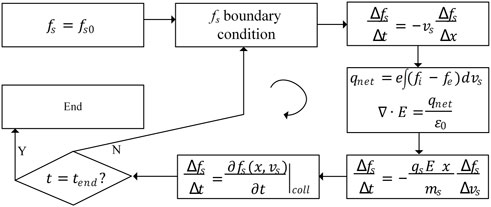
FIGURE 1. Schematic of the program execution.
Other choices of simulation parameters are introduced in the following sections. The plasma density is 5×10¹⁴ m−3, plasma electron temperature is 10 eV by default, ion temperature is 0.1 eV, emitted electron temperature is 2 eV, scale of simulation domain is 10 cm, spatial resolution is 10−4 m, and electron and ion velocity ranges cover eight times the electron thermal speed and sound speed, divided into 103 points. Typical simulation results including potential, density, and velocity distribution functions with the aforementioned settings are shown in Figure 2.
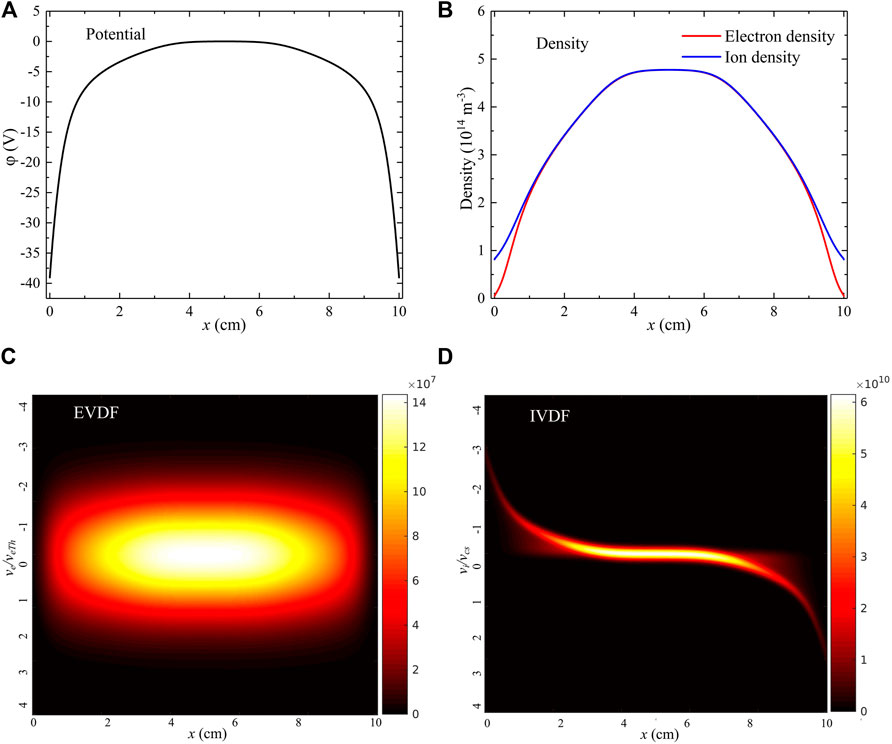
FIGURE 2. Typical simulation results obtained by the 1D1V kinetic simulation. (A) Space potential. (B) Electron and ion density. (C) Electron velocity distribution function. (D) Ion velocity distribution function.
Simulation results and model validation against theory
Influence of charge trapping on the SEE coefficient
A primary electron (PE) penetrating into a material surface, without being backscattered, generates internal secondary electrons while being slowed down. Only a fraction of the internal SEs is transported to the surface and escapes from the material, becoming true SEs. The transport of internal SEs is characterized by the escape mean free path
The term
supposing
Eq 6 indicates that SEE is dictated by two characteristic lengths:
The value of
Here,
with
Eq 9 suggests that the dielectric surface immersed in a plasma becomes more emissive (larger
The term
The wall-charging factor
A critical issue is then to determine the order of magnitude of the factor
A range of
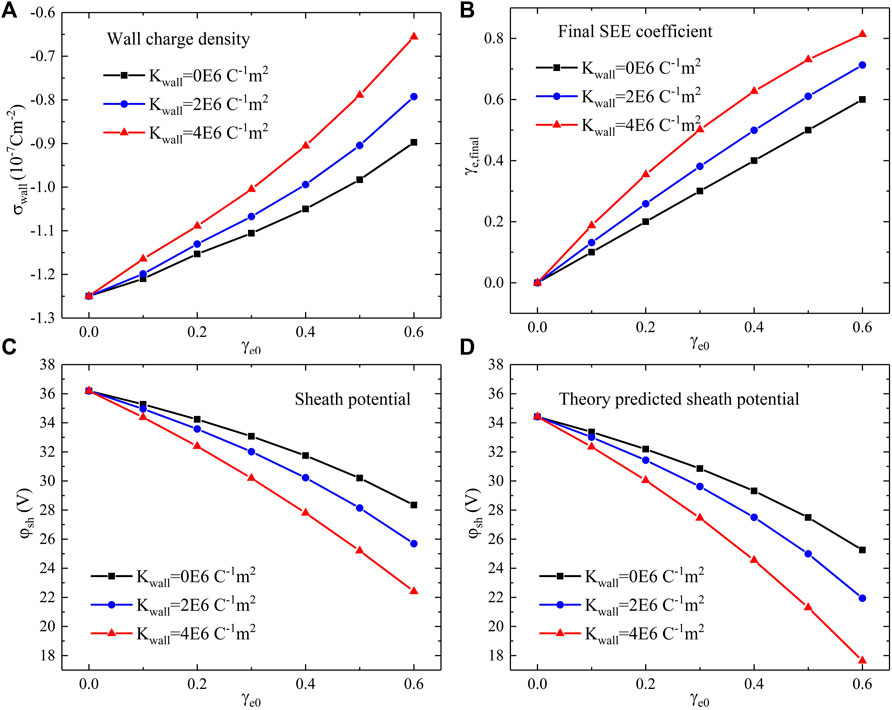
FIGURE 3. Emissive sheath properties with SEE considering the wall-charging effect, for a range of
Figure 3D shows the theoretical prediction of sheath potential according to Eqs. 1–10. Particularly, the black curve in Figure 3D is exactly the emissive sheath potential predicted by Hobbs, serving as a benchmark for code validity. Since the sheath potential in the simulation is counted from the wall to the central plasma, it includes both the sheath and presheath potential drop. A better way of presentation is to determine the presheath location from simulation and subtract it from the simulated total potential drop, but the determination of presheath incurs some uncertainties when analyzing simulation results, so the total potential drop is considered in the present work. The calculated emissive sheath potential from Equation (1) is, hence, augmented by
Energy dependency of the SEE coefficient
In the Energy dependency of the SEE coefficient section, the SEE coefficient is kept constant for all incident electron energies. This is convenient for comparison with the classic emissive sheath theory (Eq 1) by Hobbs and Wesson [5] but is oversimplified as
where the smoothness factor
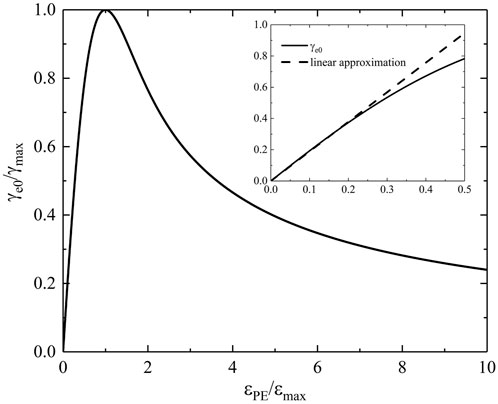
FIGURE 4. SEE coefficient as a function of incident electron energy. Normalization over
In boundary plasma simulations, the SEE coefficient is applied in a variety of ways depending on the employed simulation approach. For particle-in-cell (PIC) simulation, the implementation is straightforward, as
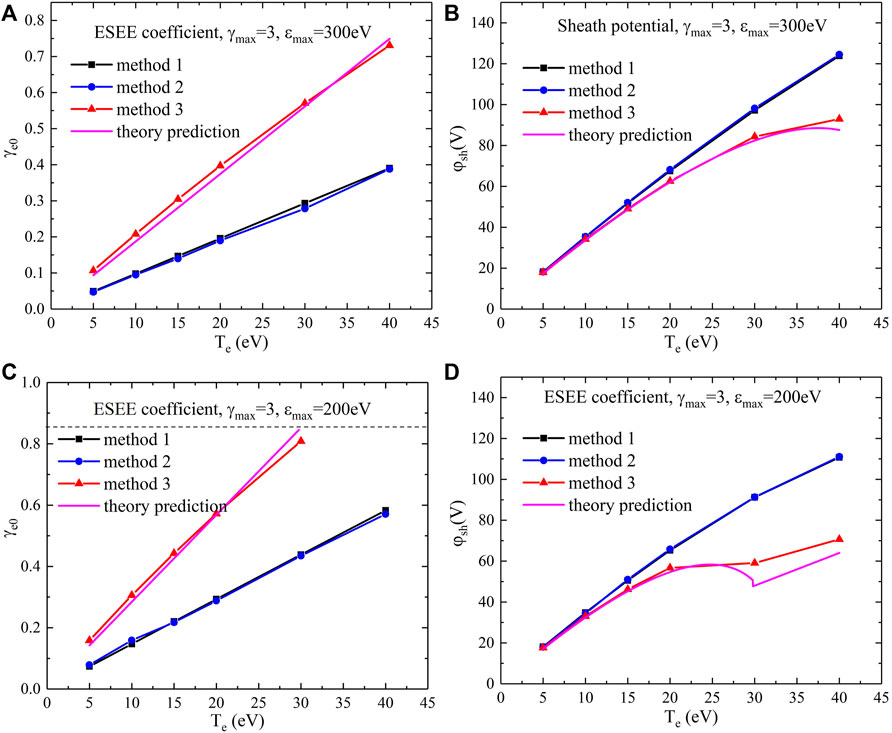
FIGURE 5. SEE coefficient and sheath potential calculated using three different
In order to verify the simulation results, the emissive sheath theory in Eq 1 is updated considering the energy dependency of
Hence, the sheath potential becomes
Eq 14 is only valid for the non-SCL sheath, which requires a SEE coefficient smaller than the critical value
In Figures 5A, B, the sheath remains in the classic sheath regime for the selected temperature range. The theory prediction is consistent with simulation results applied with the third method introduced previously. Simulations with methods 1 and 2 are close but in general underestimate
It should be noted that the adopted kinetic sheath theories mentioned previously are not valid when sheath collisionality becomes significantly higher, particularly when the ion-neutral collision mean free path is well below the Debye length. Ions are limited by their mobility at high pressure levels, and a clear presheath region cannot be defined. Fluid approaches are more favorable for the highly collisional sheath but will not be further developed in the present work.
In addition, it must be pointed out that the good agreement between kinetic sheath theory and the kinetic simulation results is partially due to the special choice of collision operator in the simulation, which ensures that the bulk plasma always follows the Maxwellian distribution at a given temperature. Larger discrepancies with the theories are expected for PIC simulation with more self-consistent treatment for collisions.
Combined SEE model and analyses of sheath stability
In the Combined SEE model and analyses of sheath stability section, the influences of wall charging and SEE coefficient energy dependency on sheath properties are discussed separately. The simulation results combining both factors are presented, applying method 3 for
with
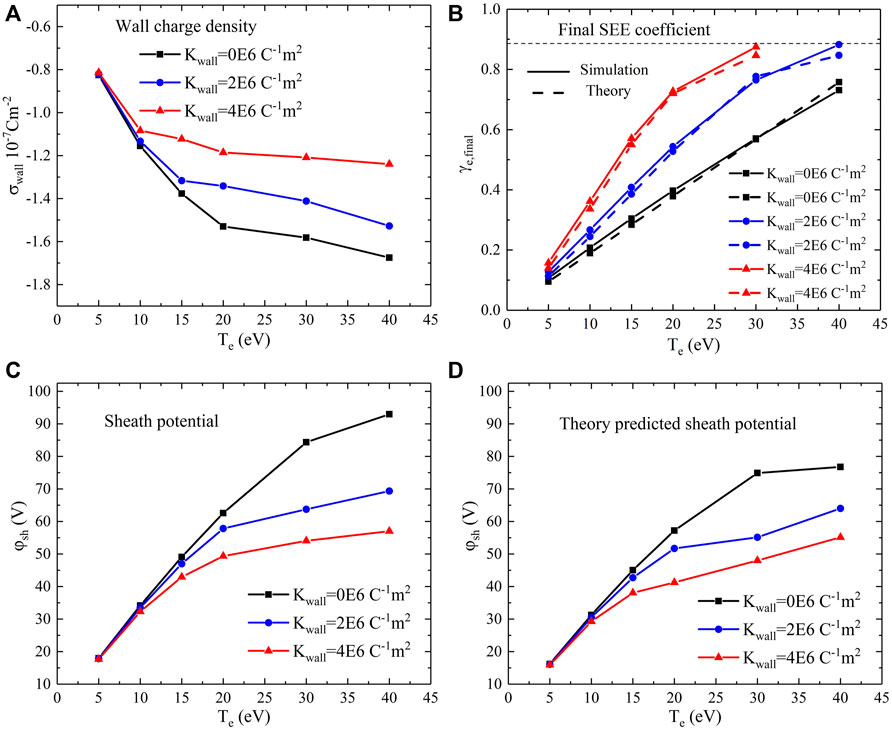
FIGURE 6. Emissive sheath properties with the combined SEE model, for a range of
The amount of wall charges increases with plasma electron temperature and decreases with the wall-charging factor
One critical implication from the aforementioned analyses is whether the inclusion of charging effects and
Here, the sheath is assumed to be a classic Debye sheath with
It should be noted that
Implementation of electron backscattering in simulation
In the aforementioned sections, the algorithms to implement secondary electron emission in the kinetic simulation are discussed in detail. Apart from SEE, some incident electrons on the solid wall are reflected back after elastic interactions with the sample atoms. Such process is called backscattering and in general occurs in a deeper region than that of SEE. The most distinct difference between the secondary electron and the backscattered electron is their velocity distribution functions. Backscattered electron velocity scales up with plasma electrons, whereas SEs mostly have low energy regardless of incident electron velocity.
A simple way to implement backscattering is to discard the different physical mechanisms of SEE and backscattering, assuming that both types of electrons have the same temperature and using an effective emission coefficient as follows [20]:
with
Here,
For the present simulation with Maxwellian plasma electron, Eq 20 is equivalent to
Here, the left wall boundary is taken as an example, where the
The EVDFs at the left wall with two different boundary conditions mentioned previously are shown in Figure 7. It is clear that the boundary EVDFs using the two methods mentioned previously are remarkably different, mainly due to different emitted electron temperatures. Since the SEE-emitted electron temperature is typically within 5 eV whereas backscattered electrons have the same temperature as the plasma electrons, the discrepancy is obvious only for simulations with high
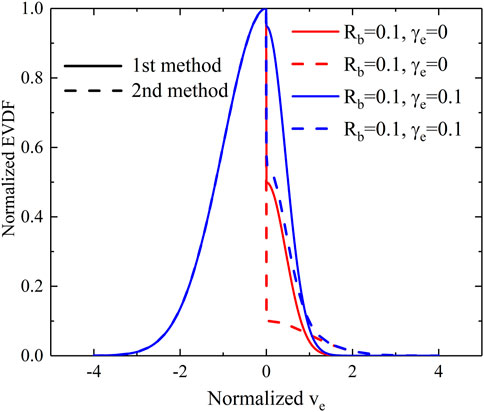
FIGURE 7. EVDF at the left wall with two different methods to set the boundary condition with backscattering.
The difference in boundary EVDF, however, is shown to have limited influences on simulation results, as shown in Figure 8. A scan of the true SEE coefficient with different backscattering coefficients is tested, with the effective SEE coefficient calculated as
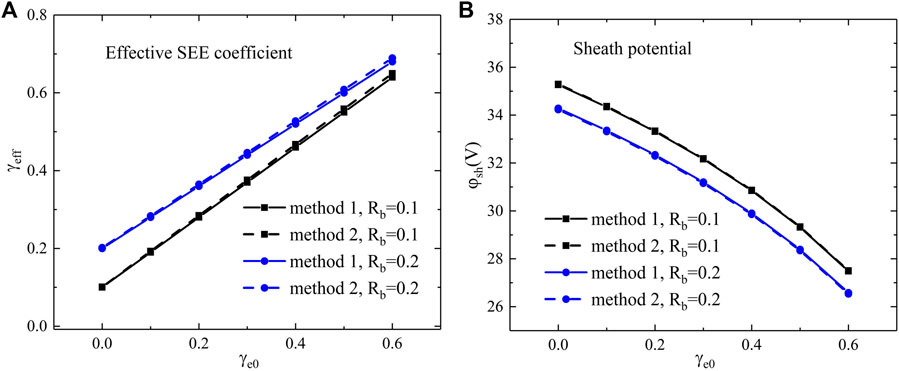
FIGURE 8. (A) Effective SEE coefficient and (B) sheath potential with a scan of true SEE coefficient and different backscattering coefficients.
With the aforementioned conclusions, the emissive sheath potential with both SEE and backscattering is simply
It should be noted that the conclusion mentioned previously is valid for purely elastic backscattering. If a constant fraction of energy
The influence of energy loss factor

FIGURE 9. (A) Effective SEE coefficient and (B) sheath potential with a scan of backscattering coefficient using different η. The true SEE coefficient is kept as 0.1, and the theory prediction is given by Eq 23.
As has been pointed out in Implementation of electron backscattering in simulation, the use of artificial collision operator, though providing good agreement with the emissive sheath theory, can conceal certain physics that are only available in, for example, the PIC model where self-consistent plasma-neutral collisions are implemented. A comparison of the kinetic simulation and PIC simulation was recently performed for the capacitively coupled plasma subject to strong electron emission from the boundary [13, 35], where discrepancies are more obvious at high neutral pressure levels as the kinetic model does not implement realistic electron-neutral collisions and ionization sources. Similar comparisons between the kinetic and PIC models of the SEE coefficient charging effect are expected for DC or RF plasma conditions.
Conclusion
One-dimensional kinetic simulation of the plasma sheath is performed involving secondary electron emission and electron backscattering. The influence of accumulated wall charges on the SEE coefficient is considered and is shown to enhance the surface electron emission and decrease the sheath potential. Using an energy-dependent instead of static SEE coefficient is found to induce a nonlinear sheath potential response to the plasma electron temperature, as opposed to the classic emissive sheath theory. The SCL sheath is formed if plasma electron temperature or wall charge density is sufficiently high so that the effective SEE coefficient is above a critical value. The EVDF boundary condition for electron backscattering is proposed and implemented in the kinetic simulation. Considering backscattering electrons mainly affects boundary EVDF as backscattered electrons are typically faster than secondary electrons. Converting the backscattered rate into SEE coefficient via an equivalent equation is shown to barely affect the sheath properties. The simulation results are well supported by the upgraded emissive sheath theories, where wall-charging effect, SEE coefficient’s energy dependency, and backscattering are included.
Data availability statement
The raw data supporting the conclusion of this article will be made available by the authors, without undue reservation.
Author contributions
G-YS, B-HG, and SZ contributed to the concept of modeling and theory, and A-BS and G-JZ supervised the work throughout. All authors contributed to the final version of the manuscript.
Funding
The research was conducted under the auspices of the National Key R and D Program of China (No. 2020YFC2201100) and the National Natural Science Foundation of China (Nos. 51827809 and 52077169). This work was also supported in part by the Swiss National Science Foundation.
Conflict of interest
The authors declare that the research was conducted in the absence of any commercial or financial relationships that could be construed as a potential conflict of interest.
Publisher’s note
All claims expressed in this article are solely those of the authors and do not necessarily represent those of their affiliated organizations, or those of the publisher, the editors, and the reviewers. Any product that may be evaluated in this article, or claim that may be made by its manufacturer, is not guaranteed or endorsed by the publisher.
References
1. Zhang Y, Charles C, Boswell RW. Density measurements in low pressure, weakly magnetized, Rf plasmas: Experimental verification of the sheath expansion effect. Front Phys (2017) 2017:5. doi:10.3389/fphy.2017.00027
2. Del Valle JI, Chang Diaz FR, Granados VH. Plasma-surface interactions within helicon plasma sources. Front Phys (2022) 2010:10. doi:10.3389/fphy.2022.856221
3. Hershkowitz N. Sheaths: More complicated than you think. Phys Plasmas (2005) 12(5):055502. doi:10.1063/1.1887189
4. Keidar M, Beilis I. Sheath and boundary conditions for plasma simulations of a Hall thruster discharge with magnetic lenses. Appl Phys Lett (2009) 94(19):191501. doi:10.1063/1.3132083
5. Hobbs GD, Wesson JA. Heat flow through a Langmuir sheath in the presence of electron emission. Plasma Phys (1967) 9(1):85–7. doi:10.1088/0032-1028/9/1/410
6. Anderson N. the formation of a plasma sheath with secondary electron emission. Int J Elect (1972) 32(4):425–33. doi:10.1080/00207217208938304
7. Qing S, Wei J, Chen W, Tang S, Wang X. Stability of different plasma sheaths near a dielectric wall with secondary electron emission. J Plasma Phys (2019) 85(6):905850609. Epub 2019/12/04. doi:10.1017/S0022377819000862
8. Ordonez CA, Peterkin RE. Secondary electron emission at anode, cathode, and floating plasma‐facing surfaces. J Appl Phys (1996) 79(5):2270–4. doi:10.1063/1.361151
9. Zhonghua X, Xiaoyun Z, Feng W, Jinyuan L, Yue L, Ye G. Effect of secondary electron emission on the sheath in spt chamber. Plasma Sci Technol (2009) 11(1):57–61. doi:10.1088/1009-0630/11/1/12
10. Sheehan JP, Hershkowitz N, Kaganovich ID, Wang H, Raitses Y, Barnat EV, et al. Kinetic theory of plasma sheaths surrounding electron-emitting surfaces. Phys Rev Lett (2013) 111(7):075002. doi:10.1103/PhysRevLett.111.075002
11. Campanell MD, Umansky MV. Strongly emitting surfaces unable to float below plasma potential. Phys Rev Lett (2016) 116(8):085003. doi:10.1103/PhysRevLett.116.085003
12. Taccogna F. Non-classical plasma sheaths: Space-Charge-Limited and inverse regimes under strong emission from surfaces. Eur Phys J D (2014) 68(7):199. doi:10.1140/epjd/e2014-50132-5
13. Sun G-Y, Sun A-B, Zhang G-J. Intense boundary emission destroys normal radio-frequency plasma sheath. Phys Rev E (2020) 101(3):033203. doi:10.1103/PhysRevE.101.033203
14. Zhang Z, Wu B, Yang S, Zhang Y, Chen D, Fan M, et al. formation of stable inverse sheath in ion–ion plasma by strong negative ion emission. Plasma Sourc Sci Technol (2018) 27(6):06LT1. doi:10.1088/1361-6595/aac070
15. Coulette D, Manfredi G. An eulerian Vlasov code for plasma-wall interactions. J Phys : Conf Ser (2014) 561:012005. doi:10.1088/1742-6596/561/1/012005
16. Cagas P, Hakim A, Juno J, Srinivasan B. Continuum kinetic and multi-fluid simulations of classical sheaths. Phys Plasmas (2017) 24(2):022118. doi:10.1063/1.4976544
17. Juno J, Hakim A, TenBarge J, Shi E, Dorland W. Discontinuous galerkin algorithms for fully kinetic plasmas. J Comput Phys (2018) 353:110–47. doi:10.1016/j.jcp.2017.10.009
18. Campanell MD, Johnson GR. Thermionic cooling of the target plasma to a sub-ev temperature. Phys Rev Lett (2019) 122(1):015003. doi:10.1103/PhysRevLett.122.015003
19. Vaughan JRM. A new formula for secondary emission yield. IEEE Trans Electron Devices (1989) 36(9):1963–7. doi:10.1109/16.34278
20. Sun G-Y, Li Y, Zhang S, Song B-P, Mu H-B, Guo B-H, et al. Integrated modeling of plasma-dielectric interaction: Kinetic boundary effects. Plasma Sourc Sci Technol (2019) 28(5):055001. doi:10.1088/1361-6595/ab17a3
21. Sun G-Y, Li H-W, Sun A-B, Li Y, Song B-P, Mu H-B, et al. On the role of secondary electron emission in capacitively coupled radio‐frequency plasma sheath: A theoretical ground. Plasma Process Polym (2019) 16(11):1900093. doi:10.1002/ppap.201900093
22. Levko D, Arslanbekov RR, Kolobov VI. Modified paschen curves for pulsed breakdown. Phys Plasmas (2019) 26(6):064502. doi:10.1063/1.5108732
23. Lye RG, Dekker AJ. Theory of secondary emission. Phys Rev (1957) 107(4):977–81. doi:10.1103/PhysRev.107.977
24. Heinisch RL, Bronold FX, Fehske H. Electron surface layer at the interface of a plasma and a dielectric wall. Phys Rev B (2012) 85(7):075323. doi:10.1103/PhysRevB.85.075323
25. Zhao CZ, Zhang JF, Zahid MB, Govoreanu B, Groeseneken G, De Gendt S. Determination of capture cross sections for as-grown electron traps in Hfo2∕Hfsio stacks. J Appl Phys (2006) 100(9):093716. doi:10.1063/1.2364043
26. Boughariou A, Damamme G, Kallel A. Evaluation of the effective cross-sections for recombination and trapping in the case of pure spinel. J Microsc (2015) 257(3):201–7. doi:10.1111/jmi.12202
27. Ghorbel N, Kallel A, Damamme G. Analytical model of secondary electron emission yield in electron beam irradiated insulators. Micron (2018) 112:35–41. doi:10.1016/j.micron.2018.06.002
28. Belhaj M, Odof S, Msellak K, Jbara O. Time-dependent measurement of the trapped charge in electron irradiated insulators: Application to Al2o3–sapphire. J Appl Phys (2000) 88(5):2289–94. doi:10.1063/1.1287131
29. Fitting H-J, Glaefeke H, Wild W. Electron penetration and energy transfer in solid targets. Phys Stat Sol (1977) 43(1):185–90. doi:10.1002/pssa.2210430119
30. Kaganovich ID, Raitses Y, Sydorenko D, Smolyakov A. Kinetic effects in a Hall thruster discharge. Phys Plasmas (2007) 14(5):057104. doi:10.1063/1.2709865
31. Sun G-Y, Guo B-H, Mu H-B, Song B-P, Zhou R-D, Zhang S, et al. Flashover strength improvement and multipactor suppression in vacuum using surface charge pre-conditioning on insulator. J Appl Phys (2018) 124(13):134102. doi:10.1063/1.5048063
32. Schwarz SA. Application of a semi‐empirical sputtering model to secondary electron emission. J Appl Phys (1990) 68(5):2382–91. doi:10.1063/1.346496
33. Sydorenko D, Smolyakov A, Kaganovich I, Raitses Y. Plasma-sheath instability in Hall thrusters due to periodic modulation of the energy of secondary electrons in cyclotron motion. Phys Plasmas (2008) 15(5):053506. doi:10.1063/1.2918333
34. Hussain A, Yang L, Mao S, Da B, Tőkési K, Ding ZJ. Determination of electron backscattering coefficient of beryllium by a high-precision Monte Carlo simulation. Nucl Mater Energ (2021) 26:100862. doi:10.1016/j.nme.2020.100862
Keywords: plasma sheath, secondary electron emission, plasma-facing component, plasma–wall interaction, Vlasov simulation
Citation: Sun G-Y, Zhang S, Guo B-H, Sun A-B and Zhang G-J (2022) Vlasov simulation of the emissive plasma sheath with energy-dependent secondary emission coefficient and improved modeling for dielectric charging effects. Front. Phys. 10:1006451. doi: 10.3389/fphy.2022.1006451
Received: 29 July 2022; Accepted: 14 September 2022;
Published: 03 October 2022.
Edited by:
Yangyang Fu, Tsinghua University, ChinaReviewed by:
Dmitry Levko, Esgee Technologies (United States), United StatesWei Jiang, Huazhong University of Science and Technology, China
Copyright © 2022 Sun, Zhang, Guo, Sun and Zhang. This is an open-access article distributed under the terms of the Creative Commons Attribution License (CC BY). The use, distribution or reproduction in other forums is permitted, provided the original author(s) and the copyright owner(s) are credited and that the original publication in this journal is cited, in accordance with accepted academic practice. No use, distribution or reproduction is permitted which does not comply with these terms.
*Correspondence: An-Bang Sun, YW5iYW5nLnN1bkB4anR1LmVkdS5jbg==; Guan-Jun Zhang, Z2p6aGFuZ0B4anR1LmVkdS5jbg==