 Kui Hou
 Zhendong Zhang1
- 1School of Mathematics and Physics, Anhui Jianzhu University, Hefei, China
- 2Key Laboratory of Advanced Electronic Materials and Devices, Hefei, China
- 3Key Laboratory of Architectural Acoustic Environment of Anhui Higher Education Institutes, Hefei, China
- 4School of Physical Science and Technology, Soochow University, Suzhou, China
- 5Collaborative Innovation Center of Light Manipulations and Applications, Shandong Normal University, Jinan, China
- 6MOE Key Laboratory of Advanced Micro-Structured Materials, School of Physics Science and Engineering, Tongji University, Shanghai, China
We theoretically investigate the influence of the Van der Waals interaction on the two-photon blockade phenomenon with the corresponding photon correlation functions g(2)(0) > 1 and g(3)(0) < 1 in a two-atom cavity-QED system, where two three-level ladder-type atoms are coherently driven by a pumping field and a coupling field simultaneously. Choosing a specific frequency of the coupling field, we show the energy splitting phenomenon caused by electromagnetically induced transparency. Correspondingly, the two-photon blockade phenomenon can be achieved near the two-photon resonant frequency. Using the Van der Waals interaction between the Rydberg states of the two atoms, we also show that the two-photon blockade can be improved when two atoms radiate in-phase or out-of-phase. As a result, two photons leak from the cavity simultaneously, but the third photon is blockaded. These results presented in this study hold potential applications in manipulating photon states and generating nonclassical light sources.
1 Introduction
Creation and manipulation of single photons are pivotal requirements in quantum science and technology. Photon blockade (PB), proposed by Imamoḡlu et al. [1], is one of the effective methods for realizing single-photon sources. In the process of single PB, the absorption of the first photon blocks the absorption of the next photon until the previous photon is released from the system. As a consequence, the photons are emitted from the system one by one and antibunched photons with sub-Poissonian distribution can be observed [2].
To date, this single PB has been experimentally implemented in various quantum systems, such as the atom-cavity quantum electrodynamics (QED) system [3–6], semiconductor cavity-QED system [7], photonic crystal system [8], circuit cavity-QED system [9], and so on. Recently, the realization of two-photon blockade (two-PB) via the quantum interference effect has been proposed [10, 11] and demonstrated in quantum dot cavity-QED systems [12]. Moreover, the two-PB phenomenon also increases great research interest, where two photons go out of the cavity together, but the third photon is blockaded [13–15].
Two-PB can occur if the driving field frequency is equal to the two-photon dressed-state resonance frequency while far from one-photon resonance and three-photon absorption [16]. Thus, the observation of two-PB requires strong nonlinearities with respect to the decay rate of the system, e.g., Kerr nonlinearity magnitudes [1] or atom-cavity coupling strength [3] to be at least larger than the cavity mode linewidth. In the strong coupling regime, two-PB has been predicted in a few systems, such as a cavity with a Kerr-type medium coherently driven by a laser field [17] or a sequence of Gaussian pulses [18], and coupled nanomechanical resonator systems [19]. Recently, the two-PB phenomenon has been realized experimentally in an atom-driven cavity-QED system [20].
In this study, we study the two-PB behavior in a single-mode cavity-QED system with two three-level ladder-type atoms coupled via the Rydberg interaction. Unlike using an effective Kerr-type interaction to achieve two-PB in Ref. [19], we show that the Van der Waals interaction (Vdw) between two Rydberg states will significantly enhance the optical nonlinearity [21] in the cavity-QED system, leading to a significant improvement of the two-PB. Moreover, the mean photon number can also be enhanced in the presence of the Vdw interaction.
2 Physical model
As shown in Figure 1, two ladder-type three-level atoms are trapped inside a single model optical cavity with wavelength λcav, and the distance between the two atoms is ΔZ. The corresponding energy levels and energies of each atom are labeled by |i⟩ and ℏωi (i = g, e, r), respectively. A weak probe field with the Rabi frequency Ωp and angular frequency ωp drives the |g⟩ ↔|e⟩ transition, and a strong coupling field with the Rabi frequency Ωc and angular frequency ωc drives the |e⟩ ↔|r⟩ transition. In our system, the atomic state |r⟩ is chosen as the Rydberg state so that the decay rate of state |r⟩ is much smaller than that of the state |e⟩. Assuming the cavity-mode frequency ωcav is equal to ωe for mathematical simplicity and using the electric dipole and rotating-wave approximations, the Hamiltonian of the system can be expressed as (setting ℏ = 1)
where Δp = ωcav − ωp and Δr = Δp + Δc with Δc = ωr − ωe − ωc. Here, a (a†) is the annihilation (creation) operator of the cavity mode, while
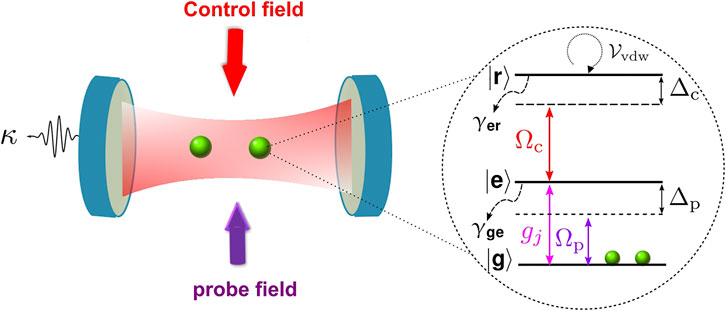
FIGURE 1. (Color online) Schematic diagram of a single-mode cavity coupled with two three-level ladder-type atoms. Levels |g⟩ and |e⟩ are coupled to the cavity field with the coupling strength gj. Moreover, the control field of frequency ωc with Rabi frequency ΩC couples the transition |e⟩ to |r⟩ and a probe field with frequency ωp and strength Ωp coupled the state |g⟩ and |e⟩, respectively. γer and γge are the spontaneous emission rates from states |r⟩ and |e⟩, respectively, and κ is the cavity decay. The two-atom system with Van der Waals potential between the Rydberg states creates an interaction
The master equation for the density matrix operator of the system is then given by
where
Numerically solving Eq. 2, one can evaluate the equal-time second-order correlation function
3 Two-PB for in phase radiations
First, we turn off the coupling field and consider the case of in-phase radiation, i.e., ΦZ = 0, resulting in g1 = g2 = g0. In this case, the dressed states in absence of the coupling field (equivalent Jaynes–Cummings model) are given in Figure 2A(see the blue states). In panel (b), there exist four peaks in the cavity excitation spectrum, where two large side peaks correspond to the single photon excitations with
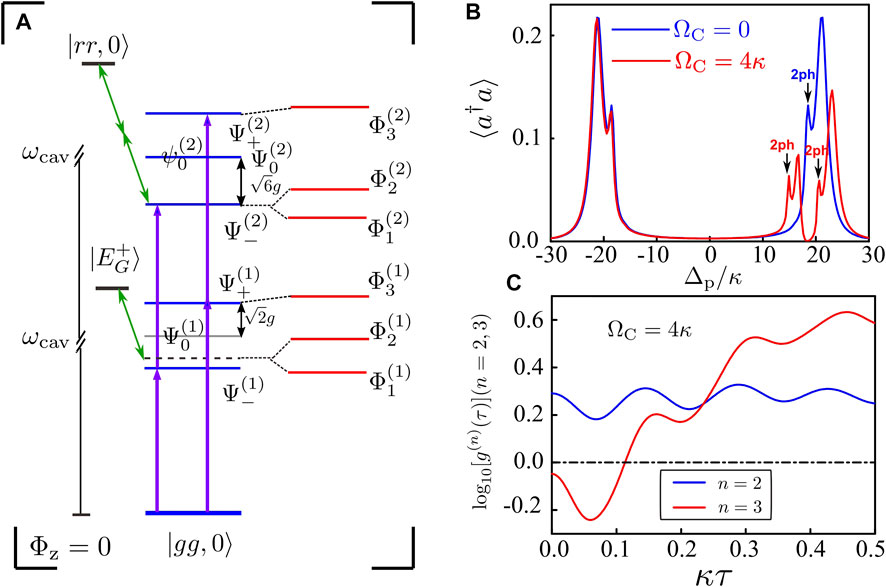
FIGURE 2. (Color online) (A) Schematic energy-level structure diagram explaining the energy splitting induced by ΩC in the case of Φz = 0. (B) Mean photon number ⟨a†a⟩ as a function of normalized detuning Δp/κ for the ΩC = 0 (blue solid curve) and ΩC = 4κ (pink solid curve). (C) Time-dependent field correlation functions log10 [g(2)(τ)] and log10 [g(3)(τ)] versus the normalized delay time κτ with Δp = 21.3κ. The strength of the probe field is Ωp = 0.8κ in panel (B) and Ωp = 1.5κ in panel (C). Other system parameters are chosen as g0 = 15κ, γer = 1κ, and γge = γer/200.
To overcome this energy broadening, we turn on the coupling field but neglect the Vdw interaction so that the physical mechanism can be clearly demonstrated. Choosing
In Figure 2C, we plot the time-dependent second-order correlation
Now, let us consider the influence of the Vdw interaction on the two-PB. As shown in Figure 3A, the g(2)(0) is always larger than unity, but the g(3)(0) decreases as the Vdw interaction [23–26] strength increases. Thus, the two-PB can be improved by increasing the Vdw interaction strength. At the same time, the mean photon number is also slightly increased (see blue dashed curve). This phenomenon can be explained by exploring the analytical expression of the photon correlation functions. It should be noted that the following analytical expressions are valid only for weak driving fields. Truncating the Hilbert space by the three-photon space, g(2)(0) and g(3)(0) can be expressed analytically as functions of the photon number distributions pn under the weak probe field regime,
where
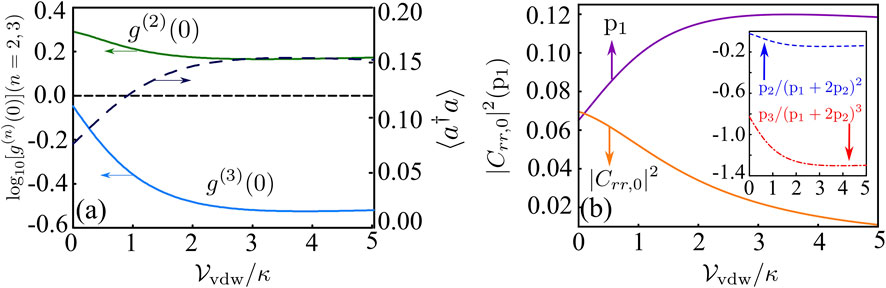
FIGURE 3. (Color online) (A) log10 [⟨a†a⟩] (blue-black dashed curve), log10 [g(2)(0)] (green solid curve), and log10 [g(3)(0)] (wathet blue solid curve) are plotted as functions of the Vdw interaction strength
4 Two-PB for out-of-phase radiations
Now, we study the out-of-phase configuration Φz = π, yielding g1 = −g2 = g0. In the absence of the control field, one can easily obtain the dressed states of the system as shown in Figure 4A (see the blue states). Detailed expressions of the eigenvalues and eigenstates can be found in Ref. [13]. Contrary to the in-phase case, the
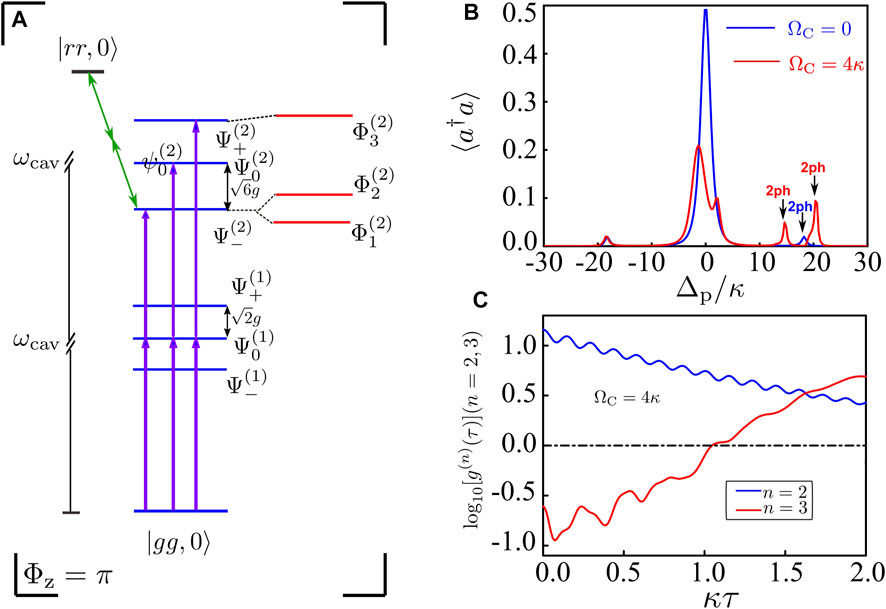
FIGURE 4. (Color online) (A) Schematic energy-level structure illustrating the energy splitting induced by ΩC in the case of Φz = π. (B) Numerical results for ⟨a†a⟩ as functions of normalized detuning Δp/κ with ΩC = 0 (blue solid line) and ΩC = 4κ (red solid line). (C) Time evolution of log10 [g(2)(τ)] (reseda solid curve) and log10 [g(3)(τ)] (wathet blue solid curve) with Δp = 21.3κ. In (b) ΩP = 1.5κ and in (c) ΩP = 2.0κ, other system parameters are the same as in Figure 2.
In the presence of the control field but without the Vdw interaction, the energy levels (blue lines in Figure 4A) will experience shifting and splitting due to the EIT effect. To improve the two-PB blockade, one requires that the state in two-photon space is resonantly coupled by the pump field via the two-photon process, but other states in N-photon (N > 3) states are far off-resonance. Thus, we choose the control field detuning
Finally, we investigate the influence of the Vdw interaction on the two-PB when two atoms radiate out of phase. In Figure 5A, we show the dependence of the correlation functions log10 [g(2)(0)], log10 [g(3)(0)], and the mean photon number ⟨a†a⟩ on the Vdw interaction strength. Here, we choose the system parameters as g = 15κ, γge = κ, γer = γge/200, Ωp = 2.0κ, Δp = 21.3κ,
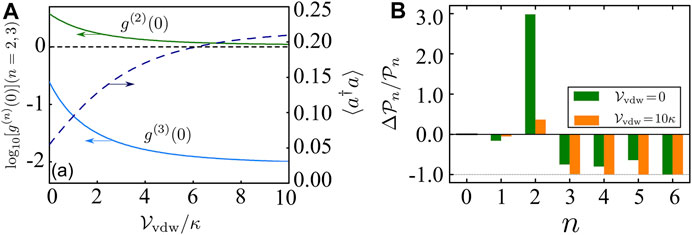
FIGURE 5. (Color online) (A) log10 [⟨a†a⟩] (blue-black dashed curve), log10 [g(2)(0)] (green solid curve), and log10 [g(3)(0)] (wathet blue solid curve) for different values of
5 Conclusion
In summary, we have proposed a model to realize strong two-PB (g(2)(0) > 1 and g(3)(0) < 0.01) by trapping two Rydberg atoms with EIT configuration inside an optical cavity. We show that the external control field can be used to effectively control the collective states of two atoms and the cavity mode, yielding two-PB for in-phase and out-of-phase radiations, respectively. Moreover, in the presence of the Vdw interaction, the mean photon number can be increased, and the two-PB phenomenon can be strongly improved in the case of out-of-phase radiations. With the development of atom trapping and cooling techniques, our scheme can be implemented not only in classical cavity-QED systems, as in experiments of Meschede [27] and Rempe groups [28], but also in a 1D topological photonics system involving an asymmetric edge mode [29]. Thus, our scheme has potential applications in manipulating photon states and generating nonclassical light, such as the two-photon source.
Data availability statement
The raw data supporting the conclusion of this article will be made available by the authors, without undue reservation.
Author contributions
YY and CZ took the lead on the research work by running the simulations, performing most of the analysis, and producing all the figures. KH contributed to the code development. KH, ZZ, CZ, and YY wrote substantial parts of the manuscript. All authors contributed equally to the discussions, read the manuscript, and provided critical feedback.
Funding
KH acknowledges the support of the Natural Science Foundation of Anhui Provincial Education Department (Grant No. KJ2021A0632), the project of excellent young talents of universities in Anhui province (Grant No. gxyq2021194), and the Doctor Foundation of Anhui Jianzhu University (Grant No. 2020QDZ21). CZ and YY acknowledge the support of the National Nature Science Foundation (Grants No. 61975154 and 11874287) and the National Key Research and Development Program of China (Grants No. 2021YFA1400600 and 2021YFA1400602).
Conflict of interest
The authors declare that the research was conducted in the absence of any commercial or financial relationships that could be construed as a potential conflict of interest.
Publisher’s note
All claims expressed in this article are solely those of the authors and do not necessarily represent those of their affiliated organizations, or those of the publisher, the editors, and the reviewers. Any product that may be evaluated in this article, or claim that may be made by its manufacturer, is not guaranteed or endorsed by the publisher.
References
1. Imamoglu A, Schmidt H, Woods G, Deutsch M. Strongly interacting photons in a nonlinear cavity. Phys Rev Lett (1997) 78:1467–70. doi:10.1103/PhysRevLett.79.1467
3. Birnbaum KM, Boca A, Miller R, Boozer AD, Northup TE, Kimble HJ. Photon blockade in an optical cavity with one trapped atom. Nature (2005) 436:87–90. doi:10.1038/nature03804
4. Fink JM, Göppl M, Baur M, Bianchetti R, Leek PJ, Blais A, et al. Climbing the Jaynes-Cummings ladder and observing its nonlinearity in a cavity QED system. Nature (2008) 454:315–8. doi:10.1038/nature07112
5. Souza JA, Figueroa E, Chibani H, Villas-Boas CJ, Rempe G. Coherent control of quantum fluctuations using cavity electromagnetically induced transparency. Phys Rev Lett (2013) 111:113602. doi:10.1103/PhysRevLett.111.113602
6. Zhou YH, Shen HZ, Zhang XY, Yi XX. Zero eigenvalues of a photon blockade induced by a non-Hermitian Hamiltonian with a gain cavity. Phys Rev A (2018) 97:043819. doi:10.1103/PhysRevA.97.043819
7. Ulrich SM, Gies C, Ates S, Wiersig J, Reitzenstein S, Hofmann C, et al. Photon statistics of semiconductor microcavity lasers. Phys Rev Lett (2017) 98:043906. doi:10.1103/PhysRevLett.98.043906
8. Faraon A, Fushman I, Englund D, Stoltz N, Petroff P, Vuckovic J. Coherent generation of non-classical light on a chip via photon-induced tunnelling and blockade. Nat Phys (2008) 4:859–63. doi:10.1038/nphys1078
9. Liu YX, Xu XW, Miranowicz A, Nori F. From blockade to transparency: Controllable photon transmission through a circuit-QED system. Phys Rev A (2014) 89:043818. doi:10.1103/physreva.89.043818
10. Liew TCH, Savona V. Single photons from coupled quantum modes. Phys Rev Lett (2011) 104:183601. doi:10.1103/PhysRevLett.104.183601
11. Bamba M, Imamoglu A. Origin of strong photon antibunching in weakly nonlinear photonic molecules. Phys Rev A (2011) 83:021802. doi:10.1103/PhysRevA.83.021802
12. Snijders HJ, Frey JA, Norman J, Flayac H, Savona V, Gossard A, et al. Observation of the unconventional photon blockade. Phys Rev Lett (2018) 121:043601. doi:10.1103/PhysRevLett.121.043601
13. Zhu CJ, Yang YP, Agarwal GS. Collective multiphoton blockade in cavity quantum electrodynamics. Phys Rev A (2017) 95:063842. doi:10.1103/PhysRevA.95.063842
14. Hou K, Zhu CJ, Yang YP, Agarwal GS. Interfering pathways for photon blockade in cavity QED with one and two qubits. Phys Rev A (2019) 100:063817. doi:10.1103/PhysRevA.100.063817
15. Zhu CJ, Hou K, Yang YP, Deng L. Hybrid level anharmonicity and interference-induced photon blockade in a two-qubit cavity QED system with dipole–dipole interaction. Photon Res (2021) 9:1264–71. doi:10.1364/PRJ.421234
16. Shamailov SS, Parkins AS, Collett MJ, Carmichael HJ. Multi-photon blockade and dressing of the dressed states. Opt Commun (2010) 283:766–72. doi:10.1016/j.optcom.2009.10.062
17. Miranowicz A, Paprzycka M, Liu YX, Bajer J, Nori F. Two-photon and three-photon blockades in driven nonlinear systems. Phys Rev A (2013) 87:023809. doi:10.1103/PhysRevA.87.023809
18. Hovsepyan GH, Shahinyan AR, Kryuchkyan GY. Multiphoton blockades in pulsed regimes beyond stationary limits. Phys Rev A (2014) 90:013839. doi:10.1103/PhysRevA.90.013839
19. Miranowicz A, Bajer J, Lambert N, Liu YX, Nori F. Tunable multiphonon blockade in coupled nanomechanical resonators. Phys Rev A (2016) 93:013808. doi:10.1103/PhysRevA.93.013808
20. Hamsen C, KNicolas T, Wilk T, Rempe G. Two-photon blockade in an atom-driven cavity QED system. Phys Rev Lett (2017) 118:133604. doi:10.1103/PhysRevLett.118.133604
21. Peyronel T, Firstenberg O, Liang QY, Hofferberth S, Gorshkov AV, Pohl T, et al. Quantum nonlinear optics with single photons enabled by strongly interacting atoms. Nature (2012) 488:57–60. doi:10.1038/nature11361
22. Pleinert MO, Zanthier JV, Agarwal GS. Hyperradiance from collective behavior of coherently driven atoms. Optica (2017) 4:779–85. doi:10.1364/OPTICA.4.000779
23. Jaksch D, Cirac JI, Zoller P, Rolston SL, Cote R, Lukin MD. Fast quantum gates for neutral atoms. Phys Rev Lett (2010) 85:2208–11. doi:10.1103/PhysRevLett.85.2208
24. Boddeda R, Usmani I, Bimbard E, Grankin A, Ourjoumtsev A, Brion E, et al. Rydberg-induced optical nonlinearities from a cold atomic ensemble trapped inside a cavity. J Phys B: Mol Opt Phys (2016) 49:084005. doi:10.1088/0953-4075/49/8/084005
25. Grankin A, Brion E, Bimbard E, Boddeda R, Usmani I, Ourjoumtsev A, et al. Quantum statistics of light transmitted through an intracavity Rydberg medium. New J Phys (2014) 16:043020. doi:10.1088/1367-2630/16/4/043020
26. Huang JF, Liao JQ, Sun CP. Photon blockade induced by atoms with Rydberg coupling. Phys Rev A (2013) 87:023822. doi:10.1103/PhysRevA.87.023822
27. Reimann R, Alt W, Kampschulte T, Macha L, Ratschbacher L, Thau N, et al. Cavity-modified collective Rayleigh scattering of two atoms. Phys Rev Lett (2015) 114:023601. doi:10.1103/PhysRevLett.114.023601
28. Neuzner A, Korber M, Rempe G. Interference and dynamics of light from a distance-controlled atom pair in an optical cavity. Nat Photon (2016) 10:303–6. doi:10.1038/nphoton.2016.19
Keywords: quantum optics, photon blockade, cavity-QED system, Rydberg atoms, Van der Waals interaction
Citation: Hou K, Zhang Z, Zhu C and Yang Y (2022) Enhancement of the two-photon blockade effect via Van der Waals interaction. Front. Phys. 10:979427. doi: 10.3389/fphy.2022.979427
Received: 27 June 2022; Accepted: 08 August 2022;
Published: 15 September 2022.
Edited by:
Zeyang Liao, Sun Yat-sen University, ChinaCopyright © 2022 Hou, Zhang, Zhu and Yang. This is an open-access article distributed under the terms of the Creative Commons Attribution License (CC BY). The use, distribution or reproduction in other forums is permitted, provided the original author(s) and the copyright owner(s) are credited and that the original publication in this journal is cited, in accordance with accepted academic practice. No use, distribution or reproduction is permitted which does not comply with these terms.
*Correspondence: Chengjie Zhu, Y2hlbmdqaWUuemh1QHlhaG9vLmNvbQ==; Yaping Yang, eWFuZy15YXBpbmdAdG9uZ2ppLmVkdS5jbg==