Your new experience awaits. Try the new design now and help us make it even better

ORIGINAL RESEARCH article

Front. Phys., 11 December 2025

Sec. Interdisciplinary Physics

Volume 13 - 2025 | https://doi.org/10.3389/fphy.2025.1611559

Null Bertrand partner -curves on spacelike surfaces

  • Department of Mathematics, Manisa Celal Bayar University, Manisa, Türkiye

In this paper, by using the Darboux frame of null curves, we define null Bertrand partner D-curves and present the relations between curvatures of these curves in Minkowski 3-space E13. In addition, we obtain some special results. Finally, by considering surface construction methods, we provide examples for null Bertrand partner D-curves in E13.

1 Introduction

The associated curve of a given curve is a fascinating subject of differential geometry. So, finding such a curve is an interesting problem. Many geometers have investigated this problem in different spaces. The well-known examples of associated curves are Bertrand and Mannheim curves in the Euclidean 3-space. A Bertrand curve is a curve that shares its principal normal vectors with another curve and is characterized by the property that λκ+μτ=1, where λ,  μ are constants [1]. Similarly, Mannheim curves are special curves for which the principal normal of one of the curves is linearly dependent on the binormal vector of the other curve.

Considering the curves on surfaces is more interesting and provides an idea for defining new types of associated curves on surfaces. We note that a new type of Bertrand curve has been defined on surfaces and is called the Bertrand partner D-curves [2, 3]. In this definition, the authors have considered the Darboux frames of surface curves and obtained some characterizations of those curves.

Moreover, studying a concept of Euclidean space within Minkowski space is particularly interesting since the curves of this space are related to physics and the theory of relativity. A timelike curve corresponds to the path of an observer moving slower than the speed of light, a null curve corresponds to the observer moving at the speed of light, and a spacelike curve corresponds to an observer moving faster than light [4]. Particularly, null curves have extra importance since the classical relativistic string is a surface or world-sheet in Minkowski space, which satisfies the Lorentzian analog of the minimal surface equation [5]. Moreover, string equations are useful tools for simplifying the wave equation and a few additional simple equations. For instance, the solution of a two-dimensional (2D) wave equation shows that strings are related to null curve pairs, and if the string is open, it is related to a single null curve [5, 6].

In this paper, we define null Bertrand partner D-curves lying on spacelike surfaces and present characterizations for these associated null curves. We obtain relations between curvatures of null Bertrand partner D-curves. Finally, we provide some examples for null Bertrand partner D-curves in Minkowski 3-space E13.

2 Preliminaries

The Minkowski 3-space E13 is the real vector space IR3 provided with the standard flat metric given by ,=dx12+dx22+dx32, where (x1,x2,x3) is a rectangular coordinate system of E13. An arbitrary vector v=(v1,v2,v3) in E13 can have one of three Lorentzian causal characters; it can be spacelike if v,v>0 or v=0, timelike if v,v<0, and null (light-like) if v,v=0 and v0. Similarly, an arbitrary curve α=α(s) can locally be spacelike, timelike, or null (light-like) if all of its velocity vectors α(s) are spacelike, timelike, or null (light-like), respectively. For any vectors x=(x1,x2,x3) and y=(y1,y2,y3) in E13, the Lorentz vector product of x and y is defined as follows:

x×y=e1e2e3x1x2x3y1y2y3=x2y3x3y2,x1y3x3y1,x2y1x1y2,

where δij=1i=j,0ij,ei=(δi1,δi2,δi3) and e1×e2=e3,    e2×e3=e1,    e3×e1=e2 [7, 8].

l,  n,u is used to denote the moving frame along the null curve α(s) in E13. For an arbitrary null curve α(s), the following Frenet formulas are given

lnu=00k100k2k2k10lnu,

where l,l=n,n=l,u=u,n=0,  u,u=l,n=1 and “” denotes the derivative with respect to the arc length parameter s [9].

Similar to the curves, a surface in E13 can be timelike or spacelike. A surface S:UR2E13 is called a timelike (spacelike) surface if the induced metric on the surface is a Lorentz metric (positive definite Riemannian metric); i.e., the normal vector on the spacelike (timelike) surface is a timelike (spacelike) vector, where U is an open set in R2 [10].

Let S be a spacelike surface in E13 defined on an open set UR2, and let us consider a null curve α(s) on S with Frenet frame T,N,B. Since α(s) lies on S, there exists another frame along α(s), which is called the Darboux frame of α(s) and is denoted by T,U,V. In this frame, T is the unit tangent of the curve, U is the unit normal of the surface S along α(s), and V is the unique vector obtained by

V=1X,TXX,X2X,TT,   XTαtS,   X,T0,

where

T,T=V,V=T,U=V,U=0,    T,V=U,U=1.(1)

Therefore, the Darboux formula of the moving frame is

TVU=kg0kn0kgτgτgkn0TVU.(2)

In these formulas, kg,   kn, and τg are called the geodesic curvature, the normal curvature, and the geodesic torsion, respectively. Henceforth, we use “quote” to denote the derivative with respect to the arc length parameter of α(s) [9, 11].

3 Null Bertrand partner D-curves on spacelike surfaces in E13

In this section, by considering the Darboux frame of null curves, we define null Bertrand partner D-curves and provide the characterizations of these curves in E13.

Definition 1. Let S1 and S2 be oriented spacelike surfaces in E13, and let us consider the unit-speed null curves α1(s1) and α2(s2) lying fully on S1 and S2, respectively. The Darboux frames of null curves α1(s1) and α2(s2) are denoted by T1,U1,V1 and T2,U2,V2, respectively. If there exists a corresponding relationship between the curves α and α1 such that at the corresponding points of the curves, the Darboux frame element U1 of α1 coincides with the Darboux frame element U2 of α2, then α1 is called a null Bertrand D-curve and α2 is called a null Bertrand partner D-curve of α1. Then, the pair α1,α2 is said to be a null Bertrand D-pair.

Theorem 1. Let S1 and S2 be oriented spacelike surfaces in E13, and let null curves α1(s1) and α2(s2) with non-zero normal curvatures kn1 and kn2 lie on S1 and S2, respectively. Then, α1(s1) and α2(s2) are null Bertrand partner D-curves if and only if the following equality holds:

kn22dsds14=kn12.(3)

Proof. Suppose that the pair α1,α2 is a null Bertrand D-pair. The Darboux frames of α1(s1) and α2(s2) are denoted by T1,U1,V1 and T2,U2,V2, respectively. Then, by the definition, we can assume that

α2s2=α1s1+λs1U1s1,(4)

for some smooth function λ(s1). By taking the derivative of Equation 4 with respect to s1 and applying the Darboux Formula 2, we obtain

T2ds2ds1=1λτg1T1λkn1V1+λU1.(5)

Since the direction of U1 coincides with the direction of U2, the inner product of Equation 5 with U1 yields

λs1=0.(6)

Thus, λ is a non-zero constant. Now, equality Equation 5 can be written as

T2ds2ds1=1λτg1T1λkn1V1.(7)

Taking the inner product of Equation 7 with itself, we obtain

0=2kn11λτg1.(8)

From Equation 8, we obtain

τg1=1λ.(9)

Therefore, Equation 7 can be written as follows:

T2ds2ds1=λkn1V1.(10)

By taking the derivative of Equation 10, we obtain

kg2ds2ds12+d2s2ds12T2+kn2ds2ds12U2=kn1U1+λkn1+λkn1kg1V1,(11)

and taking the inner product of Equation 11 with itself, we obtain

kn22ds2ds14=kn12,(12)

which yields Equation 3.

Conversely, we assume that Equation 3 holds. For a non-zero constant λ, we define a curve as

α2s2=α1s1+λU1s1.(13)

We will prove that α1 is a null Bertrand D-curve and that α2 is the null Bertrand partner D-curve of α1. By taking the derivative of Equation 13 with respect to s1 twice, we obtain

T2ds2ds1=1λτg1T1λkn1V1,(14)

and

kg2ds2ds12+d2s2ds12T2+kn2ds2ds12U2=λτg1+kg1λkg1τg1T1+λkn1+λkn1kg1V1+kn12λkn1τg1U1,(15)

respectively. Taking the cross-product of Equation 15 and Equation 14, we obtain

kn2ds2ds13V2=λkn1212λτg1T1.(16)

Without loss of generality, taking the inner product of Equation 14 with itself yields τg1=1λ. Thus, Equation 14 can be written as

T2ds2ds1=λkn1V1.(17)

Finally, the cross-product of Equation 16 and Equation 17 shows that the Darboux frame element U1 of α1 coincides with the Darboux frame element U2 of α2 at the corresponding points of the curves; i.e., the curves α1 and α2 are null Bertrand D-pair curves.

Theorem 2 has the following corollaries.

Corollary 1. The distance between the corresponding points of null Bertrand curves is constant and is given by λ=1τg1.

Corollary 2. Let the pair α1,α2 be a null Bertrand D-pair. Then, the geodesic torsion of α1 is a non-zero constant and is given by τg1=1λ.

Corollary 3. There is no null Bertrand D-curve α that is a principal line; i.e., τg=0.

Theorem 2. Let α1(s1) and α2(s2) be null Bertrand partner D-curves with non-zero normal curvatures kn1 and kn2, respectively. Then,

kn1=kn21+2λτg2ds2ds12.(18)

Proof. Based on the definition, we can assume that

α1s1=α2s2λU2s2(19)

for a non-zero constant λ. By taking the derivative of Equation 19 with respect to s1 twice and applying the Darboux formulas, we obtain

T1=1+λτg2ds2ds1T2+λkn2ds2ds1V2(20)

and

T1=kg1T1+kn1U1=λτg2+kg2+λkg2τg2ds2ds12+1+λτg2d2s2ds12T2+λkn2λkn2kg2ds2ds12+λkn2d2s2ds12V2+kn21+2λτg2ds2ds12U2,(21)

respectively. By substituting Equation 20 into Equation 21, we obtain

kg11+λτg2ds2ds1T2+λkg1kn2ds2ds1V2+kn1U1=λτg2+kg2+λkg2τg2ds2ds12kg11+λτg2ds2ds1+1+λτg2d2s2ds12T2+λkn2λkn2kg2ds2ds12λkn2kg1ds2ds1+λkn2d2s2ds12V2+kn21+2λτg2ds2ds12U2.(22)

Since α1(s1) and α2(s2) are null Bertrand partner Dcurves, we obtain the desired equation

kn1=kn21+2λτg2ds2ds12.(23)

Theorem 3. Let α1 and α2 be null Bertrand partner Dcurves lying on surfaces S1 and S2, respectively. Then, the geodesic torsion of α2 is constant and is given by τg2=1λ.

Proof. From (Equation 3), we obtain

ds2ds12=kn1kn2,(24)

and by substituting Equation 24 into Equation 23, we obtain

τg2=1λ.(25)

From corollary 4 and theorem 7, we have the following corollary.

Corollary 4. The relationship between the geodesic torsions of null Bertrand partner Dcurves α1 and α2 is given by

τg1=τg2=1λ.

Corollary 5. Let α1 and α2 be null Bertrand partner Dcurves. Then, the curvatures of α1 and α2 hold

λkn2λkn2kg2ds2ds12=λkn2kg1ds2ds1d2s2ds12.(26)

Proof. It is proven based on Equation 22.

Corollary 6. Let α1 and α2 be null Bertrand partner Dcurves. Then, α1 and α2 are geodesic null Bertrand partner Dcurves on S1 and S2 if and only if

kn2ds2ds12+d2s2ds12kn2=0.

Proof. The proof is clear from Equation 26.

4 Examples

In this section, we provide some examples of null Bertrand partner Dcurves. For this purpose, we use a method related to the construction of spacelike surfaces [12].

Example 1. Let us consider the null curve α1(s)=(sinhs,coshs,s). Then, by using the method proposed by [12], the spacelike surface S1 containing α1(s) as a geodesic is obtained as S1(s,v)=A1(s,v),B1(s,v),C1(s,v), where

A1s,v=sinhs1+sinsv12sinhvcoshs,B1s,v=coshs1+sinsv12sinhssinhv,C1s,v=s+12sinhv,

where 0.5s,v1.5 (Figure 1). Then, by using the Darboux frame components, the Bertrand partner Dcurve α2 of α1 is obtained as

α2s=sinhs,coshs,s.

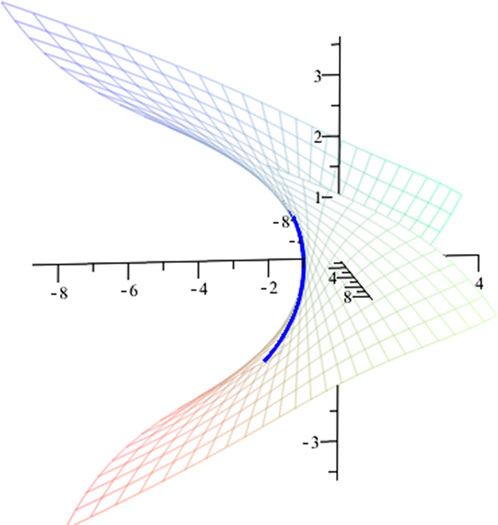
Then, we can construct a spacelike surface S2(s,v) with null geodesic α2 as S2(s,v)=A2(s,v),B2(s,v),C2(s,v), where

A2s,v=sinhs1+sinsvcoshssinhv,B2s,v=coshs1+sinsvsinhssinhv,C2s,v=s+sinhv,

and 1.5s,v1.5 (Figure 2).

Figure 1
A three-dimensional parametric curve is depicted, with a red line following the trajectory on a colorful mesh grid surface. The axes are labeled with numerical increments, and the surface has a wavy appearance.

Figure 1. Surface S1(s,v) and geodesic null curve α1(s).

Figure 2
A 3D surface plot with a grid-like pattern, illustrating a curved surface bending along the y-axis. The surface fades from blue to red, with a prominent blue line running along the curve near the center. Axes are labeled from negative eight to four on the x-axis and negative three to three on the z-axis.

Figure 2. Surface S2(s,v) and geodesic null Bertrand partner Dcurve α2(s).

Example 2. Let α3(s)=(s,sins,coss) be a null curve. Similarly, by using the method described by [12], the surface S3(s,v) containing α3(s) as a geodesic is constructed as S3(s,v)=A3(s,v),B3(s,v),C3(s,v), where

A3s,v=s+sinvv2,B3s,v=sins+sinvcoss+v2coss,C3s,v=cosssinvsinsv2sins,

and 2πs2π and πvπ (Figure 3). Then, by using the Darboux frame, the Bertrand partner Dcurve α4 of α3 is obtained as

α4s=s,sins,coss.

Now, the surface S4(s,v) containing α4 as a geodesic is constructed as S4(s,v)=A4(s,v),B4(s,v),C4(s,v), where

A4s,v=s12sins2v,B4s,v=sins12cosssins2v+sinssinv,C4s,v=coss+12sinssins2v+cosssinv,

and 2s2 and 1v1 (Figure 4).

Figure 3
A three-dimensional mathematical graph with a grid structure displaying two intersecting surfaces. The surfaces are outlined with red contours and colored lines, creating a layered and complex geometric pattern. The axes are labeled with numerical values.

Figure 3. Surface S3(s,v) and null geodesic curve α3(s).

Figure 4
Three-dimensional plot of a curving surface with a blue curve along the top edge. The surface consists of a grid pattern transitioning from green on the left, through beige, to pink on the right. The graph includes axes labeled with numbers and crosses at zero.

Figure 4. Surface S4(s,v) and null geodesic Bertrand partner Dcurve α4(s).

Data availability statement

The original contributions presented in the study are included in the article/supplementary material; further inquiries can be directed to the corresponding author.

Author contributions

TK: Writing – original draft.

Funding

The author declares that no financial support was received for the research and/or publication of this article.

Conflict of interest

The author declares that the research was conducted in the absence of any commercial or financial relationships that could be construed as a potential conflict of interest.

Generative AI statement

The author declares that no Generative AI was used in the creation of this manuscript.

Any alternative text (alt text) provided alongside figures in this article has been generated by Frontiers with the support of artificial intelligence and reasonable efforts have been made to ensure accuracy, including review by the authors wherever possible. If you identify any issues, please contact us.

Publisher’s note

All claims expressed in this article are solely those of the authors and do not necessarily represent those of their affiliated organizations, or those of the publisher, the editors and the reviewers. Any product that may be evaluated in this article, or claim that may be made by its manufacturer, is not guaranteed or endorsed by the publisher.

References

1. Matsuda H, Yorozu S. Notes on bertrand curves. Yokohama Math J (2003) 50:41–58.

Google Scholar

2. Kazaz M, Uğurlu HH, Önder M, Oral S. Bertrand partner D-curves in the euclidean 3-space E3. Afyon Kocatepe Univ J Sci Eng (2016) 16:76–83. doi:10.5578/fmbd.25270

CrossRef Full Text | Google Scholar

3. Kazaz M, Uğurlu HH, Önder M, Oral S. Bertrand partner D-curves in the minkowski 3-space. Math Sci Appl E-Notes (2014) 2(1):68–82.

Google Scholar

4. El Naschie MS. Einstein’s dream and fractal geometry. Chaos Solitons Fractals (2005) 24:1–5. doi:10.1016/j.chaos.2004.09.001

CrossRef Full Text | Google Scholar

5. Hughston LP, Shaw WT. Constraint-free analysis of relativistic strings. Classical Quan Gravity (1988) 5:69–72. doi:10.1088/0264-9381/5/3/001

CrossRef Full Text | Google Scholar

6. Hughston LP, Shaw WT. Real classical string. Proc R Soc Lond Ser A (1987) 414:415–422.

Google Scholar

7. O‘Neill B. Semi-riemannian geometry with applications to relativity. New York: Academic Press (1983).

Google Scholar

8. Walrave J, Leuven KU. Curves and surfaces in minkowski space. Leuven: Fac of Science (1995). PhD thesis.

Google Scholar

9. Duggal KL, Bejancu A. Lightlike submanifolds of Semi-Riemannian manifolds and applications. Dordrecht: Kluwer Academic Publishers (1996). p. 54–75.

CrossRef Full Text | Google Scholar

10. Beem JK, Ehrlich PE. Global lorentzian geometry. New York: Marcel Dekker (1981).

Google Scholar

11. Çöken AC, Çiftçi Ü. On null curves on surfaces and null vectors in lorentz space. Süleyman Demirel Univ J Sci (2007) 2(1):111–116.

Google Scholar

12. Şaffak G, Kasap E. Family of surface with a common null geodesic. Int J Phys Sci (2009) 4(8):428–433.

Google Scholar

Keywords: null curve, Bertrand, string, spacelike surfaces, partner curves

Citation: Kahraman T (2025) Null Bertrand partner D-curves on spacelike surfaces. Front. Phys. 13:1611559. doi: 10.3389/fphy.2025.1611559

Received: 15 April 2025; Accepted: 29 October 2025;
Published: 11 December 2025.

Edited by:

Clemente Cesarano, Università Telematica Internazionale Uninettuno, Italy

Reviewed by:

Yanlin Li, Hangzhou Normal University, China
Janos Polonyi, Université de Strasbourg, France

Copyright © 2025 Kahraman. This is an open-access article distributed under the terms of the Creative Commons Attribution License (CC BY). The use, distribution or reproduction in other forums is permitted, provided the original author(s) and the copyright owner(s) are credited and that the original publication in this journal is cited, in accordance with accepted academic practice. No use, distribution or reproduction is permitted which does not comply with these terms.

*Correspondence: Tanju Kahraman, dGFuanUua2FocmFtYW5AY2J1LmVkdS50cg==

Disclaimer: All claims expressed in this article are solely those of the authors and do not necessarily represent those of their affiliated organizations, or those of the publisher, the editors and the reviewers. Any product that may be evaluated in this article or claim that may be made by its manufacturer is not guaranteed or endorsed by the publisher.