 Gerardo Salvato
 Roy Dings
 Lucia Reuter
- 1Department of Brain and Behavioral Sciences, University of Pavia, Pavia, Italy
- 2Department of Psychiatry, Oxford Centre for Human Brain Activity, University of Oxford, Oxford, UK
- 3Department of Philosophy, Radboud University Nijmegen, Nijmegen, Netherlands
- 4Department of Psychiatry, Charité University Hospital of Berlin, Berlin, Germany
Society, Neuroscience, and Law
Nowadays, immigration flow to industrial cities has increased significantly. As a result, cultures are mixed and society has to deal with diverse languages, traditions and behaviors that appear to coexist in the same environment. This issue might influence the way justice is conducted. Legal trials increasingly involve citizens who have not necessarily grown up in the local culture or followed the same rules as native residents since their childhood. Interestingly enough, over the past few years, due to the growing complexity of legal trials, neuroscience and law started a promising partnership, which is now a recognized field of study (Goodenough and Tucker, 2010). Indeed, neuroscientific evidence in the courtroom offers reliable support in establishing the responsibility, free will and moral judgment of the defendant (Jones et al., 2013). When law calls for neuroscience in the courtroom, cross-cultural cases raise some ethical and practical concerns (Brickman et al., 2006). Mainly, these issues are related to the strong impact of culture on human behavior and to the absence of clear guidelines to follow when a neuroscientist is required to undertake a foreign defendant's profile assessment.
The Cultural Shape of the Human Brain
The consistent modulatory and constitutional effects of culture on brain and behavior in humans have been largely demonstrated (for a review see Rule et al., 2013). For instance, differences in neural activity have been identified across cultures (Han and Northoff, 2008). It has been demonstrated that Americans show different brain activation patterns compared to Japanese people performing the same cognitive task on object processing during a functional Magnetic Resonance Imaging (fMRI) study (Gutchess et al., 2006). Behavioral studies exploring differences across populations have shown that culture has a considerable impact on basic cognitive functions, such as visual perception, memory and language. For instance, hunter-gatherers are less susceptible to the Müller-Lyer illusion (Segall et al., 1966). Moreover, evidence for differences in numerical cognition in several indigenous populations is present (Gordon, 2004; Pica et al., 2004; Frank et al., 2008). Culture could also influence spatial cognition (Majid et al., 2004). It has been shown that spatial cognitive strategies are modulated by the linguistic frame of references used in the native tongue. Indeed, language might influence the conceptual coding of space Pederson et al., 1998; Levinson et al., 2002; Haun et al., 2011. Cultural background also plays a pivotal role on more complex social mechanisms, such as emotion. In fact, the regulation of emotions is directly adjusted by culture, in which intrinsic norms guiding social interactions are present (De Leersnyder et al., 2013). For instance, Japanese people are more receptive than Dutch people in the vocal processing and perception of emotion (Tanaka et al., 2010).
The Transcultural Cognitive Assessment and its Interpretation: Some Recommendations
As a result, anatomical and behavioral ethnic differences shaping social behavior might have some implications in the field of law. For example, previous studies have revealed that violent behaviors are more widespread in collectivistic compared to individualistic populations (Nesdale and Naito, 2005; Negy et al., 2013; Catalá-Miñana et al., 2014). More specifically, in the case of domestic violence, the severity of physical assaults was found to be higher in English than Spanish offenders (Catalá-Miñana et al., 2014). From this point of view, a comprehensive evaluation of the foreign defendant's profile could take into account these distinctive characteristics, which are relevant for both cognitive assessment and legal treatment. Remarkably, the neuroscientific assessment and legal report of foreign defendants raise a number of important questions. First of all, should tests that have specifically been developed for western subjects be used in the neuropsychological assessment of subjects of a different ethnicity? And if not, who is qualified to design and translate tests for ethnic minorities and non-English speakers? Who is qualified to administer and interpret the results? When a neuroscientist is required to undertake a legal report in the case of a foreign defendant's assessment, there are no clear guidelines to follow. In order to address these issues, we suggest an integrated approach accounting for cross-cultural differences that could be useful for a better understanding of the foreign defendants' profile in the courtroom. The assessment of cognitive functions through neuropsychological testing should include tests with adequate psychometric characteristics for culture or culture-free tests, in order to compare the subject's profile with a coherent group of healthy controls of the same age, education, gender and most importantly, the same cultural background. The importance of a qualitative as well as quantitative collection of data has been emphasized when neuropsychological tests are not available or scarce (e.g., few standardized neuropsychological measures for small-scale human communities) (Caetano, 2006). Indeed, a qualitative interpretation of results could shed light on the meaning of behaviors, choices and thoughts associated with a particular cultural background (Norenzayan, 2011). Additionally the involvement of a multidisciplinary team could be essential to more suitable assessments. Such a team could include experts belonging to both clinical and research practice. Hence, the “neuro-in-law” equip could involve at least a neuropsychologist, neuroscientist, neuroimaging expert, neurologist, psychiatrist, anthropologist as well as a translator to allow for a clear interpretation of the defendant's profile. Each of these experts could assess the defendant separately, with no prior knowledge of the diagnosis reached by other team members.
Conclusions
Particular attention should be paid to the scientific methodology used for cognitive profiling when ethnic differences are present. Importantly, as the interaction between neuroscience and law is quite recent, is still necessary to establish suitable protocols for experts required to produce legal reports of foreign defendants. This issue is not marginal considering the influence of culture on behavior mentioned previously, as more and more legal trials also involve neuroscientific evidence. Additionally, it is worth noting that when cultural differences are taken into account, there is a risk that stereotypes leading to prejudice might be reinforced. For this reason, the cognitive diversity found across populations should be handled with some care as it might not be relevant to other fields of law (e.g., law enforcement official practice). Instead, when legal trials involve cultural diversity, a comprehensive neuroscientific procedure may contribute to more objective legal outcomes. In this case, neuroscience could assist law in decoding the significance of a range of culturally modulated social behaviors, which might have a strong impact on evidence examined in court (Figure 1). Advances in neuroscience are required to better fit the law's demands in the courtroom.
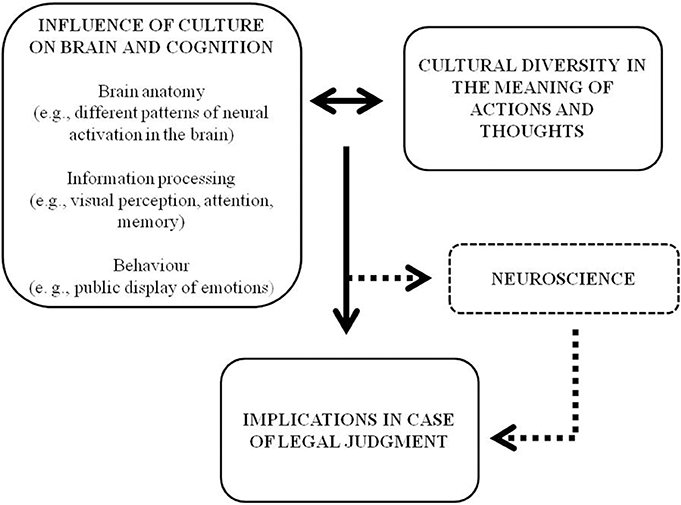
Figure 1. Culture, neuroscience and law. Culture influences human brain and cognition, hence the diversity we can observe in the meaning of actions and behaviors across different cultures. In the case of cross-cultural legal trials, this diversity could influence the legal outcomes. For example, the foreign defendants' or witnesses' testimonies might be influenced by the way they have perceived or remembered the situation, according to their cultural background. From this perspective, neuroscience could assist law for a clear and objective interpretation of the foreign defendant's behavior, taking into account the weight of culture on the brain.
Conflict of Interest Statement
The Associate Editor Asifa Majid declares that, despite being affiliated to the same institution as the author Roy Dings, the review process was handled objectively and no conflict of interest exists. The authors declare that the research was conducted in the absence of any commercial or financial relationships that could be construed as a potential conflict of interest.
Acknowledgments
The authors thank Dr. Anna Sedda for her helpful comments.
References
Brickman, A. M., Cabo, R., and Manly, J. J. (2006). Ethical issues in cross-cultural neuropsychology. Appl. Neuropsichol. 13, 91–100. doi: 10.1207/s15324826an1302_4
Pubmed Abstract | Pubmed Full Text | CrossRef Full Text | Google Scholar
Caetano, C. (2006). “Qualitative assessment within and across cultures,” in International Handbook of Cross-Cultural Neuropsychology, eds B. Uzzell, M. Ponton, and A. Ardila (Mahwah, NJ: Lawrence Erlbau), 93–108.
Catalá-Miñana, A., Walker, K., Bowen, E., and Lila, M. (2014). Cultural differences in personality and aggressive behavior in intimate partner violence offenders: a comparison of english and spanish offenders. J. Interpers. Violence 29, 2652–2669. doi: 10.1177/0886260513517301
Pubmed Abstract | Pubmed Full Text | CrossRef Full Text | Google Scholar
De Leersnyder, J., Boiger, M., and Mesquita, B. (2013). Cultural regulation of emotion: individual, relational, and structural sources. Front. Psychol. 4:55. doi: 10.3389/fpsyg.2013.00055
Pubmed Abstract | Pubmed Full Text | CrossRef Full Text | Google Scholar
Frank, M. C., Everett, D. L., Fedorenko, E., and Gibson, E. (2008). Number as a cognitive technology: Evidence from Pirahã language and cognition. Cognition 108, 819–824. doi: 10.1016/j.cognition.2008.04.007
Pubmed Abstract | Pubmed Full Text | CrossRef Full Text | Google Scholar
Goodenough, O. R., and Tucker, M. (2010). Law and cognitive neuroscience. Ann. Rev. Law Soc. Sci. 6, 61–92. doi: 10.1146/annurev.lawsocsci.093008.131523
Gordon, P. (2004). Numerical cognition without words: evidence from Amazonia. Science 306, 496–499. doi: 10.1126/science.1094492
Pubmed Abstract | Pubmed Full Text | CrossRef Full Text | Google Scholar
Gutchess, A. H., Welsh, R. C., Boduroglu, A., and Park, D. C. (2006). Cultural differences in neural function associated with object processing. Cogn. Affect. Behav. Neurosci. 6, 102–109. doi: 10.3758/CABN.6.2.102
Pubmed Abstract | Pubmed Full Text | CrossRef Full Text | Google Scholar
Han, S., and Northoff, G. (2008). Culture-sensitive neural substrates of human cognition: a transcultural neuroimaging approach. Nat. Rev. Neurosci. 9, 646–654. doi: 10.1038/nrn2456
Pubmed Abstract | Pubmed Full Text | CrossRef Full Text | Google Scholar
Haun, D., Rapold, C. J., Janzen, G., and Levinson, S. C. (2011). Plasticity of human spatial cognition: spatial language and cognition covary across cultures. Cognition 119, 70–80. doi: 10.1016/j.cognition.2010.12.009
Pubmed Abstract | Pubmed Full Text | CrossRef Full Text | Google Scholar
Jones, O. D., Wagner, A. D., Faigman, D. L., and Raichle, M. E. (2013). Neuroscientists in court. Nat. Rev. Neurosci. 14, 730–736. doi: 10.1038/nrn3585
Pubmed Abstract | Pubmed Full Text | CrossRef Full Text | Google Scholar
Levinson, S. C., Kita, S., Haun, D., and Rasch, B. H. (2002). Returning the tables: language affects spatial reasoning. Cognition 84, 155–188. doi: 10.1016/S0010-0277(02)00045-8
Pubmed Abstract | Pubmed Full Text | CrossRef Full Text | Google Scholar
Majid, A., Bowerman, M., Kita, S., Haun, D., and Levinson, S. C. (2004). Can language restructure cognition? The case for space. Trends Cogn. Sci. 8, 108–114. doi: 10.1016/j.tics.2004.01.003
Pubmed Abstract | Pubmed Full Text | CrossRef Full Text | Google Scholar
Negy, C., Ferguson, C. J., Galvanovskis, A., and Smither, R. (2013). Predicting violence: a cross-national study of United States and Mexican young adults. J. Soc. Clin. Psychol. 32, 54–70. doi: 10.1521/jscp.2013.32.1.54
Nesdale, D., and Naito, M. (2005). Individualism-collectivism and the attitudes to school bullying of Japanese and Australian students. J. Cross Cult. Psychol. 36, 1–20. doi: 10.1177/0022022105278541
Norenzayan, A. (2011). Explaining human behavioral diversity. Science 332, 1041–1042. doi: 10.1126/science.1207050
Pubmed Abstract | Pubmed Full Text | CrossRef Full Text | Google Scholar
Pederson, E., Danziger, E., Wilkins, D., Levinson, S., Kita, S., and Senft, G. (1998). Semantic typology and spatial conceptualization. Language 74, 557–589. doi: 10.1353/lan.1998.0074
Pica, P., Lemer, C., Izard, V., and Dehaene, S. (2004). Exact and approximate arithmetic in an Amazonian indigene group. Science 306, 499–503. doi: 10.1126/science.1102085
Pubmed Abstract | Pubmed Full Text | CrossRef Full Text | Google Scholar
Rule, O. N., Freeman, B. J., and Ambady, N. (2013). Culture in social neuroscience: a review. Soc. Neurosci. 8, 3–10. doi: 10.1080/17470919.2012.695293
Pubmed Abstract | Pubmed Full Text | CrossRef Full Text | Google Scholar
Segall, M. H., Campbell, D. T., and Herskovits, M. J. (1966). The Influence of Culture on Visual Perception. Indianapolis, IN: Bobbs-Merrill.
Tanaka, A., Koizumi, A., Imai, H., Hiramatsu, S., Hiramoto, E., and de Gelder, B. (2010). I feel your voice cultural differences in the multisensory perception of emotion. Psychol. Sci. 21, 1259–1262. doi: 10.1177/0956797610380698
Pubmed Abstract | Pubmed Full Text | CrossRef Full Text | Google Scholar
Keywords: cross-cultural differences, neuroscience, law and cognitive science, society, neuropsychological tests, neurolaw
Citation: Salvato G, Dings R and Reuter L (2014) Culture, neuroscience, and law. Front. Psychol. 5:1196. doi: 10.3389/fpsyg.2014.01196
Received: 23 June 2014; Accepted: 03 October 2014;
Published online: 22 October 2014.
Edited by:
Asifa Majid, Radboud University Nijmegen, NetherlandsReviewed by:
Mikhail Lebedev, Duke University, USACopyright © 2014 Salvato, Dings and Reuter. This is an open-access article distributed under the terms of the Creative Commons Attribution License (CC BY). The use, distribution or reproduction in other forums is permitted, provided the original author(s) or licensor are credited and that the original publication in this journal is cited, in accordance with accepted academic practice. No use, distribution or reproduction is permitted which does not comply with these terms.
*Correspondence:Z2VyYXJkb3NhbHZhdG9AZ21haWwuY29t