 Quan Wang
 Xinyu Liu4†
 Li Yang
 Qiang Sun
- 1Center for Health Management and Policy Research, School of Public Health, Cheeloo College of Medicine, Shandong University, Jinan, China
- 2National Health Commission (NHC) Key Lab of Health Economics and Policy Research, Shandong University, Jinan, China
- 3Institute of Health Policy, Management and Evaluation (IHPME), Dalla Lana School of Public Health, University of Toronto, Toronto, ON, Canada
- 4Jinan Municipal Center for Disease Control and Prevention, Jinan, Shandong Province, China
- 5School of Public Health, Peking University, Beijing, China
- 6School of Basic Medicine Science, Shandong University, Jinan, China
- 7School of Integrated Traditional Chinese and Western Medicine, Binzhou Medical University, Yantai, China
Objectives: More and more countries have decided to cancel most or even all COVD-19 restrictions. However, it is unclear how ending of restrictions will affect primary care providers' job satisfaction and organizational commitment. Our objectives are to explore the current status and possible change in primary care providers' job satisfaction and organizational commitment after massive restriction policies ended in China.
Methods: This was a mixed-method study that utilized structured questionnaires and semi-structured qualitative individual interviews. The 20-item Minnesota Satisfaction Questionnaire (MSQ) and 25-item organizational commitment survey were adopted to assess job satisfaction and organization commitment. Descriptive statistics and mediation models, as well as inductive thematic analysis, were used to analyze quantitative and qualitative data.
Results: A total of 18 interviews and 435 valid survey responses were included in our analysis. The average scores for job satisfaction and organizational commitment were 80.6 and 90.8. The thematic analysis revealed one major theme: ethical and moral responsibility to provide care as primary care providers, on which we established a mediation model. The mediation analysis revealed that normative commitment could positively affect the other four dimensions of organizational commitment and job satisfaction. The direct effect of affective commitment on job satisfaction was significant (LLCI = 0.11, ULCI = 0.31), and the mediators were identified to have a partial mediating effect instead of a total mediating effect.
Conclusion: After COVID-19 restrictions end, the job satisfaction and organizational commitment of primary care providers will return to levels before the pandemic and during this estimated process, a brief rise in resignation is predictable. The normative commitment positively affects the other four dimensions of organizational commitment and job satisfaction for primary care providers, which suggests a possible way to motivate primary care providers when restrictions end.
Introduction
At the end of 2019, a new highly infectious respiratory virus, named severe acute respiratory syndrome coronavirus 2 (SARS-CoV-2), attacked the world and posed a significant challenge to all countries (The Lancet, 2020; World Health Organization, 2020). In response to the pandemic, China's government implemented a series of restriction policies in February 2020 to control the spread of SARS-CoV-2 (Wu and McGoogan, 2020). These restrictions included a national lockdown policy, active case surveillance (monitoring of floating population, massive monitoring of body temperatures, epidemiological investigation, trace track of patients with COVID-19, suspected patients, and close contacts), massive quarantine and management, mandatory face mask, prohibition on all forms of gathering, meeting and school activities, travel ban, and traffic restrictions (Ding and Zhang, 2022). By implementing these restriction policies, China successfully controlled COVID-19 in a few months (Chen H. et al., 2021). Since 26 April 2020, the very last patients with COVID-19 in Wuhan got fully recovered and discharged from the hospital, and the incremental COVID-19 cases in China were under 20 per day. Therefore, regions and provinces in China began to cancel the state of emergency and social restrictions gradually, including: lockdown policy, mandatory face masks, travel ban, prohibition on all forms of gathering, meeting and school activities, and traffic restrictions (Xu et al., 2020). Although some restriction policies remained, such as case surveillance and health code (a type of QR code for everyone to prove health status), they had little impact on people's lives insignificantly (Jin et al., 2022). Schools, factories, malls, and all other public facilitates reopened until June 2020, people could freely travel to other provinces, and the society basically returned to normal. The restrictions impacted both primary care providers and patients. Due to the lockdown policy and complicated admission procedure, many patients failed to access the healthcare services they needed during the restriction period (Xiang et al., 2020; Chen X. et al., 2021). While the burden on primary care providers' shoulders was not released, because there were many extra works, including: (1) identifying the residents with fever and providing basic healthcare services; (2) managing and quarantining the floating population; (3) health education and campaigns; and (4) help local governments and CDCs to control the spread of SARS-CoV-2 (Fu et al., 2020; Nation Health Commission, 2020; Pan et al., 2020; Wuhan Government, 2020; Xiong et al., 2020). Primary care providers are employees working in primary care institutes and provide primary health services to local residents, like prevention, rehabilitation, diagnosis and treatment of common and frequently occurring diseases, and health education (Liu et al., 2021). Some of them may also undertake administrative works, since specialized administrators and managers are very rare in Chinese primary care institute (Hao et al., 2022). These added responsibilities have placed primary care providers at relatively dangerous risk of COVID-19 exposure (Lai et al., 2020).
Healthcare workers exposed to COVID-19 are at high risk of developing mental health. A Chinese-based study of 1257 healthcare providers, conducted from January to February 2020, found that a considerable proportion of participants reported suffering from symptoms of depression, anxiety, insomnia, and distress (Lai et al., 2020). Zhang and his colleagues surveyed 450 healthcare providers in urban primary care institutions in February 2020 and concluded that experiencing psychological distress was a common phenomenon among study participants (Zhang et al., 2021). Aymerich synthesized current evidence and concluded that 33% of healthcare workers exposed to COVID-19 reported depressive symptoms, 42% anxiety features, 40% acute stress, 32% post-traumatic symptoms, 42% insomnia, and 37% burnout (Aymerich et al., 2022). Muller tried to explore the risk factors associated with mental health problems in healthcare workers and found that exposure to patients with COVID-19, being a woman, and worrying about being infected were the most common ones (Muller et al., 2020). In addition, the shortage of protective equipment (Lu et al., 2020), the environment of isolation (Zhang et al., 2020), and financial threats (Bohlken et al., 2020) were also important risk factors. Previous studies have proved that job-related stress, high workload, and unhealthy work environment could lead to job satisfaction deterioration among medical staff (Alrawashdeh et al., 2021). However, according to Yu, the job satisfaction of frontline medical staff during the restriction period remained decent, even higher than the previous similar measures among medical staff (Yu et al., 2020). Nevertheless, the status quo of care providers after restriction policies ended is still not well-known, especially how they feel about their job and working institutes.
As estimated, with high vaccination rates and the milder Omicron variant, the end of the pandemic is near (Murray, 2022; World Health Organization, 2022). Actually, many countries have canceled most or even all COVID-19 restrictions, like the UK, Sweden, and Denmark. In foreseeable future, more and more will join them. Therefore, understanding the change in medical care providers' work attitudes after restriction policies end is rather important, because work attitudes can highly influence the job performance and function of the entire organization (Wang, 2008).
Job satisfaction is an individual's psychological feeling composed of attitude, belief, emotion, and evaluation of his or her work, which is related to work performance and patient quality of care (Noroxe et al., 2019). Organizational commitment encompasses a series of behaviors performed by employees that lead them to undertake efforts for the good of the institution, a yearning to remain in it, and accepting its goals and values (Porter and Lawler, 1965). Its core element is whether employees are willing to believe, commit to, and stay in the organization (Lu et al., 2019), which has a significant predictive effect on employee turnover and retention (Ling et al., 2001; Wagner, 2007). Organizational commitment has shown to have a significant positive correlation with job satisfaction (Baek et al., 2019; Gonzalez-Gancedo et al., 2019). In the present study, we first assessed the job satisfaction and organizational commitment of primary care workers 2 months after most COVID-19 restrictions ended in China. Then we tried to explore how organizational commitment impacted job satisfaction. The results of this study could provide evidence for professionals to facilitate further motivation plans for primary care providers and maintain the reliance on the primary care system, which is essential for family and community health (Rasanathan and Evans, 2020).
Methods
Study design
Due to complex interactions between job satisfaction and organizational commitment, and in order to gain a comprehensive and in-depth overview both narratively and numerically, a mixed-method design was implemented. In the current study, the research aim was addressed using both qualitative and quantitative methods thus, achieving a comprehensive interpretation of data based on the power of methods triangulation (Creswell and Clark, 2017). A mixed-method approach is characterized by the integration that occurs between qualitative and quantitative methods at single or multiple steps of research (Moseholm and Fetters, 2017). In our study, qualitative and quantitative methods were implemented simultaneously.
Study setting and population
For the quantitative methods, we distributed a web-based questionnaire to all (n = 989) primary care providers in District H of Jinan. Compared with other regions in China, the restriction policies in District H were not special, including lockdown policy, active case surveillance, traffic restrictions, etc. The lockdown policy was canceled on 17 February 2020 and most public facilities reopened at 1st April of the same year. Since then, there were no patients with COVID-19 in District H for more than 1 year. Therefore, the social restrictions in District H were quite limited, as mentioned above. Just as in other regions of China, District H has a highly hospital-centered healthcare system. Although the primary care institute is easy to access and get primary care, a significant part of residents would like to choose the hospital due to various reasons (so as the other part of China). Based on the population and socioeconomic status of Jinan city, we selected three districts in Jinan (Lixia, Huaiyin, and Changqing districts) to conduct our qualitative study. From each district, we randomly selected two Community Health Centers (CHCs) and conducted a face-to-face interview with the primary care providers and managers. In every CHC selected, two primary care providers and one manager (usually the director) were interviewed in appropriate and accessible meeting rooms.
Instruments and validity
Measurement of job satisfaction
The job satisfaction of primary care providers was measured by The Minnesota Satisfaction Questionnaire (MSQ) short form validated in Chinese which contained 20 questions (University of Minnesota, 1977). The short form uses Likert ratings (1 to 5 from very dissatisfied to very satisfied). A higher score indicated a better job satisfaction. The Chinese version of the MSQ short form has been widely used in various studies about health workers, and its Cronbach's alpha ranged from 0.88 to 0.93 (Ge et al., 2011; Liu et al., 2018; Zhou et al., 2019). The MSQ short form assesses two aspects of job satisfaction: intrinsic job satisfaction and extrinsic job satisfaction. Intrinsic job satisfaction refers to whether people feel satisfied with the factors related to the nature of their jobs; whereas extrinsic job satisfaction refers to whether people feel satisfied with the factors related to the working conditions that are external to their jobs (Spector, 1997).
Measurement of organizational commitment
The questionnaire on Chinese employees' organizational commitment, which Ling develops in 2001 (Ling et al., 2001), was used and validated to measure the organizational commitment of medical workers by Gao in 2013 (Gao, 2014). The organizational commitment was assessed by a model composed of five dimensions: affective, normative, ideal, economic, and choice commitment. Affective commitment is defined as the solid emotional attachment employee has for the organization, and is associated with devotion in support of the organization regardless of reward and firm intention to maintain membership in resistance to any lure. Normative commitment is a sense of obligation and responsibility to exert effort for the organization, with the guidance of social norms and professional ethics. Ideal commitment is the wishes of the potential opportunity organization for improvement and promotion, when personal growth, specialty utilization, and realization of ambition are valued by the employee. Choice commitment is the fear of uncertainty of leaving the organization and difficulty of re-employment due to existing shortages in expertise and practice. Finally, economic commitment is the awareness of financial income loss. Considering the unique characteristics of health workers, Gao adjusted the original questionnaire slightly and retested its validity. The Cronbach's alpha of the adjusted scale ranged from 0.78 to 0.86 (Gao, 2014). The scale contains 25 Likert (1 to 5 from very dissatisfied to very satisfied) questions that reflect the five dimensions (affective commitment, normative commitment, ideal commitment, economic commitment, and choice commitment) of organizational commitment. In other words, a higher score is indicative of a stronger organizational commitment.
Data collection
The questionnaires were distributed to all primary care providers in Jinan's District H via Wenjuanxing, a webpage-based tool that allowed the participants to fill out the questionnaire on a computer or smart cellphone. Wenjuanxing allowed us to get results automatically. The period for data collection was 9 days, namely from 5 August 2020 to 13 August 2020 (~2 months after most COVID-19 restrictions ended).
The face-to-face semi-structured individual interview was applied as the qualitative data collection method. Participants could choose their interview date during the data collection period (from 5 August 2020 to 13 August 2020) according to their preference. Each interview lasted about 60 min and was conducted by trained interviewers using a semi-structured interview guideline. All interviews were audio-recorded and transcribed verbatim with participants' permission.
Data analysis
Mixed methods were used in this study, including semi-structured interviews, which aimed to explore how five dimensions of organizational commitment affected job satisfaction qualitatively, and the mediation model aimed to quantitatively confirm the assumption we got from the interviews.
First, we collected and cleaned the data from Wenjuanxing. Any questionaries completed in 300 s were excluded from the analysis, to ensure high-quality responses. Second, descriptive statistics were conducted to examine the demographic data collected. Third, two researchers (QW and XL) individually analyzed the qualitative data gathered from the interview and explored the relationship between the five dimensions of organizational commitment and job satisfaction, based on which a hypothetical mediation model was established. Spearman coefficients were used to test the correlation between five dimensions of organizational commitment and job satisfaction. Then, a bootstrapped mediation analysis based on the PROCESS script was used to analyze the mediating effects of five dimensions of organization commitment to job satisfaction and test the hypothetical model. In order to control for any possible unequal distributions within clusters, the sociodemographic variables such as age, gender, working years, education, income, and professional title were included as predictors. All data were analyzed in SPSS 15.0.
Results
A total of 528 primary care providers in District H took the survey with a response rate of 53.4%. After removing those submitted in <300 s or incorrectly filled, we are left with a final sample consisting of 435 valid responses.
The average age of respondents was 36 years old, and about 84.4% were female subjects. Concerning their career, only 20.0% of them got a budgeted post (a kind of permanent employment relation between individual and public institute) with an average of 7.76 years working in their current institution, about half of their total years of experience (14.1 years). About half of them (49.89%) had a master's degree, followed by those who had a bachelor degree (42.30%). Most people were engaged in only one type of professional field (73.33%), and most were public health professionals and nurses. The time they spent on patient care-related work far exceeded their time devoted to management work (72 vs. 20%). The average total scores for job satisfaction and organizational commitment were 80.60 and 90.75, respectively. For each dimension of organizational commitment, the average scores of emotional commitment, normative commitment, ideal commitment, economic commitment, and choice commitment were 19.10, 19.54, 19.15, 18.54, and 14.42, respectively (Table 1).
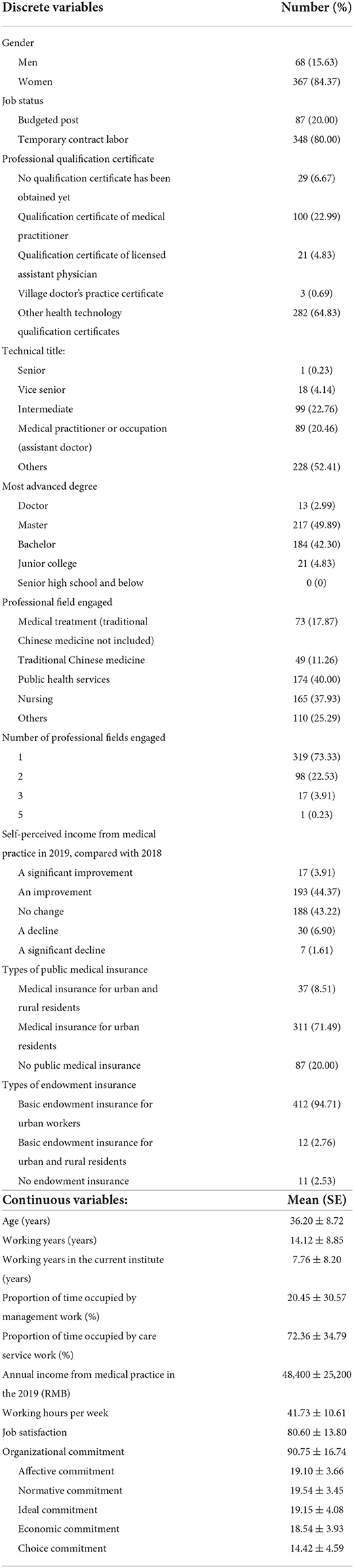
Table 1. Characteristics of included participants (N = 435).
The interview results showed one major theme which is the ethical and moral responsibility of providing care. One participant summarized it as: “As a doctor, this is exactly the right time we need to fulfill our responsibilities to society. We are doing our best to get the work done.” Another participant said, “the sense of responsibility allows us to ignore personal gains and losses.” Therefore, we guessed the normative commitment shared effect on the other four dimensions of organizational commitment as well as job satisfaction. We proposed the relationship between organizational commitment and job satisfaction via a mediation model (Figure 1).
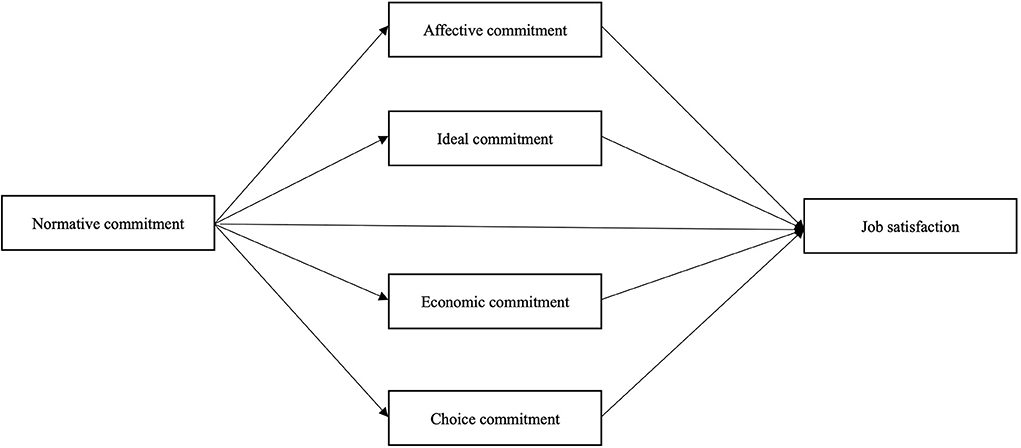
Figure 1. Hypothesized mediation model of organizational commitment and job satisfaction.
To test the model we developed, we conducted mediation analysis on the quantitative data. The results of the correlation analysis using the Pearson's correlation coefficients are shown in Table 2. The results of correlation analysis showed that both normative commitment and job satisfaction were positively related to the other four dimensions of organizational commitment, while such relation was also found between normative commitment and job satisfaction. To investigate the mediating effect, a bootstrap method with 5000 bootstrap samples and 95% confidence interval (CI), including lower limit CI (LLCI) and upper limit CI (ULCI), was used. After controlling for demographic characteristics, it was demonstrated by the absence of 0 throughout the CI that affective commitment (LLCI = 0.09, ULCI = 0.28), ideal commitment (LLCI = 0.15, ULCI = 0.35), choice commitment (LLCI = – 0.09, ULCI = – 0.03), and economic commitment (LLCI = 0.05, ULCI = 0.26) have a significant indirect effect and their parallel multiple mediations on the association between normative commitment and job satisfaction was established. The mediating effect was calculated as 0.18 (affective commitment), 0.25 (ideal commitment), – 0.06 (choice commitment), and 0.15 (economic commitment). Moreover, since the direct effect of affective commitment on job satisfaction was significant (LLCI = 0.11, ULCI = 0.31), the mediators above were identified to have a part mediating effect instead of the total mediating effect (Table 3 and Figure 2).
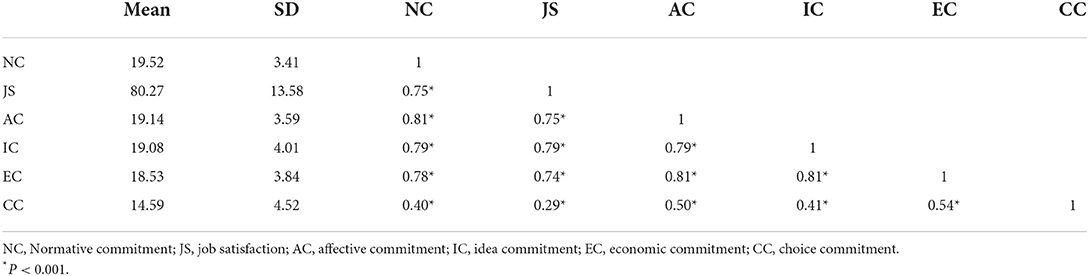
Table 2. Correlation between job satisfaction and five dimensions of organizational commitment.
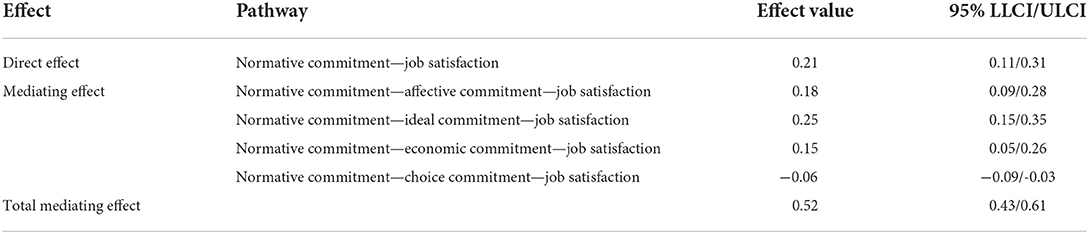
Table 3. Mediation analysis.
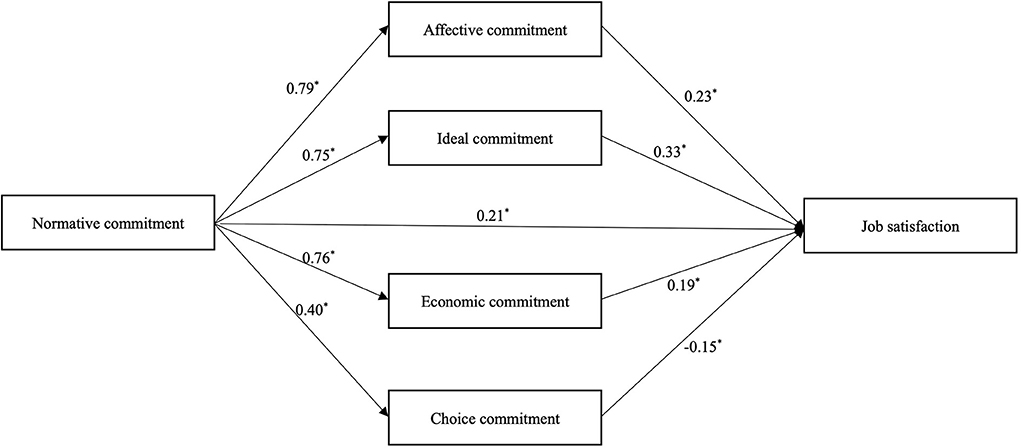
Figure 2. Mediation model of organizational commitment and job satisfaction. *: P < 0.001.
Discussion
To our knowledge, this is the first study about primary care providers' job satisfaction and organizational commitment in China after massive restriction policies ended. This study found that the job satisfaction and organizational commitment of primary care providers remained high: the average scores for job satisfaction and organizational commitment were 80.6 and 90.8, respectively. The thematic analysis revealed one major theme: ethical and moral responsibility to provide care as primary care providers, on which we established a mediation model. The mediation analysis revealed that normative commitment could positively affect the other four dimensions of organizational commitment and job satisfaction. The direct effect of affective commitment on job satisfaction was significant (LLCI = 0.11, ULCI = 0.31), and the mediators identified a partial mediating effect instead of a total mediating effect.
However, due to the unpredictability of the pandemic, we do not have data about the situation before the COVID-19 breakout or during the restriction period. Considering the comparability and accessibility, we identified four possible homogenous groups from prior studies to compare to our findings. Wang surveyed Beijing's primary care providers in 2019, and the results showed that the average job satisfaction total score was 71.8 (Wang, 2020). In 2018, Jiao conducted a similar research on the general practitioner in primary care institutions in Shanghai and reported that the average job satisfaction total score was 71.5 (Jiao and Wang, 2020). Both results showed a slightly lower level of job satisfaction than ours. Liu believed that medical worker in China took full responsibility for patients' wellbeing and overcame various difficulties through their resilience and the spirit of professional dedication (Liu et al., 2020). We also observed the same experience in our research. Besides, during the restriction period, Yu assessed the job satisfaction of 455 frontline medical staff and the average score was 82.58 which was slightly higher than our results. Yu also believed that the financial and mental support from the government and gratitude from the whole society improved the professional fulfillment and job satisfaction of frontline medical staff. We guessed that primary care providers achieved self-realization by fulfilling their duty to society during the COVID-19 pandemic. Therefore, the level of job satisfaction and ideal commitment increased. However, as COVID-19 restrictions ended, the extra benefits from the government would also decrease. As people become more and more accustomed to life in the pandemic, their gratitude to medical staff may disappear. Consequently, the ending of massive restrictions was unlikely to improve the job satisfaction of primary care providers and we estimated that their job satisfaction would fall back to the pre–COVID-19 level.
With regard to organizational commitment, we identified two possibly relevant studies, one from China before the pandemic and one from Iran during the pandemic. The Iranian study showed that at the time of the coronavirus outbreak, healthcare workers had very positive and high organizational commitments (Aghalari et al., 2021). However, the authors did not mention any COVID-19 restriction information in their study and the measure tool was different from ours; therefore, we could not compare two results quantitatively. Rui's study in China showed that the average total scores for organizational commitment, affective commitment, normative commitment, ideal commitment, economic commitment, and choice commitment were 90.0, 19.3, 19.7, 17.7, 17.4, and 16.0, respectively (Rui and Huang, 2021). Although the level of organizational commitment remained stable, it seemed that the COVID-19 pandemic positively impacted ideal commitment and economic commitment, whereas it impacted choice commitment in a contrary way. We speculate that the extra subsidies from the government might have improved primary care providers' economic commitment. Regardless, before the COVID-19 breakout or during, the ideal commitment was the lowest dimension in organizational commitment. We believe one reason for the low ideal commitment was that only a small proportion (20.0% in this study) of primary care providers received budgeted posts. In other words, most primary care providers were employed as contract employees and were not permanently employed by the primary care institution. As for the decrease in choice commitment, we believe that the pandemic had made primary care providers realize the value of their professional skills, and they were less afraid of changing working institutions as the need for their skillset was in high demand. Given that the end of COVID-19 restrictions resulted in a decrease in primary care providers' income, a brief increase in resignation was expected, particularly for those without a budgeted post. However, we do not believe that the above changes are permanent. It might just be stress and stress-release reaction within health care providers, and it could disappear with the gradual social or medical end of the pandemic.
Another interesting finding from our study was the impact of organizational commitment on job satisfaction. Most studies currently focus on the relationship between organizational commitment and job satisfaction, that is, the impact of job satisfaction and its dimensions on organizational commitment or grouping them together as a factor influencing another variable. Studies about normative commitment and its impact on job satisfaction are very limited and the relation between them is still unclear. Gorgulu believed that there is a positive correlation and significant relation between normative commitment and job satisfaction (Gorgulu and Akilli, 2017). Jahangir's study in Iran got the same result (Jahangir and Shokrpour, 2009). Besides, Jahangir also found normative commitment was positively related to affective commitment (Jahangir and Shokrpour, 2009). We hypothesized a model based on qualitative interview findings that organizational commitment, in turn, affected job satisfaction, and verified it with quantitative data. The normative commitment of primary care providers positively affected the other four dimensions of organizational commitment as well as job satisfaction. The finding suggested that it was possible to improve primary care providers' job satisfaction and loyalty by helping them achieve self-realization. A possible explanation is that the roles and functions of Chinese primary care providers have been significantly emphasized by both government and society during the COVID-19 time. Actually, in the last decade, the primary care system was relatively ignored due to various reasons. Compared with care providers in the hospital, primary care providers have lower incomes, welfares, and individual development opportunities (Li et al., 2019). The waves of COVID-19 have proved that a hospital-centered system could not meet this challenge. Besides, during the restriction time, a lot of COVID-19 control and prevention works were conducted by primary care providers, as mentioned above. Therefore, a social consensus emerges that China needs a strong primary care system. Such social concern raised the morale of primary care providers and made them aware of their social values.
The results can be used to inform the policymaker on its restriction policies and help them to design interventions that can maximize job satisfaction during the COVID-19 pandemic. First, as part of our findings, we think that the end of massive social retractions would not improve the job satisfaction and organizational commitment of primary care providers. With lower choice commitment, we think the wave of quitting might be foreseeable in China, which has been witnessed in many countries (Fronda and Labrague, 2022). Second, the ideal commitment and economic commitment improved during the COVID-19 pandemic time. Therefore, we believe that budgeted posts and financial bonuses are two effective ways to maintain primary care providers' morale. Actually, the budgeted post has been the top social topic in China and a significant portion of Chinese graduates (not just medical graduate students) choose a job with budgeted posts as their priority over any other jobs. Besides, we also found that the normative commitment of primary care providers positively affected the other four dimensions of organizational commitment as well as job satisfaction. Therefore, policymakers can design interventions to maintain the normative commitment, like publicizing the importance of primary care providers to society or emphasizing the responsibility of health workers.
There still exist several limitations in the present study. First, the study utilized the cross-sectional design, therefore, cannot assume cause and effect association. Second, we only surveyed primary care providers in the urban area, namely District H, and the situation in the rural area could be different. Third, we utilized a webpage-based tool to conduct the survey and about 53.4% of all primary care providers in District H participated in the survey, which might lead to a response bias. In addition, this was not a mandatory survey, so the responders could be those who had negative feelings about their job and thus looking for changes. Furthermore, because we used a webpage-based tool, some elderly primary care providers may be unfamiliar with cellphones and thus hesitant to participate in the survey. Lastly, work-related stress has been proven associated with job satisfaction of medical staff (Khamisa et al., 2015). In this study, we did not survey the work-related stress, which may stop us from some findings. The mediation analysis is also noteworthy. Mediation analysis is prominent in psychological theory and research. During this process, a mediating variable transmits the effect of an independent variable on a dependent variable, which provides more interpretability for specific research (MacKinnon et al., 2007). One of the most difficult aspects of creating mediation analysis is determining how to create a path or casual relationship between variables. In this study, we utilized a mixed-method study design and the pathway was established based on qualitative interviews (also proved by other studies). Although a significance test is provided, some key variables may be omitted, resulting in model defaults. Therefore, the relation, especially the mechanism, on how normative commitment affects the other four dimensions of organizational commitment and job satisfaction is still unclear. More studies are needed on this topic.
Conclusion
When most COVID-19 restriction policies ended in China, the job satisfaction of primary care providers was higher than that reported in pre–COVID-19 surveys and lower than that reported in the restriction time study. Compared with the study before the pandemic, we observed the improvement of primary care providers' ideal commitment, economic commitment, and the decline of choice commitment. We believe that the job satisfaction and organizational commitment of primary care providers will return to levels before the pandemic and during this estimated process, a brief rise in resignation is predictable.
By verifying the proposed mediation model, we think that normative commitment positively affects the other four dimensions of organizational commitment and job satisfaction for primary care providers, which suggests a possible way to motivate primary care providers when restrictions end.
Data availability statement
The datasets presented in this article are not readily available because they are subject to ongoing research. Requests to access the datasets should be directed to the corresponding author.
Ethics statement
Ethical review and approval was not required for the study on human participants in accordance with the local legislation and institutional requirements. Informed consent was obtained from all individual participants included in the study.
Author contributions
QW: conceptualization, methodology, investigation, and writing—original draft. XL: data curation, and formal analysis, validation. TW: conceptualization, methodology, and investigation. ZZ, LY, SG, and HL: writing—review and editing. QS: methodology, resources, supervision, writing—review and editing. All authors contributed to the article and approved the submitted version.
Acknowledgments
We would like to thank Dr. Hanadi Hamad for her expertise and generosity in providing editorial comments as this manuscript evolved. We also want to present our best wishes to frontline medical workers around the world, as we believe their work of integrity and selflessness is critical to bringing the COVID-19 pandemic to an end.
Conflict of interest
The authors declare that the research was conducted in the absence of any commercial or financial relationships that could be construed as a potential conflict of interest.
Publisher's note
All claims expressed in this article are solely those of the authors and do not necessarily represent those of their affiliated organizations, or those of the publisher, the editors and the reviewers. Any product that may be evaluated in this article, or claim that may be made by its manufacturer, is not guaranteed or endorsed by the publisher.
References
Aghalari, Z., Dahms, H. U., Jafarian, S., and Gholinia, H. (2021). Evaluation of organizational and social commitments and related factors during the coronavirus pandemic of healthcare workers in northern Iran. Global Health 17, 12. doi: 10.1186/s12992-020-00658-0
Alrawashdeh, H. M., Al-Tammemi, A. B., Alzawahreh, M. K., Al-Tamimi, A., Elkholy, M., Al Sarireh, F., et al. (2021). Occupational burnout and job satisfaction among physicians in times of COVID-19 crisis: a convergent parallel mixed-method study. BMC Public Health 21, 811. doi: 10.1186/s12889-021-10897-4
Aymerich, C., Pedruzo, B., Perez, J. L., Laborda, M., Herrero, J., Blanco, J., et al. (2022). COVID-19 pandemic effects on health worker's mental health: systematic review and meta-analysis. Eur Psychiatry 65, e10. doi: 10.1192/j.eurpsy.2022.1
Baek, H., Han, K., and Ryu, E. (2019). Authentic leadership, job satisfaction and organizational commitment: the moderating effect of nurse tenure. J. Nurs. Manag. 27, 1655–1663. doi: 10.1111/jonm.12853
Bohlken, J., Schomig, F., Seehagen, T., Kohler, S., Gehring, K., Roth-Sackenheim, C., et al. (2020). Experience of practice-based psychiatrists and neurologists during the COVID-19 pandemic. Psychiatr. Prax. 47, 214–217. doi: 10.1055/a-1159-5575
Chen, H., Shi, L., Zhang, Y., Wang, X., and Sun, G. (2021). Policy disparities in response to COVID-19 between China and South Korea. J. Epidemiol. Glob. Health 11, 246–252. doi: 10.2991/jegh.k.210322.001
Chen, X., Zou, Y., and Gao, H. (2021). Role of neighborhood social support in stress coping and psychological wellbeing during the COVID-19 pandemic: evidence from Hubei, China. Health Place 69, 102532. doi: 10.1016/j.healthplace.2021.102532
Creswell, J. W., and Clark, V. L. P. (2017). Designing and Conducting Mixed Methods Research. Thousand Oaks: Sage publications.
Ding, D., and Zhang, R. (2022). China's COVID-19 control strategy and its impact on the global pandemic. Front Public Health 10, 857003. doi: 10.3389/fpubh.2022.857003
Fronda, D. C., and Labrague, L. J. (2022). Turnover intention and coronaphobia among frontline nurses during the second surge of COVID-19: the mediating role of social support and coping skills. J. Nurs. Manag. 30, 612–621. doi: 10.1111/jonm.13542
Fu, W., Qin, J., Wang, E., Miao, Y., Zhang, Y., Zhang, L., et al. (2020). Developing strategies for primary healthcare in times of epidemic of COVID-19. Chinese General Practice 23, 1199–1201. doi: 10.12114/j.issn.1007-9572.2020.00.324
Gao, Y. (2014). The Influence Factor on the Public Hospital Doctor's Work Enthusiasm. Master, Fujian Medical University.
Ge, C., Fu, J., Chang, Y., and Wang, L. (2011). Factors associated with job satisfaction among Chinese community health workers: a cross-sectional study. BMC Public Health 11, 884. doi: 10.1186/1471-2458-11-884
Gonzalez-Gancedo, J., Fernandez-Martinez, E., and Rodriguez-Borrego, M. A. (2019). Relationships among general health, job satisfaction, work engagement and job features in nurses working in a public hospital: a cross-sectional study. J. Clin. Nurs. 28, 1273–1288. doi: 10.1111/jocn.14740
Gorgulu, O., and Akilli, A. (2017). The determination of the levels of burnout syndrome, organizational commitment, and job satisfaction of the health workers. Niger. J. Clin. Pract. 20, 48–56. doi: 10.4103/1119-3077.180051
Hao, A., Chen, C., Wang, D., and He, Q. (2022). Level and associated factors of job satisfaction in general practitioners in Guangdong's primary care settings. Chinese General Practice 25, 1629–1635. doi: 10.12114/j.issn.1007-9572.2022.0057
Jahangir, F., and Shokrpour, N. (2009). Three components of organizational commitment and job satisfaction of hospital nurses in Iran. Health Care Manag. 28, 375–380. doi: 10.1097/HCM.0b013e3181b3eade
Jiao, J., and Wang, H. (2020). Investigation and association analysis of job satisfaction,psychological capital and work engagement of general practitioners in Jiading District of Shanghai. Chinese General Practice 23, 182–183. doi: 10.12114/j.issn.1007-9572.2019.00.801
Jin, H., Li, B., and Jakovljevic, M. (2022). How China controls the Covid-19 epidemic through public health expenditure and policy? J. Med. Econ. 25, 437–449. doi: 10.1080/13696998.2022.2054202
Khamisa, N., Oldenburg, B., Peltzer, K., and Ilic, D. (2015). Work related stress, burnout, job satisfaction and general health of nurses. Int. J. Environ. Res. Public Health 12, 652–666. doi: 10.3390/ijerph120100652
Lai, J. B., Ma, S. M., Wang, Y., Cai, Z. X., Hu, J. B., Wei, N., et al. (2020). Factors associated with mental health outcomes among health care workers exposed to coronavirus disease 2019. JAMA Network Open 3, e203976. doi: 10.1001/jamanetworkopen.2020.3976
Li, H., Yuan, B., Wang, D., and Meng, Q. (2019). Motivating factors on performance of primary care workers in China: a systematic review and meta-analysis. BMJ Open 9, e028619. doi: 10.1136/bmjopen-2018-028619
Ling, W., Zhang, Z., and Fang, L. (2001). A study of the organizational commitment of Chinese employees. Soc. Sci. China 128, 90–102.
Liu, D., Yang, X., Li, Q., Shi, L., and Tang, Q. (2021). Prevalence and associated factors of the career plateau of primary care providers in Heilongjiang, China: a cross-sectional study. BMC Fam. Pract. 22, 38. doi: 10.1186/s12875-021-01389-w
Liu, Q., Luo, D., Haase, J. E., Guo, Q., Wang, X. Q., Liu, S., et al. (2020). The experiences of health-care providers during the COVID-19 crisis in China: a qualitative study. Lancet Glob Health 8, e790–e798. doi: 10.1016/S2214-109X(20)30204-7
Liu, W., Zhao, S., Shi, L., Zhang, Z., Liu, X., Li, L., et al. (2018). Workplace violence, job satisfaction, burnout, perceived organisational support and their effects on turnover intention among Chinese nurses in tertiary hospitals: a cross-sectional study. BMJ Open 8, e019525. doi: 10.1136/bmjopen-2017-019525
Lu, H., Zhao, Y., and While, A. (2019). Job satisfaction among hospital nurses: a literature review. Int. J. Nurs. Stud. 94, 21–31. doi: 10.1016/j.ijnurstu.2019.01.011
Lu, W., Wang, H., Lin, Y., and Li, L. (2020). Psychological status of medical workforce during the COVID-19 pandemic: a cross-sectional study. Psychiatry Res. 288, 112936. doi: 10.1016/j.psychres.2020.112936
MacKinnon, D. P., Fairchild, A. J., and Fritz, M. S. (2007). Mediation analysis. Annu. Rev. Psychol. 58, 593–614. doi: 10.1146/annurev.psych.58.110405.085542
Moseholm, E., and Fetters, M. D. (2017). Conceptual models to guide integration during analysis in convergent mixed methods studies. Methodol Innovat. 10, 2059799117703118. doi: 10.1177/2059799117703118
Muller, A. E., Hafstad, E. V., Himmels, J. P. W., Smedslund, G., Flottorp, S., Stensland, S. O., et al. (2020). The mental health impact of the covid-19 pandemic on healthcare workers, and interventions to help them: a rapid systematic review. Psychiatry Res. 293, 113441. doi: 10.1016/j.psychres.2020.113441
Murray, C. J. L. (2022). COVID-19 will continue but the end of the pandemic is near. Lancet 399, 417–419. doi: 10.1016/S0140-6736(22)00100-3
Nation Health Commission (2020). Notice on NCP Prevention and Control in Primary Health Care Institutions. Available online at: http://wjw.hunan.gov.cn/wjw/ztzl/knowledge/tzggzcfg/202003/11816912/files/3ff92abc8e124ec7a9e2431c21c70262.pdf (accessed 2020).
Noroxe, K. B., Pedersen, A. F., Carlsen, A. H., Bro, F., and Vedsted, P. (2019). Mental well-being, job satisfaction and self-rated workability in general practitioners and hospitalisations for ambulatory care sensitive conditions among listed patients: a cohort study combining survey data on GPs and register data on patients. BMJ Qual. Saf. 28, 997–1006. doi: 10.1136/bmjqs-2018-009039
Pan, A., Liu, L., Wang, C., Guo, H., Hao, X., Wang, Q., et al. (2020). Association of public health interventions with the epidemiology of the COVID-19 Outbreak in Wuhan, China. JAMA 323, 1915–1923. doi: 10.1001/jama.2020.6130
Porter, L. W., and Lawler, E. E. (1965). Managerial Attitudes and Performance. AL, USA: R. D. Irwin.
Rasanathan, K., and Evans, T. G. (2020). Primary health care, the declaration of Astana and COVID-19. Bull. World Health Organ. 98, 801–808. doi: 10.2471/BLT.20.252932
Rui, C., and Huang, L. (2021). Study on turnover intention and its influencing factors among health workers in primary health- care institutions. Chinese J. Health Policy 14, 55–60.
Spector, P. E. (1997). Job satisfaction: Application, Causes, and Consequences. SAGE Publications, Inc.: SAGE Publications, Inc.
The Lancet (2020). COVID-19: too little, too late? Lancet 395, 755. doi: 10.1016/S0140-6736(20)30522-5
University of Minnesota (1977). Minnesota Satisfaction Questionnaire (short-form). Available online at: http://vpr.psych.umn.edu/sites/g/files/pua2236/f/msq_booklet_short-form_1977.pdf (accessed September 1, 2021).
Wagner, C. M. (2007). Organizational commitment as a predictor variable in nursing turnover research: literature review. J. Adv. Nurs. 60, 235–47. doi: 10.1111/j.1365-2648.2007.04421.x
Wang, B. (2020). Research on the Relationship Between Perceived Organizational Support, Job Satisfaction and Job Engagement of Medical Workers in Community Health Service Center. Kaifeng: Master, Henan University.
Wang, X. (2008). Analyzing work attitudes of Chinese employees: a comparison between state-owned and privately-owned enterprises in China. Chin. Manage. Stud. 2, 215–228. doi: 10.1108/17506140810895906
World Health Organization (2020). Naming the coronavirus disease (COVID-19) and the virus that causes it. Available online at: https://www.who.int/emergencies/diseases/novel-coronavirus-2019/technical-guidance/naming-the-coronavirus-disease-(covid-2019)-and-the-virus-that-causes-it (accessed 2020).
World Health Organization (2022). Statement by Dr Hans Henri P. Kluge, WHO Regional Director for Europe. Available online at: https://www.euro.who.int/en/health-topics/health-emergencies/coronavirus-covid-19/statements/statement-cancer-services-disrupted-by-up-to-50-in-all-countries-reporting-a-deadly-impact-of-covid-19 (accessed February 3, 2022).
Wu, Z., and McGoogan, J. M. (2020). Characteristics of and important lessons from the coronavirus disease 2019 (COVID-19) outbreak in China: summary of a report of 72314 cases from the Chinese center for disease control and prevention. JAMA 323, 1239–1242. doi: 10.1001/jama.2020.2648
Wuhan Government. (2020). Notice of COVID-19 control and prevention, No.7. Available online at: http://www.gov.cn/xinwen/2020-01/24/content_5472017.htm (accessed September 1, 2021).
Xiang, D., Xiang, X., Zhang, W., Yi, S., Zhang, J., Gu, X., et al. (2020). (2020). Management and outcomes of patients with STEMI during the COVID-19 pandemic in China. J Am Coll Cardiol. 76, 1318–24. doi: 10.1016/j.jacc.2020.06.039
Xiong, Z., Chen, Y., Zhang, Y., Zhang, S., Zhang, Y., Xiaoya, T., et al. (2020). COVID-19 screening and triage using a unified approach to the management of relevant healthcare workers, procedure and goals within a regional medical consortium:a development from disorderly to orderly. Chinese General Practice 23, 3912–3916. doi: 10.12114/j.issn.1007-9572.2020.00.545
Xu, T. L., Ao, M. Y., Zhou, X., Zhu, W. F., Nie, H. Y., Fang, J. H., et al. (2020). China's practice to prevent and control COVID-19 in the context of large population movement. Infect Dis. Poverty 9, 115. doi: 10.1186/s40249-020-00716-0
Yu, X., Zhao, Y., Li, Y., Hu, C., Xu, H., Zhao, X., et al. (2020). Factors associated with job satisfaction of frontline medical staff fighting against COVID-19: a cross-sectional study in China. Front Public Health 8, 426. doi: 10.3389/fpubh.2020.00426
Zhang, C., Yang, L., Liu, S., Ma, S., Wang, Y., Cai, Z., et al. (2020). Survey of insomnia and related social psychological factors among medical staff involved in the 2019 novel coronavirus disease outbreak. Front Psychiatry 11, 306. doi: 10.3389/fpsyt.2020.00306
Zhang, J., Deng, X., Liu, H., Xu, X., and Fang, R. (2021). Evaluation of the mental health status of community healthcare workers during the COVID-19 outbreak. Medicine. 100, e24739. doi: 10.1097/MD.0000000000024739
Keywords: primary care provider, job satisfaction, organizational commitment, COVID-19, mixed method, mediation model
Citation: Wang Q, Liu X, Wang T, Zhu Z, Yang L, Guo S, Li H and Sun Q (2022) Primary care provider's job satisfaction and organizational commitment after COVID-19 restrictions ended: A mixed-method study using a mediation model. Front. Psychol. 13:873770. doi: 10.3389/fpsyg.2022.873770
Received: 25 February 2022; Accepted: 16 September 2022;
Published: 13 October 2022.
Edited by:
Carson Leung, University of Manitoba, CanadaReviewed by:
Yu-Tien Hsu, Harvard University, United StatesFan Jiang, University of Northern British Columbia, Canada
Copyright © 2022 Wang, Liu, Wang, Zhu, Yang, Guo, Li and Sun. This is an open-access article distributed under the terms of the Creative Commons Attribution License (CC BY). The use, distribution or reproduction in other forums is permitted, provided the original author(s) and the copyright owner(s) are credited and that the original publication in this journal is cited, in accordance with accepted academic practice. No use, distribution or reproduction is permitted which does not comply with these terms.
*Correspondence: Qiang Sun, cWlhbmdzQHNkdS5lZHUuY24=
†These authors have contributed equally to this work