Abstract
Background:
The psychobiological state known as mental fatigue (MF) is by engaging in mentally taxing activities for an extended period, which is typically found in team sports, of the high cognitive demand and unpredictable environment. It increases the perception of effort and influences executive functions, impairing sport-specific performance in athletes. However, the consequences of MF on sport-specific motor performance (SSMP) among athletes in team sports remain unclear.
Objective:
This scoping review seeks to find and map research publications that investigate the effect of MF on SSMP in team sports.
Methods:
Web of Science, Scopus, and PubMed were searched as the main databases, and CENTRAL, Psychology, and Behavioral Sciences Collection, SPORTDicus obtained from EBSCOhost, as well as gray literature was searched for relevant literature and Google Scholar. Cognitive tasks before the SSMP exam are the focus of the selected literature on mental exhaustion. Only experiments testing mental and non-mental exhaustion were chosen.
Results:
Twelve studies fulfill the requirement of selection criteria. SSMP in team sports, including soccer, basketball, cricket, and Australian football mainly is examined as physical and technical performance. More specifically, MF significantly influenced physical performance measured as intermittent endurance and total distance (P < 0.05), while data was inclusive when assess in an ecological setting (e.g., small-sided game) (P > 0.05). Technical performance was mainly measured as ball loss, errors in passing and shooting, interception, and successful tackle and showed a dramatic impairment (P < 0.05). The decline of physical activity is relevant with higher level PRE, while decreased technical performance is related to impaired attention resources shown as visual perceptual.
Conclusion:
MF adversely influences SSMP in team sports. The most relevant theory for future study to examine the impacts of MF on team-sport athletes could be the psychological model of exercise and its potential extension on attention resources, rather than the traditional “catastrophe” theory.
Introduction
Team sports refer to sports in that athletes are organized together and played by teams that move freely across a field and score by manipulating a ball into predefined goals (Cockburn et al., 2013). In this context, Fatigue is characterized by a drop in force or power related to prolonged exertion and a decline in performance (Reilly, 1994). Based on these data, it is believed that a performance decline during a match is symptomatic of an athlete's acute physiological impairment and acute fatigue (Mohr et al., 2003, 2005).
These physiological impairments were well explained by the so-called “catastrophe” theory (Noakes and St Clair Gibson, 2004; Noakes et al., 2005) in the team sports context, which has dominated the literature, whereby mechanisms (either, or a combination, of peripheral and central factors) restrict muscular contraction, decreasing physical capacity (e.g., stamina and power) (Bangsbo et al., 2006). However, as another form of fatigue, MF has attracted more and more attention recently (Sun et al., 2021, 2022e; Skala and Zemková, 2022), and it seems unrelated to physiological changes (Marcora et al., 2009). Moreover, it is cognitive from brain activities and associated with reduced sports performance, especially at the end of the matches (Smith et al., 2018). Therefore, to have an overall picture of the psychophysiological indicators underpinning existing theory that explains reduced performance in team sports with mentally fatigued athletes, and provide insight for future studies, there is the necessity to have a review.
Notably, cognitive demands in team sports are exceptionally difficult (Faubert and Sidebottom, 2012; Heppe et al., 2016). That is, neither your teammates nor your opponents can predict the paths that their movements and the ball will take; disruptions can cause a change in direction, and a variety of occlusions in which objects partially or completely disappear from vision. As a result, athletes must be alert all game long (Faubert and Sidebottom, 2012; Smith et al., 2018) and face high demands of cognitive challenge, which highly increases the likelihood of MF. Probably because of this challenge, current evidence has only focused on cognitive performance in team sports. For example, Skala and Zemková (2022) summarized 12 studies and found that MF significantly influences cognitive performance such as decision-making skills, perception, and attention abilities with different durations and intensity of prior mental exertion. Similar findings were detected by Dong et al. (2022). Notably, in team sports, SSMP is critical since it determines a team's success or failure by allowing them to perform skills such as passing, shooting, and tackling (Sun et al., 2021) and move efficiently to create scoring chances (Silva D. C. D. et al., 2022). Therefore, a synthesis with SSMP is necessary for mentally fatigued athletes.
As a type of acute fatigue, MF is a psychobiological state brought on by sustained mental work and manifested as a general sense of weariness and lethargy (Boksem and Tops, 2008; Marcora et al., 2009). MF has been demonstrated to impede physical performance in healthy individuals, such as distance-clamped self-paced running (MacMahon et al., 2014; Pageaux et al., 2014), muscle endurance (Pageaux et al., 2013), and maximal voluntary contraction (Martin et al., 2015; Pageaux et al., 2015).
In sports science, Marcora et al. (2009) introduced an emphasis on the influence of MF on physical performance (e.g., endurance) almost a decade ago. They observed that MF worsened cycling time to exhaustion. Surprisingly, none of the observed physiological indicators (e.g., heart rate, oxygen uptake, and the concentration of blood lactate) altered in conjunction with this performance decline. The only factor linked with the decline in physical performance was a higher evaluation of the rating perception of effort (RPE). In addition, Martin et al. (2018) found that MF reduced dopamine levels in the ACC, which may explain why RPE levels changed in those individuals. Notably, This ACC activation also may lead to impaired executive functions, such as decreased movement monitoring (Lorist et al., 2005; Boksem et al., 2006), response time or accuracy (Lorist et al., 2005), which are highly associated with technical performance among team sports (Sun et al., 2021).
Several narrative (Habay et al., 2021; Sun et al., 2021; Cao et al., 2022) and quantitative (Clemente et al., 2021; Grgic et al., 2022) attempts to synthesize the literature have been made in recent years, whereby performing prior cognitive tasks has led to subsequent decreases in sports performance. Nevertheless, they did not focus on the impacts of MF on SSMP, probably because the condition of MF is in the cognitive domain and consistently it's considered to hinder cognitive performance in sports.
Notably, in a sport-specific context, SSMP refers to the explicit physical actions or the outcomes of a task (Schmidt and Lee, 2005). In terms of SSMP outcomes, common indicators encompass physical (e.g., endurance, power, etc.) and technical performance (e.g., passing, dribbling, etc.). Therefore, the present scoping review aimed to map: (i) research article addressing the impacts of MF on SSMP in team sports; (ii) understand existing theories about fatigue that explained reduced performance in the athletes of team sports context; and (iii) identify literature gaps and make suggestions for further research.
Methods
The methods and analysis strategy for this scoping review were documented in the prospective registry for systematic reviews (INPLASY: ref. INPLASY202250039). Protocols on the consequences of mental tiredness can be found in INPLASY, but none of them specifically address SSMP, especially in team sports. By this means, the novelty of the suggested protocol was ensured.
We conducted the review to map our important findings addressing the impact of MF on SSMP in team sports with the following 5 stages proposed by Arksey and O'Malley (2005) and Levac et al. (2010); (i) the identification of the research questions; (ii) the identification of the relevant studies; (iii) the selection of the studies; (iv) charting the data; and (v) summarizing and reporting the results.
In this study, we aimed to address three specific research questions:
-
(1) What are the impacts of MF on SSMP regarding physical and technical performance?
-
(2) How to understand existing theory related to performance reduction in team sports context with the condition of MF?
The identification of relevant studies
With the assistance of a medical librarian, a literature search was conducted between March 2022 and May 2022 with no date/year restrictions, searching for the key terms in the following databases: Web of Science, PubMed, Scopus, EBSCOhost (CENTRAL, Psychology and Behavioral Sciences Collection, SPORTDicus), and. The Boolean search query used for our databases search encompassed “mental fatigue” and its alternative terms, combined with the varied terms of SSMP such as physical performance and technical performance; specifically, they are (“mental fatigue” OR “mental exertion” OR “cognitive fatigue” OR “cognitive exertion” OR “mental exhaustion” OR “mental tiredness”) AND (sport) AND (“technical performance” OR “technique” OR “skill” OR “physical performance” OR “endurance” OR “power” OR “performance”). The details of the search strategy were shown in Supplementary Table S1.
The selection of relevant studies
As directed by the Joanna Briggs Institute, Figure 1 depicts the research team's search and selection procedure (Peters et al., 2015). The current review considered the following criteria to retrieve the relevant studies. Specifically, the studies were included, if they examined:
-
(i) a variety of levels of athletes without any injury such as amateur, semi-professional, and professional;
-
(ii) athletes are organized together and played by teams that move freely across a field and score by manipulating a ball into predefined goals;
-
(iii) with a task for prior mental exertion;
-
(iv) any performance tasks measured SSMP;
-
(v) with a design of a randomized controlled trial;
-
(vi) with an English publication.
Figure 1
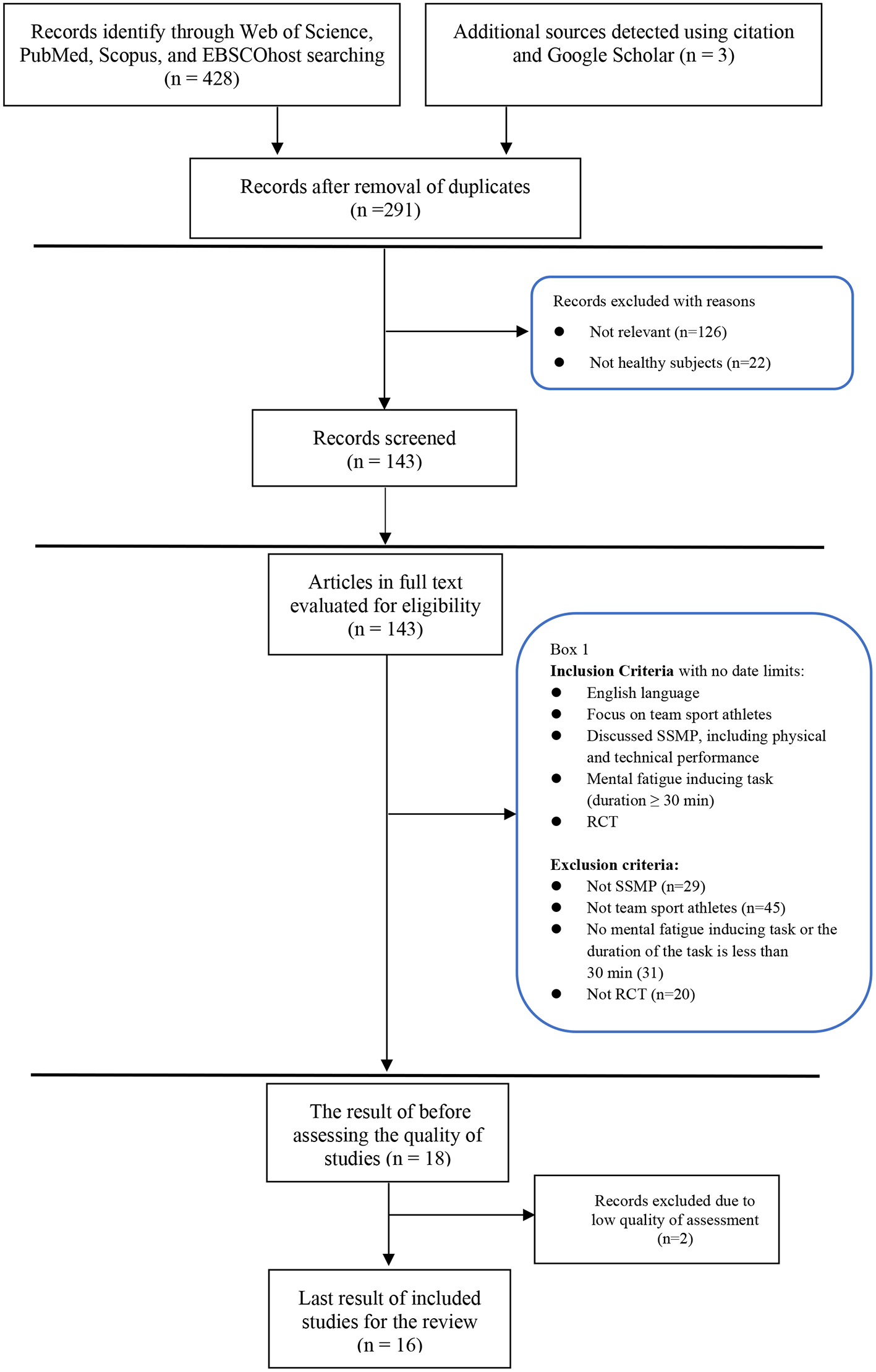
PRISMA summary of the study selection process.
Initial identification yielded 431 articles. S.H. and A.M. assessed study titles for the inclusion of abstracts. The abstracts were then divided between the researchers A.M. and S.K.G., while S.H. assessed all abstracts (n = 291) separately. S.H. reviewed with each researcher their independent evaluation of the abstracts to determine eligibility for full-text review based on the inclusion criteria (Figure 1: Box 1). This led to the identification of 143 publications that were thoroughly evaluated by all scholars. All researchers discussed any disparities until an agreement was reached. Then, it was determined that 18 papers met the inclusion requirements.
However, two studies (Kunrath et al., 2018; Bahrami et al., 2020) identified low quality through the quality assessment with “QualSyst”, including 14 items shown in Supplementary Table S2. The score (no = 0, partial = 1, yes = 2) is determined by the degree to which a particular requirement was met. The letter “NA” denotes items that were removed from the calculation of the total score because they were irrelevant to the study design. The summary score for each study was derived by tallying all the points achieved and dividing that number by the highest possible score. The scores of 55%, 55–75%, and 75% reflect low, medium, and high quality, respectively. Any low-quality studies should be omitted (Kmet et al., 2004). Finally, 16 studies were included in the review.
Charting the data
A descriptive analysis method was applied to the 16 publications found through the selection procedure depicted in Figure 1. The characteristics of each article were summarized in an Excel spreadsheet, including publication year, study location, author, research purpose, study type, data collection techniques, a summary of results, and important messages.
Summarizing and reporting results
The final component of the framework is a summary of the selected studies (e.g., Arksey and O'Malley, 2005). As the aim of this systematic scoping review was to identify studies that presented studies about the effects of MF on SSMP among team sport athletes, our reporting on the key message such as prior mentally fatiguing tasks, SSMP, and outcome assessment, including physiological, and psychological changes from each study. To enhance the understanding, some specific statistics were reported in the review; they are: mean differences between experimental and control groups; 90 and 95% confidence interval; and effect size (Cohens d ES [d]) or Partial eta squared ES []).
Results
Table 1 shows the overall picture of included studies. Sixteen studies were found that involved team sports; twelve of them focused on soccer, while the rest focused on cricket (Veness et al., 2017), basketball (Moreira et al., 2018), Australian football (Smith et al., 2015; Weerakkody et al., 2020), rugby (Smith et al., 2015), field hockey (Smith et al., 2015), and volleyball (Fortes et al., 2021a). Moreover, the majority of included studies recruited male athletes.
Table 1
| Publication | Subjects | Level and specialization | Fatigue inducing task | Sport-specific motor performance | Type of assessment | Post-test MD | 90% CIa 95% CIb ES [d]c ES [d |
|---|---|---|---|---|---|---|---|
| Smith et al. (2015) | Male (n = 10; 22 ± 2 yr) | Well-trained soccer, Australian football, rugby and field hockey athletes | 90 min AX-CPT | Physical performance | Intermittent running | ||
| Velocity (ms− 1) Total distance (m) |
−0.04* −91.00* |
||||||
| Smith et al. (2016) Study 1 |
Male (n = 12; 24.0 ± 0.4) | Moderately trained soccer athletes | 30 min Stroop task | Physical performance | Yo-Yo IR1 | 2.37 d | |
| Total distance (m) | −207*** | ||||||
| Study 2 | Male (n = 14; 19.6 ± 3.5) | Well-trained soccer athletes | Technical performance | Loughborough soccer passing test | |||
| Penalty time (s) | 4.70* | 0.76d | |||||
| Loughborough soccer shooting test | |||||||
| Point per shot (n) | −0.7.0** | 0.75d | |||||
| Badin et al. (2016) | Male (n = 20; 17.8 ± 1 yr) | Elite soccer athletes | 30 min Stroop task | Physical performance | Small-sided game (5 vs. 5) | ||
| Total distance (m) | 0.00 | (−2.20, 2.00)a 0.00d | |||||
| Technical performance | Involvement + (%) | −7.00## | (−16.00, −3.80)a −0.73d | ||||
| Possessions + (%) | −8.00## | (−15.20, −3.60)a −0.63d | |||||
| Smith et al. (2017) | Male (n = 14; 19.6 ± 3.5 yr) | Well-trained soccer athletes | 30 min Stroop task | Technical performance | Loughborough soccer passing test | ||
| Errors (n) | 1.50** | (−2.60, −0.40)b 0.39d | |||||
| Missed target (n) | 8.00* | (−1.40, −0.10)b 0.34d | |||||
| Veness et al. (2017) | Male (n = 10; 21 ± 8 yr) | Elite cricket athletes | 30 min Stroop task | Physical performance | Run-two test | ||
| Completion time (s) | 0.10** | −0.51c | |||||
| Yo-Yo IR1 | |||||||
| Total distance (m) | 160.00* | 0.39c | |||||
| Moreira et al. (2018) | (n = 48; 15.2 ± 1.2 yr) | Elite basketball athletes | 30 min Stroop task | Technical performance | Small-sided game (4 vs. 4) | ||
| Turnover (n) | NA# | 0.71c | |||||
| Coutinho et al. (2018) | (n = 10; (age = 13.7 ± 0.5 yr) | Amateur soccer athletes | 30 min Stroop task | Physical performance | Small-sided game (GK ± 6 vs. 6± GK) | ||
| Total distance (m) | −16.50 | ||||||
| Kunrath et al. (2020) | Male (n = 18; 21.8 ± 2.5 yr) | Amateur soccer athletes | 30 min Stroop task | Physical Performance | Small-sided game (GK ± 3 vs. 3 ± GK) | 39.50** | (−53.73, −9.53)b |
| Total distance (m) | |||||||
| Trecroci et al. (2020) | (n = 9; 17.6 ± 0.5 yr) | Sub-elite soccer athletes | 30 min Stroop task | Physical Performance | Small-sided game (4 vs. 4 ± W) | ||
| Total distance (m) | −101.30* | (−1.24, 0.83)a −0.21c | |||||
| Technical performance | Passing accuracy (%) | −6.20* | (−1.16, 0.17)a −0.49c | ||||
| Filipas et al. (2020) | Male (n = 36; 13–18 yr) | Youth soccer athletes | 30 min Stroop task | Physical performance | Yo-Yo IR1 Total distance | ||
| 14 | NA* NA* NA* |
||||||
| 16 | |||||||
| 18 | |||||||
| Technical performance | Loughborough soccer passing test Penalty time (s) | ||||||
| 14 | 3.50 | ||||||
| 16 | 2.50 | ||||||
| 18 | 7.30*** | ||||||
| Weerakkody et al. (2020) | Male (n = 25; 23.8 ± 4.6 yr) | Amateur Australian football athletes |
30 min Stroop task | Physical performance | AFL agility (s) | −0.05 | −0.13c |
| 20 m sprint (s) | 0.01 | −0.05c | |||||
| MLch test (points) | 0.36 | 0.10c | |||||
| Yo-Yo IR1 | −142.4* | −0.45c | |||||
| Technical performance | Brad Johnson kicking test (points) | −2.64* | −0.40c | ||||
| Soylu and Arslan (2021) | Male (n = 18; 19.1 ± 1.2 yr) | Amateur soccer athletes | 30 min Stroop task | Technical performance | Small-sided game | ||
| 2 vs. 2 Interception (n) | −0.83* | 0.75c | |||||
| Successful tackle (n) | −0.61* | 0.78c | |||||
| Filipas et al. (2021) | Male (n = 19; 20 ± 3) | Amateur basketball athletes | 30 min tactical basketball videos | Technical performance | Free throw (score) | −3.10* | 0.40c |
| Ball lost (n) | 0.61* | 0.65c | |||||
| 3 vs. 3 Interception (n) | −0.61 | ||||||
| Successful tackle (n) | −1.72 | 1.95c | |||||
| Ball lost (n) | 2.11* | 1.66c | |||||
| 4 vs. 4 Interception (n) | −0.45 | ||||||
| Successful tackle (n) | −0.11 | ||||||
| Ball lost (n) | 0.94* | 0.88c | |||||
| Fortes et al. (2021a) | Male (n = 24; 15.7 ± 0.6) | Elite volleyball athletes | 30 min Smartphone | Physical Performance | Yo-Yo IR1 | ||
| Individual distance | NA | (0.47, 0.60)b 0.06c | |||||
| Countermovement Jump | NA | (0.41, 0.55)b 0.04 c | |||||
| Ciocca et al. (2022) | (n = 10; 17.2 ± 0.9) | Sub-elite soccer athletes | 30 min video-based tactical task | Physical Performance | Small-sided game Total distance (m) | −5.10 | 0.05c |
| Technical performance | Passing accuracy (%) | 8.40 | 0.95c | ||||
| Successful tackle (n) | 0.50 | 0.20c | |||||
| Control errors (n) | 0.60 | 0.46c | |||||
| Soylu et al. (2022) | (n = 24; 15.9 ± 1.0 yr) | Youth soccer athletes | 30 min Stroop task | Technical performance | Small-sided game | ||
| 2 vs. 2 Successful pass (n) | −1.10 | (−2.61, −4.81) 0.25c | |||||
| Ball lost (n) | 1.30* | (−1.65, −0.92)b 2.05c | |||||
| 3 vs. 3 Successful pass (n) | −2.13 | (−3.26, 7.51)b 0.23c | |||||
| Ball lost (n) | 0.08 | (1.19, 1.97)b 0.19c | |||||
| 4 vs. 4 Successful pass (n) | −7.12* | (2.82, 11.42)b 1.04c | |||||
| Ball lost (n) | 0.79* | (−0.96, −0.61)b 2.72c |
Overview of publication details.
p ≤ 0.05;
p ≤ 0.01;
p ≤ 0.001;
likely negative;
very likely negative at 90% confidence interval;
NA, not available; Post-test MD, Post-test mean differences between experimental and control groups; ES, effect size ; AX-CPT, AX-continuous performance test; Yo-Yo IR1, Yo-Yo intermittent recovery test, level 1; MLch test, Matthew Lloyd clean hands test; GK, goalkeeper; W, wildcard; a: 90% CI; b: 95% CI; c: ES [d]; d: ES [].
Mental fatigue inducting task
Thirty minutes Stroop task is predominant in all fatigue-inducing tasks (Table 1). Moreover, Le Mansec et al. (2017) requested athletes to complete AX-continuous tasks in 90 min. Filipas et al. (2021) and Ciocca et al. (2022) examined the 30 min tactical task in basketball and soccer, respectively. Finally, Fortes et al. (2021a) evaluated the influence when athletes expose to screens (e.g., cellphones) with social network apps for 30 min, which is more realistic in the modern environment.
Sport-specific motor performance outcome
As shown in Table 1, eleven investigations examined physical performance, including 7 types of team sports; they are soccer (Smith et al., 2015, 2016; Badin et al., 2016; Coutinho et al., 2018; Filipas et al., 2020; Kunrath et al., 2020; Trecroci et al., 2020; Ciocca et al., 2022), cricket (Veness et al., 2017), Australian football (Weerakkody et al., 2020), and volleyball (Fortes et al., 2021a). Additionally, one study mixed 4 types of team sport athletes (soccer, Australian football, rugby, and field hockey) (Smith et al., 2015).
Furthermore, eleven experiments were done on technical performance in 3 types of team sports: soccer (Badin et al., 2016; Smith et al., 2016, 2017; Moreira et al., 2018; Filipas et al., 2020; Trecroci et al., 2020; Soylu and Arslan, 2021; Ciocca et al., 2022; Soylu et al., 2022), basketball (Filipas et al., 2021), and Australian football (Weerakkody et al., 2020).
Physical performance
Specifically, to examine the impact of MF among team sports athletes, Smith et al. (2015) employed a high-intensity, intermittent running regimen, which was highly relevant to the activity profile of intermittent team sports. The results showed that velocity (1.50 ± 0.18ms−1 vs. 1.54 ± 0.18 ms−1, p = 0.02), and total distance (4,072 ± 409 m vs. 4,163 ± 430 m, p = 0.02) were significantly different between the MF and control group (Smith et al., 2015). Consistently, Smith et al. (2016) study 1 corroborated the findings and showed a total distance of Yo-Yo intermittent recovery test, level 1 (Yo-Yo IR1) was dramatically impaired in the MF group compared with the control group (1,203 ± 402 m vs. 1,410 ± 354 m; t11 = 7.19, P < 0.001, ES = 2.37). Further, a similar finding was detected in cricket (1,732 ± 402 m vs. 1,892 ± 357 m; MF vs. control group, p = 0.023, ES = 0.39) (Veness et al., 2017), and Australian football athletes (1,040 ± 492.75 m vs. 1,182.40 ± 537.78 m; MF vs. control group, p = 0.03, ES = −0.45) (Weerakkody et al., 2020). Interestingly, a moderating effect of age was detected by Filipas et al. (2020) as older athletes showed greater declines in Yo-Yo IR1 distance.
To investigate more ecologically, however, the results showed inconsistency with running performance. The very first investigation was from Badin et al. (2016). The authors recruited a small-sided game (SSG) and did not uncover any significant difference between the experimental and control group in total distances running (1,531 ± 142 m vs. 1,531 ± 125 m, ES = 0.00). The non-significant finding was corroborated by another two studies that investigated total distance in SSG (P > 0.05) (Trecroci et al., 2020; Ciocca et al., 2022). Inconsistently, Kunrath et al. (2020) conducted a study to examine tactical and physical performance together. The result showed running performance measured as total distance significantly increased in the MF group (1,375.40 ± 1,050.00 m vs. 1,335.90 ± 94.30 m, p = 0.008, ES = 0.396), for the reduced accuracy in tactical actions (e.g., offensive and defensive coverage).
Moreover, Weerakkody et al. (2020) investigated other SSMP and did not find the negative impact of MF on Australian Football League agility (8.46 ± 0.40 s vs. 8.51 ± 0.32 s, p = 0.51, ES = −0.13), 20 m sprint (3.23 ± 0.15 s vs. 3.22 ± 0.30 s, p = 0.38, ES = −0.05), and Matthew Lloyd clean hands test (14.72 ± 3.69 vs. 14.36 ± 3.83, p = 0.66, ES = 0.10), when compared with the control group. Additionally, Fortes et al. (2021a) did not detect any significant effect of MF on endurance performance measured by the Yo-Yo test [F(4, 20) = 0.05; p = 0.81; ES: trivial], and Countermovement Jump [F(4, 20) = 0.01; p = 0.91; ES: small] induced by the social media using on smartphone before 4 weeks training sessions.
Technical performance
In the lab setting, MF significantly influenced SSMP, measured as increased penalty time (t13 = 2.93; p = 0.012; = 0.76) (Smith et al., 2016), the number of errors [F(1, 13) = 8.19; p = 0.01; = 0.39] and missed target [F(1, 13) = 6.67; p = 0.02; = 0.34] (Smith et al., 2017), as well as decreased point per shot (t13 = 3.24; p = 0.006; = 0.75) in the Loughborough soccer passing and shooting test. However, Filipas et al. (2020) found the adverse effect only exists in the U18 age group (increased penalty time: 15.3 ± 4.7 vs. 8.0 ± 3.1; P < 0.001) rather than U14 and U16 age groups.
Moreover, ball loss (n) in 2 vs. 2, 3 vs. 3, and 4 vs. 4 SSG were dramatically impaired in the condition of MF of soccer athletes (Soylu and Arslan, 2021; Soylu et al., 2022). In contrast, only interception (2.78 ± 1.17 vs. 3.61 ± 1.04; d = 0.75) and successful tackle (0.56 ± 0.62 vs. 1.17 ± 0.92; d = 0.78; P < 0.05) was influenced significantly which are more related to defensive skill in 2 vs. 2 SSG in soccer (Soylu and Arslan, 2021).
Besides soccer, basketball athletes showed a significant increase in turnover (ES = 0.71, 0.29;1.12) (Moreira et al., 2018) and a decrease in the free-throw score (P = 0.01) in SSG (Moreira et al., 2018). Moreover, Australian football athletes showed lower skill in kicking (18.32 + 5.27 vs. 20.96 + 6.35; p = 0.048) measured in Brad Johnson kicking test (Weerakkody et al., 2020).
Psychophysiological outcome
Nineteen studies found significantly higher MF in experimental groups (see Table 2: Psychological Indicators). Notably, nine studies measured RPE in Table 2 and the result showed that RPE level was dramatically increased in mentally fatigued athletes (Smith et al., 2015, 2016; Badin et al., 2016; Coutinho et al., 2017; Veness et al., 2017; Trecroci et al., 2020; Filipas et al., 2021; Fortes et al., 2021a; Soylu et al., 2022). The variable of motivation also showed consistently non-significance in many studies. However, when athletes performed in SSG with different formats, the results showed a difference. That is, motivation was significantly lower in 2 vs. 2 and 3 vs. 3 (Soylu and Arslan, 2021). In contrast, it did not show any significance in the format of 4 vs. 4 (Soylu and Arslan, 2021).
Table 2
| Publication | Physiological indicators | Psychological indicators | |||
|---|---|---|---|---|---|
| Smith et al. (2015) | Blood glucose ↔* | Blood lactate ↔* | MF↑* | RPE↑* | |
| VO 2↓* | Heart rate ↔* | Motivation ↔* | |||
| Smith et al. (2016) | Heart rate ↔* | MF↑* | RPE↑* | ||
| ME↑* | Motivation ↔* | ||||
| Badin et al. (2016) | Heart rate↓* | MF↑* | RPE↑* | ||
| Motivation ↔* | |||||
| Smith et al. (2017) | MF↑* | Motivation ↔* | |||
| ME↑* | |||||
| Veness et al. (2017) | MF↑* | RPE↑* | |||
| Motivation ↔* | |||||
| Moreira et al. (2018) | Testosterone (Exp: ↔; Con: ↑##) | MF↑* | |||
| Alpha-Amylase (Exp: ↑#; Con: ↑##) | |||||
| Cortisol (Exp: ↔; Con ↔) | |||||
| Coutinho et al. (2018) | MF↑* | RPE↑* | |||
| Kunrath et al. (2020) | MF↑* | VF↑** | TD ↔** | ||
| RT ↔** | OT ↔** | ||||
| Trecroci et al. (2020) | MF↑* | RPE↑*** | |||
| ME↑*** | Motivation ↔* | ||||
| Filipas et al. (2020) | MF↑* | Motivation ↔* | |||
| Weerakkody et al. (2020) | MF↑* | Motivation ↔* | |||
| Filipas et al. (2021) | MF↑* | Motivation ↔* | |||
| Soylu and Arslan (2021) | 2 vs. 2 | ||||
| MF↑* | Feeling↑* | ||||
| Felt Arousal↑* | Motivation ↓* | ||||
| Cognitive demand↓* | |||||
| 3 vs. 3 | |||||
| MF↑* | Feeling↑* | ||||
| Felt Arousal↑* | Motivation ↓* | ||||
| Cognitive demand↓* | |||||
| 4 vs. 4 | |||||
| MF ↔* | Feeling↑* | ||||
| Felt Arousal↑* | Motivation ↔* | ||||
| Cognitive demand↓* | |||||
| Fortes et al. (2021a) | MF↑*** | RPE↑* | |||
| Ciocca et al. (2022) | RPE ↔* | Motivation ↔* | |||
| Soylu et al. (2022) | 2 vs. 2 | ||||
| Heart rate↑** | HRmax↑** | MF↑* | RPE↑* | ||
| ME↑* | PACES ↔* | ||||
| 3 vs. 3 | |||||
| Heart rate↑** | HRmax↑** | MF↑* | RPE↑* | ||
| ME↑* | PACES ↔* | ||||
| 4 vs. 4 | |||||
| Heart rate↑** | HRmax↑** | MF↑* | RPE↑* | ||
| ME↑* | PACES ↔* | ||||
Psychophysiological outcomes of included publications.
MF, mental fatigue; ME, mental effort; RPE, the rating of perception effort; PP, peripheral perception; Exp, experimental group; Con, control group;
Large and clear difference between time-points;
Moderate and clear difference between time-points;
significance between conditions;
significance between time-points;
significant interaction;
VF, visual field; TD, tracking deviation; RT, reaction time; OT, number of omitted reactions; HR max, percentage of maximum heart rate; PACES, physical activity enjoyment scale. Higher↑, lower↓, no significant difference ↔ in the mental fatigue condition compared with control condition.
The traditional physiological indicator for fatigue such as blood glucose (p = 0.935) and blood lactate (p = 0.809) was also not influenced by MF (Smith et al., 2015). Regarding the parameter of heart rate, the included studies showed inconsistent results. Specifically, Smith et al. (2015); Badin et al. (2016), and Smith et al. (2016) showed that MF did not influence heart rate (P > 0.05), while Soylu et al. (2022) detected a significantly higher value of heart rate in 3 different formats of SSG. Furthermore, Moreira et al. (2018) found that the salivary parameters of alpha-amylase were considerably higher in mentally fatigued athletes (P < 0.05) after the performance task (e.g., basketball SSG).
Discussion
This scoping review aims to summarize the present state of knowledge about the impact of the mental effect on the sport-specific motor, including physical and technical performance in team sport athletes. Moreover, to summarize the psychophysiological outcomes from the perspective of potential mechanisms regarding the effect of MF and understand existing theories related to performance reduction in team sports.
Overview of team sports
Unsurprisingly, all these team sports (soccer, basketball, volleyball, and Australian football) have centered on ball sports, as the cognitive demands of ball sports are particularly demanding (Faubert and Sidebottom, 2012; Heppe et al., 2016). Athletes' movements and the ball's trajectories are often erratic in sports due to factors including interruptions, which can cause abrupt changes in course, and occlusions and segmentation, in which various objects obscure or disappear from view. As a result, those who compete in ball sports need to maintain vigilance the entire time (Faubert and Sidebottom, 2012; Smith et al., 2018), which raises the likelihood of MF.
Soccer significantly outnumbered other sports. Specifically, eleven investigations examined the effect of MF on soccer athletes, while the other four focused on basketball (Moreira et al., 2018; Filipas et al., 2021), cricket (Veness et al., 2017), volleyball (Fortes et al., 2021a), and Australian football (Weerakkody et al., 2020).
The effect of mental fatigue on sport-specific motor performance
Physical performance
To our best knowledge, this is the first review to synthesize sport-specific motor performance, including physical and technical performance in team sports.
The different demands of physical performance in team sports are highlighted in the current review, which may cause different effects of MF. Specifically, physical performance such as intermittent endurance was impaired after the elicitation of acute MF in soccer (Smith et al., 2015, 2016; Filipas et al., 2020; Kunrath et al., 2020), cricket (Veness et al., 2017), and Australian football athletes (Weerakkody et al., 2020). In contrast, volleyball athletes were not influenced (Fortes et al., 2021a) by the difference in demand for low aerobic endurance for competition activities lasting less than 10 seconds, as there are typically 15-sec rest intervals between successive points (Freitas et al., 2014). The same result also showed in individual sports with a short duration of a performance task. For example, MF did not influence 100 m and 200 m dash performance in sprinters (Fortes et al., 2021b). Future studies may compare different types of sports (e.g., team and individual) to understand more about the mechanism of the effect of MF.
Moreover, the major attention on soccer athletes may be owing to the fact that these athletes may be more sensitive to MF than athletes in other sports as a result of their prolonged exposure to cognitive demands. It is also consistent with the definition of MF, which comes from “prolonged” cognitive tasks.
Therefore, adverse effects of MF may not extend to physical performance among all the team athletes. The effect is highly dependent on the action demands and the duration of the task or competition. However, more studies are required to directly compare these effects in different team sports.
To investigate more ecologically, Badin et al. (2016) tested total distance during possession 5 vs. 5 SSG, however, no impairment was detected in the MF condition. This non-significance was also reported in the goalkeeper + 6 vs. 6 + goalkeeper SSG (Coutinho et al., 2017). Inconsistently, the impairment of intermittent was shown in goalkeeper + 3 vs. 3 + goalkeeper SSG (Kunrath et al., 2020), and 4 vs. 4 + wildcard SSG (Trecroci et al., 2020).
Notably, the formats of SSG determine different responses in team-sport athletes. For example, maximum velocity, maximum acceleration, and deceleration increased with the decrease in the number of athletes (Gaudino et al., 2014; Silva H. et al., 2022). And some rules such as the inclusion or exclusion of goalkeepers had a large effect on physical load (Santos et al., 2021).
Since another recent review indicated that the impairment of performance during SSG could not be conclusive (Costa et al., 2022), there are several questions raised, for example, could the non-significant effect of MF on physical performance measured as intermittent endurance be from the less demand in the possession format of SSG in the study of Badin et al. (2016)? Are the number of athletes on each side of SSG in the study of Coutinho et al. (2017) too big to induce the adverse effect?
Previous studies only noticed a likely explanation of such contradictory findings of physical performance in SSG may be attributed to the different assessments. Indeed, Trecroci et al. (2020) considered accelerations >2 m/s2, while Badin et al. (2016) considered accelerations >2.78 m/s2. On the other hand, future studies could consider more about that MF may influence differently in a variety of SSG formats.
Technical performance
Regarding technical performance, the results showed rather a consistency in the impairment in team sports, including soccer (Badin et al., 2016; Smith et al., 2016, 2017; Filipas et al., 2020; Trecroci et al., 2020), basketball (Moreira et al., 2018; Filipas et al., 2021; Soylu et al., 2022), and Australian football (Weerakkody et al., 2020). A most recent study conducted by Sun et al. (2022a) synthesized the adverse effect of MF on soccer players' technical performance. The authors found the adverse effects of defensive technique are more than that of offensive technique. However, the current review showed impairment in both types of technical performance (see Table 1) and could not compare the specific effect on defensive and offensive technique due to it being out of scope. It is considered important to examine different types (defensive and offensive) of techniques in all team sports in the future.
Mechanism of mental fatigue in team sport
Previous studies measured psychobiological responses shown in Table 2 and provide a way to understand the mechanism of MF in a team sport.
The self-paced nature of exercise largely exists in team sports and it could be used by athletes to mitigate acute fatigue in matches (Aughey, 2010), including MF. A “central controller” (central nervous system) is thought to determine exercise intensity in response to various physiological signals and regulates this intensity to avoid premature fatigue (Noakes et al., 2005; Noakes, 2012). Therefore, it is reasonable that previous studies shown in Table 2 did not detect a higher level of these physiological indicators such as blood lactate (Smith et al., 2015) and heart rate (Smith et al., 2015, 2016; Badin et al., 2016) in MF condition. The results could be explained by the study of Taheri and Irandoust (2020). The authors indicated that low-intensity exercise alters brain structure and function from cells and molecules to behavior and system, which may reduce fatigue due to better cognition. Therefore, more studies are required to examine the effect of the self-paced nature of low-intensity exercise in team sports on MF. On the other hand, although Soylu et al. (2022) detected a higher level of heart rate between time points (pre and post-test) in MF conditions, it is not conclusive due to the comparison between conditions and interaction should be focused more.
During exercise in a team sport, homeostasis threats are signaled via afferent feedback (Noakes, 2012). This perceived magnitude of homeostatic threats is generated as a higher level of RPE in the previous studies (see Table 2: RPE). Moreover, Soylu et al. (2021) argued that RPE increased due to MF lowering performance profile and shifting perceived exertion against exhaustion time. Consistent with the psychobiological model proposed by Marcora (2008), explaining the negative effects of MF on self-paced exercise such as team sports in physical performance.
Therefore, the current review indicates that the psychobiological model of exercise performance could be the prestigious theory used in a team sport, rather than the traditional “catastrophe” theory to explain the impacts of MF.
Moreover, the potential extension of the model should be noticed. The reductions in technical performance were not attributed to the raised level of RPE (Sun et al., 2022c). It could be confirmed in team sports due to the result shown in Table 2. Specifically, four studies investigated the technique of sport-specific motor performance in soccer (Smith et al., 2017; Soylu and Arslan, 2021; Soylu et al., 2022), and basketball (Moreira et al., 2018) did not report RPE. Thus, it is necessary to divide the investigation of the sport-specific motor performance to be two parts; physical and technical performance due to the different mechanisms of the effects.
Notably, Kunrath et al. (2020) detected decreased vision perceptual in mentally fatigued athletes, which could confirm that besides RPE, attention could be a crucial factor attributed to the impairment of performance in team sport athletes (e.g., soccer). Consistently, the attention resources could be manipulated to combat MF and increase subsequent performance significantly (Sun et al., 2022b,c,e).
Therefore, the current review recognizes the psychological model of exercise performance (Marcora, 2008), and its potential extension (Sun et al., 2022d) as the best theory for team sports due to the consistency of the mechanism with the impacts of MF on sport-specific motor performance.
Limitations
There are a few significant caveats to this review. First, the systematic review focuses only on SSMP, defined as physical and technical performance, excluding perceptual-cognitive skills in team sports. Future research could examine all three of these skilled performances together to acquire more complete data, as they are interconnected and all contribute to athletes' performance, especially when the sports are open-skill (Soylu et al., 2021; Dong et al., 2022). Also, MF impaired athletes' perceptual-cognitive skills such as decision-making due to the inability of perceiving environmental clues with limited attention resources (Gantois et al., 2019; Fortes et al., 2020, 2022). The overall picture of athletes' performance with SSMP and perceptual-cognitive skills needs to be examined.
Second, the current review only detected the inconclusive data in different formats of SSGs (e.g., number differences, with or without a goalkeeper). Perhaps the effect may be larger when there are fewer athletes and a goalkeeper in the SSGs due to the increased physical load (Santos et al., 2021; Silva H. et al., 2022). However, it is necessary to be examined by future studies.
Furthermore, it was suggested that MF influence more offensive skill due to cognitive resources being more exhausted (Sun et al., 2021). To contrast, the suggestion was not supported by a recent meta-analysis that showed a larger effect on defensive skills (Sun et al., 2022a). The current review only creates the overall picture of technical skill. Future studies should clarify the conflicting result.
Finally, selecting only English-language studies may further restrict the representation of the findings.
Conclusion
In team sports, such as soccer, cricket, Australian football, and basketball, MF adversely influences sport-specific motor performance, including physical and technical performance. Future studies may examine different formats of SSG (e.g., the number of playing athletes, with or without wildcard and goalkeeper) due to different responses and effects of subsequent performance in mentally fatigued athletes. Moreover, the most relevant theory should be the psychological model of exercise performance and its potential extension of attention resources regarding the topic of the impacts of MF on performance among athletes in team sports.
Statements
Data availability statement
The original contributions presented in the study are included in the article/Supplementary material, further inquiries can be directed to the corresponding author.
Author contributions
All authors listed have made a substantial, direct, and intellectual contribution to the work and approved it for publication.
Conflict of interest
The authors declare that the research was conducted in the absence of any commercial or financial relationships that could be construed as a potential conflict of interest.
Publisher’s note
All claims expressed in this article are solely those of the authors and do not necessarily represent those of their affiliated organizations, or those of the publisher, the editors and the reviewers. Any product that may be evaluated in this article, or claim that may be made by its manufacturer, is not guaranteed or endorsed by the publisher.
Supplementary material
The Supplementary Material for this article can be found online at: https://www.frontiersin.org/articles/10.3389/fpsyg.2023.1143618/full#supplementary-material
References
1
Arksey H. O'Malley L. (2005). Scoping studies: towards a methodological framework. Int. J. Soc. Res. Methodol.8, 19–32. 10.1080/1364557032000119616
2
Aughey R. J. (2010). Australian Football Player Work Rate: Evidence of Fatigue and Pacing?Int. J. Sports Physiol. Perform.5, 394–405. 10.1123/ijspp.5.3.394
3
Badin O. O. Smith M. R. Daniele C. Coutts A. J. (2016). Mental fatigue impairs technical performance in small-sided soccer games. Int. J. Sports Physiol. Perform.17, 413–426. 10.1123/ijspp.2015-0710
4
Bahrami A. Moradi J. Etaati Z. (2020). The effect of mental fatigue on three-point shot performance in skilled basketball players. Int. J. Motor Control Learn.2, 4–10. 10.29252/ijmcl.2.4.4
5
Bangsbo J. Mohr M. Krustrup P. (2006). Physical and metabolic demands of training and match-play in the elite football player. J. Sports Sci.24, 665–674. 10.1080/02640410500482529
6
Boksem M. A. S. Meijman T. F. Lorist M. M. (2006). Mental fatigue, motivation and action monitoring. Biol. Psychol.72, 123–132. 10.1016/j.biopsycho.2005.08.007
7
Boksem M. A. S. Tops M. (2008). Mental fatigue: Costs and benefits. Brain Res. Rev.59, 125–139. 10.1016/j.brainresrev.2008.07.001
8
Cao S. Geok S. K. Roslan S. Sun H. Lam S. K. (2022). Mental fatigue and basketball performance: a systematic review. Front. Psychol.12, 819081. 10.3389/fpsyg.2021.819081
9
Ciocca G. Tessitore A. Mandorino M. Tschan H. (2022). A video-based tactical task does not elicit mental fatigue and does not impair soccer performance in a subsequent small-sided game. Sports (Basel)10, 31. 10.3390/sports10030031
10
Clemente F. M. Ramirez-Campillo R. Castillo D. Raya-González J. Silva A. F. Afonso J. et al . (2021). Effects of mental fatigue in total running distance and tactical behavior during small-sided games: a systematic review with a meta-analysis in youth and young adult's soccer players. Front. Psychol.12, 656445. 10.3389/fpsyg.2021.656445
11
Cockburn E. Bell P. G. Stevenson E. (2013). Effect of milk on team sport performance after exercise-induced muscle damage. Med. Sci. Sports Exer.45, 1585–1592. 10.1249/MSS.0b013e31828b7dd0
12
Costa Y. P. d Freitas-JúniorC.Lima-JúniorD. d Soares-SilvaE. L.et al. (2022). Mental fatigue and ball sports: a narrative review focused on physical, technical, and tactical performance. Motriz: Revista de Educação Física28, 822. 10.1590/s1980-657420220004822
13
Coutinho D. Gonçalves B. Travassos B. Wong D. P. Coutts A. J. Sampaio J. E. (2017). Mental fatigue and spatial references impair soccer players' physical and tactical performances. Front. Psychol.8, 1645. 10.3389/fpsyg.2017.01645
14
Coutinho D. Gonçalvesa B. Wong D. P. Travassosc B. Coutts A. J. Sampaioa J. (2018). Exploring the effects of mental and muscular fatigue in soccer players' performance. Human Movem. Sci.58, 287–296. 10.1016/j.humov.2018.03.004
15
Dong L. Pageaux B. Romeas T. Berryman N. (2022). The effects of fatigue on perceptual-cognitive performance among open-skill sport athletes: A scoping review. Int. Rev. Sport Exerc. Psychol.42, 1–52. 10.1080/1750984X.2022.2135126
16
Faubert J. Sidebottom L. (2012). Perceptual-cognitive training of athletes. J. Clin. Sport Psychol.6, 85–102. 10.1123/jcsp.6.1.85
17
Filipas L. Borghi S. La Torre A. Smith M. R. (2020). Effects of mental fatigue on soccer-specific performance in young players. Sci. Med. Football5, 150–7. 10.1080/24733938.2020.1823012
18
Filipas L. Ferioli D. Banfi G. La Torre A. Vitale J. A. (2021). Single and combined effect of acute sleep restriction and mental fatigue on basketball free-throw performance. Int. J. Sports Physiol. Perform.16, 415–420. 10.1123/ijspp.2020-0142
19
Fortes L. S. De Lima-Junior D. Fiorese L. Nascimento-Júnior J. R. A. Mortatti A. L. Ferreira M. E. C. (2020). The effect of smartphones and playing video games on decision-making in soccer players: A crossover and randomised study. J. Sports Sci.38, 552–558. 10.1080/02640414.2020.1715181
20
Fortes L. S. de Lima-Júnior D. Fonseca F. S. Albuquerque M. R. Ferreira M. E. C. (2021b). Effect of mental fatigue on mean propulsive velocity, countermovement jump, and 100-m and 200-m dash performance in male college sprinters. Appl. Neuropsychol. Adult2021, 1–10. 10.1080/23279095.2021.2020791
21
Fortes L. S. Fonseca F. S. Nakamura F. Y. Barbosa B. T. Gantois P. de Lima-Júnior D. et al . (2021a). Effects of mental fatigue induced by social media use on volleyball decision-making, endurance, and countermovement jump performance. Perceptual Motor Skills128, 2745–2766. 10.1177/00315125211040596
22
Fortes L. S. Lima-Junior D. Barbosa B. T. Faro H. K. C. Ferreira M. E. C. Almeida S. S. (2022). Effect of mental fatigue on decision-making skill and visual search behaviour in basketball players: an experimental and randomised study. Int. J. Sport Exer. Psychol. 58, 1–20. 10.1080/1612197X.2022.2058055
23
Freitas V. H. Nakamura F. Y. Miloski B. Samulski D. Bara-Filho M. G. (2014). Sensitivity of physiological and psychological markers to training load intensification in volleyball players. J. Sports Sci. Med.13, 571–579.
24
Gantois P. Ferreira M. E. C. de Lima-Junior D. Nakamura F. Y. Batista G. R. Fonseca F. S. et al . (2019). Effects of mental fatigue on passing decision- making performance in professional soccer athletes. Eur. J. Sport Sci.20, 534–543. 10.1080/17461391.2019.1656781
25
Gaudino P. Alberti G. Iaia F. M. (2014). Estimated metabolic and mechanical demands during different small-sided games in elite soccer players. Human Movem. Sci.36, 123–133. 10.1016/j.humov.2014.05.006
26
Grgic J. Mikulic I. Mikulic P. (2022). Negative effects of mental fatigue on performance in the yo-yo test, loughborough soccer passing and shooting tests: a meta-analysis. J. Funct. Morphol. Kinesiol.7, 10. 10.3390/jfmk7010010
27
Habay J. Van Cutsem J. Verschueren J. De Bock S. Proost M. De Wachter J. et al . (2021). Mental fatigue and sport-specific psychomotor performance: a systematic review [Review]. Sports Med.51, 1527–1548. 10.1007/s40279-021-01429-6
28
Heppe H. Kohler A. Fleddermann M. T. Zentgraf K. (2016). The relationship between expertise in sports, visuospatial, and basic cognitive skills. Front. Psychol.7, 1–14. 10.3389/fpsyg.2016.00904
29
Kmet L. M. Lee R. C. Cook L. S. (2004). Standard quality assessment criteria for evaluating primary research papers from a variety of fields. Available online at: https://www.ihe.ca/advanced-search/standard-quality-assessment-criteria-for-evaluating-primary-research-papers-from-a-variety-of-fields (accessed May 31, 2022).
30
Kunrath C. A. Cardoso F. Nakamura F. Y. Teoldo I. (2018). Mental fatigue as a conditioner of the tactical and Physical response in soccer players: A pilot study. Human Movem.19, 16–22. 10.5114/hm.2018.76075
31
Kunrath C. A. Nakamura F. Y. Roca A. Tessitore A. Teoldo I. (2020). How does mental fatigue affect soccer performance during small-sided games? A cognitive, tactical and physical approach. J. Sport Sci.38, 1818–28. 10.1080/02640414.2020.1756681
32
Le Mansec Y. Pageaux B. Nordeza A. Dorela S. Jubeaua M. (2017). Mental fatigue alters the speed and the accuracy of the ball in table tennis. J. Sports Sci.36, 2751–2759. 10.1080/02640414.2017.1418647
33
Levac D. Colquhoun H. O'Brien K. K. (2010). Scoping studies: advancing the methodology. Implement. Sci.5, 69. 10.1186/1748-5908-5-69
34
Lorist M. M. Boksem M. A. S. Ridderinkhof K. R. (2005). Impaired cognitive control and reduced cingulate activity during mental fatigue. Cogn. Brain Res.24, 199–205. 10.1016/j.cogbrainres.2005.01.018
35
MacMahon C. Schücker L. Hagemann N. Strauss B. (2014). Cognitive fatigue effects on physical performance during running. J. Sport Exer. Psychol.36, 375–381. 10.1123/jsep.2013-0249
36
Marcora S. M. (2008). Do we really need a central governor to explain brain regulation of exercise performance?Eur. J. Appl. Physiol.104, 929–931. 10.1007/s00421-008-0818-3
37
Marcora S. M. Staiano W. Manning V. (2009). Mental fatigue impairs physical performance in humans. J. Appl. Physiol.106, 857–864. 10.1152/japplphysiol.91324.2008
38
Martin K. Meeusen R. Thompson K. G. Keegan R. Rattray B. (2018). Mental fatigue impairs endurance performance: a physiological explanation. Sports Med.48, 2041–2051. 10.1007/s40279-018-0946-9
39
Martin K. Thompson K. G. Keegan R. Ball N. Rattray B. (2015). Mental fatigue does not affect maximal anaerobic exercise performance. Eur. J. Appl. Physiol.115, 715–725. 10.1007/s00421-014-3052-1
40
Mohr M. Krustrup P. Bangsbo J. (2003). Match performance of high-standard soccer players with special reference to development of fatigue. J. Sports Sci.21, 519–528. 10.1080/0264041031000071182
41
Mohr M. Krustrup P. Bangsbo J. (2005). Fatigue in soccer: A brief review. J. Sports Sci.23, 593–599. 10.1080/02640410400021286
42
Moreira A. Aoki M. S. Franchini E. da Silva Machado D. G. Paludo A. C. Okano A. H. (2018). Mental fatigue impairs technical performance and alters neuroendocrine and autonomic responses in elite young basketball players. Physiol. Behav.196, 112–118. 10.1016/j.physbeh.2018.08.015
43
Noakes T. D. (2012). The Central Governor Model in 2012: eight new papers deepen our understanding of the regulation of human exercise performance. Br. J. Sports Med.46, 1. 10.1136/bjsports-2011-090811
44
Noakes T. D. St Clair Gibson A. (2004). Logical limitations to the “catastrophe” models of fatigue during exercise in humans. Br. J. Sports Med.38, 648. 10.1136/bjsm.2003.009761
45
Noakes T. D. St Clair Gibson A. Lambert E. V. (2005). From catastrophe to complexity: a novel model of integrative central neural regulation of effort and fatigue during exercise in humans: summary and conclusions. Br. J. Sports Med.39, 120. 10.1136/bjsm.2003.010330
46
Pageaux B. Lepers R. Dietz K. C. Marcora S. M. (2014). Response inhibition impairs subsequent self-paced endurance performance. Eur. J. Appl. Physiol.114, 1095–1105. 10.1007/s00421-014-2838-5
47
Pageaux B. Marcora S. M. Lepers R. (2013). Prolonged mental exertion does not alter neuromuscular function of the knee extensors. Med. Sci. Sports Exerc.45, 2254–2264. 10.1249/MSS.0b013e31829b504a
48
Pageaux B. Marcora S. M. Rozand V. Lepers R. (2015). Mental fatigue induced by prolonged self-regulation does not exacerbate central fatigue during subsequent whole-body endurance exercise. Front. Human Neurosci.67, 1–12. 10.3389/fnhum.2015.00067
49
Peters M. D. J. Godfrey C. M. Khalil H. McInerney P. Parker D. Soares C. B. (2015). Guidance for conducting systematic scoping reviews. JBI Evid. Implement.13, 900. 10.1097/XEB.0000000000000050
50
Reilly T. (1994). Physiological aspects of soccer. Biol. Sports11, 3–20.
51
Santos F. J. Verardi C. E. L. de Moraes M. G. Filho D. M. P. Macedo A. G. Figueiredo T. P. et al . (2021). Effects of pitch size and goalkeeper participation on physical load measures during small-sided games in sub-elite professional soccer players. Appl. Sci.11, 8024. 10.3390/app11178024
52
Schmidt R. A. Lee T. D. (2005). Motor Control and Learning: A Behavioral Emphasis, 4th ed. Champaign, IL: Human Kinetics.
53
Silva D. C. D. Afonso J. Augusto D. Petiot G. H. Martins Filho C. C. Vasconcellos F. (2022). Influence of pre-induced mental fatigue on tactical behaviour and performance among young elite football players. Int. J. Sport Exer. Psychol.84:1–13. 10.1080/1612197X.2022.2084765
54
Silva H. Nakamura F. Y. Beato M. Marcelino R. (2022). Acceleration and deceleration demands during training sessions in football: a systematic review. Sci. Med. Football20, 1–16. 10.1080/24733938.2022.2090600
55
Skala F. Zemková E. (2022). Effects of acute fatigue on cognitive performance in team sport players: does it change the way they perform? A scoping review. Appl. Sci.12, 1736. 10.3390/app12031736
56
Smith M. R. Coutts A. J. Merlini M. Deprez D. Lenoir M. Marcora S. M. (2016). Mental fatigue impairs soccer-specific physical and technical performance. Med. Sci. Sports Exerc.48, 267–276. 10.1249/MSS.0000000000000762
57
Smith M. R. Fransen J. Deprez D. Lenoir M. Coutts A. J. (2017). Impact of mental fatigue on speed and accuracy components of soccer-specific skills. Sci. Med. Football1, 48–52. 10.1080/02640414.2016.1252850
58
Smith M. R. Marcora S. M. Coutts A. J. (2015). Mental fatigue impairs intermittent running performance. Med. Sci. Sports Exerc.47, 1682–1690. 10.1249/MSS.0000000000000592
59
Smith M. R. Thompson C. Marcora S. M. Skorski S. Meyer T. Coutts A. J. (2018). Mental fatigue and soccer: current knowledge and future directions. Sports Med.48, 1525–1532. 10.1007/s40279-018-0908-2
60
Soylu Y. Arslan E. (2021). Effects of mental fatigue on psychophysiological, cognitive responses, and technical skills in small-sided games in amateur soccer players. Baltic J. Health Phys. Activ.2, 43–50. 10.29359/BJHPA.2021.Suppl.2.05
61
Soylu Y. Arslan E. Kilit B. (2021). Psychophysiological Responses and Cognitive Performance: A Systematic Review of Mental Fatigue on Soccer Performance. Int. J. Sport Stud. Health.4, e124244. 10.5812/intjssh.124244
62
Soylu Y. Ramazanoglu F. Arslan E. Clemente F. (2022). Effects of mental fatigue on the psychophysiological responses, kinematic profiles, and technical performance in different small-sided soccer games. Biol. Sport39, 965–72. 10.5114/biolsport.2022.110746
63
Sun H. Soh K. G. Mohammadi A. Wang X. Bin Z. Zhao Z. (2022a). Effects of mental fatigue on technical performance in soccer players: A systematic review with a meta-analysis. Front. Public Health. 10, 922630. 10.3389/fpubh.2022.922630
64
Sun H. Soh K. G. Norjali Wazir M. R. W. Ding C. Xu T. Zhang D. (2022b). Can Self-Regulatory Strength Training Counter Prior Mental Exertion? A Systematic Review of Randomized Controlled Trials. Front. Public Health10, 904374. 10.3389/fpubh.2022.904374
65
Sun H. Soh K. G. Roslan S. Norjali Wazir M. R. Liu F. Zhao Z. (2022c). The counteractive effect of self-regulation-based interventions on prior mental exertion: a systematic review of randomised controlled trials. Brain Sci.12, 896. 10.3390/brainsci12070896
66
Sun H. Soh K. G. Roslan S. Wazir M. Soh K. L. (2021). Does mental fatigue affect skilled performance in athletes? A systematic review. PLoS ONE16, e0258307. 10.1371/journal.pone.0258307
67
Sun H. Soh K. G. Roslan S. Wazir M. R. W. N. Mohammadi A. Ding C. et al . (2022d). Nature exposure might be the intervention to improve the self-regulation and skilled performance in mentally fatigue athletes: A narrative review and conceptual framework. Front. Psychol.13, 941299. 10.3389/fpsyg.2022.941299
68
Sun H. Soh K. G. Xu X. (2022e). Nature Scenes Counter Mental Fatigue-Induced Performance Decrements in Soccer. Front. Psychol.13, 1–12. 10.3389/fpsyg.2022.877844
69
Taheri M. Irandoust K. (2020). Morning exercise improves cognitive performance decrements induced by partial sleep deprivation in elite athletes. Biol. Rhythm Res.51, 644–653. 10.1080/09291016.2019.1576279
70
Trecroci A. Boccolini G. Duca M. Formenti D. Alberti G. (2020). Mental fatigue impairs physical activity, technical and decision-making performance during small-sided games. PLoS ONE15, 1–12. 10.1371/journal.pone.0238461
71
Veness D. Patterson S. D. Jeffries O. Waldron M. (2017). The effects of mental fatigue on cricket-relevant performance among elite players. J. Sports Sci.35, 2461–2467. 10.1080/02640414.2016.1273540
72
Weerakkody N. S. Taylor C. J. Bulmer C. L. Hamilton D. B. Gloury J. O'Brien N. J. et al . (2020). The effect of mental fatigue on the performance of Australian football specific skills amongst amateur athletes. J. Sci. Med. Sport40, 3–7. 10.1016/j.jsams.2020.12.003
Summary
Keywords
team sport, motor performance, athletes, mental fatigue, scoping review
Citation
Yuan R, Sun H, Soh KG, Mohammadi A, Toumi Z and Zhang Z (2023) The effects of mental fatigue on sport-specific motor performance among team sport athletes: A systematic scoping review. Front. Psychol. 14:1143618. doi: 10.3389/fpsyg.2023.1143618
Received
13 January 2023
Accepted
01 March 2023
Published
11 April 2023
Volume
14 - 2023
Edited by
Leonardo De Sousa Fortes, Federal University of Paraíba, Brazil
Reviewed by
Ersan Arslan, Tokat Gaziosmanpasa University, Türkiye; Morteza Taheri, Imam Khomeini International University, Iran
Updates
Copyright
© 2023 Yuan, Sun, Soh, Mohammadi, Toumi and Zhang.
This is an open-access article distributed under the terms of the Creative Commons Attribution License (CC BY). The use, distribution or reproduction in other forums is permitted, provided the original author(s) and the copyright owner(s) are credited and that the original publication in this journal is cited, in accordance with accepted academic practice. No use, distribution or reproduction is permitted which does not comply with these terms.
*Correspondence: Zhendong Zhang zzd0506@zzu.edu.cn
†These authors have contributed equally to this work and share first authorship
This article was submitted to Movement Science and Sport Psychology, a section of the journal Frontiers in Psychology
Disclaimer
All claims expressed in this article are solely those of the authors and do not necessarily represent those of their affiliated organizations, or those of the publisher, the editors and the reviewers. Any product that may be evaluated in this article or claim that may be made by its manufacturer is not guaranteed or endorsed by the publisher.