In the published article, there was an error in Figure 7 as published. Figure 5 and Figure 7 were erroneously assigned the same image, and the correct image for Figure 7 was not uploaded. The corrected Figure 7 caption should be: Effect of self-construal on consumers' brand attitudes under different number of endorsers.
The correct Figure 7 appears below.
In the published article, there was an error. There were missing symbols for statistical result parameters in the main body text.
A correction has been made to 4.2 Results, 4.2.3 Moderated analysis, Paragraph 2. The sentences previously stated:
“For consumers in the multiple (four-person) endorsement group, those with interdependent self-construal (M interdependent = 5.78, SD = 0.51) had higher brand attitudes compared to those with independent self-construal (M independent= 4.13, SD = 1.13, F (1,61) = 56.597, p < 0.001, = 0.481).”
“In the single (one-person A) endorsement group, consumers with independent self-construal (M independent= 5.84, SD = 0.58) had higher brand attitudes compared to those with interdependent self-construal (M interdependent= 5.01, SD = 0.95, F (1,74) = 20.456, p < 0.001, = 0.217).”
“Similarly, in the single (one person B) endorsement group, consumers with independent self-construal (M independent=5.72, SD = 0.49) had higher brand attitudes compared to those with interdependent self-construal (M interdependent= 4.96, SD = 0.85, F (1,62) = 19.323, p < 0.001, = 0.238) (as shown in Figure 5)”
The corrected sentences appear below:
“For consumers in the multiple (four-person) endorsement group, those with interdependent self-construal (M interdependent = 5.78, SD = 0.51) had higher brand attitudes compared to those with independent self-construal (M independent = 4.13, SD = 1.13, F(1, 61) = 56.597, p < 0.001, η2 = 0.481).”
“In the single (one-person A) endorsement group, consumers with independent self-construal (M independent = 5.84, SD = 0.58) had higher brand attitudes compared to those with interdependent self-construal (M interdependent = 5.01, SD = 0.95, F(1, 74) = 20.456, p < 0.001, η2 = 0.217).”
“Similarly, in the single (one person B) endorsement group, consumers with independent self-construal (M independent = 5.72, SD = 0.49) had higher brand attitudes compared to those with interdependent self-construal (M interdependent = 4.96, SD = 0.85, F(1, 62) = 19.323, p < 0.001, η2 = 0.238) (as shown in Figure 5)”.
Figure 7
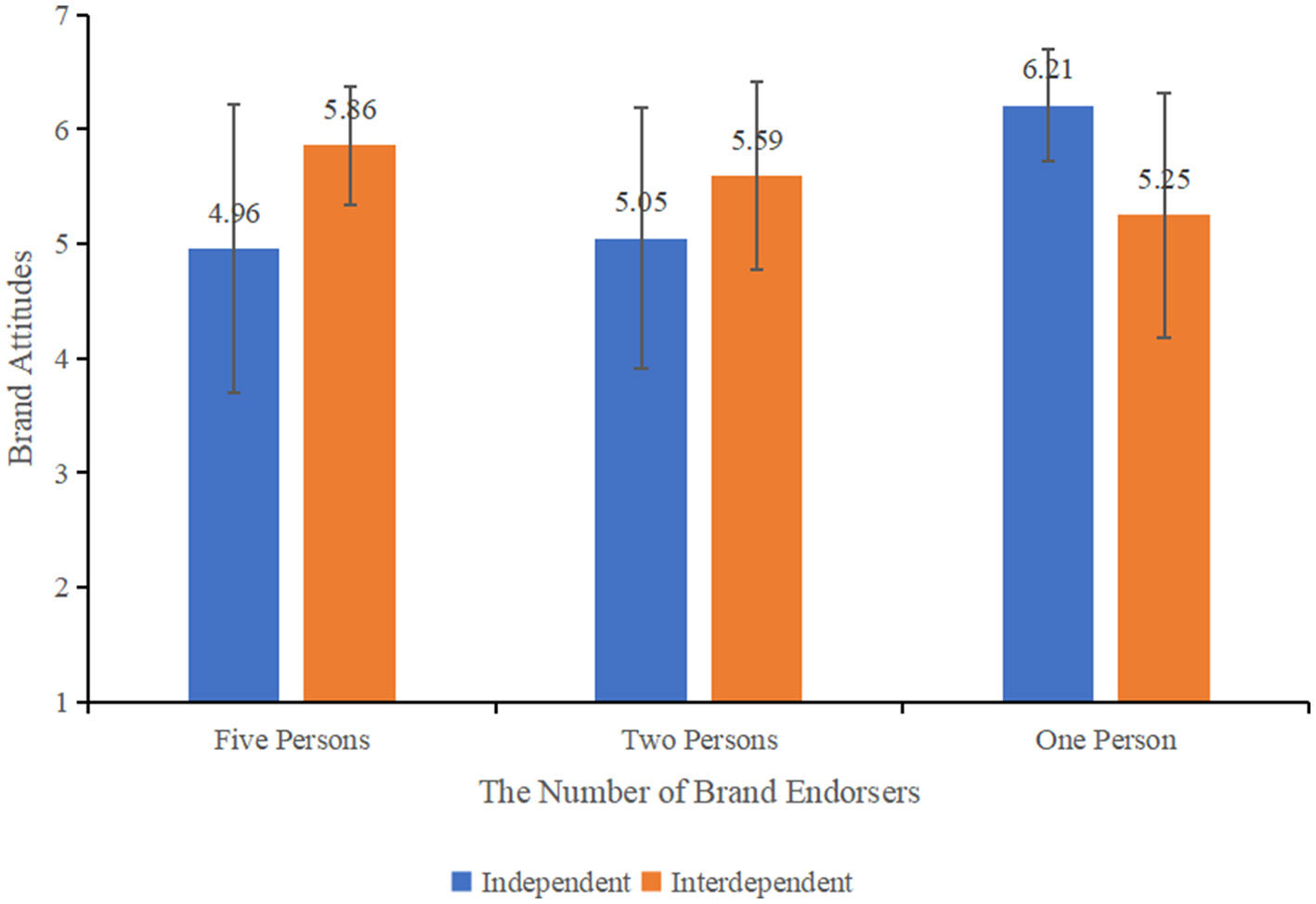
Effect of self-construal on consumers' brand attitudes under different number of endorsers.
In the published article, there was an error. The phrase “In addition, cultural variables such as power perception, risk preference, and social exclusion also affect consumers' brand attitudes.” appears twice consecutively.
A correction has been made to 8.3 Research limitations and future work. This sentence previously stated:
“In addition, cultural variables such as power perception, risk preference, and social exclusion also affect consumers' brand attitudes. In addition, cultural variables such as power perception (Liang et al., 2023), risk preference (Liang et al., 2022), and social exclusion (Liang et al., 2021) also affect consumers' brand attitudes.”
The corrected sentence appears below:
“In addition, cultural variables such as power perception (Liang et al., 2023), risk preference (Liang et al., 2022), and social exclusion (Liang et al., 2021) also affect consumers' brand attitudes.”
The original article has been updated.
Statements
Publisher’s note
All claims expressed in this article are solely those of the authors and do not necessarily represent those of their affiliated organizations, or those of the publisher, the editors and the reviewers. Any product that may be evaluated in this article, or claim that may be made by its manufacturer, is not guaranteed or endorsed by the publisher.
Summary
Keywords
brand endorser, number of endorsers, self-construal, brand attitude, self-consistency
Citation
Liang S, Cai K, Zhang Y, Yuan X, Pan S and Teng L (2025) Correction: One independent or many independent? The relationship among self-construal, number of brand endorsers and brand attitudes. Front. Psychol. 16:1654914. doi: 10.3389/fpsyg.2025.1654914
Received
27 June 2025
Accepted
01 July 2025
Published
18 July 2025
Volume
16 - 2025
Edited and reviewed by
Dan-Cristian Dabija, Babeş-Bolyai University, Romania
Updates
Copyright
© 2025 Liang, Cai, Zhang, Yuan, Pan and Teng.
This is an open-access article distributed under the terms of the Creative Commons Attribution License (CC BY). The use, distribution or reproduction in other forums is permitted, provided the original author(s) and the copyright owner(s) are credited and that the original publication in this journal is cited, in accordance with accepted academic practice. No use, distribution or reproduction is permitted which does not comply with these terms.
*Correspondence: Yiwei Zhang zyw3723@126.com
Disclaimer
All claims expressed in this article are solely those of the authors and do not necessarily represent those of their affiliated organizations, or those of the publisher, the editors and the reviewers. Any product that may be evaluated in this article or claim that may be made by its manufacturer is not guaranteed or endorsed by the publisher.