Abstract
Introduction:
Few studies explored the effects of combining different resources on work behavior. This study tested the interaction effect of personal (i.e., ego-resilience) and organizational resources (i.e., perceived organizational support) in the relationship between teacher professional identity and work engagement.
Methods:
A total of 2,956 teachers took part in this study. Four scales measured the professional identity, ego-resilience, perceived organizational support, and work engagement.
Results:
Results showed that: (1) teacher professional identity has significant correlations to ego-resilience (r = 0.49, p < 0.01), perceived organizational support (r = 0.50, p < 0.01), and work engagement (r = 0.64, p < 0.01); (2) when the scores of ego-resilience and perceived organizational support were both high, the predictive effect of teacher professional identity on work engagement was the biggest (B = 0.72, SE = 0.07, p = 0.000, 95% CI = 0.58 to 0.86).
Discussion:
Enhancing teachers’ ego-resilience and improving organizational support are of great significance for increasing teachers’ work engagement.
1 Introduction
Work engagement is a positive, fulfilling, and emotionally motivating state (Bakker and Albrecht, 2018) and is characterized by energy, dedication, and focus (Schaufeli et al., 2002). Work engagement and burnout both belong to the field of professional mental health; however, the state described by work engagement is the opposite of burnout (Qi and Wu, 2018; Xiao et al., 2024; Xue et al., 2024). Initial research mainly focuses on how to alleviate the effects of work stress on job burnout, and with the emergence of positive psychology, more and more studies pay attention to how to increase employees’ work engagement (Bakker et al., 2010; Freudenberger, 2010; Li et al., 2025; Midje et al., 2024; Wu et al., 2010). This study explored the effects of teacher professional identity, ego-resilience, and perceived organizational support on teacher work engagement at the personal level and organizational level.
Teacher professional identity, which is defined as the positive cognition and behavioral tendency of teachers toward the profession, is a multi-dimensional concept comprising professional values, role values, professional belonging, and professional behavioral tendencies (Sun et al., 2025; Wei et al., 2013). As the basic motivation of teacher behavior, teacher professional identity is positively related to teacher mental health (Sun et al., 2025; Wei and Song, 2012) and career development (Qin and Liu, 2023). The Job Demands-Resources Model (JD-R Model) is used to explain the effects of job demands and resources on professional behavior (Bakker and Demerouti, 2017). Job resources refer to the working factors that can provide support and assistance to workers, which have the potential for motivation, and can promote a high level of work commitment and excellent job performance (Bakker et al., 2010). In brief, job resources refer to those resources that assist workers in achieving their work goals and that can alleviate the physical and mental strain caused by work demands. Teacher professional identity can help teachers cope with stress effectively, promote the growth of teachers, and thus be regarded as a work resource, and improve teachers’ work engagement. Furthermore, studies on other occupations have also found that there is a positive correlation between professional identity and work engagement (Um and Bardhoshi, 2025; Zhang et al., 2023). For example, the research conducted by Zhang et al. (2023) found that professional identity was positively correlated with work engagement among nurses. Based on these empirical results and the related theory, this study hypothesized that teacher work engagement can be positively related to professional identity (H1).
Ego-resilience has been defined as the manifestation of positive outcomes in the face of some form of adversity (Luthar et al., 2000; Masten, 2001). One research study conducted by Kim and Han (2021) found that ego-resilience had a moderating effect in the relationship between emotional labor and job satisfaction among nurses. Job resources can be divided into personal and organizational resources according to the main body of resources. Personal resources include physical, mental, emotional, and intellectual aspects (Hobfoll, 2002). Previous research mainly focuses on the effect of mental resources on professional behavior (Ghafoori et al., 2024; Hasani, 2024; Xanthopoulou et al., 2008). Among these resources, mental resources include personal optimism (Zhang et al., 2020), self-efficacy (Li et al., 2024), and ego-resilience. The research conducted by Li et al. (2024) found that self-efficacy can moderate the relationship between teacher professional identity and work engagement. In actual educational settings, regardless of how high their level of professional identity is, teachers are also exposed to practical obstacles (e.g., unmotivated students and problems with colleagues), which can affect their work engagement (Llorens-Gumbau and Salanova-Soria, 2014). When dealing with these issues, the teacher’s ego-resilience plays a crucial role. Teachers with high ego-resilience can learn from adversity, find meaning, and experience positive emotions. They can actively seek social support, thereby quickly replenishing the psychological resources that have been depleted (Scott et al., 2024).
Perceived organizational support refers to employees’ perceptions of the extent to which an organization values their contributions and cares about their well-being (Rhoades and Eisenberger, 2002). Research has found that perceived organizational support has a positive effect on employee outcomes (Gavino et al., 2012; Tabak and Hendy, 2016). The research conducted by Tabak and Hendy (2016) found that perceived organizational support promotes employees’ work engagement. The positive effect of organizational support on work engagement can be explained by the Theory of Social Support, which posits that perceived support from friends, colleagues, and relatives can buffer the negative influence of job stress on burnout by providing individuals with instrumental support (e.g., the way to cope with stress effectively) and emotional support (e.g., encouragement) (Cohen and Wills, 1985). Thus, when teachers perceived a high level of organizational support, they would like to put more engagement into their job.
It can be known from the summary of previous studies that ego-resilience and perceived organizational support can positively affect work engagement. Work engagement is influenced by the combined effects of personal and organizational resources (Hobfoll, 2002). According to the Job Demands-Resources model, job resources can be categorized into personal resources and organizational resources, both have a positive effect on work engagement. When both personal and organizational resources are present, they create a robust system of motivation and protection for employees, enabling them to maintain high levels of energy and work engagement. Meanwhile, related research found that when scores of self-efficacy and perceived organizational support were high, the predictive effect of teacher professional identity on teacher burnout was the biggest (Li et al., 2024). Therefore, this study hypothesized that when these two types of resources interact, the impact of teacher professional identity on work engagement is the biggest (H2). The hypothesized model can be seen in Figure 1.
FIGURE 1
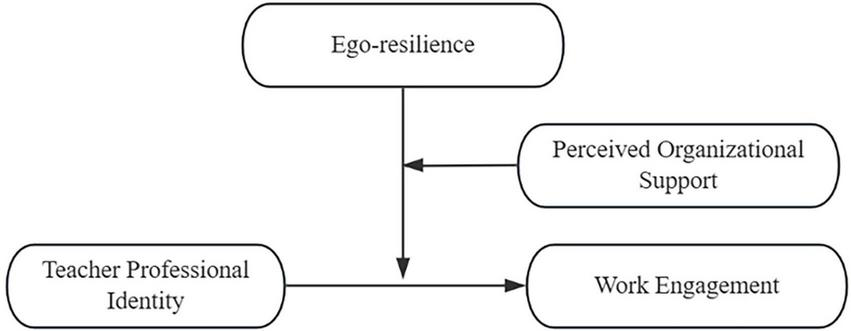
Hypothesized model.
2 Materials and methods
2.1 Participants and procedures
This study was conducted according to the Declaration of Helsinki and APA ethical standards and was approved by the local committee (No ZSRT2022020). Convenience sampling was used in this study. Data was collected by a platform called Credamo. The specific procedure was as follows: Firstly, we will create questionnaires on Credamo and generate a link that will be used to send to our participants. Secondly, they must finish the informed consent before filling out the questionnaire. Thirdly, they were asked to complete the questionnaires under the written instructions, and their data were finally exported to SPSS.
All participants were from Zhejiang Province. A total of 2,956 teachers took part in this study. After the initial review, 233 participants were excluded from further analysis due to missing key variables. Thus, data from 2723 teachers (valid response rate: 92.12%) were used for additional correlational and mediation analyses. Among these participants, 800 were male (29.40%). Their average age was 38.40 years (SD = 9.01), and their average seniority was 18.62 years (SD = 11.12).
2.2 Materials and measurements
Teacher professional identity was measured using the Chinese version of the Teacher Professional Identity Scale, compiled by Wei et al. (2013). This scale consists of four sub-dimensions: Occupational values, role values, sense of occupational belonging, and professional behavior inclination, comprising a total of 18 items. Scores ranged from 1 (strongly disagree) to 5 (strongly agree), with a Cronbach’s alpha of 0.95.
2.2.1 Ego-resiliency
It was measured by the scale designed by Block and Kremen (1996). It consists of 14 items (e.g., I would be willing to describe myself as a pretty “strong” personality). Items were rated on a four-point Likert scale (1 = does not apply at all, 5 = applies very strongly). The Cronbach α of this scale was 0.93.
2.2.2 Perceived organizational support
This was measured using the Perceived Organizational Support Scale designed by Eisenberger et al. (2001). In this study, we used the Chinese version that was translated by Liu et al. (2013). The scale includes eight items, and every item was scored from 1 (strongly disagree) to 7 (strongly agree). The Cronbach α was 0.89 in our study.
2.2.3 Work engagement
This was measured using the Utrecht Work Engagement Scale (UWES-9) developed by Schaufeli and Bakker (2004), which consists of three dimensions (i.e., vigor, dedication, and absorption). This scale was translated into Chinese by Zhang and Gan (2005). The scale includes nine items, and every item was scored from 1 (never) to 5 (always). The Cronbach α was 0.94 in our study.
3 Results
3.1 Common method bias
Harman’s single-factor test was used to test possible common method deviation in this study. Results showed that there were 7 characteristic roots greater than 1, and the total variance was 39.89%, less than 40%, indicating that there is no obvious common methodological bias in this study (Podsakoff et al., 2003).
3.2 Correlation results
The results of correlation among the main variables showed that teacher professional identity positively related to ego-resilience (r = 0.49, p < 0.01), perceived organizational support (r = 0.50, p < 0.01), and work engagement (r = 0.64, p < 0.01); Ego-resilience positively related to perceived organizational support (r = 0.47, p < 0.01), and work engagement (r = 0.63, p < 0.01); Perceived organizational support positively related to work engagement (r = 0.54, p < 0.01). The specific results can be seen in Table 1.
TABLE 1
| Variables | M | SD | 1 | 2 | 3 | 4 |
|---|---|---|---|---|---|---|
| TPI | 4.43 | 0.58 | – | |||
| ER | 3.15 | 0.56 | 0.49** | – | ||
| POS | 3.78 | 0.82 | 0.50** | 0.47** | – | |
| WE | 3.87 | 0.80 | 0.64** | 0.63** | 0.54** | – |
Correlational analyses of main variables.
TPI, teacher professional identity; ER, ego-resilience; POR, perceived organizational support; WE, work engagement.
**p < 0.01.
3.3 Results of moderators of ego-resilience and perceived organizational support
Model 3 (Process macro in SPSS 25.0, Hayes, 2013) was used to test the moderating roles of ego-resilience and perceived organizational support in the relationship between teacher professional identity and work engagement. Results showed that the interaction effect of teacher professional identity, ego-resilience, and perceived organizational support on work engagement was significant (B = 0.12, SE = 0.04, p = 0.001, 95% CI = 0.05 to 0.19). Further simple analysis showed that when scores of ego-resilience and perceived organizational support were high, the effect of teacher professional identity on work engagement was the biggest (B = 0.72, SE = 0.07, p = 0.000, 95% CI = 0.58 to 0.86). The specific results are shown in Table 2.
TABLE 2
| Y: WE | |||||
|---|---|---|---|---|---|
| Variables | B | SE | P | 95% CI | |
| X: TPI | 0.52 | 0.02 | 0.000 | 0.48, 0.57 | |
| M: ER | 0.48 | 0.02 | 0.000 | 0.43, 0.53 | |
| W: POS | 0.17 | 0.02 | 0.000 | 0.13, 0.20 | |
| X × M | 0.17 | 0.04 | 0.000 | 0.08, 0.25 | |
| X × W | −0.002 | 0.03 | 0.952 | −0.06, 0.06 | |
| M × W | −0.001 | 0.03 | .974 | −0.05, 0.05 | |
| X × M × W | 0.12 | 0.04 | 0.001 | 0.05, 0.19 | |
| Constant | 3.84 | 0.01 | 0.000 | 3.82, 3.87 | |
| Conditional indirect of X on Y | |||||
| B | SE | P | 95%CI | ||
| M: M−1SD | W: M−1SD | 0.49 | 0.03 | 0.000 | 0.44, 0.54 |
| W: M+1SD | 0.38 | 0.06 | 0.000 | 0.27, 0.49 | |
| M: M−1SD | W: M−1SD | 0.58 | 0.05 | 0.000 | 0.49, 0.67 |
| W: M+1SD | 0.72 | 0.07 | 0.000 | 0.58, 0.86 | |
Results of moderating roles of ego-resilience and perceived organizational support.
TPI, teacher professional identity; ER, ego-resilience; POR, perceived organizational support; WE, work engagement.
4 Discussion
This study tested the effects of teacher professional identity, ego-resilience, and perceived organizational support on work engagement. Results showed that work engagement was positively predicted by teacher professional identity, supporting H1. This result was similar to other previous studies (Li et al., 2024, 2025; Sun et al., 2025). For example, the research conducted by Li et al. (2024) found that work engagement was positively related to teacher professional identity. This result could be explained by JD-R theory, which posits that job resources can promote a high level of work commitment and excellent job performance due to job resources have the nature of motivation (Bakker et al., 2010). Teacher professional identity, as the positive cognition and behavioral tendency of teachers toward the profession, has the most basic motivation to work, and thus can promote teacher work engagement.
Meanwhile, this study found that when teachers have a high level of ego-resilience and perceived organizational support, the predictive effect of teacher professional identity on work engagement was the strongest, supporting H2. This result, on the one hand, indicates that job resources can promote work engagement (Qi and Wu, 2018). On the other hand, this result suggests that when different kinds of resources work together, they may have the strongest effect. This result was similar to the research conducted by Sun et al. (2025), who found that when competence and growth values, and ego-resilience were both high, the predictive effect of teacher professional identity on teacher empathy was strongest. Furthermore, we did an additional analysis of when ego-resilience and perceived organizational support exchange positions of their moderating effects, and results showed that the triple interaction effect of teacher professional identity, ego-resilience, and perceived organizational support on work engagement was not significant. This result indicates that in the relationship where teacher professional identity influences work engagement, the different resources exert their effects at different levels and under different conditions. Specifically speaking, perceived organizational support may be a more fundamental boundary condition for the motivational roles of teacher professional identity and ego-resilience. In environments lacking sufficient organizational support, even if teachers have a strong sense of professional identity and ego-resilience, their level of work engagement may still be difficult to enhance (Xu et al., 2023, 2025).
This study has some theoretical and practical implications. Theoretically, this study supported the JD-R model and expanded this theory to some degree. JD-R theory describes the different effects of job demands and resources on professional health, and it introduces the related resources and demands (Bakker and Demerouti, 2017). However, this theory did not explore the interaction effect of different kinds of resources. This study examined the interaction effect of personal (i.e., ego-resilience) and organizational resources (i.e., perceived organizational support) on teacher work engagement, finding that when both ego-resilience and organizational support were high, the effect of teacher professional identity on work engagement was the most pronounced. Practically, this study indicated the importance of teacher professional identity, ego-resilience, and perceived organizational support on work engagement. For school managers, trying their best to provide support to teachers can help teachers engage with their work. Meanwhile, through relevant training to enhance teachers’ professional identity and ego-resilience, only in this way can both individuals and organizations play their roles in teachers’ work engagement.
Some limitations should be noted in the study. First, the cross-sectional nature of data is a key limitation, as it prevents us from drawing causal inferences. Longitudinal or experimental designs should be used to better establish the causal directions among these variables in future research. Second, using a single self-report questionnaire for all measures carries a risk of Common Method Variance. Future studies can mitigate this by using multi-source data (e.g., supervisor ratings of work engagement) or incorporating temporal separations in the measurement of predictors and outcomes. Third, the sample was drawn from a single province (i.e., Zhejiang) in China, which may limit the generalizability of findings. Future research should replicate this study in other regions of China with different developmental levels and in cross-national contexts to enhance its external validity. Fourth, some variables (e.g., student behavior) may influence the findings, with future studies to include a broader set of variables, particularly key job demands from the JD-R model, to gain a more comprehensive understanding of the antecedents of teacher work engagement and to control for their potential confounding effects.
Statements
Data availability statement
The data can be obtained from the corresponding author with reasonable request.
Ethics statement
The studies involving humans were approved by Local committee of Zhejiang Normal University. The studies were conducted in accordance with the local legislation and institutional requirements. The participants provided their written informed consent to participate in this study.
Author contributions
XY: Writing – review & editing. ZX: Writing – original draft, Data curation. WL: Supervision, Writing – original draft. HZ: Investigation, Writing – original draft. XL: Writing – original draft. WX: Conceptualization, Writing – original draft.
Funding
The author(s) declare financial support was received for the research and/or publication of this article. This study was supported by the 2024 General Planning Project of Education Science Research in Zhejiang Province: “Research on Strategies for Enhancing the Cross-disciplinary Teaching Practice Ability of Science Teachers” (Project Number: 2024SCG043, Xiajun Yu), the 2025 General Planning Project of Education Science Research in Zhejiang Province: “The Influence of Contextual Event Intensity on Teachers’ Moral Awareness and Its Neural Mechanism Research” (Project Number: 2025SCG355, Xinwei Li), and was funded by the China National Scholarship Council (Xinwei Li).
Conflict of interest
The authors declare that the research was conducted in the absence of any commercial or financial relationships that could be construed as a potential conflict of interest.
Generative AI statement
The authors declare that no Generative AI was used in the creation of this manuscript.
Any alternative text (alt text) provided alongside figures in this article has been generated by Frontiers with the support of artificial intelligence and reasonable efforts have been made to ensure accuracy, including review by the authors wherever possible. If you identify any issues, please contact us.
Publisher’s note
All claims expressed in this article are solely those of the authors and do not necessarily represent those of their affiliated organizations, or those of the publisher, the editors and the reviewers. Any product that may be evaluated in this article, or claim that may be made by its manufacturer, is not guaranteed or endorsed by the publisher.
References
1
Bakker A. Demerouti E. Verbeke W. (2010). Using the job demands-resources model to predict burnout and performance.Hum. Resource Manag.4383–104. 10.1002/hrm.20004
2
Bakker A. B. Albrecht S. (2018). Work engagement: Current Trends.Career Dev. Internatl.234–11. 10.1108/CDI-11-2017-0207
3
Bakker A. B. Demerouti E. (2017). Job demands–resources theory: Taking stock and looking forward.J. Occup. Health Psychol.22273–285. 10.1037/ocp0000056
4
Block J. Kremen A. M. (1996). IQ and ego-resiliency: Conceptual and empirical connections and separateness.J. Personal. Soc. Psychol.70349–361. 10.1037//0022-3514.70.2.349
5
Cohen S. Wills T. A. (1985). Stress, social support, and the buffering hypothesis.Psychol. Bull.98310–357. 10.1037/0033-2909.98.2.310
6
Eisenberger R. Armeli S. Rexwinkel B. Lynch P. D. Rhoades L. (2001). Reciprocation of perceived organizational support.J. Appl. Psychol.8642–51. 10.1037/0021-9010.86.1.42
7
Freudenberger H. (2010). Staff burnout.J. Soc. Issues30159–165. 10.1111/j.1540-4560.1974.tb00706.x
8
Gavino M. C. Wayne S. J. Erdogan B. (2012). Discretionary and transactional human resource practices and employee outcomes: The role of perceived organizational support.Hum. Resource Manag.51665–686. 10.1002/hrm.21493
9
Ghafoori B. Triliva S. Chrysikopoulou P. Vavvos A. (2024). Resilience, coping Self-Efficacy, and posttraumatic stress symptoms among healthcare workers who work with refugees and asylum seekers in greece.Behav. Sci.141–1510.3390/bs14060509
10
Hasani S. (2024). Innovative behavior as a mediator: Self-efficacy, supportive environment, and creativity on employee performance.J. Innov. Sustainabil.1590–109. 10.23925/2179-3565.2024v15i4p90-109
11
Hayes A. (2013). Introduction to mediation, moderation, and conditional process analysis: A regression-based approach.Guildford WA: The Guilford.
12
Hobfoll S. (2002). Social and psychological resources and adaptation.Rev. General Psychol.6307–324. 10.1037/1089-2680.6.4.307
13
Kim T. Han K. (2021). The moderating effects of self-esteem and ego-resilience on the relationship between emotional labor, depressive symptoms, and job satisfaction in nurses.Kor. Acad. Psychiatric Mental Health Nurs.30209–219. 10.12934/jkpmhn.2021.30.3.209
14
Li X. Xiao W. Sun C. Li W. Sun B. (2024). Does burnout decrease with teacher professional identity among teachers in China?J. Career Dev.50983–996. 10.1177/08948453221138937
15
Li X. Xu L. Sun C. Sun B. (2025). The relationship between professional identity and job burnout among Chinese teachers: Mediating roles of career satisfaction and work engagement.Psychol. Sch.621830–1840. 10.1002/pits.23432
16
Liu Z. Deng C. Liao J. Long L. (2013). Organizational support, perceived status and employees’ innovative behavior: Perspective of employment and diversity.J. Manag. Sci. China1880–94.
17
Llorens-Gumbau S. Salanova-Soria M. (2014). Loss and gain cycles? a longitudinal study about burnout, engagement and self-efficacy.Burnout Res.13–11. 10.1016/j.burn.2014.02.001
18
Luthar S. S. Cicchetti D. Becker B. (2000). The construct of resilience: A critical evaluation and guidelines for future work.Child Dev.71543–562. 10.1111/1467-8624.00164
19
Masten A. S. (2001). Ordinary magic. Resilience processes in development.Am. Psychol.56227–238. 10.1037//0003-066x.56.3.227
20
Midje H. H. Nyborg V. N. Nordsteien A. Øvergård K. I. Brembo E. A. Torp S. (2024). Antecedents and outcomes of work engagement among nursing staff in long-term care facilities-A systematic review.J. Adv. Nurs.8042–59. 10.1111/jan.15804
21
Podsakoff P. M. MacKenzie S. B. Lee J. Y. Podsakoff N. P. (2003). Common method biases in behavioral research: A critical review of the literature and recommended remedies.J. Appl. Psychol.88879–903. 10.1037/0021-9010.88.5.879
22
Qi Y. J. Wu X. C. (2018). Job Demands-Resources Model: The development of theoretical and empirical research.J. Beijing Normal Univ.628–36.
23
Qin X. Liu S. (2023). The relationship between principal support, teacher professional identity, and teacher professional learning in china: Investigating gender differences.Psychol. Sch.604871–4884. 10.1002/pits.23066
24
Rhoades L. Eisenberger R. (2002). Perceived organizational support: A review of the literature.J. Appl. Psychol.87698–714. 10.1037/0021-9010.87.4.698
25
Schaufeli W. B. Bakker A. B. (2004). Job demands, job resources, and their relationship with burnout and engagement: A multi-sample study.J. Organ. Behav.25293–315. 10.1002/job.248
26
Schaufeli W. B. Salanova M. Vicente G. Bakker A. B. (2002). The measurement of engagement and burnout: A two-sample confirmatory factor analytic approach.J. Happiness Stud.371–92. 10.1023/A:1015630930326
27
Scott K. L. Ferrise E. Sheridan S. Zagenczyk T. J. (2024). Work-related resilience, engagement and wellbeing among music industry workers during the Covid-19 pandemic: A multiwave model of mindfulness and hope.Stress Health40:e3466. 10.1002/smi.3466
28
Sun C. Zhuang L. Xiao W. Li X. Sun B. (2025). Teacher professional identity on teacher empathy: The moderating roles of competence and growth values and Ego-Resilience.Psychol. Sch.621530–1538. 10.1002/pits.23413
29
Tabak F. Hendy N. T. (2016). Work engagement: Trust as a mediator of the impact of organizational job embeddedness and perceived organizational support.Organ. Manag. J.1321–31. 10.1080/15416518.2015.1116968
30
Um B. Bardhoshi G. (2025). Organizational resources, burnout, and work engagement of school counselors: The mediating effect of professional identity.J. Counsel. Dev.10360–70. 10.1002/jcad.12538
31
Wei S. Song G. (2012). The relationship between principal support, teacher professional identity, and teacher professional learning in China: Investigating gender differences.Psychol. Exp.6564–569.
32
Wei S. Song G. Zhang D. J. (2013). Study on primary, middle, and high school teachers’ professional identity: Structure and scale.Teach. Educ. Res.2555–60.
33
Wu S. Zhu W. Li H. Wang Z. Wang M. (2010). Relationship between job burnout and occupational stress among doctors in china.Stress Health24143–149. 10.1002/smi.1169
34
Xanthopoulou D. Bakker A. B. Heuven E. Demerouti E. Schaufeli W. B. (2008). Working in the sky: A diary study on work engagement among flight attendants.J. Occup. Health Psychol.13345–356. 10.1037/1076-8998.13.4.345
35
Xiao W. Sun B. Yu X. Xue D. Zhou H. (2024). Core symptoms of teachers’ compassion fatigue and their characteristics at different career stages.Sch. Mental Health16239–252. 10.1007/s12310-024-09633-1
36
Xu L. Sun C. Li X. Xiao W. Sun B. (2025). Job burnout, career satisfaction, perceived organizational support, and perceived social support among chinese teachers: A network analysis.Sch. Mental Health17449–466. 10.1007/s12310-024-09737-8
37
Xu L. Li X. Sun C. Sun B. Li W. (2023). Relationship between professional identity, career satisfaction, value of competence and growth, and job burnout: A cross-sectional study of primary and secondary school teachers in China.Psychol. Sch.601234–1248. 10.1002/pits.22828
38
Xue D. Sun B. Li W. Li X. Xiao W. (2024). The relationship between resiliency, psychological empowerment, and teacher burnout across different genders: A psychological network analysis.Behav. Sci.14878–896. 10.3390/bs14100878
39
Zhang H. Zhao Y. Zou P. Liu Y. Lin S. Ye Z. et al (2020). The relationship between autonomy, optimism, work engagement and organizational citizenship behavior among nurses fighting COVID-19 in Wuhan: A serial multiple mediation.BMJ Open10:e039711. 10.1136/bmjopen-2020-039711
40
Zhang Y. Gan Y. (2005). The Chinese version of the Utrecht Work engagement scale: An examination of reliability and validity.Chin. J. Clin. Psychol.3268–271.
41
Zhang Y. P. Peng X. Y. Li Z. H. Chen F. H. (2023). Hyperglycemic effects of a periocular dexamethasone injection in diabetic patients after vitreoretinal surgery.Biomed. Environ. Sci.25311–316. 10.3967/0895-3988.2012.03.009
Summary
Keywords
teacher professional identity, ego-resilience, perceived organizational support, work engagement, Chinese teachers
Citation
Yu X, Xiong Z, Li W, Zhang H, Li X and Xiao W (2025) Teacher professional identity on work engagement: the moderating roles of ego-resilience and perceived organizational support. Front. Psychol. 16:1657911. doi: 10.3389/fpsyg.2025.1657911
Received
02 July 2025
Revised
05 November 2025
Accepted
07 November 2025
Published
27 November 2025
Volume
16 - 2025
Edited by
Huaruo Chen, Nanjing University of Posts and Telecommunications, China
Reviewed by
Uğur Özbilen, Akdeniz University, Türkiye
Mohammad Hossein Arefian, Imam Khomeini International University, Iran
Updates
Copyright
© 2025 Yu, Xiong, Li, Zhang, Li and Xiao.
This is an open-access article distributed under the terms of the Creative Commons Attribution License (CC BY). The use, distribution or reproduction in other forums is permitted, provided the original author(s) and the copyright owner(s) are credited and that the original publication in this journal is cited, in accordance with accepted academic practice. No use, distribution or reproduction is permitted which does not comply with these terms.
*Correspondence: Xinwei Li, lixinwei0417@126.com
Disclaimer
All claims expressed in this article are solely those of the authors and do not necessarily represent those of their affiliated organizations, or those of the publisher, the editors and the reviewers. Any product that may be evaluated in this article or claim that may be made by its manufacturer is not guaranteed or endorsed by the publisher.