Abstract
Background:
While the detrimental intergenerational effects of adverse childhood experiences (ACEs) are well-documented, the potential developmental benefits associated with parental positive childhood experiences (PCEs) warrant further clarification, particularly concerning the social competence of offspring. The present study examines the relationship between parental PCEs and social skills in preschool-aged children, as well as the moderating role of the home-rearing environment.
Methods:
This cross-sectional study was conducted in three kindergartens in Xuzhou, Shangqiu, and Tianjin, representing the eastern and northern regions of mainland China. The study included 320 Chinese preschoolers (mean age = 4.76 years, SD = 1.01) and their parents. Parental PCEs were assessed using the Benevolent Childhood Experiences Scale, children’s social skills were measured with the Social Skills Scale, and the home-rearing environment was evaluated using the Index of Child Care Environment.
Results:
The findings demonstrated a significant positive association between parental PCEs and social skills in children (β = 1.15, p < 0.001). Furthermore, the quality of the home-rearing environment moderated this relationship, with more supportive environments amplifying the benefits of PCEs (β = 0.54, p < 0.05).
Conclusion:
These findings underscore the importance of incorporating both parental experiences and family environments in interventions aimed at fostering children’s social development.
1 Introduction
Social skills are defined as learned, socially appropriate behaviors that facilitate effective interpersonal interactions and reduce the likelihood of inappropriate responses (Gresham and Elliott, 1984), are critical for children’s future social adaptation and psychological well-being (Mohammadi et al., 2019; Siranchuk and Bondarenko, 2023). In early childhood, the development of these skills is shaped by a range of familial and environmental factors, with parental childhood experiences emerging as a significant influence through intergenerational transmission (Zhang et al., 2023; Zhu et al., 2023; Blackwell et al., 2024).
Parental childhood experiences, encompassing both adverse and positive events, play a pivotal role in shaping parenting behaviors and, consequently, child development. Adverse childhood experiences (ACEs) are potentially traumatic life events that occur before the age of 18, including child abuse (physical, emotional or sexual) and neglect, mental illness of family members, parental divorce or separation, and family member substance use (Felitti et al., 1998). Existing research has focused on ACEs, showing that mothers with more exposure to ACEs can pass the negative effects of ACEs to the next generation through poor health behaviors, parenting styles and broader family relationship health, which increases the risk of problem behavior in offspring (Greene et al., 2020; Narayan et al., 2021; Reese et al., 2022; Racine et al., 2023). At the social level, it is reflected in an increased risk of socioemotional difficulties and a delay in personal-social development in children (Zhang et al., 2023; Folger et al., 2018).
Positive Childhood Experiences (PCEs) refer to beneficial experiences before age 18 characterized by perceived safety, stable support systems, structured household routines, comforting belief systems, and strong community connections (Narayan et al., 2018). While the detrimental effects of ACEs have been widely documented, limited research has examined the potential protective impact of parental PCEs on the development of the child.
1.1 Parental PCEs and social skills development in young children
Parental PCEs are hypothesized to influence children’s development by shaping parents’ psychological well-being and parenting practices. Prior studies have shown that parental PCEs serve as protective factors for adult psychological well-being, reducing stress and enhancing emotional regulation (Crandall et al., 2019). These psychological benefits enable parents to engage in constructive parenting practices, and demonstrate positive parenting attitudes and behaviors, such as emotional warmth and responsive caregiving (Chen et al., 2008; Kosterman et al., 2011), which foster a home-rearing environment characterized by positive parent–child interactions (Haven et al., 2014; Liu et al., 2022). Closer parent–child relationships would enhance emotional support and family cohesion—both critical elements for fostering children’s social skills (Haven et al., 2014; Liu et al., 2022), creating opportunities for children to observe and internalize prosocial behaviors (Yamaoka and Bard, 2019; Zhong et al., 2020). Furthermore, children of parents with higher PCEs have been shown to exhibit fewer prosocial difficulties and fewer mental health concerns (Zhu et al., 2023; Blackwell et al., 2024). Since fewer prosocial difficulties in children are generally associated with higher children’s social skills, such as the demonstration of appropriate social behaviors and constructive coping strategies, it is reasonable to hypothesize that higher parental PCEs are positively associated with improved children’s social skills (Eisenberg et al., 1996).
Despite these insights, there remains limited research on the intergenerational transmission of parental PCEs. Two studies have shown that parental PCEs were associated with nurturing parenting attitudes (Morris et al., 2021) and improved family health (Daines et al., 2021), both of which are known contributors to children’s development. More direct evidence suggests that children with high parental PCEs scores exhibited fewer psycho-social problems and higher levels of well-being (Zhu et al., 2023; Blackwell et al., 2024). However, these studies primarily focus on broad health outcomes, leaving the relationship between parental PCEs and children’s social skills development largely unexplored.
1.2 The moderating role of the home-rearing environment
Parents’ childhood experiences are not decisive factors. Even parents with high PCEs may face barriers to translating these experiences into positive child outcomes. The home-rearing environment is central to understanding how parental positive childhood experiences (PCEs) influence children’s social skill development, as it constitutes the primary microsystem within Ecological Systems Theory (Bronfenbrenner, 2000). This theory posits that children’s development is shaped by interactions within and across multiple environmental systems, among which micro-systems have the most direct impact on children. In this context, the home-rearing environment serves as a critical micro-system, which interacts dynamically with parental characteristics and transforms into children’s social outcomes. As the most immediate setting, the home-rearing environment directly shapes children’s day-to-day experiences and serves as the primary context through which parental characteristics are transmitted to children.
The quality of the home-rearing environment, defined by factors such as emotional warmth, positive parent–child interactions, and avoidance of harsh discipline, can either amplify or diminish the intergenerational benefits of PCEs. Empirical evidence from Western indicates that family environments characterized by high emotional support and positive parent–child interactions strengthen the translation of parental PCEs into effective parenting behaviors (Schofield et al., 2014). Such environments provide children with frequent opportunities for social learning, which contributes to the development of emotional regulation and interpersonal skills (Feldman et al., 2023; Mirabile et al., 2018; Perry et al., 2020).
In contrast, the potential benefits of PCEs may be attenuated in less supportive home environments characterized by high stress, low emotional warmth, or culturally driven authoritarian practices. A US study demonstrated that family health mediates the relationship between parental positive childhood experiences (PCEs) and children’s adverse family experiences, revealing that unsupportive family environments attenuate the benefits of PCEs (Daines et al., 2021). Specifically, reduced socioemotional functioning and limited family resources are key characteristics of unsupportive home environments. In such contexts, the positive influence of parental PCEs on fostering a nurturing family system is weakened, which may increase developmental risks for children, including difficulties in social skills development. This is particularly relevant in the Chinese cultural context, where Confucian values often prioritize discipline, academic achievement, and parental authority over emotional expressiveness. For example, a study in China found that authoritarian parenting, prevalent in traditional Chinese families, restricted children’s autonomy, creativity, and emotional management (Ning, 2022; Li et al., 2023), even when parents had positive developmental histories. Consequently, the use of a Chinese sample is critical to explore these dynamics, as cultural factors uniquely shape parenting practices and home environments in China. The present study posits that the home-rearing environment moderates the association between parental PCEs and children’s social skills.
1.3 Current study
Empirical research examining the intergenerational effects of parental PCEs on the development of social skills in children remains limited, particularly within the Chinese sociocultural context. This study aims to examine the association between parental PCEs and preschool children’s social skills, and to assess whether home-rearing environment quality moderates this relationship.
2 Methods
2.1 Study design
This cross-sectional study was conducted in three kindergartens in Xuzhou, Shangqiu, and Tianjin, representing the eastern and northern regions of mainland China. Questionnaires were distributed to parents of preschool-aged children through kindergarten administrators, who provided informed consent forms and study information. Data were collected through multiple methods to assess main variables. Teachers conducted daily observations to evaluate children’s social skills, providing an objective measure based on classroom interactions. Concurrently, parents completed a self-reported questionnaire that included demographic information, details on parental positive childhood experiences (PCEs), and characteristics of the home-rearing environment.
The study included children aged 3–6 years residing with at least one parent. Children with disabilities, clinically diagnosed developmental delays, or parents with health conditions that could interfere with participation were excluded. Ethical approval was obtained from the University of Tsukuba (Approval No. 2035), and written informed consent was obtained from all participants.
2.2 Participants
To determine the appropriate sample size for detecting a potential moderating effect, a priori power analysis was conducted using G*Power 3.1 statistical software (Faul et al., 2007). Based on Cohen’s guidelines, a large effect size (f2 = 0.35) was assumed for the moderation analysis, with a significance level (α) of 0.05 and statistical power (1 − β) of 0.7 (Cohen, 1977). The analysis yielded a minimum required sample size of 102 participants.
A total of 491 questionnaires were distributed across the selected kindergartens. Following the application of inclusion and exclusion criteria, and the removal of questionnaires with incomplete data (missing demographic information or core outcome measures), a final sample of 320 completed questionnaires was retained for analysis. Details of the sampling strategy of the study and the flow chart of included participants are described in Supplementary Figure S1.
2.3 Measures
2.3.1 Positive childhood experiences
Parental PCEs were assessed using the Benevolent Childhood Experiences (BCEs) Scale (Narayan et al., 2018), which has demonstrated acceptable validity and reliability in Chinese populations (Zhan et al., 2021). The scale was completed by parents, who retrospectively reported on their positive experiences prior to age 18. The BCEs Scale comprises 10 dichotomous (yes, no) items assessing dimensions such as predictable and positive quality of life, social support, and perceived safety. Each “yes” response is scored as 1, and each “no” response is scored as 0, with total scores ranging from 0 to 10. Higher scores indicate greater exposure to PCEs. In the current study, the scale showed satisfactory internal consistency (Cronbach’s α = 0.76).
2.3.2 Social skills
Children’s social skills were assessed using the Social Skill Scale (SSS), an observation-based instrument scale with demonstrated validity and reliability for use with preschool-aged children (Anme et al., 2013). The SSS has shown cross-cultural applicability and measurement invariance in both Japanese and Chinese populations (Zhu et al., 2023). The SSS consists of 24 items across three subdomains: assertion, self-control and cooperation. Each item was scored on a 3-point Likert scale (0 = rarely, 1 = sometimes, 2 = always) according to daily observations in kindergartens by teachers. Subdomain scores are calculated as the sum of the respective items (range: 0–16 per subdomain), and the total score ranges from 0 to 48, with higher scores indicating greater social competence. In the present study, the SSS demonstrated excellent internal consistency (Cronbach’s α = 0.93).
2.3.3 Home-rearing environment
The Index of Child Care Environment (ICCE) was used to assess the quality of the home-rearing environment, which is strongly correlated with the Home Observation for Measurement of the Environment (HOME) and has been widely used in Chinese research with robust reliability and validity (Zhu et al., 2023; Wang et al., 2024). The ICCE was completed by parents, who reported on their home environment and parenting practices. The scale includes 13 items across four dimensions: family interaction, external contact, avoidance of punishment, and social support. Total scores range from 0 to 13, with higher scores indicating more supportive and nurturing home-rearing environments. The ICCE demonstrated acceptable internal consistency in this study (Cronbach’s α = 0.81).
2.3.4 Covariates
Covariates included parental relationship to the child, child’s age, child’s sex, sibling status, family structure, parental age, parental education background, and family income.
2.4 Statistical analysis
Quantitative data were analyzed using SPSS software version 26.0. Descriptive statistics and Pearson’s correlation analyses were conducted to analyze the study variables. First, Univariate regression of parental PCEs and home-rearing environment on children’s social skills. To test the moderating effect of the home-rearing environment on the association between parental PCEs and children’s social skills, a moderation analysis was conducted using PROCESS Macro (Model 1) for SPSS (Hayes, 2017). In this model, PCEs were entered as the independent variable, children’s social skills as the dependent variable, and the home-rearing environment as the moderating variable. Covariates included the child’s sex, child’s age, and other demographic variables. Bootstrapping with 5,000 resamples was used to estimate the 95% confidence intervals for the significance of effects.
3 Results
3.1 Descriptive characteristics of the sample
A total of 320 valid responses were included in the final analysis. Table 1 presents the demographic characteristics of the participants. The mean age of the children was 4.76 years (SD = 1.01). Among the children, 52.2% were male (n = 167) and 47.8% were female (n = 153). The primary caregiver was predominantly the mother (86.6%, n = 277), while 13.4% (n = 43) reported the father as the caregiver.
Table 1
| Variables | Categories | n | % |
|---|---|---|---|
| Gender | Male | 167 | 52.2 |
| Female | 153 | 47.8 | |
| Siblings | Yes | 179 | 55.9 |
| No | 141 | 44.1 | |
| Family structure | Single Parent | 23 | 7.2 |
| Nuclear | 208 | 65.0 | |
| Extended | 89 | 27.8 | |
| Parental relation to child | Father | 43 | 13.4 |
| Mother | 277 | 86.6 | |
| Parental age | <25y | 2 | 0.6 |
| 25-30y | 43 | 13.4 | |
| 31-35y | 148 | 46.3 | |
| 36-40y | 92 | 28.7 | |
| 41-45y | 32 | 10.0 | |
| >45y | 3 | 0.9 | |
| Parental education background | High School or Below | 57 | 17.8 |
| Associate/Bachelor’s Degree | 210 | 65.6 | |
| Master’s Degree or Above | 53 | 16.6 | |
| Family income | <100 thousand | 69 | 21.6 |
| 100–300 thousand | 149 | 46.6 | |
| 300–500 thousand | 50 | 15.6 | |
| >500 thousand | 52 | 16.2 |
Demographic characteristics (n = 320).
3.2 Correlation analysis
Among the participating parents, 37.8% reported experiencing all 10 PCEs. The mean PCEs score was 0.83 (SD = 0.20). The mean score for the home-rearing environment was 0.78 (SD = 0.22), and the average social skills score was 1.50 (SD = 0.38). Table 2 presents the bivariate correlations among the primary study variables.
Table 2
| M | SD | Min | Max | 1 | 2 | 3 | |
|---|---|---|---|---|---|---|---|
| 1 PCEs | 0.83 | 0.20 | 0.10 | 1.00 | - | ||
| 2 Home-rearing environment | 0.78 | 0.22 | 0.08 | 1.00 | 0.447*** | - | |
| 3 Social skills | 1.50 | 0.38 | 0.42 | 2.00 | 0.564*** | 0.697*** | - |
Bivariate correlations among the main variables (n = 320).
*p < 0.05, **p < 0.01, ***p < 0.001.
3.3 Moderation analysis
First, univariate models showed that parental PCEs were strongly associated with higher levels of children’s social skills (β = 1.15, p < 0.001), indicating that children of parents with more positive childhood experiences tend to exhibit greater social competence. Similarly, a more supportive home-rearing environment was associated with enhanced social skills in children (β = 1.14, p < 0.001), suggesting that more supportive families can foster stronger social abilities in preschoolers. A two-variable model (without interaction) yielded similar main effects (PCEs: β = 0.72, p < 0.001; home-rearing environment: β = 0.82, p < 0.001). The results are similar for uncontrolled for covariates (see Supplementary Tables S1, S2).
In the full moderation model (Table 3), the interaction term between PCEs and the home-rearing environment significantly predicted children’s social skills (β = 0.54, p = 0.027), indicating that the home-rearing environment significantly moderated the relationship between PCEs and children’s social skills. Unadjusted models (excluding covariates; see Supplementary Tables S3) yielded similar patterns.
Table 3
| Relationship | Estimate | SE | t | 95% CI | |
|---|---|---|---|---|---|
| Lower | Upper | ||||
| Constant | 1.154 | 0.082 | 14.001*** | 0.992 | 1.317 |
| PCEs → Social skills | 0.801 | 0.077 | 10.357*** | 0.649 | 0.953 |
| HRE → Social skills | 0.851 | 0.065 | 13.163*** | 0.724 | 0.979 |
| PCEs*HRE → Social skills | 0.541 | 0.243 | 2.227* | 0.063 | 1.018 |
| Child’s sex → Social skills | 0.008 | 0.024 | 0.329 | −0.039 | 0.054 |
| Child’s age → Social skills | 0.048 | 0.012 | 3.839*** | 0.023 | 0.072 |
| Siblings → Social skills | −0.006 | 0.024 | −0.234 | −0.052 | 0.041 |
| Family structure → Social skills | −0.001 | 0.021 | −0.053 | −0.043 | 0.04 |
| Relationship → Social skills | 0.021 | 0.034 | 0.618 | −0.046 | 0.089 |
| Parental age → Social skills | 0.009 | 0.013 | 0.699 | −0.017 | 0.035 |
| Parental education background → Social skills | 0.034 | 0.021 | 1.593 | −0.008 | 0.076 |
| Family income → Social skills | 0.006 | 0.003 | 2.146* | 0.000 | 0.011 |
Moderating effect of home-rearing environment.
*p < 0.05, **p < 0.01, ***p < 0.001. SS, social skills; HRE, home-rearing environment.
To further interpret this interaction, a simple slope analysis was conducted (Figure 1). Results showed that when the home-rearing environment was at a low level (M - 1 SD), the positive association between PCEs and children’s social skills was weaker (simple slope = 0.68, t = 9.60, p < 0.01). Conversely, when the home-rearing environment was at a high level (M + 1 SD), the association was stronger (simple slope = 0.92, t = 8.372, p < 0.01). These findings demonstrate that the home-rearing environment significantly moderates the relationship between PCEs and children’s social skills.
Figure 1
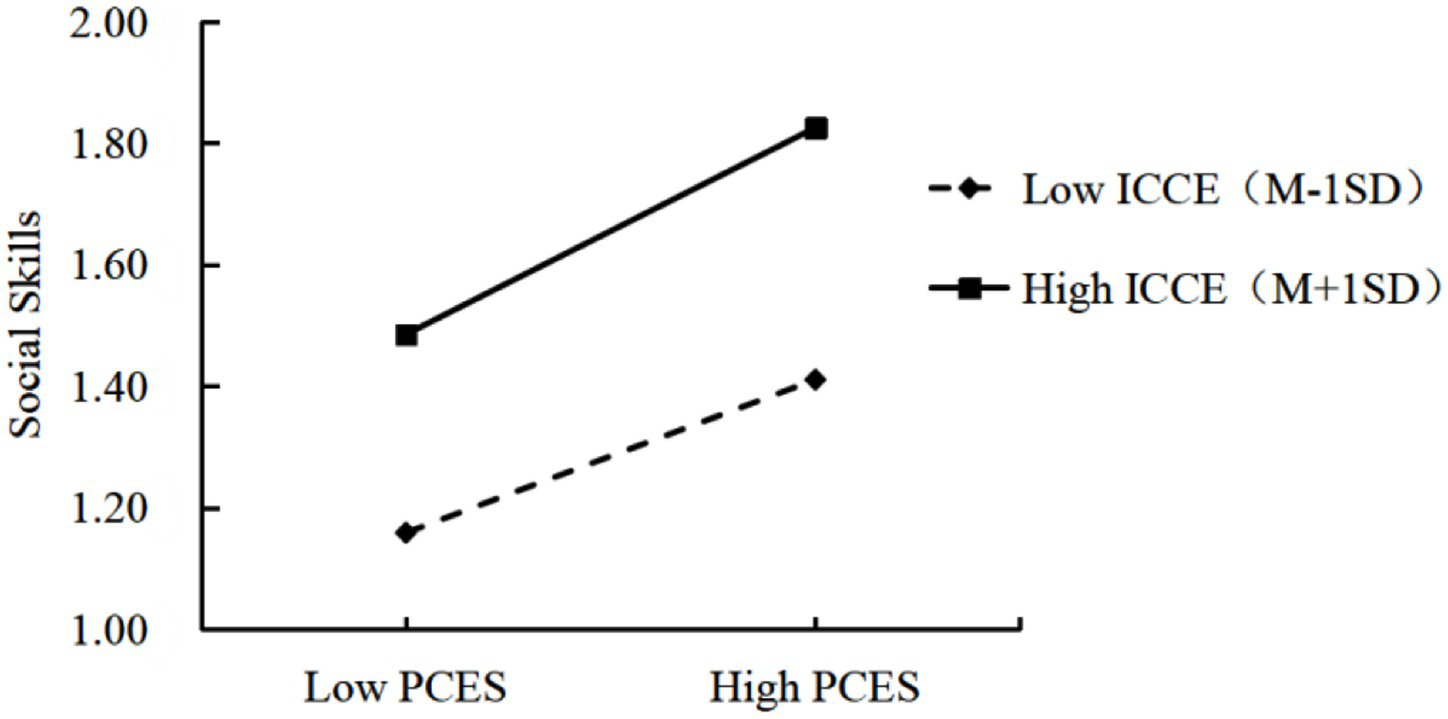
Potential patterns of parental positive childhood experiences, home-rearing environment and children’s social skills in moderation analysis model (n = 320).
4 Discussion
This study systematically examined the intergenerational influence of parental PCEs on children’s social skills, with particular emphasis on the moderating role of the home-rearing environment within the context of Chinese parenting culture. The findings indicate that parental PCEs are positively associated with children’s social skills, and that this relationship is significantly moderated by the home-rearing environment.
The observed association between parental PCEs and children’s social skills may be explained by the intergenerational transmission of parenting behaviors (Putallaz et al., 1998). Prior research demonstrates that maternal PCEs mitigate the adverse effects of ACEs on offspring prosocial deficits, underscoring PCEs as a pivotal determinant of children’s prosocial development (Zhu et al., 2023). This linkage arises from the profound influence of parental childhood experiences on subsequent parenting practices (Weiqiang et al., 2022). Parental with adverse childhood experiences is prone to overindulgent, permissive, authoritarian, or inconsistent styles, which engender emotional, behavioral, and peer-related difficulties in school-aged children (Yu et al., 2022). Conversely, parents with elevated PCEs exhibit positive parenting characterized by diminished psychological and physical aggression, enhanced mind-minded commentary, and improved parent–child interactions (Han et al., 2023), thereby attenuating child aggression, augmenting cooperation and conflict resolution capacities, and bolstering peer relational competencies (Stormshak et al., 2000; Parvin, 2016). Moreover, these parents serve as prosocial role models through their words, actions, and values, fostering children’s social and emotional abilities (Li et al., 2023).
Importantly, the current study offers novel insights into how the home-rearing environment moderates the relationship between parental PCEs and children’s social skills, emphasizing the critical role of family context in the intergenerational transmission of social competencies. According to Social Learning Theory, supportive home contexts marked by emotionally sensitive communication, diverse social experiences, and well-structured interactions provide abundant opportunities for modeling and timely reinforcement, thereby accelerating the internalization of children’s prosocial behaviors (Grusec and Lytton, 1988). Conversely, home environments characterized by low emotional warmth or high authoritarian control restrict meaningful parent–child exchanges, weakening the observational learning loops essential for social-skill acquisition (Shean, 2004; Vieira and Kraemer, 2022). Even parents with rich PCEs may struggle to transmit positive models if interactions are strained or punitive (Wolf et al., 2021). By contrast, when parents with high PCEs operate within nurturing, low-stress households, they can more reliably display responsive behaviors, which children readily emulate, fostering secure attachment and greater social confidence (Belsky, 1984; Koehn and Kerns, 2018; Zhang et al., 2019). Therefore, improving the quality of the home-rearing environment may amplify PCEs’ developmental benefits on children’s social skills.
In the Chinese context, however, Confucian values emphasizing discipline and authority often lead to authoritarian parenting, which may constrain opportunities for positive social interactions (Xie et al., 2022; Huang et al., 2024). Traditional Chinese parenting practices emphasize discipline, obedience, and structured behavioral guidance. While such practices may promote social order and responsibility, they may limit emotional expressiveness and parental warmth (Chao, 1994). Our findings suggest that when parents successfully balance warmth and structure—integrating emotional support with behavioral expectations—children are more likely to develop social confidence and effective social skills (Chen and French, 2008; Liu et al., 2022).
The study also indicated significant associations between key covariates—particularly children’s age and family income—and social skills. These findings are consistent with established developmental principles that identify early childhood, particularly the kindergarten period, as a crucial stage for social skill acquisition (Zhu et al., 2021). As language and cognition mature, children become more adept at navigating social interactions. Furthermore, children from families with higher income levels exhibited stronger social skills (Griffith et al., 2016; Davis and Qi, 2020). This disparity may be attributed to the greater financial resources available to higher-income families, enabling them to provide enriched educational opportunities, socially stimulating environments, and diverse extracurricular activities, which collectively enhance children’s social competence (Garratt et al., 2017).
The findings of this study are consistent with ecological systems theory, which emphasizes that children’s social development is influenced by a combination of individual factors (e.g., age), family factors (e.g., PCEs, home-rearing environment), and socioeconomic factors (e.g., family income) (Bronfenbrenner, 2000). Practically, this suggests that interventions should not only address parental well-being but also target the home environment. Parenting programs that foster emotionally supportive, cognitively stimulating, and structured interactions may enable parents to draw more effectively on their positive childhood experiences when nurturing their children’s social skills.
Despite its contributions, this study has several limitations. First, the study relies primarily on parent self-reported measures (e.g., PCEs, home-rearing environment), which may introduce biases like social desirability and recall inaccuracies. While SSS used teacher observations, future research should add multi-informant or direct observational methods for all measures to enhance validity. Second, the study sample was limited to preschool-aged children from three urban areas in China, with the majority in middle to upper preschool grades (ages 4–5). The urban sample from three cities limits generalizability to rural or diverse socioeconomic contexts in China. Future studies should include more diverse samples across various regions and developmental stages. Finally, this study cannot establish causality because it used a cross-sectional design. Future research should use a longitudinal design to determine whether the effects of parental positive childhood experiences on children’s social skills are moderated by the home-rearing environment.
5 Conclusion
The study revealed two key findings. First, parental PCEs showed a significant positive association with children’s social skills. Second, the home-rearing environment played a moderating role, with parental PCEs demonstrating a stronger influence on children’s social skills in more supportive home-rearing environments. These findings underscore the need to consider both parents’ early experiences and current family contexts when understanding and promoting early social development in children.
Statements
Data availability statement
The original contributions presented in the study are included in the article/Supplementary material, further inquiries can be directed to the corresponding author.
Ethics statement
The studies involving humans were approved by Secretariat of the Ethics Committee, Faculty of Medicine and Health Sciences, University of Tsukuba. The studies were conducted in accordance with the local legislation and institutional requirements. Written informed consent for participation was not required from the participants or the participants’ legal guardians/next of kin in accordance with the national legislation and institutional requirements.
Author contributions
XY: Conceptualization, Data curation, Formal analysis, Funding acquisition, Investigation, Methodology, Project administration, Resources, Software, Supervision, Validation, Visualization, Writing – original draft, Writing – review & editing. ZZ: Data curation, Investigation, Writing – review & editing. YW: Conceptualization, Data curation, Formal analysis, Methodology, Writing – review & editing. RZ: Data curation, Formal analysis, Investigation, Validation, Writing – review & editing. YS: Conceptualization, Writing – review & editing. XL: Conceptualization, Writing – review & editing. HG: Methodology, Writing – review & editing. TA: Conceptualization, Data curation, Formal analysis, Funding acquisition, Investigation, Methodology, Project administration, Resources, Software, Supervision, Validation, Visualization, Writing – review & editing.
Funding
The author(s) declare that financial support was received for the research and/or publication of this article. This study was supported by the Support for Pioneering Research Initiated by the Next Generation (SPRING) Fellowship, University of Tsukuba.
Acknowledgments
We would like to acknowledge the hard and dedicated work of all the staff that implemented the intervention and evaluation components of the study.
Conflict of interest
The authors declare that the research was conducted in the absence of any commercial or financial relationships that could be construed as a potential conflict of interest.
Generative AI statement
The author(s) declare that no Gen AI was used in the creation of this manuscript.
Any alternative text (alt text) provided alongside figures in this article has been generated by Frontiers with the support of artificial intelligence and reasonable efforts have been made to ensure accuracy, including review by the authors wherever possible. If you identify any issues, please contact us.
Publisher’s note
All claims expressed in this article are solely those of the authors and do not necessarily represent those of their affiliated organizations, or those of the publisher, the editors and the reviewers. Any product that may be evaluated in this article, or claim that may be made by its manufacturer, is not guaranteed or endorsed by the publisher.
Supplementary material
The Supplementary material for this article can be found online at: https://www.frontiersin.org/articles/10.3389/fpsyg.2025.1679531/full#supplementary-material
Abbreviations
AbbreviationsPCEs, Positive childhood experiences; SSS, Social Skill Scale; ICCE, Index of Child Care Environment; BCEs, The Benevolent Childhood Experiences Scale.
References
1
Anme T. Shinohara R. Sugisawa Y. Tanaka E. Watanabe T. Hoshino T. (2013). Validity and reliability of the social skill scale (SSS) as an index of social competence for preschool children. J. Health Sci.3, 5–11. doi: 10.5923/j.health.20130301.02
2
Belsky J. (1984). The determinants of parenting: a process model. Child Dev., 55, 83–96. doi: 10.1111/j.1467-8624.1984.tb00275.x
3
Blackwell C. K. Cella D. Mansolf M. (2024). Intergenerational transmission of adverse and positive childhood experiences and associations with child well-being. Child Abuse Negl.157:107050. doi: 10.1016/j.chiabu.2024.107050
4
Bronfenbrenner U. (2000). Ecological systems theory. In Encyclopedia of Psychology. Ed. A. E. Kazdin. (Vol. 3, pp. 129–133). Oxford University Press.
5
Chao R. K. (1994). Beyond parental control and authoritarian parenting style: understanding Chinese parenting through the cultural notion of training. Child Dev.65, 1111–1119.
6
Chen X. French D. C. (2008). Children's social competence in cultural context. Annu. Rev. Psychol.59, 591–616. doi: 10.1146/annurev.psych.59.103006.093606
7
Chen Z. Y. Liu R. X. Kaplan H. B. (2008). Mediating mechanisms for the intergenerational transmission of constructive parenting: a prospective longitudinal study. J. Fam. Issues29, 1574–1599. doi: 10.1177/0192513X08318968
8
Cohen J. (1977). Statistical power analysis for the behavioral sciences (Rev. ed.). Lawrence Erlbaum Associates, Inc.
9
Crandall A. Miller J. R. Cheung A. Novilla L. K. Glade R. Novilla M. L. et al . (2019). ACEs and counter-ACEs: how positive and negative childhood experiences influence adult health. Child Abuse Negl.96:104089. doi: 10.1016/j.chiabu.2019.104089
10
Daines C. L. Hansen D. Novilla M. L. B. Crandall A. (2021). Effects of positive and negative childhood experiences on adult family health. BMC Public Health21:651. doi: 10.1186/s12889-021-10732-w
11
Davis A. N. Qi C. H. (2020). A longitudinal examination of language skills, social skills, and behavior problems of preschool children from low-income families. Top. Early Child. Spec. Educ.40, 172–186. doi: 10.1177/0271121420946104
12
Eisenberg N. Fabes R. A. Karbon M. Murphy B. C. Wosinski M. Polazzi L. et al . (1996). The relations of children's dispositional prosocial behavior to emotionality, regulation, and social functioning. Child Dev.67, 974–992.
13
Faul F. Erdfelder E. Lang A. G. Buchner A. (2007). G* power 3: a flexible statistical power analysis program for the social, behavioral, and biomedical sciences. Behav. Res. Methods39, 175–191. doi: 10.3758/BF03193146
14
Feldman J. S. Dolcini-Catania L. G. Wang Y. Shaw D. S. Nordahl K. B. Nærde A. (2023). Compensatory effects of maternal and paternal supportive parenting in early childhood on children's school-age adjustment. Dev. Psychol.59, 1074–1086. doi: 10.1037/dev0001523
15
Felitti V. J. Anda R. F. Nordenberg D. Williamson D. F. Spitz A. M. Edwards V. et al . (1998). Relationship of childhood abuse and household dysfunction to many of the leading causes of death in adults: the adverse childhood experiences (ACE) study. Am. J. Prev. Med.14, 245–258.
16
Folger A. T. Eismann E. A. Stephenson N. B. Shapiro R. A. Macaluso M. Brownrigg M. E. et al . (2018). Parental adverse childhood experiences and offspring development at 2 years of age. Pediatrics141, 146–151. doi: 10.1542/peds.2017-2826
17
Garratt E. A. Chandola T. Purdam K. Wood A. M. (2017). Income and social rank influence UK children's behavioral problems: a longitudinal analysis. Child Dev.88, 1302–1320. doi: 10.1111/cdev.12649
18
Greene C. A. Haisley L. Wallace C. Ford J. D. (2020). Intergenerational effects of childhood maltreatment: a systematic review of the parenting practices of adult survivors of childhood abuse, neglect, and violence. Clin. Psychol. Rev.80:101891. doi: 10.1016/j.cpr.2020.101891
19
Gresham F. M. Elliott S. N. (1984). Assessment and classification of children's social skills: a review of methods and issues. Sch. Psychol. Rev.13, 292–301.
20
Griffith S. Arnold D. Voegler-Lee M. E. Kupersmidt J. (2016). Individual characteristics, family factors, and classroom experiences as predictors of low-income kindergarteners’ social skills. Aust. J. Educ. Dev. Psychol.6, 59–76. doi: 10.5539/jedp.v6n1p59
21
Grusec J. E. Lytton H. (1988). Socialization and the family. In Social development: History, theory, and research. Berlin: Springer-Verlag.
22
Han D. Dieujuste N. Doom J. R. Narayan A. J. (2023). A systematic review of positive childhood experiences and adult outcomes: promotive and protective processes for resilience in the context of childhood adversity. Child Abuse Negl.144:106346. doi: 10.1016/j.chiabu.2023.106346
23
Haven E. L. Manangan C. N. Sparrow J. K. Wilson B. J. (2014). The relation of parent–child interaction qualities to social skills in children with and without autism spectrum disorders. Autism18, 292–300. doi: 10.1177/1362361312470036
24
Hayes A. F. (2017). Introduction to mediation, moderation, and conditional process analysis: A regression-based approach. Guilford publications.
25
Huang H. Hu B. Curby T. W. Gao X. Lv B. (2024). Early parenting styles and children’s social skills in China: a longitudinal exploration of mediating mechanism. Early Child Dev. Care194, 1138–1152. doi: 10.1080/03004430.2024.2404007
26
Koehn A. J. Kerns K. A. (2018). Parent–child attachment: Meta-analysis of associations with parenting behaviors in middle childhood and adolescence. Attach Hum. Dev.20, 378–405. doi: 10.1080/14616734.2017.1408131
27
Kosterman R. Mason W. A. Haggerty K. P. Hawkins J. D. Spoth R. Redmond C. (2011). Positive childhood experiences and positive adult functioning: prosocial continuity and the role of adolescent substance use. J. Adolesc. Health49, 180–186. doi: 10.1016/j.jadohealth.2010.11.244
28
Li D. Li W. Zhu X. (2023). Parenting style and children emotion management skills among Chinese children aged 3–6: the chain mediation effect of self-control and peer interactions. Front. Psychol.14:1231920. doi: 10.3389/fpsyg.2023.1231920
29
Li S. Tang Y. Zheng Y. (2023). How the home learning environment contributes to children’s social–emotional competence: a moderated mediation model. Front. Psychol.14:1065978. doi: 10.3389/fpsyg.2023.1065978
30
Liu H. Qiu Y. Luo L. (2022). Exploring family educational involvement and social skills in Chinese preschoolers: the moderating role of parent-child relationship. Front. Psychol.13:911421. doi: 10.3389/fpsyg.2022.911421
31
Mirabile S. P. Oertwig D. Halberstadt A. G. (2018). Parent emotion socialization and children's socioemotional adjustment: when is supportiveness no longer supportive?Soc. Dev.27, 466–481. doi: 10.1111/sode.12226
32
Mohammadi L. Hejazi Deanan P. Shamsipour D. P. (2019). The role of the developmental environment (home, kindergarten, and nursery) on the intelligence quotient and social skills of children. Q. J. Child Mental Health.6, 126–137. doi: 10.29252/jcmh.6.3.12
33
Morris A. S. Hays-Grudo J. Zapata M. I. Treat A. Kerr K. L. (2021). Adverse and protective childhood experiences and parenting attitudes: the role of cumulative protection in understanding resilience. Advers. Resil. Sci.2, 181–192. doi: 10.1007/s42844-021-00036-8
34
Narayan A. J. Lieberman A. F. Masten A. S. (2021). Intergenerational transmission and prevention of adverse childhood experiences (ACEs). Clin. Psychol. Rev.85:101997. doi: 10.1016/j.cpr.2021.101997
35
Narayan A. J. Rivera L. M. Bernstein R. E. Harris W. W. Lieberman A. F. (2018). Positive childhood experiences predict less psychopathology and stress in pregnant women with childhood adversity: a pilot study of the benevolent childhood experiences (BCEs) scale. Child Abuse Negl.78, 19–30. doi: 10.1016/j.chiabu.2017.09.022
36
Ning P. (2022). How does authoritarian parenting style influence adolescents in China. J. Student Res.11, 1–5. doi: 10.47611/jsrhs.v11i4.3663
37
Parvin A. (2016). Conflict resolution in children and the association between parenting style and the children’s own social skills Graduate Theses/Dissertations. 3038.
38
Perry N. B. Dollar J. M. Calkins S. D. Keane S. P. Shanahan L. (2020). Maternal socialization of child emotion and adolescent adjustment: indirect effects through emotion regulation. Dev. Psychol.56, 541–552. doi: 10.1037/dev0000815
39
Putallaz M. Costanzo P. R. Grimes C. L. Sherman D. M. (1998). Intergenerational continuities and their influences on children’s social development. Soc. Dev.7, 389–427.
40
Racine N. Deneault A.-A. Thiemann R. Turgeon J. Zhu J. Cooke J. et al . (2023). Intergenerational transmission of parent adverse childhood experiences to child outcomes: a systematic review and meta-analysis. Child Abuse Negl.:106479. doi: 10.1016/j.chiabu.2023.106479
41
Reese E. M. Barlow M. J. Dillon M. Villalon S. Barnes M. D. Crandall A. (2022). Intergenerational transmission of trauma: the mediating effects of family health. Int. J. Environ. Res. Public Health19:5944. doi: 10.3390/ijerph19105944
42
Schofield T. J. Conger R. D. Neppl T. K. (2014). Positive parenting, beliefs about parental efficacy, and active coping: three sources of intergenerational resilience. JFam Psychol.28, 973. doi: 10.1037/fam0000024
43
Shean M B . Social competence: An exploration of children's experiences within the home environment. Edith Cowan University. (2004).
44
Siranchuk N. Bondarenko G. (2023). Kompetentnisne spriamuvannia uroku ukrainskoi movy v pochatkovii shkoli [Competent instruction of Ukrainian language lessons in primary school]. Acta Paedagogica Volynienses.2, 93–99. doi: 10.32782/apv/2023.2.14
45
Stormshak E. A. Bierman K. L. McMahon R. J. Lengua L. J. (2000). Parenting practices and child disruptive behavior problems in early elementary school. J. Clin. Child Psychol.29, 17–29. doi: 10.1207/S15374424jccp2901_3
46
Vieira S. T. Kraemer C. (2022). The contribution of child education on the social skills’ repertory of children of 4 and 5 years old. Revista Tempos e Espaços em Educação.15:e16993. doi: 10.20952/revtee.v15i34.17244
47
Wang S. Liu C. Ouyang H. (2024). Home-rearing environment and preschoolers’ academic and behavioral competence: the indirect role of children’s screen time. Humanities and social sciences. Communications11, 1–9. doi: 10.1057/s41599-024-03326-5
48
Weiqiang Y. Ruoyu L. Yongling H. (2022). The association between mothers' adverse experiences in childhood and emotional and behavioral problems in preschool children. Chinese School Health43, 1130–1133. doi: 10.16835/j.cnki.1000-9817.2022.08.003
49
Wolf J. P. Freisthler B. Chadwick C. (2021). Stress, alcohol use, and punitive parenting during the COVID-19 pandemic. Child Abuse Negl.117:105090. doi: 10.1016/j.chiabu.2021.105090
50
Xie S. Wu D. Liang L. (2022). Family environment profile in China and its relation to family structure and young children’s social competence.Early Education and Development,33, 469–489. doi: 10.1080/10409289.2021.1904732
51
Yamaoka Y. Bard D. E. (2019). Positive parenting matters in the face of early adversity. Am. J. Prev. Med.56, 530–539. doi: 10.1016/j.amepre.2018.11.018
52
Yu Z. Wang L. Chen W. Zhang J. Bettencourt A. F. (2022). Positive childhood experiences associate with adult flourishing amidst adversity: a cross sectional survey study with a national sample of young adults. Int. J. Environ. Res. Public Health19:14956. doi: 10.3390/ijerph192214956
53
Zhan N. Xie D. Zou J. Wang J. Geng F. (2021). The validity and reliability of benevolent childhood experiences scale in Chinese community adults. Eur. J. Psychotraumatol.12:1945747. doi: 10.1080/20008198.2021.1945747
54
Zhang C. Cubbin C. Ci Q. (2019). Parenting stress and mother–child playful interaction: the role of emotional support. J. Fam. Stud.25, 101–115. doi: 10.1080/13229400.2016.1200113
55
Zhang L. Mersky J. P. Lee C. P. (2023). Intergenerational pathways linking mothers’ adverse childhood experiences and children’s social-emotional problems. Child Maltreat.28, 107–118. doi: 10.1177/10775595211067212
56
Zhong J. He Y. Chen Y. Luo R. (2020). Relationships between parenting skills and early childhood development in rural households in western China. Int. J. Environ. Res. Public Health17:1506. doi: 10.3390/ijerph17051506
57
Zhu Z. Jiao D. Li X. Zhu Y. Kim C. Ajmal A. et al . (2023). Measurement invariance and country difference in children’s social skills development: evidence from Japanese and Chinese samples. Curr. Psychol.42, 20385–20396. doi: 10.1007/s12144-022-03171-2
58
Zhu Y. T. Li X. Jiao D. D. Tanaka E. Tomisaki E. Watanabe T. et al . (2021). Development of social skills in kindergarten: a latent class growth modeling approach. Children8:870. doi: 10.3390/children8100870
59
Zhu Z. Sun Y. Li X. Anme T. (2023). The effects of change of home-rearing environment on child development. SYSTED2023:31.
60
Zhu Y. Zhang G. Anme T. (2023). Intergenerational associations of adverse and positive maternal childhood experiences with young children’s psychosocial well-being. Eur. J. Psychotraumatol.14:2185414. doi: 10.1080/20008198.2023.2185414
Summary
Keywords
Chinese preschoolers, home-rearing environment, positive childhood experiences, social skills, intergenarational effects
Citation
Yuan X, Zhu Z, Wang Y, Zhao R, Sun Y, Li X, Gao H and Anme T (2025) Intergenerational effects of parental positive childhood experiences on social skills development in Chinese preschoolers: the moderating role of the home-rearing environment. Front. Psychol. 16:1679531. doi: 10.3389/fpsyg.2025.1679531
Received
04 August 2025
Accepted
30 September 2025
Published
10 November 2025
Volume
16 - 2025
Edited by
Shelia M. Kennison, Oklahoma State University, United States
Reviewed by
Rivo Panji Yudha, Surabaya State University, Indonesia
Maxwell Mansolf, Northwestern University, United States
Updates
Copyright
© 2025 Yuan, Zhu, Wang, Zhao, Sun, Li, Gao and Anme.
This is an open-access article distributed under the terms of the Creative Commons Attribution License (CC BY). The use, distribution or reproduction in other forums is permitted, provided the original author(s) and the copyright owner(s) are credited and that the original publication in this journal is cited, in accordance with accepted academic practice. No use, distribution or reproduction is permitted which does not comply with these terms.
*Correspondence: Tokie Anme, tokieanme@gmail.com
†These authors have contributed equally to this work and share second authorship
‡These authors have contributed equally to this work and share third authorship
ORCID: Xinyi Yuan, orcid.org/0009-0002-6383-8313
Zhu Zhu, orcid.org/0000-0001-6997-5007
Ruifeng Zhao, orcid.org/0009-0003-1568-0387
Yanlin Wang, orcid.org/0009-0005-7419-7621
Xiang Li, orcid.org/0000-0001-8875-1930
Yixin Sun, orcid.org/0009-0008-4318-7668
Haotian Gao, orcid.org/0009-0006-5270-3017
Tokie Anme, orcid.org/0000-0002-3361-7715
Disclaimer
All claims expressed in this article are solely those of the authors and do not necessarily represent those of their affiliated organizations, or those of the publisher, the editors and the reviewers. Any product that may be evaluated in this article or claim that may be made by its manufacturer is not guaranteed or endorsed by the publisher.