MC
michele crivellari
Bruno Kessler Foundation (FBK )
Trento, Italy
4,020
Total downloads
21k
Total views and downloads
Laser-driven particle acceleration is a novel field of physics that is rapidly evolving thanks to the continuing development of high power laser systems, thus allowing researchers to investigate the interaction of relativistic laser intensities (> 1019 W/cm2) with the matter. As a result of such interaction, extremely high electric and magnetic fields are generated. Such tremendous fields, which can be supported only in plasma, allow for the acceleration of particles by way of very compact approaches. Currently, the scenarios of laser-driven acceleration, as well as particle handling systems, are being improved in order to fulfill requirements of foreseen applications with strong socioeconomic impact e.g. cancer treatment (laser-driven hadrontherapy), fast ignition of inertial confinement fusion (ICF) targets, laser triggering and control of nuclear reactions, material science, non-destructive heritage testing, chemistry, etc.
For instance, the fusion reaction between a proton and a boron-11 nucleus to yield three alpha particles is very attractive as it involves only abundant and stable isotopes in the reactants and no neutron in the reaction products. Unfortunately, the hydrogen-boron plasma has an ignition temperature that is ten times higher than the deuterium-tritium one, thus proton-boron fusion is prohibitive to exploit under thermonuclear schemes. Nevertheless, in the last 15 years, proton-boron fusion has effectively been induced by means of high-power lasers showing an impressive progression in the reaction yield.
This Research Topic focuses on experimental and theoretical studies related to laser-based plasma acceleration, which is a non-conventional method for the generation of high energy particles (protons, ions, electrons). This technique is based on the use of compact high power laser systems and ad-hoc designed targets (composition, spatial geometry, etc.), and is emerging as an innovative approach for exploiting interdisciplinary applications in several fields, such as plasma and nuclear physics, laboratory astrophysics, material science, archeology, space radiation, biology and also medicine.
A special emphasis will be given to research investigations related to the design and fabrication of advanced targets to be used for acceleration of ions and generation of nuclear fusion sources based on the interaction with high power laser pulses, such as the D-D (deuterium-deuterium) fusion reaction and the “ultraclean” p-B11 (proton-boron) fusion reaction both for energy production and for the generation of high flux alpha-particle sources.
Contributions in the field of advanced diagnostics for characterization of laser-plasma acceleration products are welcome, along with articles reporting on laser-based secondary source beamlines and target areas recently implemented at international research facilities.
The areas of interest include but are not limited to:
• Laser-driven particle acceleration experimental systems and techniques, innovative geometries and methodologies, numerical simulations of laser-driven particle acceleration schemes.
• Micro and nanofabrication of advanced targets for laser particle acceleration.
• Laser-induced nuclear reactions in plasmas (experimental systems and techniques, innovative geometries and methodologies, numerical simulations).
• Micro and nanofabrication of advanced targets for laser-induced nuclear reactions.
• Laser-based secondary source beamlines and target areas.
• Advanced diagnostics for characterization of laser-plasma acceleration products.
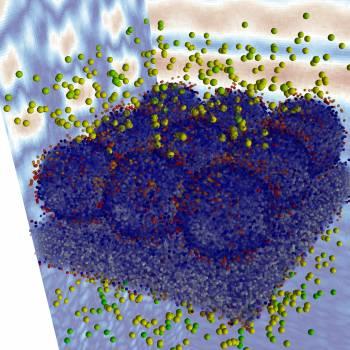
Keywords: Laser plasma interaction, laser driven particle acceleration, advanced targets, laser induced nuclear reactions
Important note: All contributions to this Research Topic must be within the scope of the section and journal to which they are submitted, as defined in their mission statements. Frontiers reserves the right to guide an out-of-scope manuscript to a more suitable section or journal at any stage of peer review.