LG
luis gago duport
University of Vigo
Vigo, Spain
1,338
Total downloads
12k
Total views and downloads
Submit your idea
Select the journal/section where you want your idea to be submitted:
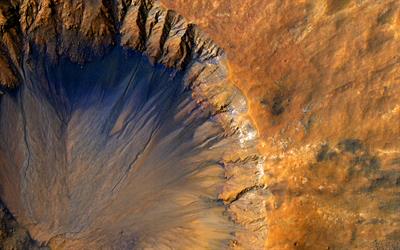
The study of secondary minerals in the solar system, particularly on Mars and other celestial bodies, is a burgeoning field that offers profound insights into planetary evolution, geological history, and potential habitability. Secondary minerals, formed through processes such as weathering and crystallization, are crucial indicators of past or present aqueous environments, as evidenced by clays, sulfates, and carbonates. These minerals not only map ancient water bodies but also provide critical data on a planet's climate history. Recent studies have leveraged data from orbital explorers and field rovers, alongside laboratory analogs and geochemical models, to elucidate crystallization mechanisms and draw parallels with Earth's processes. However, the unique environmental conditions and energy sources on other celestial bodies pose challenges to the direct application of Earth's mineral formation principles. Despite the universal applicability of chemical and thermodynamic principles, the specific processes of secondary mineral formation in the solar system remain underexplored, particularly in the context of extreme conditions and unique geological histories.
This research topic aims to deepen our understanding of secondary mineral formation across various celestial bodies, with a focus on comparing and contrasting these processes with those on Earth. By addressing the specific questions of how secondary minerals form under different planetary conditions and testing hypotheses related to their crystallization mechanisms, this research seeks to unravel the complexities of planetary evolution. The goal is to explore the potential pathways for mineral weathering and conversion, particularly in the presence or absence of aqueous phases, and to investigate the implications for organic chemistry and potential life.
To gather further insights into the formation and significance of secondary minerals in the solar system, we welcome articles addressing, but not limited to, the following themes:
- Spectral data from orbital probes and field data collected by rovers
- Terrestrial analogs for understanding extraterrestrial mineral processes
- Geochemical modeling, with a focus on kinetic approaches
- Laboratory experiments using specially developed devices
- Novel analyses of experimental data from Mars rovers, particularly Curiosity and Perseverance.
This Research Topic accepts the following article types, unless otherwise specified in the Research Topic description:
Articles that are accepted for publication by our external editors following rigorous peer review incur a publishing fee charged to Authors, institutions, or funders.
Keywords: urey reaction, mars weathering, clays, sulfides, oxides, clathrates, europa, titan, enceladus, carbonates on Mars, Actualism in geology
Important note: All contributions to this Research Topic must be within the scope of the section and journal to which they are submitted, as defined in their mission statements. Frontiers reserves the right to guide an out-of-scope manuscript to a more suitable section or journal at any stage of peer review.

Manuscripts can be submitted to this Research Topic via the main journal or any other participating journal.
Submit your idea
Select the journal/section where you want your idea to be submitted: