Abstract
This study examined the association between mental rotation ability and facial masculinity preference in gay and bisexual men in China. The participants (436 gay/bisexual men, 132 heterosexual men, and 254 heterosexual women) completed an online Shepard and Metzler-type mental rotation task and a forced-choice preference task of 10 pairs of masculinized/feminized male faces. The results revealed that mental rotation ability was significantly associated with preference for masculinized faces in both gay and bisexual men. There were no significant correlations between mental rotation ability and facial masculinity preference in both heterosexual men and women. The findings imply homogamy in partner preference in gay and bisexual men in terms of masculinity.
Introduction
Masculine male facial characteristics (e.g., a pronounced brow and large jaw) are positively related to the circulating testosterone levels (Roney et al., 2006) and they may be regarded as a cue to good health (Gangestad and Simpson, 2000; Rhodes et al., 2003; Thornhill and Gangestad, 2006). Various factors contribute to individual differences in male facial masculinity preference in women, including relationship status (Sacco et al., 2012), self-reported attractiveness (Little and Mannion, 2006), sexual desire (Jones et al., 2011), sociosexuality (Glassenberg et al., 2010; Stower et al., 2019), and menstrual cycle (Penton-Voak et al., 1999; Johnston et al., 2001).
In general, gay and bisexual men prefer masculinized faces over feminized faces (Glassenberg et al., 2010; Zheng et al., 2013; Zheng and Zheng, 2015). However, some studies found no overriding preference among homosexual males for either masculine or feminine facial features (Valentová et al., 2013; Welling et al., 2013). There are also extensive individual differences in facial masculinity preference in gay and bisexual men for some variables, including sex role identity (i.e., tops, versatiles, and bottoms; Zheng et al., 2013), relationship status (Zheng, 2019), sexism (Zheng and Zheng, 2015), and pathogen disgust (Zheng et al., 2016).
Previous empirical evidence indicates homogamy in partner preference in gay men. Gay men prefer potential partners who are similar to themselves in personality (Štěrbová et al., 2017), height (Valentova et al., 2014, 2016), and beardedness (Valentova et al., 2017). Gay men prefer masculine men, and preference for masculinity may be related to the participants’ own levels of masculinity (Bailey et al., 1997). Gay men with positive attitudes toward masculine gay men preferred masculine male faces, voices, bodies, and personality traits (Zheng and Zheng, 2016). Moreover, homogamy in masculinity-femininity is positively linked to relationship quality in gay male couples (Bártová et al., 2017). Overall, previous studies indicated that gay men’s self-perceived masculinity and masculinity norms were related to masculinity preference in partner choice.
It is possible that gay men’s masculinity in the cognitive domain would be related to facial masculinity preference, based on the theory of homogamy. Mental rotation ability has been found to be related to masculine traits, such as systemizing (Cook and Saucier, 2010; Zheng and Zheng, 2017). In general, men significantly outperform women on tests of mental rotation ability (e.g., Voyer et al., 1995; Peters et al., 2007). Therefore, mental rotation ability is a masculine cognitive capacity and may be related to facial masculinity preference in gay men.
Mental rotation ability has been found to be highly related to face processing (e.g., Lewis, 2001; Stevenage and Osborne, 2006). The majority of previous studies manipulated the degree of facial masculinization and feminization based on the same original face (Rowland and Perrett, 1995; Penton-Voak et al., 1999). There were only minor differences between masculinized and feminized faces. Face processing-related ability might be helpful for individuals to determine their preferred facial features; if one could not detect the tiny differences between masculinized and feminized faces, on the other hand, this process would be difficult. If mental rotation ability is related to male facial masculinity preference via face processing ability, this effect would be true for both gay men and heterosexual women. Thus, I also assessed the relationship between mental rotation and preference for male facial masculinity in heterosexual women to test this hypothesis.
In addition, previous studies indicated that intrasexually competitive individuals similarly indicate heightened preferences toward good gene cues in same-sex faces (e.g., Sacco et al., 2009; Brown and Sacco, 2017). Gay men could view masculine men as competition as much as prospective mates. Therefore, it is possible that gay men with high mental rotation ability would prefer masculine faces due to the potential competition posed by masculine faces. To test this hypothesis, I also assessed the relationship between mental rotation and preference for male facial masculinity in heterosexual men. If competition contributes to facial masculinity preference, both gay and heterosexual men would show a similar pattern.
Overall, this study examined the association between mental rotation ability and facial masculinity preference in gay/bisexual men and heterosexuals in China. I hypothesized that gay and bisexual men with high mental rotation ability would prefer more masculine faces, based on the theory of homogamy. I also examined this association in heterosexual women to test the potential explanation of face processing ability. In addition, this association was also examined in heterosexual men to test whether this association was based on intrasexual competition rather than homogamy.
Methods
Participants
The required sample size was 138 participants, as indicated by GPower3.1, targeting power of 0.95 in a tow-tailed correlation. The participants in this study were 327 self-identified gay men and 109 self-identified bisexual men aged between 16 and 50 years (M = 23.4, SD = 5.6). The control sample included 132 heterosexual men and 245 heterosexual women aged between 17 and 49 years (M = 27.1, SD = 5.9). Of these, 35 (4.3%) had a junior high school education or lower, 136 (16.7%) had a senior high school education, 576 (70.8%) had a college education, and 66 (8.1%) had a postgraduate education or higher. In terms of employment, 513 participants (63.1%) were employed full-time and 300 (36.9%) were students.
Procedure
The study was conducted online via a Chinese survey website1. The written informed consent was inferred by completion of the online study. Gay and bisexual participants were recruited via several Chinese websites that cater to gay people (including forums and QQ groups: a popular chat software in China) in February 2019. Heterosexual participants were recruited via Weidiaocha, a professional survey platform, in August 2019. They first responded to questions about their demographic information, including sex (male or female), age, sexual orientation (homosexual, bisexual, or heterosexual), occupation, and education. Then, they completed the facial masculinity preference measures. Finally, the participants performed a mental rotation task. The three sections were presented on three webpages. The participants could not enter the next section until they had finished all of the items in the previous section. If they missed any item, the system would remind them and locate the missing items.
Measures
Facial Masculinity Preference
Ten pairs of male faces that were created in a previous study (Zheng et al., 2013) were used to measure the facial masculinity preference. Twenty young adult Chinese male faces and 20 young adult Chinese female faces were used to create a male prototype face and a female prototype face, respectively. The 10 Chinese male face images were transformed by +50% of the differences in shape between the male and female prototypes to create masculinized versions and by −50% of the differences in shape to create feminized versions. Each pair of faces consisted of one version of a masculinized face and one version of a feminized face morphed from the same male face. The example stimuli are shown in Figure 1. Participants were asked to select which face was more attractive in each pair of faces. The proportion of masculinized faces chosen was calculated as the dependent variable.
Figure 1
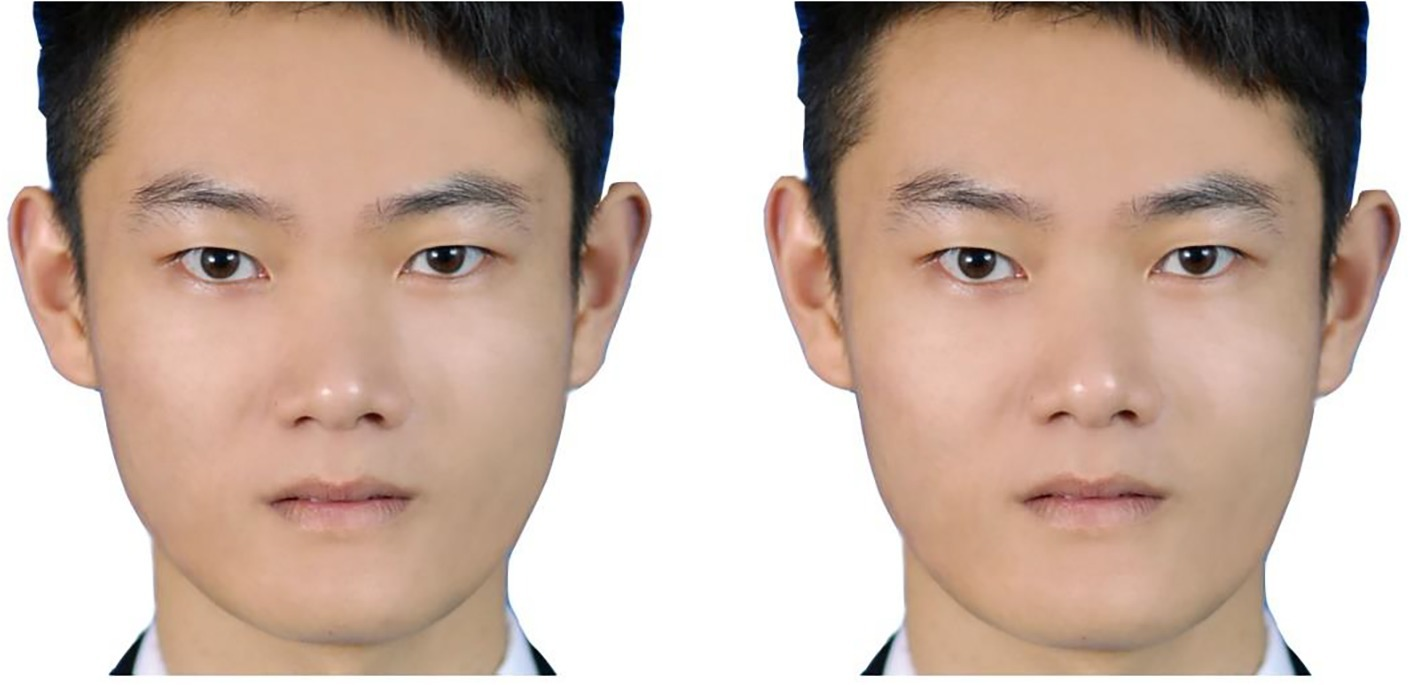
Examples of feminized (left) and masculinized (right) versions of a male face image used in this study. The written informed consent was obtained from the individual for the publication of this image.
Mental Rotation Ability
A short six-item three-dimensional mental rotation test, which was designed in a previous study (Zheng and Zheng, 2017), was used to measure the participants’ mental rotation ability. Items were selected from a mental rotation stimulus library (Peters and Battista, 2008). All diagrams were shown in white on a black background. Participants viewed the target diagram displayed on the top row and were asked to select the two matching comparison figures from four diagrams displayed on the bottom row. Following the procedure of previous studies (Zheng and Zheng, 2017), participants were asked to complete the task within 240 s, which included 30 s to complete each item, 30 s to read the introduction, and 30 s for the webpage to load. Participants could use the time freely and a countdown timer showed the amount of time that remained. The performance score was calculated by awarding a single point for each correct answer. Thus, the total score ranged from 0 to 12.
Results
I conducted analyses of variance to examine group differences (heterosexual men, heterosexual women, gay men, and bisexual men) in the mental rotation ability and facial masculinity preference. There were significant differences in the mental rotation ability among groups, F(3, 809) = 17.9, p < 0.001, partial η2 = 0.062. Bonferroni post hoc test revealed that heterosexual women (M = 7.94, SD = 2.14) scored lower on mental rotation task than heterosexual men (M = 8.80, SD = 2.23, d = 0.4, p < 0.001); bisexual men (M = 9.22, SD = 1.73, d = 0.63, p < 0.001); and gay men (M = 9.09, SD = 1.94, d = 0.57, p < 0.001). There were no significant differences among other groups. There were also significant differences in facial masculinity preference among groups, F(3, 809) = 7.72, p < 0.001, partial η2 = 0.028. Bonferroni post hoc test revealed that gay men (M = 0.518, SD = 0.238) and bisexual men (M = 0.507, SD = 0.211) preferred more masculinized faces than heterosexual women (M = 0.427, SD = 0.222, d = 0.39/0.37, p < 0.001, d = 0.37, p = 0.017).
The association between the mental rotation ability and facial masculinity preference was significant for both the gay (r = 0.11, p = 0.045) and bisexual men (r = 0.22, p = 0.026) controlling for age, education, and occupation. There were no significant correlations between the mental rotation ability and facial masculinity preference in both heterosexual men (r = −0.054, p = 0.542) and women (r = 0.061, p = 0.342).
Discussion
This study examined the association between the mental rotation ability and facial masculinity preference of gay and bisexual men. The results revealed that there was a significant association between mental rotation ability and facial masculinity preference in both gay and bisexual men, but not in heterosexual men or women.
There were significant gender differences in mental rotation ability, which is consistent with previous findings in western cultures (e.g., Voyer et al., 1995; Peters et al., 2007). However, there was no significant difference in mental rotation ability between heterosexual and homosexual men. Previous research has shown mixed findings with regard to sexual orientation differences in mental rotation ability. Some studies have found that heterosexual men outperform homosexual men in mental rotation ability (e.g., Rahman and Wilson, 2003; Maylor et al., 2007). Other research has shown no significant differences in mental rotation ability between heterosexual and homosexual men (e.g., Gladue et al., 1990). As for the facial masculinity preference, heterosexual women typically preferred more feminized male faces than did homosexual men. One recent study also indicated that women prefer feminized male faces in China (Liu and Wu, 2016).
The current findings indicated the association between mental rotation ability and facial masculinity preference. This association may be attributed to homogamy in partner preference in terms of masculinity in gay and bisexual men. Previous studies indicated that masculine gay and bisexual men tend to prefer masculine partners (Bailey et al., 1997; Zheng et al., 2013; Zheng and Zheng, 2015). Mental rotation ability is a masculine cognitive ability. Therefore, gay and bisexual men with high mental rotation ability would self-perceive more masculinity and prefer more masculine male faces. The current findings extend previous findings and indicate an association between masculine cognitive ability and facial masculinity preference, which was consistent with previous findings in heterosexual men that masculine cognitive style (i.e., systemizing) was related to facial masculinity preference (Smith et al., 2010). However, mental rotation was not associated with facial masculinity preference in heterosexual women. One previous study revealed no homogamy in facial masculinity-femininity in heterosexual couples (Burriss et al., 2011), which highlighted the homogamy theory in partner preference among gay and bisexual men.
If face processing ability could explain the association between mental rotation ability and facial masculinity preference, these associations should occur in both gay/bisexual men and heterosexual women. There was no significant association between mental rotation ability and facial masculinity preference in heterosexual women, which was consistent with a previous finding (Scarbrough and Johnston, 2005). This indicated that the association between mental rotation ability and facial masculinity preference could not be explained by face processing ability.
If gay and bisexual men’s preference for facial masculinity was based on intrasexual competition, mental rotation ability would be associated with facial masculinity preference in both gay/bisexual men and heterosexual men. There was no significant association between mental rotation ability and facial masculinity preference in heterosexual men, which was consistent with a previous finding (Vonnahme, unpublished). This indicated that preference for facial masculinity in gay and bisexual men was not based on intrasexual competition.
Mental rotation task performance is correlated with prenatal testosterone levels (Grimshaw et al., 1995), and relates to the ratio of the lengths of the second and fourth digits of the hand (a marker of prenatal exposure to androgens), which may reflect fetal exposure to prenatal sex hormones in early gestation (Burton et al., 2005; Collaer et al., 2007; Peters et al., 2007). Previous studies revealed the potential influences of prenatal androgen exposure on preference for exaggerated sex-typical characteristics in heterosexual men and women (Vonnahme, unpublished; Scarbrough and Johnston, 2005; Kuna and Galbarczyk, 2018). However, some recent studies did not find an association between hormone levels and facial masculinity preference (e.g., Jones et al., 2018a,b). The current findings may indicate the potential effects of prenatal androgen exposure on facial masculinity preference in gay and bisexual men.
There were several limitations in this study. First, the mental rotation task was conducted on a website rather than in a controlled laboratory environment. The devices that the participants used to complete the task may have influenced their performance because the display of the stimuli would be slightly different on a smartphone screen and desktop monitor. Second, as the current sample was young, the conclusion of this study is restricted to young gay and bisexual men in China. Third, the association between mental rotation ability and facial masculinity in gay and bisexual men was weak. The association between masculine cognitive ability and facial masculinity preference in gay and bisexual men should be tested with other abilities. Finally, the gay/bisexual participants and heterosexual participants were not recruited at the same time. This could have led to history effects.
Statements
Data availability statement
All datasets generated for this study are included in the article/supplementary material.
Ethics statement
The studies involving human participants were reviewed and approved by the Academic Ethical Review Committee of Faculty of Psychology in Southwest University. Written informed consent from the participants was not required to participate in this study in accordance with the national legislation and the institutional requirements.
Author contributions
The author confirms being the sole contributor of this work and has approved it for publication.
Conflict of interest
The author declares that the research was conducted in the absence of any commercial or financial relationships that could be construed as a potential conflict of interest.
Footnotes
References
1
BaileyJ. M.KimP. Y.HillsA.LinsenmeierJ. A. W. (1997). Butch, femme, or straight acting? Partner preferences of gay men and lesbians. J. Pers. Soc. Psychol.73, 960–973. doi: 10.1037/0022-3514.73.5.960
2
BártováK.ŠtěrbováZ.NovákováL. M.BinterJ.Corrêa VarellaM. A.ValentovaJ. V. (2017). Homogamy in masculinity–femininity is positively linked to relationship quality in gay male couples from the Czech Republic. Arch. Sex. Behav.46, 1349–1359. doi: 10.1007/s10508-016-0931-z
3
BrownM.SaccoD. F. (2017). Unrestricted sociosexuality predicts preferences for extraverted male faces. Personal. Individ. Differ.108, 123–127. doi: 10.1016/j.paid.2016.12.023
4
BurrissR. P.RobertsS. C.WellingL. L.PutsD. A.LittleA. C. (2011). Heterosexual romantic couples mate assortatively for facial symmetry, but not masculinity. Personal. Soc. Psychol. Bull.37, 601–613. doi: 10.1177/0146167211399584
5
BurtonL.HenningerD.HafetzJ. (2005). Gender differences in relationships of mental rotation, verbal fluency, and SAT scores to finger length ratios as hormonal indices. Dev. Neuropsychol.28, 493–505. doi: 10.1207/s15326942dn2801_3
6
CollaerM. L.ReimersS.ManningJ. T. (2007). Visuospatial performance on an internet line judgment task and potential hormonal markers: sex, sexual orientation, and 2D:4D. Arch. Sex. Behav.36, 177–192. doi: 10.1007/s10508-006-9152-1
7
CookC. M.SaucierD. M. (2010). Mental rotation, targeting ability and baron-cohen’s empathizing–systemizing theory of sex differences. Pers. Individ. Differ.49, 712–716. doi: 10.1016/j.paid.2010.06.010
8
GangestadS. W.SimpsonJ. A. (2000). The evolution of human mating: trade-offs and strategic pluralism. Behav. Brain Sci.23, 573–644. doi: 10.1017/S0140525X0000337X
9
GladueB. A.BeattyW. W.LarsonJ.StatonR. D. (1990). Sexual orientation and spatial ability in men and women. Psychobiology18, 101–108.
10
GlassenbergA. N.FeinbergD. R.JonesB. C.LittleA. C.DeBruineL. M. (2010). Sex-dimorphic face shap preference in heterosexual and homosexual men and women. Arch. Sex. Behav.39, 1289–1296. doi: 10.1007/s10508-009-9559-6
11
GrimshawG. M.SitareniosG.FineganJ. K. (1995). Mental rotation at 7 years: relations with prenatal testosterone levels and spatial play experiences. Brain Cogn.29, 85–100. doi: 10.1006/brcg.1995.1269
12
JohnstonV. S.HagelR.FranklinM.FinkB.GrammerK. (2001). Male facial attractiveness: evidence for a hormone-mediated adaptive design. Evol. Hum. Behav.22, 251–267. doi: 10.1016/S1090-5138(01)00066-6
13
JonesB. C.HahnA. C.FisherC. I.WangH.KandrikM.HanC.et al. (2018a). No compelling evidence that preferences for facial masculinity track changes in women’s hormonal status. Psychol. Sci.29, 996–1005. doi: 10.1177/0956797618760197
14
JonesB. C.HahnA. C.FisherC. I.WangH.KandrikM.LaoJ.et al. (2018b). No compelling evidence that more physically attractive young adult women have higher estradiol or progesterone. Psychoneuroendocrinology98, 1–5. doi: 10.1016/j.psyneuen.2018.07.026
15
JonesB. C.LittleA. C.WatkinsC. D.WellingL. L. M.DeBruineL. M. (2011). Reported sexual desire predicts men’s preferences for sexually dimorphic cues in women’s faces. Arch. Sex. Behav.40, 1281–1285. doi: 10.1007/s10508-010-9721-1
16
KunaB.GalbarczykA. (2018). Men with more masculine digit ratios are partnered with more attractive women. Personal. Individ. Differ.124, 8–11. doi: 10.1016/j.paid.2017.11.040
17
LewisM. B. (2001). The Lady’s not for turning: rotation of the Thatcher illusion. Perception30, 769–774. doi: 10.1068/p3174
18
LittleA. C.MannionH. (2006). Viewing attractive or unattractive same-sex individuals changes self-rated attractiveness and face preferences in women. Anim. Behav.72, 981–987. doi: 10.1016/j.anbehav.2006.01.026
19
LiuJ.WuZ. (2016). Preferences for sexual dimorphic faces among university students (in Chinese). Guide Sci. Educ.1, 166–167. doi: 10.16400/j.cnki.kjdkz.2016.01.076
20
MaylorE. A.ReimersS.ChoiJ.CollaerM. L.PetersM.SilvermanI. (2007). Gender and sexual orientation differences in cognition across adulthood: age is kinder to women than to men regardless of sexual orientation. Arch. Sex. Behav.36, 235–249. doi: 10.1007/s10508-006-9155-y
21
Penton-VoakI. S.PerrettD. I.CastlesD. L.KobayashiT.BurtD. M.MurrayL. K.et al. (1999). Menstrual cycle alters face preference. Nature399, 741–742. doi: 10.1038/21557
22
PetersM.BattistaC. (2008). Applications of mental rotation figures of the Shepard and Metzler type and description of a mental rotation stimulus library. Brain Cogn.66, 260–264. doi: 10.1016/j.bandc.2007.09.003
23
PetersM.ManningJ. T.ReimersS. (2007). The effects of sex, sexual orientation, and digit ratio (2D,4D) on mental rotation performance. Arch. Sex. Behav.36, 251–260. doi: 10.1007/s10508-006-9166-8
24
RahmanQ.WilsonG. D. (2003). Large sexual-orientation-related differences in performance on mental rotation and judgement of line orientation tasks. Neuropsychology17, 25–31. doi: 10.1037/0894-4105.17.1.25
25
RhodesG.ChanJ.ZebrowitzL. A.SimmonsL. W. (2003). Does sexual dimorphism in human faces signal health?Proc. R. Soc. Lond. B270, S93–S95. doi: 10.1098/rsbl.2003.0023
26
RoneyJ. R.HansonK. N.DuranteK. M.MaestripieriD. (2006). Reading men’s faces: women’s mate attractiveness judgments track men’s testosterone and interest in infants. Proc. R. Soc. Lond. B273, 2169–2175. doi: 10.1098/rspb.2006.3569
27
RowlandD. A.PerrettD. I. (1995). Manipulating facial appearance through shape and color. IEEE Comput. Graph. Appl.15, 70–76. doi: 10.1109/38.403830
28
SaccoD. F.HugenbergK.SefcekJ. A. (2009). Sociosexuality and face perception: unrestricted sexual orientation facilitates sensitivity to female facial cues. Personal. Individ. Differ.47, 777–782. doi: 10.1016/j.paid.2009.06.021
29
SaccoD. F.JonesB. C.DeBruineL. M.HugenbergK. (2012). The roles of sociosexual orientation and relationship status in women’s face preferences. Personal. Individ. Differ.53, 1044–1047. doi: 10.1016/j.paid.2012.07.023
30
ScarbroughP. S.JohnstonV. S. (2005). Individual differences in women’s facial preferences as a function of digit ratio and mental rotation ability. Evol. Hum. Behav.26, 509–526. doi: 10.1016/j.evolhumbehav.2005.03.002
31
SmithF. G.JonesB. C.DebruineL. M. (2010). Individual differences in empathizing and systemizing predict variation in face preferences. Pers. Individ. Differ.49, 655–658. doi: 10.1016/j.paid.2010.05.023
32
ŠtěrbováZ.BártováK.NovákováL. M.VarellaM. A. C.HavlíčekJ.ValentovaJ. V. (2017). Assortative mating in personality among heterosexual and male homosexual couples from Brazil and the Czech Republic. Personal. Individ. Differ.112, 90–96. doi: 10.1016/j.paid.2017.02.036
33
StevenageS. V.OsborneC. D. (2006). Making heads turn: the effect of familiarity and stimulus rotation on a gender-classification task. Perception35, 1485–1494. doi: 10.1068/p5409
34
StowerR. E.LeeA. J.McIntoshT. L.SidariM. J.SherlockJ. M.DixsonB. J. W. (2019). Mating strategies and the masculinity paradox: how relationship context, relationship status, and sociosexuality shape women’s preferences for facial masculinity and beardedness. Arch. Sex. Behav. doi: 10.1007/s10508-019-1437-2
35
ThornhillR.GangestadS. W. (2006). Facial sexual dimorphism, developmental stability, and susceptibility to disease in men and women. Evol. Hum. Behav.27, 131–144. doi: 10.1016/j.evolhumbehav.2005.06.001
36
ValentovaJ. V.BártováK.ŠtěrbováZ.VarellaM. A. C. (2016). Preferred and actual relative height are related to sex, sexual orientation, and dominance: evidence from Brazil and the Czech Republic. Personal. Individ. Differ.100, 145–150. doi: 10.1016/j.paid.2016.01.049
37
ValentováJ. V.RobertsS. C.HavlíčekJ. (2013). Preferences for facial and vocal masculinity in homosexual men: the role of relationship status, sexual restrictiveness, and self-perceived masculinity. Perception42, 187–197. doi: 10.1068/p6909
38
ValentovaJ. V.StulpG.TřebickýV.HavlíčekJ. (2014). Preferred and actual relative height among homosexual ale partners vary with preferred dominance and sex role. PLoS One9:e86534. doi: 10.1371/journal.pone.0086534
39
ValentovaJ. V.VarellaM. A. C.BártováK.ŠtěrbováZ.DixsonB. J. W. (2017). Mate preferences and choices for facial and body hair in heterosexual women and homosexual men: influence of sex, population, homogamy, and imprinting-like effect. Evol. Hum. Behav.38, 241–248. doi: 10.1016/j.evolhumbehav.2016.10.007
40
VoyerD.VoyerS.BrydenM. P. (1995). Magnitude of sex differences in spatial abilities: a meta-analysis and consideration of critical variables. Psychol. Bull.117, 250–270. doi: 10.1037/0033-2909.117.2.250
41
WellingL. L. M.SinghK.PutsD. A.JonesB. C.BurrissR. P. (2013). Self-reported sexual desire in homosexual men and women predicts preferences for sexually dimorphic facial cues. Arch. Sex. Behav.42, 785–791. doi: 10.1007/s10508-012-0059-8
42
ZhengL. (2019). Facial masculinity preferences according to relationship status and sociosexual orientation in gay and bisexual men in China. Personal. Individ. Differ.138, 243–246. doi: 10.1016/j.paid.2018.10.012
43
ZhengL.HartT. A.ZhengY. (2013). Attraction to male facial masculinity in gay men in China: relationship to intercourse preference positions and sociosexual behavior. Arch. Sex. Behav.42, 1223–1232. doi: 10.1007/s10508-012-0057-x
44
ZhengL.ZhangJ.ZhengY. (2016). Relationships between pathogen disgust sensitivity and preference for male facial masculinity in gay men in China. Personal. Individ. Differ.92, 33–36. doi: 10.1016/j.paid.2015.12.021
45
ZhengL.ZhengY. (2015). Young gay men’s sexism predict their male facial masculinity preference in China. Personal. Individ. Differ.76, 183–186. doi: 10.1016/j.paid.2014.12.022
46
ZhengL.ZhengY. (2016). Preferences for masculinity across faces, bodies, and personality traits in homosexual and bisexual chinese men: relationship to sexual self-labels and attitudes toward masculinity. Arch. Sex. Behav.45, 725–733. doi: 10.1007/s10508-015-0543-z
47
ZhengL.ZhengY. (2017). Associations between empathizing-systemizing cognitive style and mental rotation task performance among homosexual men and women in China. Personal. Individ. Differ.106, 10–14. doi: 10.1016/j.paid.2016.10.025
Summary
Keywords
facial masculinity preference, mental rotation, homogamy, gay and bisexual men, partner choice
Citation
Zheng L (2019) Preference for Male Facial Masculinity as a Function of Mental Rotation Ability in Gay and Bisexual Men, but Not in Heterosexual Men and Women in China. Front. Psychol. 10:2419. doi: 10.3389/fpsyg.2019.02419
Received
18 July 2019
Accepted
11 October 2019
Published
25 October 2019
Volume
10 - 2019
Edited by
Nicholas Furl, Royal Holloway, University of London, United Kingdom
Reviewed by
Jaroslava Varella Valentova, University of São Paulo, Brazil; Liudmila Liutsko, Instituto Salud Global Barcelona (ISGlobal), Spain
Updates
Copyright
© 2019 Zheng.
This is an open-access article distributed under the terms of the Creative Commons Attribution License (CC BY). The use, distribution or reproduction in other forums is permitted, provided the original author(s) and the copyright owner(s) are credited and that the original publication in this journal is cited, in accordance with accepted academic practice. No use, distribution or reproduction is permitted which does not comply with these terms.
*Correspondence: Lijun Zheng, 274875998@qq.com
This article was submitted to Personality and Social Psychology, a section of the journal Frontiers in Psychology
Disclaimer
All claims expressed in this article are solely those of the authors and do not necessarily represent those of their affiliated organizations, or those of the publisher, the editors and the reviewers. Any product that may be evaluated in this article or claim that may be made by its manufacturer is not guaranteed or endorsed by the publisher.