Abstract
Previous studies have shown that peer relationship affects learning engagement. And learning engagement plays a vital role in promoting knowledge acquisition and production, enhancing adolescents’ academic success. However, few studies have focused on the mechanism between peer relationship and learning engagement. As such, based on Social Cognitive Theory, this study attempts to explore how peer relationship of adolescents is linked to learning engagement through the chain mediating roles of self-efficacy and academic resilience. The participants were 250 students who were selected via random sampling in a public middle school, in Eastern China, in June 2021. All the participants filled in the structured self-report questionnaires on peer relationship, self-efficacy, academic resilience, and learning engagement. The data were analyzed with structural equation modeling (SEM) in SPSS 24.0 and AMOS 24.0. Results indicated that peer relationship was directly and positively associated with learning engagement. Results also indicated that peer relationship was indirectly and positively associated with learning engagement via self-efficacy and academic resilience, respectively, and sequentially. More importantly, it was found that the direct effect was much lower than the indirect effects of which self-efficacy was the greatest. It is suggested that appropriate interventions and support should be provided to facilitate adolescents’ peer relationship, self-efficacy, and academic resilience, thus promoting their learning engagement and academic success.
Introduction
Peer relationship refers to a kind of interpersonal relationship developed in the process of interaction in small clusters of individuals that are closely connected with each other based on shared interests and friendships (Rohrbeck and Garvin, 2014). Peer relationship is categorized into dimensions such as warmth, support, attachment, friendship quality, and communication quality (Boele et al., 2019; Terlektsi et al., 2020). As a critical social relationship, peer relationship is crucial to the physical and mental development of adolescents. It not only reduces adolescents’ social anxiety, shapes their moral cognition and behaviors, but also enhances their engagement, which contributes to their academic successes (Fredricks, 2011; Tillfors et al., 2012; Zulfiqar, 2020; Chiu et al., 2021). Student engagement, as a key element in learning, can be defined from three perspectives, namely, behavioral, emotional, and cognitive engagement (Fredricks et al., 2004; Reeve and Tseng, 2011; Yazzie-Mintz and McCormick, 2012). Behavioral engagement refers to students’ participation and involvement in academic activities that reflect on-task attention, effort, and persistence (Fredricks et al., 2004). Emotional engagement refers to student’s positive feeling, attitude, and perception toward learning activities (Park and Yun, 2017; Tvedt et al., 2019). Cognitive engagement refers to students’ active involvement in learning with positive psychological status (Nguyen et al., 2016; Yang Y. et al., 2021). Among them, behavioral engagement reflects the substantive connotation of student engagement (Newmann, 1992) and it is relatively easier to measure due to their observable characteristics (Nguyen et al., 2016). Based on the above literature, learning engagement can be defined as students’ positive psychological state of mind concerning learning behaviors, with three dimensions—vigor, dedication, and absorption (Schaufeli et al., 2002a; Christenson et al., 2012). Vigor is defined as how individuals are ready to work hard and persevere in their studies, even in facing difficulties. Dedication refers to individuals’ strong senses of responsibility and achievement toward learning, while absorption refers to individuals’ concentration on learning for long periods of time and obtaining positive psychological experiences during the process of learning (Li et al., 2019).
Research has shown that peer relationship is correlated with learning engagement, in which self-efficacy is a potential predictor (Sökmen, 2019). Self-efficacy is understood as “an individual belief in one’s capabilities to organize and execute the courses of action required in producing given attainments” (Bandura, 1997a, p3). It is also defined as “the perception of one’s ability to successfully perform a particular behavior” (Block et al., 2010, p44). Research has noted that academic resilience is also a potential predictor of learning engagement (Romano et al., 2021). Academic resilience is considered as the personal ability to overcome acute or chronic adversity in learning (Martin, 2013) or effectively deal with setbacks, challenges, adversity, and pressure in the academic setting (Martin and Marsh, 2006) with three-dimensional elements, namely, perseverance, adaptability, and emotional response (Cassidy, 2016). However, few studies have tested how peer relationship of adolescents is linked to learning engagement through the mediating roles of self-efficacy and academic resilience based on relative theory.
Social Cognitive Theory (SCT) (Bandura, 1997b) is based on a psycho-social model, which explains socio-cognitive constructs of behaviors (Komendantova et al., 2018). It has been viewed as an important theoretical framework to explain human behaviors (Yazdanpanah et al., 2015; Hou et al., 2021). SCT proposes that environment and personal factors influence human behaviors (Bandura, 1986). That is to say, human behaviors are motivated and regulated by a combination of environmental, personal, and behavioral factors (Bandura, 2012). Environmental factors are social support and barriers to individuals’ behaviors. Personal factors include knowledge, self-efficacy, and outcome expectations associated with behavioral adoption (Komendantova et al., 2018). Of the personal factors, self-efficacy is a major element and plays a central role in changing behaviors (Bandura, 1997b). Behavioral factors consist of endeavor or planning to execute a behavior (Shahangian et al., 2021). Several researchers have applied SCT to explore classroom cognitive engagement or online learning engagement among college students (Sahil and Hashim, 2011; El-Sayad et al., 2021; Kuo et al., 2021). However, little has been done to explore the interrelated associations of the influencing factors in adolescents’ learning engagement with SCT. Therefore, the study attempts to apply SCT, (1) to explore the mechanism in which peer relationship predicts learning engagement among adolescents via self-efficacy and academic resilience, and (2) to provide evidence for how peer relationship influences adolescents’ learning engagement.
The study includes the following contributions. First, the study examines the association between peer relationship and learning engagement based on Social Cognitive Theory in the Chinese context, which provides evidence for the research on similar themes in other countries. Second, the study explores the mechanism between peer relationship and learning engagement by emphasizing the chain mediating roles of self-efficacy and academic resilience. The new perspective may explain that adolescents’ learning engagement is mainly affected by self-efficacy and academic resilience (personal factors) that stem from sound peer relationship (environmental factor).
Peer relationship and learning engagement
Relevant studies have showed that peer relationship can exert a direct influence on learning engagement (Juvonen et al., 2012; Gremmen et al., 2018). Fredricks et al. (2019) have suggested that support from peers aligns with greater learning engagement. Similarly, Kiefer et al. (2015) have pointed out that support from peers can exert a profound influence on students’ learning engagement. When students can get support from their peers, they are more likely to feel confident in learning; on the contrary, when students have less support from their peers, they are more likely to feel afraid to accomplish tasks, which lessens their learning engagement (Juvonen et al., 2012; Geven et al., 2013; Shin and Chang, 2022). In addition, Furrer et al. (2014) have reported that the quality of students’ relationships with peers is a fundamental substrate for the development of learning engagement. It is reported that high-quality friendship is protective against being conflicted, rejected, and bullied, which promotes engagement in learning (Terlektsi et al., 2020). Hence, it could be argued that adolescents with sound peer relationship are likely to engage in learning. Based on this view, the following hypothesis is proposed.
-
H1: Peer relationship is positively associated with learning engagement.
Self-efficacy as a mediator
In social cognitive theory, Bandura (1997b) has emphasized the construction of self-efficacy and its impact on learning. Students with stronger self-efficacy tend to set higher goals and undertake more challenging tasks. And they are more likely to put forth the effort and be persistent in learning. Even when it comes to academic challenges or difficulties, they still stick to it instead of giving it up (Masud et al., 2016).
Several studies have acknowledged that self-efficacy is often influenced by peer interaction (Ruegg, 2014; Sökmen, 2019; Shyr et al., 2021). Support from peer interaction is important in establishing a positive attitude and increasing self-confidence and the ability to make judgments in learning (Chu and Chu, 2010), while imitation from peer interaction contributes to the development of adolescents’ cognition, emotion, and behaviors. It is reported that adolescents accept the influence of role models in peer imitation to promote the development of their self-efficacy (Lee et al., 2021). In addition, peer collaboration exerts an influence on self-efficacy (Lee and Evans, 2019). It is believed that peer relationship is positively associated with adolescents’ self-efficacy.
Self-efficacy is also believed to be one of the key factors influencing students’ learning engagement (Wu et al., 2020; Shao and Kang, 2022). Students with higher self-efficacy have higher engagement in learning. Some researchers have suggested that self-efficacy can help develop positive beliefs about personal skills and abilities, thus enabling students to be more involved in their learning (Zhen et al., 2017; Ahmed et al., 2018). Other researchers have argued that self-efficacy affects students’ classroom participation, thereby affecting students’ learning engagement (Sökmen, 2019). Similarly, Liem et al. (2008) have also pointed out that peer relationship plays an important role in adolescents’ self-efficacy, which affects their learning engagement. The above views indicate that peer relationship may affect adolescents’ learning engagement via the indirect role of self-efficacy. Based on these, the following hypotheses are proposed:
-
H2: Peer relationship is positively associated with self-efficacy.
-
H3: Self-efficacy is positively associated with learning engagement.
-
H4: Self-efficacy plays a mediating role in the association between peer relationship and learning engagement.
Academic resilience as a mediator
Academic resilience is influenced by peer relationship (Baltaci and Karataş, 2015). Permatasari et al. (2021) have proposed that peer support could contribute to academic resilience in the learning process. Chen et al. (2017) have emphasized that peer support was a consistent predictor of academic resilience. Hoshek et al. (2016) have argued that more contact with peers can ease students’ negative perceptions in dealing with academic challenges. Frisby et al. (2020) have also argued that the relational resources that students have at school, especially with peers, may inspire students’ academic resilience. Hence, these shreds of evidence support the belief that peer relationship may enhance adolescents’ academic resilience.
Academic resilience influences adolescents’ learning engagement (Cheung et al., 2014). Students with academic resilience tend to express higher levels of achievement despite risks and difficulties (Simões et al., 2021). Romano et al. (2021) have argued that students with a higher level of academic resilience show a higher level of learning engagement. Gillham et al. (2013) have demonstrated that students who feel more connected with peers have higher academic resilience, which plays a crucial role in learning engagement. Therefore, this study speculates that there is a positive relationship between adolescents’ academic resilience and their learning engagement, and academic resilience may play an intermediary role between peer relationship and learning engagement.
Academic resilience is believed to influence by self-efficacy (Cassidy, 2016). In another word, self-efficacy is a significant predictor of academic resilience (Martin and Marsh, 2008; Murray, 2018; Rachmawati et al., 2020; Hydar Choupani and Dehsorkhi, 2021; Kuo et al., 2021), which provides a fundamental basis for the serial variables of self-efficacy and academic resilience. According to SCT, the environment filled with peers is conducive to enhancing their self-efficacy (Zysberg and Schwabsky, 2020). With enhanced self-efficacy, students are more able to encounter difficulties, engage themselves in challenging learning tasks, and develop their academic resilience (Skinner and Pitzer, 2012; Cassidy, 2015). And the personal factors—self-efficacy and academic resilience affect their behavior—learning engagement (Wang and Holcombe, 2010; Honicke and Broadbent, 2016; Vîrgã et al., 2020). Therefore, it is believed that peer relationship may influence learning engagement via the serial variables of self-efficacy and academic resilience.
Based on the above analysis, this study intends to examine whether peer relationship may positively contribute to learning engagement via the mediating roles of sequential self-efficacy and academic resilience. In view of this, the following hypotheses are proposed:
-
H5: Peer relationship is positively associated with academic resilience.
-
H6: Self-efficacy is positively associated with academic resilience.
-
H7: Academic resilience is positively associated with learning engagement.
-
H8: Academic resilience plays a mediating role in the association between peer relationship and learning engagement.
-
H9: Self-efficacy and academic resilience play a chain mediating role in the association between peer relationship and learning engagement.
Guided by Social Cognitive Theory and the above hypotheses, we have constructed a theoretical model to test the association between peer relationship and learning engagement, as well as the mediating roles of self-efficacy and academic resilience (see Figure 1).
FIGURE 1
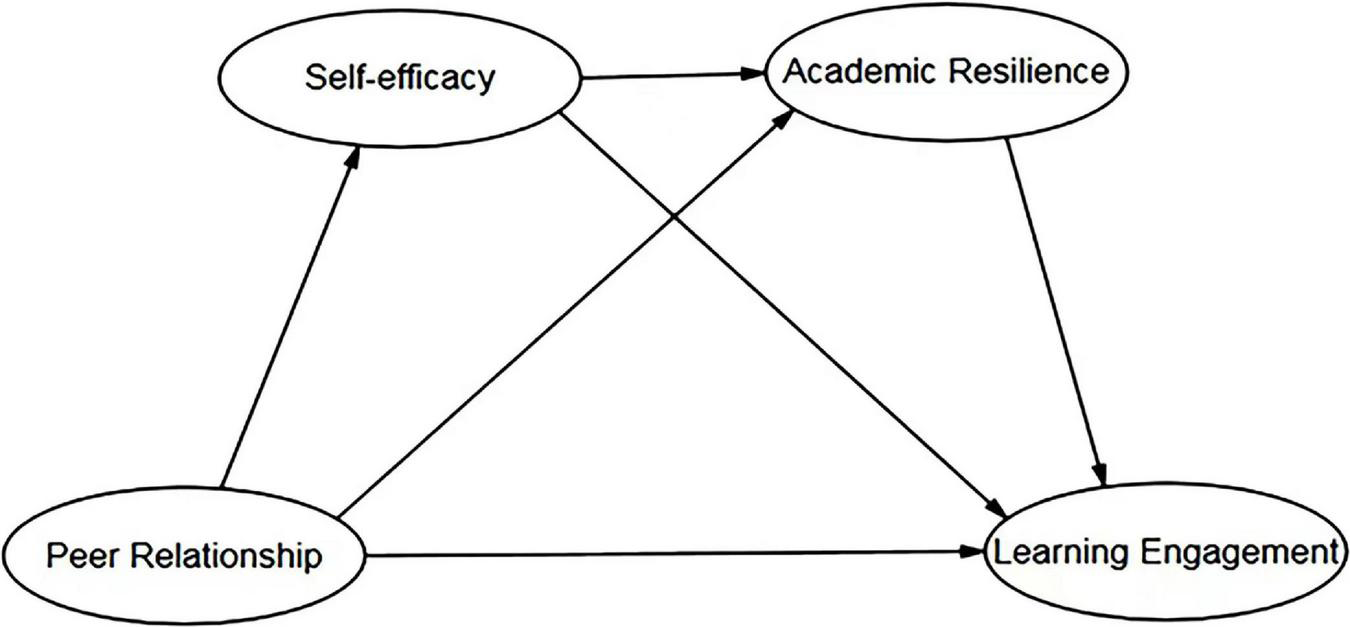
The Proposed theoretical model.
Materials and methods
Sampling and procedure
The sample size was estimated according to the requirement of Structural Equation Modeling (SEM) (Zhang et al., 2020) that the appropriate sample size was targeted at least ten times the total observed variables. The samples for the study were drawn from participants who were 13–14 years old from a public middle school, in Eastern China, in June 2021. One of the main reasons for choosing the school was that it is a relatively large-scale public school with more than 3,000 students. In the school, 270 students from seventh and eighth grades were randomly chosen to participate in the survey. Finally, 250 valid samples with a response rate of 92.6% were obtained and adopted for data analysis.
Before conducting the study, permission was obtained from the Research Ethics Committee of Qufu Normal University, the headmaster of the participating school, and the parents of the participants. Then, the survey was described to the students for a better understanding. Lastly, the students were told the purpose of the study and guided to complete the questionnaires anonymously.
Questionnaire design
The questionnaire was designed with reference to previous instruments that had been widely accepted with high reliability and validity. It was composed of two main parts. The first part aimed to measure the general demographic variables to capture sample characteristics. The second part, as the main body of the questionnaire, consisted of four latent variables, namely, peer relationship, self-efficacy, academic resilience, and learning engagement, with nineteen measurement items (Table 1). All measurement items within the model were rated on a 5-point Likert scale with a response category ranging from 1 (strong disagreement) to 5 (strong agreement). The four dimensions of the questionnaire were modified from well-accepted instruments. The four items of peer relationship were from Wei (1998). The five items of self-efficacy were from Schwarzer (1994). The five items of academic resilience were from Cassidy (2016). The five items of learning engagement were from Fang et al.’s (2008) Chinese version modified in line with Utrecht Work Engagement Scale-Student (Schaufeli et al., 2002a,b). The modified items had good reliability and validity in the context of Chinese culture, which has been widely used in China. The specific measurement items are shown in Table 1.
TABLE 1
| Latent variable | Code | Measurement items |
| Peer relationship (PR) | PR1 | Classmates are willing to listen to my opinions. |
| PR2 | When classmates are ill, I feel very sad. | |
| PR3 | When I achieve success, my classmates are proud of me. | |
| PR4 | When classmates are unhappy or crying, I usually go to comfort them. | |
| Self-efficacy (SE) | SE1 | If I try my best, I can always solve problems. |
| SE2 | It is easy for me to pursue my dream and achieve my goals. | |
| SE3 | I can calmly face difficulties because I trust my ability to deal with problems. | |
| SE4 | When there is trouble, I can usually think of some ways to cope with it. | |
| SE5 | No matter what happens to me, I can handle it. | |
| Academic resilience (AR) | AR1 | When facing difficulties in learning, I can try to think of new solutions. |
| AR2 | When I am discouraged by my studies, I can use situations to motivate myself. | |
| AR3 | I can’t change my long-term goals and ambitions until I make a success. | |
| AR4 | I usually look forward to showing that I can improve my grades. | |
| AR5 | I can do my best to stop thinking negative thoughts when I fail to achieve the desired goals. | |
| Learning Engagement (LE) | LE1 | When I get up in the morning, I want to study. |
| LE2 | I can keep on learning, even if it does not go smoothly. | |
| LE3 | I feel that I have a clear learning goal and that learning is meaningful. | |
| LE4 | When I study, I feel time passing quickly. | |
| LE5 | I am proud of my persistent learning. |
Latent variables and items.
Statistical analysis
The data were analyzed with SPSS 24.0 and Amos 24.0. First, the Harman single factor test was carried out to test the common method bias. Then, descriptive analysis was conducted to examine the sample characteristics. Finally, structural equation modeling (SEM) analysis was performed to examine the measurement model and the structural model. Specifically, confirmatory factor analysis was performed to examine the reliability and validity by providing the values of factor loadings, CR, and AVE. And the analyses of the goodness-of-fit index and path coefficient were adopted to test the acceptable level for the structural model. In addition, sensitivity analysis was conducted to calculate the effect size. Lastly, the bootstrapping method was used to evaluate the statistical significance of the mediating effects of the proposed hypotheses.
Results
Common method variance
All the data were obtained from the self-report of middle school students. In order to reduce the common method variance that may influence the validity and reliability of the study (Podsakoff et al., 2012), the Harman single factor test was adopted to test the common method bias by SPSS 24.0 (Podsakoff et al., 2003). The results indicated that there were 4 factors with a characteristic root greater than 1, and the variance explanation rate of the first factor was 41.696%, less than the critical criterion of 50% (Hair et al., 2010), indicating that the common method variance was not serious.
Sample characteristics
As shown in Table 2, the distribution between males and females was almost equal. The sample was split evenly across gender, with 48% of students studying in Grade Seven and 52% in Grade Eight. Students living in the towns were the larger group in the sample. Students were split across median household monthly income with a great proportion falling from 5,000 to 10,000 Yuan (42%), 3,000–5,000 Yuan (38%), less than 3,000 Yuan (11.6%) to 10,000 Yuan and more (8.4%).
TABLE 2
| Demographic | Sample (n = 250) | Frequency | Percentage |
| Gender | Male | 117 | 46.8% |
| Female | 133 | 53.2% | |
| Grade | Grade 7 | 120 | 48% |
| Grade 8 | 130 | 52% | |
| Resident | Town | 198 | 79.2% |
| Countryside | 52 | 20.8% | |
| Median household monthly income | Less than 3,000 Yuan | 29 | 11.6% |
| 3,000–5,000 Yuan | 95 | 38.% | |
| 5,000–10,000 Yuan | 105 | 42.% | |
| 10,000 Yuan and more | 21 | 8.4% |
Descriptive summary of socio-demographic profile of students.
Measurement model
The study aimed to test the measurement model with CFA by reporting the reliability and validity of the model. Cronbach’s α is used as the most common index to estimate the reliability. Its value ranges between 0.80 and 0.89, indicating that the model is reliable (Yockey, 2010). Factor loadings, composition reliability (CR), and the average variance extracted (AVE) are adopted to measure convergent validity (Chen and Lin, 2019). All the indexes are 0.5 or higher, indicating this model has good convergent validity. The square root value of AVE is greater than the correlation coefficient value, showing that there is discriminant validity between the constructs (Fornell and Larcker, 1981).
As indicated in Table 3, Cronbach’s α ranged from 0.818 to 0.901. The standardized factor loadings ranged from 0.671 to 0.864 and they were significant (p < 0.001). The values of CR and AVE ranged from 0.820 to 0.903, and from 0.533 to 0.651 respectively. It can be seen from Table 4 that the square root values of AVE in each construct were greater than any other correlation coefficient value. Overall, all the values exceeded the standardized value, thus indicating that the model had a reasonable degree of reliability and validity.
TABLE 3
| Latent variable | Item | UC | SE | Z-value | P-value | SC | Cronbach’s a | CR | AVE |
| Peer relationship (PR) | PR1 | 1.000 | 0.705 | ||||||
| PR2 | 0.985 | 0.101 | 9.731 | *** | 0.703 | ||||
| PR3 | 1.176 | 0.108 | 10.896 | *** | 0.829 | 0.818 | 0.820 | 0.533 | |
| PR4 | 0.939 | 0.100 | 9.377 | *** | 0.674 | ||||
| Self-efficacy (SE) | SE1 | 1.000 | 0.793 | ||||||
| SE2 | 0.910 | 0.071 | 12.907 | *** | 0.761 | ||||
| SE3 | 1.033 | 0.068 | 15.148 | *** | 0.864 | 0.901 | 0.903 | 0.651 | |
| SE4 | 1.011 | 0.074 | 13.682 | *** | 0.797 | ||||
| SE5 | 0.985 | 0.070 | 14.099 | *** | 0.816 | ||||
| Academic resilience (AR) | AR1 | 1.000 | 0.706 | ||||||
| AR2 | 1.024 | 0.099 | 10.383 | *** | 0.722 | ||||
| AR3 | 1.223 | 0.105 | 11.680 | *** | 0.827 | ||||
| AR4 | 1.064 | 0.101 | 10.533 | *** | 0.734 | 0.850 | 0.853 | 0.539 | |
| AR5 | 1.069 | 0.110 | 9.695 | *** | 0.671 | ||||
| Learning engagement (LE) | LE1 | 1.000 | 0.707 | ||||||
| LE2 | 1.186 | 0.103 | 11.513 | *** | 0.786 | ||||
| LE3 | 1.250 | 0.103 | 12.097 | *** | 0.831 | 0.877 | 0.878 | 0.592 | |
| LE4 | 1.165 | 0.108 | 10.787 | *** | 0.734 | ||||
| LE5 | 1.231 | 0.107 | 11.467 | *** | 0.783 |
Reliability and validity examination.
UC, Unstandardized Coefficients; SE, standard error; SC, standardized coefficients.
***p < 0.001.
TABLE 4
| Latent variable | Peer relationship | Self-efficacy | Academic resilience | Learning engagement |
| Peer relationship | 0.730 | |||
| Self-efficacy | 0.437*** | 0.807 | ||
| Academic resilience | 0.441*** | 0.557*** | 0.734 | |
| Learning engagement | 0.514 | 0.646 | 0.663 | 0.769 |
The discriminate validity test of latent variables.
The square root of the AVE of four latent constructs is given in the diagonal, and the correlation coefficient is given on the below diagonal.
The bold values represent the square root of AVE.
***p < 0.001.
Structural model
The study adopted the goodness-of-fit index and path coefficient to assess the structural model in Amos 24.0. Researchers suggested that a structural model had a good fit to the data with indexes of x2/df (Chi-square/df) between 0 and 3, IFI, CFI, TLI, GFI, and AGFI greater than 0.9, SRMR and SMSEA less than 0.08 (Zhang et al., 2020). Table 5 shows that their goodness-of-fit index values were as follows: Chi-square (X2)/df = 1.469 (X2 = 214.446, df = 146), IFI = 0.973, CFI = 0.972, TII = 0.968, GFI = 0.914, AGFI = 0.888, SRMR = 0.0483, SMSEA = 0.043. The result of sensitivity analysis also shows that the effect size was 0.437, reaching the cut-off value of effect size that Cohen (1992) recommended. As such, the current 250 sample size can obtain statistically convincing test results.
TABLE 5
| Fit index | X2/df | IFI | CFI | TLI | GFI | AGFI | SRMR | SMSEA |
| Suggested value | 0–3 | > 0.900 | >0.900 | > 0.900 | >0.900 | > 0.900 | < 0.080 | <0.080 |
| Value of this study | 1.469 | 0.973 | 0.972 | 0.968 | 0.914 | 0.888 | 0.0483 | 0.043 |
Goodness of fit index of the structural model.
Most values reached the suggested value, indicating that the alternative structural model was revealed to be adequate. In addition, Figure 2 shows the explanatory variance and path coefficient of the alternative structural model with standardized parameter estimation. The construct of peer relationship explained 19% of the variance of the self-efficacy construct with a standardized regression coefficient of 0.437. The constructs of peer relationship and self-efficacy explained a 36% variance of academic resilience, with standardized regression coefficients of 0.244 and 0.450 respectively. Peer relationship, self-efficacy, and academic resilience illustrated a 58% variance of the learning engagement construct with the corresponding standardized regression coefficients of 0.193, 0.348, and 0.384 respectively. The bootstrap test was conducted with 5,000 resamplings, and all the path coefficients were statistically significant (P < 0.001). Therefore, the alternative structural model was verified by these data.
FIGURE 2
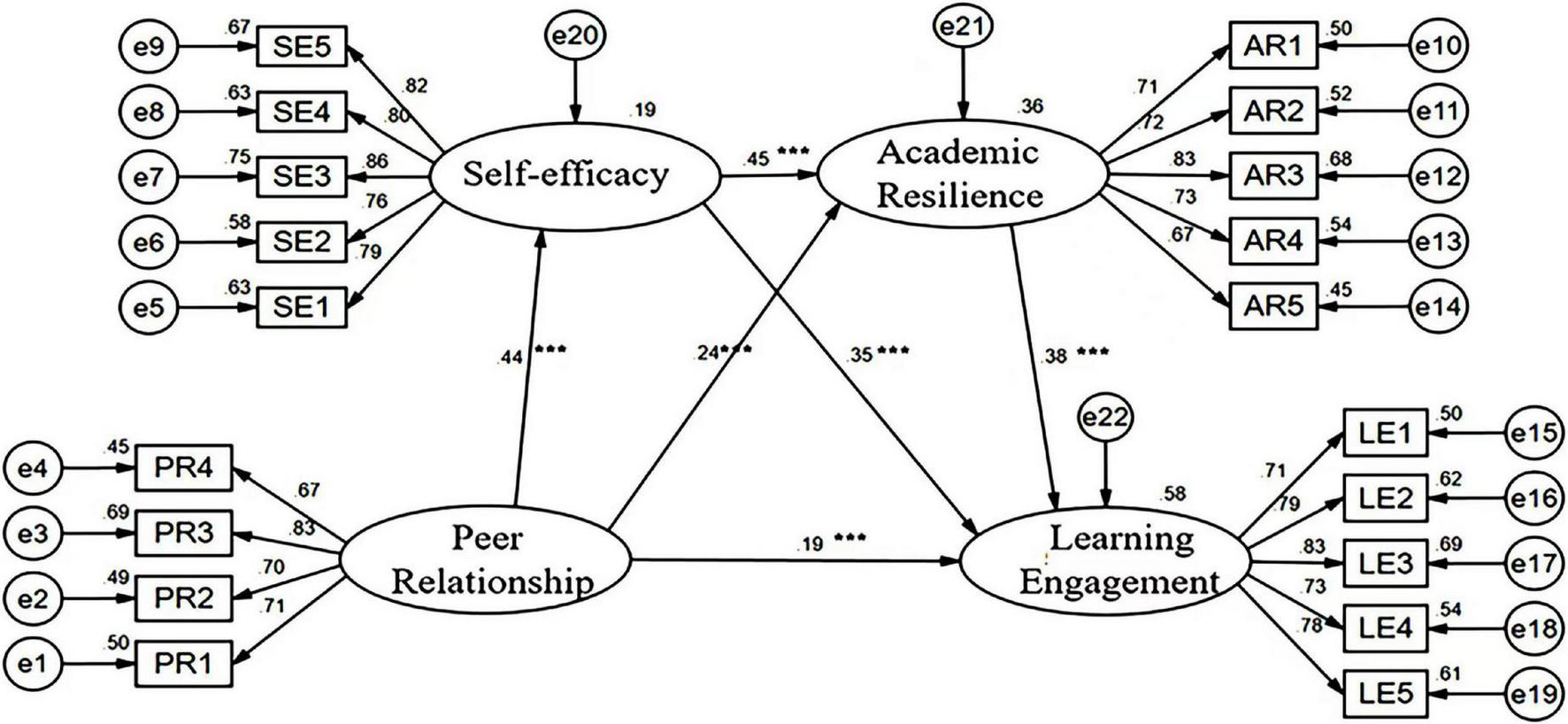
The structural modeling diagram. ***p < 0.001.
Hypotheses tested
As shown in Table 6, the hypotheses H1, H2, H3, H5, H6, and H7 were statistically significant and their paths were supported by the empirical data. Specifically, peer relationship significantly and positively predicted learning engagement (β = 0.193, P < 0.01), hence H1 was verified; peer relationship and self-efficacy established significant and positive relationships (β = 0.437, P < 0.001), therefore H2 was supported; self-efficacy was significantly and positively related to learning engagement (β = 0.348, P < 0.001), therefore H3 was verified; peer relationship was significantly and positively associated with academic resilience (β = 0.244, P < 0.01), therefore H5 was supported; self-efficacy was significantly and positively correlated with academic resilience (β = 0.450, P < 0.001), therefore H6 was verified; academic resilience significantly and positively predicted learning engagement (β = 0.384, P < 0.001), therefore H7 was verified.
TABLE 6
| Hypothesis | Path | Unstand estimates | Standard error | Z-value | Sig. | Stand estimates | Hypothesis test |
| H1 | PR→LE | 0.173 | 0.060 | 2.892 | 0.004 | 0.193 | Supported |
| H2 | PR→ SE | 0.447 | 0.078 | 5.715 | *** | 0.437 | Supported |
| H3 | SE→ LE | 0.307 | 0.064 | 4.766 | *** | 0.348 | Supported |
| H5 | PR→AR | 0.230 | 0.071 | 3.212 | 0.001 | 0.244 | Supported |
| H6 | SE→AR | 0.414 | 0.072 | 5.735 | *** | 0.450 | Supported |
| H7 | AR→LE | 0.367 | 0.075 | 4.918 | *** | 0.384 | Supported |
The test results of path relationship.
PR, Peer Relationship; LE, Learning Engagement; SE, Self-efficacy; AR, Academic Resilience.
***p < 0.001.
Analyses of the mediating effect of peer relationship on learning engagement
To analyze the mediating effect, the bootstrap method suggested by MacKinnon (2008) was used. It is believed that a statistically significant mediating effect must meet the following conditions: Z value is greater than 1.96 and the value of 95% bias-corrected confidence intervals (CI) excludes 0. As presented in Table 7, the total effect of peer relationship on learning engagement was 0.462 [Z = 5.250, 95% bias-corrected CI (0.307, 0.657), P < 0.01] and the direct effect of peer relationship on learning engagement was 0.173 [Z = 2.471, 95% bias-corrected CI (0.043, 0.316), P < 0.01], indicating that both the total effect and direct effect were statistically significant. The indirect effects were 0.068 [Z = 3.091, 95% bias-corrected CI (0.036, 0.132), P < 0.01] in the pathway of peer relationship-self-efficacy-academic resilience-learning engagement, 0.137 [Z = 2.978, 95% bias-corrected CI (0.067, 0.252), P < 0.01] in the pathway of peer relationship-self-efficacy-learning engagement, and 0.084 [Z = 2.270, 95% bias-corrected CI (0.028, 0.175), P < 0.01] in the pathway of peer relationship-academic resilience-learning engagement, showing that all the mediating effects were statistically significant.
TABLE 7
| Path relationship | Point estimate | Product of coefficient | Bootstrapping |
|||||
| Bias-corrected 95% CI | Percentile 95% CI | |||||||
|
|
|
|
||||||
| SE | Z-value | Lower | Upper | Lower | Upper | |||
| Test of indirect, direct and total effects | ||||||||
| DistalIE | PR→SE→AR→LE | 0.068 | 0.022 | 3.091 | 0.036 | 0.132 | 0.032 | 0.120 |
| SEIE | PR→SE→LE | 0.137 | 0.046 | 2.978 | 0.067 | 0.252 | 0.063 | 0.245 |
| ARIE | PR→AR→LE | 0.084 | 0.037 | 2.270 | 0.028 | 0.175 | 0.024 | 0.166 |
| TIE | Total indirect effect | 0.289 | 0.055 | 5.255 | 0.198 | 0.412 | 0.196 | 0.407 |
| DE | PR→LE | 0.173 | 0.070 | 2.471 | 0.043 | 0.316 | 0.042 | 0.316 |
| TE | Total effect | 0.462 | 0.088 | 5.250 | 0.307 | 0.657 | 0.305 | 0.652 |
| Comparison of indirect effects | ||||||||
| SEDIEdiff | SE VS.DistalIE | 0.069 | 0.049 | 1.408 | −0.013 | 0.186 | −0.015 | 0.184 |
| ARDIEdiff | AR VS.DistalIE | 0.016 | 0.041 | 0.390 | −0.070 | 0.105 | −0.069 | 0.106 |
| SEARdiff | SE VS. AR | 0.053 | 0.069 | 0.768 | −0.084 | 0.200 | −0.083 | 0.203 |
| Percentage of indirect effects | ||||||||
| P1 | DistalIE/TIE | 0.235 | 0.065 | 3.615 | 0.141 | 0.404 | 0.126 | 0.376 |
| P2 | SEIE/TIE | 0.474 | 0.121 | 3.917 | 0.237 | 0.715 | 0.242 | 0.720 |
| P3 | ARIE/TIE | 0.291 | 0.114 | 2.553 | 0.098 | 0.553 | 0.084 | 0.538 |
| P4 | TIE/TE | 0.625 | 0.109 | 5.734 | 0.448 | 0.878 | 0.451 | 0.882 |
| P5 | DE/TE | 0.375 | 0.109 | 3.440 | 0.122 | 0.552 | 0.118 | 0.549 |
Direct, indirect and total effects of the hypothesized model.
To further explore the potential mediating roles played by self-efficacy and academic resilience in the association between peer relationship and learning engagement, three alternative models were tested. First, an alternative model was tested to examine the mediating role played by self-efficacy. In this case, the model was found to be adequate, with fit indices: X2/df = 1.591, IFI = 0.977, CFI = 0.976, TLI = 0.971, GFI = 0.937, AGFI = 0.910, SRMR = 0.0454, SMSEA = 0.049, indicating that self-efficacy played a mediating role in the association between peer relationship and learning engagement. Second, an alternative model was tested, in which academic resilience played a mediating role. The model was revealed to be adequate with fit indices: X2/df = 1.324, IFI = 0.985, CFI = 0.985, TLI = 0.982, GFI = 0.946, AGFI = 0.924, SRMR = 0.0405, SMSEA = 0.036, showing that academic resilience played a mediating role in the association between peer relationship and learning engagement. Third, an alternative model was tested to examine the mediating roles played by self-efficacy and academic resilience. The model was found to be adequate with fit indices (as shown in Table 5).
Data analysis indicated thatv the mediating effect of peer relationship on learning engagement was associated with self-efficacy and academic resilience, which significantly and positively played a partial mediating role in the association between peer relationship and learning engagement. And H4, H8, and H9 were also verified. In addition, the indirect effect percentage of self-efficacy and academic resilience as partial mediators were examined. As indicated in Table 7, the direct effect of peer relationship on learning engagement accounted for 37.5%, while the total indirect effect of peer relationship on learning engagement accounted for 62.5%, greater than the direct effect. Among the three significant indirect mediators, the indirect effect of self-efficacy is the greatest, accounting for 47.4% of the total indirect effect.
Discussion
This study aimed to examine the association between peer relationship and learning engagement. In parallel, it also aimed to examine the mediating roles of self-efficacy and academic resilience in the association between peer relationship and learning engagement. The study tentatively proved that SCT can be used to explain the behaviors with regard to learning engagement. The findings are as follows.
Peer relationship is directly and positively associated with learning engagement which aligns with the research result of Juvonen et al. (2012) and Gremmen et al. (2018), that is, peer relationship contributes positively to learning engagement. One possible reason is that the classroom environment for peer interaction in school stimulates adolescents to improve their self-perception of efficacy, which is conducive to promoting learning engagement (Yang J. et al., 2021). In addition, peer relationship has been increasingly linked with different indicators of learning engagement (Ladd et al., 2009) and a stronger relationship with peers is related to higher classroom engagement (Fredricks et al., 2016). The results of this study further proved the prominent role of peer relationship in learning engagement.
Consistent with SCT, the results of the study identified self-efficacy as one significant partial mediating role on the pathway from peer relationship to learning engagement, which is consistent with previous studies (Sahil and Hashim, 2011; Gairns et al., 2015). Self-efficacy is concerned with individuals’ beliefs (Ritchie et al., 2021) and it is a premise of learning engagement (Shao and Kang, 2022). Students high in efficacy are more likely to show improvements in their effort and increase their engagement in learning activities (El-Sayad et al., 2021). The emergence of self-efficacy as a significant mediating role in the study further demonstrated the importance of self-efficacy in promoting adolescents’ learning engagement.
The results of the study demonstrated that academic resilience is another significant partial mediating variable, which is congruent with the suggestion of Permatasari et al. (2021) that the importance of resilience is highlighted between peer relationship and learning engagement. Students with high academic resilience can show flexibility and persistence when facing challenges and show more endeavor in overcoming difficulties, thus actively participating in learning (Ahmed et al., 2018). Similarly, the finding is consistent with another research result that peer interactions can be helpful in creating a soothing and supportive social environment that makes it possible for students to strengthen their academic resilience and stay engaged in learning (Gillham et al., 2013). In sum, the finding once indicated the role of academic resilience between peer relationship and learning engagement.
The results of the study also showed that self-efficacy and academic resilience functioned as a chain mediating role, which is one of the most striking findings. This means that self-efficacy and academic resilience sequentially played a mediating role in the association between peer relationship and learning engagement. The results of the study also revealed that among the three significant mediating roles, the mediating role of self-efficacy is the greatest, which is in line with the view that self-efficacy is the most important factor to change behaviors (Komendantova et al., 2018). In addition, the finding is similar to the result of Chu and Chu (2010) that self-efficacy plays the most important role in the relationship between peer support and learning engagement. Furthermore, it revealed that compared with peer relationship (β = 0.244, P < 0.01), adolescents’ self-efficacy contributed more to academic resilience (β = 0.450, P < 0.001). This may indicate that academic resilience was mainly derived from the self-efficacy of adolescents in the learning process due to their perceived ability to overcome difficulties in learning activities (Warshawski, 2022). Generally, the results of this study may enrich the research on learning behaviors to a certain extent by analyzing the complicated relations among peer relationship, self-efficacy, academic resilience, and learning engagement based on Social Cognitive Theory.
The theoretical and practical implications
The study can make both theoretical and practical implications. Theoretically, this study has contributed to the literature in two aspects. On one hand, the findings of this study indicate that the peer relationship has a positive impact on learning engagement, which may offer extended knowledge in understanding the mechanism between peer relationship and learning engagement. Specifically, individuals who can get support from their peers may change their learning behaviors and improve their learning engagement (Kiefer et al., 2015). On the other hand, the study has shown that the mediating roles of self-efficacy and academic resilience may explain how peer relationship is associated with learning engagement, which enriches the literature about learning engagement (Juvonen et al., 2012; Gremmen et al., 2018; Fredricks et al., 2019). The study tentatively proves that self-efficacy and academic resilience can significantly transmit the positive impact of peer relationship on learning engagement. In learning, adolescents with stronger self-efficacy and academic resilience will hold better psychological state of mind concerning learning behaviors. Learning context with positive peer relationship can foster adolescents’ personal factors—self-efficacy and academic resilience, which in turn facilitates their learning engagement. Practically, the study can help educational practitioners understand students’ learning engagement better from the perspective of environmental aspect (e.g., peer relationship) and learner factors such as self-efficacy and academic resilience. Concerning peer relationship, adolescents should be provided with necessary training, lectures, and symposiums that may help them realize the importance of developing sound peer relationship and improve their skills in building friendships with peers (Doumen et al., 2012). Besides, adolescents’ group work and cooperation with peers should be strengthened in learning contexts so as to promote their learning engagement (Yang J. et al., 2021). In terms of self-efficacy, strategies should be offered to help adolescents develop self-efficacy and approach their learning actively. In addition, adolescents’ confidence should be enhanced through educational programs to make them get over any difficulties in learning activities. With regard to academic resilience, teachers should develop adolescents’ strategies and skills to enhance their persistence and flexibility through purposeful projects and activities in classroom teaching and/or relevant training programs.
Limitations and future research directions
Limitations in the study should be stated. First, the proposed theoretical model was tested only in connection with the sample selected from one school, which may limit the generalizability of the findings. Further validation of the model with diverse samples from more schools is needed in the future. Second, this study explores the mechanism between peer relationship and learning engagement with the mediating roles of self-efficacy and academic resilience. However, there are more factors affecting learning engagement, such as academic stress, learning motivation, self-assessment, and so on. Future studies should take more variables into consideration so as to derive more convincing results and suggestions for practice. Third, the study focused on the cross-sectional study design, so it may make us unable to infer causal relations among the variables. Future studies could focus on longitudinal studies to explore the relationship between peer relationship and learning engagement.
Statements
Data availability statement
The original contributions presented in this study are included in the article/Supplementary material, further inquiries can be directed to the corresponding author.
Author contributions
YS analyzed the data and wrote the manuscript. SK developed the conceptual framework and revised the manuscript. Both authors contributed to the article and approved the submitted version.
Funding
The work was supported by the National Social Science Foundation of Education of China (BEA180110).
Conflict of interest
The authors declare that the research was conducted in the absence of any commercial or financial relationships that could be construed as a potential conflict of interest.
Publisher’s note
All claims expressed in this article are solely those of the authors and do not necessarily represent those of their affiliated organizations, or those of the publisher, the editors and the reviewers. Any product that may be evaluated in this article, or claim that may be made by its manufacturer, is not guaranteed or endorsed by the publisher.
Supplementary material
The Supplementary Material for this article can be found online at: https://www.frontiersin.org/articles/10.3389/fpsyg.2022.938756/full#supplementary-material
References
1
Ahmed U. Umrani W. A. Qureshi M. A. Samad A. (2018). Examining the links between teachers support, academic efficacy, academic resilience, and student engagement in Bahrain.Int. J. Adv. Appl. Sci.539–46. 10.21833/ijaas.2018.09.008
2
Baltaci H. Karataş Z. (2015). Perceived social support, depression and life satisfaction as the predictor of the resilience of secondary school students: the case of Burdur.Eur. J. Educ. Res.15111–130. 10.14689/ejer.2015.60.7
3
Bandura A. (1986). Social Foundations of Thought and Action: A Social Cognitive Theory.Englewood Cliffffs, NJ: Prentice-Hall.
4
Bandura A. (1997b). Self-efficacy: toward a unifying theory of behavioral change.Psychol. Rev.84191–215. 10.1037/0033-295X.84.2.191
5
Bandura A. (1997a). Self-Efficacy: The Exercise of Control.New York: Freeman.
6
Bandura A. (2012). “Social cognitive theory,” in Handbook of Theories of Social Psychology, Vol. 1edsVan LangeP. M.KruglanskiA. W.HigginsE. (Thousand Oaks, CA: Sage Publications Ltd), 349–373.
7
Block M. Taliaferro A. Harris N. Krause J. (2010). Using self-efficacy theory to facilitate inclusion in general physical education.J. Phys. Educ. Recreat. Dance8143–46. 10.1080/07303084.2010.10598448
8
Boele S. Van der Graaff J. de Wied M. Van der Valk I. Crocetti E. Branje S. (2019). Linking parent–child and peer relationship quality to empathy in adolescence: a multilevel meta-analysis.J. Youth Adoles.481033–1055. 10.1007/s10964-019-00993-5
9
Cassidy S. (2015). Resilience building in students: the role of academic self-efficacy.Front. Psychol.6:1–14. 10.3389/fpsyg.2015.01781
10
Cassidy S. (2016). The academic resilience scale (ARS-30): a new multidimensional construct measure.Front. Psychol.7:1787. 10.3389/fpsyg.2016.01787
11
Chen S. Lin C. (2019). Understanding the effect of social media marketing activities: the mediation of social identification, perceived value, and satisfaction.Technol. Forecast. Soc. Chan.14022–32. 10.1016/j.techfore.2018.11.025
12
Chen X. Cheung H. Y. Fan X. Wu J. (2017). Factors related to resilience of academically gifted students in the Chinese cultural and educational environment.Psychol. Schools20171–13. 10.1002/pits.22044
13
Cheung K. Sit P. Soh K. Ieong M. Mak S. (2014). Predicting academic resilience with reading engagement and demographi variables: comparing shanghai, hong kong, korea, and singapore from the PISA perspective.Asia Pacific Educ. Res.23895–909. 10.1007/s40299-013-0143-4
14
Chiu K. Clark D. M. Leigh E. (2021). Prospective associations between peer functioning and social anxiety in adolescents: a systematic review and meta-analysis.J. Affect. Dis.279650–661. 10.1016/j.jad.2020.10.055
15
Christenson S. L. Reschly A. L. Wylie C. (2012). Handbook of Research on Student Engagement.Berlin, Germany: Springer Science and Business Media.
16
Chu R. J. Chu A. Z. (2010). Multi-level analysis of peer support, internet self-efficacy and e-learning outcomes-the contextual effects of collectivism and group potency.Comput. Educ.55145–154. 10.1016/j.compedu.2009.12.011
17
Cohen J. (1992). A power primer.Psychol. Bull.112155–159. 10.1037/0033-2909.112.1.155
18
Doumen S. Smits I. Luyckx K. Duriez B. Vanhalst J. Verschueren K. et al (2012). Identity and perceived peer relationship quality in emerging adulthood: the mediating role of attachment-related emotions.J. Adoles.351417–1425. 10.1016/j.adolescence.2012.01.003
19
El-Sayad G. Md Saad N. H. Thurasamy R. (2021). How higher education students in egypt perceived online learning engagement and satisfaction during the COVID-19 pandemic.J. Comput. Educ.8527–550. 10.1007/s40692-021-00191-y
20
Fang L. Shi K. Zhang K. (2008). Reliability and validity of the Chinese version of the learning input scale.Chin. J. Clin. Psychol.6618–620.
21
Fornell C. Larcker D. F. (1981). Evaluating structural equation models with unobservable variables and measurement error.J. Mark. Res.1839–50. 10.1177/002224378101800104
22
Fredricks J. A. (2011). Engagement in school and out-of-school contexts: a multidimensional view of engagement.Theory Pract.50327–335. 10.1080/00405841.2011.607401
23
Fredricks J. A. Blumenfeld P. C. Paris A. H. (2004). School engagement: potential of the concept, state of the evidence.Rev. Educ. Res.7459–109. 10.3102/00346543074001059
24
Fredricks J. A. Filsecker M. Michael A. L. (2016). Student engagement, context, and adjustment: addressing definitional, measurement, and methodological issues.Learn. Instruct.431–4. 10.1016/j.learninstruc.2016.02.002
25
Fredricks J. A. Parr A. K. Amemiya J. L. Wang M. Brauer S. (2019). What matters for urban adolescents’ engagement and disengagement in school: a mixed-methods study.J. Adoles. Res.20191–37. 10.1177/0743558419830638
26
Frisby B. N. Hosek A. M. Beck A. C. (2020). The role of classroom relationships as sources of academic resilience and hope.Commun. Quart.20201–17. 10.1080/01463373.2020.1779099
27
Furrer C. J. Skinner E. A. Pitzer J. R. (2014). The influence of teacher and peer relationships on students’ classroom engagement and everyday motivational resilience.Teachers College Record116101–123. 10.1177/016146811411601319
28
Gairns F. Whipp P. R. Jackson B. (2015). Relational perceptions in high school physicaleducation: teacher- and peer-related predictors of female students’ motivation, behavioral engagement, and social anxiety.Front. Psychol.6:1–13. 10.3389/fpsyg.2015.00850
29
Geven S. Weesie J. Van Tubergen F. (2013). The influence of friends on adolescents’ behavior problems at school: the role of ego, alter and dyadic characteristics.Soc. Net.35583–592. 10.1016/j.socnet.2013.08.002
30
Gillham J. Abenavoli R. M. Brunwasser S. M. Linkins K. J. Seligman M. E. P. (2013). Resilience Education.Oxford: Oxford Handbook of Happiness, 10.1093/oxfordhb/9780199557257.013.0046
31
Gremmen M. C. Van den Berg Y. M. Steglich C. Veenstra R. Dijkstra J. K. (2018). The importance of near-seated peers for elementary students’ academic engagement and achievement.J. Appl. Dev. Psychol.5742–52. 10.1016/j.appdev.2018.04.004
32
Hair J. F. Black W. C. Babin B. J. Anderson R. E. (2010). Multivariate Data Analysis, 7th Edn. New Jersey: Pearson Education.
33
Honicke T. Broadbent J. (2016). The influence of academic self-efficacy on academic performance: a systematic review.Educ. Res. Rev.1763–84. 10.1016/j.edurev.2015.11.002
34
Hoshek A. Frisby B. N. Waldbuesser C. Rubinsky V. (2016). Conceptualizing Academic Challenges And Approaches To Coping From The Perspective Of College Students.Philadelphia, PA: National Communication Association.
35
Hou C. Wen Y. Liu X. Dong M. (2021). Impacts of regional water shortage information disclosure on public acceptance of recycled water—evidences from China’s urban residents.J. Cleaner Produ.278:123965. 10.1016/j.jclepro.2020.123965
36
Hydar Choupani A. H. Dehsorkhi H. F. (2021). The mediating role of students’ academic resilience in the relationship between self-efficacy and test anxiety.J. Educ. Health Promot.10:297. 10.4103/jehp.jehp_35_21
37
Juvonen J. Espinoza G. Knifsend C. (2012). “The role of peer relationships in student academic and extracurricular engagement,” in Handbook of Research on Student Engagement, edsChristensonS.ReschlyA.WylieC. (New York, NY: Springer Science), 387–401.
38
Kiefer S. M. Alley K. M. Ellerbrock C. R. (2015). Teacher and peer support for young adolescents’ motivation, engagement, and school belonging.RMLE Online381–18. 10.1080/19404476.2015.11641184
39
Komendantova N. Yazdanpanah M. Shafiei R. (2018). Studying young people’ views on deployment of renewable energy sources in Iran through the lenses of social cognitive theory.AIMS Energy6216–228. 10.3934/energy.2018.2.216
40
Kuo T. M. Tsai C. Wang J. (2021). Linking web-based learning self-efficacy and learning engagement in MOOCs: the role of online academic hardiness.Int. Higher Educ.51:10089. 10.1016/j.iheduc.2021.100819
41
Ladd G. W. Herald-Brown S. L. Koche L. K. (2009). “Peers and motivation,” in Handbook of Motivation at School, edsWentzelK. R.WigfieldA. (New York, London: Taylor & Francis Group), 323–348.
42
Lee M. Evans M. (2019). Investigating the operating mechanisms of the sources of L2 writing self-efficacy at the stages of giving and receiving peer feedback.Mod. Lang. J. Mod.2019:12598. 10.1111/modl.12598
43
Lee S. Kwon S. Ahn J. (2021). The effect of modeling on self-efficacy and flow state of adolescent athletes through role models.Front. Psychol.12:1–7. 10.3389/fpsyg.2021.661557
44
Li Y. Yao C. Zeng S. Wang X. Lu T. Li C. et al (2019). How social networking site addiction drives university students’ academic achievement: the mediating role of learning engagement.J. Pacific Rim Psychol.13:e19. 10.1017/prp.2019.12
45
Liem A. D. Lau S. Nie Y. (2008). The role of self-efficacy, task value, and achievement goals in predicting learning strategies, task disengagement, peer relationship, and achievement outcome.Contemp. Educ. Psychol.33486–512. 10.1016/j.cedpsych.2007.08.001
46
MacKinnon D. P. (2008). Introduction to Statistical Mediation Analysis.Mahwah: Erlbaum.
47
Martin A. J. (2013). Academic buoyancy and academic resilience: exploring ‘everyday’ and ‘classic’ resilience in the face of academic adversity.School Psychol. Int.34488–500. 10.1177/0143034312472759
48
Martin A. J. Marsh H. W. (2006). Academic resilience and its psychological and educational correlates: a construct validity approach.Psychol. Schools43267–281. 10.1002/pits.20149
49
Martin A. J. Marsh H. W. (2008). Academic buoyancy: towards an understanding of students’ everyday academic resilience.J. School Psychol.4653–83. 10.1016/j.jsp.2007.01.002
50
Masud H. Ahmad M. S. Jan F. A. Jamil A. (2016). Relationship between parenting styles and academic performance of adolescents: mediating role of self-efficacy.Asia Pacific Educ. Rev.17121–131. 10.1007/s12564-015-9413-6
51
Murray N. L. (2018). Examining Academic Resilience Factors Among African American High School Students (Publication No. 73) Ph. D, Thesis.UKnowledge, 10.13023/etd.2018.244
52
Newmann F. M. (1992). Student Engagement and Achievement in American Secondary School.New York: Teachers College Press.
53
Nguyen T. D. Cannata M. Miller J. (2016). Understanding student behavioral engagement: importance of student interaction with peers and teachers.J. Educ. Res.20161–12. 10.1080/00220671.2016.1220359
54
Park S. Yun H. (2017). The influence of motivational regulation strategies on online students’ behavioral, emotional, and cognitive engagement.Am. J. Dis. Educ.20171–14. 10.1080/08923647.2018.1412738
55
Permatasari N. Rahmatillah A. F. Ismail N. (2021). Contribution of perceived social support (peer, family, and teacher) to academic resilience during COVID-19.Golden Ratio Soc. Sci. Educ.11–12. 10.52970/grsse.v1i1.94
56
Podsakoff P. M. MacKenzie S. B. Podsakoff N. P. (2012). Sources of method bias in social science research and recommendations on how to control it.Ann. Rev. Psychol.63539–569. 10.1146/annurev-psych-120710-100452
57
Podsakoff P. M. Mackenzie S. B. Lee J. Y. Podsakoff N. P. (2003). Common method biases in behavioral research: a critical review of the literature and recommended remedies.J. Appl. Psychol.88879–903. 10.1037/0021-9010.88.5.879
58
Rachmawati I. Setyosari P. Handarini D. M. Hambali I. M. (2020). Do social support and self-efficacy correlate with academic resilience among adolescence?Int. J. Learn. Chang1349–62.
59
Reeve J. Tseng C. (2011). Agency as a fourth aspect of students’ engagement during learning activities.Contemp. Educ. Psychol.36257–267. 10.1016/j.cedpsych.2011.05.002
60
Ritchie L. Cervone D. Sharpe B. T. (2021). Goals and self-efficacy beliefs during the initial COVID-19 lockdown: a mixed methods analysis.Front. Psychol.11:559114. 10.3389/fpsyg.2020.559114
61
Rohrbeck C. A. Garvin M. (2014). “Peer relationships: promoting positive peer relationships during adolescence,” in Encyclopedia of Primary Prevention and Health Promotion, edsGullottaT. P.BloomM. (Boston, MA: Springer), 10.1007/978-1-4614-5999-6
62
Romano L. Angelini G. Consiglio P. Fiorilli C. (2021). Academic resilience and engagement in high school students: the mediating role of perceived teacher emotional support.Eur. J. Investig. Health Psychol. Educ.11334–344. 10.3390/ejihpe11020025
63
Ruegg R. (2014). The effect of peer and teacher feedback on changes in EFL students’ writing self-efficacy.Lang. Learn. J.20141–18. 10.1080/09571736.2014.958190
64
Sahil S. A. Hashim R. (2011). The roles of social support in promoting adolescents’ classroom cognitive engagement through academic self-efficacy.Malaysian J. Learn. Instruct.849–69.
65
Schaufeli W. B. Martinez I. M. Pinto A. M. Salanova M. Bakker A. B. (2002a). Burnout and engagement in university students: a cross-national study.J. Cross Cult. Psychol.33464–481. 10.1177/0022022102033005003
66
Schaufeli W. B. Salanova M. Gonzalez-roma V. Bakker A. B. (2002b). The measurement of engagement and burnout: a two sample confirmatory factor analytic approach.J. Happ. Stud.371–92. 10.1023/a:1015630930326
67
Schwarzer R. (1994). Optimism, vulnerability, and self-beliefs as health-related cognitions: a systematic overview.Psychol. Health Int. Natl. J.9161–180. 10.1080/08870449408407475
68
Shahangian S. A. Tabesh M. Yazdanpanah M. (2021). How can socio-psychological factors be related to water-efficiency intention and behaviors among Iranian residential water consumers?J. Environ. Manag.288:112466. 10.1016/j.jenvman.2021.112466
69
Shao Y. Kang S. (2022). The link between parent-child relationship and learning engagement among adolescents: the chain mediating roles of learning motivation and academic self-efficacy.Front. Educ.7:854549. 10.3389/feduc.2022.854549
70
Shin H. Chang Y. (2022). Relational support from teachers and peers matters: links with different profiles of relational support and academic engagement.J. School Psychol.92209–226. 10.1016/j.jsp.2022.03.006
71
Shyr W. Hsieh Y. Chen C. (2021). The effects of peer-based instant response system to promote learning performance.Int. Motivat. Self Efficacy Sustainabili.13:4320. 10.3390/su13084320
72
Simões C. Santos A. C. Lebre P. Daniel J. R. Branquinho C. Gaspar T. et al (2021). Assessing the impact of the European resilience curriculum in preschool, early and late primary school children.School Psychol. Int.42539–566. 10.1177/01430343211025075
73
Skinner E. A. Pitzer J. R. (2012). “Developmental dynamics of engagement, coping, and everyday resilience,” in Handbook of Research On Student Engagement, edsChristensonS.ReschlyA.WylieC. (Springer Science), 21–44.
74
Sökmen Y. (2019). The role of self-efficacy in the relationship between the learning environment and student engagement.Educ. Stud.451–19. 10.1080/03055698.2019.1665986
75
Terlektsi E. Kreppner J. Mahon M. Worsfold S. Kennedy C. R. (2020). Peer relationship experiences of deaf and hard-of-hearing adolescents.J. Deaf Stud. Deaf Educ.20201–14. 10.1093/deafed/enz048
76
Tillfors M. Persson S. Willén M. Burk W. J. (2012). Prospective links between social anxiety and adolescent peer relations.J. Adoles.351255–1263. 10.1016/j.adolescence.2012.04.008
77
Tvedt M. S. Bru E. Idsoe T. (2019). Perceived teacher support and intentions to quit upper secondary school: direct, and indirect associations via emotional engagement and boredom.Scand. J. Educ. Res.20191–22. 10.1080/00313831.2019.1659401
78
Vîrgã D. Pattusamy M. Kumar D. P. (2020). How psychological capital is related to academic performance, burnout, and boredom? The mediating role of study engagement.Curr. Psychol.2020:1162. 10.1007/s12144-020-01162-9
79
Wang M. T. Holcombe R. (2010). Adolescents’ perceptions of school environment, engagement, and academic achievement in middle school.Am. Educ. Res. J.47633–662. 10.3102/0002831209361209
80
Warshawski S. (2022). Academic self-efficacy, resilience and social support among first-year Israeli nursing students learning in online environments during COVID-19 pandemic.Nurse Educ. Today110:105267. 10.1016/j.nedt.2022.105267
81
Wei Y. (1998). Study on the influence of school factors on self-esteem development of children.Psychol. Dev. Educ.212–16.
82
Wu H. Li S. Zheng J. Guo J. (2020). Medical students’ motivation and academic performance: the mediating roles of self-efficacy and learning engagement.Med. Educ. Online25:1742964. 10.1080/10872981.2020.1742964
83
Yang J. Peng M. Y. Wong S. Chong W. (2021). How E-learning environmental stimuli influence determinates of learning engagement in the context of COVID-19? SOR model perspective.Front. Psychol.12:584976. 10.3389/fpsyg.2021.584976
84
Yang Y. Yuan Y. Tan H. Wang Y. Li G. (2021). The linkages between Chinese children’s both cognitive engagement and emotional engagement and behavioral engagement: mediating effect of perceptions of classroom interactions in math.Psychol. Schools20211–14. 10.1002/pits.22571
85
Yazdanpanah M. Feyzabad F. R. Forouzani M. Mohammadzadeh S. Burton R. J. F. (2015). Predicting farmers’ water conservation goals and behavior in Iran: a test of social cognitive theory.Land Use Policy47401–407.
86
Yazzie-Mintz E. McCormick K. (2012). “Finding the humanity in the data: understanding, measuring, and strengthening student engagement,” in Handbook of Research on Student Engagement, edsChristensonS. L.ReschlyA. L.WileyC. (New York, NY: Springer), 743–761.
87
Yockey R. D. (2010). “SPSS is actually very simple,” in Translating, edsLiuC.WuZ. (Beijing: China Renmin University Press).
88
Zhang W. Xu M. Su H. (2020). Dance with Structural Equations.Xiamen: Xiamen University Press.
89
Zhen R. Liu R. Ding Y. Wang J. Liu Y. Xu L. (2017). The mediating roles of academic self-efficacy and academic emotions in the relation between basic psychological needs satisfaction and learning engagement among Chinese adolescent students.Learn. Indiv. Diff.54210–216. 10.1016/j.lindif.2017.01.017
90
Zulfiqar N. (2020). Association between severity of adolescents’ peer problems and moral judgment development.Pakistan J. Psychol. Res.3523–35. 10.33824/PJPR.2020.35.1.2
91
Zysberg L. Schwabsky N. (2020). School climate, academic self-efficacy and student achievement.Educ. Psychol.20201–16. 10.1080/01443410.2020.1813690
Summary
Keywords
peer relationship, learning engagement, self-efficacy, academic resilience, adolescents
Citation
Shao Y and Kang S (2022) The association between peer relationship and learning engagement among adolescents: The chain mediating roles of self-efficacy and academic resilience. Front. Psychol. 13:938756. doi: 10.3389/fpsyg.2022.938756
Received
08 May 2022
Accepted
15 July 2022
Published
03 August 2022
Volume
13 - 2022
Edited by
Delia Virga, West University of Timişoara, Romania
Reviewed by
Masoud Yazdanpanah, University of Florida, United States; Rosana Stan, University of Oradea, Romania
Updates
Copyright
© 2022 Shao and Kang.
This is an open-access article distributed under the terms of the Creative Commons Attribution License (CC BY). The use, distribution or reproduction in other forums is permitted, provided the original author(s) and the copyright owner(s) are credited and that the original publication in this journal is cited, in accordance with accepted academic practice. No use, distribution or reproduction is permitted which does not comply with these terms.
*Correspondence: Shumin Kang, Kangsm2015@163.com
This article was submitted to Educational Psychology, a section of the journal Frontiers in Psychology
Disclaimer
All claims expressed in this article are solely those of the authors and do not necessarily represent those of their affiliated organizations, or those of the publisher, the editors and the reviewers. Any product that may be evaluated in this article or claim that may be made by its manufacturer is not guaranteed or endorsed by the publisher.