Abstract
With the deepening of the research on emotional factors, foreign language anxiety (FLA) has become the focus of researchers in the field of foreign language learning (FLL) and teaching. This paper aims to provide an overview of the historical trajectory of FLA research that has been published in System between 2004 and 2023. While examining the retrieved 49 studies, focus has been laid on the methodologies including research instruments, methods, participants, major themes and key findings of FLA research. Although almost all of the studies employed quantitative and mix-methods methodologies, questionnaires and semi-structured interviews were the most preferred research methods. FL learners from 21 countries/regions were represented, but a significant number of the studies came from China, Japan and Iran. And an overwhelming majority of the studies focused on FLA among the learners learning English as a foreign language (EFL). The review concluded with some research lacunae and possible directions for future research on FLA.
Introduction
FLA, prevalent among foreign language (FL) learners (Dewaele and Macintyre, 2014; Li, 2020), is a very special and complex psychological phenomenon during the process of FLL (Gardner, 1985; Macintyre and Gardner, 1994). FLA is regarded as the biggest emotional obstacle during the process of FLL (Arnold and Brown, 1999), which may undermine students’ confidence and motivation in FLL (Macintyre, 2017). Horwitz (2010) considered FLA as one of the strongest predictors of success or failure in FLL. Previously, anxiety in FFL, as an auxiliary variable in FLL research, had only drawn scarcity of attention from researchers (Chastain, 1975; Dewaele and Li, 2021). It was not until 1986 that Horwitz et al. (1986), for the first time, proposed the concept of FLA, reckoning that FLA is a unique synthesis of self-perception, belief, emotion and behavior associated with FLL. Meanwhile, Horwitz et al. (1986) developed the Foreign Language Classroom Anxiety Scale (FLCAS), which has become the most widely accepted FLA scale. Since then, researchers have conducted a plethora of studies on the connotations (Macintyre and Gardner, 1994; Oxford, 1999), categorization (Horwitz et al., 1986; Ellis, 1994; Macintyre and Gardner, 1994), impacts (Steinberg and Horwitz, 1986; MacIntyre and Charos, 1996), sources (Young, 1991; Macintyre, 2017), and measurement tools (Macintyre and Gardner, 1994; Satio et al., 1999; Kim, 2000; Elkhafaifi, 2005; Woodrow, 2006; Cheng, 2017) of FLA.
System, one of the most influential and prestigious international journals devoted to FL teaching and learning, has stayed abreast of the development of FLA research. The articles having been published on FLA in System represent to a large extent the development trajectory of FLA research. Therefore, this review paper chooses System as the material to provide the historical trajectory of FLA research and suggest some under-researched topics and future directions of FLA research.
Foreign language anxiety
FLA, a principal learner emotional factor in foreign language learning (FLL), has become one of the significant research focuses in FLL since the 1970s. Originating from psychology, anxiety is defined as “an unpleasant state of mind that is characterized by individual perceived feelings like nervous, fear, and worry, and is activated by the autonomic nervousness system” (Spielberger, 1972). FLA is a unique form of anxiety in the specific context of foreign language learning (Horwitz et al., 1986; MacIntyre, 1995). Horwitz et al. (1986) conceptualized FLA as “a distinct complex of self-perceptions, beliefs, feelings, and behaviors related to classroom language learning arising from the uniqueness of the language learning process.”
Horwitz et al. (1986) first studied FLA as an independent phenomenon. In order to resolve the deficiency and insufficiency of traditional research tools in respect of FLA, Horwitz et al. (1986) framed the Foreign Language Classroom Anxiety Scale (FLCAS), putting an end to the history of FLA study having no standardized measurement tools (Guo and Xu, 2014), foreboding that FLA research entered a period of relative maturity when researchers began to focus on the overall performance of FLA and its relationship with a variety of variables (Young, 1986, 1992; Aida, 1994), as well as the relationship between FLA and some basic language skills like listening, speaking, reading and writing (Gungle and Taylor, 1989; Vogely, 1998; Sellers, 2000).
Simply put, FLA is the feeling of tension, fear and nervousness in self-consciousness, emotions, beliefs, and behaviors (Aida, 1994) associated with a context which requires an individual to use a foreign language he or she is not proficient with (MacIntyre and Gardner, 1991).
Research design
In order to present a systematic analysis of FLA research published in System, a narrative approach of systematic review was adopted. Systematic review involves “a clearly formulated question” and adopts “systematic and explicit methods to identify, select, and critically appraise relevant research, and to collect and analyze data from the studies that are included in the review” (Cochrane Collaboration, 2003). A narrative approach relies “primarily on the use of words and text to summarize and explain the findings,” and is considered helpful to systematically review topics that have been studied differently researchers (Popay et al., 2006), highlight the strengths and limitations of studies being reviewed (Wong et al., 2013).
The review aims to provide a systematic analysis of FLA research during the past two decades between 2004 and 2023 by answering the following questions:
Question 1: What is the overall trend in FLA research published in System during the past two decades?
Question 2: What are the major themes and the key findings of FLA research?
Question 3: What are the existent gaps in the current research and the potential directions for future research?
Data collection
Following the PRISMA guidelines (Moher et al., 2009), an extensive literature search was conducted to ensure a comprehensive analysis of the current FLA research published in System. The data selection criteria and collection process are summarized in Figure 1.
Figure 1
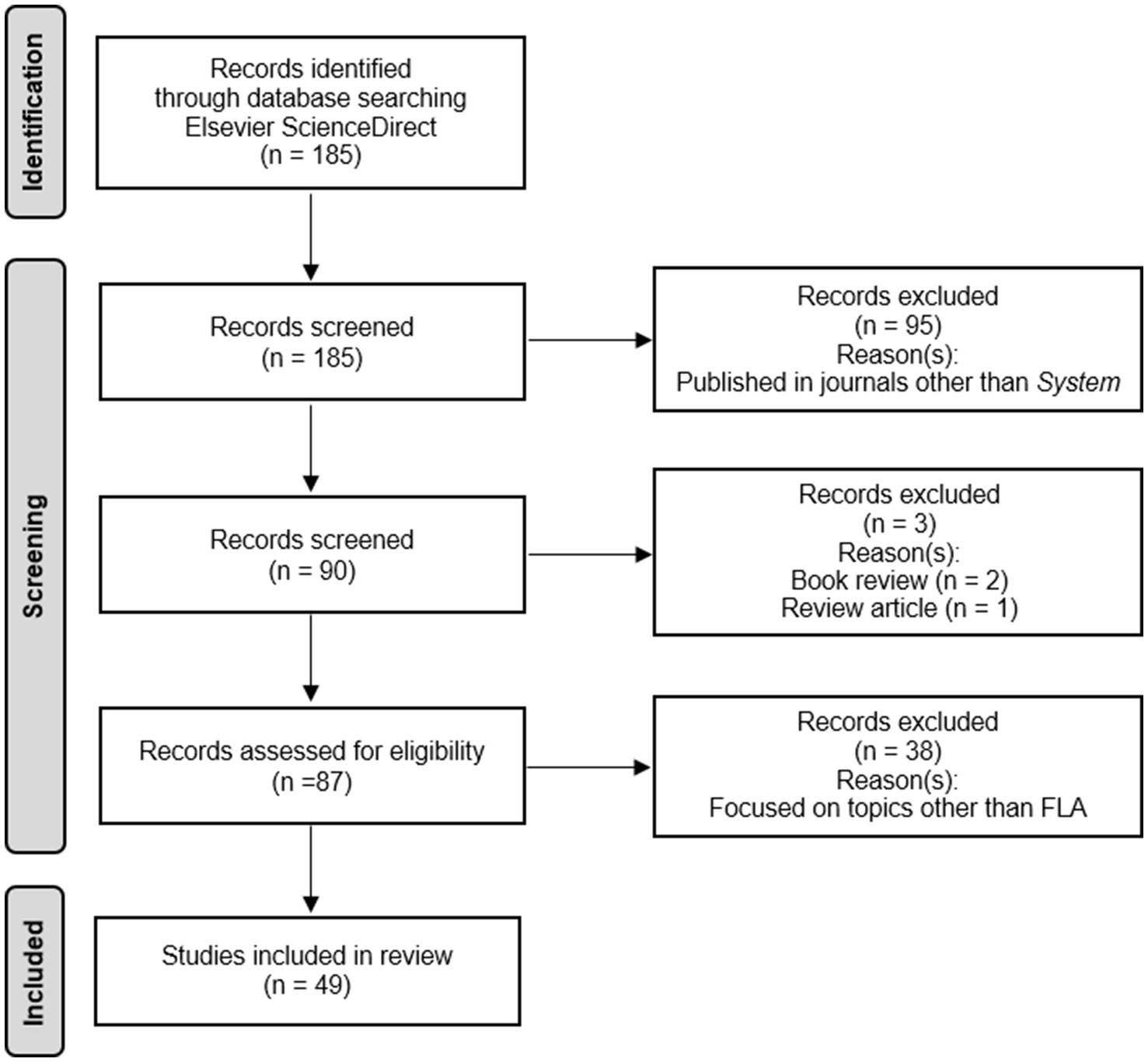
PRISMA flow chart.
Firstly, relevant studies published until and including December 15, 2023 were searched in the database of Elsevier ScienceDirect. The author conducted advanced searches in the database with the following searching parameters: In this journal or book title = (System) AND Title, abstract, or author-specific keywords = (anxiety). Overall, the database returned 185 publications, among which 95 were published in journals other than System and therefore were deleted. Then, 2 book reviews and 1 review article were deleted. The remaining 87 publications were evaluated for the eligibility by reading and analyzing the titles, abstracts and full texts, and 38 publications were excluded based on the following criterion that the studies focused on topics other than FLA.
Data analysis
This review first conducted a bibliometric analysis of the retrieved records. A coding analysis was then performed through iterative reading with the highlights on the following categories that guided the data analysis: year of publication, characteristics of samples, research methodologies, and key findings.
Results
Descriptive characteristics of studies
Publishing years
There is a dynamic upward trend in the number of studies on FLA over the past two decades (see Figure 2). 2021 witnessed a surge in the number of publications, reaching an all-time peak of 8 papers. There is a gradual downward trend in the following 2 years, but compared with the average of about 2 papers per year, there is still an increase in the number of papers in 2022 and 2023.
Figure 2
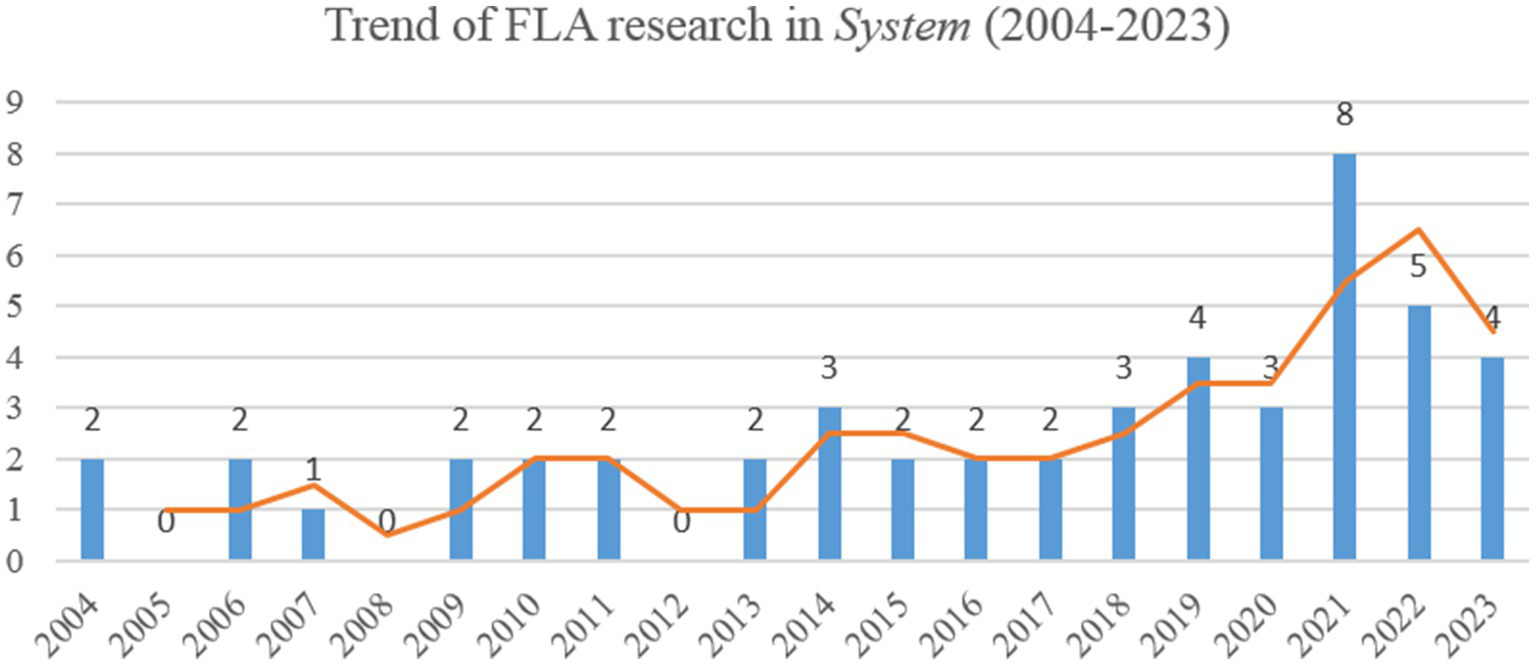
Trend of FLA research in System (2004–2023).
Countries/regions of research
There was diversity of countries/ regions where the studies took place, with 21 countries/regions represented. Twenty-one papers (42.86%) came from China, followed by 6 papers (12.24%) from Japan and 4 papers (8.16%) from Iran. Three papers were conducted in Korea and USA each, followed by 2 papers from Saudi Arabia, and 1 paper from Canada, Australia, Indonesia, Austria, Germany, Switzerland, Italy, Slovakia, Macau, Chile, Thailand, Turkey, and UK each.
Research participants
The overwhelming majority of the studies (n = 43, 87.76%) focused on FLA among university students, with 3 papers focused on primary school students and 5 on secondary school students. It is noteworthy to point out that there were 3 studies which focused on PhD students, adult students, and vocational high school students, respectively.
Foreign languages studied
Since the status of English as a universal language is beyond doubt, almost all the studies examined FLA in the context of EFL learning. Among the 49 papers, there were only 4 papers focusing on FLA in the context of FLL other than EFL learning. These foreign languages included Korean, Arabic, German and Chinese. There was 1 paper comparing the possible FLA differences between the contexts of German as L1 learning and English as LX learning.
Research methodologies
Of the retrieved records, 38 were cross-sectional studies and 11 were longitudinal studies. The average length of time for the longitudinal studies was approximately 11.36 weeks, ranging from the shortest length of 1 week to the longest length of 18 weeks. The studies adopting quantitative methods (n = 24, 48.98%) and the studies using mix-methods (n = 24, 48.98%) markedly dwarfed the only one study using qualitative methods (2.04%).
Questionnaires were the most common research method in both quantitative studies and mix-methods studies. The FLCAS was the most frequently-used scale (n = 22, 48.83%), which a significant number of studies used directly (n = 7, 14.58%), adapted (n = 4, 8.33%), modified (n = 6, 12.50%) or translated (n = 5, 10.42%). Besides, a number of studies used questionnaires that adopted, modified or translated other scales such as the FLRAS (Satio et al., 1999), the FLLAS (Elkhafaifi, 2005), and the S-FLCAS (Dewaele and Macintyre, 2014) among many others. Notwithstanding, some researchers devised targeted questionnaires (Hurd, 2007; Woodrow, 2011; Lee, 2016; Li, 2018; Wang H. et al., 2021; Alrabai, 2022).
With regard to qualitative methodology, the research methods frequently used to measure FLA embraced interviews (n = 15, 62.50%), classroom observations (n = 5, 20.83%), students’ reflective journals (n = 5, 20.83%), open-ended questions (n = 3, 12.50%). Of note, Hurd (2007) employed audio-recorded think-aloud protocols combined with questionnaires and one-to-one semi-structured telephone interviews to explore FLA in a distance learning environment. Dryden et al. (2021) used linguistic ethnography to investigate how four migrant EFL learners in Australia experienced FLA.
Research themes and key findings
Level of FLA
Twelve papers (24.49%) were found to investigate FLA level of FL learners, however, no consensus has been reached on the level of FLA among FL learners, possibly due to the fact that the participants of the retrieved studies were different. For example, Jiang and Dewaele (2020) found 1,031 university freshmen in China experienced a moderate level of FLA. Zuniga and Simard (2022) and Lee et al. (2023) had similar findings. However, Jiang and Dewaele (2019) found a higher level of FLA among 564 EFL university freshmen in China than the counterpart participants in the study of Dewaele and MacIntyre (2014). Similarly, Bekleyen (2009) found the language teacher candidates in Turkey experienced a high level of FL listening anxiety.
Dynamicity of FLA drew attention from some scholars. Koga (2010) investigated the dynamicity of FLA among 88 first-year university students in Japan and found FLA decreased significantly at the end of the 15-week English courses. Veenstra and Weaver (2022) investigated 341 students from two private universities in Japan and a continuum of FL speaking anxiety showed that the participants’ overall level of FL speaking anxiety decreased after finishing an English presentation course lasting 15 weeks.
Some studies explored some potential differences of FLA among different participants or among the same participants in different contexts. For example, Chen et al. (2022) found Chinese undergraduates had a higher level of EFL reading anxiety than Spanish undergraduates. Resnik and Dewaele (2020) found the participants experienced a higher level of FLA in English (LX) classes than in German (L1) classes.
Sources of FLA
Nine studies (18.37%) explored sources or causes of FLA. Bekleyen (2009) revealed some major sources of FL listening anxiety, including low priority of listening in previous FLL, and failure to recognize the spoken form of word, phrase or sentence. Jiang and Dewaele (2019) uncovered a number of factors contributing to FL class anxiety, including exams and quizzes, speaking in front of the class without preparation, challenging classroom activities, and teacher questioning. Bashori et al. (2021) identified insufficient vocabulary knowledge as one of the factors provoking FL speaking anxiety. Besides, speaking strategies, willingness to communicate, speaking self-efficacy and speaking proficiency were found to have positive direct effects on FLA (Sun and Teng, 2021). Of note, Zare et al. (2022) focused on FLA outside the traditional face-to-face classroom and found that autonomous learning was the source of the participants’ anxiety during the data-driven FFL.
Correlation of FLA with other variables
Some studies (n = 5, 10.20%) explored the correlation of FLA with demographic variables of the participants. Park and French (2013) found female students had significantly higher levels of FLA than male students. However, Jiang and Dewaele (2020) found gender and ethnic affiliation were not correlated with FLA while geographical background and experience in traveling abroad had a weak correlation with FLA. Similarly, Matsuda and Gobel (2004) found EFL learners with overseas experience experienced lower anxiety when speaking English and gender did not have a significant effect on FLA. However, Yim (2014) found gender had a significant effect of FLA. The discrepancies in the correlation with demographic variables may be attributed to the different samples or the possibility that male learners are not inclined to willingly admit anxiety than female learners (Williams, 1996; Pappamihiel, 2002).
A number of studies (n = 9, 18.37%) explored the correlation of FLA with academic performance/ achievement. For example, Pyun et al. (2014) found that oral achievement of the participants was negatively correlated with FLA. However, Tsang and Lee (2023) found FL speaking anxiety was not significantly related to speaking proficiency. Hamada and Takaki (2021) found FL reading anxiety had significantly direct effects on course achievement. Woodrow (2011) and Li et al. (2023) found FL writing anxiety was significantly negatively correlated with writing performance, but FLA did not have a significant prediction on writing achievement (Li et al., 2023). Besides, In’nami (2006) found that test anxiety did not affect FL listening test performance.
Many studies (n = 19, 38.78%) focused on the correlation of FLA with other student-specific variables, including learning motivation (Tsai and Liao, 2021), willingness to communicate (Lee and Hsieh, 2019; Wang H. et al., 2021), language proficiency (Jiang and Dewaele, 2020) and trait emotional intelligence (Resnik and Dewaele, 2020; Li et al., 2021) among many others. Several studies (n = 5, 10.20%) focused on the correlation of FLA with teacher-specific variables, such as teachers’ oral corrective feedback (Lee, 2016), perceived teacher emotional support (Jin and Dewaele, 2018), and teaching styles (Briesmaster and Briesmaster-Paredes, 2015).
Ways to relieve FLA
Ways to relieve FLA was also a topic of immense interest to researchers. Ten studies (20.41%) explored how to relieve or alleviate FLA. Jin et al. (2021) and Alrabai (2022) applied positive psychology intervention to reduce leaners’ FLA. Alrabai (2022) revealed that the integration of positive and negative emotions in FLL could result in alleviation of FLA among Saudi EFL learners. Jin et al. (2021) uncovered that reminiscing about language achievements significantly mitigated the levels of FLA among Chinese EFL learners. Similarly, Lee et al. (2023) found that constructing learners’ growth language mindset relieved their FLA.
Besides, Tsai and Liao (2021) found using machine translation systems had a positive effect on lowering FLA among EFL learners in Taiwan. Bashori et al. (2021) investigated the potential effects of Automatic Speech Recognition-based websites on EFL learners’ vocabulary, FLA and FLE. Other studies found that self-regulatory strategies (Guo et al., 2018), recasts (Li, 2018), and translanguaging (Dryden et al., 2021) had a significant effect on mitigating the levels of FLA among EFL learners. Of note, Kralova et al. (2017) employed psycho-social training as a strategy to alleviate FLA among 68 Slovak EFL learners.
Discussion
During the past two decades between 2004 and 2023, System has been an ardent supporter of FLA research, committed to probing into and resolving FLA-related problems of foreign language teaching and learning. However, based on the review, some research lacunae are discerned concerning samples, methodologies and themes of FLA research, and some possible directions for future FLA research are also suggested.
Research samples
Notwithstanding the FLA studies in System involved a variety of FL learners as the participants, there was a serious polarization phenomenon concerning the diversity of the research samples. An overwhelmingly large number of the studies focused on FLA among the FL learners in school and few studies focused on FLA among non-school FL learners. Moreover, a majority of the studies explored FLA among undergraduate students, especially the non-English-major university students, and there is a scarcity of studies investigating FLA among students in primary schools, secondary schools, vocational colleges as well as postgraduate students. In terms of geographical distribution of the research samples, most studies focused on FL learners from Asian countries including China, Japan and Iran among many others, and less attention was paid to FL learners from Europe, North America and South America. And no studies on FLA involving FL learners in Africa have been found. Meanwhile, most participants were from urban places, and only a couple of studies explored FLA among rural FL learners (Hamada and Takaki, 2021; Li et al., 2023). Last but not the least, with regard to the types of FL, a plethora of studies concentrated on English as a FL. Of the 49 retrieved studies, only 4 studies focused on FLA among the participants learning Korean, Arabic, German and Chinese as a FL, respectively.
Future research should diversify the research objects and focus increasing attention on the FLA research among primary school students, secondary school students, vocational college students and non-school FL adult learners, and moderate attention should be paid to the FLA research among preschool children and postgraduate students, so as to avoid the polarization of research samples. Besides, the dominance of English as a lingua franca has made English the FL taught in schools around the globe (Rose et al., 2020), facilitating FLA studies among EFL learners. However, recent years has witnessed frequent calls for conducting research on teaching and learning of foreign languages other than English (Zhang et al., 2019; Guo et al., 2021). Future studies can also focus on FLA among learners of foreign languages other than English as well as FL learners in countries and regions outside Asia.
Research methodologies
Notwithstanding an increasing number of studies combined quantitative methods and qualitative methods in recent years, questionnaires were still the staple tool for quantitative data collection, and semi-structured interviews for qualitative data collection. A few mix-methods studies used classroom observation, student journals, field investigation and case studies for qualitative analysis. In addition, the FLCAS was the most popular scale for quantitative data collection and analysis, and only a few studies devised target questionnaires for their research. Moreover, cross-sectional studies far exceeded longitudinal studies, and the average length of time for longitudinal studies were relatively short, lasing about 10 weeks. Finally, there were only three comparative studies on FLA, probing into FLA differences among the participants (Resnik and Dewaele, 2020; Hamada and Takaki, 2021; Chen et al., 2022).
Future FLA research should adopt mix-methods studies with qualitative research not just being confined to semi-structured interviews, but embracing a variety of methods, such as classroom observation, video recording, student journals, field investigation, case study and particularly audio-recorded think-aloud protocols. And path analysis and structural equation modeling analysis should be increasingly employed to analyze the quantitative data. Meanwhile, some advanced techniques such as Event-related Potentials (ERP), Positron Emission Tomography (PET) and functional Magnetic Resonance Imaging (fMRI) can be used in future research to analyze FLA from the perspective of neural mechanism by measuring the electromagnetic, blood flow and neuronal activities of the human brain. In addition, it is necessary to devise localized FLA scale with ideal validity and reliability in accordance with the cultural background and educational environment of the country or region where the research objects are located. Moreover, the dynamic nature of FLA requires more longitudinal studies to explain how FLA changes dynamically and what impacts FLA exerts on FLL. Finally, future studies can pay more attention to the comparative study of FLA differences among different groups, which is more conducive to understanding the characteristics and distribution of FLA among different groups of FL learners, so as to put forward targeted strategies to mitigate FLA in FLL.
Research themes
Research themes of the studies on FLA in System were of rich variety. However, no research has been found on translation anxiety and interpretation anxiety. Besides, there was a scarcity of research on the effectiveness of alleviating FLA. Studies on strategies to reduce FLA were mostly conducted from the perspective of teachers, and few studies revealed how to alleviate FLA from the perspective of learners. And most of the specific strategies to mitigate FLA were only at the theoretical level, lacking sufficient theoretical and empirical evidence, which were not applicable in practical FL teaching.
The following research themes deserve more attention in future research: translation anxiety and interpretation anxiety, types and effectiveness of strategies for alleviating FLA among different groups of FL learners, FLA among learners of heritage languages as well as non-heritage languages, and comparative studies on the effects of regional locations and mother languages on FLA. Moreover, future studies should not only focus on the theoretical research of FLA, but also carry out more empirical studies on strategies on how to alleviate FLA among different FL learners, such as learners from different regional locations, learners in monolingualism, bilingualism and multilingualism, and the effectiveness of FLA-alleviating strategies.
Conclusion
By reviewing the 49 studies on FLA published in System between 2004 and 2023, this paper demonstrates that the journal’s commitment to FLA research embraces a wide range of research themes being explored with different research methods. Based on the findings of the review, some research lacunae regarding samples, methodologies and themes of FLA research are discussed, and some possible directions for future FLA research are also suggested.
Statements
Data availability statement
The original contributions presented in the study are included in the article/supplementary material, further inquiries can be directed to the corresponding author.
Author contributions
QY: Writing – review & editing, Writing – original draft.
Funding
The author(s) declare that financial support was received for the research, authorship, and/or publication of this article. This work was supported by grants from the Research Project of Humanities, Foreign Languages and Arts, Xi’an University of Technology (110-451623011) and the Research Project on Graduate Education and Teaching Reform, Xi’an University of Technology (310-252042342).
Conflict of interest
The author declares that the research was conducted in the absence of any commercial or financial relationships that could be construed as a potential conflict of interest.
Publisher’s note
All claims expressed in this article are solely those of the authors and do not necessarily represent those of their affiliated organizations, or those of the publisher, the editors and the reviewers. Any product that may be evaluated in this article, or claim that may be made by its manufacturer, is not guaranteed or endorsed by the publisher.
References
1
Aida Y. (1994). Examination of Horwitz, Horwitz, and Cope's construct of foreign language anxiety: the case of students of Japanese. Mod. Lang. J.78, 155–168. doi: 10.2307/329005
2
Alrabai F. (2022). The role of mixed emotions in language learning and teaching: a positive psychology teacher intervention. System107:102821. doi: 10.1016/j.system.2022.102821
3
Arnold J. Brown H. D. (1999). “A map of the terrain” in Affect in language learning. ed. ArnoldJ. (Cambridge: Cambridge University Press)
4
Bashori M. van Hout R. Strik H. Cucchiarini C. (2021). Effects of ASR-based websites on EFL learners’ vocabulary, speaking anxiety, and language enjoyment. System99:102496. doi: 10.1016/j.system.2021.102496
5
Bekleyen N. (2009). Helping teachers become better English students: causes, effects, and coping strategies for foreign language listening anxiety. System37, 664–675. doi: 10.1016/j.system.2009.09.010
6
Briesmaster M. Briesmaster-Paredes J. (2015). The relationship between teaching styles and NNPSETs’ anxiety levels. System49, 145–156. doi: 10.1016/j.system.2015.01.012
7
Chastain K. (1975). Affective and ability factors in second language acquisition. Lang. Learn.25, 153–161. doi: 10.1111/j.1467-1770.1975.tb00115.x
8
Chen S. Du H. Wang S. Yang L. (2022). Understanding EFL reading anxiety in relation to learning motivation, attitudes and strategies for Chinese and Spanish undergraduates. System108:102842. doi: 10.1016/j.system.2022.102842
9
Cheng Y. (2017). Development and preliminary validation of four brief measures of L2 language-skill-specific anxiety. System68, 15–25. doi: 10.1016/j.system.2017.06.009
10
Cochrane Collaboration (2003). Glossary. London: Cochrane Collaboration.
11
Dewaele J. M. Li C. (2021). Teacher enthusiasm and students’ social-behavioral learning engagement: the mediating role of student enjoyment and boredom in Chinese EFL classes. Lang. Teach. Res.25, 922–945. doi: 10.1177/13621688211014538
12
Dewaele J. M. Macintyre P. D. (2014). The two faces of Janus? Anxiety and enjoyment in the foreign language classroom. Stud. Second Lang. Learn. Teach.4, 237–274. doi: 10.14746/ssllt.2014.4.2.5
13
Dryden S. Tankosić A. Dovchin S. (2021). Foreign language anxiety and translanguaging as an emotional safe space: migrant English as a foreign language learners in Australia. System101:102593. doi: 10.1016/j.system.2021.102593
14
Elkhafaifi H. (2005). Listening comprehension and anxiety in the Arabic language classroom. Mod. Lang. J.89, 206–220. doi: 10.1111/j.1540-4781.2005.00275.x
15
Ellis R. (1994). The study of second language acquisition. Oxford: Oxford University Press.
16
Gardner R. C. (1985). Social psychology and second language learning: the role of attitudes and motivation. London: Edward Arnold.
17
Gungle B. W. Taylor V. (1989). “Writing apprehension and second language writers” in Richness in writing: Empowering ESL students. eds. JohnsonD. M.RoenD. H. (White Plains, NY: Longman), 235–248.
18
Guo Y. Xu J. (2014). A multi-dimensional study on foreign language anxiety of non-English major college students in China. Foreign Lang. World4, 2–11.
19
Guo Y. Xu J. Liu X. (2018). English language learners’ use of self-regulatory strategies for foreign language anxiety in China. System76, 49–61. doi: 10.1016/j.system.2018.05.001
20
Guo Q. Zhou X. Gao X. (2021). Research on the teaching and learning of languages other than English in system. System100:102541. doi: 10.1016/j.system.2021.102541
21
Hamada A. Takaki S. (2021). Effects of multidimensional foreign language reading anxiety on achievement in Japanese EFL classrooms. System101:102613. doi: 10.1016/j.system.2021.102613
22
Horwitz E. K. (2010). Foreign and second language anxiety. Lang. Teach.43, 154–167. doi: 10.1017/S026144480999036X
23
Horwitz E. K. Horwitz M. B. Cope J. (1986). Foreign language classroom anxiety. Mod. Lang. J.70, 125–132. doi: 10.1111/j.1540-4781.1986.tb05256.x
24
Hurd S. (2007). Anxiety and non-anxiety in a distance language learning environment: the distance factor as a modifying influence. System35, 487–508. doi: 10.1016/j.system.2007.05.001
25
In’nami Y. (2006). The effects of test anxiety on listening test performance. System34, 317–340. doi: 10.1016/j.system.2006.04.005
26
Jiang Y. Dewaele J. M. (2019). How unique is the foreign language classroom enjoyment and anxiety of Chinese EFL learners?System82, 13–25. doi: 10.1016/j.system.2019.02.017
27
Jiang Y. Dewaele J. M. (2020). The predictive power of sociobiographical and language variables on foreign language anxiety of Chinese university students. System89:102207. doi: 10.1016/j.system.2020.102207
28
Jin Y. X. Dewaele J. M. (2018). The effect of positive orientation and perceived social support on foreign language classroom anxiety. System74, 149–157. doi: 10.1016/j.system.2018.01.002
29
Jin Y. Dewaele J. M. MacIntyre P. D. (2021). Reducing anxiety in the foreign language classroom: a positive psychology approach. System101:102604. doi: 10.1016/j.system.2021.102604
30
Kim J. H. (2000). Foreign language listening anxiety: a study of Korean students learning English. Austin: The University of Texas.
31
Koga T. (2010). Dynamicity of motivation, anxiety and cooperativeness in a semester course. System38, 172–184. doi: 10.1016/j.system.2010.03.001
32
Kralova Z. Skorvagova E. Tirpakova A. Markechova D. (2017). Reducing student teachers' foreign language pronunciation anxiety through psycho-social training. System65, 49–60. doi: 10.1016/j.system.2017.01.001
33
Lee E. J. (2016). Reducing international graduate students’ language anxiety through oral pronunciation corrections. System56, 78–95. doi: 10.1016/j.system.2015.11.006
34
Lee J. S. Hsieh J. C. (2019). Affective variables and willingness to communicate of EFL learners in in-class, out-of-class, and digital contexts. System82, 63–73. doi: 10.1016/j.system.2019.03.002
35
Lee H. Jin S. Lee J. H. (2023). Ending the cycle of anxiety in language learning: a non-recursive path analysis approach. System118:103154. doi: 10.1016/j.system.2023.103154
36
Li H. (2018). Recasts and output-only prompts, individual learner factors and short-term EFL learning. System76, 103–115. doi: 10.1016/j.system.2018.05.004
37
Li C. (2020). A positive psychology perspective on Chinese EFL students’ trait emotional intelligence, foreign language enjoyment and EFL learning achievement. J. Multiling. Multicult. Dev.41, 246–263. doi: 10.1080/01434632.2019.1614187
38
Li C. Huang J. Li B. (2021). The predictive effects of classroom environment and trait emotional intelligence on foreign language enjoyment and anxiety. System96:102393. doi: 10.1016/j.system.2020.102393
39
Li C. Wei L. Lu X. (2023). Contributions of foreign language writing emotions to writing achievement. System116:103074. doi: 10.1016/j.system.2023.103074
40
MacIntyre P. D. (1995). How does anxiety affect second language learning? A reply to Sparks and Ganschow. Mod. Lang. J.1, 90–99. doi: 10.1111/j.1540-4781.1995.tb05418.x
41
Macintyre P. D. (2017). “An overview of language anxiety research and trends in its development” in New insights into language anxiety: theory, research and educational implications. ed. DewaeleJ. M. (Bristol: Multilingual Matters)
42
MacIntyre P. D. Charos C. (1996). Personality, attitudes and affect as predictors of second language communication. J. Lang. Soc. Psychol.15, 3–26. doi: 10.1177/0261927X960151001
43
MacIntyre P. D. Gardner R. C. (1991). Methods and results in the study of anxiety and language learning: a review of the literature. Lang. Learn.41, 85–117. doi: 10.1111/j.1467-1770.1991.tb00677.x
44
Macintyre P. D. Gardner R. C. (1994). The subtle effects of language anxiety on cognitive processing in the second language. Lang. Learn.44, 283–305. doi: 10.1111/j.1467-1770.1994.tb01103.x
45
Matsuda S. Gobel P. (2004). Anxiety and predictors of performance in the foreign language classroom. System32, 21–36. doi: 10.1016/j.system.2003.08.002
46
Moher D. Liberati A. Tetzlaff J. Altman D. G. (2009). Preferred reporting items for systematic reviews and meta-analyses: the PRISMA statement. PLoS Med.6:e1000097. doi: 10.1371/journal.pmed.1000097
47
Oxford R. L. (1999). “Anxiety and the language learner: new insights” in Affect in language learning. ed. ArnoldJ. (Cambridge: Cambridge University Press)
48
Pappamihiel N. E. (2002). English as a second language students and English language anxiety: issues in the mainstream classroom. Res. Teach. Engl.36, 327–355. doi: 10.1023/A:1013074218134
49
Park G. P. French B. F. (2013). Gender differences in the foreign language classroom anxiety scale. System41, 462–471. doi: 10.1016/j.system.2013.04.001
50
Popay J. Roberts H. Sowden A. Petticrew M. Arai L. Rodgers M. et al . (2006). Guidance on the conduct of narrative synthesis in systematic reviews. A product from the ESRC methods Programme (version 1). Lancaster: Lancaster University.
51
Pyun D. O. Kim J. S. Cho H. Y. Lee J. H. (2014). Impact of affective variables on Korean as a foreign language learners’ oral achievement. System47, 53–63. doi: 10.1016/j.system.2014.09.017
52
Resnik P. Dewaele J. M. (2020). Trait emotional intelligence, positive and negative emotions in first and foreign language classes: a mixed-methods approach. System94:102324. doi: 10.1016/j.system.2020.102324
53
Rose H. Syrbe M. Montakantiwong A. Funada N. (2020). Global TESOL for the 21st century: teaching English in a changing world. Bristol, Blue Ridge Summit: Multilingual Matters
54
Satio Y. Garza T. J. Horwitz E. K. (1999). Foreign language reading anxiety. Mod. Lang. J.83, 202–218. doi: 10.1111/0026-7902.00016
55
Sellers V. D. (2000). Anxiety and Reading comprehension in Spanish as a foreign language. Foreign Lang. Ann.33, 512–520. doi: 10.1111/j.1944-9720.2000.tb01995.x
56
Spielberger C. D. (1972). “Conceptual and methodological issues in anxiety research” in Anxiety: current trends in theory and research. ed. SpielbergerC. D. (New York, NY: Academic Press)
57
Steinberg F. S. Horwitz E. K. (1986). The effect of induced anxiety on the denotative and interpretative content of second language speech. TESOL Q.20, 131–136. doi: 10.2307/3586395
58
Sun P. P. Teng L. S. (2021). Why so nervous? Revisiting the sources of speech anxiety in Chinese as a second language. System103:102647. doi: 10.1016/j.system.2021.102647
59
Tsai P. S. Liao H. C. (2021). Students’ progressive behavioral learning patterns in using machine translation systems– a structural equation modeling analysis. System101:102594. doi: 10.1016/j.system.2021.102594
60
Tsang A. Lee J. S. (2023). The making of proficient young FL speakers: the role of emotions, speaking motivation, and spoken input beyond the classroom. System115:103047. doi: 10.1016/j.system.2023.103047
61
Veenstra R. Weaver C. (2022). Examining a continuum of FL speaking anxiety over time in an EFL classroom in Japan. System110:102889. doi: 10.1016/j.system.2022.102889
62
Vogely A. J. (1998). Listening comprehension anxiety: students’ reported sources and solutions. Foreign Lang. Ann.31, 67–80. doi: 10.1111/j.1944-9720.1998.tb01333.x
63
Wang H. Peng A. Patterson M. M. (2021). The roles of class social climate, language mindset, and emotions in predicting willingness to communicate in a foreign language. System99:102529. doi: 10.1016/j.system.2021.102529
64
Williams J. E. (1996). Gender-related worry and emotionality test anxiety for high-achieving students. Psychol. Schools33, 159–162. doi: 10.1002/(SICI)1520-6807(199604)33:23.0.CO;2-M
65
Wong G. Greenhalgh T. Westhorp G. Buckingham J. Pawson R. (2013). RAMESES publication standards: meta-narrative reviews. BMC Med.11, 11–20. doi: 10.1186/1741-7015-11-20
66
Woodrow L. (2006). Anxiety and speaking English as a second language. RELC J.37, 308–328. doi: 10.1177/0033688206071315
67
Woodrow L. (2011). College English writing affect: self-efficacy and anxiety. System39, 510–522. doi: 10.1016/j.system.2011.10.017
68
Yim S. Y. (2014). An anxiety model for EFL young learners: a path analysis. System42, 344–354. doi: 10.1016/j.system.2013.12.022
69
Young D. J. (1986). The relationship between anxiety and foreign language Oral proficiency ratings. Foreign Lang. Ann.19, 439–445. doi: 10.1111/j.1944-9720.1986.tb01032.x
70
Young D. J. (1991). Creating a low-anxiety classroom environment: what does language anxiety research suggest?Mod. Lang. J.75, 426–437. doi: 10.2307/329492
71
Young D. J. (1992). Language anxiety from the foreign language Specialist's perspective: interviews with Krashen, Omaggio Hadley, Terrell, and Rardin. Foreign Lang. Ann.25, 157–172. doi: 10.1111/j.1944-9720.1992.tb00524.x
72
Zare J. Karimpour S. Delavar K. A. (2022). The impact of concordancing on English learners’ foreign language anxiety and enjoyment: an application of data-driven learning. System109:102891. doi: 10.1016/j.system.2022.102891
73
Zhang L. J. Thomas N. Qin L. T. (2019). Language learning strategy research in system: looking back and looking forward. System84, 87–92. doi: 10.1016/j.system.2019.06.002
74
Zuniga M. Simard D. (2022). Exploring the intricate relationship between foreign language anxiety, attention and self-repairs during L2 speech production. System105:102732. doi: 10.1016/j.system.2022.102732
Summary
Keywords
foreign language anxiety, foreign language learning, English as a foreign language, foreign language learners, literature review
Citation
Yu Q (2024) Foreign language anxiety research in System between 2004 and 2023: looking back and looking forward. Front. Psychol. 15:1373290. doi: 10.3389/fpsyg.2024.1373290
Received
19 January 2024
Accepted
09 April 2024
Published
22 April 2024
Volume
15 - 2024
Edited by
Douglas F. Kauffman, Medical University of the Americas – Nevis, United States
Reviewed by
Chili Li, Hubei University of Technology, China
Paloma Cavalcante Bezerra Medeiros, Federal University of the Parnaíba Delta, Brazil
Updates
Copyright
© 2024 Yu.
This is an open-access article distributed under the terms of the Creative Commons Attribution License (CC BY). The use, distribution or reproduction in other forums is permitted, provided the original author(s) and the copyright owner(s) are credited and that the original publication in this journal is cited, in accordance with accepted academic practice. No use, distribution or reproduction is permitted which does not comply with these terms.
*Correspondence: Qiangfu Yu, yuqiangfu@xaut.edu.cn
Disclaimer
All claims expressed in this article are solely those of the authors and do not necessarily represent those of their affiliated organizations, or those of the publisher, the editors and the reviewers. Any product that may be evaluated in this article or claim that may be made by its manufacturer is not guaranteed or endorsed by the publisher.