Abstract
This study employed virtual reality to study heritage bilinguals’ pragmatic and morphosyntactic use of pronouns of address in heritage Spanish, namely the tú/usted paradigm. Forty-four heritage speakers experienced eight virtual scenarios embedding an array of social factors, such as gender and social rank of the addressee. This experimental design elicited a corpus of 21,882 words, which includes 753 instances of second-person address distributed into the tú (50.60%) and usted (49.40%) pronouns. Importantly, participants produced the tú/usted paradigm across all the expected syntactic environments, indicating that the feature geometry of this linguistic paradigm does not constrain its everyday use in heritage Spanish. A mixed-effects analysis further revealed that participants were more likely to express formality with female and unknown interlocutors. Since the majority of the participants are female (88.09%), a separate analysis confirmed the gender effect, which suggests that female speakers conveyed in-group solidarity through their pronoun usage in female-to-female interactions. Although participants produced the tú/usted paradigm across the target scenarios, they reported higher usage of usted (68.45%) in their perception data compared to their production data (49.40%), revealing a discrepancy between what speakers believe they do with language and how they actually behave in context. By studying the nuances of address in virtual worlds, the present study contributes to our current understanding of pragmatics in heritage bilingualism.
1 Introduction
When interacting with others, speakers must employ some linguistic form or sign to engage in a communicative exchange with their interlocutor. These linguistic forms are conceptualized as address systems in linguistics research, and pronouns are the most common forms of address cross-linguistically. The use of a particular form of address signals how the speaker wishes to be perceived by her interlocutor, e.g., the desire to be approved of or liked. Thus, in languages with formality distinctions in the pronominal system (e.g., the T/V dichotomy in Brown and Gilman, 1960), the speaker must assess the relative power of addressee over speaker, the social distance between speaker and addressee, and the degree to which a particular pronoun of address is rated as an imposition in the target culture (Brown and Levinson, 1978). Failure to make such assessment in a spontaneous interaction can expose the speaker to negative judgments in a speech community, e.g., being perceived as disrespectful or annoying, namely because formality is often correlated with age and unfamiliarity.
The everyday use of address systems involves both structural agreement and social pragmatic norms. As such, they serve as an ideal testing ground for exploring heritage speakers’ morphosyntactic and pragmatic knowledge. For instance, Spanish has a binary system for second-person singular address, namely the pronouns tú and usted (henceforth, the T/U paradigm). Following the feature geometry in Harley and Ritter (2002), the tú and usted pronouns are presumably specified as PARTICIPANT in the speech act with ‘addressee’ as their value, as illustrated in (1). However, this pronominal paradigm exhibits different verb agreement: the tú-pronoun inflects for second-person singular (e.g., Tú tienes), whereas the usted-pronoun exhibits third-person singular verb agreement (e.g., Usted tiene). In other words, usted requires activation of the ‘addressee’ node dependent on PARTICIPANT in (1), but the notionally perceived person of this node (2nd person) does not condition verb agreement.1
(1) Feature geometry of the T/U paradigm in Spanish. 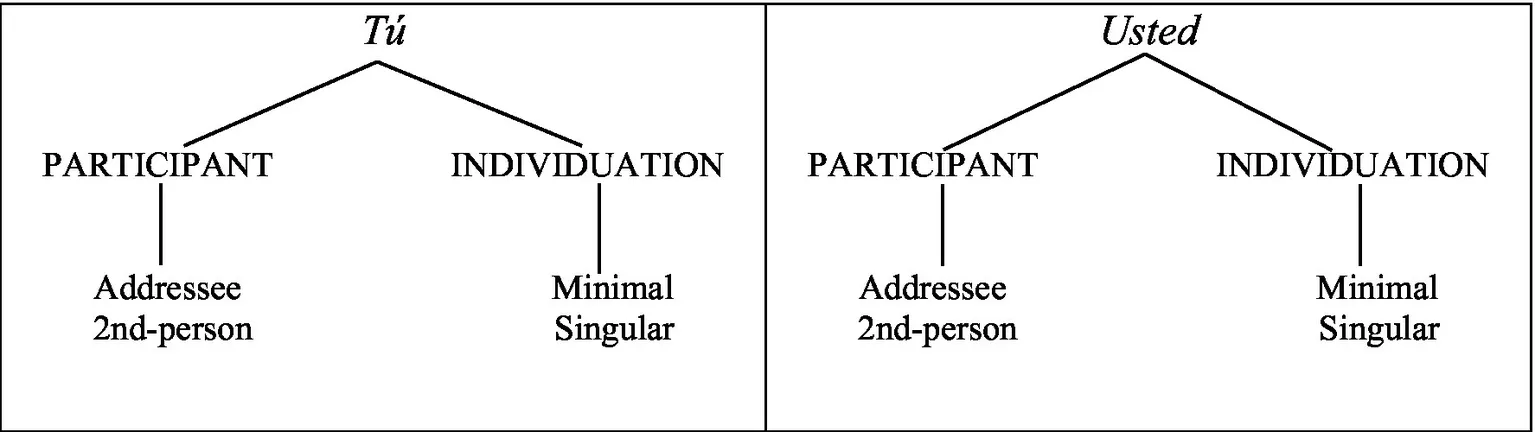
The T/U paradigm is then an addressee-sensitive variable subject to pragmatic norms in a speech community. Naturally, norms of address, which can be understood as conditions of (in)appropriate application of a form of address, emerge from our social relations with others, including parents and teachers. Child language studies indicate that by two to 3 years of age, children have acquired a robust understanding of social norms and their conditions of (in)appropriate application (Rakoczy and Tomasello, 2009; Schmidt and Rakoczy, 2023). In particular, children show awareness of social factors such a person’s social rank in society and solidarity for others early in life, and they consequently mitigate their speech (e.g., use politeness) to assess their social relations with others (Ervin-Tripp et al., 1990; Emihovich, 2008; Ryckyebusch and Marcos, 2004). In heritage bilingualism, however, heritage speakers learn their heritage language at home, but they are educated in the language of the broader speech community, English in the U. S. context (Valdés, 2005). Consequently, in most cases, English becomes their dominant language, and their heritage language is relegated to home usage. This learning trajectory limits heritage speakers to pragmatic norms of informal language use, while they learn other registers of language socialization through schooling in English (Carrira and Kagan, 2011; He, 2011; Polinsky, 2018).
While this learning trajectory suggests lack of cultural reference in the heritage language, there is an emerging body of literature showing that pragmatic competence in heritage bilingualism is sensitive to speakers’ heritage identity and bilingual experience (Cruz, 2024; Dubinina, 2021; Escalante and Quan, 2023; Pinto, 2018; Taguchi et al., 2017; Wolski-Moskoff, 2018; Xiao-Desai, 2019). Here, I understand pragmatic competence as “the speaker’s knowledge and use of rules of appropriateness and politeness” (Koike, 1989, p. 279). In the case of social relations, for example, heritage bilinguals employ pronouns of address to position themselves as members of a speech community, or to construct social identity (Liebscher et al., 2010; Warditz, 2025). Clearly, more studies are needed to have a better understanding of heritage speakers’ speech styles and pragmatic norms in their heritage languages (Polinsky, 2018). The present study aims to contribute to this line of research by examining Spanish heritage speakers’ use of pronouns of address in simulated interactions mimicking real-world scenarios.
The learning trajectory of heritage languages (e.g., learning contexts of unbalanced input) may also have structural consequences for heritage grammars (Flores et al., 2020; Montrul, 2023; Polinsky and Scontras, 2019, among others). In particular, grammatical phenomena such as agreement morphology have been reported to suffer in heritage Spanish in the U. S. context (Silva-Corvalán, 1994; Montrul, 2002; Polinsky, 2018), though studies in other languages in non-U. S. contexts report agreement patterns that closely resemble those of homeland speakers (Łyskawa and Nagy, 2020). While previous studies indicate that person agreement is mostly a stable feature in heritage grammars (Benmanmoun et al., 2013), I am not aware of any studies that have empirically investigated heritage speakers’ morphosyntactic knowledge of the T/U paradigm. As mentioned before, this linguistic paradigm exhibits a discourse-driven morphosyntactic mismatch that may cause morphological ambiguity for the heritage language learner, who may favor tú for second-person singular addressing because of its meaning-to-form mapping for verb agreement.2
The aim of the present study is then two-fold: to examine whether/how the feature geometry of the T/U paradigm constrains heritage speakers’ choice of pronoun of address in spontaneous speech and the social factors (pragmatic norms) that may inform their choice. The social factors governing heritage speakers’ use of pronouns of address in social contexts have received much attention in heritage bilingualism (Fernández-Mallat and Newman, 2021; Jaramillo, 1988, 1996; Sigüenza-Ortiz, 1996; Warditz, 2025). Yet, these studies rely mainly on questionnaires or translation tasks for data elicitation. While these methodologies provide valuable data, they are challenged with ecological validity. For example, in a traditional discourse completion task, participants are asked to imagine being in different scenarios where they would interact with others, creating an artificial spatial divide between participant and addressee (Peeters, 2019).
Noting this limitation, the present study employs Virtual Reality (VR) to elicit production data from heritage speakers’ use of the T/U paradigm. This new technology combines high ecological validity with high experimental control (Peeters, 2019; Titus et al., 2024). In particular, virtual reality allows for creating dynamic and interactive virtual worlds that generate a sense of presence, that is, the subjective experience of being in one place or environment when one is physically situated in another location (Witmer and Singer, 1998). VR is a compelling methodology for the study of address systems because it gives participants the opportunity to assess speaker-addressee relations in real time. The virtual scenarios created for the present study were carefully designed to reflect the social factors that have been previously reported to influence heritage speakers’ choice of pronoun in self-reported data. Importantly, production data is crucial to delimit whether preference for one particular pronoun over the other in a binary system is motivated by conventional norms of address in a given heritage community or by the feature geometry of the address system in the heritage language.
2 Literature review
2.1 Pronouns of address in the Americas
Brown and Gilman’s (1960) classic model of pronoun usage is the predominant framework to study address systems cross-linguistically. According to these authors, the semantics of power and solidarity mediate pronoun usage in some European languages, including the Romance languages, and the T/V dichotomy originating from the pronominal system of Latin captures these social dimensions. In a power relation, then, the inferior gives deferential V and receives subordinating T. In a solidary relation, by contrast, power equals give and receive reciprocal T. Social factors such as age, social rank, and gender—which pertain to both the speaker and the addressee—condition the use of the T/V dichotomy in a given speech community. The T/U paradigm that concern us here has been mainly studied within the T/V model, whereby usted conveys deference and tú expresses solidarity.
Spanish–English bilinguals have different linguistic forms at their disposal for expressing deference ad solidarity. In American English, for example, the pronoun ‘you’ refers to many persons or one, but this pronoun does not encode the semantics of power and solidarity described above (Brown and Gilman, 1960). Instead, other forms of address, such as a person’s title followed by last name or a person’s nickname, are used to convey these social dimensions (Brown and Ford, 1961). In contrast to American English, the Spanish spoken in the Americas has a tripartite system for second-person singular address, namely, tú, vos, and usted, and only one plural counterpart, ustedes (Fontanella de Weinberg, 1999). Thus, Spanish-speaking regions in the Americas are classified into three main dialectal regions: tuteo, voseo, and ustedeo (Cepeda Ruiz, 2018; Fernández-Mallat and Barrero, 2023). Tuteo and voseo refer to the use of the second-person singular pronouns tú and vos, respectively. These pronouns exhibit different verb morphology (e.g., tú eres vs. vos sos for present tense), but their object pronoun is always the same, te; their related possessives are tu and tuyo for both tú and vos. Ustedeo refers to the use of second-person singular pronoun usted, which derived from the reverential phrase vuestra merced ‘your grace’ (Moreno, 2002). As mentioned before, the pronoun usted exhibits a discourse-driven morphosyntactic mismatch for verb agreement, and this mismatch is also relevant for agreement with (in)direct object pronouns and possessives.
Contextual features and social factors play a crucial role in pronoun usage cross-linguistically, and those governing the T/U paradigm across the Americas are well documented in the literature (see Fernández-Mallat and Barrero, 2023 for a brief overview). For sake of space, here I limit the discussion to the social factors governing the T/U paradigm in Mexican Spanish. In a corpus study of Mexico City, Lastra (1972) found that speakers employed the pronoun tú almost exclusively in the familial domain, but they also extended it to people who have high social ranks in the Mexican society, such as priests and teachers. In another study from Mexico City, Schwenter (1993) found an overwhelming use of tú, while usted was primarily used to address strangers, and regardless of their social rank or gender. In a more recent study, Cepeda Ruiz (2018) reported that tú is relatively more frequent than usted in present-day Mexico City, whereby younger speakers preferred the tú form but also reported using usted with older people. Interestingly, Cepeda Ruiz found that women, compared to men, preferred using the tú form because it is more ‘respectful’ and ‘elegant’ than usted.
In short, the Mexican society applies informal (solidarity) language use in the familiar domain, but social factors such as age, social rank, and unfamiliarity still motivate the use of the T/U paradigm in this speech community. Although the present study does not seek to make a comparison of pronoun usage to a baseline speech community (see Rothman et al., 2023 for arguments against the monolingual comparative normativity in bilingualism), most of the existing studies on pronoun usage in heritage communities in the U.S. context include heritage speakers of Mexican descent, as summarized in the next section. In fact, the majority (78.58%) of the participants in the present study have a parent born and raised in Mexico, while only six participants have a parent born in El Salvador (11.90%) or Guatemala (2.38%); the rest of the participants have a parent born in the U. S. but of Mexican descent (7.14%). While five participants were presumably exposed to Salvadoran Spanish, where the pronoun vos is often used instead of tú, none of the participants of Salvadoran heritage produced this pronoun in the present study. Previous studies show that Salvadorans in the U. S. accommodate their pronoun usage to that of the Mexican-American community (Rivera-Mills, 2011); this may be particularly relevant in California where Mexican Spanish is predominant. Thus, it is fair to assume that the target heritage population was primarily exposed to the T/U paradigm in their heritage communities.
2.2 Norms of address in heritage bilingualism
Norms of address are part of heritage speakers’ pragmatic competence, or “the speaker’s knowledge and use of rules of appropriateness and politeness” (Koike, 1989, p. 279). Importantly, pragmatic competence in heritage bilingualism must include speakers’ heritage identity and bilingual experience (Dubinina, 2021; Escalante and Quan, 2023; Pinto, 2018; Taguchi et al., 2017; Wolski-Moskoff, 2018; Xiao-Desai, 2019). While studies on heritage pragmatics are scarce, the use of the tú/usted paradigm in heritage Spanish is well documented in the literature, though current studies stem primarily from self-reported pronoun usage elicited via questionnaires. For example, Brown (1971) surveyed 59 Spanish–English bilinguals from Tucson, AZ on their use of the T/U paradigm with their parents. Interestingly, more than twice as many participants across genders (63%) reported using usted with their parents. Similarly, Spanish–English bilinguals from Tomé, NM reported categorical usage of usted with their parents and, to a lesser extent, with co-workers regardless of their social rank (Jaramillo, 1988). Jaramillo’s study further showed that older bilinguals (50 + years) gave and received usted more frequently than their younger counterparts, which Jaramillo interpreted as reflecting the sociological differences in the Tomé community, whereby participants who grew up after World War II were innovating toward greater use of tú (e.g., more egalitarian norms).
In fact, more recent studies report greater use of tú across Spanish heritage communities in the U. S. context. In a follow-up study, for instance, Jaramillo (1996) surveyed 108 Spanish–English bilinguals from Tucson, AZ, divided into three age groups: 17–30, 31–50, and +51 years-old. The study controlled for participants’ age, gender, and domain of interaction (e.g., nuclear, extended or ceremonial family, compadrazgo) as potential factors informing speakers’ choice of pronoun. Participants across age groups and gender reported using tú categorically with nuclear family but less so with their extended family, and least frequently with ceremonial family. Moreover, in a study of Spanish–English bilinguals from Pico Rivera, CA, Sigüenza-Ortiz (1996) found categorical use of tú in the familial domain, but most of the participants in that study were observed using usted at church.
The studies discussed so far provide self-reported data, but more recent studies have applied other methodologies to study heritage speakers’ choice of pronoun of address. First, in a qualitative study, Gutiérrez-Rivas (2010) investigated how second- and third-generation Cuban Americans from Miami use the T/U paradigm when making requests in Spanish; second-generation included participants who were born in Cuba but arrived to the U. S. before age 12. All participants (n = 20) engaged in three role-plays involving different social relations: a neighbor-to-neighbor relation, an employer-to-employee relation, and a friend-to-friend relation. After completing the role-plays, participants were further asked which of the tú-usted pronouns they would use with strangers. Although both groups used the usted pronoun in their requests across the target role-plays, they produced greater usage of tú, especially the third-generation group; unfortunately, the author did not cross-tabulate the data by scenario, so it is unclear whether the social factors involved in the role-plays influenced participants’ use of the T/U paradigm. As for their reported usage of the T/U paradigm, 60% of the participants reported using usted when addressing a stranger, a usage pattern that suggests a discrepancy between produced and perceived pronoun usage by the target population.
More recently, Fernández-Mallat and Newman (2021) developed an innovative translation task in which participants viewed a picture, read an accompanying statement in English, and translated it into Spanish. The scenarios involved in this translation task controlled for social factors such as age, gender, social status, and distance, among other contextual and linguistic factors such as setting and speech act. The study included a sample of Spanish–English bilinguals (n = 149) who lived their childhood in New York City (65%) or in Latin America (35%). In general, these bilinguals used tú overwhelmingly (83.19%) over usted (15.78%) in their translations; in fact, 33 participants applied categorical use of tú. Their statistical analysis further revealed that participants were more likely to use usted with strangers and people who hold high social ranks, such as professors and employers. Though an innovative task, it is important to note that a translation task requires metacognition.
To summarize, heritage speakers of Spanish across speech communities in the U. S.-context show a strong preference for the tú over the usted pronoun, especially in studies conducted in the 1990s and thereafter. In particular, bilinguals reported using tú almost categorically within the nuclear family, while usted is more common in extended and ceremonial family relations, with unfamiliar interlocutors, and in church settings. Furthermore, these studies demonstrate that social factors such as age, social rank, unfamiliarity, and setting inform heritage speakers’ use of the T/U paradigm. Finally, Gutiérrez-Rivas (2010) study indicates that heritage speakers’ production of the T/U paradigm may not necessarily match their perceptions, but it is important to note that her study included only one question about speakers’ perceived use of the T/U paradigm. However, existing studies rely primarily on self-reported or written data and rarely incorporate objective measures of language proficiency to assess its potential role in pronoun usage. In addition, most studies report only relative frequencies of pronoun usage. Statistical analyses appropriate for binary variables are crucial to capture heritage speakers’ pronoun usage.
As mentioned before, speakers’ choice of pronoun can be manifested through subject pronouns, object pronouns, possessives, and through verb morphology. Thus, production data is crucial to delimit whether the reported preference for tú in heritage Spanish in U. S.-context is motivated by conventional norms of address in heritage bilingualism (e.g., use of language informal practices) or by the feature geometry of the T/U paradigm in the heritage language (e.g., where the morphosyntax of the grammar constrains the speaker’s realization of the T/U paradigm in favor of one-to-one mapping). Building on the observation that heritage speakers invoke social factors such as age, social rank, and social distance in their pronoun usage, the present study develops an interactive experimental design to investigate how these social factors influence heritage speakers’ use of the T/U paradigm in simulated, real-world interactions, thereby addressing some of the limitations noted above. In particular, the present methodology makes it possible to control for social factors from the addressee’s perspective.
3 Materials and methods
3.1 Research questions and predictions
RQ1: Does the feature geometry of the T/U paradigm constrain heritage speakers’ choice of pronoun in production data?
Prediction: Drawing on previous findings indicating that agreement morphology suffers in heritage Spanish (Silva-Corvalán, 1994; Montrul, 2002), we predict that the feature geometry of the T/U paradigm constrains heritage speakers’ pronoun choice in favor of tú because of its meaning-to-form mapping.
RQ2: What social factors inform heritage speakers’ use of the tú/usted paradigm in simulated interactions mimicking real-world scenarios?
Prediction: Given the predominantly informal context of heritage language development and lack of formal instruction in the heritage language (Carrira and Kagan, 2011), addressee’s age, perceived social rank or the social distance between speaker and addressee will not influence heritage speakers’ use of the pronoun usted, which conveys deference in the T/V dichotomy.
RQ3: Does heritage speakers’ production of the T/U paradigm match their perceptions about the use of this linguistic paradigm?
Prediction: Drawing on Gutiérrez-Rivas (2010) preliminary findings of a heritage community in Miami, heritage speakers are expected to report higher perceived use of usted, while producing limited use of this pronoun in their production data.
3.2 Participants
Forty-four heritage speakers of Spanish (5 males) between the ages of 19 and 26 (M = 20.40, SD = 1.39) participated in this study. All participants were recruited in a university setting in Northern California. Two participants were excluded due to late exposure to English (age 13) or malfunction of the recording. The final sample included forty-two participants (5 males) between the ages of 19 and 26 (M = 20.40, SD = 1.41). Thirty-three of the participants were born or raised in California, and two participants were born outside of the U. S. but arrived to California at ages eight and 10. The rest of the participants (n = 7) were born and raised in other states across the U. S., including Colorado (n = 2), Idaho (n = 2), Washington (n = 1), Arizona (n = 1), and New York (n = 1). All participants lived in Northern California at the time of the study. Participants completed a modified version of the Language and Social Background Questionnaire (LSBQ) (Anderson et al., 2018), which collected participants’ demographics, language background information, and self-reported proficiency in Spanish and English. Proficiency in Spanish was further assessed with the Spanish Elicited Imitation Task (EIT) validated in Bowden (2016), which is a slightly modified version of a shortcut measure of language proficiency developed by Ortega et al. (2002).
Participants’ language profile information is summarized in Table 1. The majority of the participants (95.24%) reported exposure to Spanish from birth, while one participant reported exposure to Spanish at age 3 and another participant at age 11 (M = 0.33, SD = 1.74). Exposure to English ranged from birth to age 10 (M = 3.45 years, SD = 2.60). As for language proficiency, participants reported high proficiency in both Spanish and English, and in both oral communication and reading and writing. The EIT proficiency measure confirmed participants’ high proficiency in Spanish with a mean of 106.47 (SD = 11.59); for example, in Bowden’s (2016) validation of the EIT version used in this study, a mean of 109.3 (SD = 8.2) represented her ‘very advanced’ group of Spanish language learners. Finally, participants reported, on average, greater Spanish use with family members (68.88%) than English (39.19%), whereas with friends they reported greater English use (87.23%) than Spanish (30.38%) on a weekly basis. In short, the target heritage population represents early Spanish–English bilinguals who were immersed in a bilingual experience either from birth or as early sequential bilinguals and who use their two languages in diverse contexts and with different groups of people (e.g., Ortega, 2020).
Table 1
| Participants’ characteristics | M (SD) | min–max |
|---|---|---|
| Age at testing (years) | 20.40 (1.41) | 19–26 |
| Onset age of exposure to Spanish | 0.33 (1.74) | 0–11 |
| Onset age of exposure to English | 3.45 (2.60) | 0–10 |
| Self-rated Spanish proficiency in | ||
| Reading | 6.07 (0.86) | 4–7 |
| Writing | 5.6 (1.05) | 3–7 |
| Speaking | 5.90 (0.98) | 4–7 |
| Listening | 6.54 (0.63) | 5–7 |
| Self-rated English proficiency in | ||
| Reading | 6.57 (0.57) | 5–7 |
| Writing | 6.5 (0.77) | 4–7 |
| Speaking | 6.57 (0.63) | 5–7 |
| Listening | 6.66 (0.61) | 5–7 |
| Spanish EIT Scores | 106.47 (11.59) | 71–120 |
| Spanish language use in percentage (%) per week | ||
| With family | 68.88 (30.53) | 10–100 |
| At work | 20.71 (19.74) | 0–90 |
| With friends | 30.38 (28.33) | 0–90 |
| English language use in percentage (%) per week | ||
| With family | 39.19 (30.01) | 0–100 |
| At work | 86.70 (14.47) | 40–100 |
| With friends | 87.23 (14.34) | 50–100 |
Participants’ characteristics and bilingual profile information.
Self-ratings are from 1 = not proficient at all to 7 = highly proficient. Spanish EIT maximum total score is 120.
Parents’ birth place is also relevant for the present study. In particular, the majority (78.58%) of the participants have a parent who was born and raised in Mexico. The rest of the participants have a parent born and raised in El Salvador (11.90%), the U. S. (7.14%), or Guatemala (2.38%). Thus, the majority of these heritage bilinguals were presumably exposed to Mexican Spanish.
3.3 Materials
The present study employed virtual reality to elicit production data from heritage speakers’ use of the T/U paradigm. This new technology allows for creating virtual worlds that are as dynamic, interactive, and rich as the real world. The VR experience involved a head-mounted display that gave participants a 360-degree view of the target virtual scenarios, creating a high sense of presence in the virtual environment (Witmer and Singer, 1998). The program was created in the software program Unity 5. Eight different scenarios framed within a study abroad journey were created (see Supplementary Table S1 for summary of scenarios). The scenarios were carefully designed to control for the interlocutor/addressee’s (virtual agent) age, gender, social rank, and social distance in relation to the speaker/participant. All virtual agents were matched with human voices of their respective age and gender. The setting of the virtual environment also contributed to the expected social relations between participant and interlocutor. Participants also perceived motion from other agents participating in the 3D environment, which aimed to enhance presence in the VR experience. The VR game was 13 min long. The files to use the VR game for future studies can be accessed in the author’s Open Science Framework (OSF).3
In the interactions, the participant played the role of an international college student participating in a study abroad program in the School of Economics at the University of Mexico in Mexico City. As described before, the ages of the participants ranged from 19 to 26 (M = 20.40). Therefore, the age and gender factors (equally divided) are in relation to the perceived age and gender of the addressee, not the participant. The ‘power’ factor (equally divided) refers to the addressee’s assigned social rank, e.g., a person’s professional title or family hierarchy. Finally, the ‘distance’ factor refers to whether the addressee is known or unknown to the participant; in the next section, I discuss how these social factors were coded in the analysis. Although it would be desirable to have more scenarios, the scenarios designed for the present study were successful in eliciting a large corpus of production data from a large number of participants.4
Participants also completed an Immersiveness Questionnaire (IQ) and a Language Awareness Questionnaire (LAQ). In the IQ, which used a five-point scale (1 = not at all immersed, 5 = very immersed), participants rated how immersed they felt in each of the scenarios they experienced in VR. In the LAQ, participants further indicated which of the tú and usted pronouns they would use for each of the scenarios they experienced in VR and to justify their selection. In the LAQ, participants answered two open-ended questions: (a) In general, in what situation would you say you use the pronoun tú when interacting with others in Spanish? and (b) In general, in what situation would you say you use the pronoun usted when interacting with others in Spanish? These questions probed participants’ understanding of the social factors that govern the use of the T/U paradigm. Finally, as part of the LAQ, participants indicated which pronoun they use when addressing their parents, siblings, aunts and uncles, grandparents, and their religious leader, if applicable.
3.4 Procedure
This study was approved by the author’s Institutional Review Board. Participants provided written consent before starting the VR experience, which took place in a quiet room. Once consent form was obtained, participants were told that they would be wearing a headset to immerse themselves in a virtual reality experience that simulated a study abroad journey to the University of Mexico in Mexico City. Participants were further told that they would encounter different scenarios throughout their virtual experience in which they would engage in a conversation in Spanish with virtual agents who would ask them questions about their journey to Mexico.
The immersive experience started with written instructions in English, which indicated that participants were participating in a study abroad program with the School of Economics at the University of Mexico and instructed participants to use Spanish in their interactions and to be as natural as possible in their conversations. Before engaging in a conversation, participants read a short prompt in the VR environment that briefly explained the upcoming scenario and the kind of information they were supposed to request or share with their addressee. The virtual agents initiated the conversation with an opening phrase in Spanish (e.g., ¡Hola! ¿Estás bien? ¿Te puedo ayudar en algo? ‘Hi, are you okay? Can I help you?’), which in turn prompted the participant to respond in Spanish to the agent’s question. Each scenario was timed according to the nature of the expected response, and the program continued to the next scenario after the allotted time expired (the interested reader can watch the video of the VR game in the author’s OSF: https://osf.io/trcuh/).5 The interactions were audio recorded and transcribed using Sonix. The author carefully edited the transcriptions and annotated the data for analysis.
After the immersive experience, participants completed the Immersiveness Questionnaire, the Language Awareness Questionnaire, and the Language Background Questionnaire via Qualtrics. Finally, participants took the Spanish Elicited Imitation Task (EIT). Altogether, the study took approximately 50–60 min to complete. Participants who were enrolled in a Spanish language class received extra credit for their participation.
3.5 Analysis
The data analysis was carried out using mixed-effects logistic regression, performed with the lme4 package (Baayen et al., 2008; Bates et al., 2015) in the statistical software R (R Core Team, 2021). In particular, I fit a mixed-effects model testing participants’ choice of pronoun, tú or usted, a binary dependent variable. The social factors potentially informing participants’ choice of pronoun were the following:
Age, binary factor referring to the agents’ perceived age, equally divided into same age as participant and older than participant;
Gender, binary factor referring to the agents’ perceived gender, equally divided into male and female;
Power, binary factor referring to the agents’ perceived social rank, equally divided into present and absent;
Distance, binary factor referring to the social distance between participant and addressee, known or unknown;
Linguistic category, categorical factor with verb, object clitic pronoun and other (lone pronoun, which includes instances of tú and usted without verb morphology, and possessives) as its levels;
Spanish proficiency as a continuous variable.
Unfortunately, participants’ gender was not included in the analysis because the majority of the participants (88.09%) are female, only 5 male participants. I should also note that three participants defaulted to tú pronoun use, but none defaulted to usted usage. Moreover, as a reviewer noted, one participant reported age 11 as the onset age of exposure to Spanish. Thus, I ran three models for the present analysis; one including all participants (Model-1), one excluding four participants (Model-2), and a third model (Model-3) for female-only participants.
This study concerns a binary dependent variable, and so I followed the recommendations in Gries (2021), being careful to follow the steps in Cruz and Suethanapornkul (2025). First, I applied the following transformations to the predictors: categorial predictors were sum-coded and Spanish proficiency was grand-mean centered and standardized. The first model (Model-1) included all 42 participants (5 males). In building Model-1, which included a total of 753 instances of the variable of analysis, I first added the item-level (item = scenario in this case) predictors (age, gender, power, distance, linguistic category) and participant-level predictor(s) (Spanish proficiency) as fixed effects and checked variance inflation factors (VIFs), predictors were not correlated (all VIFs = 1 or 2). Then, I included intra-level interactions for four item-level predictors (power, distance, age, gender), but the gender:power and gender:distance interactions were dropped because they were not identifiable by VIFs. Next, I incorporated random slopes into the model, Model-1. Initially, I included by-participant slopes for age, gender, power, distance, and linguistic category, as well as by-scenario/item slopes for Spanish proficiency.
However, this maximal model returned a singular fit, so I simplified the structure by retaining intercepts for participant and scenario, as well as by-participant random slopes for ‘gender’ and ‘distance,’ which were significant in the model. Lastly, I incorporated cross-level interactions into the model, but none of these interactions were significant, so they were removed (Likelihood-ratio tests (LRTs) confirmed their removal, χ2 (8) = 11.407, p = 0.179). The predictors ‘age’ and ‘linguistic category’ had large p-values, and were subsequently removed (LRTs = χ2 (3) = 1.05, p = 0.789). The final model from which I drew inferences for Model-1 (all participants) was significantly different from the null model (LRTs = χ2 (4) = 20.525, p < 0.001; AICfinal model = 615.89; AICnull model = 628.42) with VIFs equal to 1; the value for R2marginal was 0.28, and R2conditional was 0.90. The model’s C score was 0.97, which is above the 0.80 threshold commonly used in linguistics (Gries, 2021).
Model-2, which excluded four participants for reasons explained above, included 38 participants (5 males), and a data set of 696 instances of the tú/usted paradigm, tú = 369 and usted = 327. Following the same model preparation steps for Model-1, Model-2 was simplified by retaining intercepts for participant and scenario, as well as by-participant random slopes for ‘gender’ and ‘distance,’ which were also significant in the output for Model-2. Similar to Model-1, none of the cross-level interactions were significant, so they were removed from the model [LRTs = χ2 (8) = 9.157, p = 0.329], as was age and category for having large p-values [LRTs = χ2 (3) = 1.048, p = 0.789]. The final model was significantly different from the null model [χ2 (4) = 24.08, p < 0.000; AICfinal model = 581.41; AICnull model = 597.49], with all VIFs equal to 1; the value for R2marginal was 0.39, and R2conditional was 0.90. The model’s C score was 0.97.
The reader may recall that the majority of the participants (n = 37, or 88.09%) are female. Thus, I ran a third model (Model-3) that included only female participants. The final specification of Model-3 included random-effect components of participant and scenario, as well as by-participant random slopes for ‘gender’ and ‘distance’ because these factors were significant in the model. Similar to the other two models, none of the cross-level interactions were significant, so they were removed from the model [LRTs = χ2 (8) = 8.89, p = 0.351], as was “age” and “category” for having large p-values [LRTs = χ2 (3) = 1.39, p = 0.707]. The final model for Model-3 was significantly different from the null model [χ2 (4) = 20.16, p < 0.001; AICfinal model = 566.99; AICnull model = 579.16], with all VIFs equal to 1 or 2; the value for R2marginal was 0.33, and R2conditional was 0.90. The model’s C score was 0.97. The data sets and r-scripts for this study are available at OSF: https://osf.io/trcuh/.
4 Results
The experimental design employed in this study was successful in eliciting a large amount of production data from the target population, for a corpus of 21,882 words. Moreover, participants rated their immersive experience as “somewhat immersed” or “moderately immersed” (range: 3.66–4.24, see Supplementary Table S2 for full data set). Before discussing the results, it is important to highlight participants’ understanding of the social dimensions that govern the use of the T/U paradigm in their everyday speech. In their responses to the open questions on the language awareness questionnaire about their general use of the tú and usted pronouns, participants mentioned concepts like friendship, family, equal power, similar age, and informal settings as key social dimensions informing their use of the tú pronoun, whereas power dynamics, unfamiliarity, older in age, titles, parents, grandparents, and formal settings influence their use of usted. These comments are comparable with the social dimensions attributed to the T/U paradigm in other heritage communities, and in Mexican society more generally.
As for the variable of analysis, there are 753 instances of second-person singular address in the target corpus, 381 (50.60%) of which represent the tú pronoun and 372 (49.40%) represent the usted pronoun. These tokens are manifested in verb agreement, clitic pronouns, possessives, and the tú/usted pronouns, as reported in Table 2. Importantly, there are only a few instances of unexpected agreement with possessive pronouns, but they were excluded from the final data set in Table 2.
Table 2
| Variable | Lone pronoun | Verb morphology | Clitic pronoun | Possessive pronoun | Total |
|---|---|---|---|---|---|
| TU | 10 | 219 | 90 | 62 | 381 |
| USTED | 24 | 212 | 92 | 44 | 372 |
| Total | 34 | 431 | 182 | 106 | 753 |
Frequencies of the tú/usted paradigm by syntactic environment.
The ‘lone pronoun’ category in Table 2 includes instances of tú and usted without verb morphology (e.g., para ti or para usted ‘for you’). For the ‘verb agreement’ category in Table 2, the target verb could cooccur with the tú/usted pronouns as the subject, but the majority (87.47%) occurred without an overt subject; low frequencies of overt subject expression are expected because Spanish is a pro-drop language. The ‘clitic pronoun’ category in Table 2 includes direct and indirect clitic pronouns, and the ‘possessive pronoun’ category includes singular and plural possessives.
Table 3 further breaks the distribution of the T/U paradigm across the target scenarios. Table 3 illustrates that participants produced both pronouns across the same scenario. That is, and contrary to what we would expect given the social relations involved in the target scenarios, none of the scenarios triggered categorical use of tú or usted. Therefore, a mixed-effects logistic regression analysis was carried out to examine the social factors that may influence participants’ choice of pronoun across scenarios. Table 4 reports the results of the best fitting model for the full data set, Model-1 in the analysis.
Table 3
| Variable | V1 | V2 | V3 | V4 | V5 | V6 | V7 | V8 | Total |
|---|---|---|---|---|---|---|---|---|---|
| TU | 51 | 42 | 8 | 12 | 128 | 13 | 37 | 90 | 381 |
| USTED | 46 | 42 | 31 | 44 | 15 | 63 | 46 | 85 | 372 |
| Total | 97 | 84 | 39 | 56 | 143 | 76 | 83 | 175 | 753 |
Distribution of the tú/usted paradigm by target scenario in production.
Table 4
| Parameters | Estimates | SE | 95% CI | z | p |
|---|---|---|---|---|---|
| (Intercept) | 0.56 | 0.66 | [−0.94, 1.88] | 0.85 | 0.394 |
| Gendermale vs. female | −2.72 | 0.87 | [−4.43, −0.99] | −3.09 | 0.001** |
| Distanceknown vs unknown | −2.76 | 0.83 | [−4.40, −1.13] | −3.31 | 0.001*** |
| Powerpresent vs absent | 0.71 | 0.43 | [−0.13, 1.56] | 1.65 | 0.098 |
| ProficiencySpanish | 0.83 | 0.46 | [−0.06, 1.74] | 1.83 | 0.067 |
| Random Effects | Variance | SD | |||
| Intercept | subject | 10.35 | 3.22 | |||
| Intercept | scenario | 0.80 | 0.89 |
Participants’ likelihood of expressing formality through the usted pronoun.
The 95% CIs were approximated using the Wald method; *p < 0.05; **p < 0.01; ***p < 0.001.
As mentioned before, I used sum-coding for categorical predictors, meaning that the estimates in Table 4 represent the deviation of each level from the grand mean of the intercept. Table 4 shows a significant and negative effect for gender, that is, the perceived gender of the interlocutor (β = −2.72, SE = 0.87, z = −3.09, p < 0.001). This negative estimate means that participants were less formal with male interlocutors and, conversely, more likely to be more formal with female interlocutors through their use of usted. Predictions from the model further revealed that the proportion of formality with female interlocutors was 45.2%, compared to 0.36% with male interlocutors. In other words, participants were significantly more likely to express formality through the use of usted when addressing female interlocutors than when addressing male interlocutors.
The model reported in Table 4 also revealed a significant and negative effect for “distance” (β = −2.76, SE = 0.83, z = −3.31, p < 0.001), meaning that participants were significantly more likely to express formality with unknown interlocutors than with known interlocutors. In particular, the proportion of formality with unknown interlocutors was 47.6%, compared to 0.35% with known interlocutors. On the other hand, power, or the social rank assigned to the addressee, (β = 0.71, SE = 0.43, z = 1.65, p = 0.098) and proficiency in Spanish (β = 0.83, SE = 0.46, z = 1.83, p = 0.067) did not reach significance; the reader may also recall that none of the interactions between proficiency and scenario-level predictors was significant. That is, in the full data set of 42 participants (Model-1), proficiency in Spanish did not influence participants’ expression of formality. Finally, recall that the “age” and linguistic “category” factors were removed from the final model because they did not contribute in a meaningful way.
The reader may also call that three participants defaulted to tú pronoun usage, and one participant reported late exposure to Spanish (at age 11). Thus, I ran a second analysis (Model-2) that excluded these four participants, for a total of 38 participants (5 males). This second analysis included 696 instances of the tú/usted paradigm. In this analysis (Model-2), gender (β = −2.98, SE = 0.93, z = −3.20, p < 0.001) and distance (β = −3.06, SE = 0.88, z = −3.47, p < 0.000) were also significant. Unlike the analysis with all participants (Model-1), proficiency also reached significance at conventional p < 0.5 level in Model-2 (β = 0.92, SE = 0.43, z = 2.17, p < 0.03). In other words, higher proficiency increased the odds of using usted over tú in Model-2 (see Supplementary Table S3 for full results of Model-2). In the next section, I provide some insights on this particular finding.
Since the majority of the participants are female (88.09%), I ran a third analysis for female-only participants (Model-3). The female-only data set consists of 677 tokens of the T/U paradigm almost equally distributed: 339 instances of tú (50.07%) and 338 of usted (49.93%) Table 5 reports the results for the best fitting model.
Table 5
| Parameters | Estimates | SE | 95% CI | z | p |
|---|---|---|---|---|---|
| (Intercept) | 0.43 | 0.66 | [−0.87, 1.74] | 065 | 0.518 |
| Gendermale vs. female | −2.65 | 0.90 | [−4.42, −0.89] | −2.95 | 0.003** |
| Distanceknown vs unknown | −2.68 | 0.86 | [−4.38, −0.99] | −3.09 | 0.001** |
| Powerpresent vs absent | 0.90 | 0.43 | [0.06, 1.75] | 2.11 | 0.034* |
| ProficiencySpanish | 0.79 | 0.49 | [−0.17, 1.77] | 1.61 | 0.106 |
| Random Effects | Variance | SD | |||
| Intercept | subject | 9.45 | 3.07 | |||
| Intercept | scenario | 0.74 | 0.86 |
Female participants’ likelihood of expressing formality through the usted pronoun.
The 95% CIs were approximated using the Wald method; *p < 0.05; **p < 0.01; ***p < 0.001.
In the female-only model (Model-3), gender (β = −2.65, SE = 0.90, z = −2.95, p < 0.003) and distance (β = −2.68, SE = 0.86, z = −3.09, p < 0.001) were significant. Unlike the model with all participants (Model-1) and the one with participant exclusion (Model-2), ‘power’ reached a level of significance (β = 0.90, SE = 0.43, z = 2.12, p < 0.03) in the female-only model reported in Table 5, but proficiency was not significant (β = 0.79, SE = 0.49, z = 1.61, p = 0.106).
For the sake of illustration, Figure 1 reports the predicted probabilities of gender and distance for the female-only model, though this interaction was not significant. In Figure 1, we can see that female participants applied formality (e.g., use of usted pronoun) when addressing unknown male interlocutors. That is, they did not default to tú pronoun use with all male interlocutors, but the predicted probabilities indicate that they applied formality with unknown female interlocutors in a categorical fashion. In fact, female participants also applied formality with known female interlocutors; note that ‘known’ interlocutors included their professor and their grandmother, so power may be influencing their high probability illustrated in Figure 1.
Figure 1

Predicted probabilities of expressing formality across gender and distance.
‘Power,’ or social rank, also reached a level of significance in the female-only analysis reported in Table 5. Figure 2 shows that female participants were more likely to apply formality when addressing female interlocutors who hold high social ranks (e.g., a professor or university secretary), but not with male interlocutors who also hold power (e.g., potential employer). Similarly, participants also applied formality when addressing female interlocutors who do not hold high social ranks (e.g., a young waitress at a college cafeteria). In short, social factors such as the social distance between speaker and addressee and the perceived gender and social rank of the addressee informed female heritage speakers’ use of usted with female interlocutors. In the next section, I provide a possible explanation of these findings.
Figure 2

Predicted probabilities of expressing formality across gender and power.
In the Language Awareness Questionnaire (LAQ), participants were further asked to indicate which of the tú and usted pronouns they would use for each of the interactions they experienced in VR and to briefly explain their selection. This questionnaire was included to explore whether participants’ production of the T/U paradigm would match their reported usage. Table 6 summarizes the percentages of participants (all participants) who reported either tú or usted across the target scenarios.
Table 6
| Variable | V1 | V2 | V3 | V4 | V5 | V6 | V7 | V8 |
|---|---|---|---|---|---|---|---|---|
| TU | 61.90% | 7.14% | 4.76% | 57.14% | 95.24% | 0.00% | 0.00% | 26.19% |
| USTED | 38.10% | 92.86% | 95.24% | 42.86% | 4.76% | 100% | 100% | 73.81% |
Participants’ reported pronoun usage in percentages by target scenario.
As we can see in Table 6, all participants reported using usted with their professor (V6) or potential employer (V7), and the majority reported usted usage with the university secretary (V3, 95.24%), a taxi driver (V2, 92.86%), and their grandmother (V8, 73.81%). These particular scenarios involve interlocutors older than the participant, and social rank for scenarios V3, V6, and V7, two factors (age and power) that were not significant in the analysis including all participants reported in Table 4. When asked to justify their choice of pronoun, participants stated that age, social rank, and professional setting informed their use of usted. On the other hand, the majority of the participants reported using tú with their male classmate (V5, 95.25%), and more than half of them reported tú usage with a stranger at the airport (V1, 61.90%) and with a female waitress at a college cafeteria (V4, 57.14%). In their justifications, participants stated that equal relations concerning age (same as participant), familiarity, and informality influenced their use of the tú pronoun in these scenarios (see Supplementary Table S4 for summary of full responses).
The results for scenario V4 are telling. This scenario involved a 20-year-old female waiter at a college cafeteria, but 42.86% of the participants reported using usted in this scenario. In fact, 78.57% of the production data in Table 3 represent usted pronoun usage for scenario V4. In their justifications, participants stated that they applied formality in such scenario because the waitress was providing a service for them, and they wanted to show politeness and respect for such disposition.
Finally, as part of the LAQ, all participants reported their pronoun usage with family members and, when applicable, with their religious leader. For these results, about 31% reported addressing their parents with usted, while all reported using tú with their siblings; and a majority uses usted with extended family: 59.52% with aunts and uncles, 71.43% with grandmothers, and 73.68% with grandfathers, with four participants selecting ‘NA’ for grandfather. Among those affiliated with the church (85.71%), all reported using usted with their religious leader. In the next section, I discuss how these findings inform address practices in the target heritage community.
5 Discussion
The present study employed virtual reality to investigate heritage bilinguals’ pragmatic and morphosyntactic use of 2nd-person singular pronouns of address in heritage Spanish, namely the tú/usted paradigm. Pronouns of address are of particular interest because social dimensions govern their everyday use, which are difficult to study in survey questionnaires or through the sociolinguistic interview in which participants remain consistent in their choice of pronoun. Thus, I reasoned that virtual reality gives participants the opportunity to assess social relations between speaker and addressee in real-time (Peeters, 2019; Wirtz et al., 2024). It is therefore fair to assume that the production data analyzed here, combined with speakers’ perception data, is representative of Spanish heritage speakers’ pragmatic and morphosyntactic knowledge of the T/U paradigm.
In this study, forty-two Spanish heritage speakers who lived in Northern California at the time of the study experienced eight virtual scenarios controlling for the interlocutor/addressee’s perceived age, gender, social rank, and social distance between speaker and addressee. This novel methodology elicited a total of 21,882 words. The results revealed that participants produced the T/U paradigm in an almost equal distribution: 50.60% of the tú pronoun and 49.40% of the usted pronoun. While previous studies reported a strong preference for the tú over the usted pronoun in other Spanish heritage communities in the U. S. (Brown, 1971; Fernández-Mallat and Newman, 2021; Jaramillo, 1996; Sigüenza-Ortiz, 1996), the majority of these studies reported perception rather than production data. However, I stressed that production data is needed to delimit whether this reported preference is promoted by the morphosyntactic mismatch of the T/U paradigm for verb agreement, which favors the use of tú because of its meaning-to-form mapping, or by conventional norms of address in a heritage community (e.g., informal language use).
Thus, RQ1 asked whether/how the feature geometry of the T/U paradigm in (1) constrains heritage speakers’ choice of pronoun in spontaneous speech. I predicted that participants would use tú more frequently than usted because of its meaning-to-form mapping for verb agreement. However, the results showed that the target population produced both pronouns across the syntactic environments relevant for 2nd-person singular address. In fact, the results indicate that participants produced the T/U paradigm in similar frequencies across the syntactic environments relevant for the target variable (see Table 2). Moreover, only a few instances of agreement mismatches were observed with possessive pronouns, but none with verb agreement or object clitic pronouns. Finally, of the 431 instances of 2nd-person singular address manifested in verb agreement, the majority (87.47%) occurred without an overt subject expression. While this usage pattern is expected given that Spanish is a pro-drop language, previous studies have reported that heritage bilinguals overuse overt pronouns in contexts that normally call for a null form (Montrul, 2002; Otheguy et al., 2007).
The present study then suggests that the category of ‘person’ is not a vulnerable feature in the grammar of the target heritage population, as demonstrated by participants’ agreement patterns of the tú/usted paradigm in spontaneous speech. This finding is consistent with the observation that person agreement is mostly a stable feature in heritage grammars (Benmanmoun et al., 2013); but see Fenyvesi (2005) who reported some instances of person agreement errors in heritage Hungarian. Polinsky and Scontras (2020) suggested that unlike gender and number, the category of ‘person’ is resilient in heritage grammars because of its inherent indexical nature, that is, the fact that ‘person’ encodes the roles of participant and addressee relative to the speech act (Harley and Ritter, 2002). The present study then indicates that ‘person’ is a resilient feature in heritage grammars even in morphosyntactic contexts where the notionally perceived addressee does not condition verb agreement.
The language questionnaire reported in Table 1 showed that, with the exception of one participant who reported exposure to Spanish at age 11, the target population experienced exposure to Spanish from birth, and they were subsequently exposed to English at approximately age 4. Thus, I assumed that language socialization norms in Spanish were primarily learned at home for most of the participants, a social domain where informal language use is promoted (Dubinina, 2021; He, 2011; Polinsky, 2018). Consequently, RQ2 asked about the social factors that may inform the use of the T/U paradigm in the target heritage population. I predicted that social factors such as age, social rank or the social distance between speaker and addressee would not influence heritage speakers’ use of the usted pronoun because these language learners were primarily exposed to informal language practices during heritage language development, and they rarely receive formal education in the heritage language (Carrira and Kagan, 2011; He, 2011; Polinsky, 2018). In fact, participants reported, on average, greater English use at work (86.20%) compared to Spanish (20.71%) (see Table 1).
However, a mixed-effects analysis including all participants (see Table 4) revealed that participants were more likely to use usted when addressing female and unknown interlocutors. The reader may recall that proficiency did not reached statistical significance in the analysis including all participants, but this variable reached a significance level in Model-2, which excluded four female participants. This particular finding is perplexing because proficiency was not significant in the female-only analysis either, which included the four female participants excluded in Model-2. Unfortunately, the limited number of male participants (n = 5) does not support including participants’ gender as a potential factor in the analysis. Future studies should control for participants’ gender.
Addressee’s gender also emerged as a significant factor in the analysis including all participants (see Table 4), but this factor was more relevant in the female-only analysis (see Table 5). In particular, female speakers used usted with unknown male interlocutors but rarely did so with a known male interlocutor (see Figure 1). By contrast, they employed usted with both known and unknown female interlocutors. Moreover, while ‘power,’ or perceived social rank, did not strongly affect female participants’ use of usted with male addressees, it played a significant role in interactions with female interlocutors (see Figure 2). Taken together, these findings suggest that female speakers were more likely to employ the pronoun that prototypically signals deference in Spanish, namely usted, to address female than male addressees, which in turn suggests that female heritage speakers invoked language practices that convey in-group solidarity when interacting with other females. In other words, female heritage speakers may be using usted to create social similarity and/or to ensure a female addressee that no imposition is intended (e.g., Brown, 1980).
In the survey data reported in Table 6, for example, participants stated that they would use usted with a waitress of similar age because she was providing a service to them, and they wanted to be polite for such disposition. Similarly, they mentioned using usted with their grandmothers to show ‘respect.’ Grandparents play a crucial role in heritage language maintenance (Jasso et al., 2024), and the heritage experience more generally (Carrira and Kagan, 2011). Participants’ reference to ‘respect’ may in fact reflect an affective dimension of politeness toward grandparents (see, e.g., Cruz, 2024 on how the diminutive conveys affection toward grandparents in heritage Spanish). In short, both politeness and affection emerged as key pathways through which usted indexes in-group solidarity in female-to-female interactions, whereas social distance between speaker and addressee signals deference in female-to-male interactions.
The present study is not the first one to show that Spanish speakers apply the pronoun that prototypically expresses deference to convey in-group solidarity. For instance, Cepeda Ruiz (2017) and Fernández-Mallat and Barrero (2023) found that Colombian men use usted to address other men, but they use tú to address women. While the use of usted in male-to-male dyads is driven by the social connotations attributed to tú usage in Colombia (e.g., effeminacy), these studies indicate that usted also indexes in-group membership in other speech communities, an indexation that is not necessarily driven by power relations. While the present study supports the well-documented observation that men and women employ different linguistic practices in same-gender groups (Brown, 1980; Lakoff, 1973), future studies should examine how the social conventions governing pronoun choice in the Spanish-speaking world diverge between men and women.
The church is another a space for heritage language socialization, and where politeness is promoted (Joo et al., 2024). For example, in Sigüenza-Ortiz’s (1996) study, heritage bilinguals reported (or were observed) using usted at church. Moreover, heritage bilinguals from Tomé, NM and Tucson, AZ reported using usted in compadrazgo relationships brought into existence through religious ceremonies (Jaramillo, 1988, 1996). As Jaramillo noted, these relationships often involve relatives or close friends, but the transition to a new compadrazgo relationship creates special religious and social responsibilities, which in turn promote politeness and mutual respect. Religious celebrations also play a crucial role in the Quinceañera tradition among Latina youth in the U. S. (Potowski and Gorman, 2011). In the Quinceañera ritual, families engage in compadrazgo relationships, and the Quinceañera is expected to express gratitude and politeness toward her padrinos ‘godparents’ and those who provide financial support for the celebration (Cantú, 2002). Thus, it is fair to suggest that the use of usted in these social domains also conveys in-group solidarity, rather than deference rooted in religious ideologies or social hierarchies.
Nevertheless, the use of solidary usted in heritage communities does not mean that heritage speakers lack social norms of formal language socialization. For instance, the present study revealed that social distance between speaker and addressee plays a crucial role in informing heritage speakers’ use of formal usted in their social interactions. Moreover, and while ‘power’ was not a significant factor in the analysis including all participants, in their self-reported data, all participants reported using usted with their professor or potential employer, and the majority did so for the university secretary scenario (95.25%). Finally, in their justifications, participants stated that social rank and professional setting informed their use of usted. The majority of the participants (85.71%) reported having taken at least one Spanish language course in college, so it is possible that they learned about these social norms in their language courses in college, although they may not necessarily invoke them in spontaneous speech given their informal language practices in their heritage language(s). Fernández-Mallat and Newman (2021) also found that heritage speakers from New York applied formality with unknown interlocutors, so the present study provides further evidence that social distance is a strong predictor for expressing formality in heritage Spanish.
After completing the VR game, participants selected the pronoun they would use for each of the scenarios they experienced in VR. RQ3 then asked whether participants’ production data would match their self-reported data about the scenarios they experienced in VR. Drawing on Gutiérrez-Rivas (2010) preliminary findings, I predicted higher usage of usted in the self-reported data. In Table 6 reporting participants’ perception data, we saw that perceived age and social rank of the addressee influenced participants selection of usted for scenarios involving older and socially superior interlocutors. Yet, these factors did not reach statistical significance in the analysis including all participants (see Table 4); and as explained before, ‘power’ reached statistical significance in the female-only analysis for reasons other than expressing deference.
More interestingly, none of the participants mentioned gender as a potential factor informing their use of the usted pronoun, but gender was a significant factor across analyses, providing further support for the claim that female speakers used usted in female-to-female interactions to convey in-group solidarity and similarity. Finally, participants reported higher usage of usted (68.45%) in the survey data compared to their production data (49.40%) for the same target scenarios. In short, participants’ self-reported pronoun usage only partially matched their production data. This finding corroborates Gutiérrez-Rivas’s (2010) preliminary findings that heritage speakers report greater use of formal address compared to their actual use in production. As a reviewer suggests, this particular finding reveals a discrepancy between what speakers believe they do with language and how they actually behave in context. As mentioned before, the majority of existing studies on the social pragmatics of address in heritage Spanish presented self-reported data, limiting their findings to heritage speakers’ perceived use of the T/U paradigm. Future studies should consider eliciting production and perception data from the same participants about the same linguistic variable(s).
While the use of usted by female speakers in the present study is somewhat contradictory to the prototypical dimensions of the T/V dichotomy proposed by Brown and Gilman (1960), research shows that bilingualism is a marker of identity for heritage speakers (Carrira and Kagan, 2011; Leeman, 2015; Polinsky, 2018; Valdés, 2005). Consequently, their use of social pragmatics should not be limited to conventional norms in the homeland (Shively, 2021; Pinto, 2018; Polinsky, 2018; Escalante and Quan, 2023). For instance, studies show that heritage bilinguals employ pronouns of address to position themselves as members of a speech community, or to construct social identity (Liebscher et al., 2010; Warditz, 2025). Similarly, they may engage in codeswitching to avoid marking social hierarchies in their discourse (Zentella, 1997). The social pragmatics of address in heritage bilingualism, then, involve a complex set of pragmatic norms sensitive to the heritage experience and bilingual practices. In this sense, the present study provides further evidence for a more contextually situated framework to study address systems cross-linguistically (e.g., Fernández-Mallat and Moyna, 2025). In short, the social pragmatics of address are dynamic and evolving, and they are sensitive to the social norms unique to a speech community.
A note on pragmatic competence is in order. The reader will recall that the experimental design was framed within a study abroad journey to Mexico. In the Introduction section, I noted that speakers must assess the degree to which a particular pronoun of address is rated as an imposition in the target culture. In the literature review, I further reported that Cepeda Ruiz (2018) found that women, compared to men, preferred using the tú pronoun in their everyday interactions in present-day Mexico City because this pronoun is more ‘respectful’ and ‘elegant’ than its deferential counterpart. In the present study, however, female heritage speakers were more likely to use usted with female interlocutors and, conversely, tú with male interlocutors in a study abroad journey to Mexico; and despite the fact that they were presumably exposed to the Mexican variety in their community. In other words, female heritage speakers applied norms of address that are contrary to the host country’s pragmatic norms. This particular finding points to the importance of addressing social pragmatics in heritage language classes (Díaz and Callahan, 2020; Escalante and Quan, 2023).
The setting of the experimental design poses some challenges for broader implications of the results presented here. First, one could argue that the gender effect found in this study could be attributed to the fact that participants were immersed in a foreign country, which could have triggered higher politeness in interactions with Mexican interlocutors. However, Figure 2 showed that the probability of applying formality with male interlocutors is very low (0 to 2%) compared to the probability of employing formality with female interlocutors (79 to 38%). Thus, context per se cannot explain the gender effect found in this study. Nevertheless, the results presented here may not necessarily reflect heritage speakers’ social pragmatics of address in interactions with other members of their speech community in the U. S.-context. Similarly, virtual reality does not replace real-world interactions in their totality. Future studies are needed to understand heritage speakers’ social pragmatics of address among members of their speech community. I hope that the experimental design presented here, which includes the VR game available in the author’s OSF repository, may inspire other researchers to replicate this study with other heritage communities in the U. S.-context.
Moreover, future studies should consider examining heritage speakers along the proficiency continuum and analyze the role of proficiency and formal instruction in promoting heritage speakers’ knowledge of social pragmatics. A larger number of scenarios involving more social relations may increase statistical power to tease out the potential role of social factors such as age and power in heritage language socialization. Finally, as a reviewer points out, future studies should include cognitive functioning measures to control for individual differences, especially because the immersive nature of VR may increase cognitive load. Despite the limitations of the present study, virtual reality is a promising technology for studying addressee-dependent linguistic variables (see Wirtz et al., 2024 for application of VR in second language acquisition research). As this technology continues to evolve, researchers could explore ways to benefit from this technology for linguistics research, especially in the interplay between different modalities in dynamic and communicative real-world contexts.
6 Conclusion
This study employed virtual reality to examine the social dimensions that may inform Spanish heritage speakers’ use of pronouns of address, as well as the extent to which the feature geometry of these pronouns constrain their use in spontaneous speech. Unlike survey questionnaires, virtual reality gives the speaker/participant the opportunity to assess social relations between speaker and addressee in real time. The study controlled for the interlocutor/addressee’s perceived age, gender, and social rank, as well as the social distance relation between speaker and interlocutor. While the results for the most part corroborate previous studies in term of the social factors that inform heritage speakers’ pronoun usage in heritage communities in the U.S. (e.g., the role of social distance), the analysis revealed a gender effect that is novel to the literature. Specifically, female participants were more likely to employ formality (e.g., use of the usted pronoun) when addressing female rather than male interlocutors. I interpreted this finding to indicate that female participants applied language practices that convey in-group solidarity and social similarity, at least in a study abroad context. Moreover, the study revealed a discrepancy between what speakers believe they do with language and how they actually behave in context, highlighting the importance of eliciting production and perception data from the same participants about the same linguistic variable(s). By studying the nuances of address systems in virtual worlds, the present study contributes to our current understanding of pragmatics in heritage bilingualism.
Statements
Data availability statement
The datasets presented in this study can be found in online repositories. The names of the repository/repositories and accession number(s) can be found at: Open Science Framework: https://osf.io/trcuh/.
Ethics statement
The studies involving humans were approved by Santa Clara University Institutional Review Board. The studies were conducted in accordance with the local legislation and institutional requirements. The participants provided their written informed consent to participate in this study.
Author contributions
AC: Methodology, Conceptualization, Resources, Writing – review & editing, Data curation, Validation, Investigation, Writing – original draft, Funding acquisition, Visualization, Project administration, Supervision, Formal analysis.
Funding
The author(s) declared that financial support was received for this work and/or its publication. This research project was funded by a Dean’s Grant awarded to the author by the College of Arts and Sciences at Santa Clara University.
Acknowledgments
I would like to thank the participants of the study for their participation and suggestions on how to improve the virtual reality game. I am grateful to Grant Swanson for creating the VR game and to Carlos Carta for his help with running the study. I would also like to thank David Jeong from the Imaginarium Lab at Santa Clara University for his support on this project and for allowing me to use his equipment to run the study. I thank Laura Callahan for her help on previous drafts of this paper.
Conflict of interest
The author(s) declared that this work was conducted in the absence of any commercial or financial relationships that could be construed as a potential conflict of interest.
Generative AI statement
The author(s) declared that Generative AI was not used in the creation of this manuscript.
Any alternative text (alt text) provided alongside figures in this article has been generated by Frontiers with the support of artificial intelligence and reasonable efforts have been made to ensure accuracy, including review by the authors wherever possible. If you identify any issues, please contact us.
Publisher’s note
All claims expressed in this article are solely those of the authors and do not necessarily represent those of their affiliated organizations, or those of the publisher, the editors and the reviewers. Any product that may be evaluated in this article, or claim that may be made by its manufacturer, is not guaranteed or endorsed by the publisher.
Supplementary material
The Supplementary material for this article can be found online at: https://www.frontiersin.org/articles/10.3389/fpsyg.2026.1719331/full#supplementary-material
Footnotes
1.^Instead, some extra syntactic element is required for third-person singular verb agreement with usted (see Collins and Ordóñez, 2021 for a possible analysis). Similarly, the plural counterpart of usted also requires activation of the ‘addressee’ node dependent on PARTICIPANT in (1), but it exhibits third-person plural verb agreement (e.g., Ustedes tienen); in fact, ustedes is the only form for 2nd person plural reference in non-Peninsular varieties.
2.^This discourse-driven morphosyntactic mismatch is common across languages that express formality. For example, in Italian, second-person singular formal Lei is third-person singular and feminine but refers to a single addressee of either gender; similarly, in German, second-person singular formal Sie is third-person plural feminine but refers to a single addressee of either gender (Portner et al., 2019).
4.^We created all the scenarios employed in the present study from scratch. The number of scenarios was limited to eight because of the limited resources allocated to this project.
5.^Timing of the virtual experience was carefully tested out with multiple participants to determine the timing of the expected response. Participants were told that the game was timed and that they might be cut off during their interaction.
References
1
AndersonJ. A. E.MakL.Keyvani ChahiA.BialystokE. (2018). The language and social background questionnaire: assessing degree of bilingualism in a diverse population. Behav. Res. Methods50, 250–263. doi: 10.3758/s13428-017-0867-9,
2
BaayenR. H.DavidsonD. J.BatesD. M. (2008). Mixed-effects modeling with crossed random effects for subjects and items. J. Mem. Lang.59, 390–412. doi: 10.1016/j.jml.2007.12.005
3
BatesD.MaechlerM.BolkerB.WalkerS. (2015). Fitting linear mixed-effects models using lme4. J. Stat. Softw.67, 1–48. doi: 10.18637/jss.v067.i01
4
BenmanmounE.MontrulS.PolinskyM. (2013). Heritage languages and their speakers: opportunities and challenges for linguistics. Theor. Linguist.39, 129–181. doi: 10.1515/tl-2013-0009
5
BowdenH. (2016). Assessing second-language oral proficiency for research: the Spanish elicited imitation task. Stud. Second. Lang. Acquis.38, 647–675. doi: 10.1017/S0272263115000443
6
BrownD. (1971). The use of “tú” and “usted” with parents by some Mexican American students. Hispania58, 126–127.
7
BrownP. (1980). “How and why are women more polite: some evidence from a Mayan community” in Women and language in literature and society. eds. McConnel-GinnetS.BorkerR.FurmanF. (Westport, CT: Praeger), 111–136.
8
BrownR.FordM. (1961). Address in American English. J. Abnorm. Soc. Psychol.62, 375–385. doi: 10.1037/h0042862
9
BrownR.GilmanA. (1960). “The pronouns of power and solidarity” in Style in language. ed. SebeokT. A. (Cambridge: MIT Press), 253–276.
10
BrownP.LevinsonS. C. (1978). Politeness: Some universals in language usage. Cambridge: Cambridge University Press.
11
CantúN. E. (2002). “Chicana life-cycle rituals” in Chicana traditions: Continuity and change. eds. CantúN. E.Nájera-RamírezO. (Champaign, IL: University of Illinois Press), 15–34.
12
CarriraM.KaganO. (2011). The results of the National Heritage Language Survey: implications for teaching, curriculum design, and professional development. Foreign Lang. Ann.44, 40–64. doi: 10.1111/j.1944-9720.2010.01118.x
13
Cepeda RuizC. Y. (2017). ¿Tú o Usted? Estigmatización del tuteo en Bogotá. Anu. Letras Lingüíst. Filol.5, 35–65.
14
Cepeda RuizC. Y. (2018). Tú y Usted en la ciudad de México. ¿Qué tanto y cómo influyen el sexo, la edad y el nivel educativo?Textos Proceso4, 1–29. doi: 10.17710/tep.2018.4.1.1garciaramon
15
CollinsC.OrdóñezF. (2021). Spanish usted as an imposter. Probus33, 249–269. doi: 10.1515/prbs-2021-0006
16
CruzA. (2024). Expressing diminutive meaning in heritage Spanish: linking the heritage experience to diminutive use in everyday speech. Front. Lang. Sci.3, 1–18. doi: 10.3389/flang.2024.1377977
17
CruzA.SuethanapornkulS. (2025). Second language learners’ sensitivity to grammatical gender in Spanish–English codeswitching environments. Second. Lang. Res.41, 743–767. doi: 10.1177/0267658325131400
18
DíazA. R.CallahanL. (2020). Intercultural communicative competence and Spanish heritage language speakers: an overview from the U.S., Australia and Europe. J. Span. Lang. Teach.7, 150–162. doi: 10.1080/23247797.2020.1847408
19
DubininaI. (2021). “Pragmatics in heritage languages” in The Cambridge handbook of heritages languages and linguistics. eds. MontrulS.PolinskyM. (Cambridge: Cambridge University Press), 728–758.
20
EmihovichC. A. (2008). The intimacy of address: friendship markers in children’s social play. Lang. Soc.10, 189–199. doi: 10.1017/S0047404500008629
21
Ervin-TrippS.GuoJ.LampertM. (1990). Politeness and persuasion in children’s control acts. J. Pragmat.14, 307–331. doi: 10.1016/0378-2166(90)90085-R
22
FenyvesiA. (2005). Hungarian language contact outside Hungary: Studies on Hungarian as a minority language. Amsterdam: John Benjamins.
23
Fernández-MallatV.BarreroD. (2023). Changes and continuities in second person address pronoun usage in Bogotá Spanish. Open Linguist.9, 1–19. doi: 10.1515/opli-2022-0241
24
Fernández-MallatV.MoynaM. I. (2025). “Introduction,” in beyond binaries in address research: politeness and identity practices in interactions. Amsterdam: John Benjamins, 1–17.
25
Fernández-MallatV.NewmanM. (2021). Continuity and change in new dialect formation: Tú vs. Usted in new York City Spanish. J. Lang. Contact15, 240–264. doi: 10.1163/19552629-15010006
26
FloresC.GürelA.PutmanM. T. (2020). Different perspectives on critical factors in heritage language development and maintenance. Lang. Learn.70, 5–14. doi: 10.1111/lang.12367
27
Fontanella de WeinbergM. B. (1999). “Sistemas pronominales de tratamiento usados en el mundo hispánico” in Gramática descriptiva de la lengua Española. eds. BosqueI.DemonteV. (Madrid: Espasa), 1401–1425.
28
GriesS. T. (2021). (generalized linear) mixed-effects modelling: a learner corpus example. Lang. Learn.71, 757–798. doi: 10.1111/lang.12448
29
Gutiérrez-RivasC. (2010). Los usos de ‘tú’ y ‘Ud.’ en los actos de habla: una aproximación a la pragmática del bilingüe. Alpha31, 85–102. doi: 10.4067/S0718-22012010000200007
30
HarleyH.RitterE. (2002). Person and number in pronouns: a feature-geometric analysis. Language78, 482–526. doi: 10.1353/lan.2002.0158
31
HeA. W. (2011). “Heritage language socialization” in The handbook of language socialization. eds. DurantiA.OchsE.SchieffelingB. (Hoboken, NJ: Blackwell), 587–609.
32
JaramilloJ. A. (1988). Second person address in New Mexican Spanish. Southwest Hispanic Research Institute Available online at: https://digitalrepository.unm.edu/shri_publications/25.
33
JaramilloJ. A. (1996). Tu and Usted: address etiquette in the Mexican American family. Hispanic J. Behav. Sci.18, 522–532. doi: 10.1177/07399863960184006
34
JassoJ.Castilla-EarlsA.Fulcher-RoodK.HerediaG. (2024). Bilingual young adults’ perceived influence of parents, grandparents, siblings, and friends on their Spanish and English proficiency: a qualitative analysis. Int. J. Bilingual.29, 1638–1656. doi: 10.1177/13670069241299949
35
JooJ. S.ChikA.DjonovE. (2024). Church is like a mini Korea: the potential of migrant religious organisations for promoting heritage language maintenance. Appl. Linguist. Rev.15, 1717–1745. doi: 10.1515/applirev-2022-0052
36
KoikeD. A. (1989). Pragmatic competence and adults L2 acquisition: speech acts in interlanguage. Mod. Lang. J.73, 279–289. doi: 10.2307/327002
37
LakoffR. (1973). Language and woman’s place. Lang. Soc.2, 45–79. doi: 10.1017/S0047404500000051
38
LastraY. (1972). Los pronombres de tratamiento en la Ciudad de México. Anu. Let.10, 213–217.
39
LeemanJ. (2015). Heritage language education and identity in the United States. Annu. Rev. Appl. Linguist.35, 100–119. doi: 10.1017/S0267190514000245
40
LiebscherG.Dailey-O’CainJ.MüllerM.ReichertT. (2010). Negotiating identities through pronouns of address in an immigrant community. Pragmatics20, 375–400. doi: 10.1075/prag.20.3.04lie
41
ŁyskawaP.NagyN. (2020). Case marking variation in heritage Slavic language in Toronto: not so different. Lang. Learn.70, 122–156. doi: 10.1111/lang.12348
42
MontrulS. (2002). Incomplete acquisition and attrition of Spanish tense/aspect distinctions in adult bilinguals. Biling. Lang. Cogn.5, 39–68. doi: 10.1017/S1366728902000135
43
MontrulS. (2023). Heritage languages: language acquired, language lost, language regained. Annu. Rev. Linguist.9, 399–418. doi: 10.1146/annurev-linguistics-030521-050236
44
MorenoM. C. (2002). The address system in the Spanish of the Golden age. J. Pragmat.34, 15–47. doi: 10.1016/S0378-2166(00)00074-6
45
OrtegaL. (2020). The study of heritage language development from a bilingualism and social justice perspective. Lang. Learn.70, 15–53. doi: 10.1111/lang.12347
46
OrtegaL.IwashitaN.NorrisJ. M.RabieS. (2002). An investigation of elicited imitation tasks in cross-linguistic SLA research. Paper presented at the 20th second language research forum, Toronto, October 3–6 [Unpublished handout retrieved from IRIS].
47
OtheguyR.ZentellaA. C.LivertD. (2007). Language and dialect contact in Spanish in New York: toward the formation of a speech community. Language83, 770–802. doi: 10.1353/lan.2008.0019
48
PeetersD. (2019). Virtual reality: a game-changing method for the language sciences. Psychon. Bull. Rev.26, 894–900. doi: 10.3758/s13423-019-01571-3,
49
PintoD. (2018). “Heritage Spanish pragmatics” in The Routledge handbook of Spanish as a heritage language. ed. PotowskiK. (Abingdon: Routledge), 190–202.
50
PolinskyM. (2018). Heritage languages and their speakers. Cambridge: Cambridge University Press.
51
PolinskyM.ScontrasG. (2019). Understanding heritage languages. Biling. Lang. Cogn.23, 4–20. doi: 10.1017/S1366728919000245
52
PolinskyM.ScontrasG. (2020). A roadmap for heritage language research. Biling. Lang. Cogn.23, 50–55. doi: 10.1017/S1366728919000555
53
PortnerP.PakM.ZanuttiniR. (2019). The speaker-addressee relation at the syntax-semantics interface. Language95, 1–36. doi: 10.1353/lan.2019.0008
54
PotowskiK.GormanL. (2011). “Hybridized tradition, language use, and identity in the U.S. Latina quinceañera ritual” in Bilingual youth: Spanish in English-speaking societies. eds. PotowskiK.RothmanJ. (Amsterdam: John Benjamins), 57–87.
55
PozziR.EscalanteC.QuanT. (2023). Being myself in Spanish: a heritage speaker’s evolving pragmatic choices and awareness during study abroad. Study Abroad Res Second Lang Acquis Int Educ, 8: 230–258. doi: 10.1075/sar.22001.poz
56
R Core Team. (2021). R: A Language and Environment for Statistical Computing. R Foundation for Statistical Computing. Available online at: https://www.r-project.org/.
57
RakoczyH.TomaselloM. (2009). Done wrong or said wrong? Young children understand the normative directions of fit of different speech acts. Cognition113, 205–212. doi: 10.1016/j.cognition.2009.07.013
58
Rivera-MillsS. V. (2011). Use of voseo and Latino identity: an intergenerational study of Hondurans and Salvadorans in the Western region of the U.S. In: Selected proceedings of the 13th Hispanic linguistics symposium (Cascadilla proceedings project), pp. 94–106
59
RothmanJ.BayramF.DeLucaV.Di PisaG.DuñabeitiaJ. A.GharibiK.et al. (2023). Monolingual comparative normativity in bilingualism research is out of “control”: arguments and alternatives. Appl. Psycholinguist.44, 316–329. doi: 10.1017/S0142716422000315
60
RyckyebuschC.MarcosH. (2004). Speech acts, social context and parent-toddler play between the ages 1;5 and 2;3. J. Pragmat.36, 883–897. doi: 10.1016/j.pragma.2003.10.019
61
SchmidtM. F.RakoczyH. (2023). Children’s acquisition and application of norms. Annu. Rev. Dev. Psychol.5, 193–215. doi: 10.1146/annurev-devpsych-120621-034731
62
SchwenterS. (1993). Diferenciación dialectal por medio de pronombres: una investigación del uso de tú y usted en España y México. Nueva Rev. Filol. Hisp.41, 127–149.
63
ShivelyR. L. (2021). “Researching Spanish heritage language pragmatics in study abroad” in Heritage speakers of Spanish and study abroad. eds. PozziR.TracyQ.EscalanteC. (Abingdon: Routledge), 101–116.
64
Sigüenza-OrtizC. (1996). Social deixis in a Los Angeles Spanish-English bilingual community: TU and USTED patterns of address [dissertation]. (Los Angeles (CA): University of Southern California.
65
Silva-CorvalánM. C. (1994). Language contact and change: Spanish in Los Angeles. Oxford: Oxford University Press.
66
TaguchiN.ZhangH.LiQ. (2017). Pragmatic competence of heritage learners of Chinese and its relationship to social contact. Chin. Second Lang. Res.6, 7–37. doi: 10.1515/caslar-2017-0002
67
TitusA.DijkstraT.WillemsR. M.PeetersD. (2024). Beyond the tried and true: how virtual reality, dialog setups, and a focus on multimodality can take bilingual language production research forward. Neuropsychologia193, 1–14. doi: 10.1016/j.neuropsychologia.2023.108764,
68
ValdésG. (2005). Bilingualism, heritage language learners, and SLA research: opportunities lost or seized?Mod. Lang. J.89, 410–426. doi: 10.1111/j.1540-4781.2005.00314.x
69
WarditzV. (2025). The formal address forms in heritage polish in Germany: the dynamics of transgenerational language change. Language10, 1–25. doi: 10.3390/languages10070154
70
WirtzM. A.PfenningerS. E.KaiserI.EnderA. (2024). Sociolinguistic competence and varietal repertoires in a second language: a study on addressee-dependent varietal behavior using virtual reality. Mod. Lang. J.108, 385–411. doi: 10.1111/modl.12918
71
WitmerB.SingerM. J. (1998). Measuring presence in virtual environments: a presence questionnaire. Presence Teleoperators Virtual Environ.7, 225–240. doi: 10.1162/105474698565686
72
Wolski-MoskoffI. (2018). Knowledge of forms of address in polish heritage speakers. Herit. Lang. J.15, 118–156. doi: 10.46538/hlj.15.1.6
73
Xiao-DesaiY. (2019). “Heritage learner pragmatics” in The Routledge handbook of second language acquisition and pragmatics. ed. TaguchiN. (Abingdon: Routledge), 462–478.
74
ZentellaA. C. (1997). Growing up bilingual: Puerto Rican children in New York. Hoboken: Wiley-Blackwell.
Summary
Keywords
heritage bilingualism, morphosyntax, pragmatics, production data, virtual reality
Citation
Cruz A (2026) The social pragmatics of address in heritage Spanish: a virtual reality study. Front. Psychol. 17:1719331. doi: 10.3389/fpsyg.2026.1719331
Received
06 October 2025
Revised
23 December 2025
Accepted
29 January 2026
Published
24 February 2026
Volume
17 - 2026
Edited by
Fanli Jia, Seton Hall University, United States
Reviewed by
Katrin Monika Schmitz, University of Wuppertal, Germany
Cristina Lopez Rojas, University of Granada, Spain
Updates
Copyright
© 2026 Cruz.
This is an open-access article distributed under the terms of the Creative Commons Attribution License (CC BY). The use, distribution or reproduction in other forums is permitted, provided the original author(s) and the copyright owner(s) are credited and that the original publication in this journal is cited, in accordance with accepted academic practice. No use, distribution or reproduction is permitted which does not comply with these terms.
*Correspondence: Abel Cruz, acruzflores@scu.edu
Disclaimer
All claims expressed in this article are solely those of the authors and do not necessarily represent those of their affiliated organizations, or those of the publisher, the editors and the reviewers. Any product that may be evaluated in this article or claim that may be made by its manufacturer is not guaranteed or endorsed by the publisher.