 Mahmoud A. Hamad1*
 Hatem R. Alamri2
- 1Basic Science Department, Higher Institute of Engineering and Technology, King Marriott Academy, Alexandria, Egypt
- 2Physics Department, Aljamoum-University-College, Umm Al-Qura University, Makkah, Saudi Arabia
The magnetocaloric effect (MCE) of La0.5Ca0.1Ag0.4MnO3 (LCAMO) is simulated using a phenomenological model (PM). The LCAMO MCE parameters are calculated as the results of simulations for magnetization vs. temperature at different values of external magnetic field (Hext). The temperature range of MCE in LCAMO grew as the variation in Hext increased, eventually covering the room temperature at high Hext values. The MCE of LCAMO is tunable with the variation of Hext, proving that LCAMO is practically more helpful as a magnetocaloric (MC) material for the development of magnetic refrigerators in an extensive temperature range, including room temperature and lower and higher ones. The MCE parameters of LCAMO are practically greater than those of some MC samples in earlier works.
Introduction
The need to solve the problem of emission of hazard gases, which come out of conventional vapor refrigerators, results in increased interest in functioning magnetic refrigerator (MR), the idea of which depends on functioning magnetocaloric effect (MCE) (Dhahri et al., 2014; El-Sayed and Hamad, 2019a; El-Sayed and Hamad, 2019b; Ahmed et al., 2021a, Ahmed et al., 2021b; Hamad et al., 2021; Jebari et al., 2021), because the MR provides high efficiency for cooling without any negative impact on the environment and has low energy consumption, availability of mechanical stability, and fewer noise events during cooling operation (Dhahri et al., 2015; Hamad, 2015a; ErchidiElyacoubi et al., 2018a, ErchidiElyacoubi et al., 2018b; Hamad et al., 2020; Sharma et al., 2020; Belhamra et al., 2021). MCE is described as a change in magnetic entropy (∆SM) with a variation in the external magnetic field (Hext) exerted on the material, causing a change in temperature (Masrour et al., 2016; ErchidiElyacoubi et al., 2018c; Kadim et al., 2020, Kadim et al., 2021a, Kadim et al., 2021b). Numerous research over decades have studied various magnetic materials to discover their suitability as magnetocaloric (MC) materials suitable for the MR industry (Hamad, 2015b; Masrour et al., 2017; Jebari et al., 2021; Labidi et al., 2021). It is preferable to use MC materials that have a magnetic transition type of the second degree with a suitable Curie temperature (
Theoretical Considerations
According to PM, as described in Hamad (2012, 2015c, 2015d), the magnetization (M) vs. temperature is simulated by:
where
where
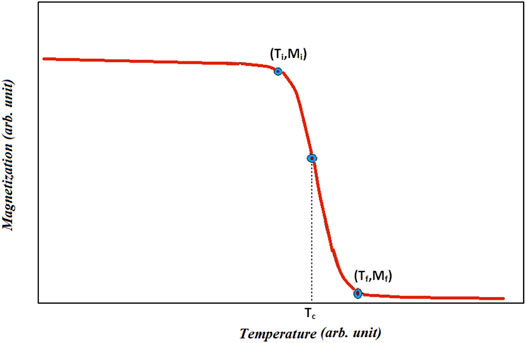
FIGURE 1. Isofield magnetization vs. temperature.
The numerical evaluation of ∆SM of LCAMO under Hext variation (ΔH) can be derived from Maxwell’s relation and derived from Eq. 1 as follows:
From Eq. 4, we can easily calculate ΔSM(T) by determining the Mi, Mf, θc, β, and γ from isofield M(T) curves. Moreover, a maximum value of ∆SM(
The full-width at half-maximum (
A magnetic cooling efficiency of LCAMO is expected by considering the magnitude of
The
Results and Discussion
At values of Hext <5 T, there are two magnetic transitions of LCAMO, as can be observed in Figure 2, at two different temperatufvariation, which is about 57% of the correspondingres. It is possible that this is due to the presence of a canted FM phase in the FM matrix, which can be attributed to the additional Ag content (Jeddi et al., 2020), thus expecting two peaks in the ΔSM curves. However, at Hext = 5 T, it seems like a single magnetic transition of LCAMO, expecting a single peak in the ΔSM curve. It is possible that this is due to the presence of a strong interatomic double exchange interaction at Hext = 5 T. To simulate the MCE of LCAMO, the PM parameters (Mi, Mf, ɵc, β, and α) of LCAMO for each magnetic transition were determined directly from experimental data (isofield magnetization vs. temperature) as in Jeddi et al. (2020). We can see from Figure 2 that there is a good agreement between the experimental and theoretical results of M(T), confirming the good fit of this model for simulating the MCE of LCAMO. This work demonstrates the good coincidence between the experimental data and the continuous curves given by PM, indicating that this model allows us to predict the MCE for LCAMO under different magnetic fields. The M(T) curves of LCAMO demonstrate the magnetic transition from the FM phase to a paramagnetic one under different magnetic fields. The
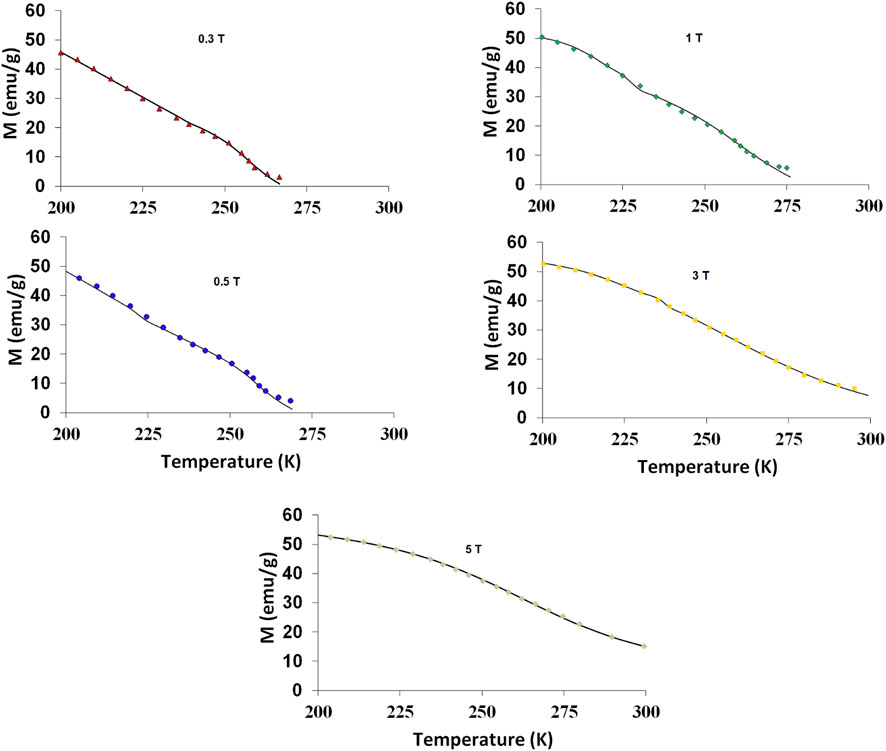
FIGURE 2. Magnetization vs. temperature for La0.5Ca0.1Ag0.4MnO3. The dashed curves are modeled results, and the symbols represent experimental data from Jeddi et al. (2020).
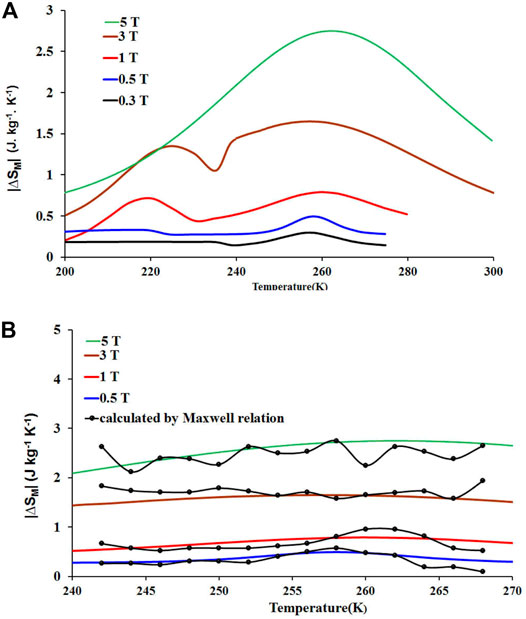
FIGURE 3. (A) ∆SM and (B) ∆SM(T) was calculated by Maxwell relation, and ∆SM(T) was calculated by a phenomenological model.
Figure 4 shows that ∆CP,H(T) has an inverse change from a negative change to a positive one at around
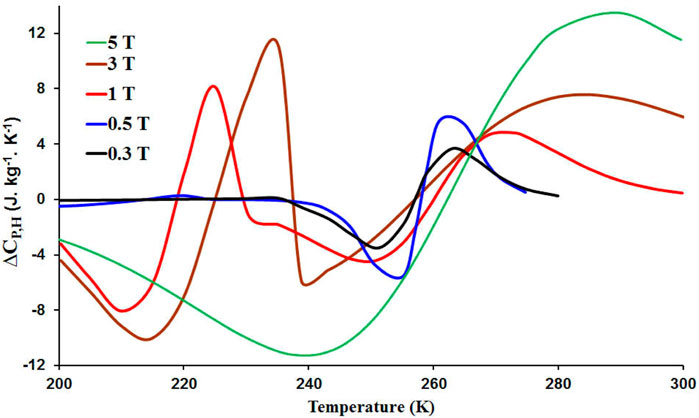
FIGURE 4. ∆CP,H vs. temperature for La0.5Ca0.1Ag0.4MnO3.
Figures 5–8 show the values of |∆SMax|, δTFWHM, RCP, and ∆CP,H(Max) (maximum value of ∆CP,H) for LCAMO, respectively. It is clear that |∆SMax|, RCP, and ∆CP,H(max) show a general increase with an increase in ∆H due to enhancing the variations of alignment in the local spins with an increase in ∆H, resulting in an increase in MC properties.
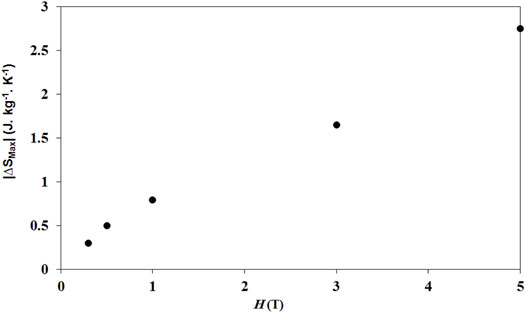
FIGURE 5. |∆SMax| vs. ∆H for La0.5Ca0.1Ag0.4MnO3.
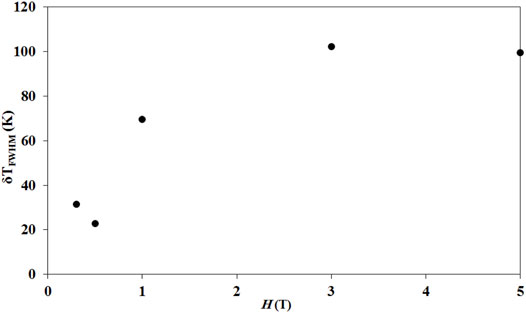
FIGURE 6. δTFWHM vs. ∆H for La0.5Ca0.1Ag0.4MnO3.
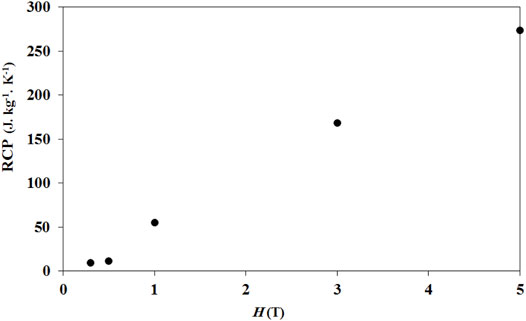
FIGURE 7. Relative cooling power vs. ∆H for La0.5Ca0.1Ag0.4MnO3.
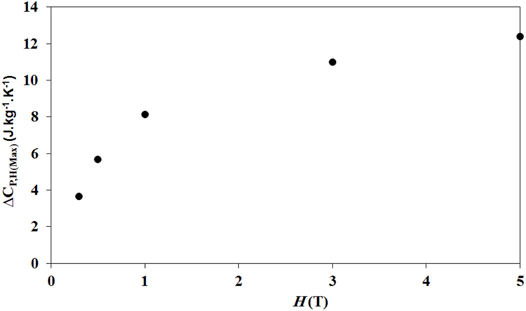
FIGURE 8. ∆CP,H(max) vs. ∆H for La0.5Ca0.1Ag0.4MnO3.
These large values of |∆SMax|, δTFWHM, RCP, and ∆CP,H(Max) in LCAMO prevailed as well in perovskite manganite due to the strong coupling between spin and lattice (Dhahri et al., 2008). Since lattice change is associated to magnetic transition in the manganite, this caused a further change in the magnetism of manganite (Dhahri et al., 2008). Furthermore, the bond distance of <Mn–O> plus bond angle <Mn–O–Mn> changes to favor the spin ordering with a high value of Hext, leading to enhanced |∆SMax|, δTFWHM, RCP, and ∆CP,H(Max) in LCAMO (Radaelli et al., 1995; Hamad, 2015b).
Table 1 gives a comparative importance of the MCE parameters of LCAMO with those of various materials in terms of the high values of ΔH in previous works (Álvarez-Alonso et al., 2013; Hamad, 2013; Saadaoui et al., 2013; Ho et al., 2014; Bhumireddi et al., 2015; Boutahar et al., 2015; Jerbi et al., 2015; Gupta and Poddar, 2016; Mansouri et al., 2016; Oubla et al., 2016; Long et al., 2018; Biswal et al., 2019; El Boubekri et al., 2020). The MCE parameters of LCAMO are significantly larger than some MCE parameters of MC samples in the corresponding values of ΔH and the higher ones. From this comparative image, we conclude that LCAMO can function as a favorable MC magnet for the MR.
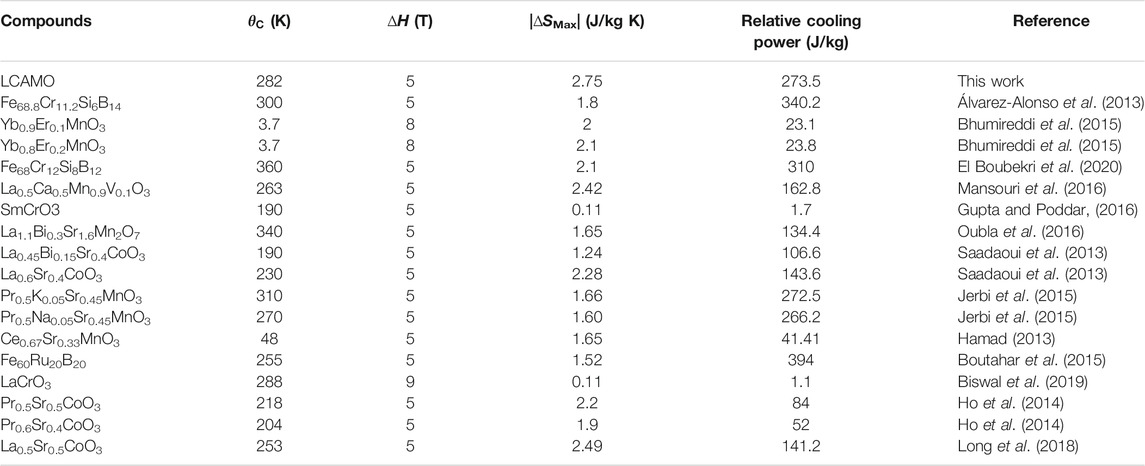
TABLE 1. The comparison of magnetocaloric effect parameters for La0.5Ca0.1Ag0.4MnO3 (LCAMO) with corresponding ones of various magnetocaloric effect materials in high ∆H.
Conclusion
Based on thermodynamic calculation via PM, the MCE of LCAMO is simulated under different values of variation in Hext. The MCE of LCAMO is strongly tunable with the value of the variation of Hext. Therefore, LCAMO can be used over a wide temperature range as an effective material for MR, covering a large range of temperatures, including room temperature and lower and higher ones. The MCE of LCAMO is tunable with the variation of Hext, proving that LCAMO is practically more helpful as a MC magnet for the development of MRs in an extensive temperature range, including room temperature. The values of the MCE parameters of LCAMO are practically greater than the MCE ones of some MC samples in earlier works.
Data Availability Statement
The original contributions presented in the study are included in the article/supplementary material. Further inquiries can be directed to the corresponding author.
Author Contributions
All authors listed have made a substantial, direct, and intellectual contribution to the work and approved it for publication.
Conflict of Interest
The authors declare that the research was conducted in the absence of any commercial or financial relationships that could be construed as a potential conflict of interest.
Publisher’s Note
All claims expressed in this article are solely those of the authors and do not necessarily represent those of their affiliated organizations or those of the publisher, the editors, and the reviewers. Any product that may be evaluated in this article or claim that may be made by its manufacturer is not guaranteed or endorsed by the publisher.
References
Ahmed, E. M., Alamri, H. R., Elghnam, S. M., Eldarawi, O., Tawfik, T. E., Mahmoud, A. M., et al. (2021). Tuning Magnetocaloric Properties for La1 - xSrxCoO3. Phys. Solid State. doi:10.1134/S1063783421100024
Ahmed, E. M., Hemeda, O. M., Alamri, H. R., Elghnam, S. M., and Hamad, M. A. (2021). Investigation of Thermomagnetic Properties in Ca3Co2O6 over Cryogenic Temperature between 0 and 100 K. Phase Transitions. 94, 835–841. doi:10.1080/01411594.2021.1975706
Álvarez-Alonso, P., Santos, J. D., Pérez, M. J., Sánchez-Valdes, C. F., Sánchez, J. L., and Gorria, P. (2013). The Substitution Effect of Chromium on the Magnetic Properties of (Fe1− xCrx) 80Si6B14 Metallic Glasses (0.02≤ X≤ 0.14). J.Magn.Magn.Mater. 347, 75–78.
Alzahrani, B., Hsini, M., Hcini, S., Boudard, M., Dhahri, A., and Bouazizi, M. L. (2020). Study of the Magnetocaloric Effect by Means of Theoretical Models in La0.6Ca0.2Na0.2MnO3 Manganite Compound. J. Low Temp Phys. 200, 26–39. doi:10.1007/s10909-020-02455-w
Belhamra, S., Masrour, R., Jabar, A., and Hlil, E. K. (2021). A Comparative Study of the Structural, Electronic, Magnetic Properties and Magnetocaloric Effect of Perovskite LaRO3 (R = Mn, Cr and Fe). Polyhedron. 193, 114891. doi:10.1016/j.poly.2020.114891
Bhumireddi, S., Bhatnagar, A. K., Singh, D., Rayaprol, S., Das, D., and Ganesan, V. (2015). Specific Heat and Magnetocaloric Studies of Hexagonal Yb1−xErxMnO3. Mater. Lett. 161, 419–422. doi:10.1016/j.matlet.2015.08.151
Biswal, H., Singh, V., Nath, R., Angappane, S., and Sahu, J. R. (2019). Magnetic and Magnetocaloric Properties of LaCr1-xMnxO3 (X = 0, 0.05, 0.1). Ceramics Int. 45, 22731–22736. doi:10.1016/j.ceramint.2019.07.311
Boutahar, A., Lassri, H., and Hlil, E. K. (2015). Magnetic, Magnetocaloric Properties and Phenomenological Model in Amorphous Fe60Ru20B20 Alloy. Solid State. Commun. 221, 9–13. doi:10.1016/j.ssc.2015.08.002
Choura-Maatar, S., Nofal, M. M., M’nassri, R., Cheikhrouhou-Koubaa, W., Chniba-Boudjada, N., and Cheikhrouhou, A. (2020). Enhancement of the Magnetic and Magnetocaloric Properties by Na Substitution for Ca of La0.8Ca0.2MnO3 Manganite Prepared via the Pechini-type Sol-Gel Process. J. Mater. Sci. Mater. Electron. 31, 1634–1645. doi:10.1007/s10854-019-02680-4
Dhahri, A., Dhahri, E., and Hlil, E. K. (2014). Structural Characterization, Magnetic Properties and Magnetocaloric Effects of La0.75Sr0.25Mn1-X Cr X O3 (X = 0.15, 0.20, and 0.25). Appl. Phys. A. 116, 2077–2085. doi:10.1007/s00339-014-8404-5
Dhahri, A., Jemmali, M., Dhahri, E., and Valente, M. A. (2015). Structural Characterization, Magnetic, Magnetocaloric Properties and Phenomenological Model in Manganite La0.75 Sr0.1Ca0.15 MnO3 Compound. J. Alloys Compounds. 638, 221–227. doi:10.1016/j.jallcom.2015.01.314
Dhahri, J., Dhahri, A., Oumezzine, M., and Dhahri, E. (2008). Effect of Sn-Doping on the Structural, Magnetic and Magnetocaloric Properties of La0.67Ba0.33Mn1−xSnxO3 Compounds. J. Magnetism Magn. Mater. 320, 2613–2617. . doi:10.1016/j.jmmm.2008.05.030
El Boubekri, A., Tillaoui, S., Sajieddine, M., Sahlaoui, M., Lassri, H., Hlil, E. K., et al. (2020). Magnetic and Magnetocaloric Properties of Fe68+Cr12−Si8B12 Ribbons. J. Magnetism Magn. Mater. 507, 166819. doi:10.1016/j.jmmm.2020.166819
El-Sayed, A. H., and Hamad, M. A. (2019a). Nickle Concentration Effect on Low Magnetic Field Magnetocaloric Properties for Ni2+xMn1−xGe. J. Supercond. Nov. Magn. 32, 1447–1450. doi:10.1007/s10948-018-4855-9
El-Sayed, A. H., and Hamad, M. A. (2019b). Tailoring Thermomagnetic Properties in Pb(Zr0.52Ti0.48)O3-Ni(1−x)ZnxFe2O4. Phase Transitions. 92, 517–524. doi:10.1080/01411594.2019.1597096
ErchidiElyacoubi, A. S., Masrour, R., and Jabar, A. (2018a). Surface Effects on the Magnetocaloric Properties of Perovskites Ferromagnetic Thin Films: A Monte Carlo Study. Appl. Surf. Sci. 459, 537–543. . doi:10.1016/j.apsusc.2018.08.020
ErchidiElyacoubi, A. S., Masrour, R., and Jabar, A. (2018b). Magnetocaloric Effect and Magnetic Properties in SmFe1-xMnxO3 Perovskite: Monte Carlo Simulations. Solid State. Commun. 271, 39–43. . doi:10.1016/j.ssc.2017.12.015
Erchidi Elyacoubi, A. S., Masrour, R., Jabar, A., Ellouze, M., and Hlil, E. K. (2018c). Magnetic Properties and Magnetocaloric Effect in Double Sr2FeMoO6 Perovskites. Mater. Res. Bull. 99, 132–135. doi:10.1016/j.materresbull.2017.10.037
Felhi, H., Dhahri, R., Smari, M., Dhahri, E., and Hlil, E. K. (2019). Magnetocaloric Effect and Critical Behaviour of La0.5Ca0.2Ag0.3MnO3 Compound. Chem. Phys. Lett. 733, 136632. doi:10.1016/j.cplett.2019.136632
Gupta, P., and Poddar, P. (2016). Study of Magnetic and thermal Properties of SmCrO3 Polycrystallites. RSC Adv. 6, 82014–82023. doi:10.1039/c6ra17203b
Hamad, M. A. (2012). Prediction of Thermomagnetic Properties of La0.67Ca0.33MnO3and La0.67Sr0.33MnO3. Phase Transitions 85, 106–112. doi:10.1080/01411594.2011.605027
Hamad, M. A. (2013). Magnetocaloric Effect of Perovskite Manganites Ce0.67Sr0.33MnO3. J. Supercond Nov Magn. 26, 2981–2984. doi:10.1007/s10948-013-2124-5
Hamad, M. A. (2015a). Lanthanum Concentration Effect of Magnetocaloric Properties in Lax MnO3−δ. J. Supercond Nov Magn. 28, 173. doi:10.1007/s10948-014-2834-3
Hamad, M. A. (2015b). Magnetocaloric Effect in Sr2FeMoO6/Ag Composites. Process. Appl. Ceram. 9, 11. doi:10.2298/PAC1501011H
Hamad, M. A. (2015c). Effects of Addition of Rare Earth on Magnetocaloric Effect in Fe82Nb2 B 14. J. Supercond. Nov. Magn. 28, 3111–3115. doi:10.1007/s10948-015-3140-4
Hamad, M. A. (2015d). Magnetocaloric Effect in La1-X Ce X MnO3. J. Adv. Ceram. 4, 206–210. doi:10.1007/s40145-015-0150-4
Hamad, M. A., Hemeda, O. M., and Mohamed, A. M. (2020). Investigations on Enhancing Thermomagnetic Properties in CoxZn1−xFe2O4. J. Supercond. Nov. Magn. 33, 2753–2757. doi:10.1007/s10948-020-05503-4
Hamad, M. A., Hemeda, O. M., Alamri, H. R., and Mohamed, A. M. (2021). Investigations on Thermomagnetic Properties of YbFe2As2. J. Low Temp Phys. 202, 121–127. . doi:10.1007/s10909-020-02528-w
Henchiri, C., Mnasri, T., Benali, A., Hamdi, R., Dhahri, E., Valente, M. A., et al. (2020). Structural Study and Large Magnetocaloric Entropy Change at Room Temperature of La1−x□xMnO3 Compounds. RSC Adv. 10, 8352–8363. doi:10.1039/c9ra10469k
Ho, T. A., Thanh, T. D., Ho, T. O., Tran, Q. T., Phan, T. L., and Yu, S. C. (2014). Critical Behavior and Magnetocaloric Effect of Pr1-xSrxCoO3. IEEE Trans. Magn. 50, 2505104. doi:10.1109/tmag.2014.2322906
Jebari, H., Tahiri, N., Boujnah, M., El Bounagui, O., Taibi, M., and Ez-Zahraouy, H. (2021). Theoretical Investigation of Electronic, Magnetic and Magnetocaloric Properties of Bi25FeO40 Compound. Phase Transitions. 94, 147–158. doi:10.1080/01411594.2021.1931690
Jeddi, M., Gharsallah, H., Bekri, M., Dhahri, E., and Hlil, E. K. (2020). Phenomenological Modeling of Magnetocaloric Properties in 0.75La0.6Ca0.4MnO3/0.25La0.6Sr0.4MnO3 Nanocomposite Manganite. J. Low Temp Phys. 198, 135–144. doi:10.1007/s10909-019-02256-w
Jerbi, A., Krichene, A., Chniba-Boudjada, N., and Boujelben, W. (2015). Magnetic and Magnetocaloric Study of Manganite Compounds Pr0.5A0.05Sr0.45MnO3 (A=Na and K) and Composite. Physica B: Condensed Matter 477, 75–82. doi:10.1016/j.physb.2015.08.022
Kadim, G., Masrour, R., and Jabar, A. (2020). Large Magnetocaloric Effect, Magnetic and Electronic Properties in Ho3Pd2 Compound: Ab Initio Calculations and Monte Carlo Simulations. J. Magnetism Magn. Mater. 499, 166263. . doi:10.1016/j.jmmm.2019.166263
Kadim, G., Masrour, R., Jabar, A., and Hlil, E. K. (2021a). Room-Temperature Large Magnetocaloric, Electronic and Magnetic Properties in La0.75Sr0.25MnO3 Manganite: Ab Initio Calculations and Monte Carlo Simulations. Physica A: Stat. Mech. its Appl. 573, 125936. doi:10.1016/j.physa.2021.125936
Kadim, G., Masrour, R., and Jabar, A. (2021b). Magnetocaloric Effect, Electronic and Magnetic Properties of Ba1-xSrxFeO3 Barium-Strontium Ferrites: Monte Carlo Simulations and Comparative Study between TB-mBJ and GGA+U. Mater. Today Commun. 26, 102071. doi:10.1016/j.mtcomm.2021.102071
Laajimi, K., Khlifi, M., Hlil, E. K., Gazzah, M. H., Ayed, M. B., Belmabrouk, H., et al. (2020). Influence of Sr Substitution on Structural, Magnetic and Magnetocaloric Properties in La0.67Ca0.33−xSrxMn0.98Ni0.02O3 Manganites. J. Mater. Sci. Mater. Electron. 31, 15322–15335. . doi:10.1007/s10854-020-04096-x
Labidi, S., Masrour, R., Jabar, A., and Ellouze, M. (2021). Mechanical, Electronic and Magnetic Properties of Double Sr2FeMoO6 Perovskite: Density Functional Theory and Monte Carlo Simulation. J. Magnetism Magn. Mater. 523, 167594. . doi:10.1016/j.jmmm.2020.167594
Long, P. T., Manh, T. V., Ho, T. A., Dongquoc, V., Zhang, P., and Yu, S. C. (2018). Magnetocaloric Effect in La1-xSrxCoO3 Undergoing a Second-Order Phase Transition. Ceramics Int. 44, 15542–15549. doi:10.1016/j.ceramint.2018.05.216
Mansouri, M., Omrani, H., Cheikhrouhou-Koubaa, W., Koubaa, M., Madouri, A., and Cheikhrouhou, A. (2016). Effect of Vanadium Doping on Structural, Magnetic and Magnetocaloric Properties of La 0.5 Ca 0.5 MnO 3. J. Magnetism Magn. Mater. 401, 593–599. doi:10.1016/j.jmmm.2015.10.066
Masrour, R., Jabar, A., Benyoussef, A., Hamedoun, M., and Hlil, E. K. (2016). Monte Carlo Simulation Study of Magnetocaloric Effect in NdMnO 3 Perovskite. J. Magnetism Magn. Mater. 401, 91–95. . doi:10.1016/j.jmmm.2015.10.019
Masrour, R., Jabar, A., Khlif, H., Jemaa, F. B., Ellouze, M., and Hlil, E. K. (2017). Experiment, Mean Field Theory and Monte Carlo Simulations of the Magnetocaloric Effect in La 0.67 Ba 0.22 Sr 0.11 MnO 3 Compound. Solid State. Commun. 268, 64–69. . doi:10.1016/j.ssc.2017.10.003
Oubla, M., Lamire, M., Boutahar, A., Lassri, H., Manoun, B., and Hlil, E. K. (2016). Structural, Magnetic and Magnetocaloric Properties of Layered Perovskite La1.1Bi0.3Sr1.6Mn2O7. J. Magnetism Magn. Mater. 403, 114–117. doi:10.1016/j.jmmm.2015.11.076
Radaelli, P. G., Cox, D. E., Marezio, M., Cheong, S.-W., Schiffer, P. E., and Ramirez, A. P. (1995). Simultaneous Structural, Magnetic, and Electronic Transitions inLa1−xCaxMnO3withx=0.25 and 0.50. Phys. Rev. Lett. 75, 4488–4491. doi:10.1103/physrevlett.75.4488
Saadaoui, F., Koubaa, M., Cheikhrouhou-Koubaa, W., and Cheikhrouhou, A. (2013). Effects of Bismuth Doping on the Physical Properties of La0.6−x Bi X Sr0.4CoO3 (0≤x≤0.15) Cobaltites. J. Supercond. Nov. Magn. 26, 3043–3047. doi:10.1007/s10948-013-2122-7
Keywords: magnetocaloric effect, phenomenological model, phase transition, perovskite, entropy change
Citation: Hamad MA and Alamri HR (2022) Investigations on Strong-Tuned Magnetocaloric Effect in La0.5Ca0.1Ag0.4MnO3. Front. Mater. 9:832703. doi: 10.3389/fmats.2022.832703
Received: 10 December 2021; Accepted: 04 January 2022;
Published: 08 February 2022.
Edited by:
Wissem Cheikhrouhou-Koubaa, Centre de Recherche en Numérique de Sfax (CRNS), TunisiaReviewed by:
Rachid Masrour, Sidi Mohamed Ben Abdellah University, MoroccoGaofeng Wang, Inner Mongolia University of Science and Technology, China
Copyright © 2022 Hamad and Alamri. This is an open-access article distributed under the terms of the Creative Commons Attribution License (CC BY). The use, distribution or reproduction in other forums is permitted, provided the original author(s) and the copyright owner(s) are credited and that the original publication in this journal is cited, in accordance with accepted academic practice. No use, distribution or reproduction is permitted which does not comply with these terms.
*Correspondence: Mahmoud A. Hamad, bV9oYW1hZDc2QHlhaG9vLmNvbQ==