 Dong Li Zhang1,2
 Wei Tang
- 1Center on Nanoenergy Research, School of Physical Science and Technology, Guangxi University, Nanning, China
- 2CAS Center for Excellence in Nanoscience, Beijing Institute of Nanoenergy and Nanosystems, Chinese Academy of Sciences, Beijing, China
- 3Institute of Nuclear Physics and Chemistry, China Academy of Engineering Physics, Mianyang, China
- 4School of Nanoscience and Technology, University of Chinese Academy of Sciences, Beijing, China
- 5Institute of Applied Nanotechnology, Jiaxing, China
- 6School of Material Science and Engineering, Georgia Institute of Technology, Atlanta, GA, United States
Triboelectric Nanogenerators (TENGs) have been regarded as an effective method to solve the energy problem since they were first demonstrated in 2012. Due to their high-power generation and low cost, TENGs have been widely applied in the fields of energy, security, biomedicine, the environment, and so on. For now, many researchers are focusing on contact electrification (CE) and surface modification in order to discover the fundamental CE mechanism and approaches to further enhance the performance of TENG devices. In this work, we employ gamma radiation (
Introduction
With a rapid increase in portable electronics and wireless sensing networks, triboelectric nanogenerators (TENGs) as a sustainable power source that can scavenge ambient mechanical energy for these devices is a research focus. Various approaches based on piezoelectric (Chang et al., 2010; S. Q.; Lin, Xu, Zhu, et al., 2019; Wang and Song., 2006; S.; Xu et al., 2010; Yang et al., 2009), electromagnetic (Glynne-Jones et al., 2004; Beeby et al., 2007), and electrostatic (Mitcheson et al., 2004; Naruse et al., 2009) effects have been demonstrated for decades. Recently, combining contact electrification (CE) and the electrostatic induction effect, TENGs are newly-invented (Fan et al., 2012; Wang, 2013; Wang et al., 2015; Fan et al., 2016). They are driven by the displacement current derived from the Maxwell equations (Z. L. Wang, 2017a; Wang, 2020), and their desirable features include low cost, diverse materials choices, a significant high-power output, and a high energy conversion efficiency (Tang et al., 2015). TENGs have the promise to enable self-powered, autonomous electronics and potentially large-scale power generation (Z.L. Wang, 2017b).
However, the output is dictated by the contact electrification (CE) induced charge density at the interface (Zi et al., 2015; Xia et al., 2020). Many researchers are focusing on investigating the CE mechanism and surface modifications in order to find out the fundamental theory and approaches to further enhance the performance of TENG devices. Xu et al. and Lin et al. discovered the thermal electron emission in the CE process between two inorganic solids (S. Q. Lin, Xu, Xu, et al., 2019; C. Xu et al., 2018), and then Lin et al. found out the influence of photoelectric effect on the CE process (S. Q. Lin, Xu, Zhu, et al., 2019). These works pointed out that electron transfer plays a dominant role during solid CE processes. As for the surface modification, chemical (Cheong et al., 2021), or physical (Jeong et al., 2014) methods are widely employed before, as discussed in the literature (Fan et al., 2016). Recently, Chen et al. first developed He ion irradiation, and successfully manipulated the triboelectric surface charge density of polymers (Li et al., 2020). Weng et al. studied the microstructure, mechanical, and tribological properties of gamma-irradiated polymers (Chai et al., 2021).
In this work, we investigated the polymer-metal contact electrification, and these polymers were treated with gamma radiation, one of the mature material surface chemotherapy(Rosiak et al., 2002; Khatipov et al., 2009). After treatment, it was found that, due to the high energy of the γ ray, some chemical bonds in the polymer, including C-F and C-Cl in PTFE and PVC, were destroyed, respectively, and then some C=C bonds were formed. This changed the electron transfer ability of the original polymer molecule. As a consequence, the CE process between PTFE/PVC and metal was enhanced. Meanwhile, Kapton remained stable even after a 1 Mgy-dose radiation, indicating it could be feasibly used for sensing or energy generation in space, or environments where radiation exists.
Results and Discussions
Four kinds of dielectric materials were chosen: polytetrafluoroethylene (PTFE), polyimide (Kapton), polyvinyl chloride (PVC), and polyethylene terephthalate (PET). Samples were put in the radiation condition at room temperature at 1 atm pressure. The gamma irradiation was provided by a 60Co source at dose rates of 0.06, 0.1, and 1 Gy/s, in the Institute of Nuclear Physics and Chemistry, China Academy of Engineering Physics. Figure 1A shows a schematic of radiation-induced reactions that might occur. Figure 1B illustrates the electrical measurement setup. Radiation-treated samples were fixed on the right part, with its back-side coated with the induction electrode; aluminum served as the contact metal and was fixed on the left part. A linear motor was employed for periodical contacts and separations. This configuration simply forms a triboelectric nanogenerator (TENG), whose output performance reflects the CE process between aluminum and polymers. The measurement principle is shown in Figure 1C. When aluminum contacts the polymer, charges will be formed at the interface. As reported in the literature (L. Lin et al., 2013; Tang et al., 2014), Al is normally positively charged, whereas the polymer is negatively charged. When the Al moves upward (from state i to state ii), the charges at the interface regions are separated, which will induce a higher potential in Al than in the polymer; thus the electrons in the induction electrode will be driven to flow to Al through the external circuit (forming a current flow in the reverse direction, Figure 1C-ii). In this process, electrons keep flowing until the Al reaches the farthest point, which is represented by Figure 1C-iii. At this moment, the amount of transferred charges between the two electrodes reaches the maximum value, strongly related to the charge density in the CE interface (Zi et al., 2015). As Al moves backward, the electrons will flow back in the opposite direction from Al to the induction electrode (Figure 1C-iv). The entire period is completed.
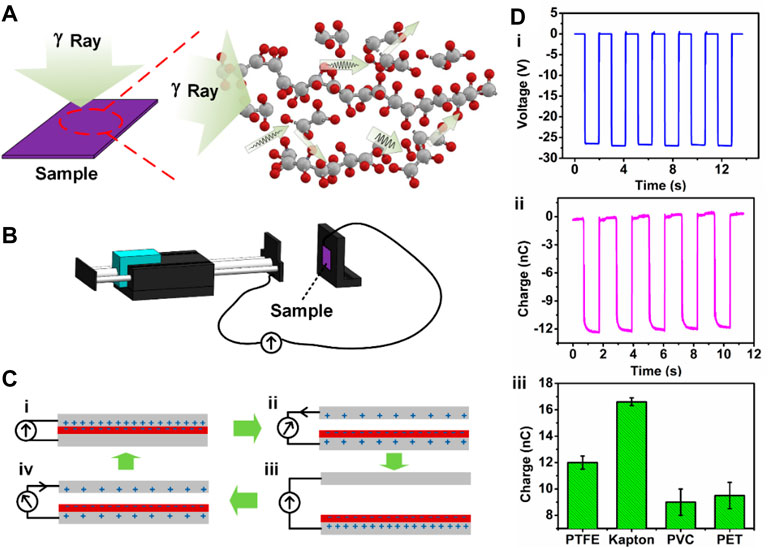
FIGURE 1. (A) Gamma radiation-induced modifications on the polymer; (B) experimental testing setup; (C) the sketch of the measurement principle; (D) the measured data of the PTFE TENG with the triggering frequency of 1 Hz: voltage, transferred charge; and a charge comparison of the PTFE, Kapton, PVC, and PET TENG.
The electrical characteristics of the original samples were measured at a triggering frequency of 1 Hz. As for the PTFE, the open-circuit voltage (Voc), and the transferred charges (Q) are displayed in Figure 1D. It can be observed that the PTFE TENG delivered an output performance as Voc = 27 V and Q = 12 nC. Outputs of Kapton, PVC, and PET TENG are plotted in Supplementary Figure S1. Transferred charges of four materials are compared in Figures 1D-iii. Kapton achieved the highest value of 16.6 nC. PVC and PET obtained 9 and 9.5 nC, respectively. Since the transferred charges are strongly correlated with the surface charge density at the interface, it is selected as the evaluation criteria in our experiments.
Then, we irradiated samples at a fixed rate of 1 Gy/s, with different doses, including 0, 1, 5, 10, 20, 50, and 100 kGy. Testing results are plotted in Figures 2A–D. As for PTFE, the output charge Q was around 11–12 nC, when the radiation dose was small. As the dose increased to 10 kGy, Q got larger, up to 13.8 nC. When the dose came to 20 kGy, Q reached 20.7 nC, showing an apparent enhancement. Afterward, Q remained relatively stable with the radiation dose increasing further. This result implies that the gamma radiation induces modifications at the PTFE surface, which further enhances the CE process. In contrast, Kapton, PVC, and PET were also tested and illustrated in Figures 2B–D. It is found that Kapton samples remained stable with an output charge around 15–17 nC. PVC showed a similar behavior as the PTFE did. Whereas, PET’s output decreased with the increase of the radiation dose.
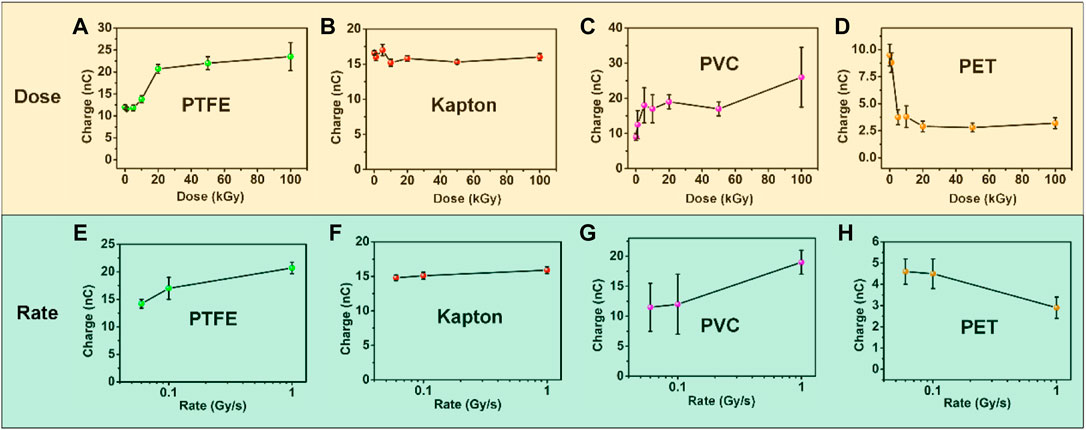
FIGURE 2. Output charges of four polymers under various doses at a certain radiation rate of 1 Gy/s: (A) PTFE; (B) Kapton; (C) PVC; (D) PET. As the radiation dose goes up, the output charge of PTFE gets larger. Kapton kept stable. PVC shows a similar behavior as PTFE, whereas PET shows an opposite trend. Output under various rates at a fixed dose of 20 kGy: (E) PTFE; (F) Kapton; (G) PVC; (H) PET. Kapton still shows as very stable. PTFE and PVC’s output becomes higher, whereas PET’s becomes lower, as the radiation rate increases.
Subsequently, we examined the influence of the radiation rate on the CE process, with a fixed dose of 20 kGy. Results are shown in Figures 2E–H. It can be found that the influence of the rate is similar to that of the dose, which can be explained that the stronger radiation rate leads to more reactions in the material with a certain duration, and thus induces more modifications.
To figure out what was introduced at the surface by the γ ray, we did Raman and Fourier Transform Infrared Spectroscopy (FTIR) tests on the samples. Taking PTFE as an example, Raman tests on samples under 0, 10, 20, and 100 kGy radiation dose are presented in Figure 3A. As we can see, around 733 cm−1, there is an obvious peak, representing the vibration of–CF2 (Stuart and Briscoe., 1994). However, as the radiation dose increased, the intensity of the peak was lowered gradually, meaning the concentration of -CF2 decreased. According to the previous literature, some C=C bonds formed instead (Khatipov et al., 2009). The main reaction is shown in Figure 5B. Primary products yielded by radiation exposure of PTFE are terminal (·CF2–CF2–) and middle (–CF2–·CF–CF2–) fluoroalkyl macroradicals resulted from the detachment of fluorine atoms and polymer main-chain scission. Then, reactions of atomic fluorine with the middle and terminal radicals yield middle and terminal double bonds. Since PVC processes a similar molecular structure as PTFE, it shows the similar behavior, i.e. Cl atoms partly detached, and C=C double bonds formed (Supplementary Figure S2). Particularly, in Supplementary Figure S1, there is a small swell around 1,600 cm−1 for the irradiated PVC, meaning the formation of C=C bonds. Comparatively, Kapton’s Raman test showed no obvious change after long-term radiation, corresponded to its stable performance.
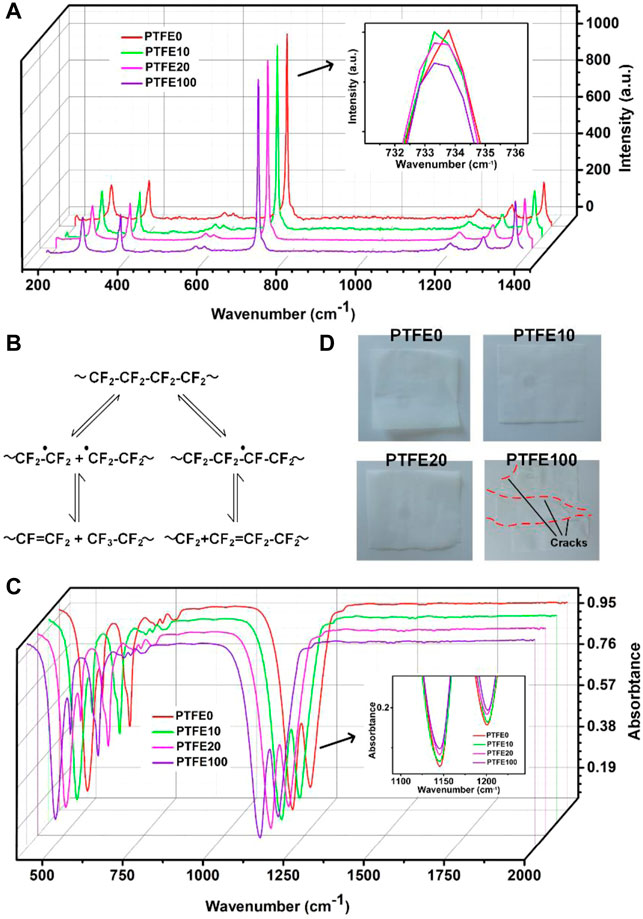
FIGURE 3. FTIR and Raman analysis of PTFE samples: (A) Raman test and zoom in CF2 vibration peak, a slight decrease shows that some C-F bond got broken (similar with the result of PVC samples, Supplementary Figure S2); (B) possible reactions under gamma radiation; (C) FTIR test and zoom in CF2 vibration peak, corresponding with Raman test; (D) optical images of PTFE samples, showing that PTFE after long-time radiation become crumbly.
We also analyzed PTFE samples through FTIR, as shown in Figure 3C. Peaks around 1,150 cm−1 and 1,200 cm−1 stand for -CF2’s stretching vibration and C-C’s vibration. That around 650 cm−1 represents -CF2’s out-of-plane bending vibration. These peaks all show a decrease with the radiation dose increasing, which indicates the detachment of fluorine atoms from the main chain, consistent with the above experiments and analysis. Furthermore, we post PTFE samples’ optical images in Figure 3D. No obvious change can be seen, except for the long-term irradiated samples, which are getting crumbly.
Subsequently, we utilized the first-principle calculation to analyze the change caused by the dielectric material’s molecular structure variation. Figures 4A, B shows the sections of the original PTFE chain and the irradiated PTFE chain (both are terminated with F atoms in the calculations). We assumed C=C bonds are formed between the second and the third C atoms when the C-F bonds are broken. Figures 4C, D presents the difference in electron density of the two molecular models. It shows that, after detaching F atoms, the molecule’s lowest energy state is changed. Thus, its molecular configuration and difference electron density are altered. As a consequence, it leads to a change in the molecular electronic affinity. As shown in Figures 4E, F, it will take up 3.76 eV energy for the original PTFE molecule to get an electron; on the contrary, the new molecule will only take up 0.50 eV energy to get an electron. Therefore, the contact electrification between the irradiated samples and metal was enhanced, which also implies the CE mechanism is related to the behavior of electrons in the interface.
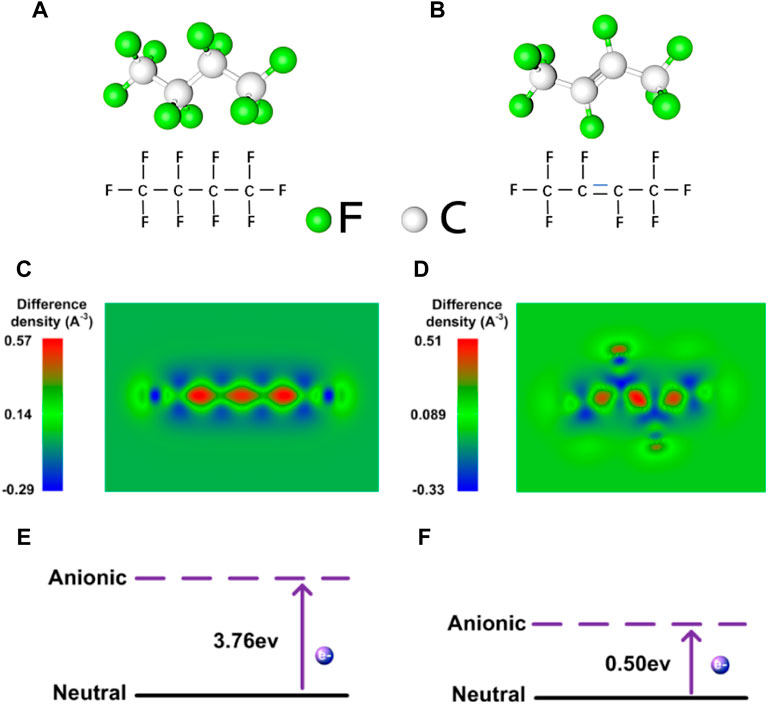
FIGURE 4. First-principle calculation: (A) The original PTFE molecular (part of the chain); (B) the one after gamma radiation, where some C-F bonds are broken, C=C bonds formed; (C) (D) compares the electron difference density of the two molecular models, which suggests that the chemical bond change leads to the change of the electron distribution in the molecular structure, and thus, affect the material’s characteristics, such as the electron attracting ability. (E) The first-principle calculation shows that it will take up 3.76 eV energy for the original PTFE molecular to get an electron; (F) The revised molecular will only take up 0.50 eV energy to get an electron. The above experiment implies that the contact electrification between the gamma-ray irradiated PTFE and metal is enhanced, which also implies the CE mechanism is related to the behavior of electrons in the interface.
Moreover, it is worth noting that the Kapton’s output is stable after the gamma radiation (Figures 2B, F). Raman and FTIR tests also confirmed this (Supplementary Figure S3 and Supplementary Figure S4). As we know, the Galactic Cosmic Rays consist of protons (85%), alpha particles (helium nuclei) (14%), and other rays (less than 1%) (Figure 5A-i). (Normally, to simulate the total-dose response of electronic devices in the natural space environment, the most common laboratory sources are moderate dose rate Co60 (Schwank et al., 2013)) In addition, there exists other working conditions filled with the high-intensity γ ray (Figure 5A-ii). In that case, a self-powered sensor or power source with high radiation resistance would be required. Therefore, we did a further demonstration and found that even after 1 million doses of gamma radiation, the Kapton TENG delivered a stable output, as shown in Figure 5B. Moreover, we used the Kapton TENG to charge a 22 μF capacitor. It can be seen from Figure 5C, that after 6–7 min of triggering with a frequency of 5 Hz, the capacitor’s voltage reached above 3 V, capable of driving some intermittent sensing and data transmitting, or sending an SOS distress signal (Chen et al., 2018).
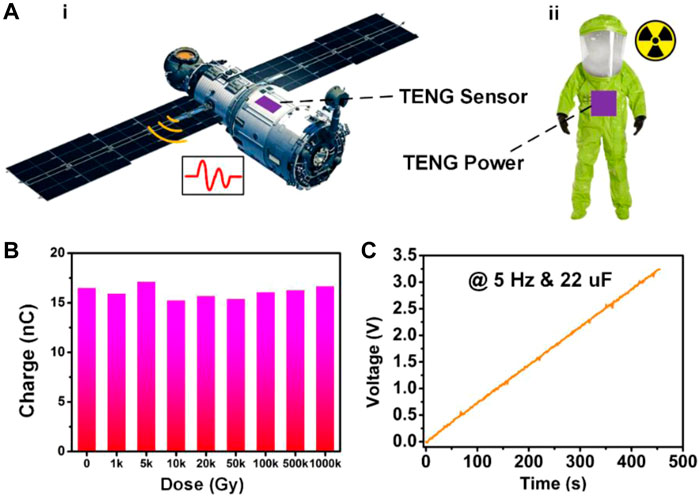
FIGURE 5. Kapton TENG shows stability during the gamma radiation, which suggests it could be feasible for sensing or energy harvesting (A) in space or under some radiation conditions. (B) Radiation stability of the Kapton TENG ranges from 0 to 1,000 kGy; (C) Kapton TENG charges a 22 uF capacitor to 3 V within 6–7 min.
Conclusion
In summary, we introduced gamma-ray radiation to probe the contact electrification between the polymer and the metal. It indicated that, after radiation, the electron affinity of the polymer varied, and significantly changed TENG devices’ output. This reconfirms that the CE mechanism, between the metal and the polymer, is related to the behavior of electrons in the interface. Moreover, this study shows that, as a dielectric material in TENG, Kapton possesses a high radiation resistance, making it able to be used for sensing or energy generation in space, or environments where radiation exists.
Data Availability Statement
The original contributions presented in the study are included in the article/Supplementary Material, further inquiries can be directed to the corresponding authors.
Author Contributions
DZ is responsible for doing experiments and writing papers. JS is responsible for the theoretical calculation of the model. ZW and WT both are responsible for experimental and theoretical guidance and thesis revision.
Funding
The research was sponsored by the National Key R & D Project from the Minister of Science and Technology (2016YFA0202704), Youth Innovation Promotion Association, CAS, Beijing Municipal Science and Technology Commission (Z171100000317001, Z171100002017017, Y3993113DF), and National Natural Science Foundation of China (Grant Nos 51605033, 51432005, 5151101243, 51561145021). Patents have been filed based on the research results presented in this manuscript.
Conflict of Interest
The authors declare that the research was conducted in the absence of any commercial or financial relationships that could be construed as a potential conflict of interest.
Publisher’s Note
All claims expressed in this article are solely those of the authors and do not necessarily represent those of their affiliated organizations, or those of the publisher, the editors and the reviewers. Any product that may be evaluated in this article, or claim that may be made by its manufacturer, is not guaranteed or endorsed by the publisher.
Acknowledgments
We thank Jian Chen of Nanyang University of Technology for his help in the theoretical model calculation. We are grateful to the Institute of Nuclear Physics and Chemistry, China Academy of Engineering Physics for providing the gamma radiation experiment environment.
Supplementary Material
The Supplementary Material for this article can be found online at: https://www.frontiersin.org/articles/10.3389/fmats.2022.878885/full#supplementary-material
References
Beeby, S. P., Torah, R. N., Tudor, M. J., Glynne-Jones, P., O'Donnell, T., Saha, C. R., et al. (2007). A Micro Electromagnetic Generator for Vibration Energy Harvesting. J. Micromech. Microeng. 17 (7), 1257–1265. doi:10.1088/0960-1317/17/7/007
Chai, L., Ning, K., Qiao, L., Wang, P., and Weng, L. (2021). Comparative Study on Microstructure, Mechanical, and Tribological Property of Gamma‐irradiated Polytetrafluoroethylene, Polyetheretherketone, and Polyimide Polymers. Surf. Interface Anal. 54 (1), 13–24. doi:10.1002/sia.7011
Chang, L. Y., Barnard, A. S., Gontard, L. C., and Dunin-Borkowski, R. E. (2010). Resolving the Structure of Active Sites on Platinum Catalytic Nanoparticles. Nano Lett. 10 (8), 3073–3076. doi:10.1021/nl101642f
Chen, B., Tang, W., Jiang, T., Zhu, L., Chen, X., He, C., et al. (2018). Three-dimensional Ultraflexible Triboelectric Nanogenerator Made by 3D Printing. Nano Energy 45, 380–389. doi:10.1016/j.nanoen.2017.12.049
Cheong, J. Y., Koay, J. S. C., Chen, R., Aw, K. C., Velayutham, T. S., Chen, B., et al. (2021). Maximizing the Output Power Density Enhancement of Solid Polymer Electrolyte Based-Triboelectric Nanogenerators via Contact Electrification-Induced Ionic Polarization. Nano Energy 90, 106616. doi:10.1016/j.nanoen.2021.106616
Fan, F.-R., Tian, Z.-Q., and Lin Wang, Z. (2012). Flexible Triboelectric Generator. Nano Energy 1 (2), 328–334. doi:10.1016/j.nanoen.2012.01.004
Fan, F. R., Tang, W., and Wang, Z. L. (2016). Flexible Nanogenerators for Energy Harvesting and Self-Powered Electronics. Adv. Mat. 28 (22), 4283–4305. doi:10.1002/adma.201504299
Glynne-Jones, P., Tudor, M. J., Beeby, S. P., and White, N. M. (2004). An Electromagnetic, Vibration-Powered Generator for Intelligent Sensor Systems. Sensors Actuators A Phys. 110 (1-3), 344–349. doi:10.1016/j.sna.2003.09.045
Jeong, C. K., Baek, K. M., Niu, S., Nam, T. W., Hur, Y. H., Park, D. Y., et al. (2014). Topographically-Designed Triboelectric Nanogenerator via Block Copolymer Self-Assembly. Nano Lett. 14 (12), 7031–7038. doi:10.1021/nl503402c
Khatipov, S. A., Konova, E. M., and Artamonov, N. A. (2009). Radiation-modified Polytetrafluoroethylene: Structure and Properties. Russ. J. Gen. Chem. 79 (9), 2006–2015. doi:10.1134/s1070363209090321
Li, S., Fan, Y., Chen, H., Nie, J., Liang, Y., Tao, X., et al. (2020). Manipulating the Triboelectric Surface Charge Density of Polymers by Low-Energy Helium Ion Irradiation/implantation. Energy Environ. Sci. 13 (3), 896–907. doi:10.1039/c9ee03307f
Lin, L., Wang, S., Xie, Y., Jing, Q., Niu, S., Hu, Y., et al. (2013). Segmentally Structured Disk Triboelectric Nanogenerator for Harvesting Rotational Mechanical Energy. Nano Lett. 13 (6), 2916–2923. doi:10.1021/nl4013002
Lin, S., Xu, L., Xu, C., Chen, X., Wang, A. C., Zhang, B., et al. (2019). Electron Transfer in Nanoscale Contact Electrification: Effect of Temperature in the Metal-Dielectric Case. Adv. Mat. 31 (17), 1808197. doi:10.1002/adma.201808197
Mitcheson, P. D., Miao, P., Stark, B. H., Yeatman, E. M., Holmes, A. S., and Green, T. C. (2004). MEMS Electrostatic Micropower Generator for Low Frequency Operation. Sensors Actuators A Phys. 115 (2-3), 523–529. doi:10.1016/j.sna.2004.04.026
Naruse, Y., Matsubara, N., Mabuchi, K., Izumi, M., and Suzuki, S. (2009). Electrostatic Micro Power Generation from Low-Frequency Vibration Such as Human Motion. J. Micromech. Microeng. 19 (9), 094002. doi:10.1088/0960-1317/19/9/094002
Rosiak, J. M., Janik, I., Kadlubowski, S., Kozicki, M., Kujawa, P., Stasica, P., et al. (2002). Radiation Formation of Hydrogels for Biomedical Application IAEA Report-Radiation Synthesis and Modification of Polymers for Biomedical Applications. Vienna, Austria: Industrial Applications and Chemistry Section International Atomic Energy Agency, 5.
Schwank, J. R., Shaneyfelt, M. R., and Dodd, P. E. (2013). Radiation Hardness Assurance Testing of Microelectronic Devices and Integrated Circuits: Radiation Environments, Physical Mechanisms, and Foundations for Hardness Assurance. IEEE Trans. Nucl. Sci. 60 (3), 2074–2100. doi:10.1109/tns.2013.2254722
Stuart, B. H., and Briscoe, B. J. (1994). A Fourier-Transform Raman-Spectroscopy Study of Poly(ether Ether Katone)/Polytetrafluoroethylene(PEEK/PTFE) Blends. Spectrochim. Acta, Pt. A Mol. Biomol. Spectrosc. 50 (11), 80212. doi:10.1016/0584-8539(94)80212-2
Tang, W., Jiang, T., Fan, F. R., Yu, A. F., Zhang, C., Cao, X., et al. (2015). Liquid-Metal Electrode for High-Performance Triboelectric Nanogenerator at an Instantaneous Energy Conversion Efficiency of 70.6%. Adv. Funct. Mat. 25 (24), 3718. doi:10.1002/adfm.201501331
Tang, W., Zhang, C., Han, C. B., and Wang, Z. L. (2014). Enhancing Output Power of Cylindrical Triboelectric Nanogenerators by Segmentation Design and Multilayer Integration. Adv. Funct. Mat. 24 (42), 6684–6690. doi:10.1002/adfm.201401936
Wang, Z. L. (2017a). Catch Wave Power in Floating Nets. Nature 542 (7640), 159–160. doi:10.1038/542159a
Wang, Z. L., Chen, J., and Lin, L. (2015). Progress in Triboelectric Nanogenerators as a New Energy Technology and Self-Powered Sensors. Energy Environ. Sci. 8 (8), 2250–2282. doi:10.1039/c5ee01532d
Wang, Z. L. (2017b). On Maxwell's Displacement Current for Energy and Sensors: the Origin of Nanogenerators. Mater. Today 20 (2), 74–82. doi:10.1016/j.mattod.2016.12.001
Wang, Z. L. (2020). On the First Principle Theory of Nanogenerators from Maxwell's Equations. Nano Energy 68, 104272. doi:10.1016/j.nanoen.2019.104272
Wang, Z. L., and Song, J. (2006). Piezoelectric Nanogenerators Based on Zinc Oxide Nanowire Arrays. Science 312 (5771), 242–246. doi:10.1126/science.1124005
Wang, Z. L. (2013). Triboelectric Nanogenerators as New Energy Technology for Self-Powered Systems and as Active Mechanical and Chemical Sensors. ACS Nano 7 (11), 9533–9557. doi:10.1021/nn404614z
Xia, X., Wang, H., Guo, H., Xu, C., and Zi, Y. (2020). On the Material-dependent Charge Transfer Mechanism of the Contact Electrification. Nano Energy 78, 105343. doi:10.1016/j.nanoen.2020.105343
Xu, C., Zi, Y., Wang, A. C., Zou, H., Dai, Y., He, X., et al. (2018). On the Electron-Transfer Mechanism in the Contact-Electrification Effect. Adv. Mat. 30 (15), 1706790. doi:10.1002/adma.201706790
Xu, S., Qin, Y., Xu, C., Wei, Y., Yang, R., and Wang, Z. L. (2010). Self-powered Nanowire Devices. Nat. Nanotech 5 (5), 366–373. doi:10.1038/nnano.2010.46
Yang, R., Qin, Y., Dai, L., and Wang, Z. L. (2009). Power Generation with Laterally Packaged Piezoelectric Fine Wires. Nat. Nanotech 4 (1), 34–39. doi:10.1038/nnano.2008.314
Keywords: triboelectric nanogenerator, polymers, surface chemotherapy, gamma radiation, contact electrification
Citation: Zhang DL, Shi JM, Wang ZL and Tang W (2022) Probing Polymer Contact Electrification by Gamma-Ray Radiation. Front. Mater. 9:878885. doi: 10.3389/fmats.2022.878885
Received: 18 February 2022; Accepted: 29 March 2022;
Published: 21 June 2022.
Edited by:
Sihong Wang, The University of Chicago, United StatesCopyright © 2022 Zhang, Shi, Wang and Tang. This is an open-access article distributed under the terms of the Creative Commons Attribution License (CC BY). The use, distribution or reproduction in other forums is permitted, provided the original author(s) and the copyright owner(s) are credited and that the original publication in this journal is cited, in accordance with accepted academic practice. No use, distribution or reproduction is permitted which does not comply with these terms.
*Correspondence: Zhong Lin Wang, emx3YW5nQGdhdGVjaC5lZHU=; Wei Tang, dGFuZ3dlaUBiaW5uLmNhcy5jbg==