 Yang Li1,2*
- 1Aviation and Automobile School, Chongqing Youth Vocational and Technical College, Chongqing, China
- 2College of Physics, Chongqing University, Chongqing, China
The field of topological states in phonon of solids have been rapidly developing in recent years. This work examined the phonon dispersion of a compound Boron Phosphide (BP) with a Zinc-Blende structure via first-principle calculation. The results show that BP is a stable compound in theory and hosts rich topological signatures in its phonon dispersion. Specifically, Weyl and quadratic nodal line states can be found in the acoustic branches, and triple point and quadratic contact triple point can be found in the optical branches. It is hoped that the rich topological states in BP can be imaged by inelastic x-ray scattering or neutron scattering in the near future.
Introduction
Topological electronic materials have been one of the most active research fields in the past decade. To this date, many types of topological electronic materials (Wang, 2008; Li et al., 2009; Hasan and Kane, 2010; Moore, 2010; Qi and Zhang, 2011; Gao et al., 2016; Tokura et al., 2019; Wang et al., 2020a; Yue et al., 2020), including topological insulators (Hasan and Kane, 2010; Moore, 2010; Qi and Zhang, 2011; Tokura et al., 2019), spin-gapless semiconductors (Wang, 2008; Li et al., 2009; Gao et al., 2016; He et al., 2017; Wang et al., 2020a; Yue et al., 2020; Yang et al., 2021), topological semimetals (Vazifeh and Franz, 2013; Yang et al., 2015; Chang et al., 2016; Liu et al., 2019a; Wang et al., 2020b; Li and Xia, 2020; Lim et al., 2020; Liu et al., 2022a), (Li et al., 2020b; Li et al., 2020c; Li et al., 2020d), and topological superconducting (Chung et al., 2011; Stoudenmire et al., 2011; Sato and Ando, 2017; Zhang et al., 2018; Frolov et al., 2020), have been predicted in theory; some of them are also confirmed in experiments. For example, some three-dimensional (3D) material databases documented tens of thousands of candidates as topological semimetals. In 2019, Zhang et al. Zhang et al. (2019a) swept through 39,519 materials in the crystal database and proposed that 8,056 of 39,519 materials have topologically nontrivial properties. In the same year, Vergniory et al. Vergniory et al. (2019) performed a high-throughput search of high-quality materials in the Inorganic Crystal Structure Database (ICSD) database and found 4,078 topological semimetals. Tang et al. Tang et al. (2019) listed 692 topological semimetals with symmetry-dominated band crossing points around the Fermi level using symmetry indicators. In 2022, Yu et al. Yu et al. (2022) exhibited an encyclopedia of emergent particles in three-dimensional crystals. They completed a complete list of all possible particles in time-reversal-invariant systems using systematic symmetry analysis.
Very recently, the studies of topological states are intensively generalized to phonons in crystalline materials (Liu et al., 2020a; Chen et al., 2021a; Li et al., 2021). Many realistic solids with diverse topological signatures (Jin et al., 2018a; Jin et al., 2018b; Liu et al., 2019b; Xia et al., 2019; Li et al., 2020a; Liu et al., 2020b; Wang et al., 2020c; Peng et al., 2020; Zheng et al., 2020; Liu et al., 2021a; Wang et al., 2021a; Xie et al., 2021a; Zhou et al., 2021a; Chen et al., 2021b; Liu et al., 2021b; Wang et al., 2021b; Xie et al., 2021b; Zhou et al., 2021b; Liu et al., 2021c; Wang et al., 2021c; Liu et al., 2021d; Wang et al., 2021d; Zheng et al., 2021; Zhong et al., 2021; Ding et al., 2022a; Wang et al., 2022a; Ding et al., 2022b; Liu et al., 2022b; Wang et al., 2022b; Liu et al., 2022c; Yang et al., 2022) are reported via first-principle calculation and symmetry analysis. For example, in theory, solids with Weyl point phonons (Xia et al., 2019; Liu et al., 2020b; Wang et al., 2020c; Liu et al., 2021b), Dirac point phonons (Chen et al., 2021b), nodal chain phonons (Zhou et al., 2021b), nodal box phonons (Zhou et al., 2021b), nodal cage phonons (Ding et al., 2022a; Wang et al., 2022b), and nodal surface phonons (Xie et al., 2021b; Wang et al., 2021d) have been reported. More interestingly, some topological signatures in the phonon spectrum have been confirmed in an experiment with the help of meV-resolution inelastic X-ray scattering. In two consecutive works (Miao et al., 2018; Zhang et al., 2019b), the double Weyl points and the parity-time reversal symmetry-dominated helical nodal lines are realized in the phonon spectrum of FeSi and MoB2, respectively.
In particular, the coexistence of topological phonons in realistic materials has attracted much attention, such as the coexistence of zero-, one-, and two-dimensional degeneracy phonons (Wang et al., 2021a), hybrid-type nodal-ring and quadratic nodal-line phonons and nodal-net and nodal-link phonons (Zhou et al., 2021b), Dirac nodal line and Weyl nodal line phonons (Wang et al., 2022a). In this work, we focus on a realistic material (Popper and Ingles, 1957), Boron Phosphide (BP), with a Zinc-Blende structure, and study the topological signatures in the phonon dispersion of BP. BP has already been prepared before by the reaction of boron and red phosphorus in an evacuated, sealed silica tube at 1,100°C. BP is with space group F-43m (space group number 216) and contains two atoms, B and P, located at the (0,0,0) and (0.75,0.75,0.75) Wyckoff sites, respectively (see Figure 1A,B). The lattice structure of BP is totally relaxed via first-principle calculation, and the obtained lattice constant is a = b = c = 3.217 Å. To the best of our knowledge, the prosperous topological state has not even been previously reported in the phonon dispersion of BP, and this is the first time to report the topological phonons in the acoustic and optical branches of BP.
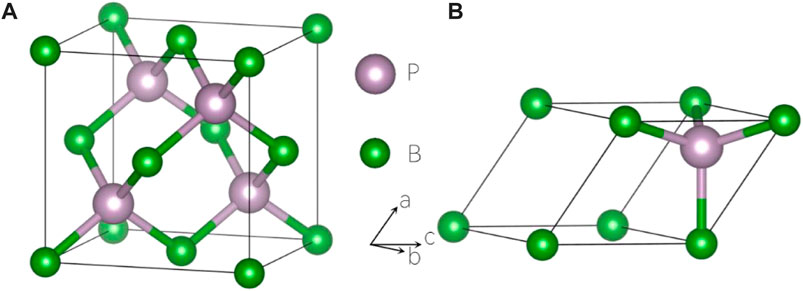
FIGURE 1. (A,B) crystal structure of unit cell and primitive cell of BP.
Computation methods
The theoretical calculation is performed in the framework of density functional theory (Cohen et al., 2012), which is implemented in the Vienna ab initio Simulation Package (Hafner, 2008). The generalized gradient approximation with Perdew-Burke-Ernzerhof formalism (Perdew et al., 1996) is used for the exchange-correlation energy, and the projector augmented wave method (Blöchl, 1994) is applied for the interactions between the ions and valence electrons. Moreover, a cutoff energy of 500 eV is chosen for the plane wave set, and a Γ-centered k grid of 5 × 5 × 5 is sampled for the Brillouin zone. Based on this optimized lattice of BP, we have computed the phonon dispersion spectrum of 2 × 2 × 2 supercell by the density functional perturbation theory, as implemented within the PHONOPY package (Togo and Tanaka, 2015).
Topological states in optical branches
The phonon dispersion of BP along the
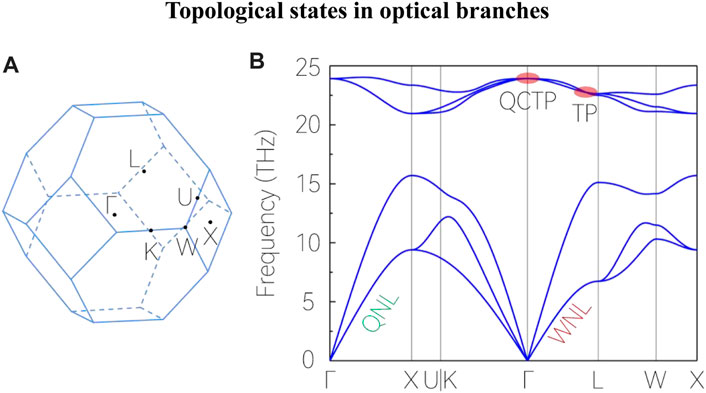
FIGURE 2. (A) Three-dimensional (3D) Brillouin zone (BZ). (B) Phonon dispersion of BP.
For the three optical branches, one finds two crossing points, one is at
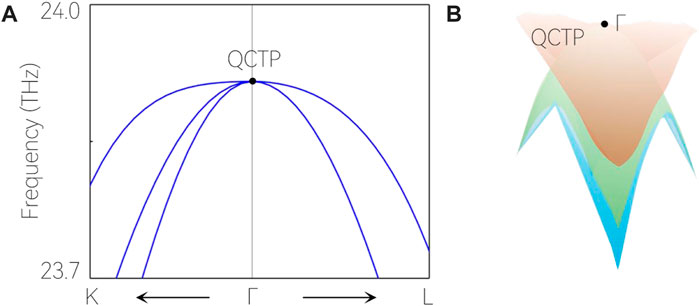
FIGURE 3. (A) Enlarged phonon dispersions of BP along
As shown in Figure 4A, the crossing point on
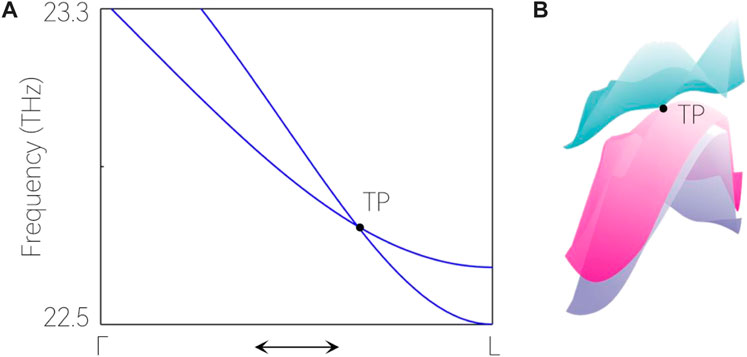
FIGURE 4. (A) Enlarged phonon dispersions of BP along
Topological states in acoustic branches
Then, we come to study the topological states in acoustic branches in BP. As shown in Figure 1C, one finds two doubly degenerate acoustic phonon bands appear along the
The crossing bands along the
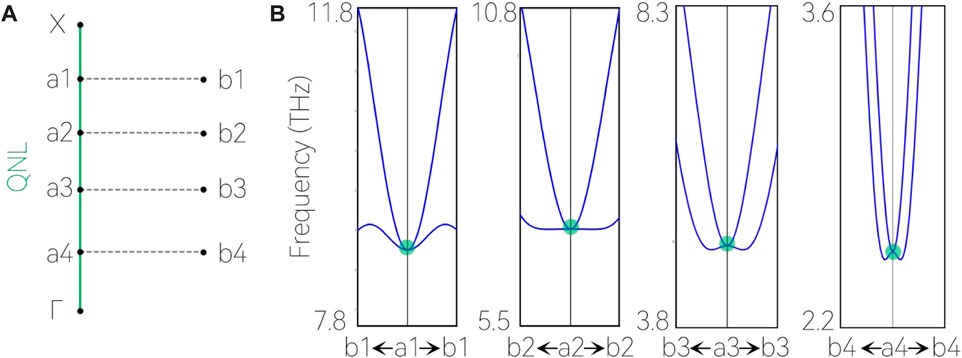
FIGURE 5. (A) Selected symmetry points a1 (0.4, 0.0, 0.4), a2 (0.3, 0.0, 0.3), a3 (0.2, 0.0, 0.2), a4 (0.1, 0.0, 0.1), b1 (0.9, 0.5, 0.4), b2 (0.8, 0.5, 0.3), b3 (0.7, 0.5, 0.2), and b4 (0.6, 0.5, 0.1). (B) Enlarged phonon dispersions of BP along the bn-an-bn (n = 1–4) paths.
Actually, the crossing bands along the
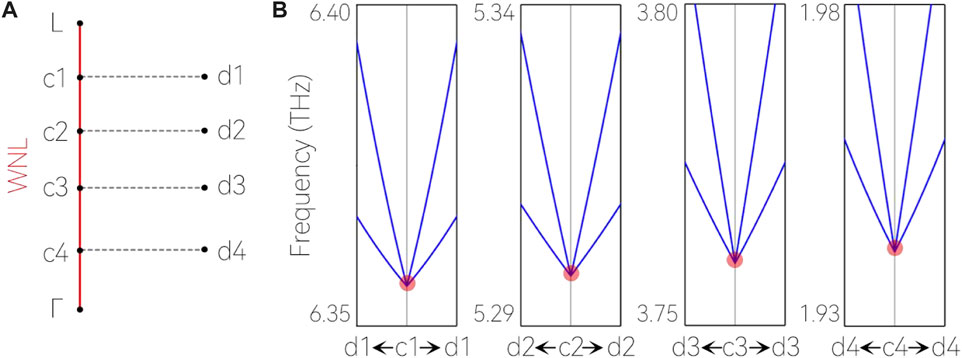
FIGURE 6. (A) Selected symmetry points c1 (0.4, 0.4, 0.4), c2 (0.3, 0.3, 0.3), c3 (0.2, 0.2, 0.2), c4 (0.1, 0.1, 0.1), d1 (0.4, 0.5, 0.4), d2 (0.3, 0.4, 0.3), d3 (0.2, 0.3, 0.2), and d4 (0.1, 0.2, 0.1). (B) Enlarged phonon dispersions of BP along the dn-cn-dn (n = 1–4) paths.
Summary
In this work, based on theoretical calculations, we studied the WNL, QNL, TP, and QTCP in the phononic system BP. The acoustic branches form the WNL and QNL and the optical branches form the TP and QCTP. There is a frequency gap between the acoustic and the optical branches. Furthermore, the rich nodal points and rich nodal lines are distributed at different frequency ranges. The WNL phonons along the
Data availability statement
The original contributions presented in the study are included in the article/supplementary material, further inquiries can be directed to the corresponding author.
Author contributions
The author confirms being the sole contributor of this work and has approved it for publication.
Fundings
This work is supported by the Science and Technology Research Program of Chongqing Municipal Education Commission (Grant No. KJZD-K202104101), the Open Project Funding of Theoretical Physics Academic Exchange Platform of Chongqing University (Grant No. 2, in the year of 2021), and the school-level Scientific Research Project of Chongqing Youth Vocational and Technical College (Grant No. CQY2021KYZ03).
Conflict of interest
The author declares that the research was conducted in the absence of any commercial or financial relationships that could be construed as a potential conflict of interest.
Publisher’s note
All claims expressed in this article are solely those of the authors and do not necessarily represent those of their affiliated organizations, or those of the publisher, the editors and the reviewers. Any product that may be evaluated in this article, or claim that may be made by its manufacturer, is not guaranteed or endorsed by the publisher.
References
Blöchl, P. E. (1994). Projector augmented-wave method. Phys. Rev. B, 50(24), 17953, 17979.doi:10.1103/physrevb.50.17953
Chang, G., Xu, S. Y., Zheng, H., Singh, B., Hsu, C. H., Bian, G., et al. (2016). Room-temperature magnetic topological Weyl fermion and nodal line semimetal states in half-metallic Heusler Co2TiX (X= Si, Ge, or Sn). Sci. Rep., 6(1), 38839–9.doi:10.1038/srep38839
Chen, X. Q., Liu, J., and Li, J. (2021). Topological phononic materials: Computation and data. Innovation, 2(3), 100134, doi:10.1016/j.xinn.2021.100134
Chen, Z. J., Wang, R., Xia, B. W., Zheng, B. B., Jin, Y. J., Zhao, Y. J., et al. (2021). Three-dimensional Dirac phonons with inversion symmetry. Phys. Rev. Lett., 126(18), 185301, doi:10.1103/physrevlett.126.185301
Chung, S. B., Zhang, H. J., Qi, X. L., and Zhang, S. C. (2011). Topological superconducting phase and Majorana fermions in half-metal/superconductor heterostructures. Phys. Rev. B, 84(6), 060510, doi:10.1103/physrevb.84.060510
Cohen, A. J., Mori-Sánchez, P., and Yang, W. (2012). Challenges for density functional theory. Chem. Rev., 112(1), 289–320.doi:10.1021/cr200107z
Ding, G., Sun, T., and Wang, X. (2022). Ideal nodal-net, nodal-chain, and nodal-cage phonons in some realistic materials. Phys. Chem. Chem. Phys., 24(18), 11175–11182.doi:10.1039/d2cp00731b
Ding, G., Zhou, F., Zhang, Z., Yu, Z. M., and Wang, X. (2022). Charge-two Weyl phonons with type-III dispersion. Phys. Rev. B, 105(13), 134303, doi:10.1103/physrevb.105.134303
Frolov, S. M., Manfra, M. J., and Sau, J. D. (2020). Topological superconductivity in hybrid devices. Nat. Phys., 16(7), 718–724.doi:10.1038/s41567-020-0925-6
Gao, G., Ding, G., Li, J., Yao, K., Wu, M., and Qian, M. (2016). Monolayer MXenes: Promising half-metals and spin gapless semiconductors. Nanoscale, 8(16), 8986–8994.doi:10.1039/c6nr01333c
Hafner, J. (2008). Ab-initio simulations of materials using VASP: Density-functional theory and beyond. J. Comput. Chem., 29(13), 2044–2078.doi:10.1002/jcc.21057
Hasan, M. Z., and Kane, C. L. (2010). Colloquium: Topological insulators. Rev. Mod. Phys., 82(4), 3045, 3067.doi:10.1103/revmodphys.82.3045
He, J., Li, X., Lyu, P., and Nachtigall, P. (2017). Near-room-temperature chern insulator and Dirac spin-gapless semiconductor: Nickel chloride monolayer. Nanoscale, 9(6), 2246–2252.doi:10.1039/c6nr08522a
Jin, Y. J., Chen, Z. J., Xia, B. W., Zhao, Y. J., Wang, R., and Xu, H. (2018). Ideal intersecting nodal-ring phonons in bcc C8. Phys. Rev. B, 98(22), 220103, doi:10.1103/physrevb.98.220103
Jin, Y., Wang, R., and Xu, H. (2018). Recipe for Dirac phonon states with a quantized valley berry phase in two-dimensional hexagonal lattices. Nano Lett., 18(12), 7755–7760.doi:10.1021/acs.nanolett.8b03492
Li, J., Liu, J., Baronett, S. A., Liu, M., Wang, L., Li, R., et al. (2021). Computation and data driven discovery of topological phononic materials. Nat. Commun., 12(1), 1204–1212.doi:10.1038/s41467-021-21293-2
Li, J., Wang, L., Liu, J., Li, R., Zhang, Z., and Chen, X. Q. (2020). Topological phonons in graphene. Phys. Rev. B, 101(8), 081403, doi:10.1103/physrevb.101.081403
Li, Y., and Xia, J. (2020). Cubic hafnium nitride: A novel topological semimetal hosting a 0-dimensional (0-D) nodal point and a 1-D topological nodal ring. Front. Chem., 8, 727, doi:10.3389/fchem.2020.00727
Li, Y., Xia, J., Khenata, R., and Kuang, M. (2020). Insight into the topological nodal line metal YB2 with large linear energy range: A first-principles study. Materials, 13(17), 3841, doi:10.3390/ma13173841
Li, Y., Xia, J., Khenata, R., and Kuang, M. (2020). Perfect topological metal CrB2: A one-dimensional (1D) nodal line, a zero-dimensional (0D) triply degenerate point, and a large linear energy range. Materials, 13(19), 4321, doi:10.3390/ma13194321
Li, Y., Zhang, D., Xia, J., Khenata, R., and Kuang, M. (2020). Cubic ScPd topological metal: Closed nodal line, spin-orbit coupling-induced triply degenerate nodal point–Dirac nodal point transition. Results Phys., 19, 103553, doi:10.1016/j.rinp.2020.103553
Li, Y., Zhou, Z., Shen, P., and Chen, Z. (2009). Spin gapless semiconductor− metal− half-metal properties in nitrogen-doped zigzag graphene nanoribbons. ACS Nano, 3(7), 1952–1958.doi:10.1021/nn9003428
Lim, J., Ooi, K. J. A., Zhang, C., Ang, L. K., and Ang, Y. S. (2020). Broadband strong optical dichroism in topological Dirac semimetals with Fermi velocity anisotropy. Chin. Phys. B, 29(7), 077802, doi:10.1088/1674-1056/ab928e
Liu, D. F., Liang, A. J., Liu, E. K., Xu, Q. N., Li, Y. W., Chen, C., et al. (2019). Magnetic Weyl semimetal phase in a Kagomé crystal. Science, 365(6459), 1282–1285.doi:10.1126/science.aav2873
Liu, D. F., Liu, E. K., Xu, Q. N., Shen, J. L., Li, Y. W., Pei, D., et al. (2022). Direct observation of the spin–orbit coupling effect in magnetic Weyl semimetal Co3Sn2S2. npj Quantum Mat., 7(1), 11–15.doi:10.1038/s41535-021-00392-9
Liu, P. F., Li, J., Tu, X. H., Li, H., Zhang, J., Zhang, P., et al. (2021). First-principles prediction of ideal type-II Weyl phonons in wurtzite ZnSe. Phys. Rev. B, 103(9), 094306, doi:10.1103/physrevb.103.094306
Liu, Q. B., Fu, H. H., and Wu, R. (2021). Topological phononic nodal hexahedron net and nodal links in the high-pressure phase of the semiconductor CuCl. Phys. Rev. B, 104(4), 045409, doi:10.1103/physrevb.104.045409
Liu, Q. B., Fu, H. H., Xu, G., Yu, R., and Wu, R. (2019). Categories of phononic topological weyl open nodal lines and a potential material candidate: Rb2sn2o3. J. Phys. Chem. Lett., 10(14), 4045–4050.doi:10.1021/acs.jpclett.9b01159
Liu, Q. B., Qian, Y., Fu, H. H., and Wang, Z. (2020). Symmetry-enforced weyl phonons. npj Comput. Mat., 6(1), 95–96.doi:10.1038/s41524-020-00358-8
Liu, Q. B., Wang, Z., and Fu, H. H. (2021). Charge-four weyl phonons. Phys. Rev. B, 103(16), L161303, doi:10.1103/physrevb.103.l161303
Liu, Q. B., Wang, Z. Q., and Fu, H. H. (2021). Ideal topological nodal-surface phonons in RbTeAu-family materials. Phys. Rev. B, 104(4), L041405, doi:10.1103/physrevb.104.l041405
Liu, Q. B., Wang, Z. Q., and Fu, H. H. (2022). Topological phonons in allotropes of carbon. Mater. Today Phys., 24, 100694, doi:10.1016/j.mtphys.2022.100694
Liu, Y., Chen, X., and Xu, Y. (2020). Topological phononics: From fundamental models to real materials. Adv. Funct. Mat., 30(8), 1904784, doi:10.1002/adfm.201904784
Liu, Y., Zou, N., Zhao, S., Chen, X., Xu, Y., and Duan, W. (2022). Ubiquitous topological states of phonons in solids: Silicon as a model material. Nano Lett., 22(5), 2120–2126.doi:10.1021/acs.nanolett.1c04299
Miao, H., Zhang, T. T., Wang, L., Meyers, D., Said, A. H., Wang, Y. L., et al. (2018). Observation of double Weyl phonons in parity-breaking FeSi. Phys. Rev. Lett., 121(3), 035302, doi:10.1103/physrevlett.121.035302
Moore, J. E. (2010). The birth of topological insulators. Nature, 464(7286), 194–198.doi:10.1038/nature08916
Peng, B., Hu, Y., Murakami, S., Zhang, T., and Monserrat, B. (2020). Topological phonons in oxide perovskites controlled by light. Sci. Adv., 6(46), eabd1618, doi:10.1126/sciadv.abd1618
Perdew, J. P., Burke, K., and Ernzerhof, M. (1996). Generalized gradient approximation made simple. Phys. Rev. Lett., 77(18), 3865–3868.doi:10.1103/physrevlett.77.3865
Popper, P., and Ingles, T. A. (1957). Boron phosphide, a III–V compound of zinc-blende structure. Nature, 179(4569), 1075–1075.doi:10.1038/1791075a0
Qi, X. L., and Zhang, S. C. (2011). Topological insulators and superconductors. Rev. Mod. Phys., 83(4), 1057, 1110.doi:10.1103/revmodphys.83.1057
Sato, M., and Ando, Y. (2017). Topological superconductors: A review. Rep. Prog. Phys., 80(7), 076501, doi:10.1088/1361-6633/aa6ac7
Singh, S., Wu, Q., Yue, C., Romero, A. H., and Soluyanov, A. A. (2018). Topological phonons and thermoelectricity in triple-point metals. Phys. Rev. Mat., 2(11), 114204, doi:10.1103/physrevmaterials.2.114204
Stoudenmire, E. M., Alicea, J., Starykh, O. A., and Fisher, M. P. (2011). Interaction effects in topological superconducting wires supporting Majorana fermions. Phys. Rev. B, 84(1), 014503, doi:10.1103/physrevb.84.014503
Tang, F., Po, H. C., Vishwanath, A., and Wan, X. (2019). Comprehensive search for topological materials using symmetry indicators. Nature, 566(7745), 486–489.doi:10.1038/s41586-019-0937-5
Togo, A., and Tanaka, I. (2015). First principles phonon calculations in materials science. Scr. Mater., 108, 1–5.doi:10.1016/j.scriptamat.2015.07.021
Tokura, Y., Yasuda, K., and Tsukazaki, A. (2019). Magnetic topological insulators. Nat. Rev. Phys., 1(2), 126–143.doi:10.1038/s42254-018-0011-5
Vazifeh, M. M., and Franz, M. (2013). Electromagnetic response of Weyl semimetals. Phys. Rev. Lett., 111(2), 027201, doi:10.1103/physrevlett.111.027201
Vergniory, M. G., Elcoro, L., Felser, C., Regnault, N., Bernevig, B. A., and Wang, Z. (2019). A complete catalogue of high-quality topological materials. Nature, 566(7745), 480–485.doi:10.1038/s41586-019-0954-4
Wang, H. X., Lin, Z. K., Jiang, B., Guo, G. Y., and Jiang, J. H. (2020). Higher-order weyl semimetals. Phys. Rev. Lett., 125(14), 266804, doi:10.1103/physrevlett.125.266804
Wang, J., Yuan, H., Kuang, M., Yang, T., Yu, Z. M., Zhang, Z., et al. (2021). Coexistence of zero-one-and two-dimensional degeneracy in tetragonal SnO2 phonons. Phys. Rev. B, 104(4), L041107, doi:10.1103/physrevb.104.l041107
Wang, J., Yuan, H., Liu, Y., Zhou, F., Wang, X., and Zhang, G. (2022). Hourglass Weyl and Dirac nodal line phonons, and drumhead-like and torus phonon surface states in orthorhombic-type KCuS. Phys. Chem. Chem. Phys., 24(5), 2752–2757.doi:10.1039/d1cp05217a
Wang, J., Yuan, H., Yu, Z. M., Zhang, Z., and Wang, X. (2021). Coexistence of symmetry-enforced phononic Dirac nodal-line net and three-nodal surfaces phonons in solid-state materials: Theory and materials realization. Phys. Rev. Mat., 5(12), 124203, doi:10.1103/physrevmaterials.5.124203
Wang, M., Wang, Y., Yang, Z., Fan, J., Zheng, B., Wang, R., et al. (2022). Symmetry-enforced nodal cage phonons in Th2BC2. Phys. Rev. B, 105(17), 174309, doi:10.1103/physrevb.105.174309
Wang, R., Xia, B. W., Chen, Z. J., Zheng, B. B., Zhao, Y. J., and Xu, H. (2020). Symmetry-protected topological triangular Weyl complex. Phys. Rev. Lett., 124(10), 105303, doi:10.1103/physrevlett.124.105303
Wang, R. Y., Chen, Z. J., Huang, Z. Q., Xia, B. W., and Xu, H. (2021). Classification and materials realization of topologically robust nodal ring phonons. Phys. Rev. Mat., 5(8), 084202, doi:10.1103/physrevmaterials.5.084202
Wang, X., Cheng, Z., Zhang, G., Yuan, H., Chen, H., and Wang, X. L. (2020). Spin-gapless semiconductors for future spintronics and electronics. Phys. Rep., 888, 1–57.doi:10.1016/j.physrep.2020.08.004
Wang, X. L. (2008). Proposal for a new class of materials: Spin gapless semiconductors. Phys. Rev. Lett., 100(15), 156404, doi:10.1103/physrevlett.100.156404
Wang, X., Zhou, F., Yang, T., Kuang, M., Yu, Z. M., and Zhang, G. (2021). Symmetry-enforced ideal lanternlike phonons in the ternary nitride Li6WN4. Phys. Rev. B, 104(4), L041104, doi:10.1103/physrevb.104.l041104
Xia, B. W., Wang, R., Chen, Z. J., Zhao, Y. J., and Xu, H. (2019). Symmetry-protected ideal type-II Weyl phonons in CdTe. Phys. Rev. Lett., 123(6), 065501, doi:10.1103/physrevlett.123.065501
Xie, C., Liu, Y., Zhang, Z., Zhou, F., Yang, T., Kuang, M., et al. (2021). Sixfold degenerate nodal-point phonons: Symmetry analysis and materials realization. Phys. Rev. B, 104(4), 045148, doi:10.1103/physrevb.104.045148
Xie, C., Yuan, H., Liu, Y., Wang, X., and Zhang, G. (2021). Three-nodal surface phonons in solid-state materials: Theory and material realization. Phys. Rev. B, 104(13), 134303, doi:10.1103/physrevb.104.134303
Yang, L. X., Liu, Z. K., Sun, Y., Peng, H., Yang, H. F., Zhang, T., et al. (2015). Weyl semimetal phase in the non-centrosymmetric compound TaAs. Nat. Phys., 11(9), 728–732.doi:10.1038/nphys3425
Yang, T., Cheng, Z., Wang, X., and Wang, X. L. (2021). Nodal ring spin gapless semiconductor: New member of spintronic materials. J. Adv. Res., 28, 43–49.doi:10.1016/j.jare.2020.06.016
Yang, T., Xie, C., Chen, H., Wang, X., and Zhang, G. (2022). Phononic nodal points with quadratic dispersion and multifold degeneracy in the cubic compound Ta3Sn. Phys. Rev. B, 105(9), 094310, doi:10.1103/physrevb.105.094310
Yu, Z. M., Zhang, Z., Liu, G. B., Wu, W., Li, X. P., Zhang, R. W., et al. (2022). Encyclopedia of emergent particles in three-dimensional crystals. Sci. Bull., 67(4), 375–380.doi:10.1016/j.scib.2021.10.023
Yue, Z., Li, Z., Sang, L., and Wang, X. (2020). Spin‐gapless semiconductors. Small, 16(31), 1905155, doi:10.1002/smll.201905155
Zhang, P., Yaji, K., Hashimoto, T., Ota, Y., Kondo, T., Okazaki, K., et al. (2018). Observation of topological superconductivity on the surface of an iron-based superconductor. Science, 360(6385), 182–186.doi:10.1126/science.aan4596
Zhang, T., Jiang, Y., Song, Z., Huang, H., He, Y., Fang, Z., et al. (2019). Catalogue of topological electronic materials. Nature, 566(7745), 475–479.doi:10.1038/s41586-019-0944-6
Zhang, T. T., Miao, H., Wang, Q., Lin, J. Q., Cao, Y., Fabbris, G., et al. (2019). Phononic helical nodal lines with PT protection in MoB2. Phys. Rev. Lett., 123(24), 245302, doi:10.1103/physrevlett.123.245302
Zheng, B., Xia, B., Wang, R., Chen, Z., Zhao, J., Zhao, Y., et al. (2020). Ideal type-III nodal-ring phonons. Phys. Rev. B, 101(10), 100303, doi:10.1103/physrevb.101.100303
Zheng, B., Zhan, F., Wu, X., Wang, R., and Fan, J. (2021). Hourglass phonons jointly protected by symmorphic and nonsymmorphic symmetries. Phys. Rev. B, 104(6), L060301, doi:10.1103/physrevb.104.l060301
Zhong, M., Liu, Y., Zhou, F., Kuang, M., Yang, T., Wang, X., et al. (2021). Coexistence of phononic sixfold, fourfold, and threefold excitations in the ternary antimonide Zr3Ni3Sb4. Phys. Rev. B, 104(8), 085118, doi:10.1103/physrevb.104.085118
Zhou, F., Chen, H., Yu, Z. M., Zhang, Z., and Wang, X. (2021). Realistic cesium fluogermanate: An ideal platform to realize the topologically nodal-box and nodal-chain phonons. Phys. Rev. B, 104(21), 214310, doi:10.1103/physrevb.104.214310
Keywords: topological state, topological phonons, density functional theory, phonon dispersion, optical branch
Citation: Li Y (2022) Topological states in boron phosphide with zinc-blende structure. Front. Mater. 9:977595. doi: 10.3389/fmats.2022.977595
Received: 24 June 2022; Accepted: 17 August 2022;
Published: 20 September 2022.
Edited by:
Xiaotian Wang, Southwest University, ChinaReviewed by:
Guangqian Ding, Chongqing University of Posts and Telecommunications, China, Gokhan Surucu, Gazi University, Turkey, Rabah Khenata, University of Mascara, AlgeriaCopyright © 2022 Li. This is an open-access article distributed under the terms of the Creative Commons Attribution License (CC BY). The use, distribution or reproduction in other forums is permitted, provided the original author(s) and the copyright owner(s) are credited and that the original publication in this journal is cited, in accordance with accepted academic practice. No use, distribution or reproduction is permitted which does not comply with these terms.
*Correspondence: Yang Li, bGl5YW5nX3BoeXNpY3NAMTI2LmNvbQ==