 Tao-Qian Tang1,2,3,4,5Muhammad Rooman6
 Zahir Shah6*Saima Khan7
 Narcisa Vrinceanu8*Ahmed Alshehri9Mihaela Racheriu10,11
- 1Department of Internal Medicine, E-Da Hospital, I-Shou University, Kaohsiung, Taiwan
- 2School of Medicine, College of Medicine, I-Shou University, Kaohsiung, Taiwan
- 3International Intercollegiate Ph.D. Program, National Tsing Hua University, Hsinchu, Taiwan
- 4Department of Family and Community Medicine, E-Da Hospital, I-Shou University, Kaohsiung, Taiwan
- 5Department of Engineering and System Science, National Tsing Hua University, Hsinchu, Taiwan
- 6Department of Mathematical Sciences, University of Lakki Marwat, Lakki Marwat, Pakistan
- 7Department of Physics, Abdul Wali Khan University, Mardan, Pakistan
- 8Department of Industrial Machines and Equipment, Faculty of Engineering, “Lucian Blaga” University of Sibiu, Sibiu, Romania
- 9Department of Mathematics, Faculty of Sciences, King Abdulaziz University, Jeddah, Saudi Arabia
- 10Medicine Faculty, Lucian Blaga University of Sibiu, Sibiu, Romania
- 11City Clinical Emergency Hospital, Sibiu, Romania
This investigation determined the effectiveness of an exterior magnetic field on bacteria enclosed by thousands of magnetite nanoparticles. Variable thermal conductivity and Joule heating were used in the interstitial nano liquid in which artificial bacteria were swimming in a biotic cell. The unsteady motions of a Powell–Eyring fluid in two dimensions were assumed. The porous extending wall was used as a bent surface shape. To convert the governing non-linear PDEs into non-linear ODEs, suitable transformations were exploited. The homotopy analysis technique (HAM) was utilized to resolve the semi-analytical results of non-linear ODEs. Plots were utilized to investigate the impact of significant parameters of velocity distribution, temperature profile, bacterial density field, nutrient concentration field, skin friction, Nusselt number, and nutrient concentration density. Clinical disease has shown that daring tumors have reduced blood flow. The results of this study showed that augmenting the values of unsteady parameters improved the blood velocity profile. The velocity distribution decreased for higher magnetite volume fraction values, as well as porosity and magnetic parameters. As the concentration of magnetite nanoparticles increased, so did the blood temperature distribution. As a result, the immersion of magnetite nanoparticles improved the physical characteristics of the blood. These findings also demonstrated that magnetic parameters and Eckert number play an essential role in increasing heat transfer rates.
1 Introduction
Radiotherapy and chemotherapy are frequently applied to treat patients with cancer. However, the combination of these treatments may be inadequate to achieve a cure in some cases. Thus, the development of advanced and novel tactics may provide oncologists with additional therapeutic possibilities. A laboratory in Spain recently produced an artificial magnetic bacterium that, when consumed, can trigger a charged magnetism compass to mark and destroy tumors because the compass rotation speed heats and melts tumors. This method is based on hyperthermia caused by magnets, which is an exploratory treatment method in which magneto-nanoparticle-saturated tumors are subjected to a discontinuous magnetic field. This treatment begins by immersing a tumor in iron magneto-nanoparticles. Every cell in the body requires oxygen to function, and tumors cannot grow beyond the size of a sugar pill without it. Thus, tumors produce hormones that permit them to obtain oxygen-rich blood by hijacking surrounding blood vessels. Moreover, because blood arteries grow in tumors in an unorganized and faster manner, they are porous and defective. When ferromagnetic iron nanoparticles are infused into blood circulation, they travel throughout the body, avoiding healthy blood vessels unless they enter the leakages that nourish tumors. Mathuriya et al. (2015)reported that these vaccinated magnetic iron nanomaterials eventually pass through the blood unless they reach a tumor’s blood generator, in which these particles accumulate. Magnetic nanoparticles show potential as a drug conveyance module because of their large surface area, high viability, low toxicity, and volume proportions. Furthermore, magnetic hyperthermia uses magnetic nanoparticles to reduce tumor volume and to target and eliminate malignant cells. Magnetic bio partitioning is useful for detaching a specific atom from a catalog of molecules. One example is the magnetic bio partitioning used to restrict viral RNA for further investigation by polymerase chain reaction. Furthermore, magnetic particles exhibit imaging characteristics, making them useful for multimodal theranostics. These characteristics of magnetic nanomaterials allow simultaneous treatment and diagnostics (Anik et al. (2021). Kong et al. (2014) and Cui et al. (2012) used an unsteady applied magnetic field impact to examine the movement of magnetotactic bacteria (MTB) in a Newtonian fluid. The authors addressed the swimming motion of MTB from a fluid dynamics standpoint in conjunction with an entire three-dimensional Stokes flow. Vincenti et al. (2018) scrutinized the effect of a magnetic field on micro-swimmer suspensions in liquid. Furthermore, Nagaraj et al. (2018) reported on the joint effect of electric and magnetic fields on the synovial fluid in a biological context. Bhatti (2021) recently investigated nanomedicine utilizing suspensions of magnetized gold
Many studies have proposed strategies for mathematical models within the human body, including the flow of fluid across a curved surface. Several investigators have also considered abdominal fluid flowing through biological cells as a non-Newtonian Powell–Eyring fluid. Saleem and Munawar (2016) examined blood flow via a stenotic artery in a constant magnetic field by assuming that blood within the artery was an Powell–Eyring fluid. Hina et al. (2016) investigated the heat transfer characteristics of a Powell–Eyring fluid in peristaltic flow within a curved channel with compliant walls. According to Riaz et al. (2019), the heat transfer procedure in the human body is a complex process that includes heat movement in tissues, membrane pores, electromagnetic radiation emitted by cell phones, exterior interface, metabolic heat production, and arterial-venous blood circulation. Their research aimed to determine the impact of bioheat and mass transfer in the peristaltic movement of an Powell–Eyring liquid in a three-dimensional rectangular cross section in the context of the human thermoregulation framework and thermotherapy. Hussain et al. (2020) numerically explored flow and explained blood flow behavior through tapered arteries as a non-Newtonian Powell–Eyring fluid. Asha and Sunitha (2018), Gholinia et al. (2019), Mallick and Misra (2019), Sultan et al. (2019), and Basha and Sivaraj (2021) conducted relevant research on this model. In the presence of a magnetic field generated using magnetite
Based on these previous findings, the present study considered the growth of artificial magnetic bacteria in a non-Newtonian Powell–Eyring nanofluid on a stretching curved surface using a porous medium. The variable fluid thermal conductivity of the nanofluid was considered. As shown in Figure 1, curvilinear coordinates were used to model mathematical expressions across the curved biological boundary. This investigation also used magnetite nanoparticles. The temperature, concentration, and velocity of magnetite/blood in biological cells were acquired by the homotopy analysis method (HAM) via MATHEMATICA and depicted in a set of plots. Additionally, different scenarios were developed by varying the impact of dimensionless parameters, and distinct cases were constructed to obtain maximum reference data. The magnetic bacterium function as a magnetically charged compass to mark and abolish tumors by revolving at such a high rate that tumors heat and melt. Section 2 provides the mathematical formulas and all relevant details. Section 3 presents the physical quantities and the solution method, and its convergence with the validation of the results is shown in Sections 4 and 5. Section 6 includes the results and discussion. Finally, Section 7 contains the conclusions.
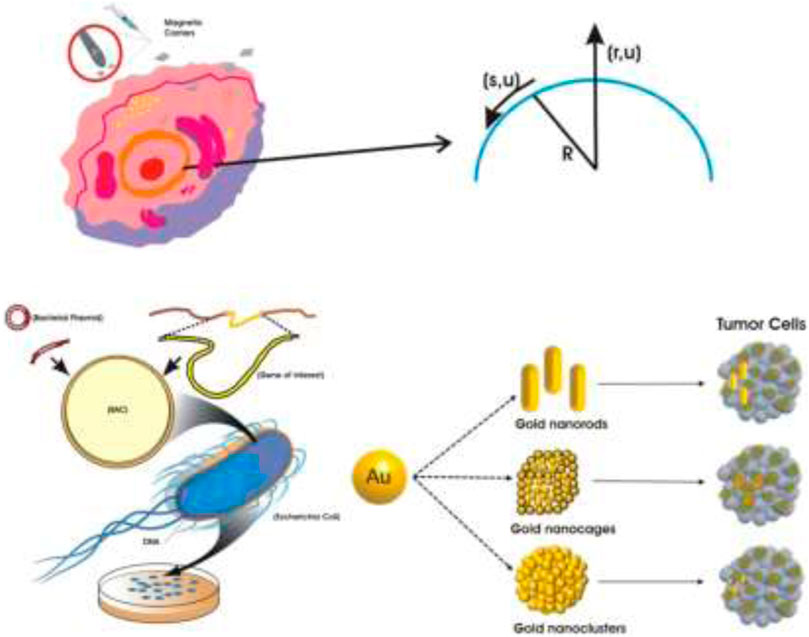
FIGURE 1. Fluid flow configuration and coordinate system.
2 Mathematical formulas
We assumed a two-dimensional unsteady boundary layer Powell–Eyring nanofluid flow on a strained curved surface using a porous medium that was a spiral in a circle with radius
2.1 Formal model and geometry
Figure 1 shows the geometry of the flow problem along with the coordinate system, velocity field, and other details.
2.1.1 Governing equations and boundary conditions after applying assumptions
Navier–Stokes flow is a type of fluid movement in which the spinning speed of the flow,
and
The appropriate governing equations to examine the foregoing fluid flow are as follows:
subject to the boundary condition (Elgazery et al., 2022)
Here,
2.1.2 Similarity transformations and modeled ODEs
Using the following dimensionless similarity transformations (Elgazery et al., 2022),
and using the aforementioned dimensionless quantity, the equation of continuity is satisfied, and after pressure elimination the governing Eqs 7–12 can be written as follows:
Similarly, pressure can be expressed as follows:
subject to the boundary conditions
where
2.1.3 Thermo-physical characteristics of nanofluid
The thermo-physical characteristics of an effective nanofluid can be expressed as follows (Mallick and Misra, 2019; Yasmin, 2022; Alyousef et al., 2023):
where
Here, the index
where

TABLE 1. Thermophysical characteristics of
3 Physical quantities
The physical quantities of concern in the current research are expressed as follows:
where
These quantities can be written in non-dimensional form as follows:
where
4 Solution methods
To find the solution to the system of Eqs 11–14 under the boundary constraints (16), a HAM (Liao, 2004) approach was used and figures were sketched for convergence. The complete procedure is shown in Eqs 23–45.
The initial guesses were selected as follows:
The linear operators are taken as
which have the following properties:
where
The resultant non-linear operatives
The fundamental concept of HAM is characterized in Cui et al. (2012), Kong et al. (2014), Mathuriya et al. (2015), and Anik et al. (2021). The zeroth-order problems from Eqs 9–12 are as follows:
The equivalent boundary conditions are as follows:
where
and expanding
where
The secondary constraints
The
The following are the corresponding boundary conditions:
Here,
where
5 Validations of the results
This section shows the result validations graphically and numerically. The results obtained using the semi-analytical HAM method are compared to the numerical (ND-Solved) techniques for temperature
Table 2(a–d) shows the results of the HAM solutions, numerical solutions, and the absolute errors for temperature
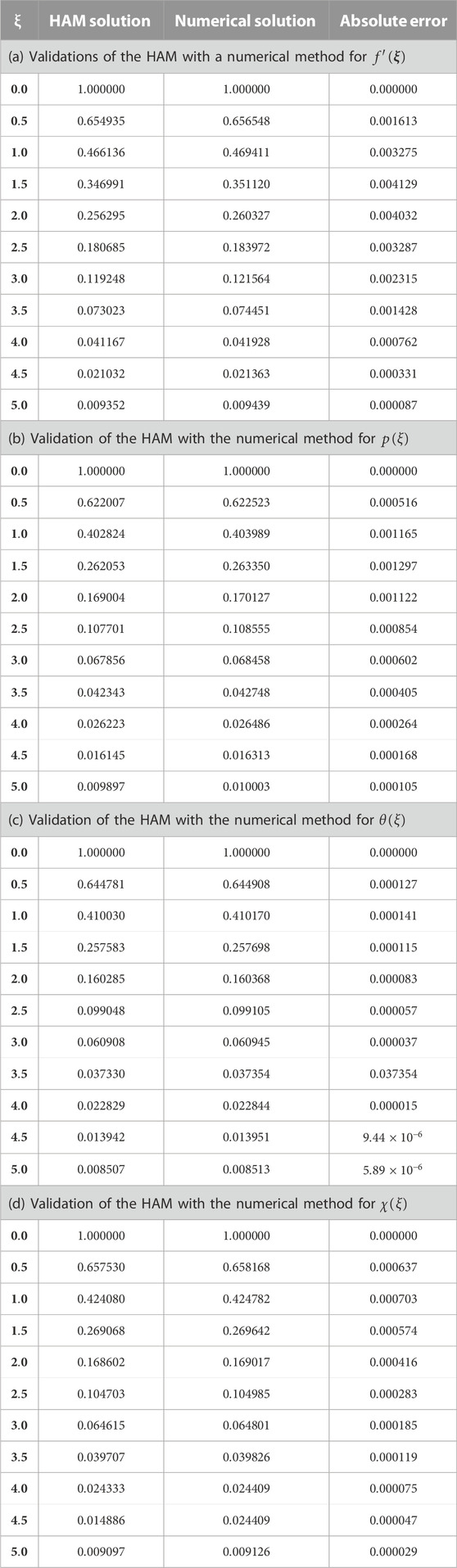
TABLE 2. Tables 2(a-d).
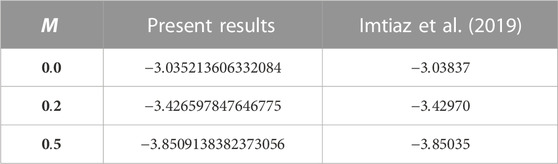
TABLE 3. Comparison of skin friction.
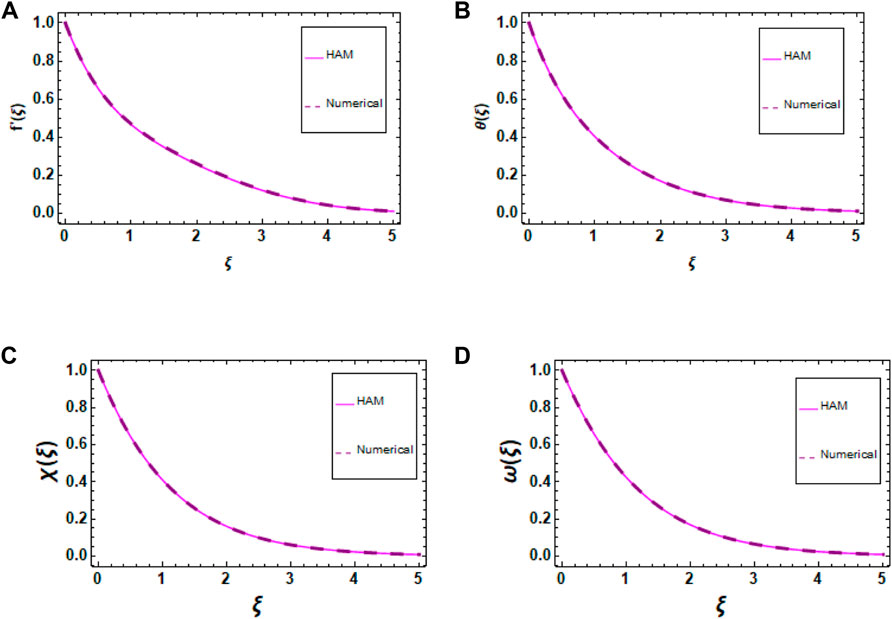
FIGURE 2. (A–D) Graphical validations of the HAM with numerical methods for
6 Results and discussion
This investigation used HAM to graphically explore the efficacy of numerous governing factors, such as the curvature factor
Figures 3A–C show how the curvature factor K affects the velocity
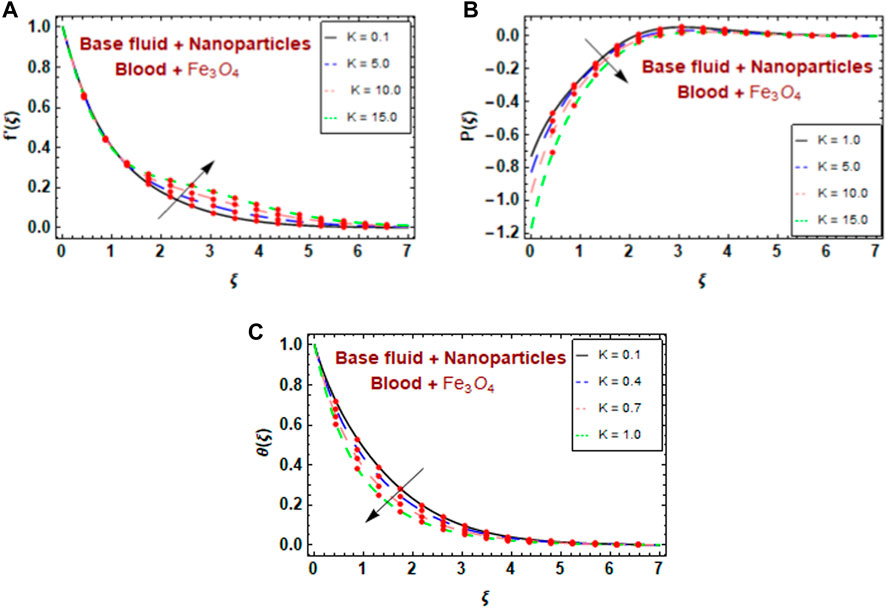
FIGURE 3. (A–C) Variations in
Furthermore, as shown in Figures 4A, B increasing the curvature parameter value increased the radius of the curved surface, which increased the velocity and decreased the pressure. Due to vascular damage, the environment within the tumors became hypoxic, acidic, and nutritionally deficient when heated. These suboptimal environmental changes enhance the tumor cell hyperthermia response, inhibit thermal damage repair, and interfere with the development of thermal tolerance. At high temperatures, the acidic environment enhances the tumor cell response to certain drugs. As shown in Figure 4C, the temperature decreased as the curvature factor increased, and increased with increasing unsteady parameter. In medical treatment, to enhance the tumor cell response to magnetic magnetite nanoparticles,
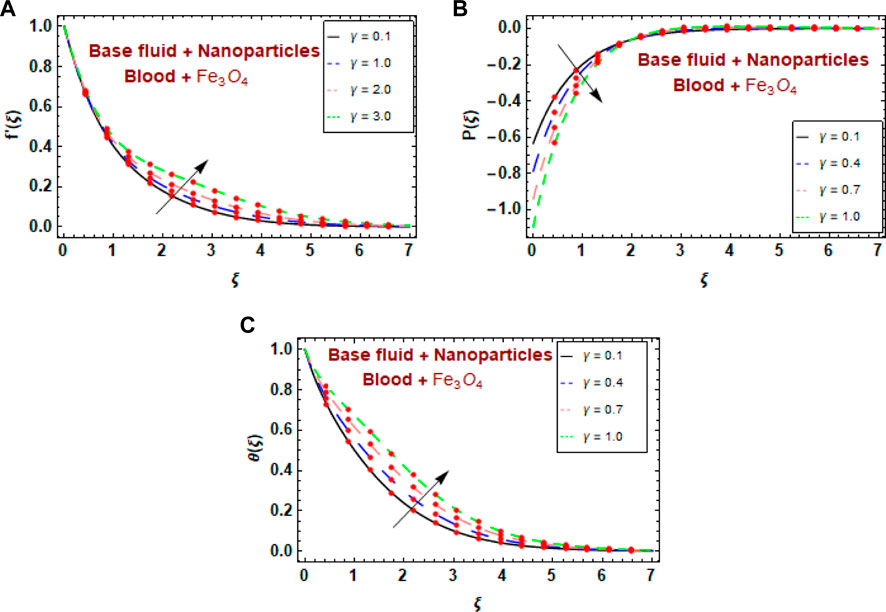
FIGURE 4. (A–C) Variations in
Figures 5A, B show the effect of the fluid parameter
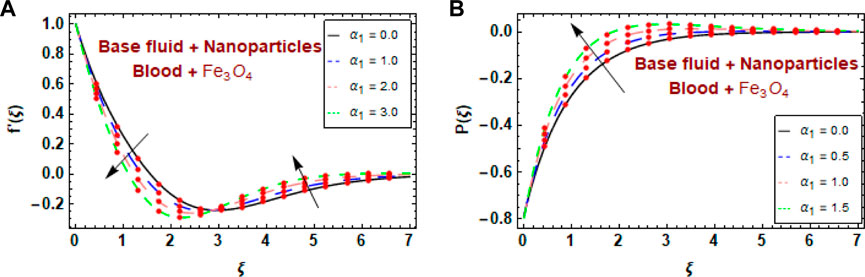
FIGURE 5. (A,B) Variations in
Figures 6A–C show how the magnetite nanoparticle volume fraction parameter
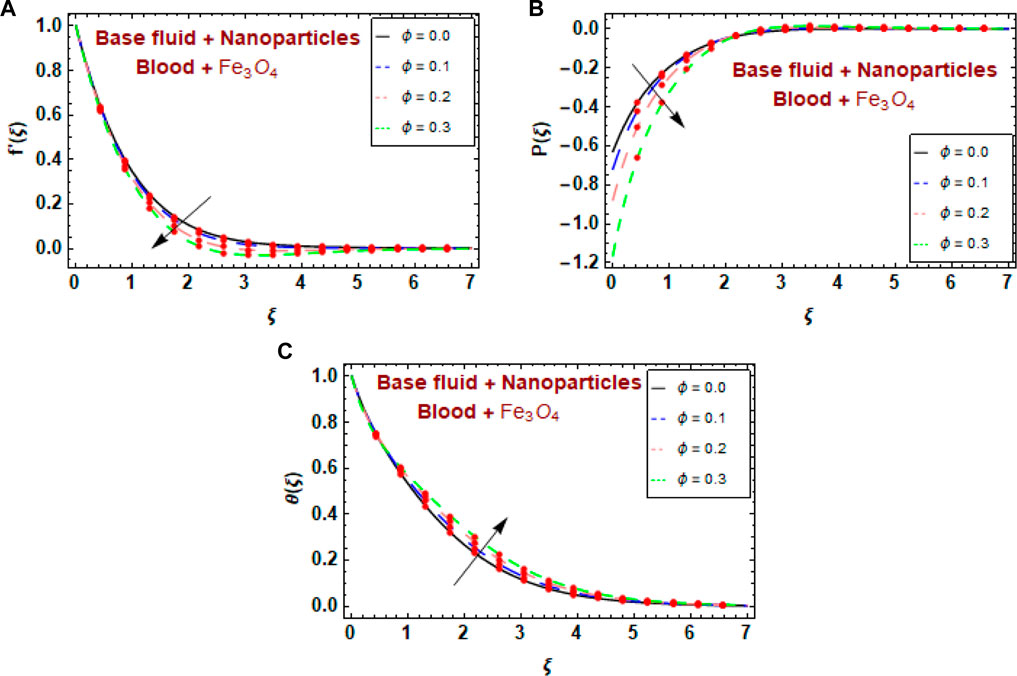
FIGURE 6. (A–C) Variations in
The impact of the porosity parameter on blood velocity is shown in Figure 7, in which the blood velocity decreased as the porosity increased. This effect occurred because increasing blood porosity increased the interactions and fraction between the flow and blood cells, resulting in decreased velocity.
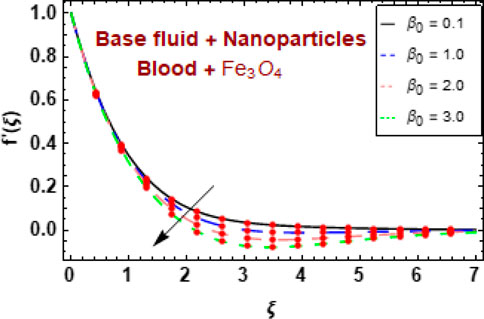
FIGURE 7. Variations in
The exploration of the magnetic factor M showed that opposition in artificial magnetic bacteria swimming within the blood flow was a major factor. Figures 8A, B show the effects of M on the velocity
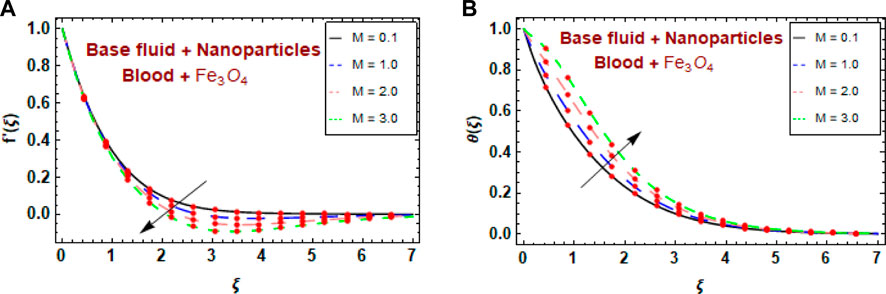
FIGURE 8. (A,B) Variations in
Figure 9 depicts the influence of the Prandtl number
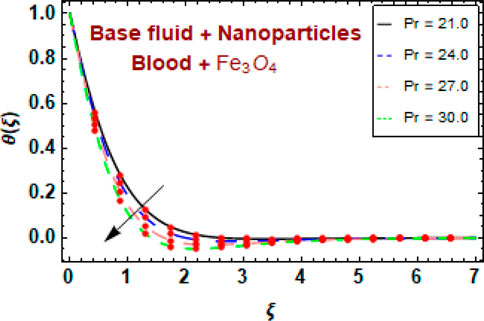
FIGURE 9. Variations in
Figure 10 shows the temperature distribution for various Eckert number
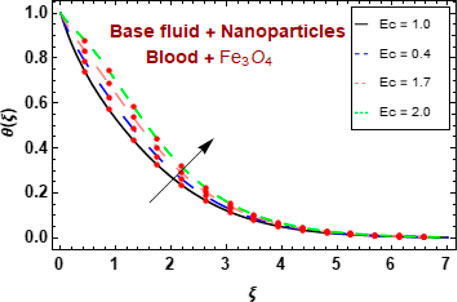
FIGURE 10. Variations in
Figures 11A, B show the effect of the bioconvection Lewis number
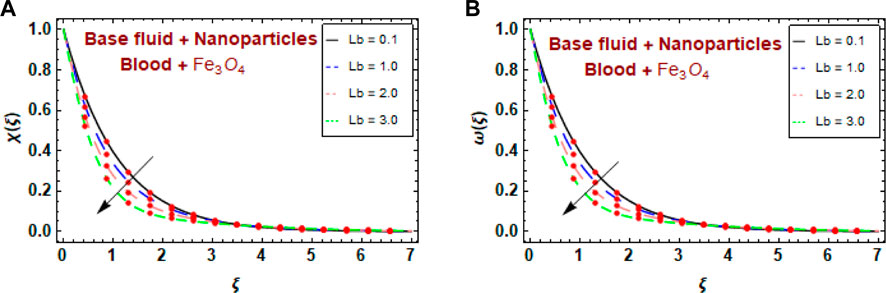
FIGURE 11. (A,B) Variations in
Figures 12A, B show the influence of the bacterial difference density parameter
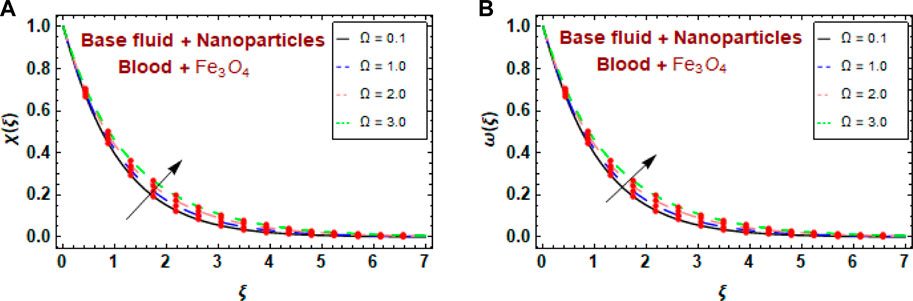
FIGURE 12. (A,B) Variations in
The effects of the bacteria maximum growth rate

FIGURE 13. (A,B) Variations in
6.1 Skin friction coefficients and Nusselt numbers
Figures 14, 15 show the effects of the nanoparticle volume fraction
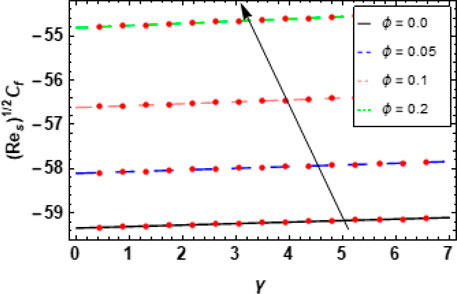
FIGURE 14. Influences of
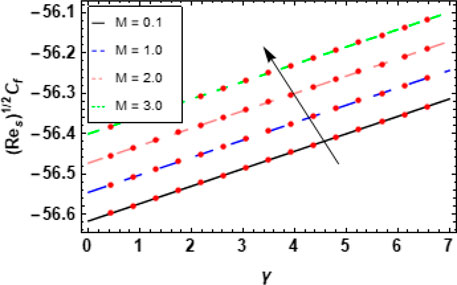
FIGURE 15. Influences of
Figure 16 shows the effects of the volume fraction
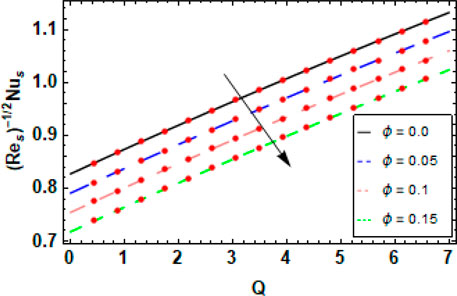
FIGURE 16. Effects of
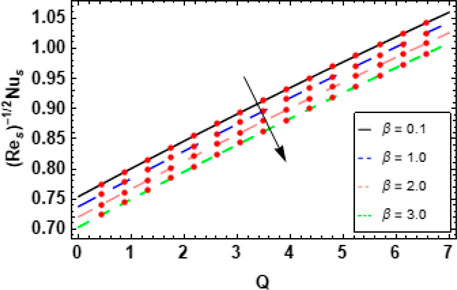
FIGURE 17. Effects of
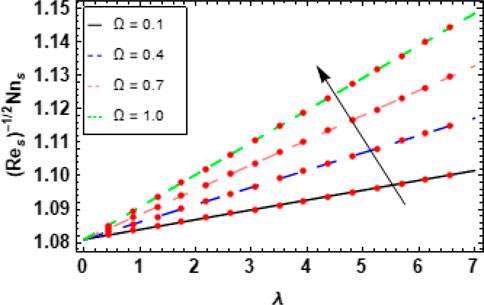
FIGURE 18. Influences of
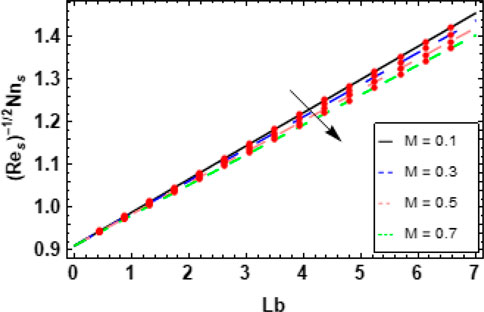
FIGURE 19. Influences of
7 Conclusion
This study aimed to determine the effectiveness of an external magnetic field on bacteria enclosed by thousands of magnetic magnetite nanoparticles. Variable thermal conductivity and Joule heating were used in the interstitial nanofluid, in which artificial bacteria swam in a biological cell. The unsteady motion of a Powell–Eyring fluid in two dimensions was considered. A porous stretching wall was used as a curved surface structure. To convert the governing non-linear PDEs into non-linear ODEs, suitable transformations were exploited. The HAM was used to resolve the semi-analytical results of non-linear ODEs. This mathematical procedure demonstrates unnatural magnetic bacterium that can function like a compass that is magnetically charged to mark and abolish tumors by spinning at such a high rate that tumors heat and melt. We discovered the following:
• The blood velocity improved at higher curvature parameter values and was unsteady when the velocity decreased for large magnetic factor, volume fraction, and porosity parameter values.
• The blood velocity profile began to decrease and then gradually increased with increasing fluid parameter values.
• The mathematical description revealed that magnetite nanoparticles lower blood pressure, which is a beneficial outcome in the clinical consideration of cancer, and demonstrates the effectiveness of magnetite nanoparticles in such medical therapy.
• The mathematical analysis showed that to enhance the reaction of tumor cells to several drugs in an acidic environment, temperatures should be raised by increasing the characteristics of the nearby environment, including the unsteady parameter, Eckert number, magnetite nanoparticles, and magnetic parameters.
• To increase nutrient consumption in normal cells while decreasing nutrient consumption in tumor cells, our mathematical outcomes showed that the bacterial difference density, bacterial growth rate, and Lewis number should be moderated in the medical treatment of cancer using magnetite nanoparticles and artificial bacteria.
• For the intensification of the unsteady parameter, applied magnetic fields should be considered.
Data availability statement
The original contributions presented in the study are included in the article/Supplementary Material. Further inquiries can be directed to the corresponding authors.
Author contributions
All authors listed have made substantial, direct, and intellectual contributions to the work and approved it for publication.
Funding
The project was financed by the Lucian Blaga University of Sibiu through research grant number LBUS-IRG-2022-08.”
Conflict of interest
The authors declare that the research was conducted in the absence of any commercial or financial relationships that could be construed as a potential conflict of interest.
Publisher’s note
All claims expressed in this article are solely those of the authors and do not necessarily represent those of their affiliated organizations, or those of the publisher, the editors, and the reviewers. Any product that may be evaluated in this article, or claim that may be made by its manufacturer, is not guaranteed or endorsed by the publisher.
References
Afridi, M. I., Alkanhal, T. A., Qasim, M., and Tlili, I. (2019). Entropy generation in Cu-Al2O3-H2O hybrid nanofluid flow over a curved surface with thermal dissipation. Entropy 21, 941. doi:10.3390/E21100941
Alyousef, H. A., Yasmin, H., Shah, R., Shah, N. A., El-Sherif, L. S., and El-Tantawy, S. A. (2023). Mathematical modeling and analysis of the steady electro-osmotic flow of two immiscible fluids: A biomedical application. Coatings 13, 115. doi:10.3390/coatings13010115
Anik, M. I., Hossain, M. K., Hossain, I., Mahfuz, A. M. U. B., Rahman, M. T., and Ahmed, I. (2021). Recent progress of magnetic nanoparticles in biomedical applications: A review. Nano Sel. 2, 6, 1146–1186. doi:10.1002/NANO.202000162
Asha, S. K., and Sunitha, G. (2018). Effect of joule heating and MHD on peristaltic blood flow of Eyring–Powell nanofluid in a non-uniform channel. J. Taibah Univ. Sci. 13 (1), 155–168. doi:10.1080/16583655.2018.1549530
Basha, H. T., and Sivaraj, R. (2021). Entropy generation of peristaltic Eyring–Powell nanofluid flow in a vertical divergent channel for biomedical applications. Proc. Inst. Mech. Eng. Part E J. Process Mech. Eng. 235 (5), 1575–1586. doi:10.1177/09544089211013926
Bhatti, M. M. (2021). Biologically inspired intra-uterine nanofluid flow under the suspension of magnetized gold (Au) nanoparticles: Applications in nanomedicine. Invent 6, 28. doi:10.3390/INVENTIONS6020028
Cui, Z., Kong, D., Pan, Y., and Zhang, K. (2012). On the swimming motion of spheroidal magnetotactic bacteria. Fluid Dyn. Res. 44 (5), 055508. doi:10.1088/0169-5983/44/5/055508
Elgazery, N. S., Elelamy, A. F., Bobescu, E., and Ellahi, R. (2022). How do artificial bacteria behave in magnetized nanofluid with variable thermal conductivity: Application of tumor reduction and cancer cells destruction. Int. J. Numer. Methods Heat Fluid Flow 32 (9), 2982–3006. doi:10.1108/HFF-11-2021-0722
Gholinia, M., Hosseinzadeh, K., Mehrzadi, H., Ganji, D. D., and Ranjbar, A. A. (2019). Investigation of MHD Eyring–Powell fluid flow over a rotating disk under effect of homogeneous–heterogeneous reactions. Case Stud. Therm. Eng. 13, 100356. doi:10.1016/J.CSITE.2018.11.007
Hina, S., Mustafa, M., Hayat, T., and Alsaedi, A. (2016). Peristaltic flow of powell-eyring fluid in curved channel with heat transfer: A useful application in biomedicine. Comput. Methods Programs Biomed. 135, 89–100. doi:10.1016/J.CMPB.2016.07.019
Hussain, A., Sarwar, L., Akbar, S., and Nadeem, S. (2020). Mathematical model for blood flow through the stenosed channel. Phys. Scr. 95 (2), 025206. doi:10.1088/1402-4896/AB43FF
Kong, D., Lin, W., Pan, Y., and Zhang, K. (2014). Swimming motion of rod-shaped magnetotactic bacteria: The effects of shape and growing magnetic moment. Front. Microbiol. 5, 8. doi:10.3389/FMICB.2014.00008
Liao, S. (2004). On the homotopy analysis method for nonlinear problems. Appl. Math. Comput. 147 (2), 499–513. doi:10.1016/S0096-3003(02)00790-7
Mallick, B., and Misra, J. C. (2019). Peristaltic flow of Eyring-Powell nanofluid under the action of an electromagnetic field. Eng. Sci. Technol. Int. J. 22 (1), 266–281. doi:10.1016/J.JESTCH.2018.12.001
Mathuriya, A. S., Yadav, K., and Kaushik, B. D. (2015). Magnetotactic bacteria: Performances and challenges. Geomicrobiol. J. 32 (9), 780–788. doi:10.1080/01490451.2014.986694
Nagaraj, C., Dinesh, P. A., and Kalavathi, G. K. (2018). Combined effects of electric field and magnetic field on electro hydrodynamic dispersion of macromolecular components in biological bearing. Defect Diffus. Forum 388, 361–377. doi:10.4028/www.scientific.net/ddf.388.361
Riaz, A., Ellahi, R., Bhatti, M. M., and Marin, M. (2019). Study of heat and mass transfer in the eyring–powell model of fluid propagating peristaltically through a rectangular compliant channel. Heat. Transf. Res. 50 (16), 1539–1560. doi:10.1615/HEATTRANSRES.2019025622
Saleem, N., and Munawar, S. (2016). A mathematical analysis of MHD blood flow of Eyring-Powell fluid through a constricted artery. Int. J. Biomath. 9 (2), 1650027. doi:10.1142/S1793524516500273
Shukla, N., Rana, P., and Bég, O. A. (2019). Unsteady MHD non-Newtonian heat transfer nanofluids with entropy generation analysis. Nonlinear Eng. 8 (1), 630–644. doi:10.1515/nleng-2017-0177
Sultan, F., Khan, N. A., Qasim, M., and Afridi, M. I. (2019). Numerical simulation of the flow of nano-eyring-powell fluid through a curved artery with time-variant stenosis and aneurysm. Nihon Reoroji Gakkaishi 47 (2), 75–85. doi:10.1678/RHEOLOGY.47.75
Vincenti, B., Douarche, C., and Clement, E. (2018). Actuated rheology of magnetic micro-swimmers suspensions: Emergence of motor and brake states. Phys. Rev. Fluids 3 (3), 033302. doi:10.1103/physrevfluids.3.033302
Yasmin, H. (2022). Design and research of biomaterials. Coatings 12, 1684. doi:10.3390/coatings12111684
Yasmin, H., Giwa, S. O., Noor, S., and Aybar, H. Ş. (2023). Influence of preparation characteristics on stability, properties, and performance of mono- and hybrid nanofluids: Current and future perspective. Machines 11, 112. doi:10.3390/machines11010112
Yasmin, H., Giwa, S. O., Noor, S., and Aybar, H. Ş. (2023). Reproduction of nanofluid synthesis, thermal properties and experiments in engineering: A research paradigm shift. Energies 16, 1145. doi:10.3390/en16031145
Yasmin, H., Giwa, S. O., Noor, S., and Sharifpur, M. (2023). Experimental exploration of hybrid nanofluids as energy-efficient fluids in solar and thermal energy storage applications. Nanomaterials 13, 278. doi:10.3390/nano13020278
Nomenclature
Greek terms
Subscripts
Keywords: Powell–Eyring fluid, blood flow, magnetite nanoparticles, porous medium, curved biological boundary, joule heating, artificial bacteria
Citation: Tang T-Q, Rooman M, Shah Z, Khan S, Vrinceanu N, Alshehri A and Racheriu M (2023) Numerical study of magnetized Powell–Eyring hybrid nanomaterial flow with variable heat transfer in the presence of artificial bacteria: Applications for tumor removal and cancer cell destruction. Front. Mater. 10:1144854. doi: 10.3389/fmats.2023.1144854
Received: 15 January 2023; Accepted: 21 February 2023;
Published: 28 March 2023.
Edited by:
Noor Saeed Khan, University of Education Lahore, PakistanReviewed by:
Khadija Maqbool, International Islamic University, Islamabad, PakistanHumaira Yasmin, King Faisal University, Saudi Arabia
Copyright © 2023 Tang, Rooman, Shah, Khan, Vrinceanu, Alshehri and Racheriu. This is an open-access article distributed under the terms of the Creative Commons Attribution License (CC BY). The use, distribution or reproduction in other forums is permitted, provided the original author(s) and the copyright owner(s) are credited and that the original publication in this journal is cited, in accordance with accepted academic practice. No use, distribution or reproduction is permitted which does not comply with these terms.
*Correspondence: Zahir Shah, emFoaXJAdWxtLmVkdS5waw==; Narcisa Vrinceanu, dnJpbmNlYW51Lm5hcmNpc2FpQHVsYnNpYml1LnJv