 Ayman A. Althuwayb1*
 Nasr Rashid1Osama I. Elhamrawy1
 Khaled Kaaniche1
 Imran Khan2,3Yung-Cheol Byun4*
 Dag Øivind Madsen5*
- 1Department of Electrical Engineering, College of Engineering, Jouf University, Sakaka, Kingdom of Saudi Arabia
- 2Department of Electrical Engineering, University of Engineering and Technology Peshawar, Peshswar, Pakistan
- 3Islamic University Centre for Scientific Research, The Islamic University, Najaf, Iraq
- 4Department of Computer Engineering, Jeju National University, Jeju City, Republic of Korea
- 5University of South-Eastern Norway, Kongsberg, Norway
Terahertz (THz) radiation, which has applications in the imaging of objects, non-destructive testing, satellite communication, medical diagnostics, and biosensing, has generated a great deal of attention due to its remarkable properties. This paper proposes a novel broadband filter for THz applications. The main idea is to overcome the insertion loss and bandwidth issues by modeling a frequency-domain finite difference method and guided-mode resonance (GMR). The optimal design scheme of the wideband pass filter based on the circular resonant ring is discussed by comparing the transmission parameters under various parameters. This scheme overcomes the restriction of the narrow passband bandwidth of the prior THz filters and achieves approximately 3 dB bandwidth of 0.54 THz. The proposed THz filter paper also has the advantages of a straightforward structure, low processing costs, and ease of conformal with other structures, and it can be used for stealth fighters, new communication technology, and precise instruments. In addition, when compared to existing models, the suggested filter offers higher 3 dB BW operation, increased transmittance, low insertion loss, and stable performance at various oblique angles.
1 Introduction
Electromagnetic waves with frequencies ranging from 0.1 to 10 THz are referred to as terahertz waves, which are electromagnetic waves with wavelengths between millimeter waves and infrared light, also known as submillimeter waves (Zhu et al., 2020; Saraereh, 2021; Luo et al., 2022). Because the frequency of the submillimeter wave band is more than 103 times higher than that of the millimeter wave band (the band used for 5G communication), the resources are abundant and the system capacity is large, so 6G technology selects the frequency in this band to achieve faster communication (Alibakhshike et al., 2021; Alibakhshikenari et al., 2022a; Sun et al., 2023). It can be seen that terahertz technology will provide crucial technical support for the development of a new generation of communication technology (Alibakhshikenari et al., 2021a; Althuwayb et al., 2021).
Electromagnetic metamaterials, also known as new artificial electromagnetic media, metamaterials, etc. (Alibakhshikenari et al., 2019a; Alibakhshikenari et al., 2020a; Alibakhshikneari et al., 2020; Alibakhshikenari et al., 2020b; Alibakhshikenari et al., 2020c; Alibakhshikenari et al., 2021b), are characterized by arranging artificial unit structures (artificial atoms) with sub-wavelength scales in a periodic or non-periodic manner, and then obtaining materials beyond the limits of natural materials. Electromagnetic properties, such as negative refractive index, zero refractive index, ultra-high refractive index, high-frequency magnetic response, etc. (Baqir and Choudhury, 2017; Alibakhshikenari et al., 2019b; Alibakhshikenari et al., 2019c; Alibakhshikenari et al., 2019d; Alibakhshikenari et al., 2022b). The research on the basic theory, functional devices and engineering applications of electromagnetic metamaterials has aroused extensive research interests in the fields of physics, information and materials (Baqir, 2019; Baqir, 2020; Pan et al., 2022a; Baqir and Choudhury, 2022; Liu et al., 2023). Based on the designable electromagnetic parameters and distribution of metamaterials, researchers have developed various new devices such as metamaterial cloaks, lenses, and antennas (Li et al., 2021a; Wang et al., 2022a; Yang et al., 2022; Zhao and Wang, 2022; Wang et al., 2023a). According to the field localization and field enhancement characteristics of metamaterials (this effect is especially significant in surface plasmon metamaterials) and subwavelength scale characteristics (Li et al., 2020a; Wang et al., 2022b; Cao, 2022; Liu et al., 2022; Xie et al., 2023), a novel metamaterial sensing and imaging device has been developed, which can effectively improve the sensor’s performance. Sensitivity and imaging resolution (Cheng et al., 2016a; Huang et al., 2020; Li et al., 2021b; Xu et al., 2021; Feng et al., 2022). With the proposal and realization of digital coding and programmable metamaterials, the characterization and design of metamaterials are carried out in binary digital mode (that is, digital 0 and 1), which promotes the integration of metamaterials and information technology, making the new system superhuman. Material imaging system and communication system become possible (Li et al., 2021c; Zhao et al., 2022; Jiang et al., 2023; Liu and Xu, 2023; Xu and Liu, 2023).
The terahertz frequency region is between microwave and far-infrared in the electromagnetic spectrum, and is usually defined as electromagnetic radiation of 0.1–10 THz (Cao et al., 2021; Li et al., 2021d; Pan et al., 2022b; Chung et al., 2022; Ding et al., 2023). With the rapid development of terahertz sources and detectors and the continuous development of terahertz functional devices, terahertz science and technology have achieved vigorous development in recent years. Terahertz technology has good application prospects in material characterization, security inspection, biomedical imaging and communication (Yao et al., 2023; Zhang et al., 2022a; Liu, 2023; Zang et al., 2021; Li et al., 2020b). Among them, in terms of imaging, compared with microwave and millimeter wave frequencies, terahertz imagers will have higher spatial resolution, and compared with optical imaging, terahertz radiation has better penetration, so it can obtain more depth information (Liu et al., 2013; Wang et al., 2022c; Wang et al., 2022d; Liao et al., 2022; Wang et al., 2023b). At the same time, because this is a kind of non-ionizing radiation, it has better biological safety, so the application of terahertz imaging has been widely concerned (Jiang and Li, 2022; Xu et al., 2023; Zhang et al., 2023; Zhou et al., 2023). Terahertz metamaterials and metasurfaces have broad application prospects in terahertz imaging systems due to their sub-wavelength unit scale and flexible manipulation of electromagnetic wave amplitude, phase and polarization characteristics (Cheng et al., 2016b; Hosseininejad et al., 2018; Wang et al., 2019; Li et al., 2021e; Shen et al., 2022; Xi et al., 2022; Li et al., 2023; Miaofen et al., 2023).
In fact, researchers conducted in-depth research on THz waves, and developed many THz devices, such as THz absorbers (Zhao et al., 2019a; Ulla et al., 2019; Fajr et al., 2020; Lee and Jeong, 2020), THz antennas (Geim and Novoselov, 2007; Diaz and Carrier, 2012), THz reflector (Carrier et al., 2013; Danciu et al., 2019; Zhang et al., 2021; Leitenstorfer et al., 2023), etc., and various THz systems, such as THz security detector (Strinati et al., 2019; Zhang et al., 2019; Akhtar et al., 2020), ultra-wideband THZ transmitter (Yi et al., 2019; Chen et al., 2020a; Zou and Chen, 2020), terahertz imaging system (Ullah et al., 2019; Jiao et al., 2020; Huang et al., 2023), etc., they can be applied is widely used in security inspection, communication (Jiang et al., 2017; Lu et al., 2020; Manjappa and Singh, 2020; Rizza and Molle, 2022; Wu and Lin, 2023), biomedicine (Zhang et al., 2022b) and many other fields. Filter, as one of the most widely used key devices in THz communication technology (Chen et al., 2020b), has attracted the close attention of many researchers. The authors in (Wang et al., 2018) used a waveguide bandpass filter made of a two-dimensional square metal photonic crystal plate structure to achieve filtering effects in the sub-terahertz band, and adjusted the parameters and lattice constants of the multilayer waveguide in the structure, making its 3 dB bandwidth reach about 0.0052 THz. However, the structure is too complicated, and there are many influencing parameters, so it is not easy to process and prepare. The authors in (Sun et al., 2020) designed a polarization-insensitive broadband terahertz bandpass filter using metamaterials with complementary resonant structures.
The filter can achieve the same filtering effect on terahertz waves under different incident polarization states, the maximum 3 dB bandwidth in the working frequency band can reach 0.405 THz, and the structure of the filter is simple and easy to prepare. However, its transmission coefficient in the working frequency band is low, resulting in high electromagnetic wave loss. Reference (Kumar et al., 2019) also developed a THz filter using a coupled complementary metamaterial structure, with a 3 dB bandwidth of 0.39 THz. The authors in (Fahad et al., 2019) used the Koch curve fractal structure filter model for simulation analysis, and obtained a THz filter with a center frequency of 0.715 THz and a 3 dB bandwidth of 0.021 THz, but the filter fractal structure of the Koch curve is too complex, and the 3 dB bandwidth is narrow (Zhao et al., 2019b; Jiang et al., 2020).
Although the research work on THz broadband filters has been widely reported so far, according to the above literature analysis, it can be found that the current THz broadband filters still have complex structures, narrow bandwidth, low transmittance, high loss, etc. In view of this, this paper proposes a novel filter design with significant features. The main contributions are as follows.
• Design a new bimetallic ring electromagnetic metamaterial terahertz broadband bandpass filter based on guided-mode resonance (GMR);
• Optimize the electromagnetic response of the filter structure parameters to THz waves through simulation, so that it has both broadband and high transmittance characteristics;
• The structure of the filter is simple and easy to process, which provides a novel design scheme for THz filtering technology.
2 Filter design
The resonant unit of the THz filter designed in this paper is composed of a two-layer structure, as shown in Figure 1. The substrate material is a flexible polyimide film, and its dielectric constant
(a) 3D structure b) Front view
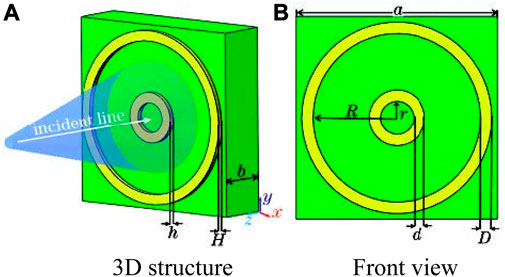
FIGURE 1. Proposed THz filter design. (A) 3D structure, (B) Front view.
The design structure of the single-layer THz filter involved in this paper is a theoretical model of artificially synthesized metamaterials. The mechanism of this model structure to achieve filtering characteristics in a certain frequency band of the THz frequency is the surface of the model that constitutes the frequency selective surface (FSS), and it has a frequency-selective effect on the incident electromagnetic wave. In this paper, the frequency domain finite difference (FDFD) software is used to carry out simulation experiments. The THz wave is vertically incident on the filter surface and the metamaterial structure has different electromagnetic response characteristics at different frequency points. The transmission coefficient decreases rapidly at the resonant frequency point, and will maintain a large value at other non-resonant frequency points, resulting in a very obvious trough in the transmission coefficient near the resonant frequency point. At the resonant frequency point, terahertz waves can hardly pass through, but at the non-resonant frequency point, a large number of THz waves can be perfectly transmitted. The above is the principle that the metamaterial structure can form a bandpass filter. Generally speaking, once the parameters of a terahertz filter made of metamaterials are determined, the filter can only work within a certain fixed frequency. By simulating the parameters of the filter and combining them with each other, the wideband pass filter with the best performance can be obtained.
3 Performance evaluation
3.1 Influence of inner ring radius
Firstly, the effect of the radius
In the frequency range of 0∼1.2 THz, the performance of the filter is simulated and calculated when the radius
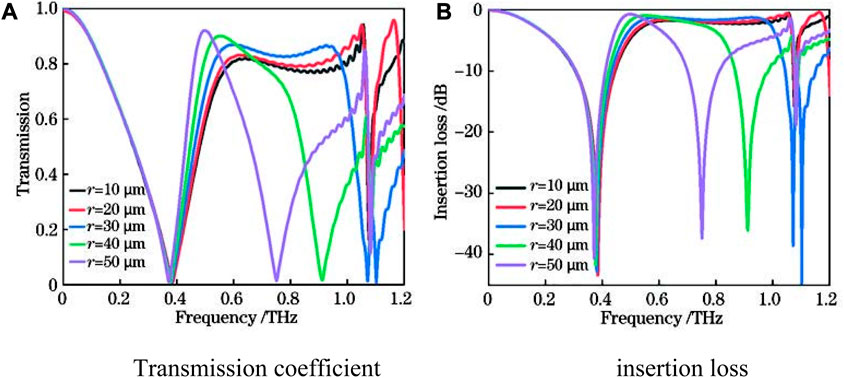
FIGURE 2. Impact of
3.2 Effect of outer ring radius
Through the simulation of the above structural parameters, it is found that adjusting the parameters of the ring-shaped resonant structure on the surface of the filter can effectively change its filtering performance. Therefore, when the radius
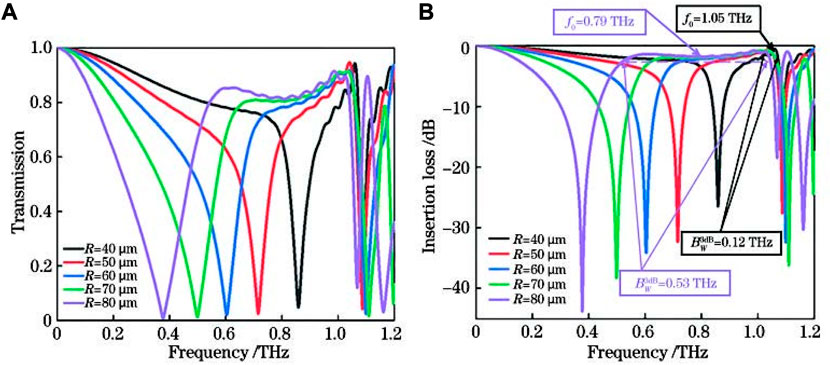
FIGURE 3. Impact of
It can be seen from Figure 3 that as the outer ring radius
3.3 Effect of outer ring width
In order to analyze the role of the surface ring resonant structure in the overall structure of the terahertz filter in detail, this paper further discusses the influence of the width of the outermost ring structure on the overall performance of the filter. Under the condition that the radius of the outer ring is
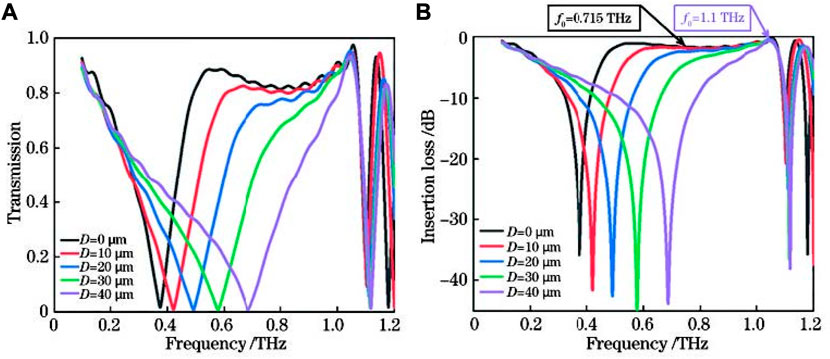
FIGURE 4. Impact of
3.4 Effect of inner ring width
The small ring also plays an important role in the overall filtering effect of the filter for the resonant structure, so this paper simulates and optimizes the width of the inner ring. Set the rest of the structural parameters unchanged, the width d of the inner ring is 0, 2.5, 5, 7.5, and 10 μm, respectively, and the corresponding transmission coefficient of the terahertz filter is shown in Figure 5.
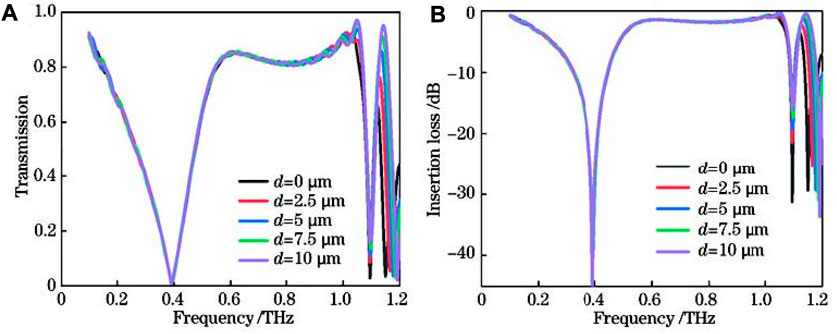
FIGURE 5. Impact of
It can be seen from Figure 5 that as the inner ring width increases from 0 μm to 10 μm, the transmission effect of terahertz waves is almost the same. It can be seen that the change of the inner ring width in the range of 0–10 μm has little effect on the performance of the whole filter. In order to reduce the processing difficulty of the THz filter, the same structural parameters as the outer ring width
3.5 Effect of period length
This subsection will analyze the effect of the period length
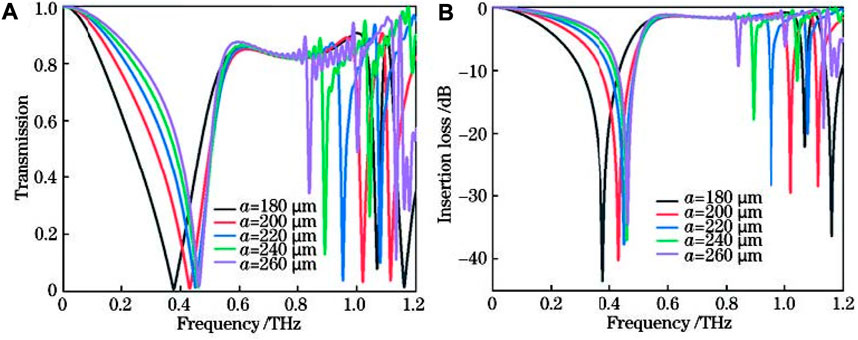
FIGURE 6. Impact of
It can be seen from Figure 6 that the increase of the period length of the structural unit has no obvious effect on the low-order resonance of the filter at low frequencies, but it will change its high-order resonance at high frequencies, and the high-order resonance frequency increases with the period length increase in λ moves from 1.18 THz to 0.82 THz, resulting in a decrease in the 3 dB bandwidth width. To ensure that the filter has a high 3 dB bandwidth, this paper selects the period length
3.6 Influence of substrate thickness
The substrate of the THz filter is polyimide flexible material, and its thickness will directly affect whether the device can easily conform to other structures when it is used later. Therefore, under the condition that the above structural parameters remain unchanged, this paper conducts simulations while changing the substrate thickness
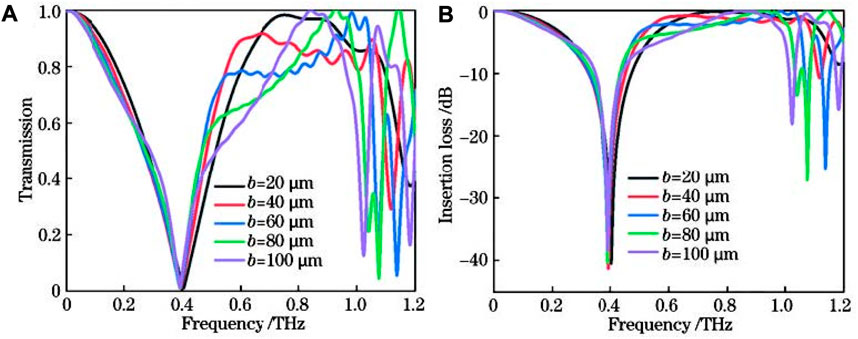
FIGURE 7. Impact of
3.7 Analysis of the overall structure parameters
In summary, the specific parameters of the terahertz filter are obtained, as shown in Table 1. The frequency domain finite difference simulation software is used for simulation, and the transmission coefficient and insertion loss of the terahertz filter are obtained, as shown in Figure 8.
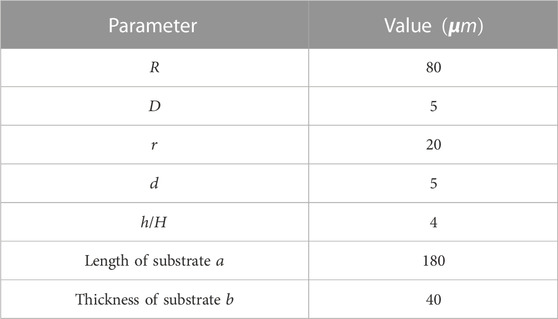
TABLE 1. Specific parameters of the THz filter.
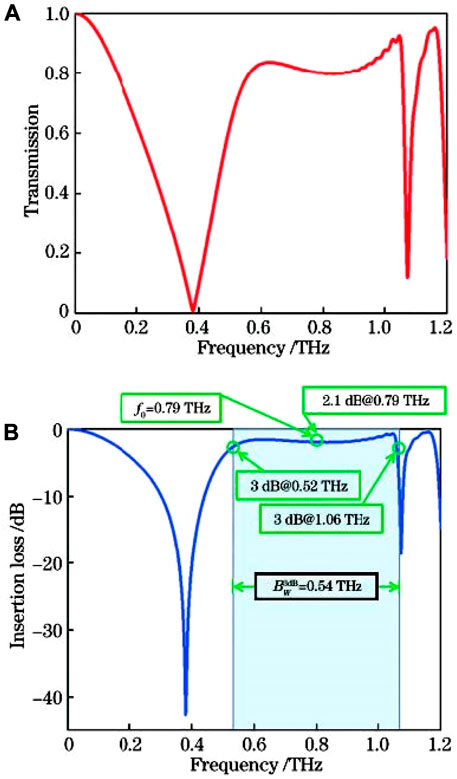
FIGURE 8. Impact of center frequency on (A) transmission coefficient and (B) insertion loss.
It can be seen from Figure 8 that the center frequency of the filter is 0.79 THz, the passband is 0.52∼1.06 THz, the 3 dB bandwidth is 0.54 THz, and the relative bandwidth reaches 68.3%. The insertion loss is less than 2.1 dB. Figure 9, Figure 10 are the simulated electric field distribution diagrams of the THz filter at the center frequency of 0.79 THz and the surface current distribution diagrams at 0.37, 0.79, and 1.06 THz, respectively. By analyzing the electric field distribution diagram of the filter near the center frequency, it can be found that when the THz wave reaches port 2 (negative direction of x-axis) from port 1 (positive direction of x-axis), the electric field distribution on the front and rear sides of the filter is roughly the same. Compared with the front side, the electric field intensity at the rear side of the filter has no obvious attenuation, which indicates that the filter has good passband characteristics at this time, and the THz wave realizes low-loss transmission in the passband.
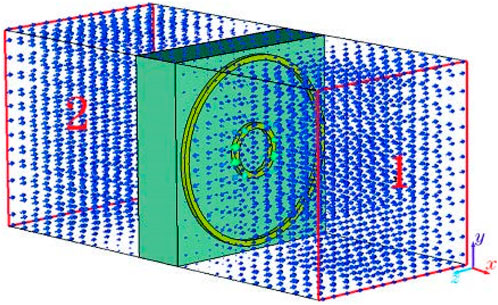
FIGURE 9. Illustration of E-field distribution.
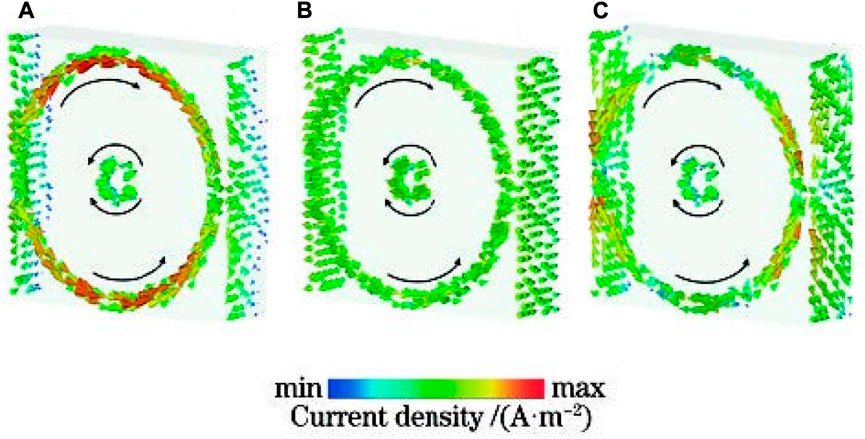
FIGURE 10. Comparison of surface current distribution. (A) 0.37 THz; (B) 0.79 THz; (C) 1.06 THz.
In order to better understand the working mechanism of the terahertz filter, this paper selects the low-order resonance frequency (
Further analysis shows that the double-ring resonance structure can generate a low-order resonance and a high-order resonance in the range of 0–1.2 THz, the two resonance frequencies are far apart, and a transmission spectrum with a high degree of attenuation can be obtained at the resonance frequency. Therefore, the filter can obtain a wider operating bandwidth and better out-of-band rejection. At the same time, in the working frequency band of the filter, the resonance response of the structure is small, which ensures that the filter has a high transmission spectrum in the passband.
Figure 11 compared the transmission characteristics of the proposed filter structure under different incident angles. As can be seen from Figure 11, the transmission performance has stable performance for different incident angles which indicates its effectiveness.
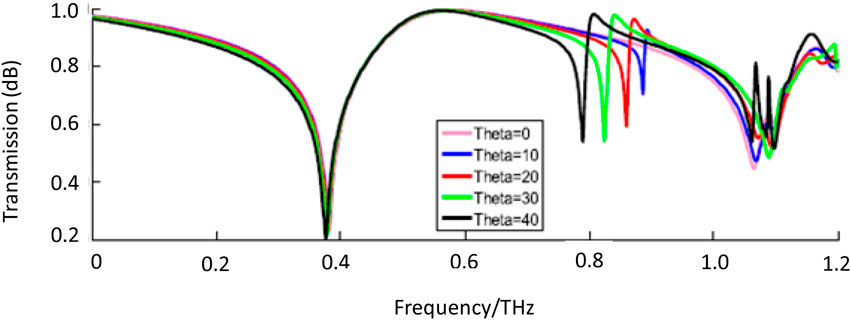
FIGURE 11. Transmission performance evaluation under different values incident angles.
Table 2 shows the comparison between the results of terahertz filters in recent years and the results of this paper.
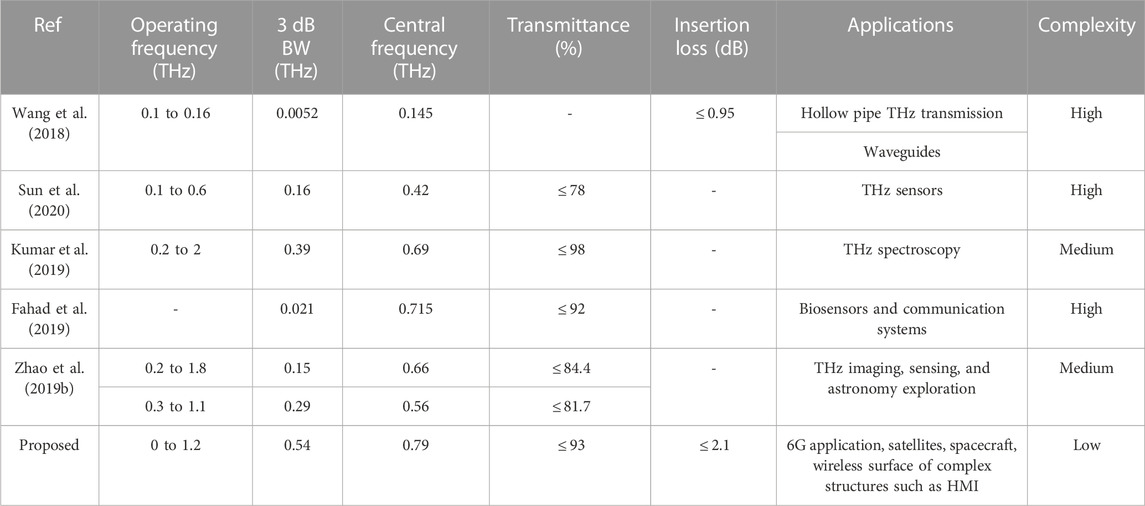
TABLE 2. Performance comparison of proposed and existing designs.
4 Conclusion
In this paper, a metamaterial THz filter with a double ring structure is designed, and then the parameters of the filter are simulated and tested using electromagnetic simulation software. The transmission parameters are analyzed, and the parameters of the resonant ring and the substrate effect of each parameter on the performance of the terahertz filter are evaluated. By comparing the transmission parameters under various parameters, the optimal design scheme of the wideband pass filter based on the circular resonant ring is discussed, which breaks through the limitation of the narrow passband bandwidth of the previous THz filters, and obtains about 3 dB bandwidth of 0.54 THz. In addition, the proposed THz filter paper has the characteristics of simple structure, low processing cost, easy conformal with other structures, and can be applied to stealth fighters, new communication equipment and precision instruments. Furthermore, the proposed filter has the advantages of higher 3 dB BW operation, improved transmittance, low insertion loss and stable performance under different oblique angles as compared with existing models. In the follow-up research, we will consider other parameters to evaluate the performance of the filter.
Data availability statement
The original contributions presented in the study are included in the article/supplementary material, further inquiries can be directed to the corresponding authors.
Author contributions
Conceptualization: AA Data Curation: NR Methodology: OE Writing original draft: KK Project administration: IK Supervision and funding acquisition: DM. All authors contributed to the article and approved the submitted version.
Funding
This research was financially supported by the Ministry of Small and Medium-sized Enterprises (SMEs) and Startups (MSS), Korea, under the "Regional Specialized Industry Development Plus Program (R&D, S3246057)" supervised by the Korea Technology and Information Promotion Agency for SMEs (TIPA). This work was also financially supported by the Ministry of Trade, Industry and ENERGY (MOTIE) through the fostering project of The Establishment Project of Industry- University Fusion District.
Conflict of interest
The authors declare that the research was conducted in the absence of any commercial or financial relationships that could be construed as a potential conflict of interest.
Publisher’s note
All claims expressed in this article are solely those of the authors and do not necessarily represent those of their affiliated organizations, or those of the publisher, the editors and the reviewers. Any product that may be evaluated in this article, or claim that may be made by its manufacturer, is not guaranteed or endorsed by the publisher.
References
Akhtar, M., Hassan, S., Ghaffar, R., Jung, H., Garg, S., and Hossain, M. S. (2020). The shift to 6G communications: vision and requirements. Human-centric Comput. Inf. Sci. 10 (53), 53–27. doi:10.1186/s13673-020-00258-2
Alibakhshikenari, M., Virdee, B., Althuwayb, A., Mariyanayagam, D., and Limiti, E. (2021). Compact and low-profile on-chip antenna using underside electromagnetic coupling mechanism for terahertz front-end transceivers. Electronics 10 (11), 1264–1318. doi:10.3390/electronics10111264
Alibakhshikenari, M., Ali, E., Soruri, M., Dalarsson, M., Naser-Moghadasi, M., Virdee, B. S., et al. (2022a). A comprehensive survey on antennas on-chip based on metamaterial, metasurface, and substrate integrated waveguide principles for millimeter-waves and terahertz integrated circuits and systems. IEEE Access 10, 3668–3692. doi:10.1109/access.2021.3140156
Alibakhshikenari, M., Parchin, N., Virdee, B., See, C., et al. (2020c). High performance metasurface-based on-chip antenna for terahertz integrated circuits, third international workshop on mobile terahertz systems (IWMTS). Essen 1–2. doi:10.1109/IWMTS49292.2020.9166324
Alibakhshikenari, M., Virdee, B., Alhameed, R., Falcon, F., et al. (2022b). Overcome the limitations of performance parameters of on-chip antennas based on metasurface and coupled feeding approaches for applications in system-on-chip for THz integrated-circuits. IEEE Asia-Pacific Microw. Conf. (APMC). doi:10.1109/APMC46564.2019.9038524
Alibakhshikenari, M., Virdee, B., Althuwayb, A., Aissa, S., See, C., Abd-Alhameed, R. A., et al. (2021b). Study on on-chip antenna design based on metamaterial-inspired and substrate-integrated waveguide properties for millimetre-wave and THz integrated-circuit applications. J. Infrated, Millim. Terahertz Waves 42, 17–28. doi:10.1007/s10762-020-00753-8
Alibakhshikenari, M., Virdee, B., Salekzamankhani, S., Aissa, S., See, C., Soin, N., et al. (2021a). High-isolation antenna array using SIW and realized with a graphene layer for sub-terahertz wireless applications. Sci. Rep. 11 (10218), 10218–10317. doi:10.1038/s41598-021-87712-y
Alibakhshikenari, M., Virdee, B., See, C., Alhameed, R., et al. (2019a). A novel 0.3-0.31 THz GaAs-based transceiver with on-chip slotted metamaterial antenna based on SIW technology. Singapore: IEEE Asia-Pacific Microwave Conference, 69–71.
Alibakhshikenari, M., Virdee, B., See, C., Alhameed, R., Falcon, F., et al. (2019b). High-performance 50 µm silicon-based on-chip antenna with high port-to-port isolation implemented by metamaterial and SIW concepts for THz integrated systems. Int. Congr. Artif. Mater. Nov. Wave Phenom. – Metamaterials 16, 23–25. doi:10.1109/APMC46564.2019.9038524
Alibakhshikenari, M., Virdee, B., See, C., Alhameed, R., Falcon, F., et al. (2019c). Silicon-based 0.450-0.475 THz series-fed double dielectric resonator on-chip antenna array based on metamaterial properties for integrated-circuits. Int. Congr. Artif. Mater. Nov. Wave Phenom. – Metamaterials 16, 26–28. doi:10.1109/MetaMaterials.2019.8900949
Alibakhshikenari, M., Virdee, B., See, C., Alhameed, R., and Limiti, E., “High performance on-chip array antenna based on metasurface feeding structure for terahertz integrated circuits,” 44th International Conference on Infrared, Millimeter, and Terahertz Waves (IRMMW-THz), Paris, France, 1-6 September, IEEE, pp. 11–17. 2019d.
Alibakhshikenari, M., Virdee, B., See, C., Alhameed, R., Falcone, F., and Limiti, E. (2020b). High-gain metasurface in polyimide on-chip antenna based on CRLH-TL for sub-terahertz integrated circuits. Sci. Rep. 10 (4298), 4298–4316. doi:10.1038/s41598-020-61099-8
Alibakhshikenari, M., Virdee, B., See, C., Shukla, P., Salekzamankhani, S., Abd-Alhameed, R. A., et al. (2020a). Study on improvement of the performance parameters of a novel 0.41-0.47 THz on-chip antenna based on metasurface concept realized on 50 μm GaAs-layer. Sci. Rep. 10 (11034), 11034–11116. doi:10.1038/s41598-020-68105-z
Alibakhshikneari, M., Virdee, B., Khalily, M., See, C., Abd-Alhameed, R., Falcone, F., et al. (2020). High-gain on-chip antenna design on silicon layer with aperture excitation for terahertz applications. IEEE Antennas Wirel. Propag. Lett. 19 (9), 1576–1580. doi:10.1109/lawp.2020.3010865
Althuwayb, A., Alibakhshikenari, M., Virdee, B., Benetatos, H., Falcone, F., and Limiti, E. (2021). Antennas on chip (AoC) design using metasurface and SIW technologies for THz wireless applications. Electronics 10 (9), 1–18. doi:10.3390/electronics10091120
Baqir, M., and Choudhury, P. (2022). Hyperbolic metamaterial-based optical biosensor for detecting cancer cells. IEEE Photonics Technol. Lett. 35 (4), 183–186. doi:10.1109/lpt.2022.3228943
Baqir, M., and Choudhury, P. (2017). Hyperbolic metamaterial-based UV absorber. IEEE Photonics Technol. Lett. 29 (18), 1548–1551. doi:10.1109/lpt.2017.2735453
Baqir, M. (2020). Conductive metal-oxide-based tunable, wideband, and wide-angle metamaterial absorbers operating in the near-infrared and short-wavelength infrared regions. Appl. Opt. 59 (34), 10912–10919. doi:10.1364/ao.411268
Baqir, M. (2019). Wide-band and wide-angle, visible-and near-infrared metamaterial-based absorber made of nanoholed tungsten thin film. Opt. Mater. Express 9 (5), 2358–2367. doi:10.1364/ome.9.002358
Cao, H. (2022). Entrepreneurship education-infiltrated computer-aided instruction system for college music majors using convolutional neural network. Front. Psychol. 13, 900195. doi:10.3389/fpsyg.2022.900195
Cao, K., Wang, B., Ding, H., Lv, L., Dong, R., Cheng, T., et al. (2021). Improving physical layer security of uplink NOMA via energy harvesting jammers. IEEE Trans. Inf. Forensics Secur. 16, 786–799. doi:10.1109/TIFS.2020.3023277
Carrier, J. P., Tamagone, M., Diaz, J. G., and Carrasco, E. (2013). Graphene antenna: Can integration and reconfigurability compensate for the loss? Nuremberg, Germany: European Microwave Conference, 141–148.
Chen, X., Tian, Z., Lu, Y., Xu, Y., Zhang, X., Ouyang, C., et al. (2020a). Electrically tunable perfect terahertz absorber based on a graphene Salisbury screen hybrid metasurface. Adv. Opt. Mater. 8 (3), 1900660–1901771. doi:10.1002/adom.201900660
Chen, Y., Cheng, J., and Liang, C. (2020b). Switchable terahertz band-pass/band-stop filter enabled by hybrid vanadium dioxide metamaterial. Adv. Condens. Matter Phys. 20, 1–6. doi:10.1155/2020/3902835
Cheng, B., Zhu, D., Zhao, S., and Chen, J. (2016a). Situation-aware IoT service coordination using the event-driven SOA paradigm. IEEE Trans. Netw. Serv. Manag. 13 (2), 349–361. doi:10.1109/tnsm.2016.2541171
Cheng, B., Zhu, D., Zhao, S., and Chen, J. (2016b). Situation-Aware IoT service coordination using the event-driven SOA paradigm. IEEE Trans. Netw. Serv. Manag. 13 (2), 349–361. doi:10.1109/TNSM.2016.2541171
Chung, K. L., Tian, H., Wang, S., Feng, B., and Lai, G. (2022). Miniaturization of microwave planar circuits using composite microstrip/coplanar-waveguide transmission lines. Alexandria Eng. J. 61 (11), 8933–8942. doi:10.1016/j.aej.2022.02.027
Danciu, M., Stratulat, T., Stefanescu, C., Dodi, G., Tamba, B., et al. (2019). Terahertz spectroscopy and imaging: A cutting-edge method for diagnosing digestive cancers. Materials 12 (9), 1–24. doi:10.3390/ma12091519
Diaz, J., and Carrier, J. P. (2012).Microwave to THz properties of graphene and potential antenna applications IEEE International Symposium on Antennas and Propagation (ISAP), 2nd November 2023, Nagoya, Japan. IEEE, 239–242.
Ding, G., Anselmi, N., Xu, W., Li, P., Rocca, P., Zhang, S., et al. (2023). A pan-cancer analysis of the role of WDFY2 in human tumors. IEEE Antennas Wirel. Propag. Lett., 1–16. doi:10.1080/02648725.2023.2194077
Fahad, A., Ruan, C., and Cheng, K. (2019). A wideband terahertz transmissive polarization manipulator based on metasurfaces. Electronics 8 (10), 1–18. doi:10.3390/electronics8101068
Fajr, S., Rajawat, A., and Gupta, S. H. (2020). Design and optimization of THz antenna for onboardy wan applications. Optik 223, 165563–165612. doi:10.1016/j.ijleo.2020.165563
Feng, Y., Zhang, B., Liu, Y., Niu, Z., Fan, Y., and Chen, X. (2022). A D-band manifold triplexer with high isolation utilizing novel waveguide dual-mode filters. IEEE Trans. Terahertz Sci. Technol. 12 (6), 678–681. doi:10.1109/TTHZ.2022.3203308
Geim, A. K., and Novoselov, K. S. (2007). The rise of graphene. Nat. Mater. 6 (3), 183–191. doi:10.1038/nmat1849
Hosseininejad, S. E., Neshat, M., Dana, R., Lemme, M., Bolivar, P. H., et al. (2018). Reconfigurable THz plasmonic antenna based on few-layer graphene with high radiation efficiency. Nanomaterials 8 (8), 1–18. doi:10.3390/nano8080577
Huang, X., Zhou, L., Yuan, Y., Qiu, L., and Mao, J. (2020). Quintuple-mode W-band packaged filter based on a modified quarter-mode substrate-integrated waveguide cavity. IEEE Trans. Components, Packag. Manuf. Technol. 9 (11), 2237–2247. doi:10.1109/TCPMT.2019.2925371
Huang, Y., Shen, Y., and Wang, J. (2023). From terahertz imaging to terahertz wireless communications. Engineering 22 (3), 106–124. doi:10.1016/j.eng.2022.06.023
Jiang, M., Hu, F., Qian, Y., Zhang, L., Zhang, W., and Han, J. (2020). Tunable terahertz band-pass filter based on MEMS reconfigurable metamaterials. J. Phys. D 53 (6), 065107–065118. doi:10.1088/1361-6463/ab5751
Jiang, W., Wang, H., Xie, W., and Qu, Z. (2023). Lithography alignment techniques based on moiré fringe. Photonics 10, 351. doi:10.3390/photonics10040351
Jiang, Y., Deng, B., Qin, Y., Wang, H., and Liu, K. (2017). A fast terahertz imaging method using sparse rotating array. Sensors 17 (10), 2209–2218. doi:10.3390/s17102209
Jiang, Y., and Li, X. (2022). Broadband cancellation method in an adaptive co-site interference cancellation system. Int. J. Electron. 109 (5), 854–874. doi:10.1080/00207217.2021.1941295
Jiao, X., Zhang, Z., Li, T., Xu, Y., Song, G., and Sohn, E. H. (2020). Visualization of mouse choroidal and retinal vasculature using fluorescent tomato lectin perfusion. Appl. Sci. 10 (20), 1–18. doi:10.1167/tvst.9.1.1
Kumar, D., Kumar, R., and Chowdhury, D. (2019). Complementary metamaterials based broadband bandpass terahertz filter. IEEE Int. Workshop Recent Adv. Photonics (WRAP), 13–14. doi:10.1016/j.rinp.2019.102887
Luo, Y., Yu, J., Cheng, Y., Chen, F., and Luo, H. (2022). A compact microwave bandpass filter on spoof surface plasmon polariton and substrate integrated plamonic waveguide structures. Appl. Phys. A 128 (97), 1159–1171. doi:10.1007/s00339-021-05250-w
Lee, C., and Jeong, J. (2020). THz cmos on-chip antenna array using defected ground structure. Electronics 9 (7), 1137–1214. doi:10.3390/electronics9071137
Leitenstorfer, A., Moskalenko, A., Kampfrath, T., Kono, J., Castro-Camus, E., Peng, K., et al. (2023). The 2023 terahertz science and technology roadmap. J. Phys. D Appl. Phys. 56 (22), 223001–223066. doi:10.1088/1361-6463/acbe4c
Li, A., Masouros, C., Swindlehurst, A. L., and Yu, W. (2021b). 1-Bit massive MIMO transmission: embracing interference with symbol-level precoding. IEEE Commun. Mag. 59 (5), 121–127. doi:10.1109/MCOM.001.2000601
Li, A., Masouros, C., Vucetic, B., Li, Y., and Swindlehurst, A. L. (2021c). Interference exploitation precoding for multi-level modulations: closed-form solutions. IEEE Trans. Commun. 69 (1), 291–308. doi:10.1109/TCOMM.2020.3031616
Li, B., Zhang, M., Rong, Y., and Han, Z. (2021d). Transceiver optimization for wireless powered time-division duplex MU-MIMO systems: non-robust and robust designs. IEEE Trans. Wirel. Commun. 21 (6), 4594–4607. doi:10.1109/TWC.2021.3131595
Li, C., Lin, L., Zhang, L., Xu, R., Chen, X., Ji, J., et al. (2021a). Long noncoding RNA p21 enhances autophagy to alleviate endothelial progenitor cells damage and promote endothelial repair in hypertension through SESN2/AMPK/TSC2 pathway. Pharmacol. Res. 173, 105920. doi:10.1016/j.phrs.2021.105920
Li, M., Wang, T., Chu, F., Han, Q., Qin, Z., and Zuo, M. J. (2021e). Scaling-basis chirplet transform. IEEE Trans. Industrial Electron. 68 (9), 8777–8788. doi:10.1109/TIE.2020.3013537
Li, Q., Lin, H., Tan, X., and Du, S. (2020b). H∞ consensus for multiagent-based supply chain systems under switching topology and uncertain demands. IEEE Trans. Syst. Man, Cybern. Syst. 50 (12), 4905–4918. doi:10.1109/TSMC.2018.2884510
Li, Q., Miao, Y., Zeng, X., Tarimo, C., Wu, C., and Wu, J. (2020a). Prevalence and factors for anxiety during the coronavirus disease 2019 (COVID-19) epidemic among the teachers in China. J. Affect. Disord. 277, 153–158. doi:10.1016/j.jad.2020.08.017
Li, Z., Kong, Y., and Jiang, C. (2023). A transfer double deep Q network based DDoS detection method for internet of vehicles. IEEE Trans. Veh. Technol. 72 (4), 5317–5331. doi:10.1109/TVT.2022.3233880
Liao, K., Lu, D., Wang, M., and Yang, J. (2022). A low-pass virtual filter for output power smoothing of wind energy conversion systems. IEEE Trans. Industrial Electron. 69 (12), 12874–12885. doi:10.1109/TIE.2021.3139177
Liu, A., Zhai, Y., Xu, N., Nie, W., Li, W., and Zhang, Y. (2022). Region-aware image captioning via interaction learning. IEEE Trans. Circuits Syst. Video Technol. 32 (6), 3685–3696. doi:10.1109/tcsvt.2021.3107035
Liu, B., Peng, Y., Jin, Z., Wu, X., Gu, H., Wei, D., et al. (2023). Terahertz ultrasensitive biosensor based on wide-area and intense light-matter interaction supported by QBIC. Chem. Eng. J. 462 (142347), 142347–142417. doi:10.1016/j.cej.2023.142347
Liu, D., Cao, Z., Jiang, H., Zhou, S., Xiao, Z., and Zeng, F. (2013). Concurrent low-power listening: A new design paradigm for duty-cycling communication. ACM Trans. Sen. Netw. 19 (1), 1–24. doi:10.1145/3517013
Liu, G. (2023). A Q-Learning-based distributed routing protocol for frequency-switchable magnetic induction-based wireless underground sensor networks. Future Gener. Comput. Syst. 139, 253–266. doi:10.1016/j.future.2022.10.004
Liu, Y., and Xu, K. (2023). Millimeter-wave bandpass filters using on-chip dual-mode resonators in 0.13 μm SiGe BiCMOS technology. IEEE Trans. Microw. Theory Tech. 71, 3650–3660. doi:10.1109/TMTT.2023.3242317
Lu, Y., Wang, X., Sun, W., Feng, S., Sheng, J., Han, P., et al. (2020). Reflective single-pixel terahertz imaging based on compressed sensing. IEEE Trans. Terahertz Sci. Technol. 10 (5), 495–501. doi:10.1109/tthz.2020.2982350
Manjappa, M., and Singh, R. (2020). Materials for terahertz optical science and technology. Adv. Opt. Mater. 8 (3), 1901984–1902593. doi:10.1002/adom.201901984
Miaofen, L., Youmin, L., Tianyang, W., Fulei, C., and Zhike, P. (2023). Adaptive synchronous demodulation transform with application to analyzing multicomponent signals for machinery fault diagnostics. Mech. Syst. Signal Process. 191, 110208. doi:10.1016/j.ymssp.2023.110208
Pan, S., Lin, M., Xu, M., Zhu, S., Bian, L., and Li, G. (2022a). A low-profile programmable beam scanning holographic array antenna without phase shifters. IEEE Internet Things J. 9 (11), 8838–8851. doi:10.1109/jiot.2021.3116158
Pan, S., Lin, M., Xu, M., Zhu, S., Bian, L., and Li, G. (2022b). A low-profile programmable beam scanning holographic array antenna without phase shifters. IEEE Internet Things J. 9 (11), 8838–8851. doi:10.1109/JIOT.2021.3116158
Rizza, C., and Molle, A. (2022). Closing THz gap Dirac semimetals,” Light Sci. Appl. 11 (124), 1–2. doi:10.1038/s41377-022-00812-w
Saraereh, O. A. (2021). A novel broadband antenna design for 5G applications. Comput. Mater. Continua 67 (1), 1121–1136. doi:10.32604/cmc.2021.015066
Shen, X., Jiang, H., Liu, D., Yang, K., Deng, F., Lui, J. C. S., et al. (2022). PupilRec: leveraging pupil morphology for recommending on smartphones. IEEE Internet Things J. 9 (17), 15538–15553. doi:10.1109/JIOT.2022.3181607
Strinati, E., Barbarossa, S., Gonzalez, J., Ktenas, D., Cassiau, N., Maret, L., et al. (2019). 6G: the next frontier: from holographic messaging to artificial intelligence using subterahertz and visible light communication. IEEE Veh. Technol. Mag. 14 (3), 42–50. doi:10.1109/mvt.2019.2921162
Sun, D., Qi, L., and Liu, Z. (2020). Terahertz broadband filter and electromagnetically induced transparency structure with complementary metasurface. Results Phys. 16 (2), 102887–103873. doi:10.1016/j.rinp.2019.102887
Sun, S., Cheng, Y., Luo, H., Chen, F., and Li, X. (2023). Notched-wideband bandpass filter based on spoof surface plasmon polaritons loaded with resonator structure. Plasmonics 18, 165–174. doi:10.1007/s11468-022-01755-z
Ullah, S., Ruan, C., Haq, T., and Zhang, X. (2019). High performance THz patch antenna using photonic band gap and defected ground structure. J. Electromagn. Waves Appl. 33 (15), 1943–1954. doi:10.1080/09205071.2019.1654929
Wang, B., Zhang, Y., and Zhang, W. (2022c). A composite adaptive fault-tolerant attitude control for a quadrotor UAV with multiple uncertainties. J. Syst. Sci. Complex. 35 (1), 81–104. doi:10.1007/s11424-022-1030-y
Wang, B., Zhu, D., Han, L., Gao, H., Gao, Z., and Zhang, Y. (2023b). Adaptive Fault-tolerant control of a hybrid canard rotor/wing UAV under transition flight subject to actuator faults and model uncertainties. IEEE Trans. Aerosp. Electron. Syst. 59, 4559–4574. doi:10.1109/TAES.2023.3243580
Wang, C., Yao, Y., Yu, J., and Chen, X. (2019). 3d beam reconfigurable THz antenna with graphene-based high impedance surface. Electronics 8 (11), 1291–1321. doi:10.3390/electronics8111291
Wang, F., Wang, H., Zhou, X., and Fu, R. (2022a). A driving fatigue feature detection method based on multifractal theory. IEEE Sensors J. 22 (19), 19046–19059. doi:10.1109/jsen.2022.3201015
Wang, H., Wang, K., Xue, Q., Peng, M., Yin, L., Gu, X., et al. (2022b). Transcranial alternating current stimulation for treating depression: A randomized controlled trial. Brain 145 (1), 83–91. doi:10.1093/brain/awab252
Wang, K., Zhang, B., Alenezi, F., and Li, S. (2022d). Communication-efficient surrogate quantile regression for non-randomly distributed system. Inf. Sci. 588, 425–441. doi:10.1016/j.ins.2021.12.078
Wang, N., Chang, T., Yang, Y., Zhang, J., Zhang, X., Gao, L., et al. (2018). Bending loss and propagation characterization of hollow pipe polymer terahertz waveguides. Microw. Opt. Technol. Lett. 60 (12), 2862–2869. doi:10.1002/mop.31440
Wang, Z., Ahmadi, A., Tian, H., Jafari, S., and Chen, G. (2023a). Lower-dimensional simple chaotic systems with spectacular features. Chaos, Solit. Fractals 169 (113299), 113299–114124. doi:10.1016/j.chaos.2023.113299
Wu, L., and Lin, Y. (2023). Flexible terahertz metamaterial filter with high transmission intensity and large tuning range for optical communication application. Phys. E Low-dimensional Syst. Nanostructures 146 (3), 115563–115578. doi:10.1016/j.physe.2022.115563
Xi, X., Xi, B., Miao, C., Yu, R., Xie, J., Xiang, R., et al. (2022). Factors influencing technological innovation efficiency in the Chinese video game industry: applying the meta-frontier approach. Technol. Forecast. Soc. Change 178, 121574. doi:10.1016/j.techfore.2022.121574
Xie, X., Tian, Y., and Wei, G. (2023). Deduction of sudden rainstorm scenarios: integrating decision makers emotions, dynamic bayesian network and DS evidence theory. Nat. Hazards 116, 2935–2955. doi:10.1007/s11069-022-05792-z
Xu, K., Guo, Y., Liu, Y., Deng, X., Chen, Q., and Ma, Z. (2021). 60-GHz compact dual-mode on-chip bandpass filter using GaAs technology. IEEE Electron Device Lett. 42 (8), 1120–1123. doi:10.1109/LED.2021.3091277
Xu, K., and Liu, Y. (2023). Millimeter-wave on-chip bandpass filter using complementary-broadside-coupled structure. IEEE Trans. Circuits Syst. II Express Briefs 70, 2829–2833. doi:10.1109/TCSII.2023.3255310
Xu, X., Sun, Y., Tian, X., Zhou, L., and Li, Y. (2023). A novel orientation determination approach of mobile robot using inertial and magnetic sensors. IEEE Trans. Industrial Electron. 70 (4), 4267–4277. doi:10.1109/TIE.2022.3177762
Yang, S., Li, Q., Li, W., Li, X., and Liu, A. (2022). Dual-level representation enhancement on characteristic and context for image-text retrieval. IEEE Trans. Circuits Syst. Video Technol. 32 (11), 8037–8050. doi:10.1109/tcsvt.2022.3182426
Yao, Y., Shu, F., Li, Z., Cheng, X., and Wu, L. (2023). Secure transmission scheme based on joint radar and communication in mobile vehicular networks. IEEE Trans. Intelligent Transp. Syst. 24, 10027–10037. doi:10.1109/TITS.2023.3271452
Yi, Z., Liang, C., Chen, X., Zhou, Z., Tang, Y., Ye, X., et al. (2019). Dual-band plasmonic perfect absorber based on graphene metamaterials for refractive index sensing application. Micromachines 10 (7), 443–518. doi:10.3390/mi10070443
Zhang, Y., He, Y., Wang, H., Sun, L., and Su, Y. (2021). Ultra-broadband mode size converter using on-chip metamaterial-based luneburg lens. Metamaterial-Based Lunebg. Lens 8 (1), 202–208. doi:10.1021/acsphotonics.0c01269
Zhang, C., Xiao, P., Zhao, Z., Liu, Z., Yu, J., Hu, X., et al. (2023). A wearable localized surface plasmons antenna sensor for communication and sweat sensing. IEEE Sensors J. 23 (11), 11591–11599. doi:10.1109/JSEN.2023.3266262
Zhang, J., Li, S., and Le, W. (2021). Advances of terahertz technology in neuroscience: current status and future perspective. iScience 24 (12), 1–11. doi:10.1016/j.isci.2021.103548
Zhang, M., Cheng, Q., Wang, B., Yang, L., Wang, J., Wu, R., et al. (2022b). Highly sensitive terahertz sensors based on polarization independent and multiple resonance. Opt. Commun. 507 (4), 127519–127531. doi:10.1016/j.optcom.2021.127519
Zhang, X., Wang, Y., Yuan, X., Shen, Y., Lu, Z., and Wang, Z. (2022a). Adaptive dynamic surface control with disturbance observers for battery/supercapacitor-based hybrid energy sources in electric vehicles. IEEE Trans. Transp. Electrification, 1. doi:10.1109/TTE.2022.3194034
Zhang, Z., Xiao, Y., Ma, Z., Xiao, M., Ding, Z., Lei, X., et al. (2019). 6G wireless networks: vision, requirements, architecture, and key technologies. IEEE Veh. Technol. Mag. 14 (3), 28–41. doi:10.1109/mvt.2019.2921208
Zhao, F., Zhu, C., Guo, W., Cong, J., Tee, C., Song, C., et al. (2019a). Resonant tunneling diode (RTD) terahertz active transmission line oscillator with graphene-plasma wave and two graphene antennas. Electronics 8 (10), 1164–1216. doi:10.3390/electronics8101164
Zhao, L., and Wang, L. (2022). A new lightweight network based on MobileNetV3. KSII Trans. Internet Inf. Syst. 8 (3), 1–15. doi:10.3837/tiis.2022.01.001
Zhao, S., Hu, F., Xu, X., et al. (2019b). Electrically triggered dual-band tunable terahertz metamaterial band-pass filter based on Si3N4-VO2-Si3N4 sandwitch. Chin. Phys. B 28 (5), 115–120. doi:10.1088/1674-1056/28/5/054203
Zhao, Z., Xu, G., Zhang, N., and Zhang, Q. (2022). Performance analysis of the hybrid satellite-terrestrial relay network with opportunistic scheduling over generalized fading channels. IEEE Trans. Veh. Technol. 71 (3), 2914–2924. doi:10.1109/TVT.2021.3139885
Zhou, D., Sheng, M., Li, J., and Han, Z. (2023). Aerospace integrated networks innovation for empowering 6G: A survey and future challenges. IEEE Commun. Surv. Tutorials 25 (2), 975–1019. doi:10.1109/COMST.2023.3245614
Zhu, S. Y., Li, Y. L., Luk, K. M., and Pang, S. W. (2020). Compact high-gain si-imprinted THz antenna for ultrahigh speed wireless communications. IEEE Trans. Antennas Propag. 68 (8), 5945–5954. doi:10.1109/tap.2020.2986863
Keywords: terahertz, metamaterial, electromagnetic spectrum, broadband filter, 6G communication, guided-mode resonance, band pass filter, surface plasmon
Citation: Althuwayb AA, Rashid N, Elhamrawy OI, Kaaniche K, Khan I, Byun Y-C and Madsen DØ (2023) Design and performance evaluation of a novel metamaterial broadband THz filter for 6G applications. Front. Mater. 10:1245685. doi: 10.3389/fmats.2023.1245685
Received: 23 June 2023; Accepted: 07 September 2023;
Published: 25 September 2023.
Edited by:
Lei Zhang, Xi’an Jiaotong University, ChinaReviewed by:
Yongzhi Cheng, Wuhan University of Science and Technology, ChinaMohammad Alibakhshikenari, Universidad Carlos III de Madrid de Madrid, Spain
Muhammad Abuzar Baqir, COMSATS University Islamabad, Sahiwal campus, Pakistan
Copyright © 2023 Althuwayb, Rashid, Elhamrawy, Kaaniche, Khan, Byun and Madsen. This is an open-access article distributed under the terms of the Creative Commons Attribution License (CC BY). The use, distribution or reproduction in other forums is permitted, provided the original author(s) and the copyright owner(s) are credited and that the original publication in this journal is cited, in accordance with accepted academic practice. No use, distribution or reproduction is permitted which does not comply with these terms.
*Correspondence: Ayman A. Althuwayb, YWFhbHRodXdheWJAanUuZWR1LnNh; Yung-Cheol Byun, eWNiQGplanUuYWMua3I=; Dag Øivind Madsen, ZGFnLm9pdmluZC5tYWRzZW5AdXNuLm5v