 Yuan Zhang1,2†
 Yang Xu
- 1School of Materials Science and Engineering, Tongji University, Shanghai, China
- 2Department of Chemistry, Anhui University, Hefei, Anhui, China
Anisotropic stimuli-responsive polymeric materials (ASRPM) exhibit distinct physical and chemical properties along various orientations and can respond to external stimuli, demonstrating exceptional adaptability and functional integration capabilities. As research advances, new discoveries and applications continue to emerge, further enhancing the appeal of these materials. Despite an increase in related publications, there remains a relative scarcity of systematic summaries. In this mini-review, we summarize the research advancements in this field over the past decade, focusing on the structural properties, fabrication methods, advantages, and potential applications of ASRPM. We present a synthesized overview through illustrative charts, aiming to provide readers with a representative snapshot of the dynamic research landscape.
1 Introduction
Nature is replete with examples of anisotropy, offering a wealth of inspiration for materials science (Ling et al., 2018; Liu and Zheng, 2024; Lu et al., 2023; Wei et al., 2022). By replicating the anisotropic structures found in nature, researchers have developed materials with unique properties that enhance the performance and functionality of traditional materials. For example, researchers have emulated the filament structure of spider silk to create carbon fiber composites that exhibit high strength and stiffness along specific axes (Li H. F. et al., 2024; Su et al., 2024; Wu et al., 2024). They also have adapted the anisotropic structures of bones and teeth to develop biomedical materials with exceptional biocompatibility and mechanical properties (Girón et al., 2021; Koons et al., 2020; Tang et al., 2024). The concept of anisotropy, derived from biomimicry, is defined as the variation in a material’s physical and chemical properties depending on the direction of measurement. This includes properties such as optical characteristics, thermal conductivity, electrical conductivity, permeability, elastic modulus, molecular structure, and chemical composition (An et al., 2024; Datta et al., 2019; Li M. et al., 2024; Pearce et al., 2021; Slavich et al., 2024; Zhao J. L. et al., 2021).
Compared to traditional materials, polymeric materials with anisotropic structures offer enhanced mechanical properties, optimized design flexibility, improved thermal and optical performance, and adjustable electrical characteristics. They also facilitate more effective thermal management and functional applications, presenting innovative possibilities and broad prospects for modern industrial design, high-performance applications, and environmental adaptability (Kim et al., 2021; Mao et al., 2024; Puebla et al., 2021). Among these materials, ASRPM emerge as a distinct class of smart materials. They can undergo changes in shape, size, color, and other properties in response to external stimuli such as temperature, pH, light, electric field, or chemical substances (Alinejad et al., 2018; Vázquez-González and Willner, 2020). These stimuli alter the molecular motion, interactions, and aggregation patterns of the polymers at the microscopic level, thereby affecting their macroscopic properties. With a wide range of applications in biomedicine, sensors, soft robotics, smart textiles, aerospace, and beyond, they represent a frontier with significant potential (Wang Z. B. et al., 2024).
ASRPM possess unique properties and hold significant promise for a wide range of applications in modern science and industry. Despite the increasing volume of research in this area, systematic and comprehensive reviews remain relatively limited. In this mini-review, we synthesize the representative advancements in this field over the past decade, with a particular focus on hydrogels, liquid crystal polymers, and shape-memory polymers (SMPs) that demonstrate anisotropic stimuli-responsiveness. As shown in Figure 1, we emphasize their structural properties and potential applications. Finally, we offer a forward-looking perspective on the future of ASRPM.
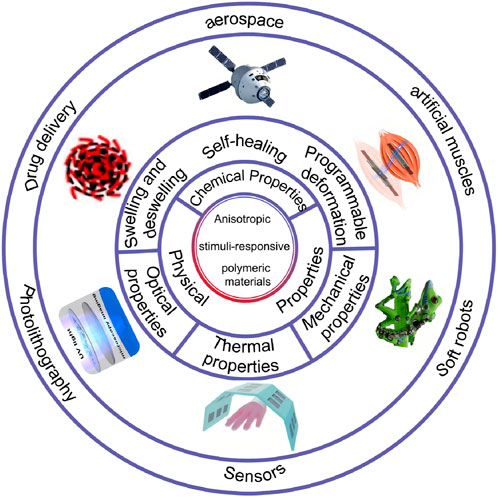
Figure 1. Schematic representation of the properties and applications of ASRPM.
2 Anisotropic stimuli-responsive polymeric materials
The inherent flexibility of polymeric materials endows materials with significant application potential in fields such as flexible electronics, bio-medicines, and wearable technologies. A variety of physical and chemical approaches have been employed to enhance the mechanical strength, thermal stability, and functionality of these polymers, aiming to meet the stringent requirements of high-performance applications in sectors such as aerospace, medical instrumentation, and artificial intelligence devices. Inspired by nature, the preparation of anisotropic soft materials presents an attractive and effective approach, potentially eliminating the need for complex synthetic procedures while concurrently advancing the performance and expanding the functionality of traditional polymers.
The stimulus response mechanism of ASRPM is a complex process that involves changes in the material’s microstructure, which subsequently lead to alterations in its macroscopic properties. For instance, temperature changes can impact the thermal motion of polymer chains, causing chain segments to relax and rearrange, which subsequently alters the shape and size of the material (Chen R. et al., 2019; Yu et al., 2024). Additionally, changes in pH can lead to ionization and charge changes within the polymers, resulting in conformational changes and volume effects at the microstructural level, which subsequently induce modifications in the macroscopic structure, such as changes in solubility and swelling (Mukherji et al., 2017; Senechal et al., 2020). Furthermore, stimuli such as light and electric fields can also modulate the intermolecular forces and arrangement of polymers, further enhancing their functionality and application potential. For example, light stimulation can increase the crosslinking density of polymers (Zhang et al., 2010), thereby altering their mechanical properties and affecting their macroscopic structural integrity. Electric field stimulation can change the orientation and arrangement of polymer chains (Chen S. et al., 2021), influencing their conductivity and mechanical strength, which in turn can lead to changes in the material’s overall performance and structural stability. These microscopic structural changes ultimately affect macroscopic properties, exhibiting unique smart response characteristics.
The incorporation of anisotropy into polymeric materials has led to a series of favorable transformations, enabling the optimization of macroscopic properties through the precise manipulation of their microstructures. These materials feature highly ordered structures, which engender distinct physical and chemical properties depending on the different direction, leading to markedly different mechanical, optical, and other performances (Ryabchun et al., 2017; Subramani et al., 2018; Zhang et al., 2023). This structure not only endows the materials with superior mechanical properties, such as high strength, toughness, and elasticity, but also imparts unique optical anisotropy, including birefringence and light scattering behaviors (Pal et al., 2022; Sokolovskaya et al., 2015; Takeuchi et al., 2017). Additionally, these materials possess self-healing capabilities, enabling them to repair damage through dynamic and reversible interactions, thus maintaining their functionality and structural integrity (Nasseri et al., 2023; Ni et al., 2021). They also exhibit programmable shape-changing abilities, allowing for specific shape transformations through precise control of polymer chain motion and phase transitions (Nasseri et al., 2023; Zhao F. et al., 2023). Furthermore, these materials exhibit excellent biocompatibility, rendering them suitable for biomimicry and biomedical engineering applications, as well as environmental adaptability (Dong et al., 2024; Tognato et al., 2019), exemplified by the swelling behavior of hydrogels (Dai et al., 2024; Neumann et al., 2023; Yan et al., 2021; Ye et al., 2023), phase transitions in liquid crystals (Fallah-Darrehchi et al., 2023; Kato et al., 2021), and the shape memory capabilities of SMPs (Schwartz et al., 2022; Tian et al., 2023). Owing to advanced fabrication methods such as 3D and 4D printing and photopolymerization, these materials can be precisely engineered into intricate structures and shapes, promising broad applications in soft robotics, sensors, biomedicine, and smart devices (Dai et al., 2022; Liu et al., 2021; Niazy et al., 2021; Oh et al., 2023; Patdiya and Kandasubramanian, 2021; Rastogi and Kandasubramanian, 2019; Wang Y. P. et al., 2022).
Focusing on three categories of anisotropic materials: hydrogels, liquid crystal polymers and SMPs, we have summarized their chemical designs, properties, applications, and advantages. This information is organized in Table 1 to facilitate expedient access and comprehensive understanding for the reader.
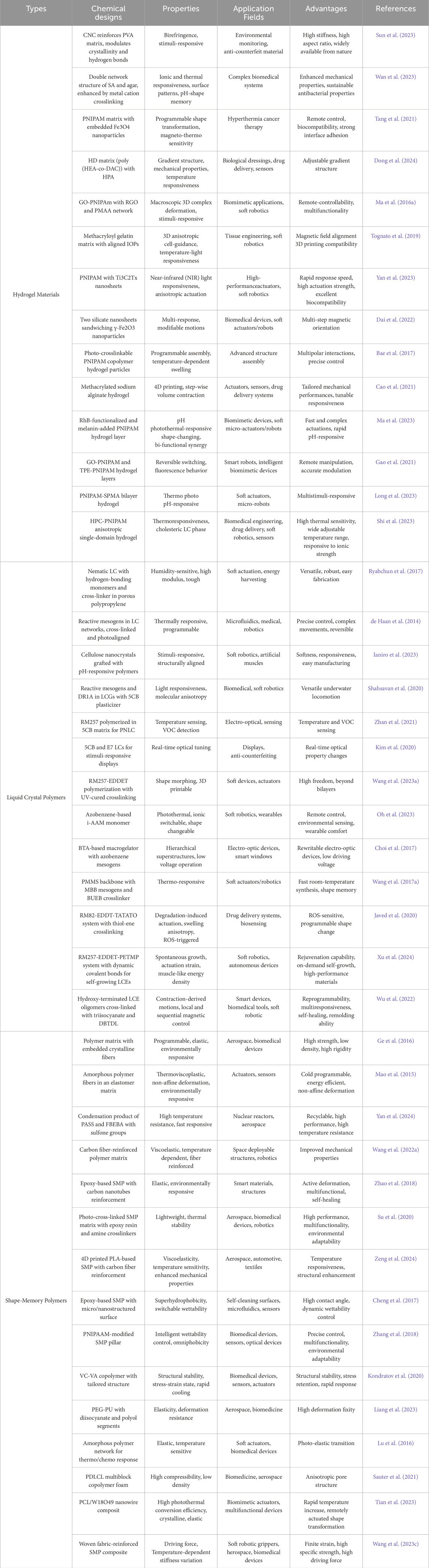
Table 1. Chemical designs, properties, applications, and advantages of ASRPM.
3 Hydrogel materials
Anisotropic stimuli-responsive hydrogels are three-dimensional hydrogel materials characterized by highly ordered structures, which are achieved through the emulation of biological tissues. These structures enable the hydrogels to retain substantial amounts of water while maintaining shape without being destroyed. By designing anisotropic distributions of structure or components, these hydrogels exhibit varying mechanical moduli and responsiveness in different directions (Mredha and Jeon, 2022). Additionally, these hydrogels possess dynamic and reversible coordination interactions, allowing for self-healing capabilities when damaged. These properties make them highly valuable in fields such as soft robotics, biomedical devices, and responsive materials design.
The preparation strategies for anisotropic hydrogels are diverse including gravity-induced (Chen Y. J. et al., 2021; Chen Z. et al., 2021; Luo et al., 2015), electric field-induced (Chen Q. L. et al., 2019; Chen et al., 2020), magnetic field-induced (Chen Q. L. et al., 2019; Gong et al., 2022; Sano et al., 2018a), local patterning (Dai et al., 2022; Liu et al., 2022; Wang Z. J. et al., 2017), shear flow (Puza and Lienkamp, 2022; Sun et al., 2021; Zhang A. K. et al., 2021) and polymer-chain alignment (Jiang et al., 2021; Zhao Y. et al., 2021), and layered structure formation (Hubbard et al., 2019; Li et al., 2021). These approaches manipulate the alignment of polymer chains or the distribution of fillers within the hydrogels matrix, or arrange the microstructure, ensuring that the hydrogels exhibit the desired anisotropy and stimuli-responsive behaviors on a macroscopic scale (Chen Z. et al., 2023; Sano et al., 2018b). For example, magnetic field-induced polymerization techniques align fillers or polymer chains to endow the hydrogel with the capacity to respond to external magnetic field variations, enabling specific motion patterns and providing a new avenue for the development of soft actuators and sensors (Dai et al., 2022). The magnetothermal effect also provides benefits for drug delivery systems, as evidenced by the work of Tang et al. (2021) with a magneto-thermo-sensitive hydrogel composed of poly (N-isopropylacrylamide) incorporating Fe3O4 nanoparticles. Under an alternating magnetic field, this material can generate heat through the magnetothermal effect, leading to rapid volume collapse and shape transformation. This mechanism allows for precise control of drug release under external magnetic field, providing new possibilities for the design and application of drug delivery systems. In addition, by selecting or designing polymers sensitive to specific stimuli such as pH, light, and chemical agents, hydrogels can be endowed with responsiveness to these stimuli, enabling controllable deformation or functional transformation in response to environmental changes. For instance, Ding et al. (2022) orderly arranged magnetic two-dimensional materials, such as cobalt-doped titanium oxide (CTO), within a ultraviolet (UV) curable magneto-birefringence resin (MB-resin) in a magnetic field. To precisely control the optical anisotropy by adjusting the strength of magnetic field, concentration of 2D CTO materials, and thickness of hydrogels, they successfully fabricated a transparent MB-hydrogel with large and finely engineerable optical anisotropy and multiple transmitted interference colours. This opens up potential applications in the fields of optical phase retarder, gradient optical attenuator, magnetic see-through colour imager, and mechano-chromic indicator. Qin et al. (2019) employed in situ polymerization and dynamic thiolate-metal coordination to construct highly-ordered lamellar network structures by the metal nanostructure assemblies. The designed hydrogels with notable anisotropic properties across mechanical, optical, deswelling and swelling behaviors exhibit superior multi--responsive and self-healing performance (Figure 2A). The solvent-responsive anisotropic actuating performance is presented in Figures 2B–H. As shown in Figures 2E, H, the material can effectively replicate intricate movements as a soft actuator, such as the vertical lifting action of a robotic arm and the grasping motion of a hand.

Figure 2. (A) Self-healing performance: NIR laser and pH-mediated self-healing mechanisms. (B) When a gel piece with lamellae perpendicular to the surface is placed in ethanol, gradual in-plane bending is observed. (C) For a gel piece with lamellae parallel to the surface, out-of-plane bending occurs. All scale bars in B and C are 5 mm. (D) Schematic of a robotic arm assembled from two hydrogel pieces with different lamellae orientations through a healing process. (E) With anisotropic structures, the integrated hydrogel piece exhibits distinct actuations, resembling a robotic arm with vertical lifting when placed in ethanol. (F) An optical image further confirms the in-plane and out-of-plane deformations. (G) Schematic of a complex robotic hand assembly composed of two fingers and one palm, conducted by three hydrogel pieces with different lamellae orientations through a healing process. (H) The integrated hand shows a grasping action when immersed in ethanol (Qin et al., 2019). (I–K) Design and fabrication of ASPC hydrogel. (I) Schematic illustration of the fabrication of the ASPC hydrogel from ASAA framework by the predesigned lamella-confined and freezing assembly-assisted polymerization process (J) schematic diagram illustrated the formation of highly-aligned AgNW/SA nanopillars interpenetrated between the adjacent lamellae in ASAA scaffold (K) schematic of ASPC hydrogel’s anisotropic deformation in different solvents due to fast water molecule transport via low-tortuosity channels. (L) Schematic illustrations and corresponding optical images of anisotropic deformations of ASPC hydrogel in different solvents triggered by stimuli of light and solvent. (M) Schematic diagrams and optical images of the hydrogel at α = 135°performing 3D self-propulsion under NIR stimulation to cross the obstacles at the interface of acetonitrile and n-hexane (Yao et al., 2024).
As research on anisotropic hydrogels continues to advance, future works will focus more on performance optimization and application expansion. Wang Y. K. et al. (2022) prepared hierarchical networks of anisotropic hydrogels based on cross-linked Poly (vinyl alcohol)/Poly (vinylpyrrolidone) with rich structural hierarchy and tunable mechanical properties through a simple strategy of directional freezing/salting-out treatments. The strategy emphasizes the regulation of hydrogels mechanical properties by physical and chemical crosslinking. The designed hydrogels exhibit rich structural hierarchy and excellent mechanical properties, with superior mechanical strengths, high elongation, and high fracture energy, as well as good cytocompatibility, making them suitable for functional or structural materials in fields such as biological tissues. Bao et al. (2023) reported a rapid strategy for the fabrication of physically robust anisotropic hydrogels, which simultaneously achieves photo-crosslinking and the establishment of biomimetic soft-hard material interface microstructures, resulting in nanocomposite hydrogels with distinctly separated phases but a strongly bonded interface. Furthermore, these hydrogels can be precisely manufactured into arbitrarily complex structures by 3D printing with micrometer-level precision, providing a generalizable preparation method for the advancement of soft materials. This approach holds promise for breakthrough applications in the fields of biomedicine, soft robotics, and high-performance manufacturing. To enhance properties through sophisticated control techniques, Yao et al. (2024) prepared anisotropic solvent-adaptive hydrogels with lamellar assembly-confined cellular structure by directional freezing-assisted polymerization within a predesigned anisotropic laminar silver nanowire (AgNW)/sodium alginate (SA) aerogel (ASAA) scaffold (Figures 2I–K). Figure 2L demonstrates the anisotropic deformation behavior of the ASPC hydrogel triggered in different solvents. This approach not only takes into account mechanical properties through highly oriented AgNW/SA nanopillars and lamellar structures to enhance the mechanical stability of the hydrogels, but also emphasizes enhancing the adaptability across various solvent environments and multimodal locomotion capabilities, by precisely controlling the structural anisotropy (Figure 2M). Consequently, the approach produces flexible and intelligent actuation materials with superior performance for extreme environments, particularly in the realms of soft robotics and biomedical engineering.
Anisotropic hydrogel materials are renowned for their exceptional structural design and responsiveness to stimuli. However, despite their self-healing capabilities, improvements are needed in terms of biocompatibility and biodegradability to ensure that these materials do not adversely affect surrounding tissues in biomedical applications (Ji et al., 2022; Ma X. et al., 2016; Sajjadi et al., 2024). Additionally, the relatively low mechanical strength of these hydrogels limits their applications in withstanding substantial mechanical loads. Therefore, enhancing the mechanical robustness of hydrogels to better adapt to demanding environments is a crucial avenue for future research (Li et al., 2018; Li et al., 2019a; Xing et al., 2014). In summary, the study and development of anisotropic hydrogel materials is a vibrant and challenging field. With continuous innovation and optimization, these materials hold promise to play an increasingly vital role in future high-tech applications.
4 Liquid crystal polymers
Anisotropic stimuli-responsive liquid crystal polymers represent a novel class of functional materials, where mesogens (comprising anisotropic molecules or molecular groups) are integrated with polymer chains to form liquid crystal phases with specific orientations. This arrangement exhibits ordered molecular alignment at the molecular level, endowing the materials with a range of unique properties, including self-assembly capabilities, long-range ordered fluidity, birefringence, and anisotropy in physical properties (such as optical, mechanical, and electrical responses) (Sun et al., 2017; Yang et al., 2024). Additionally, the synergistic interactions between molecules and their sensitivity to external stimuli enable materials to achieve complex deformations, such as bending, twisting, and spiraling (Iamsaard et al., 2014; Lan et al., 2020; Long et al., 2024; Nie et al., 2021; Wang et al., 2018). These materials also display excellent mechanical performance and recyclability, allowing for three-dimensional shaping and recovery, which opens up possibilities for constructing biomimetic three-dimensional actuators, such as biomimetic “anemone” actuators (Zhao X. et al., 2023). The distinctive physical and chemical properties of anisotropic stimuli-responsive liquid crystals polymers highlight their immense potential for applications in various fields. Among them, liquid crystal elastomers (LCEs) and azobenzene-based liquid crystal polymers represent two significant branches of this domain, both of which have garnered considerable research interest.
LCEs are celebrated for their distinctive blend of liquid crystal anisotropy and the pliability of elastomers, have become prominent in the field of smart materials (Chen M. et al., 2023; Fallah-Darrehchi et al., 2023; Ge et al., 2017; Hussain et al., 2021; Wang Q. et al., 2017; Zhang J. C. et al., 2021). Yao et al. (2023) successfully adjusted the isotropization temperature (Ti) of LCEs using an annealing process to alter the microstructure of LCEs, enabling the production of soft actuators that function effectively across a range of temperatures (Figure 3A). It demonstrates the thermal actuation behavior of monodomain xLCE-BP after annealing at different temperatures (Figures 3B, C). This innovative method allows for the fine-tuning of the material’s thermal responsiveness without the need to change its chemical composition. As shown in Figures 3D, E, different Ti values are patterned on the same LCE film through digital patterning and electrothermal films, demonstrating the flexibility and versatility of the method in practical applications. This not only expands the potential applications of LCEs but also opening up new avenues for their utilization in advanced technological fields. Chen G. C. et al. (2023) developed a technique to program the actuation onset temperature of LCEs by altering network topology (Figures 3F, G), offering a novel solution for applications requiring precise control, such as microfluidic systems and precision engineering. Figures 3H–J show the stress relaxation and alignment programming effects of LCEs at different programming temperatures. This innovative approach enables precise control at the microscopic level, allowing for accurate deformation and motion in complex engineering applications (Figure 3K). These groundbreaking studies not only demonstrate the flexibility and adaptability of LCEs in performance regulation, but also offer broad possibilities for the customization and functionalization of materials. Furthermore, Kotikian et al. (2018) employed high operating temperature direct ink writing combined with photopolymerization techniques to engineer LCEs actuators. These advanced actuators exhibit significant, reversible contractions along the direction of the printing path when heated above the nematic-to-isotropic temperature (TNI). With precise adjustment of printing parameters, including temperature, pressure, and velocity, to achieve precise control over the orientation of liquid crystal molecules within the LCEs, researchers fabricated actuators capable of intricate shape-shifting maneuvers, such as transitions from planar to 3D and from 3D to 3D’. The actuation mechanism of these actuators primarily relies on temperature changes, representing a single actuation mechanism. Additionally, Wu et al. (2022) explored the magnetothermal responsiveness of LCEs, by integrating this property with covalent adaptable networks, developed soft actuators capable of achieving a variety of magneto-actuated contraction-derived motion modes. These actuators are not only capable of large-scale contraction, but also exhibit complex dynamic 3D structures and motions under the precise control of external magnetic field. Further, Xu et al. (2024) developed a strategy that enabled non-fresh LCEs to revert to their initial state through the synergistic effects of solvents and dynamic covalent bonds, achieving on-demand self-growth. This discovery not only simplifies the storage and handling of the material, but also opens new avenues for the design and manufacturing of soft robotics, enabling structures to transition from simple planar configurations to complex 3D forms. These research findings collectively propel the advancement of LCEs in the fields of high-performance soft actuators and smart materials, showcasing the vast potential of LCEs in responsiveness and functionality.
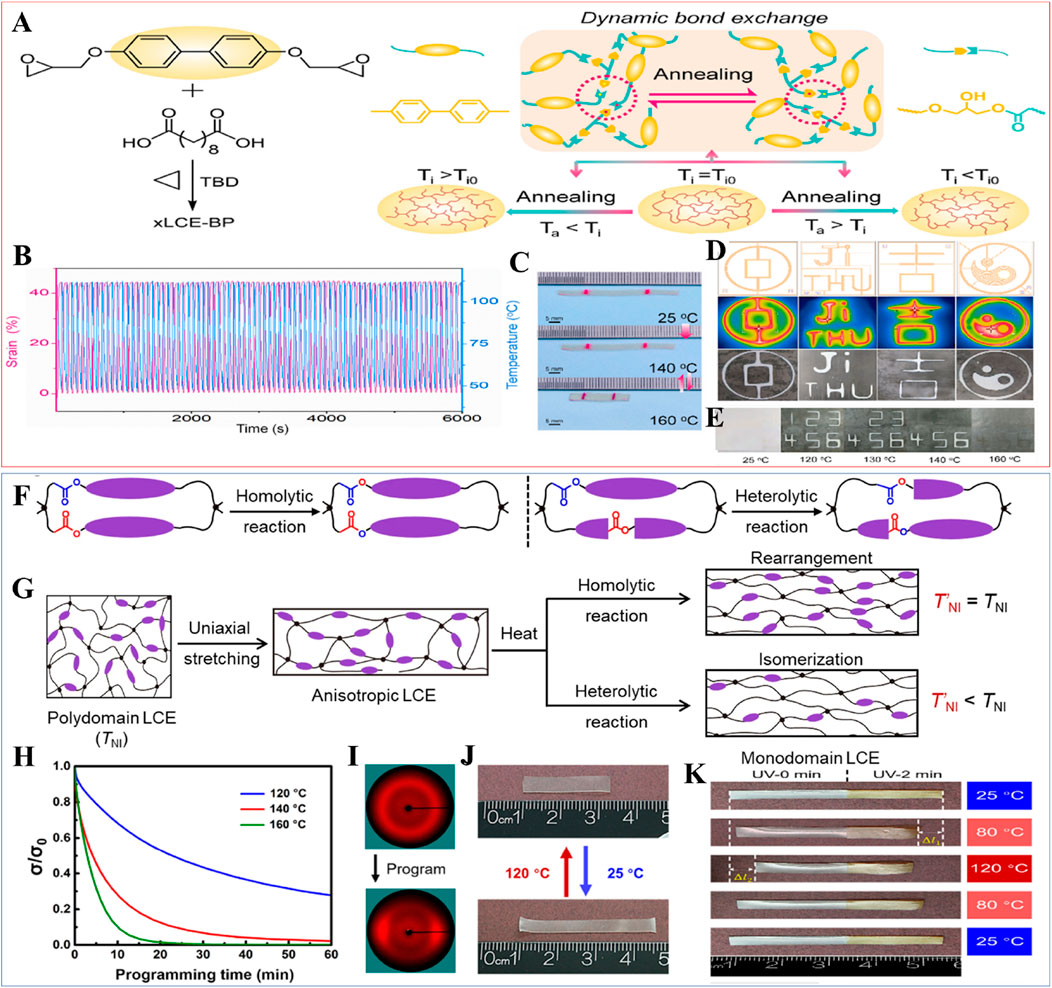
Figure 3. (A) Regulating the phase transition temperature (Ti) of polydomain xLCE-BP through annealing treatment. When the annealing temperature exceeds the original Ti, the new Ti decreases; when the annealing temperature is below the original Ti, the new Ti increases. (B) The contraction-elongation actuation of the aligned xLCE-BP for 100 heating-cooling cycles. (C) Thermal actuation of an aligned xLCE between 160°C (isotropic phase) and 140°C (liquid-crystal phase) after 200 rapid heating-cooling cycles on a hot plate. (D) Patterns of polydomain xLCE-BP (Ti0 = 113°C) with dual Ti values. (E) Patterns of polydomain xLCE-BP (Ti0 = 113°C) with multiple Ti values (Yao et al., 2023). (F, G) Programming LCEs TNI by modulating network topology. (F) Homolytic and heterolytic bond exchange reactions (G) network reconfiguration and isomerization during alignment programming. (H) Stress relaxation under different Tps. (I) Isotropic-to-anisotropic transformation of the 2D-WAXD pattern before and after alignment programming. (J) LCE linear actuation (Tp: 120 °C, tp: 10 min). (K) Active LCE strip with two distinct TNI patterned via UV exposure exhibits a sequential actuation (Chen G. C. et al., 2023).
Azobenzene liquid crystal polymers are a class of high-performance materials that combine the photoresponsive properties of azobenzene molecules with the ordered alignment characteristics of liquid crystals. They possess not only the anisotropy of liquid crystals but also the sensitivity of azobenzene groups to light stimuli, making them a very active research topic in the field of materials science and smart systems (Cao et al., 2019; Li et al., 2019b; Oh et al., 2023). In the field of single-photon response, Kang et al. (2024), from a molecular perspective, developed an azobenzene-based liquid-crystalline polymer that can rapidly respond to photoinduced solid-liquid phase transitions at room temperature by finely tuning the length of flexible spacers. The anisotropic structure endows distinct photoresponsive properties in various orientations, providing innovative pathways for applications in intelligent adhesives, photolithography, and self-healing materials. Yang et al. (2020) successfully fabricated azopolymers with phototunable mechanical properties on flexible substrates using athermal nanoimprint lithography technology. These materials can modulate viscoplasticity under irradiation of different wavelengths, offering new possibilities for imaging and anticounterfeiting applications. Zheng et al. (2021) fabricated azobenzene-based anisotropic responsive materials by integrating ionic liquids into liquid crystalline elastomers and highly elastic polyurethane composite fabrics. These materials can rapidly respond to UV radiation, converting it into mechanical stress and electrical signals, and exhibit excellent elasticity and swift responsiveness, offering a new avenue for the development of all-polymer-based wearable electronic devices and soft robots. In the field of dual-responsive materials, Zhao X. et al. (2023) achieved a groundbreaking advancement. They successfully prepared high molecular weight linear liquid crystal polymers with photo and humidity responsiveness by combining post-polymerization modification and ring-opening metathesis polymerization strategies. The photo-responsiveness is achieved through azobenzene groups, while the humidity-responsiveness is realized by converting benzoic acid groups into their corresponding carboxylic salts. These materials not only exhibit excellent mechanical properties and recyclability, but also hold broad application potential both in the fields of smart materials and complex shape-deforming actuators due to their multifunctionality and programmability. These studies demonstrate the application potential of azobenzene liquid crystal polymers in the field of light-responsive smart materials, and provide new directions for the development of future advanced manufacturing technologies.
Research on anisotropic liquid crystal polymeric materials has reached at a new starting point where nanotechnology, biotechnology, and information technology converge, indicating that these materials will play a key role in smart systems and high-tech applications (Kato et al., 2018; Lagerwall and Scalia, 2012). However, regarding processing technology, liquid crystal materials may be sensitive to the external environment, such as temperature and humidity, which could affect their stability and reliability in practical applications. Additionally, further research and improvements are needed in the areas of biocompatibility and biodegradability to facilitate broader application of liquid crystal polymer materials in the biomedical field (Gurboga et al., 2022; Hussain et al., 2021; Nesterkina et al., 2024). In conclusion, despite the challenges, the study and applications of anisotropic stimuli-responsive liquid crystal polymeric materials will continue to expand with technological progress and innovation, offering more innovations and value to society.
5 Shape-memory polymers
Anisotropic stimuli-responsive SMPs are a type of intelligent responsive materials capable of fixing temporary shapes and returning to their original shape under specific stimuli. They possess unique thermal properties and shape-memory functions (Jayalath et al., 2023; Schwartz et al., 2022). The traditional working mechanism of shape memory is primarily based on their two-phase structure: a stable polymer network and a reversible phase. The stable polymer network determines the permanent shape, while the reversible phase can transition from one state to another under specific stimuli, driving the shape memory effect (Liu et al., 2024). SMPs can be categorized into thermal-, electrical-, and photo-induced types, and they offer advantages such as lightweight, large deformation, easy programming, and tunable elastic modulus (Sanaka et al., 2024; Xia et al., 2021; Xiao et al., 2015). They have broad application value in fields like aerospace, biomedical, 4D printing, and soft robotics. Additionally, some SMPs can also respond to special chemical substances (such as glucose, nucleic acids, metal ions, etc.), further enriching their deformation capabilities and demonstrating a wider range of application potential (Vázquez-González and Willner, 2020).
Based on their unique mechanisms, a range of stimulation methods has been developed for SMPs, light, electricity, magnetism, and heat as distinct external stimuli to effectuate shape transitions (Lee et al., 2022; Ni et al., 2023). These methods present advantages such as remote (non-contact and safety), minimal energy expenditure, and provide a spectrum of control alternatives. Moreover, they facilitate precise manipulation of shape alterations by the meticulous regulation of stimulus intensity, duration, and application mode, concurrently preserving swift response times and a high level of programmability. For instance, Zhang B. et al. (2021) reported a mechanically robust and UV-curable tert-butyl acrylate and aliphatic urethane diacrylate (tBA-AUD) SMPs system suitable for digital light processing-based 4D printing. With tBA as the linear chain builder and AUD as the crosslinker, the system exhibits up to 1,240% deformability at programming temperatures (above the glass transition temperature Tg of the SMPs), excellent fatigue resistance, and superior shape-memory performance. Owing to the high molecular weight of AUD and the presence of hydrogen bonds (Figure 4A), the SMPs demonstrate exceptional stretchability in the rubbery state, enabling the printing of high-resolution, complex 3D structures. The high deformability and fatigue resistance of the tBA–AUD SMPs are demonstrated in Figures 4B–D. Figure 4E compares the elongation at break of SMPs suitable for different 3D printing technologies, highlighting the high deformability of tBA–AUD SMPs in the rubbery state. The printed smart hinges are presented in Figure 4F. This development opens up new possibilities for applications in aerospace, smart furniture, and soft robotics. Additionally, Wei et al. (2016) utilized direct-write (DW) fabrication techniques and UV cross-linkable polylactic acid (PLA)-based inks to successfully prepare anisotropic 4D shape-memory structures, encompassing SMPs and shape-memory nanocomposites (SMNCs). Parts G-J of Figure 4 schematically describe the DW printing process. The introduction of a UV cross-linking agent facilitated a polymerization reaction, forming stable chemical bonds and enhancing the internal structure of the material. This process not only significantly improves the mechanical properties and thermal stability of the material, but also endows it with excellent shape-memory performance, enabling it to execute complex 3D deformations (Figure 4N). Furthermore, the addition of iron oxide nanoparticles introduced magnetic responsiveness and rapid remote activation capabilities (Figures 4K–M), enhancing the functionality of the material. This 4D active shape-changing structure based on SMNCs offers new ideas and possibilities for the development of future biomedical devices, especially in the field of minimally invasive medicine (Figure 4O). The combination of chemical and physical modifications not only improves the performance, but also endows it with new functions, broadening its application prospects.
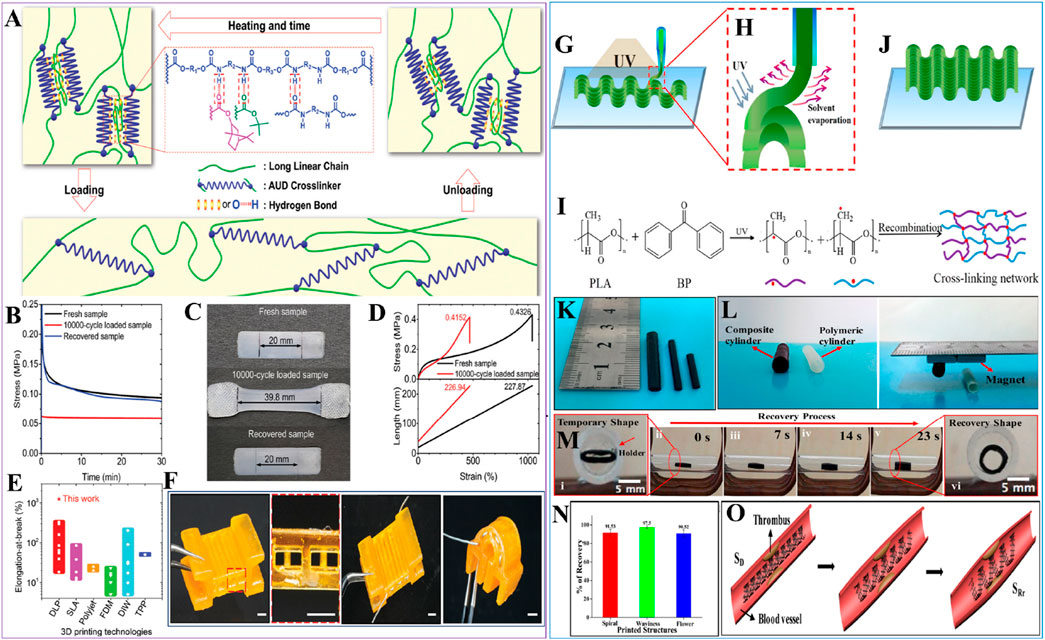
Figure 4. (A) Schematic illustration on the deformation mechanism. The unique molecular structure and internal hydrogen bonding endow the tBA–AUD SMPs system with high stretchability. (B) Stress-relaxation testing results. (C) Comparison on the gauge length of one sample after different treatments. (D) Comparison on uniaxial tensile tests between the fresh tBA–AUD SMPs sample and the one after 10,000-cycle fatigue test. (E) Chart summarizing the elongation-at-break of the SMPs suitable with different 3D printing technologies to compare the mechanical performance of tBA–AUD SMPs with those of previously reported 3D-printable SMPs. (F) The corresponding snapshots of the printed SMPs smart hinge. Scale bar in (F) 2 mm (Zhang B. et al., 2021). (G–J) Schematic illustration of the DW printing of 4D active shape-changing architecture. (G) The process of extruding UV-curable PLA-based ink through a micronozzle under appropriate pressure; (H) the rapid evaporation of solvent following the extrusion of the ink; (I) UV cross-linking reaction triggered during the depositing process; (J) a demonstration of a 3D printed structure with a wavy pattern that exhibits potential for shape transformation. (K) Printed composite cylinders with various sizes can be achieved by suitably adjusting the printing parameters. (L) Illustration of the responsive behavior of the composite cylinder under a constant magnetic field. (M) Demonstration of the remote-actuated 4D shape-changing performance of a nanocomposite cylinder in a 30 kHz alternating magnetic field. (N) Quantitative analysis of the shape-changing behavior of the select structures. Shape deformation and recovery of the 3D microspiral, 3D waviness-like structure, and 3D flower like structure happened in hot water with the temperature around 80°C. (O) Potential application of the 4D scaffold as an intravascular stent. Here, the deformation temperature was 80°C. SO, SD, and SRr represent for the original, deformed, and recovery shapes under restrictive conditions, respectively (Wei et al., 2016).
In addition to chemical modification, the incorporation of functional fillers enhances the mechanical properties of anisotropic SMPs. By compositing SMPs with other functional materials, anisotropic shape-memory polymeric composites with superior performance can be fabricated. For instance, Ze et al. (2019) reported a novel magnetic shape-memory polymer (M-SMP) that integrates two types of magnetic particles (Fe3O4 and NdFeB) into an amorphous SMPs matrix, achieving programmable and reprogrammable shape transformations along with shape locking capabilities. This material utilizes particles with low coercivity for shape locking and unlocking by magnetic inductive heating, while particles with high remanence enable programmable deformation under an applied magnetic field. The integrated multifunctional shape manipulation of M-SMP, including rapid, reversible shape transformations and locking, opens up new possibilities for applications in soft robotics, morphing antennas, and digital logic circuits. Xie et al. (2018) reported a SMPs composite based on black phosphorus nanosheets as near-infrared (NIR) photothermal nanofillers. Prepared by embedding black phosphorus nanosheets into piperazine-based polyurethane, the material exhibits excellent NIR-responsive shape memory performance. The anisotropy of the black phosphorus nanosheets leads to differences in photothermal conversion efficiency and shape memory behavior in different directions within the composite material. Additionally, the material exhibits good biocompatibility and biodegradability, naturally degrading into non-toxic carbon dioxide, water, and phosphate salts, making it highly potential for application in the biomedical field. Building upon photothermal responsive materials, Wang J. et al. (2024) integrated a 3D carbon-medium reinforced thermosetting SPMs composite by 4D printing technology. Utilizing graphene synergized with continuous carbon fibers, they achieved multidirectional thermal conductivity and load-bearing paths. This material exhibits superior bending strength, shape fixation ratio, and shape recovery ratio, along with the capability for rapid local shape response reconfiguration under near-infrared light excitation. It combines exceptional mechanical load-bearing performance with fast-response shape reconfiguration, which is particularly crucial for the application of intelligently-driven structures under extreme conditions. Additionally, Jeong et al. (2020) utilized multicolor 4D printing technology to fabricate anisotropic SMPs composites. By embedding SMPs fibers of different colors within the matrix material, they achieved precise control over the deformation. These composite materials can respond to light signals, enabling remote activation, and thus offer new possibilities for the design of smart materials and structures.
It is worth mentioning that liquid crystal polymers and anisotropic hydrogels can also achieve shape memory functions through special treatments (Guo et al., 2022; Le et al., 2018; Wan et al., 2023; Wang Y. P. et al., 2022). For example, Wang M. et al. (2023) developed a novel anisotropic aerogel based on LCE, enriched with dynamic diselenide bonds, and synthesized by the method of thiol-ene click chemistry, which exhibits excellent compressibility, shape stability, and programmability. Under thermal stimulation, it demonstrates a two-way shape memory function, achieving reversible shrinkage deformation in heating and cooling cycles, with a maximum shrinkage ratio of 26.1%. Furthermore, the porous structure and monodomain orientation of the LCE-based aerogel enable effective adsorption of the photothermal dye DR1 and reversible photothermal-induced shape deformation under 520 nm light irradiation. These characteristics suggest broad application prospects for this material in the fields of control devices and soft actuators. Liu et al. (2020) reported a novel anisotropic hydrogel that introduced transient structural anisotropy by thermomechanical programming, achieving programmable reversible shape transformation. After being programmed in hot water, the deformation of stearyl groups leads to the anisotropy of the hydrogel structure, which is erased upon cooling, allowing the hydrogel to revert to its original shape or be reprogrammed into a new shape after cooling. The reversibility of this shape memory mechanism is achieved by controlling the crystalline state of the stearyl groups and the conformational changes of poly (N-isopropylacrylamide) chains, utilizing internal structural changes of the hydrogel to drive the shape memory effect, rather than relying on externally added reversible phases. This internally driven shape memory mechanism offers new possibilities for the design of novel smart hydrogels and expands the application scope of shape-memory materials.
As new technologies continue to emerge, the potential of anisotropic stimuli-responsive SMPs will be further explored. However, SMPs may face the challenge of performance degradation over the long term, especially after multiple cycles. To maintain the long-term stability and reliability, researchers need to explore new strategies and technologies (Rafiee et al., 2021; Wang Z. et al., 2023; Zeng et al., 2024). Moreover, there is a potential trade-off between enhancing the mechanical strength of SMPs and maintaining their optimal shape memory capabilities: improvements in one area may adversely affect the other. Therefore, finding the optimal balance between these two aspects is crucial for the practical applications of SMPs (Jayalath et al., 2023). Despite the challenges, with the continuous advancement of science and technology, the research and application prospects of SMPs remain broad.
6 Conclusion
As evidenced by an increasing number of studies, ASRPM have become one of the most significant research directions in the field of soft materials science. In this mini-review, we introduce three classic polymers that exhibit anisotropic stimuli responsiveness. Due to the space limitations, a comprehensive listing is not feasible; therefore, we have distilled the information into a tabular form.
Despite the advancements, several challenges persist in this field. The stability and durability of these materials can be compromised after repeated stimulus cycles or exposure to harsh environmental conditions, leading to reduced reliability. Additionally, achieving synergistic responses to multiple stimuli is complex due to potential interference between different response mechanisms, which hinders precise and coordinated performance. Furthermore, many materials lack sufficient biocompatibility, posing risks of immune reactions or tissue damage in biomedical applications, and often are not biodegradable, raising concerns about long-term health impacts. Future research should focus on gaining a deeper understanding of their stimulus response mechanisms, optimizing biocompatibility and biodegradability, enhancing mechanical strength and stability, as well as promoting environmentally friendly production and disposal methods. Interdisciplinary collaboration will further advance technological innovation and expand the applications of these materials. By overcoming these challenges, the investigation of ASRPM will not only push the boundaries of science but also provide essential support for constructing a more sustainable and intelligent future.
Author contributions
YZ: Writing–original draft. ZL: Writing–original draft. CW: Writing–review and editing. YX: Investigation, Supervision, Writing–review and editing.
Funding
The author(s) declare that financial support was received for the research, authorship, and/or publication of this article. YX would like to acknowledge the financial support from the Fundamental Research Funds for the Central Universities, conducted at Tongji University.
Conflict of interest
The authors declare that the research was conducted in the absence of any commercial or financial relationships that could be construed as a potential conflict of interest.
Generative AI statement
The author(s) declare that no Generative AI was used in the creation of this manuscript.
Publisher’s note
All claims expressed in this article are solely those of the authors and do not necessarily represent those of their affiliated organizations, or those of the publisher, the editors and the reviewers. Any product that may be evaluated in this article, or claim that may be made by its manufacturer, is not guaranteed or endorsed by the publisher.
References
Alinejad, Z., Khakzad, F., and Mahdavian, A. R. (2018). Efficient approach to in-situ preparation of anisotropic and assemblable gold nanoparticles mediated by stimuli-responsive PDMAEMA. Eur. Polym. J. 104, 106–114. doi:10.1016/j.eurpolymj.2018.05.006
An, Q., Ren, J. N., Jia, X., Qu, S. S., Zhang, N. W., Li, X., et al. (2024). Anisotropic materials based on carbohydrate polymers: a review of fabrication strategies, properties, and applications. Carbohydr. Polym. 330, 121801. doi:10.1016/j.carbpol.2024.121801
Bae, J., Bende, N. P., Evans, A. A., Na, J. H., Santangelo, C. D., and Hayward, R. C. (2017). Programmable and reversible assembly of soft capillary multipoles. Mat. Horiz. 4 (2), 228–235. doi:10.1039/c6mh00531d
Bao, B. K., Zeng, Q. M., Li, K., Wen, J. F., Zhang, Y. Q., Zheng, Y. J., et al. (2023). Rapid fabrication of physically robust hydrogels. Nat. Mat. 22 (10), 1253–1260. doi:10.1038/s41563-023-01648-4
Cao, A. P., van Raak, R. J. H., Pan, X. L., and Broer, D. J. (2019). Temperature- and light-regulated gas transport in a liquid crystal polymer network. Adv. Funct. Mat. 29 (28), 1900857. doi:10.1002/adfm.201900857
Cao, P., Tao, L., Gong, J., Wang, T., Wang, Q., Ju, J., et al. (2021). 4D printing of a sodium alginate hydrogel with step-wise shape deformation based on variation of crosslinking density. ACS Appl. Polym. Mat. 3 (12), 6167–6175. doi:10.1021/acsapm.1c01034
Chen, G. C., Feng, H. J., Zhou, X. R., Gao, F., Zhou, K., Huang, Y. J., et al. (2023a). Programming actuation onset of a liquid crystalline elastomer via isomerization of network topology. Nat. Commun. 14 (1), 6822. doi:10.1038/s41467-023-42594-8
Chen, M., Gao, M., Bai, L. C., Zheng, H., Qi, H. J., and Zhou, K. (2023b). Recent advances in 4D printing of liquid crystal elastomers. Adv. Mat. 35 (23), 2209566. doi:10.1002/adma.202209566
Chen, Q. L., Liu, G., Gao, S., Yi, X. H., Xue, W. H., Tang, M. H., et al. (2019a). Nanoscale magnetization reversal by electric field-induced ion migration. MRS Commun. 9 (1), 14–26. doi:10.1557/mrc.2018.191
Chen, R., Xu, X. B., Yu, D. F., Liu, M. H., Xiao, C. H., Wyman, I., et al. (2019b). Temperature-regulated flexibility of polymer chains in rapidly self-healing hydrogels. NPG Asia Mater 11 (1), 22. doi:10.1038/s41427-019-0123-0
Chen, S., Yan, S., Zhan, S. Q., Wei, Q., Gao, L. F., Li, Z. H., et al. (2021a). Study on the regulation of polythiophene whiskers by electric field induction and the anisotropy of the film surface. Polym. Int. 70 (12), 1653–1658. doi:10.1002/pi.6277
Chen, Y. J., Chen, Z., Chen, C., Rehman, H. U., Liu, H. Z., Li, H., et al. (2021b). A gradient-distributed liquid-metal hydrogel capable of tunable actuation. Chem. Eng. J. 421, 127762. doi:10.1016/j.cej.2020.127762
Chen, Y. W., Liu, Y. H., Xia, Y. M., Liu, X. Q., Qiang, Z., Yang, J. Y., et al. (2020). Electric field-induced assembly and alignment of silver-coated cellulose for polymer composite films with enhanced dielectric permittivity and anisotropic light transmission. ACS Appl. Mat. Interfaces 12 (21), 24242–24249. doi:10.1021/acsami.0c03086
Chen, Z., Chen, Y., Chen, C., Zheng, X., Li, H., and Liu, H. (2021c). Dual-gradient PNIPAM-based hydrogel capable of rapid response and tunable actuation. Chem. Eng. J. 424, 130562. doi:10.1016/j.cej.2021.130562
Chen, Z., Wang, H., Cao, Y., Chen, Y., Akkus, O., Liu, H., et al. (2023c). Bio-inspired anisotropic hydrogels and their applications in soft actuators and robots. Matter 6 (11), 3803–3837. doi:10.1016/j.matt.2023.08.011
Cheng, Z., Zhang, D., Lv, T., Lai, H., Zhang, E., Kang, H., et al. (2017). Superhydrophobic shape memory polymer arrays with switchable isotropic/anisotropic wetting. Adv. Funct. Mat. 28 (7), 1705002. doi:10.1002/adfm.201705002
Choi, Y. J., Yoon, W. J., Kim, D. Y., Park, M., Lee, Y., Jung, D., et al. (2017). Stimuli-responsive liquid crystal physical gels based on the hierarchical superstructures of benzene-1,3,5-tricarboxamide macrogelators. Polym. Chem. 8 (12), 1888–1894. doi:10.1039/c7py00134g
Dai, C. F., Khoruzhenko, O., Zhang, C. Q., Zhu, Q. L., Jiao, D. J., Du, M., et al. (2022). Magneto-orientation of magnetic double stacks for patterned anisotropic hydrogels with multiple responses and modulable motions. Angew. Chem. Int. Ed. 61 (35), e202207272. doi:10.1002/anie.202207272
Dai, L., Xu, J. W., and Xiao, R. (2024). Modeling the stimulus-responsive behaviors of fiber-reinforced soft materials. Int. J. Appl. Mech. 16 (06), 2450041. doi:10.1142/s1758825124500418
Datta, P., Vyas, V., Dhara, S., Chowdhury, A. R., and Barui, A. (2019). Anisotropy properties of tissues: a basis for fabrication of biomimetic anisotropic scaffolds for tissue engineering. J. Bionic Eng. 16 (5), 842–868. doi:10.1007/s42235-019-0101-9
de Haan, L. T., Schenning, A. P. H. J., and Broer, D. J. (2014). Programmed morphing of liquid crystal networks. Polymer 55 (23), 5885–5896. doi:10.1016/j.polymer.2014.08.023
Ding, B., Zeng, P., Huang, Z., Dai, L., Lan, T., Xu, H., et al. (2022). A 2D material–based transparent hydrogel with engineerable interference colours. Nat. Commun. 13 (1), 1212. doi:10.1038/s41467-021-26587-z
Dong, S. Y., Lu, G. Q., Wang, G. H., Wang, K. Q., Tang, R. F., Nie, J., et al. (2024). Preparation of gradient HEA-DAC/HPA hydrogels by limited domain swelling method. Macromol. Rapid Commun. 46, 2400586. doi:10.1002/marc.202400586
Fallah-Darrehchi, M., Harirchi, P., Abdouss, M., and Zahedi, P. (2023). Performance of liquid crystalline elastomers on biological cell response: a review. ACS Appl. Polym. Mat. 5 (2), 1076–1091. doi:10.1021/acsapm.2c01599
Gao, Q., Pan, P., Shan, G., and Du, M. (2021). Bioinspired stimuli-responsive hydrogel with reversible switching and fluorescence behavior served as light-controlled soft actuators. Macromol. Mat. Eng. 306 (11), 2100379. doi:10.1002/mame.202100379
Ge, Q., Serjouei, A., Qi, H. J., and Dunn, M. L. (2016). Thermomechanics of printed anisotropic shape memory elastomeric composites. Int. J. Solids Struct. 102, 186–199. doi:10.1016/j.ijsolstr.2016.10.005
Ge, S. J., Zhao, T. P., Wang, M., Deng, L. L., Lin, B. P., Zhang, X. Q., et al. (2017). A homeotropic main-chain tolane-type liquid crystal elastomer film exhibiting high anisotropic thermal conductivity. Soft Matter 13 (32), 5463–5468. doi:10.1039/c7sm01154g
Girón, J., Kerstner, E., Medeiros, T., Oliveira, L., Machado, G. M., Malfatti, C. F., et al. (2021). Biomaterials for bone regeneration: an orthopedic and dentistry overview. Braz. J. Med. Biol. Res. 54 (9), e11055. doi:10.1590/1414-431X2021e11055
Gong, C., Zhai, Y., Zhou, J., Wang, Y., and Chang, C. (2022). Magnetic field assisted fabrication of asymmetric hydrogels for complex shape deformable actuators. J. Mat. Chem. C 10 (2), 549–556. doi:10.1039/d1tc04790f
Guo, H., Puttreddy, R., Salminen, T., Lends, A., Jaudzems, K., Zeng, H., et al. (2022). Halogen-bonded shape memory polymers. Nat. Commun. 13 (1), 7436. doi:10.1038/s41467-022-34962-7
Gurboga, B., Tuncgovde, E. B., and Kemiklioglu, E. (2022). Liquid crystal-based elastomers in tissue engineering. Biotechnol. Bioeng. 119 (4), 1047–1052. doi:10.1002/bit.28038
Hubbard, A. M., Cui, W., Huang, Y. W., Takahashi, R., Dickey, M. D., Genzer, J., et al. (2019). Hydrogel/elastomer laminates bonded via fabric Interphases for stimuli-responsive actuators. Matter 1 (3), 674–689. doi:10.1016/j.matt.2019.04.008
Hussain, M., Jull, E. I. L., Mandle, R. J., Raistrick, T., Hine, P. J., and Gleeson, H. F. (2021). Liquid crystal elastomers for biological applications. Nanomaterials 11 (3), 813. doi:10.3390/nano11030813
Iamsaard, S., Asshoff, S. J., Matt, B., Kudernac, T., Cornelissen, J., Fletcher, S. P., et al. (2014). Conversion of light into macroscopic helical motion. Nat. Chem. 6 (3), 229–235. doi:10.1038/nchem.1859
Ianiro, A., Berrocal, J. A., Tuinier, R., Mayer, M., and Weder, C. (2023). Computational design of anisotropic nanocomposite actuators. J. Chem. Phys. 158 (1), 014901. doi:10.1063/5.0129105
Javed, M., Tasmim, S., Abdelrahman, M. K., Ambulo, C. P., and Ware, T. H. (2020). Degradation-induced actuation in oxidation-responsive liquid crystal elastomers. Crystals 10 (5), 420. doi:10.3390/cryst10050420
Jayalath, S., Herath, M., Epaarachchi, J., Trifoni, E., Gdoutos, E. E., and Fang, L. (2023). Durability and long-term behaviour of shape memory polymers and composites for the space industry-A review of current status and future perspectives. Polym. Degrad. Stabil. 211, 110297. doi:10.1016/j.polymdegradstab.2023.110297
Jeong, H. Y., Woo, B. H., Kim, N., and Jun, Y. C. (2020). Multicolor 4D printing of shape-memory polymers for light-induced selective heating and remote actuation. Sci. Rep. 10 (1), 6258. doi:10.1038/s41598-020-63020-9
Ji, D., Park, J. M., Oh, M. S., Nguyen, T. L., Shin, H., Kim, J. S., et al. (2022). Superstrong, superstiff, and conductive alginate hydrogels. Nat. Commun. 13 (1), 3019. doi:10.1038/s41467-022-30691-z
Jiang, Z., Seraji, S. M., Tan, X., Zhang, X., Dinh, T., Mollazade, M., et al. (2021). Strong, ultrafast, reprogrammable hydrogel actuators with muscle-mimetic aligned fibrous structures. Chem. Mat. 33 (19), 7818–7828. doi:10.1021/acs.chemmater.1c02312
Kang, Y., Kim, D., Lee, W., and Lee, C. (2024). Role of flexible spacers in achieving photoinduced phase transitions of azobenzene-based liquid-crystalline polymers at room temperature. Polym. J. 56 (11), 1061–1067. doi:10.1038/s41428-024-00946-1
Kato, T., Gupta, M., Yamaguchi, D., Gan, K. P., and Nakayama, M. (2021). Supramolecular association and nanostructure formation of liquid crystals and polymers for new functional materials. Bull. Chem. Soc. Jpn. 94 (1), 357–376. doi:10.1246/bcsj.20200304
Kato, T., Uchida, J., Ichikawa, T., and Soberats, B. (2018). Functional liquid-crystalline polymers and supramolecular liquid crystals. Polym. J. 50 (1), 149–166. doi:10.1038/pj.2017.55
Kim, I., Ansari, M. A., Mehmood, M. Q., Kim, W. S., Jang, J., Zubair, M., et al. (2020). Stimuli-responsive dynamic metaholographic displays with designer liquid crystal modulators. Adv. Mat. 32 (50), 2004664. doi:10.1002/adma.202004664
Kim, S. E., Mujid, F., Rai, A., Eriksson, F., Suh, J., Poddar, P., et al. (2021). Extremely anisotropic van der Waals thermal conductors. Nature 597 (7878), 660–665. doi:10.1038/s41586-021-03867-8
Kondratov, A. P., Cherkasov, E. P., Paley, V., and Volinsky, A. A. (2020). Macrostructure of anisotropic shape memory polymer films studied by the molecular probe method. J. Appl. Polym. Sci. 138 (15), 50176. doi:10.1002/app.50176
Koons, G. L., Diba, M., and Mikos, A. G. (2020). Materials design for bone-tissue engineering. Nat. Rev. Chem. 5 (8), 584–603. doi:10.1038/s41578-020-0204-2
Kotikian, A., Truby, R. L., Boley, J. W., White, T. J., and Lewis, J. A. (2018). 3D printing of liquid crystal elastomeric actuators with spatially programed nematic order. Adv. Mat. 30 (10), 1706164. doi:10.1002/adma.201706164
Lagerwall, J. P. F., and Scalia, G. (2012). A new era for liquid crystal research: applications of liquid crystals in soft matter nano-bio- and microtechnology. Curr. Appl. Phys. 12 (6), 1387–1412. doi:10.1016/j.cap.2012.03.019
Lan, R., Sun, J., Shen, C., Huang, R., Zhang, Z., Ma, C., et al. (2020). Light-driven liquid crystalline networks and soft actuators with degree-of freedom-controlled molecular motors. Adv. Funct. Mat. 30 (19), 2000252. doi:10.1002/adfm.202000252
Le, X. X., Zhang, Y. C., Lu, W., Wang, L., Zheng, J., Ali, I., et al. (2018). A novel anisotropic hydrogel with integrated self-deformation and controllable shape memory effect. Macromol. Rapid Commun. 39 (9), 1800019. doi:10.1002/marc.201800019
Lee, Y. K., Kim, J., Lien, J. M., Lee, Y. J., and Choi, I. S. (2022). Recent progress in shape-transformable materials and their applications. Electron. Mat. Lett. 18 (3), 215–231. doi:10.1007/s13391-021-00330-8
Li, B., Ding, Z. J., Li, Z. Q., and Li, H. R. (2018). Simultaneous enhancement of mechanical strength and luminescence performance in double-network supramolecular hydrogels. J. Mat. Chem. C 6 (25), 6869–6874. doi:10.1039/c8tc02154f
Li, H., Liang, Y., Gao, G., Wei, S., Jian, Y., Le, X., et al. (2021). Asymmetric bilayer CNTs-elastomer/hydrogel composite as soft actuators with sensing performance. Chem. Eng. J. 415, 128988. doi:10.1016/j.cej.2021.128988
Li, H. F., Liu, C., Zhu, J. B., Sun, J. M., Huan, X. H., Geng, H. B., et al. (2024a). Spider silk-inspired heterogeneous interphase featuring hybrid interaction for simultaneously improving the interfacial strength and fracture toughness between carbon fiber and epoxy by regulating hydrogen bond density. Compos. Part B Eng. 280, 111476. doi:10.1016/j.compositesb.2024.111476
Li, M., Gong, P., Zhang, Z., Li, L., Chen, Y., Qin, Y., et al. (2024b). Electric-field-aligned liquid crystal polymer for doubling anisotropic thermal conductivity. Commun. Mat. 5 (1), 18. doi:10.1038/s43246-024-00455-x
Li, S., Li, B., Gong, L., Yu, Z., Feng, Y., Jia, D., et al. (2019a). Enhanced mechanical properties of polyacrylamide/chitosan hydrogels by tuning the molecular structure of hyperbranched polysiloxane. Mat. Des. 162, 162–170. doi:10.1016/j.matdes.2018.11.045
Li, S., Tu, Y. Q., Bai, H. D., Hibi, Y., Wiesner, L. W., Pan, W. Y., et al. (2019b). Simple synthesis of elastomeric photomechanical switches that self-heal. Macromol. Rapid Commun. 40 (4), 1800815. doi:10.1002/marc.201800815
Liang, Z., Li, J., Chen, K., Dong, Y., Yu, C., and Kan, Q. (2023). Multiaxial shape memory effect of thermo-induced shape memory polyurethane under proportional tension-torsion loading. Smart Mat. Struct. 32 (7), 075018. doi:10.1088/1361-665X/acdd3a
Ling, S. J., Kaplan, D. L., and Buehler, M. J. (2018). Nanofibrils in nature and materials engineering. Nat. Rev. Chem. 3 (4), 18016. doi:10.1038/natrevmats.2018.16
Liu, J., Jiang, L., Liu, A., He, S., and Shao, W. (2022). Ultrafast thermo-responsive bilayer hydrogel actuator assisted by hydrogel microspheres. Sens. Actuators B Chem. 357, 131434. doi:10.1016/j.snb.2022.131434
Liu, K. K., Zhang, Y., Cao, H. Q., Liu, H. N., Geng, Y. H., Yuan, W. H., et al. (2020). Programmable reversible shape transformation of hydrogels based on transient structural anisotropy. Adv. Mat. 32 (28), 2001693. doi:10.1002/adma.202001693
Liu, Y., Lei, Y., Hua, L. Q., Lu, J. L., Wang, K. J., and Zhao, C. Z. (2021). Biomimetic self-deformation of polymer interpenetrating network with stretch-induced anisotropicity. Chem. Mat. 33 (21), 8351–8359. doi:10.1021/acs.chemmater.1c02639
Liu, Y. K., Wang, L. L., Liu, Y. J., Zhang, F. H., and Leng, J. S. (2024). Recent progress in shape memory polymer composites: driving modes, forming technologies, and applications. Compos. Commun. 51, 102062. doi:10.1016/j.coco.2024.102062
Liu, Y. S., and Zheng, X. (2024). Bio-inspired double-layered hydrogel robot with fast response via thermo-responsive effect. Materials 17 (15), 3679. doi:10.3390/ma17153679
Long, G., Deng, Y., Zhao, W., Zhou, G., Broer, D. J., Feringa, B. L., et al. (2024). Photoresponsive biomimetic functions by light-driven molecular motors in three dimensionally printed liquid crystal elastomers. J. Am. Chem. Soc. 146 (20), 13894–13902. doi:10.1021/jacs.4c01642
Long, S., Huang, J., Xiong, J., Liu, C., Chen, F., Shen, J., et al. (2023). Designing multistimuli-responsive anisotropic bilayer hydrogel actuators by integrating lcst phase transition and photochromic isomerization. Polymers 15 (3), 786. doi:10.3390/polym15030786
Lu, H., Huang, W. M., and Leng, J. (2016). On the origin of Gaussian network theory in the thermo/chemo-responsive shape memory effect of amorphous polymers undergoing photo-elastic transition. Smart Mat. Struct. 25 (6), 065004. doi:10.1088/0964-1726/25/6/065004
Lu, X. C., Jiao, H. X., Shi, Y. F., Li, Y., Zhang, H. X., Fu, Y. Y., et al. (2023). Fabrication of bio-inspired anisotropic structures from biopolymers for biomedical applications: a review. Carbohydr. Polym. 308, 120669. doi:10.1016/j.carbpol.2023.120669
Luo, R. C., Wu, J., Dinh, N. D., and Chen, C. H. (2015). Gradient porous elastic hydrogels with shape-memory property and anisotropic responses for programmable locomotion. Adv. Funct. Mat. 25 (47), 7272–7279. doi:10.1002/adfm.201503434
Ma, C., Le, X., Tang, X., He, J., Xiao, P., Zheng, J., et al. (2016a). A multiresponsive anisotropic hydrogel with macroscopic 3D complex deformations. Adv. Funct. Mat. 26 (47), 8670–8676. doi:10.1002/adfm.201603448
Ma, C., Peng, S. Y., Chen, L., Cao, X. Y., Sun, Y., Chen, L., et al. (2023). Anisotropic bi-layer hydrogel actuator with ph-responsive color-changing and photothermal-responsive shape-changing bi-functional synergy. Gels 9 (6), 438. doi:10.3390/gels9060438
Ma, X., Sun, X., Hargrove, D., Chen, J., Song, D., Dong, Q., et al. (2016b). A biocompatible and biodegradable protein hydrogel with green and red autofluorescence: preparation, characterization and in vivo biodegradation tracking and modeling. Sci. Rep. 6 (1), 19370. doi:10.1038/srep19370
Mao, Y., Robertson, J. M., Mu, X., Mather, P. T., and Jerry Qi, H. (2015). Thermoviscoplastic behaviors of anisotropic shape memory elastomeric composites for cold programmed non-affine shape change. J. Mech. Phys. Solids. 85, 219–244. doi:10.1016/j.jmps.2015.09.003
Mao, Z. B., Xu, M., Wang, B., and Li, T. (2024). An equivalent anisotropy orientation tensor algorithm for integrated material-structure design. Comput. Methods Appl. Mech. Eng. 420, 116720. doi:10.1016/j.cma.2023.116720
Mredha, M. T. I., and Jeon, I. (2022). Biomimetic anisotropic hydrogels: advanced fabrication strategies, extraordinary functionalities, and broad applications. Prog. Mat. Sci. 124, 100870. doi:10.1016/j.pmatsci.2021.100870
Mukherji, D., Marques, C. M., Stuehn, T., and Kremer, K. (2017). Depleted depletion drives polymer swelling in poor solvent mixtures. Nat. Commun. 8 (1), 1374. doi:10.1038/s41467-017-01520-5
Nasseri, R., Bouzari, N., Huang, J. T., Golzar, H., Jankhani, S., Tang, X. W., et al. (2023). Programmable nanocomposites of cellulose nanocrystals and zwitterionic hydrogels for soft robotics. Nat. Commun. 14 (1), 6108. doi:10.1038/s41467-023-41874-7
Nesterkina, M., Kravchenko, I., Hirsch, A. K. H., and Lehr, C. M. (2024). Thermotropic liquid crystals in drug delivery: a versatile carrier for controlled release. Eur. J. Pharm. Biopharm. 200, 114343. doi:10.1016/j.ejpb.2024.114343
Neumann, M., di Marco, G., Iudin, D., Viola, M., van Nostrum, C. F., van Ravensteijn, B. G. P., et al. (2023). Stimuli-responsive hydrogels: the dynamic smart biomaterials of tomorrow. Macromolecules 56 (21), 8377–8392. doi:10.1021/acs.macromol.3c00967
Ni, C. J., Chen, D., Yin, Y., Wen, X., Chen, X. L., Yang, C., et al. (2023). Shape memory polymer with programmable recovery onset. Nature 622 (7984), 748–753. doi:10.1038/s41586-023-06520-8
Ni, X. X., Gao, Y. J., Zhang, X. H., Lei, Y., Sun, G., and You, B. (2021). An eco-friendly smart self-healing coating with NIR and pH dual-responsive superhydrophobic properties based on biomimetic stimuli-responsive mesoporous polydopamine microspheres. Chem. Eng. J. 406, 126725. doi:10.1016/j.cej.2020.126725
Niazy, D., Elsabbagh, A., and Ismail, M. R. (2021). Mono-material 4D printing of digital shape-memory components. Polymers 13 (21), 3767. doi:10.3390/polym13213767
Nie, Z. Z., Zuo, B., Wang, M., Huang, S., Chen, X. M., Liu, Z. Y., et al. (2021). Light-driven continuous rotating Möbius strip actuators. Nat. Commun. 12 (1), 2334. doi:10.1038/s41467-021-22644-9
Oh, M., Lim, S. I., Jang, J., Wi, Y., Yu, D., Hyeong, J., et al. (2023). Ionic conductivity switchable and shape changeable smart skins with azobenzene-based ionic reactive mesogens. Adv. Funct. Mat. 34 (9), 2307011. doi:10.1002/adfm.202307011
Pal, A., Kamal, M. A., and Schurtenberger, P. (2022). Structure and anisotropic dynamics of stimuli responsive colloidal ellipsoids at the nearest neighbor length scale. J. Colloid Interface Sci. 621, 352–359. doi:10.1016/j.jcis.2022.04.063
Patdiya, J., and Kandasubramanian, B. (2021). Progress in 4D printing of stimuli responsive materials. Polym. Plast. Technol. Mat. 60 (17), 1845–1883. doi:10.1080/25740881.2021.1934016
Pearce, A. K., Wilks, T. R., Arno, M. C., and O'Reilly, R. K. (2021). Synthesis and applications of anisotropic nanoparticles with precisely defined dimensions. Nat. Rev. Chem. 5 (1), 21–45. doi:10.1038/s41570-020-00232-7
Puebla, S., D'Agosta, R., Sanchez-Santolino, G., Frisenda, R., Munuera, C., and Castellanos-Gomez, A. (2021). In-plane anisotropic optical and mechanical properties of two-dimensional MoO3. npj 2D Mat. Appl. 5 (1), 37. doi:10.1038/s41699-021-00220-5
Puza, F., and Lienkamp, K. (2022). 3D printing of polymer hydrogels-from basic techniques to programmable actuation. Adv. Funct. Mat. 32 (39), 2205345. doi:10.1002/adfm.202205345
Qin, H. L., Zhang, T., Li, N., Cong, H. P., and Yu, S. H. (2019). Anisotropic and self-healing hydrogels with multi-responsive actuating capability. Nat. Commun. 10 (1), 2202. doi:10.1038/s41467-019-10243-8
Rafiee, M. M., Baniassadi, M., Wang, K., Baniasadi, M., and Baghani, M. (2021). Mechanical properties improvement of shape memory polymers by designing the microstructure of multi-phase heterogeneous materials. Comp. Mat. Sci. 196, 110523. doi:10.1016/j.commatsci.2021.110523
Rastogi, P., and Kandasubramanian, B. (2019). Breakthrough in the printing tactics for stimuli-responsive materials: 4D printing. Chem. Eng. J. 366, 264–304. doi:10.1016/j.cej.2019.02.085
Ryabchun, A., Lancia, F., Nguindjel, A. D., and Katsonis, N. (2017). Humidity-responsive actuators from integrating liquid crystal networks in an orienting scaffold. Soft Matter 13 (44), 8070–8075. doi:10.1039/c7sm01505d
Sajjadi, M., Jamali, R., Kiyani, T., Mohamadnia, Z., and Moradi, A.-R. (2024). Characterization of Schiff base self-healing hydrogels by dynamic speckle pattern analysis. Sci. Rep. 14 (1), 27950. doi:10.1038/s41598-024-79499-5
Sanaka, R., Sahu, S. K., Sreekanth, P. S. R., Senthilkumar, K., Badgayan, N. D., Siva, B. V., et al. (2024). A review of the current state of research and future prospectives on stimulus-responsive shape memory polymer composite and its blends. J. Compos. Sci. 8 (8), 324. doi:10.3390/jcs8080324
Sano, K., Arazoe, Y. O., Ishida, Y., Ebina, Y., Osada, M., Sasaki, T., et al. (2018a). Extra-large mechanical anisotropy of a hydrogel with maximized electrostatic repulsion between cofacially aligned 2d electrolytes. Angew. Chem. Int. Ed. 57 (38), 12508–12513. doi:10.1002/anie.201807240
Sano, K., Ishida, Y., and Aida, T. (2018b). Synthesis of anisotropic hydrogels and their applications. Angew. Chem. Int. Ed. 57 (10), 2532–2543. doi:10.1002/anie.201708196
Sauter, T., Kratz, K., Madbouly, S., Klein, F., Heuchel, M., and Lendlein, A. (2021). Anisotropy effects in the shape-memory performance of polymer foams. Macromol. Mat. Eng. 306 (4), 2000730. doi:10.1002/mame.202000730
Schwartz, J. J., Porcincula, D. H., Cook, C. C., Fong, E. J., and Shusteff, M. (2022). Volumetric additive manufacturing of shape memory polymers. Polym. Chem. 13 (13), 1813–1817. doi:10.1039/d1py01723c
Senechal, V., Saadaoui, H., Vargas-Alfredo, N., Rodriguez-Hernandez, J., and Drummond, C. (2020). Weak polyelectrolyte brushes: re-entrant swelling and self-organization. Soft Matter 16 (33), 7727–7738. doi:10.1039/d0sm00810a
Shahsavan, H., Aghakhani, A., Zeng, H., Guo, Y., Davidson, Z. S., Priimagi, A., et al. (2020). Bioinspired underwater locomotion of light-driven liquid crystal gels. Proc. Natl. Acad. Sci. U.S.A. 117 (10), 5125–5133. doi:10.1073/pnas.1917952117
Shi, H., Yang, Y., Huang, Y., Li, X., and Shi, Y. (2023). Anisotropic single-domain hydrogel with stimulus response to temperature and ionic strength. Macromolecules 56 (2), 528–534. doi:10.1021/acs.macromol.2c01963
Slavich, A. S., Ermolaev, G. A., Tatmyshevskiy, M. K., Toksumakov, A. N., Matveeva, O. G., Grudinin, D. V., et al. (2024). Exploring van der Waals materials with high anisotropy: geometrical and optical approaches. Light Sci. Appl. 13 (1), 68. doi:10.1038/s41377-024-01407-3
Sokolovskaya, E., Rahmani, S., Misra, A. C., Bräse, S., and Lahann, J. (2015). Dual-stimuli-responsive microparticles. ACS Appl. Mat. Interfaces 7 (18), 9744–9751. doi:10.1021/acsami.5b01592
Su, X., Wang, Y., and Peng, X. (2020). An anisotropic visco-hyperelastic model for thermally-actuated shape memory polymer-based woven fabric-reinforced composites. Int. J. Plast. 129, 102697. doi:10.1016/j.ijplas.2020.102697
Su, Y. P., Shi, S., Wang, C., Wang, Z., Li, P. S., Zhang, S. T., et al. (2024). Spider silk-inspired tough materials: multi-pathway synthesis, advanced processing, and functional applications. Nano Today 55, 102188. doi:10.1016/j.nantod.2024.102188
Subramani, K. B., Spontak, R. J., and Ghosh, T. K. (2018). Influence of fiber characteristics on directed electroactuation of anisotropic dielectric electroactive polymers with tunability. Compos. Sci. Technol. 154, 187–193. doi:10.1016/j.compscitech.2017.11.014
Sun, J., Lan, R., Gao, Y., Wang, M., Zhang, W., Wang, L., et al. (2017). Stimuli-directed dynamic reconfiguration in self-organized helical superstructures enabled by chemical kinetics of chiral molecular motors. Adv. Sci. 5 (2), 1700613. doi:10.1002/advs.201700613
Sun, W., Schaffer, S., Dai, K., Yao, L., Feinberg, A., and Webster-Wood, V. (2021). 3D printing hydrogel-based soft and biohybrid actuators: a mini-review on fabrication techniques, applications, and challenges. Front. Robot. AI 8, 673533. doi:10.3389/frobt.2021.673533
Sun, W., Wang, J., and He, M. (2023). Anisotropic cellulose nanocrystal composite hydrogel for multiple responses and information encryption. Carbohydr. Polym. 303, 120446. doi:10.1016/j.carbpol.2022.120446
Takeuchi, M., Imai, H., and Oaki, Y. (2017). Real-time imaging of 2D and 3D temperature distribution: coating of metal-ion-intercalated organic layered composites with tunable stimuli-responsive properties. ACS Appl. Mat. Interfaces 9 (19), 16546–16552. doi:10.1021/acsami.7b03567
Tang, J., Yin, Q., Shi, M., Yang, M., Yang, H., Sun, B., et al. (2021). Programmable shape transformation of 3D printed magnetic hydrogel composite for hyperthermia cancer therapy. Extreme Mech. Lett. 46, 101305. doi:10.1016/j.eml.2021.101305
Tang, S. J., Yan, Y., Lu, X. L., Wang, P., Xu, X. Q., Hu, K., et al. (2024). Nanocomposite magnetic hydrogel with dual anisotropic properties induces osteogenesis through the NOTCH-dependent pathways. NPG Asia Mat. 16 (1), 16. doi:10.1038/s41427-024-00535-x
Tian, G. M., Zhang, J., Li, M. C., Zhang, X., Yang, D., and Zheng, S. G. (2023). Photo-activated shape memory polymer with chiral twisting based on anisotropic bilayer thin sheets. Polym. Eng. Sci. 63 (12), 4274–4284. doi:10.1002/pen.26523
Tognato, R., Armiento, A. R., Bonfrate, V., Levato, R., Malda, J., Alini, M., et al. (2019). A stimuli-responsive nanocomposite for 3D anisotropic cell-guidance and magnetic soft robotics. Adv. Funct. Mat. 29 (9), 1804647. doi:10.1002/adfm.201804647
Vázquez-González, M., and Willner, I. (2020). Stimuli-responsive biomolecule-based hydrogels and their applications. Angew. Chem. Int. Ed. 59 (36), 15342–15377. doi:10.1002/anie.201907670
Wan, Y., Liu, H., Yan, K., Li, X., Lu, Z., and Wang, D. (2023). An ionic/thermal-responsive agar/alginate wet-spun microfiber-shaped hydrogel combined with grooved/wrinkled surface patterns and multi-functions. Carbohydr. Polym. 304, 120501. doi:10.1016/j.carbpol.2022.120501
Wang, J., Zhao, Y., Zhu, Y., Wang, F., Wang, X., Wang, B., et al. (2024a). 4D printing of 3D carbon-medium reinforced thermosetting shape memory polymer composites with superior load-bearing and fast-response shape reconfiguration. Adv. Funct. Mat. 34, 2409611. doi:10.1002/adfm.202409611
Wang, L., Liu, W., Guo, L. X., Lin, B. P., Zhang, X. Q., Sun, Y., et al. (2017a). A room-temperature two-stage thiol-ene photoaddition approach towards monodomain liquid crystalline elastomers. Polym. Chem. 8 (8), 1364–1370. doi:10.1039/c6py02096h
Wang, L. Q., Wei, Z. X., Xu, Z. T., Yu, Q. M., Wu, Z. L., Wang, Z. J., et al. (2023a). Shape morphing of 3D printed liquid crystal elastomer structures with precuts. ACS Appl. Polym. Mat. 5 (9), 7477–7484. doi:10.1021/acsapm.3c01335
Wang, M., Han, Y., Guo, L.-X., Lin, B.-P., and Yang, H. (2018). Photocontrol of helix handedness in curled liquid crystal elastomers. Liq. Cryst. 46 (8), 1231–1240. doi:10.1080/02678292.2018.1549285
Wang, M., Li, J., and Yang, H. (2023b). Dynamic diselenide bond-enabled liquid crystal elastomer-based two-way shape memory aerogels with weldability and closed-loop recyclability. Smart Mol. 1 (3), e20230009. doi:10.1002/smo.20230009
Wang, Q., Yu, L., Yu, M., Zhao, D., Song, P., Chi, H., et al. (2017b). Liquid crystal elastomer actuators from anisotropic porous polymer template. Macromol. Rapid Commun. 38 (15), 1600699. doi:10.1002/marc.201600699
Wang, Y., Wang, Z., Ma, J., Luo, C., Fang, G., and Peng, X. (2023c). A 3D anisotropic thermomechanical model for thermally induced woven-fabric-reinforced shape memory polymer composites. Sensors 23 (14), 6455. doi:10.3390/s23146455
Wang, Y., Zhou, H., Liu, Z., Peng, X., and Zhou, H. (2022a). A 3D anisotropic visco-hyperelastic constitutive model for unidirectional continuous fiber reinforced shape memory composites. Polym. Test. 114, 107712. doi:10.1016/j.polymertesting.2022.107712
Wang, Y. K., Li, J., Muhammad, N., Wang, Z. F., and Wu, D. F. (2022b). Hierarchical networks of anisotropic hydrogels based on cross-linked Poly (vinyl alcohol)/Poly(vinylpyrrolidone). Polymer 251, 124920. doi:10.1016/j.polymer.2022.124920
Wang, Y. P., An, J., and Lee, H. (2022c). Recent advances in molecular programming of liquid crystal elastomers with additive manufacturing for 4D printing. Mol. Syst. Des. Eng. 7 (12), 1588–1601. doi:10.1039/d2me00124a
Wang, Z., Zhang, Y., Niu, Y., Chen, X., and Song, J. (2023d). Solar-radiation-dependent anisotropic thermal management device with net zero energy from 4D printing shape memory polymer-based composites. Materials 16 (10), 3805. doi:10.3390/ma16103805
Wang, Z. B., Chen, Y. X., Ma, Y., and Wang, J. (2024b). Bioinspired stimuli-responsive materials for soft actuators. Biomimetics 9 (3), 128. doi:10.3390/biomimetics9030128
Wang, Z. J., Hong, W., Wu, Z. L., and Zheng, Q. (2017c). Site-specific pre-swelling-directed morphing structures of patterned hydrogels. Angew. Chem. Int. Ed. 56 (50), 15974–15978. doi:10.1002/anie.201708926
Wei, H., Zhang, Q., Yao, Y., Liu, L., Liu, Y., and Leng, J. (2016). Direct-write fabrication of 4D active shape-changing structures based on a shape memory polymer and its nanocomposite. ACS Appl. Mat. Interfaces 9 (1), 876–883. doi:10.1021/acsami.6b12824
Wei, H. Q., Zhang, B., Lei, M., Lu, Z., Liu, J. P., Guo, B. L., et al. (2022). Visible-light-mediated nano-biomineralization of customizable tough hydrogels for biomimetic tissue engineering. ACS Nano 16 (3), 4734–4745. doi:10.1021/acsnano.1c11589
Wu, S. J., Liu, Z., Gong, C. H., Li, W. J., Xu, S. J., Wen, R., et al. (2024). Spider-silk-inspired strong and tough hydrogel fibers with anti-freezing and water retention properties. Nat. Commun. 15 (1), 4441. doi:10.1038/s41467-024-48745-9
Wu, Y. H., Zhang, S., Yang, Y., Li, Z., Wei, Y., and Ji, Y. (2022). Locally controllable magnetic soft actuators with reprogrammable contraction-derived motions. Sci. Adv. 8 (25), eabo6021. doi:10.1126/sciadv.abo6021
Xia, Y. L., He, Y., Zhang, F. H., Liu, Y. J., and Leng, J. S. (2021). A review of shape memory polymers and composites: mechanisms, materials, and applications. Adv. Mat. 33 (6), 2000713. doi:10.1002/adma.202000713
Xiao, X. L., Kong, D. Y., Qiu, X. Y., Zhang, W. B., Liu, Y. J., Zhang, S., et al. (2015). Shape memory polymers with high and low temperature resistant properties. Sci. Rep. 5 (1), 14137. doi:10.1038/srep14137
Xie, H., Shao, J., Ma, Y., Wang, J., Huang, H., Yang, N., et al. (2018). Biodegradable near-infrared-photoresponsive shape memory implants based on black phosphorus nanofillers. Biomaterials 164, 11–21. doi:10.1016/j.biomaterials.2018.02.040
Xing, Q., Yates, K., Vogt, C., Qian, Z., Frost, M. C., and Zhao, F. (2014). Increasing mechanical strength of gelatin hydrogels by divalent metal ion removal. Sci. Rep. 4 (1), 4706. doi:10.1038/srep04706
Xu, H., Liang, H., Yang, Y., Liu, Y., He, E., Yang, Z., et al. (2024). Rejuvenating liquid crystal elastomers for self-growth. Nat. Commun. 15 (1), 7381. doi:10.1038/s41467-024-51544-x
Yan, G. M., Zhang, Y., Yang, J., Xing, X. J., Li, D. S., and Zhang, G. (2024). A new strategy for reconfigurable actuators based on oxidation of fast responsive shape memory polyarylene sulfide sulfone. Polymer 291, 126624. doi:10.1016/j.polymer.2023.126624
Yan, H. X., Su, H. D., and Zhong, Z. (2021). Modeling the free swelling of a photo-thermal-pH triple-responsive polyampholytic hydrogel loaded with Au nanoparticles under photothermal conversion and chemical reactions. Mech. Mat. 161, 104028. doi:10.1016/j.mechmat.2021.104028
Yan, Q., Ding, R., Zheng, H., Li, P., Liu, Z., Chen, Z., et al. (2023). Bio-inspired stimuli-responsive Ti3C2Tx/PNIPAM anisotropic hydrogels for high-performance actuators. Adv. Funct. Mat. 33 (34), 2301982. doi:10.1002/adfm.202301982
Yang, B., Cai, F., Huang, S., and Yu, H. (2020). Athermal and soft multi-nanopatterning of azopolymers: phototunable mechanical properties. Angew. Chem. Int. Ed. 132 (10), 4064–4071. doi:10.1002/ange.201914201
Yang, Z., Yang, Y., Liang, H., He, E., Xu, H., Liu, Y., et al. (2024). Robust liquid crystal semi-interpenetrating polymer network with superior energy-dissipation performance. Nat. Commun. 15 (1), 9902. doi:10.1038/s41467-024-54233-x
Yao, X., Chen, H., Qin, H., Wu, Q.-H., Cong, H.-P., and Yu, S.-H. (2024). Solvent-adaptive hydrogels with lamellar confinement cellular structure for programmable multimodal locomotion. Nat. Commun. 15 (1), 9254. doi:10.1038/s41467-024-53549-y
Yao, Y. J., He, E. J., Xu, H. T., Liu, Y. W., Yang, Z. J., Wei, Y., et al. (2023). Enabling liquid crystal elastomers with tunable actuation temperature. Nat. Commun. 14 (1), 3518. doi:10.1038/s41467-023-39238-2
Ye, S., Ma, W. J., and Fu, G. D. (2023). Anisotropic hydrogels constructed via a novel bilayer-co-gradient structure strategy toward programmable shape deformation. Chem. Mat. 35 (3), 999–1007. doi:10.1021/acs.chemmater.2c02820
Yu, C. W., Sun, J. Q., Wang, X. J., Liu, X. Y., Li, T. H., Hu, X., et al. (2024). Chain relaxation of carborane segments with tailored chain length at high temperatures. Eur. Polym. J. 220, 113509. doi:10.1016/j.eurpolymj.2024.113509
Ze, Q., Kuang, X., Wu, S., Wong, J., Montgomery, S. M., Zhang, R., et al. (2019). Magnetic shape memory polymers with integrated multifunctional shape manipulation. Adv. Mat. 32 (4), 1906657. doi:10.1002/adma.201906657
Zeng, C., Hu, Y., Liu, L., Xin, X., Zhao, W., Liu, Y., et al. (2024). A 3D finite deformation constitutive model for anisotropic shape memory polymer composites integrating viscoelasticity and phase transition concept. Int. J. Plast. 183, 104139. doi:10.1016/j.ijplas.2024.104139
Zhan, X., Luo, D., and Yang, K.-L. (2021). Multifunctional sensors based on liquid crystals scaffolded in nematic polymer networks. RSC Adv. 11 (61), 38694–38702. doi:10.1039/d1ra08030j
Zhang, A. K., Wang, F., Chen, L., Wei, X. S., Xue, M. Q., Yang, F., et al. (2021a). 3D printing hydrogels for actuators: a review. Chin. Chem. Lett. 32 (10), 2923–2932. doi:10.1016/j.cclet.2021.03.073
Zhang, B., Li, H., Cheng, J., Ye, H., Sakhaei, A. H., Yuan, C., et al. (2021b). Mechanically robust and UV-curable shape-memory polymers for digital light processing based 4D printing. Adv. Mat. 33 (27), 2101298. doi:10.1002/adma.202101298
Zhang, D., Cheng, Z., and Liu, Y. (2018). Smart wetting control on shape memory polymer surfaces. Chem. Eur. J. 25 (16), 3979–3992. doi:10.1002/chem.201804192
Zhang, J. C., Guo, Y. B., Hu, W. Q., and Sitti, M. (2021c). Wirelessly actuated thermo-and magneto-responsive soft bimorph materials with programmable shape-morphing. Adv. Mat. 33 (30), 2100336. doi:10.1002/adma.202100336
Zhang, Y. X., Tang, H., Zhou, J. W., Zhang, L. S., and Wang, R. (2023). Designing multimodal on-off nanoswitches of DNA-functionalized nanoparticles by stimuli-responsive polymers. J. Phys. Chem. B 127 (37), 8049–8056. doi:10.1021/acs.jpcb.3c04409
Zhang, Y. Y., Xu, J. X., Cheng, F. T., Yin, R. Y., Yen, C. C., and Yu, Y. L. (2010). Photoinduced bending behavior of crosslinked liquid-crystalline polymer films with a long spacer. J. Mat. Chem. 20 (34), 7123–7130. doi:10.1039/c0jm00510j
Zhao, F., Rong, W., Wang, L., and Sun, L. (2023a). Photothermal-responsive shape-memory magnetic helical microrobots with programmable addressable shape changes. ACS Appl. Mat. Interfaces 15 (21), 25942–25951. doi:10.1021/acsami.3c02986
Zhao, J. L., Ma, D. T., Wang, C., Guo, Z. N., Zhang, B., Li, J. Q., et al. (2021a). Recent advances in anisotropic two-dimensional materials and device applications. Nano Res. 14 (4), 897–919. doi:10.1007/s12274-020-3018-z
Zhao, W., Wang, Q., Liu, L., Zhu, L., Leng, J., and Liu, Y. (2018). Structural response measurement of shape memory polymer components using digital image correlation method. Opt. Laser Eng. 110, 323–340. doi:10.1016/j.optlaseng.2018.06.016
Zhao, X., Chen, Y., Peng, B., Wei, J., and Yu, Y. L. (2023b). A facile strategy for the development of recyclable multifunctional liquid crystal polymers via post-polymerization modification and ring-opening metathesis polymerization. Angew. Chem. Int. Ed. 62 (21), e202300699. doi:10.1002/anie.202300699
Zhao, Y., Lo, C. Y., Ruan, L., Pi, C. H., Kim, C., Alsaid, Y., et al. (2021b). Somatosensory actuator based on stretchable conductive photothermally responsive hydrogel. Sci. Robot. 6 (53), eabd5483. doi:10.1126/scirobotics.abd5483
Keywords: anisotropic, stimuli-responsive, polymeric materials, polymeric composites, smart materials
Citation: Zhang Y, Lu Z, Wu C and Xu Y (2025) Anisotropic stimuli-responsive polymeric materials: chemistry and applications. Front. Mater. 12:1533330. doi: 10.3389/fmats.2025.1533330
Received: 25 November 2024; Accepted: 10 February 2025;
Published: 13 March 2025.
Edited by:
Hyacinthe Randriamahazaka, Université de Paris, FranceReviewed by:
Hongqiu Wei, Northwest University, ChinaCopyright © 2025 Zhang, Lu, Wu and Xu. This is an open-access article distributed under the terms of the Creative Commons Attribution License (CC BY). The use, distribution or reproduction in other forums is permitted, provided the original author(s) and the copyright owner(s) are credited and that the original publication in this journal is cited, in accordance with accepted academic practice. No use, distribution or reproduction is permitted which does not comply with these terms.
*Correspondence: Yang Xu, eXh1QHRvbmdqaS5lZHUuY24=
†These authors have contributed equally to this work