 Victor D. Lakhno
- Keldysh Institute of Applied Mathematics of Russian Academy of Sciences, Moscow, Russia
A correlation is established between the theories of superconductivity based on the concept of charge density waves (CDWs) and the translation invariant (TI) bipolaron theory. It is shown that CDWs are originated from TI-bipolaron states in the pseudogap phase due to the Kohn anomaly and form a pair density wave (PDW) for wave vectors corresponding to nesting. Emerging in the pseudogap phase, CDWs coexist with superconductivity at temperatures below those of superconducting transition, while their wave amplitudes decrease as a Bose condensate is formed from TI bipolarons, vanishing at zero temperature.
Introduction
Presently, there is no agreement about the microscopic nature of the high-temperature superconductivity (HTSC). At the same time, there are phenomenological models such as a Ginzburg–Landau model [1], a model of charge density waves (CDWs) or pair density waves (PDWs) (the recent review on the theory and experiment with CDW/PDW in high-temperature superconductors, ultracold atomic gases, and mesoscopic devices was published by Agterberg et al. [2]) and a model of spin density waves which enable one to describe numerous HTSC experiments [3]. These models are silent on the nature of paired states taking part in SС. In author’s works [4–7], paired states mean translation invariant (TI) bipolaron states formed by a strong electron–phonon interaction similar to Cooper pairs (for the review of earlier pioneering works devoted to superconductivity based on the theory of small-radius bipolarons, see [8]). TI bipolarons are plane waves with a small correlation length capable of forming a Bose–Einstein condensate with high transition temperature which possesses SC properties. A correlation between the Bardeen–Cooper–Schrieffer (BCS) theory [9] and the Ginzburg–Landau theory was established by Gor’kov [10]. The aim of this work was to establish a correlation between the TI-bipolaron theory of SC and CDW (PDW).
Results
General Relations for the Spectrum of a Moving TI Bipolaron
TI bipolarons are formed at a temperature
In describing the Kohn anomaly, one usually proceeds from Frӧhlich Hamiltonian of the following form [11]:
where the first term corresponds to a free electron gas;
Renormalization of phonon frequencies corresponding to (2) is determined by the expression [11]:
where
The Kohn anomaly describes vanishing of renormalized phonon modes
In the TI-bipolaron theory of SC [4–7], bipolarons are believed to be immersed into an electron gas. The properties of such bipolarons are also described by Fröhlich Hamiltonian of the form (2), but with a field of already renormalized phonons with energies
It should be noted that spectral equation 1 is independent of the form of
The experimental evidence of the occurrence of renormalized phonons with zero energy in layered HTSC cuprates is the absence of a gap in the nodal direction in these materials which, by definition, is the phonon frequency in the TI bipolaron theory of SC.
The wave function of a TI-bipolaron with the wave vector
where
where
With the use of (6) expression for
It follows from (6) that in the case of a weak and intermediate coupling (when TI-bipolaron states are metastable for
where
TI Bipolarons and Charge Density Waves
Subject to availability of a Fermi surface with a sharp boundary, the TI-bipolaron gas under consideration will have some peculiarities. Thus, if there are rather large fragments on this surface which can be superimposed by transferring one of them onto vector
that is,
The gain in the energy is caused by the above considered Kohn anomaly [14] which implies that for
The general expression for
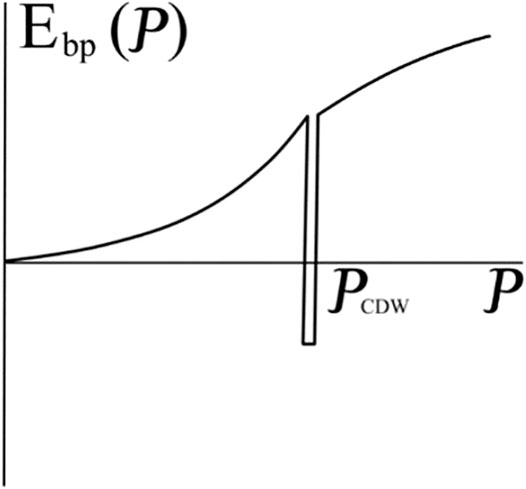
FIGURE 1. The suggested TI-bipolaron spectrum for a charge density wave. It looks as the roton spectrum, but is sharper at
For this spectrum, TI bipolarons will pass on to the state with the energy minimum
Hence, for
Energetical advantageousness of а condensate phase follows from expressions (7), (8), which suggest that a homogeneous Bose condensate has a lower energy on condition:
It should be noted that the scenario considered is close in many respects to the Fröhlich superconductivity model [15]. In the Frӧhlich model, it was assumed that two electrons with opposite momenta (as in BCS) on the Fermi surface are connected by a phonon with the wave vector
Discussion—Comparison With Experiment
To be more specific, let us consider the case of a HTSC such as YBCO. The vector of a CDW in YBCO lies in ab-plane and has two equally likely directions: along the a-axis
Still greater softening of phonon modes can be expected for
It should be noted that in the approach suggested, a difference between CDWs and PDWs disappears and
Data Availability Statement
The original contributions presented in the study are included in the article/Supplementary Material; further inquiries can be directed to the corresponding author.
Author Contributions
VL contributed to conception and design of the study, wrote the manuscript, read, and approved the submitted version.
Conflict of Interest
The author declares that the research was conducted in the absence of any commercial or financial relationships that could be construed as a potential conflict of interest.
Publisher’s Note
All claims expressed in this article are solely those of the authors and do not necessarily represent those of their affiliated organizations, or those of the publisher, the editors, and the reviewers. Any product that may be evaluated in this article, or claim that may be made by its manufacturer, is not guaranteed or endorsed by the publisher.
References
1. Larkin A, Varlamov A. Theory of Fluctuations in Superconductors. Oxford UK: Oxford University Press (2005). doi:10.1093/acprof:oso/9780198528159.001.0001
2. Agterberg DF, Séamus Davis JC, Edkins SD, Fradkin E, Van Harlingen DJ, Kivelson SA, et al. The Physics of Pair-Density Waves: Cuprate Superconductors and beyond. Annu Rev Condens Matter Phys (2020) 11:231–70. doi:10.1146/annurev-conmatphys-031119-050711
4. Lakhno VD. Superconducting Properties of 3D Low-Density Translation-Invariant Bipolaron Gas. Adv Condensed Matter Phys (2018) 2018:1380986. doi:10.1155/2018/1380986
5. Lakhno V. Superconducting Properties of a Nonideal Bipolaron Gas. Physica C: Superconductivity its Appl (2019) 561:1–8. doi:10.1016/j.physc.2018.10.009
6. Lakhno VD. Superconducting Properties of 3D Low-Density TI-Bipolaron Gas in Magnetic Field. Condensed Matter (2019) 4(2):43. doi:10.3390/condmat4020043
7. Lakhno VD. Translational-Invariant Bipolarons and Superconductivity. Condensed Matter (2020) 5(2):30. doi:10.3390/condmat5020030
8. Micnas R, Ranninger J, Robaszkiewicz S. Superconductivity in Narrow-Band Systems with Local Nonretarded Attractive Interactions. Rev Mod Phys (1990) 62:113. doi:10.1103/RevModPhys.62.113
9. Bardeen J, Cooper LN, Schrieffer JR. Theory of Superconductivity. Phys Rev. (1957) 108:1175. doi:10.1103/PhysRev.108.1175
10. Gor'kov LP. Microscopic Derivation of the Ginzburg-Landau Equations in the Theory of Superconductivity. Sov Phys JETP (1959) 9:1364. http://www.jetp.ras.ru/cgi-bin/e/index/e/9/6/p1364?a=list.
11. Grimvall G. The Electron-Phonon Interaction in Metals. ISBN: 9780444861054. Amsterdam: North-Holland Publ. Comp. (1981).
12. Lakhno VD. Pekar's Ansatz and the strong Coupling Problem in Polaron Theory. Phys.-Usp. (2015) 58:295–308. doi:10.3367/UFNe.0185.201503d.0317
13. Lee TD, Low FE, Pines D. The Motion of Slow Electrons in a Polar crystal. Phys Rev (1953) 90:297. doi:10.1103/PhysRev.90.297
14. Kohn W. Image of the Fermi Surface in the Vibration Spectrum of a Metal. Phys Rev Lett. (1959) 2:393. doi:10.1103/PhysRevLett.2.393
15. Fröhlich H. On the Theory of Superconductivity: the One-Dimensional Case. Proc R Soc Lond A (1954) 223:296–305. doi:10.1098/rspa.1954.0116
16. Wu T, Mayaffre H, Krämer S, Horvatić M, Berthier C, Hardy WN, et al. Magnetic-field-induced Charge-Stripe Order in the High-Temperature Superconductor YBa2Cu3Oy. Nature (2011) 477:191–4. doi:10.1038/nature10345
17. Wu T, Mayaffre H, Krämer S, Horvatić M, Berthier C, Kuhns PL, et al. Emergence of Charge Order from the Vortex State of a High-Temperature Superconductor. Nat Commun (2013) 4:2113. doi:10.1038/ncomms3113
18. Wu T, Mayaffre H, Krämer S, Horvatić M, Berthier C, Hardy WN, et al. Incipient Charge Order Observed by NMR in the normal State of YBa2Cu3Oy. Nat Commun (2015) 6:6438. doi:10.1038/ncomms7438
19. Ghiringhelli G, Le Tacon M, Minola M, Blanco-Canosa S, Mazzoli C, Brookes NB, et al. Long-Range Incommensurate Charge Fluctuations in (Y,Nd)Ba2Cu3O6+x. Science 337(6096), 821–5. (2012). doi:10.1126/science.1223532
20. Achkar AJ, Sutarto R, Mao X, He F, Frano A, Blanco-Canosa S, et al. Distinct Charge Orders in the Planes and Chains of Ortho-III-Ordered YBa2Cu3O6+δ Super Conductors Identified by Resonant Elastic X-ray Scattering. Phys Rev Lett 109, 167001 (2012). doi:10.1103/PhysRevLett.109.167001
21. Blackburn E, Chang J, Hücker M, Holmes AT, Christensen NB, Liang R, et al. X-Ray Diffraction Observations of a Charge-Density-Wave Order in Superconducting Ortho-II YBa2Cu3O6.54 Single Crystals in Zero Magnetic Field. Phys Rev Lett 110, 137004 (2013). doi:10.1103/PhysRevLett.110.137004
22. Comin R, Frano A, Yee MM, Yoshida Y, Eisaki H, Schierle E, et al. Charge Order Driven by Fermi-Arc Instability in Bi2Sr2-xLaxCuO6+δ. Science 343 (6169), 390–2. (2014). doi:10.1126/science.1242996
23. Chang J, Blackburn E, Holmes AT, Christensen NB, Larsen J, Mesot J, et al. Direct Observation of Competition between Superconductivity and Charge Density Wave Order in YBa2Cu3O6.67. Nat Phys (2012) 8:871–6. doi:10.1038/nphys2456
24. Le Tacon M, Bosak A, Souliou SM, Dellea G, Loew T, Heid R, et al. Inelastic X-ray Scattering in YBa2Cu3O6.6 Reveals Giant Phonon Anomalies and Elastic central Peak Due to Charge-Density-Wave Formation. Nat Phys (2014) 10:52–8. doi:10.1038/nphys2805
25. Comin R, Sutarto R, He F, da Silva Neto EH, Chauviere L, Fraño A, et al. Symmetry of Charge Order in Cuprates. Nat Mater (2015) 14:796–800. doi:10.1038/nmat4295
26. Chowdhury D, Sachdev S. Density-wave Instabilities of Fractionalized Fermi Liquids. Phys Rev B 90, 245136 (2014). doi:10.1103/PhysRevB.90.245136
Keywords: paired states, TI-bipolaron mass, Peierls transition, Kohn anomaly, charge density waves
Citation: Lakhno VD (2021) Translation-Invariant Bipolarons and Charge Density Waves in High-Temperature Superconductors. Front. Phys. 9:662926. doi: 10.3389/fphy.2021.662926
Received: 01 February 2021; Accepted: 19 August 2021;
Published: 04 October 2021.
Edited by:
Morten Ring Eskildsen, University of Notre Dame, United StatesReviewed by:
Konrad Jerzy Kapcia, Adam Mickiewicz University, PolandDaniel Agterberg, University of Wisconsin–Milwaukee, United States
Copyright © 2021 Lakhno. This is an open-access article distributed under the terms of the Creative Commons Attribution License (CC BY). The use, distribution or reproduction in other forums is permitted, provided the original author(s) and the copyright owner(s) are credited and that the original publication in this journal is cited, in accordance with accepted academic practice. No use, distribution or reproduction is permitted which does not comply with these terms.
*Correspondence: Victor D. Lakhno, bGFrQGltcGIucnU=