 John E. Marsh
 Robert Ljung
 Anatole Nöstl
 Emma Threadgold3
 Tom A. Campbell
- 1Department of Building, Energy, and Environmental Engineering, Faculty of Engineering and Sustainable Development, University of Gävle, Gävle, Sweden
- 2School of Psychology, University of Central Lancashire, Preston, Lancashire, UK
- 3Psychology, City University, London, UK
- 4Neuroscience Center, University of Helsinki, Helsinki, Finland
A corrigendum on
Failing to get the gist of what's being said: background noise impairs higher-order cognitive processing
by Marsh, J. E., Ljung, R., Nöstl, A., Threadgold, E., and Campbell, T. A. (2015). Front. Psychol. 6:548. doi: 10.3389/fpsyg.2015.00548
Error in Table
In the original article, there was a mistake in Table 1 as published. Due to a tabulation error, the total number of critical lures recalled was reported incorrectly. The corrected Table 1 appears below. The authors apologize for this error and state that this does not change the scientific conclusions of the article in any way.
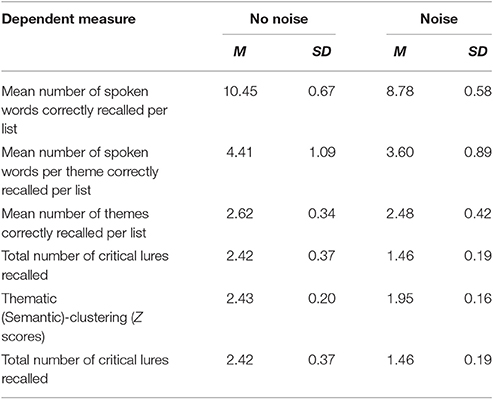
Table 1. Mean recall performance for the four recall measures as a function of two background conditions (no noise vs. noise) used in the study.
Conflict of Interest Statement
The authors declare that the research was conducted in the absence of any commercial or financial relationships that could be construed as a potential conflict of interest.
Keywords: noise, elaborative processing, false recall, semantic clustering, speech intelligibility
Citation: Marsh JE, Ljung R, Nöstl A, Threadgold E and Campbell TA (2017) Corrigendum: Failing to get the gist of what's being said: background noise impairs higher-order cognitive processing. Front. Psychol. 8:390. doi: 10.3389/fpsyg.2017.00390
Received: 31 January 2017; Accepted: 01 March 2017;
Published: 28 March 2017.
Edited and reviewed by: Jerker Rönnberg, Linköping University, Sweden
Copyright © 2017 Marsh, Ljung, Nöstl, Threadgold and Campbell. This is an open-access article distributed under the terms of the Creative Commons Attribution License (CC BY). The use, distribution or reproduction in other forums is permitted, provided the original author(s) or licensor are credited and that the original publication in this journal is cited, in accordance with accepted academic practice. No use, distribution or reproduction is permitted which does not comply with these terms.
*Correspondence: John E. Marsh, SkVNYXJzaEB1Y2xhbi5hYy51aw==
Tom A. Campbell, dG9tLmNhbXBiZWxsQGhlbHNpbmtpLmZp