 Rachel M. Santos
 Sarah Zanette1
 Kang Lee
- 1Department of Applied Psychology and Human Development, University of Toronto, Toronto, ON, Canada
- 2Department of Psychology, University of California, San Diego, La Jolla, CA, United States
- 3School of Education, Zhejiang Normal University, Jinhua, China
A commentary on
Exposure to Parenting by Lying in Childhood: Associations with Negative Outcomes in Adulthood
by Santos, R. M., Zanette, S., Kwok, S. M., Heyman, G. D., and Lee, K. (2017). Front. Psychol. 8:1240. doi: 10.3389/fpsyg.2017.01240
In the original article, there were mistakes in Figures 2–4 as published. The psychosocial maladjustment label in Figures 3, 4 were incorrect. The corrected Figures appear below. Additionally, the authors have included the standardized beta coefficients in all three of the mediation figures.
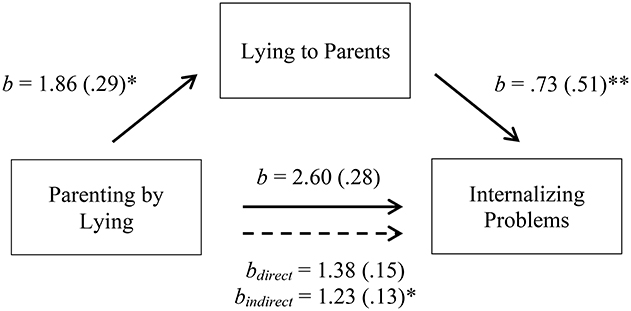
Figure 2. Indirect-only mediation model between parenting by lying and internalizing problems. The solid lines represent the simple linear regressions (paths a, b, and c); the dotted line represents the bootstrapped direct and indirect effects of X on Y after controlling for M. Bracketed values indicate the standardized Beta coefficient. *p < 0.05, **p < 0.001.
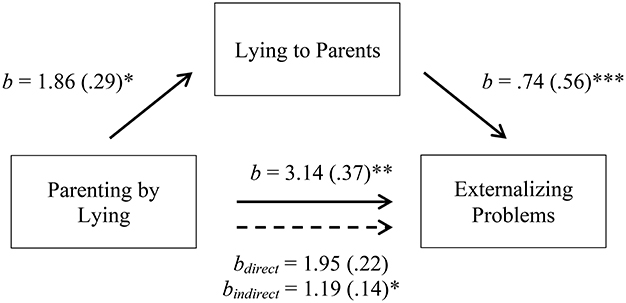
Figure 3. Indirect-only mediation model between parenting by lying and externalizing problems. The solid lines represent the simple linear regressions (paths a, b, and c); the dotted line represents the bootstrapped direct and indirect effects of X on Y after controlling for M. Bracketed values indicate the standardized Beta coefficient. *p < 0.05, **p < 0.01, ***p < 0.001.
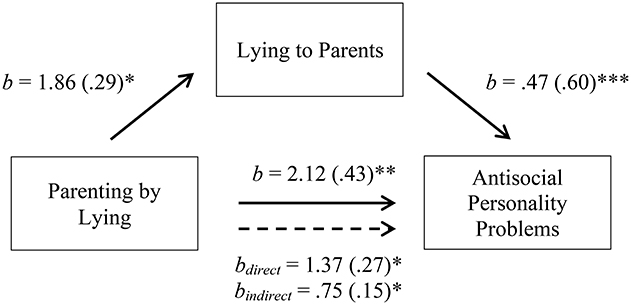
Figure 4. Complementary mediation model between parenting by lying and antisocial personality problems. The solid lines represent the simple linear regressions (paths a, b, and c); the dotted line represents the bootstrapped direct and indirect effects of X on Y after controlling for M. Bracketed values indicate the standardized Beta coefficient. *p < 0.05, **p < 0.01, ***p < 0.001.
Figure 2 Indirect-only mediation model between parenting by lying and internalizing problems. The solid lines represent the simple linear regressions (paths a, b, and c); the dotted line represents the bootstrapped direct and indirect effects of X on Y after controlling for M. Bracketed values indicate the standardized Beta coefficient. *p < 0.05, **p < 0.001.
Figure 3 Indirect-only mediation model between parenting by lying and externalizing problems. The solid lines represent the simple linear regressions (paths a, b, and c); the dotted line represents the bootstrapped direct and indirect effects of X on Y after controlling for M. Bracketed values indicate the standardized Beta coefficient. *p < 0.05, **p < 0.01, ***p < 0.001.
Figure 4 Complementary mediation model between parenting by lying and antisocial personality problems. The solid lines represent the simple linear regressions (paths a, b, and c); the dotted line represents the bootstrapped direct and indirect effects of X on Y after controlling for M. Bracketed values indicate the standardized Beta coefficient. *p < 0.05, **p < 0.01, ***p < 0.001.
In the original article, the standardized Beta value was reported in the text where the unstandardized b value should have been reported.
A correction has been made to the Results section, Parenting by Lying and the Frequency of Lying to Parents, paragraph one:
Parenting by Lying and the Frequency of Lying to Parents
We conducted a simple linear regression to determine whether parenting by lying is associated with the frequency of lying to parents. Parenting by lying was entered as the predictor variable and lying to parents served as the dependent variable. Parenting by lying significantly predicted lying to parents, explaining 8% of the total variance, ΔR2 = 0.08, ΔF(1, 48) = 4.33, p = 0.043. Thus, as exposure to parenting by lying in childhood increased, the frequency of lying to parents during adulthood also increased, bparent lying = 1.86, SE = 0.89, t(49) = 2.08, p = 0.043, 95% CI [0.06, 3.65], rpart = 0.29.
The authors apologize for these errors and state that this does not change the scientific conclusions of the article in any way.
Conflict of Interest Statement
The authors declare that the research was conducted in the absence of any commercial or financial relationships that could be construed as a potential conflict of interest.
Keywords: parenting by lying, lying, dishonesty, psychosocial adjustment, development
Citation: Santos RM, Zanette S, Kwok SM, Heyman GD and Lee K (2017) Corrigendum: Exposure to Parenting by Lying in Childhood: Associations with Negative Outcomes in Adulthood. Front. Psychol. 8:1900. doi: 10.3389/fpsyg.2017.01900
Received: 14 August 2017; Accepted: 13 October 2017;
Published: 26 October 2017.
Edited and reviewed by: Kai S. Cortina, University of Michigan, United States
Copyright © 2017 Santos, Zanette, Kwok, Heyman and Lee. This is an open-access article distributed under the terms of the Creative Commons Attribution License (CC BY). The use, distribution or reproduction in other forums is permitted, provided the original author(s) or licensor are credited and that the original publication in this journal is cited, in accordance with accepted academic practice. No use, distribution or reproduction is permitted which does not comply with these terms.
*Correspondence: Kang Lee, a2FuZy5sZWVAdXRvcm9udG8uY2E=